CHEMISTRY OF ANTIVIRAL AGENTS
Raj K. Prasad (Gold Medalist) M. Pharm. (Pharmaceutical Chemistry)
SIP-R 5/12/23 Medicinal Chemistry-III (BP601T)
Medicinal Chemistry-III
ANTIVIRAL AGENTS
Introduction
• Antiviral drugs are a class of medication used specifically for treating viral infections. Like
antibiotics, specific antivirals are used for specific viruses.
Classification
I. Acyclic nucleoside analogues
Acyclovir, Adefovir dipivoxil, Cidofovir, 6-Deoxyacyclovir, Famciclovir, Ganciclovir
and Valacyclovir etc.
II. Agents affecting the ribosome: Methisazone
III. Antiretroviral agents: Nucleoside reverse transcriptase inhibitors: Abacavir,
Didanosine, Emtricitabine, Lamivudine, Stavudine, Tenofovir disoproxil, Zalcitabine and
Zidovudin etc.
IV. Antiretroviral agents: Nonnucleoside reverse transcriptase inhibitors: Delavirdine,
Efavirenz and Nevirapine.
V. Conventional nucleoside analogues: Cytarabine, Idoxuridine, Ribavirin,
Trifluorothymidine and Vidarabine.
VI. Fusion inhibitors: Enfuvirtide and Maraviroc etc.
VII. HIV integrase inhibitors: Raltegravir
VIII. HIV protease inhibitors: Amprenavir, Atazanavir, Darunavir, Fosamprenavir, Indinavir,
Lopinavir, Nelfinavir, Ritonavir, Saquinavir and Tipranavir etc.
I. Inhibitors of viral attachment, penetration, or early replication: Amantadine,
Interferon and Rimantadine.
II. Neuraminidase inhibitors: Oseltamivir, Peramivir and Zanamivir.
III. Non nucleoside analogues: Boceprevir, Fomivirsen, Foscarnet and Telaprevir.
AMANTADINEHYDROCHLORIDE(1-adamantylamine)
Structure
• Amantadine is a primary amine derivative of adamantane.
• It has an effect on mycoviruses, which are RNA-containing viruses.
MECHANISM OF ACTION
• Amantadine hydrochloride (1-adamantanamine hydrochloride) is a symmetrical tricyclic
primary amine that inhibits penetration of RNA virus particles into the host cell..
Uses
• It has a very narrow spectrum of action and is used only for treating and preventing
influenza A.
RIMANTADINEHYDROCHLORIDE
• Rimantadine is generally 4 to 10 times more active than amantadine.
Uses
• It is used for prevention of infection caused by various human, animal, or avian strains of
infl uenza A virus in adults and children.
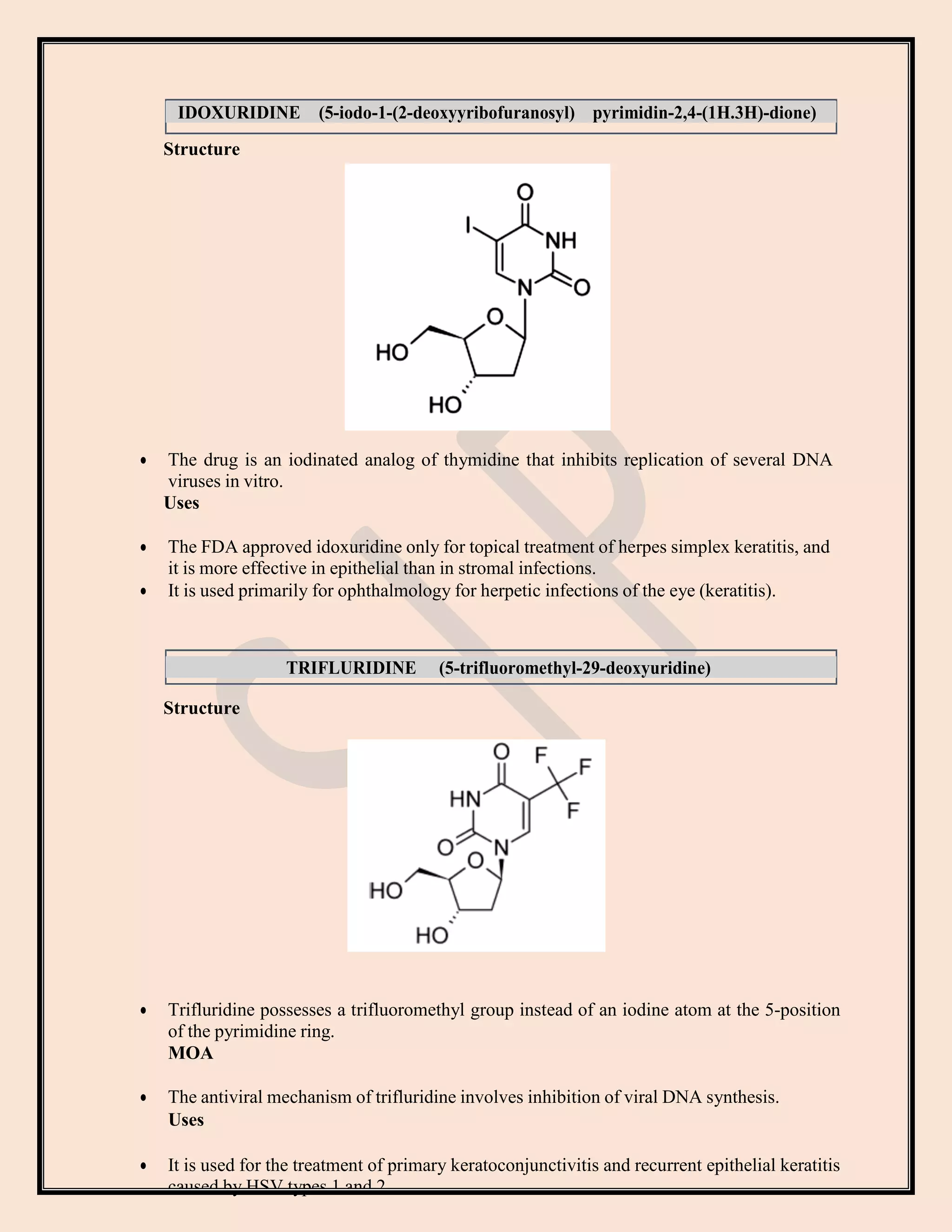
IDOXURIDINE (5-iodo-1-(2-deoxyyribofuranosyl) pyrimidin-2,4-(1H.3H)-dione)
Structure
• The drug is an iodinated analog of thymidine that inhibits replication of several DNA
viruses in vitro.
Uses
• The FDA approved idoxuridine only for topical treatment of herpes simplex keratitis, and
it is more effective in epithelial than in stromal infections.
• It is used primarily for ophthalmology for herpetic infections of the eye (keratitis).
TRIFLURIDINE (5-trifluoromethyl-29-deoxyuridine)
Structure
• Trifluridine possesses a trifluoromethyl group instead of an iodine atom at the 5-position
of the pyrimidine ring.
MOA
• The antiviral mechanism of trifluridine involves inhibition of viral DNA synthesis.
Uses
• It is used for the treatment of primary keratoconjunctivitis and recurrent epithelial keratitis
caused by HSV types 1 and 2.
ACYCLOVIR (2-amino-1,9-dihydro-9-[(2-hydroxyethoxy)methyl]-6H-purin-6-
Structure
• It is most active (in vitro) against HSV type 1, about two times less against HSV type 2,
and 10 times less potent against varicella–zoster virus (VZV).
• An advantage is that uninfected human cells are unaffected by the drug.
Synthesis
• It is synthesized by alkylating guanine with 1-benzoyloxy-2-chloromethoxyethane in
triethylamine.
MOA
• The mechanism of antiviral activity consists of its transformation to triphosphate and
subsequent inhibition of viral DNA synthesis. Its action is highly selective.
Uses
• Acyclovir is used for herpes simplex that has attacked the eyes and genetilia, for herpes in
other locations, shingles, and chicken pox.
GANCICLOVIR(9-[(1,3-dihydroxy-2-propoxy)methyl]guanine))
Structure
• Ganciclovir sodium is an acyclic deoxyguanosine analog of acyclovir with an additional
hydroxymethyl group on the acyclic side chain.
• The mechanism of action is similar to that of acyclovir; however, ganciclovir is more toxic
to human cells than is acyclovir.
Uses
• In AIDS patients, ganciclovir stopped progressive hemorrhagic retinitis and
symptomatic pneumonitis related to cytomegalovirus (CMV) infection.
ZIDOVUDINE (3’-azido-3’-deoxythymidine)
Structure
Medicinal Chemistry-III
[120]
• Zidovudine OR Azidothymidine (AZT) is an antiretroviral drug that is clinically active
against HIV-1 and is intended to treat HIV-infected patients.
• Zidovudine (AZT) is an analog of thymidine that inhibits replication of the AIDS virus. Uses
• Zidovudine has been authorized for treating patients with AIDS. It significantly prolongs
the life of the patient, although it has a number of toxic effects.
DIDANOSINE (2’, 3’-dideoxyinosine (ddI))
Structure
• Didanosine, is 2’, 3’-dideoxyinosine, a synthetic purine nucleoside analog that is
bioactivated to 2’, 3’-dideoxy-ATP (ddATP) by host cellular enzymes.
Uses
• Didanosine is recommended for the treatment of patients with advanced HIV infection who
have received prolonged treatment with AZT but have become intolerant to, or experienced
immunosuppression from, the drug.
ZALCITABINE (2’, 3’-dideoxycytidine)
Structure
Medicinal Chemistry-III
[121]
• It is another antiretroviral agent used against HIV-RT.
• Zalcitabine inhibits host mitochondrial DNA synthesis at low concentrations.
Uses:
• The drug has been approved for the treatment of HIV infection in adults with advanced
disease who are intolerant to AZT or who have disease progression while receiving AZT.
LAMIVUDINE ( (-)- 2’, 3’-dideoxy-3’-thiacytidine (3TC) )
Structure
• Lamivudine is a synthetic nucleoside analog that differs from 2’,3’-dideoxycytidine (ddC) by
the substitution of a sulfur atom in place of a methylene group at the 3’-position of the ribose
ring.
• In vivo, it is converted to trans sulfoxide metabolite, and a majority of the drug is eliminated
unchanged in urine.
Uses
• Lamivudine is used in combination with other anti-HIV drugs and appears to be as
effective as AZT.
LOVIRIDE
Structure
Medicinal Chemistry-III
[122]
• It is an α-anilino phenylacetamide derivative.
• They may act include preventing viral replication by inhibiting viral DNA polymerase;
Uses
• Agents used in the prophylaxis or therapy of VIRUS DISEASES.
DELAVIRDINE
Structure
• Delavirdine, a bis-heteroarylpiperazine derivative, is a potent nonnucleoside RT inhibitor
with activity specifi c for HIV-1.
Uses
• This drug is used with other HIV medications to help control HIV infection.
RIBAVIRIN
Structure
• Ribavirinis1-D-ribofuranosyl-1,2,4-thiazole-3-carboxamide.
• Ribavirin inhibits the replication of a very wide variety of RNA and DNA viruses,
Medicinal Chemistry-III
[123]
• Uses
• Ribavirin is highly active against infl uenza A and B and the parainfl uenza group of
viruses, genital herpes, herpes zoster, measles, and acute hepatitis types A, B, and C.
SAQUINAVIR
Structure
• It is a carboxamide derivative.
• Absorption of saquinavir is poor but is increased with a fatty meal.
Uses
• It is used in the treatment of advanced HIV infection in selected patients.
INDINAVIR
Structure
• Indinavir, a pentanoic acid amide Derivative.
Uses
• This drug is used with other HIV medications to help control HIV infection.
Medicinal Chemistry-III
[124]
RITONAVIR
• Ritonavir is an L-valine derivative.
Uses
• This is the first protease inhibitor to be indicated for the very young.
• It is an antiretroviral drug from the protease inhibitor class used to treat HIV infection and
AIDS, it is often used as a fixed-dose combination with another protease inhibitor,
lopinavir.

Anti viral drug.pdf

  • 1.
    CHEMISTRY OF ANTIVIRALAGENTS Raj K. Prasad (Gold Medalist) M. Pharm. (Pharmaceutical Chemistry) SIP-R 5/12/23 Medicinal Chemistry-III (BP601T)
  • 2.
    Medicinal Chemistry-III ANTIVIRAL AGENTS Introduction •Antiviral drugs are a class of medication used specifically for treating viral infections. Like antibiotics, specific antivirals are used for specific viruses. Classification I. Acyclic nucleoside analogues Acyclovir, Adefovir dipivoxil, Cidofovir, 6-Deoxyacyclovir, Famciclovir, Ganciclovir and Valacyclovir etc. II. Agents affecting the ribosome: Methisazone III. Antiretroviral agents: Nucleoside reverse transcriptase inhibitors: Abacavir, Didanosine, Emtricitabine, Lamivudine, Stavudine, Tenofovir disoproxil, Zalcitabine and Zidovudin etc. IV. Antiretroviral agents: Nonnucleoside reverse transcriptase inhibitors: Delavirdine, Efavirenz and Nevirapine. V. Conventional nucleoside analogues: Cytarabine, Idoxuridine, Ribavirin, Trifluorothymidine and Vidarabine. VI. Fusion inhibitors: Enfuvirtide and Maraviroc etc. VII. HIV integrase inhibitors: Raltegravir VIII. HIV protease inhibitors: Amprenavir, Atazanavir, Darunavir, Fosamprenavir, Indinavir, Lopinavir, Nelfinavir, Ritonavir, Saquinavir and Tipranavir etc. I. Inhibitors of viral attachment, penetration, or early replication: Amantadine, Interferon and Rimantadine. II. Neuraminidase inhibitors: Oseltamivir, Peramivir and Zanamivir. III. Non nucleoside analogues: Boceprevir, Fomivirsen, Foscarnet and Telaprevir.
  • 3.
    AMANTADINEHYDROCHLORIDE(1-adamantylamine) Structure • Amantadine isa primary amine derivative of adamantane. • It has an effect on mycoviruses, which are RNA-containing viruses. MECHANISM OF ACTION • Amantadine hydrochloride (1-adamantanamine hydrochloride) is a symmetrical tricyclic primary amine that inhibits penetration of RNA virus particles into the host cell.. Uses • It has a very narrow spectrum of action and is used only for treating and preventing influenza A. RIMANTADINEHYDROCHLORIDE • Rimantadine is generally 4 to 10 times more active than amantadine. Uses • It is used for prevention of infection caused by various human, animal, or avian strains of infl uenza A virus in adults and children.
  • 4.
    IDOXURIDINE (5-iodo-1-(2-deoxyyribofuranosyl) pyrimidin-2,4-(1H.3H)-dione) Structure •The drug is an iodinated analog of thymidine that inhibits replication of several DNA viruses in vitro. Uses • The FDA approved idoxuridine only for topical treatment of herpes simplex keratitis, and it is more effective in epithelial than in stromal infections. • It is used primarily for ophthalmology for herpetic infections of the eye (keratitis). TRIFLURIDINE (5-trifluoromethyl-29-deoxyuridine) Structure • Trifluridine possesses a trifluoromethyl group instead of an iodine atom at the 5-position of the pyrimidine ring. MOA • The antiviral mechanism of trifluridine involves inhibition of viral DNA synthesis. Uses • It is used for the treatment of primary keratoconjunctivitis and recurrent epithelial keratitis caused by HSV types 1 and 2.
  • 5.
    ACYCLOVIR (2-amino-1,9-dihydro-9-[(2-hydroxyethoxy)methyl]-6H-purin-6- Structure • Itis most active (in vitro) against HSV type 1, about two times less against HSV type 2, and 10 times less potent against varicella–zoster virus (VZV). • An advantage is that uninfected human cells are unaffected by the drug. Synthesis • It is synthesized by alkylating guanine with 1-benzoyloxy-2-chloromethoxyethane in triethylamine.
  • 6.
    MOA • The mechanismof antiviral activity consists of its transformation to triphosphate and subsequent inhibition of viral DNA synthesis. Its action is highly selective. Uses • Acyclovir is used for herpes simplex that has attacked the eyes and genetilia, for herpes in other locations, shingles, and chicken pox. GANCICLOVIR(9-[(1,3-dihydroxy-2-propoxy)methyl]guanine)) Structure • Ganciclovir sodium is an acyclic deoxyguanosine analog of acyclovir with an additional hydroxymethyl group on the acyclic side chain. • The mechanism of action is similar to that of acyclovir; however, ganciclovir is more toxic to human cells than is acyclovir. Uses • In AIDS patients, ganciclovir stopped progressive hemorrhagic retinitis and symptomatic pneumonitis related to cytomegalovirus (CMV) infection. ZIDOVUDINE (3’-azido-3’-deoxythymidine) Structure
  • 7.
    Medicinal Chemistry-III [120] • ZidovudineOR Azidothymidine (AZT) is an antiretroviral drug that is clinically active against HIV-1 and is intended to treat HIV-infected patients. • Zidovudine (AZT) is an analog of thymidine that inhibits replication of the AIDS virus. Uses • Zidovudine has been authorized for treating patients with AIDS. It significantly prolongs the life of the patient, although it has a number of toxic effects. DIDANOSINE (2’, 3’-dideoxyinosine (ddI)) Structure • Didanosine, is 2’, 3’-dideoxyinosine, a synthetic purine nucleoside analog that is bioactivated to 2’, 3’-dideoxy-ATP (ddATP) by host cellular enzymes. Uses • Didanosine is recommended for the treatment of patients with advanced HIV infection who have received prolonged treatment with AZT but have become intolerant to, or experienced immunosuppression from, the drug. ZALCITABINE (2’, 3’-dideoxycytidine) Structure
  • 8.
    Medicinal Chemistry-III [121] • Itis another antiretroviral agent used against HIV-RT. • Zalcitabine inhibits host mitochondrial DNA synthesis at low concentrations. Uses: • The drug has been approved for the treatment of HIV infection in adults with advanced disease who are intolerant to AZT or who have disease progression while receiving AZT. LAMIVUDINE ( (-)- 2’, 3’-dideoxy-3’-thiacytidine (3TC) ) Structure • Lamivudine is a synthetic nucleoside analog that differs from 2’,3’-dideoxycytidine (ddC) by the substitution of a sulfur atom in place of a methylene group at the 3’-position of the ribose ring. • In vivo, it is converted to trans sulfoxide metabolite, and a majority of the drug is eliminated unchanged in urine. Uses • Lamivudine is used in combination with other anti-HIV drugs and appears to be as effective as AZT. LOVIRIDE Structure
  • 9.
    Medicinal Chemistry-III [122] • Itis an α-anilino phenylacetamide derivative. • They may act include preventing viral replication by inhibiting viral DNA polymerase; Uses • Agents used in the prophylaxis or therapy of VIRUS DISEASES. DELAVIRDINE Structure • Delavirdine, a bis-heteroarylpiperazine derivative, is a potent nonnucleoside RT inhibitor with activity specifi c for HIV-1. Uses • This drug is used with other HIV medications to help control HIV infection. RIBAVIRIN Structure • Ribavirinis1-D-ribofuranosyl-1,2,4-thiazole-3-carboxamide. • Ribavirin inhibits the replication of a very wide variety of RNA and DNA viruses,
  • 10.
    Medicinal Chemistry-III [123] • Uses •Ribavirin is highly active against infl uenza A and B and the parainfl uenza group of viruses, genital herpes, herpes zoster, measles, and acute hepatitis types A, B, and C. SAQUINAVIR Structure • It is a carboxamide derivative. • Absorption of saquinavir is poor but is increased with a fatty meal. Uses • It is used in the treatment of advanced HIV infection in selected patients. INDINAVIR Structure • Indinavir, a pentanoic acid amide Derivative. Uses • This drug is used with other HIV medications to help control HIV infection.
  • 11.
    Medicinal Chemistry-III [124] RITONAVIR • Ritonaviris an L-valine derivative. Uses • This is the first protease inhibitor to be indicated for the very young. • It is an antiretroviral drug from the protease inhibitor class used to treat HIV infection and AIDS, it is often used as a fixed-dose combination with another protease inhibitor, lopinavir.