Microspore culture is a valuable tool for breeding

Rapid than getting homozygous lines by bud pollination

Increase selection efficiency for desirable genetic
   recombinantsproducing F1 hybrids of cultivars

MDE plants can be utilized in various Sci. research studies
Objective: to study factors affecting microspore
     derived embryos formation in broccoli
  Several factors influencing microspore embryogenesis

              Donor plant conditions

                      Genotype

                Developmental stage

                Media constituents

                 Culture conditions
MATERIALS AND METHODS
Donor plants were grown in a greenhouse under a 16 h
photoperiod

Later, they were vernalized in a cold room maintained at
4±1°C under a 16 h photoperiod for eight weeks

After floral differentiation and the start of generative
development, plants were transferred to a greenhouse
at 25°C under a 16 h photoperiod

 Along all stages the photoperiod with 400 μmol m-2 s-1
P hotosyntheticP hotonF luxD(ensity (PPFD
MATERIALS AND METHODS
                    Microspore isolation
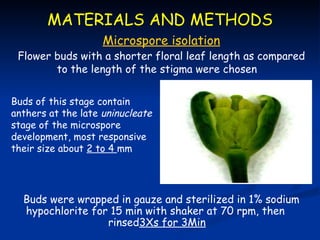
 Flower buds with a shorter floral leaf length as compared
        to the length of the stigma were chosen


Buds of this stage contain
anthers at the late uninucleate
stage of the microspore
development, most responsive
their size about 2 to 4 mm


  Buds were wrapped in gauze and sterilized in 1% sodium
  hypochlorite for 15 min with shaker at 70 rpm, then
                  rinsed3Xs for 3Min
Microspore isolation
 Buds were gently blended with 2 ml ofB5-13 medium, ground using a
mortar, filtered through a 45 μm mesh screen and collected in Cen.
tube

Suspension washed three times with 10 ml of B5-13 medium by
centrifuging at 1,000 rpm for 3 min, then re-suspended in NLN
 liquid medium with 13% sucrose, while pH adjusted to 5.8

ml of the microspore suspension dispensed into a sterile Petri-dish 2.5
and sealed with parafilm

After a24 h heat shock treatment and14day incubation in darkness,
all microspores were placed on a shaker at 60 rpm and25°C under
a 16 h photoperiod with50 μmol m-2 s-1 PPFD
Microspore treatments
Microspores were cultured with various NLN liquid medium strengths
(0.25X, 0.5X, 1.0X, 2.0X and4.0X( to investigate the effect of
NLN on MDE induction

To investigate the effects of sugar concentration on embryonic
induction, microspores were cultured in 0.5XNLN liquid medium
containing0, 3, 5, 10, 13, 15 and20% sucrose

Microspores were cultured at four different heat shock temperatures
 of25, 32.5, 37 and42°C for 24h in order to determine the
optimal temperature for MDE formation and the heat shock period
 was also varied at0, 24, 48 and72 h at32.5°C
Germination of Microspore Derived
             Embryos
Fully developed dicotyledonous embryos and torpedo
embryos were picked up and transferred directly to MS
medium containing 3% sucrose and 8% agar


All microspore embryos incubated at 25 ± 1°C under 16 h
photoperiod with 50 μmol m-2 s-1 PPFD for 4 weeks

Then transferred ex vitro
Next slideFigure
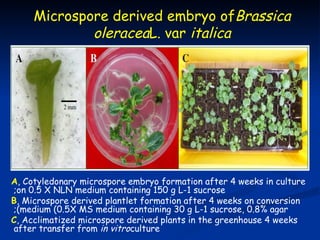
Microspore derived embryo ofBrassica
             oleraceaL. var italica


A, Cotyledonary microspore embryo formation after 4 weeks in culture
;on 0.5 X NLN medium containing 150 g L-1 sucrose
B, Microspore derived plantlet formation after 4 weeks on conversion
;(medium (0.5X MS medium containing 30 g L-1 sucrose, 0.8% agar
C, Acclimatized microspore derived plants in the greenhouse 4 weeks
after transfer from in vitroculture
RESULTS AND DISCUSSION
The high concentrations of macro and micro nutrient were not
effective for MDE formation

The nutritional requirements for induction and production of embryos
vary from species to species

Higher concentrations of macronutrients may be inhibitory to the
induction of embryogenesis, as well as to embryo growth

Addition of various amounts of micronutrients to the 0.5X NLN liquid
medium was less effective than not adding micronutrients at all

0.5X NLN liquid medium proved to be significantly better than the
other media strengths. similar results in Brassica campestrissp. Sato et al.
)1989( and Pimpinell brachycarpa))Na and Chun, 2009
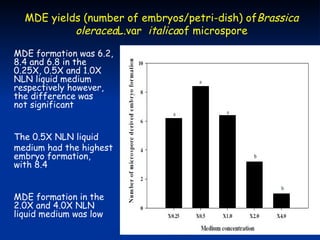
MDE yields (number of embryos/petri-dish( ofBrassica
           oleraceaL.var italicaof microspore

MDE formation was 6.2,
8.4 and 6.8 in the
0.25X, 0.5X and 1.0X
NLN liquid medium
respectively however,
the difference was
not significant


The 0.5X NLN liquid
medium had the highest
embryo formation,
with 8.4


MDE formation in the
2.0X and 4.0X NLN
liquid medium was low
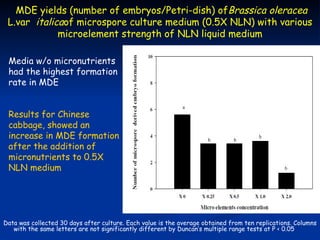
MDE yields (number of embryos/Petri-dish( ofBrassica oleracea
 L.var italicaof microspore culture medium (0.5X NLN( with various
             microelement strength of NLN liquid medium

 Media w/o micronutrients
 had the highest formation
 rate in MDE


 Results for Chinese
 cabbage, showed an
 increase in MDE formation
 after the addition of
 micronutrients to 0.5X
 NLN medium


Data was collected 30 days after culture. Each value is the average obtained from ten replications. Columns
   with the same letters are not significantly different by Duncan‘s multiple range tests at P > 0.05
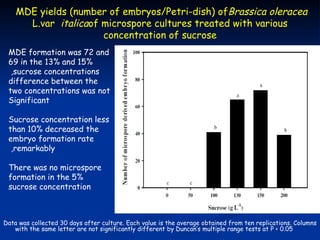
MDE yields (number of embryos/Petri-dish( ofBrassica oleracea
      L.var italicaof microspore cultures treated with various
                      concentration of sucrose
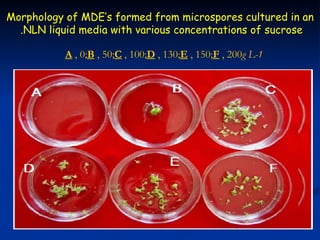
 MDE formation was 72 and
 69 in the 13% and 15%
  ,sucrose concentrations
 difference between the
 two concentrations was not
 Significant

 Sucrose concentration less
 than 10% decreased the
 embryo formation rate
  ,remarkably

 There was no microspore
 formation in the 5%
 sucrose concentration


Data was collected 30 days after culture. Each value is the average obtained from ten replications. Columns
   with the same letter are not significantly different by Duncan‘s multiple range tests at P > 0.05
Morphology of MDE‘s formed from microspores cultured in an
  .NLN liquid media with various concentrations of sucrose

           A , 0;B , 50;C , 100;D , 130;E , 150;F , 200g L-1
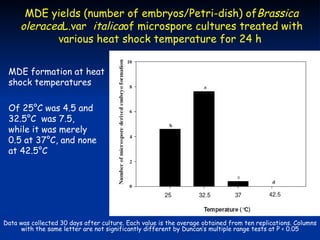
MDE yields (number of embryos/Petri-dish( ofBrassica
     oleraceaL.var italicaof microspore cultures treated with
            various heat shock temperature for 24 h


 MDE formation at heat
 shock temperatures

 Of 25°C was 4.5 and
 32.5°C was 7.5,
 while it was merely
 0.5 at 37°C, and none
 at 42.5°C


Data was collected 30 days after culture. Each value is the average obtained from ten replications. Columns
     with the same letter are not significantly different by Duncan‘s multiple range tests at P > 0.05
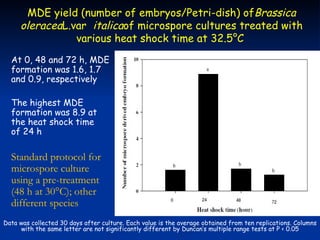
MDE yield (number of embryos/Petri-dish( ofBrassica
     oleraceaL.var italicaof microspore cultures treated with
                various heat shock time at 32.5°C
  At 0, 48 and 72 h, MDE
  formation was 1.6, 1.7
  and 0.9, respectively

  The highest MDE
  formation was 8.9 at
  the heat shock time
  of 24 h

  Standard protocol for
  microspore culture
  using a pre-treatment
  )48 h at 30°C(; other
  different species
Data was collected 30 days after culture. Each value is the average obtained from ten replications. Columns
     with the same letter are not significantly different by Duncan‘s multiple range tests at P > 0.05
Conclusion
For MDE formation in broccoli, use the standard NLN-13
media

One of the most important medium components influencing
the induction of embryogenesis is sucrose

High level of sucrose is required for initial microspore
survival and division, but a lower level is important for
the continuation of microspore division

A reduction in the concentrations of some of the
macronutrients in NLN-13, mainly NO3, may be useful
for promoting embryogenesis

Anther culture

  • 1.
    Microspore culture isa valuable tool for breeding Rapid than getting homozygous lines by bud pollination Increase selection efficiency for desirable genetic recombinantsproducing F1 hybrids of cultivars MDE plants can be utilized in various Sci. research studies
  • 2.
    Objective: to studyfactors affecting microspore derived embryos formation in broccoli Several factors influencing microspore embryogenesis Donor plant conditions Genotype Developmental stage Media constituents Culture conditions
  • 3.
    MATERIALS AND METHODS Donorplants were grown in a greenhouse under a 16 h photoperiod Later, they were vernalized in a cold room maintained at 4±1°C under a 16 h photoperiod for eight weeks After floral differentiation and the start of generative development, plants were transferred to a greenhouse at 25°C under a 16 h photoperiod Along all stages the photoperiod with 400 μmol m-2 s-1 P hotosyntheticP hotonF luxD(ensity (PPFD
  • 4.
    MATERIALS AND METHODS Microspore isolation Flower buds with a shorter floral leaf length as compared to the length of the stigma were chosen Buds of this stage contain anthers at the late uninucleate stage of the microspore development, most responsive their size about 2 to 4 mm Buds were wrapped in gauze and sterilized in 1% sodium hypochlorite for 15 min with shaker at 70 rpm, then rinsed3Xs for 3Min
  • 5.
    Microspore isolation Budswere gently blended with 2 ml ofB5-13 medium, ground using a mortar, filtered through a 45 μm mesh screen and collected in Cen. tube Suspension washed three times with 10 ml of B5-13 medium by centrifuging at 1,000 rpm for 3 min, then re-suspended in NLN liquid medium with 13% sucrose, while pH adjusted to 5.8 ml of the microspore suspension dispensed into a sterile Petri-dish 2.5 and sealed with parafilm After a24 h heat shock treatment and14day incubation in darkness, all microspores were placed on a shaker at 60 rpm and25°C under a 16 h photoperiod with50 μmol m-2 s-1 PPFD
  • 6.
    Microspore treatments Microspores werecultured with various NLN liquid medium strengths (0.25X, 0.5X, 1.0X, 2.0X and4.0X( to investigate the effect of NLN on MDE induction To investigate the effects of sugar concentration on embryonic induction, microspores were cultured in 0.5XNLN liquid medium containing0, 3, 5, 10, 13, 15 and20% sucrose Microspores were cultured at four different heat shock temperatures of25, 32.5, 37 and42°C for 24h in order to determine the optimal temperature for MDE formation and the heat shock period was also varied at0, 24, 48 and72 h at32.5°C
  • 7.
    Germination of MicrosporeDerived Embryos Fully developed dicotyledonous embryos and torpedo embryos were picked up and transferred directly to MS medium containing 3% sucrose and 8% agar All microspore embryos incubated at 25 ± 1°C under 16 h photoperiod with 50 μmol m-2 s-1 PPFD for 4 weeks Then transferred ex vitro Next slideFigure
  • 8.
    Microspore derived embryoofBrassica oleraceaL. var italica A, Cotyledonary microspore embryo formation after 4 weeks in culture ;on 0.5 X NLN medium containing 150 g L-1 sucrose B, Microspore derived plantlet formation after 4 weeks on conversion ;(medium (0.5X MS medium containing 30 g L-1 sucrose, 0.8% agar C, Acclimatized microspore derived plants in the greenhouse 4 weeks after transfer from in vitroculture
  • 9.
    RESULTS AND DISCUSSION Thehigh concentrations of macro and micro nutrient were not effective for MDE formation The nutritional requirements for induction and production of embryos vary from species to species Higher concentrations of macronutrients may be inhibitory to the induction of embryogenesis, as well as to embryo growth Addition of various amounts of micronutrients to the 0.5X NLN liquid medium was less effective than not adding micronutrients at all 0.5X NLN liquid medium proved to be significantly better than the other media strengths. similar results in Brassica campestrissp. Sato et al. )1989( and Pimpinell brachycarpa))Na and Chun, 2009
  • 10.
    MDE yields (numberof embryos/petri-dish( ofBrassica oleraceaL.var italicaof microspore MDE formation was 6.2, 8.4 and 6.8 in the 0.25X, 0.5X and 1.0X NLN liquid medium respectively however, the difference was not significant The 0.5X NLN liquid medium had the highest embryo formation, with 8.4 MDE formation in the 2.0X and 4.0X NLN liquid medium was low
  • 11.
    MDE yields (numberof embryos/Petri-dish( ofBrassica oleracea L.var italicaof microspore culture medium (0.5X NLN( with various microelement strength of NLN liquid medium Media w/o micronutrients had the highest formation rate in MDE Results for Chinese cabbage, showed an increase in MDE formation after the addition of micronutrients to 0.5X NLN medium Data was collected 30 days after culture. Each value is the average obtained from ten replications. Columns with the same letters are not significantly different by Duncan‘s multiple range tests at P > 0.05
  • 12.
    MDE yields (numberof embryos/Petri-dish( ofBrassica oleracea L.var italicaof microspore cultures treated with various concentration of sucrose MDE formation was 72 and 69 in the 13% and 15% ,sucrose concentrations difference between the two concentrations was not Significant Sucrose concentration less than 10% decreased the embryo formation rate ,remarkably There was no microspore formation in the 5% sucrose concentration Data was collected 30 days after culture. Each value is the average obtained from ten replications. Columns with the same letter are not significantly different by Duncan‘s multiple range tests at P > 0.05
  • 13.
    Morphology of MDE‘sformed from microspores cultured in an .NLN liquid media with various concentrations of sucrose A , 0;B , 50;C , 100;D , 130;E , 150;F , 200g L-1
  • 14.
    MDE yields (numberof embryos/Petri-dish( ofBrassica oleraceaL.var italicaof microspore cultures treated with various heat shock temperature for 24 h MDE formation at heat shock temperatures Of 25°C was 4.5 and 32.5°C was 7.5, while it was merely 0.5 at 37°C, and none at 42.5°C Data was collected 30 days after culture. Each value is the average obtained from ten replications. Columns with the same letter are not significantly different by Duncan‘s multiple range tests at P > 0.05
  • 15.
    MDE yield (numberof embryos/Petri-dish( ofBrassica oleraceaL.var italicaof microspore cultures treated with various heat shock time at 32.5°C At 0, 48 and 72 h, MDE formation was 1.6, 1.7 and 0.9, respectively The highest MDE formation was 8.9 at the heat shock time of 24 h Standard protocol for microspore culture using a pre-treatment )48 h at 30°C(; other different species Data was collected 30 days after culture. Each value is the average obtained from ten replications. Columns with the same letter are not significantly different by Duncan‘s multiple range tests at P > 0.05
  • 16.
    Conclusion For MDE formationin broccoli, use the standard NLN-13 media One of the most important medium components influencing the induction of embryogenesis is sucrose High level of sucrose is required for initial microspore survival and division, but a lower level is important for the continuation of microspore division A reduction in the concentrations of some of the macronutrients in NLN-13, mainly NO3, may be useful for promoting embryogenesis