• Igor Ansoff provided a roadmap for firms to
grow depending on whether they are
launching new products or entering new
markets or a combination of these options.
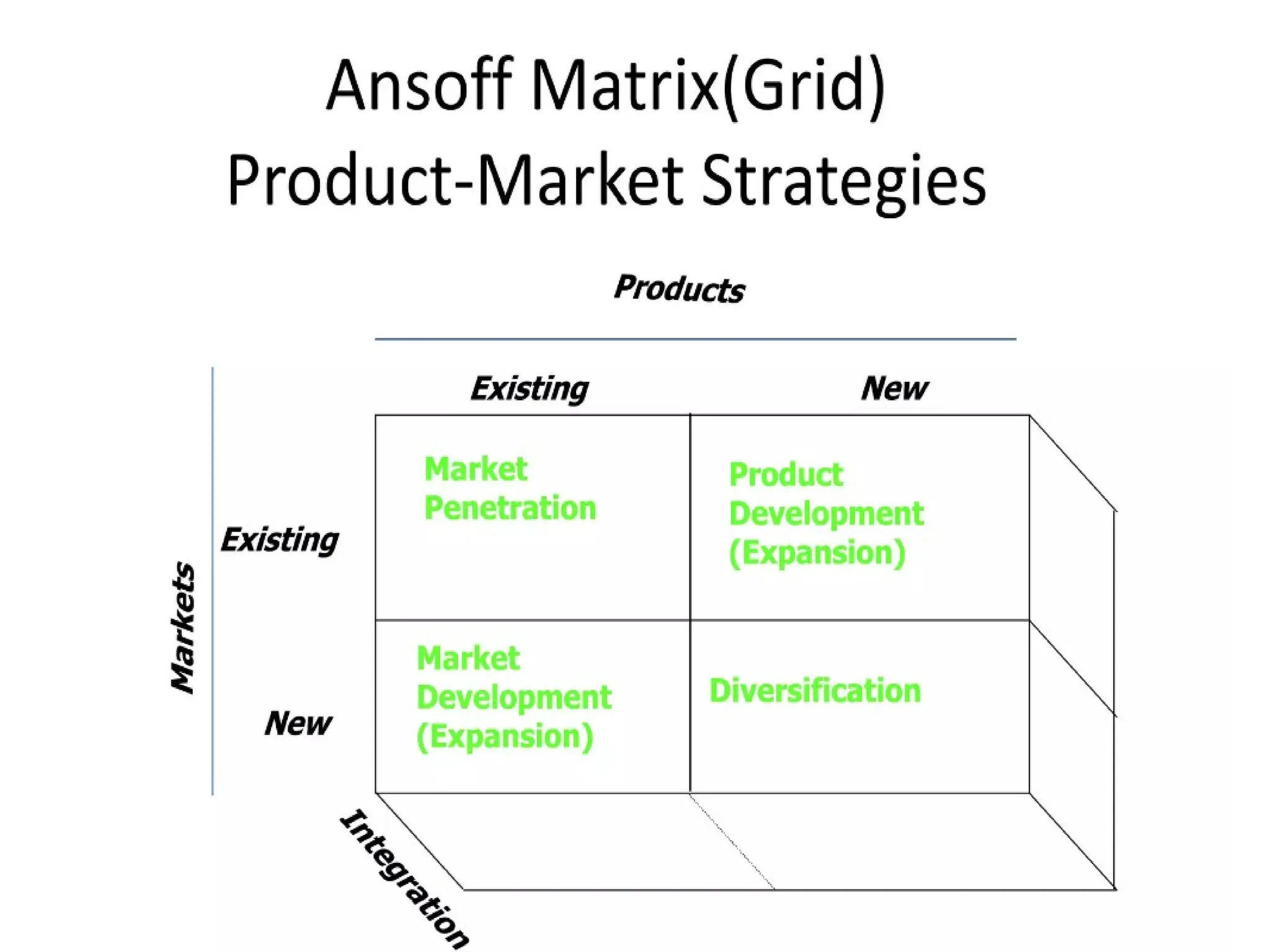
• Its a Matrix that has four quadrants with the
dimensions of products and markets which
becomes the determinants of the strategies.
• Market penetration
• Market development
• Product development
• Diversification
• The four quadrants pertain to increasing
market share through market penetration,
• Venturing into new markets with the existing
products or market development,
• and launching new products in existing
markets with product development,
• and finally, diversification when firms seek to
enter new markets with new products.
• ANSOFF is a product-market growth
framework that assists with the
development of strategic plans.
• This approach describes 4 alternatives
for organizational growth in existing or
new markets.
1. Market Penetration: Develop strategies to promote existing
products in the existing market. For example, price decrease,
discounts, acquisition of competitors in same market, or small
improvements.
2. Market Development: This approach focuses on expansion in
different market segments like geographic or demographic. This
growth strategy can be achieved by changing target customers,
targeting commercial or consumers, explore foreign markets.
3. Product Development: New products or services to supply in
existing markets. This requires expansion of product range by
investing in research and development. Similarly, acquire rights to
third-party products or resell under the brand.
4. Diversification: New products in a new market – This is the most
risk-taking growth strategy. There are two types of diversifications,
related and unrelated.
Diversification
• The riskiest growth strategy in the Ansoff
Growth Matrix is diversification. This is
because you need to invest in product and
market development. Businesses deciding
to diversify means they're developing new
products to be distributed in a new,
unfamiliar market.
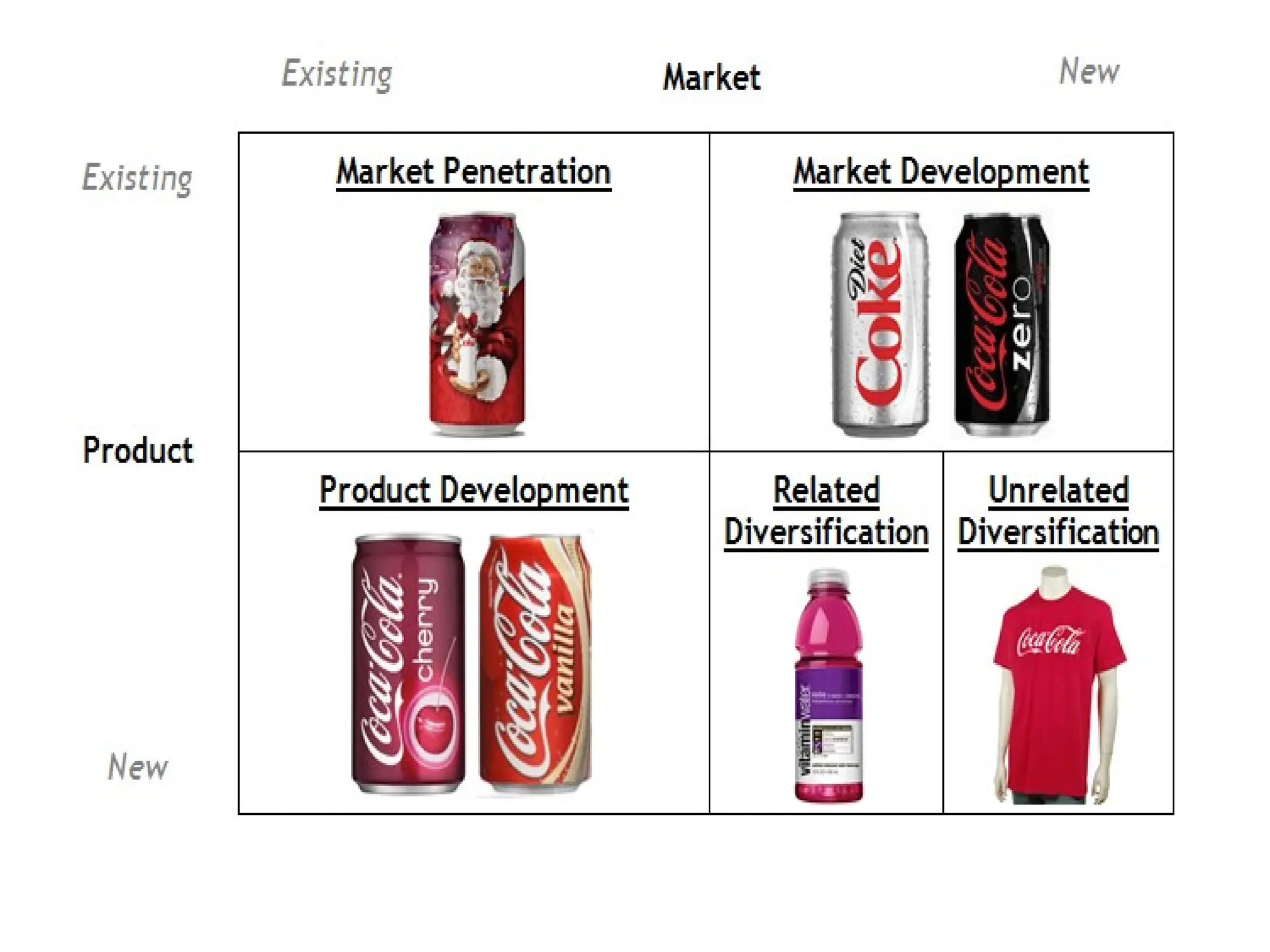
COCACOLA
• To demonstrate the robustness and
legitimacy of Ansoff’s Matrix, it has been
applied to Coca-Cola, the most well-known
trade name in the world and a company
today operating in over 200 countries; and
a brand that has undertaken countless
growth strategies in its 100+ year history.
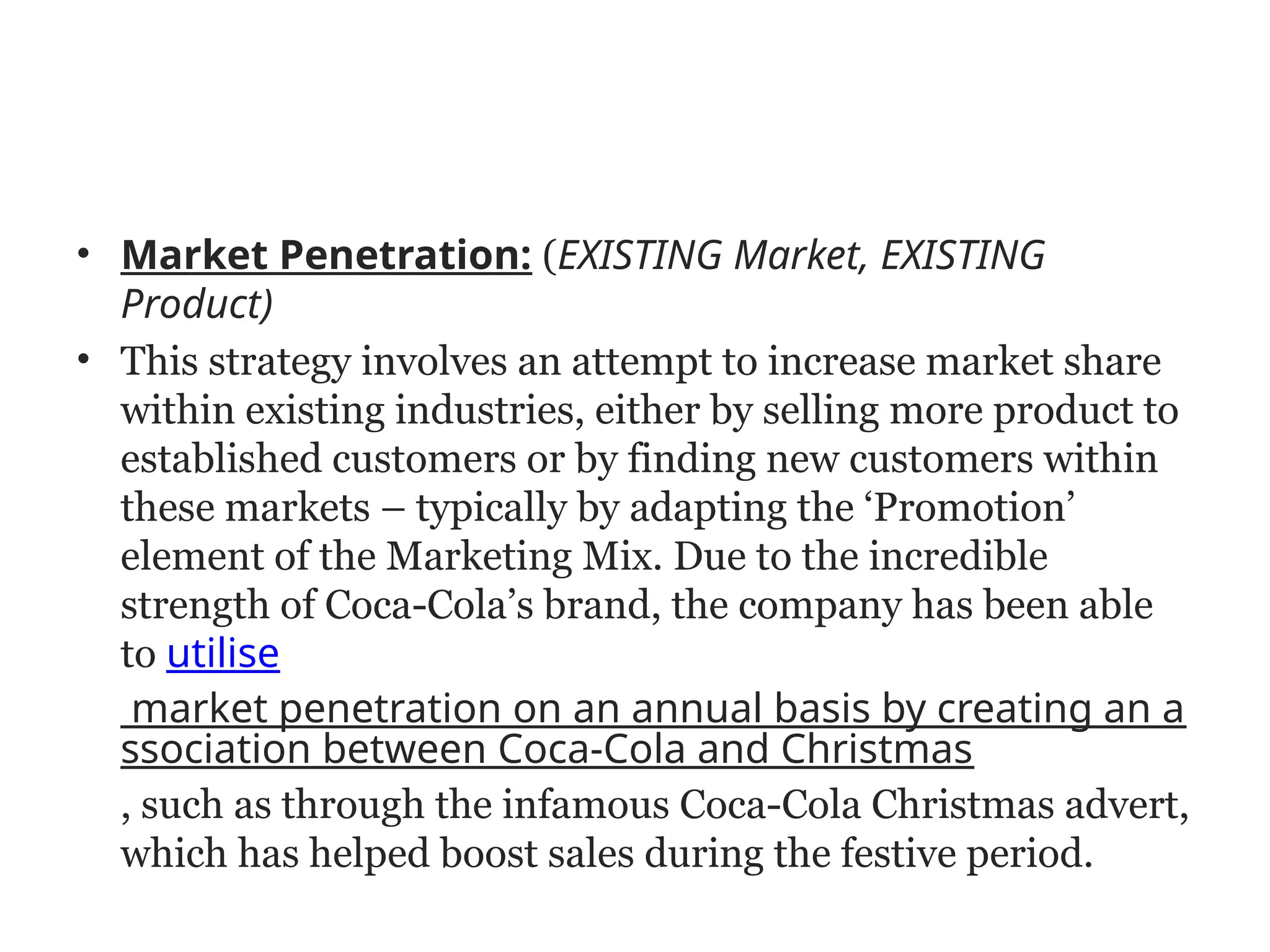
• Market Penetration: (EXISTING Market, EXISTING
Product)
• This strategy involves an attempt to increase market share
within existing industries, either by selling more product to
established customers or by finding new customers within
these markets – typically by adapting the ‘Promotion’
element of the Marketing Mix. Due to the incredible
strength of Coca-Cola’s brand, the company has been able
to utilise
market penetration on an annual basis by creating an a
ssociation between Coca-Cola and Christmas
, such as through the infamous Coca-Cola Christmas advert,
which has helped boost sales during the festive period.
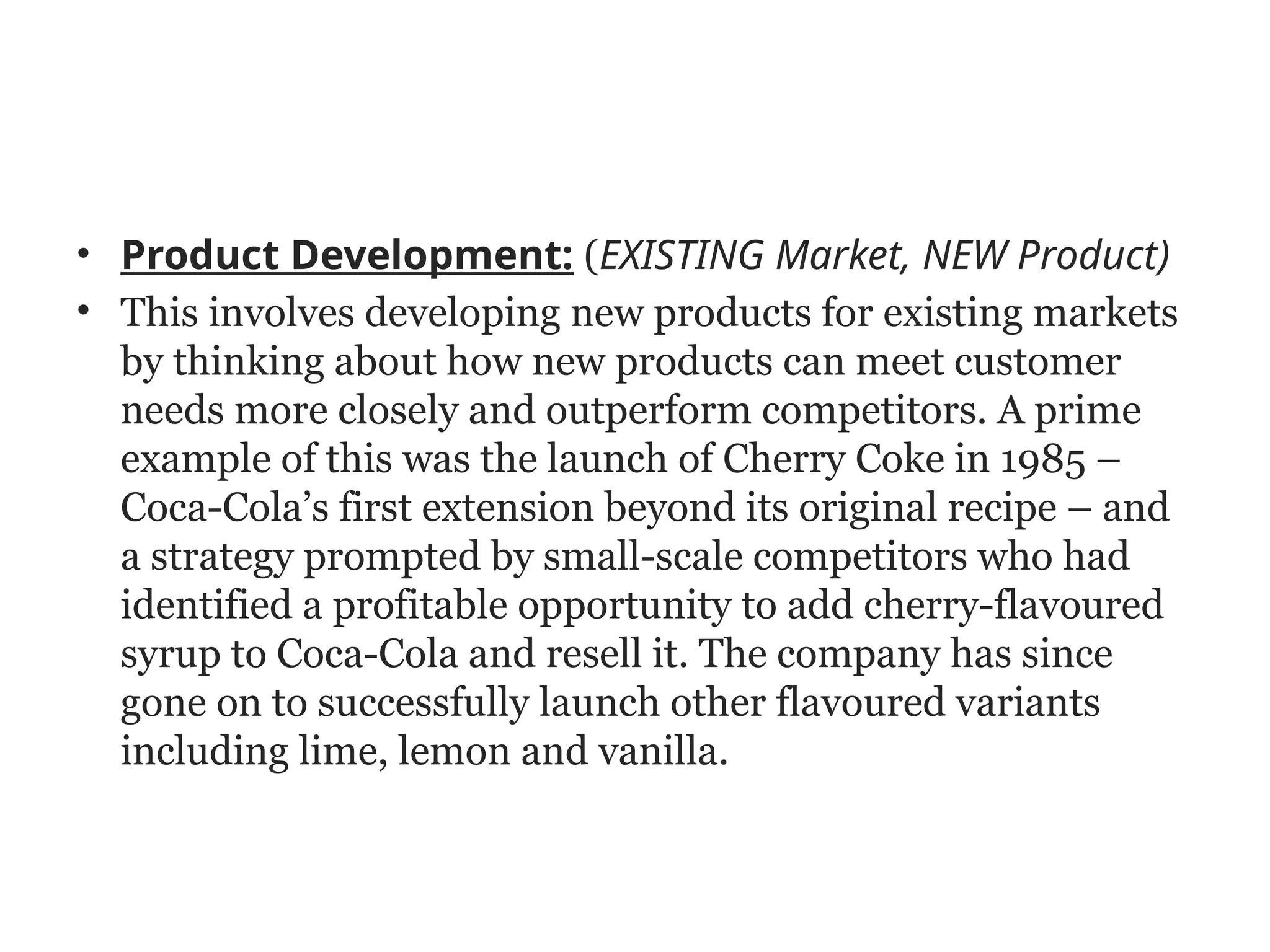
• Product Development: (EXISTING Market, NEW Product)
• This involves developing new products for existing markets
by thinking about how new products can meet customer
needs more closely and outperform competitors. A prime
example of this was the launch of Cherry Coke in 1985 –
Coca-Cola’s first extension beyond its original recipe – and
a strategy prompted by small-scale competitors who had
identified a profitable opportunity to add cherry-flavoured
syrup to Coca-Cola and resell it. The company has since
gone on to successfully launch other flavoured variants
including lime, lemon and vanilla.
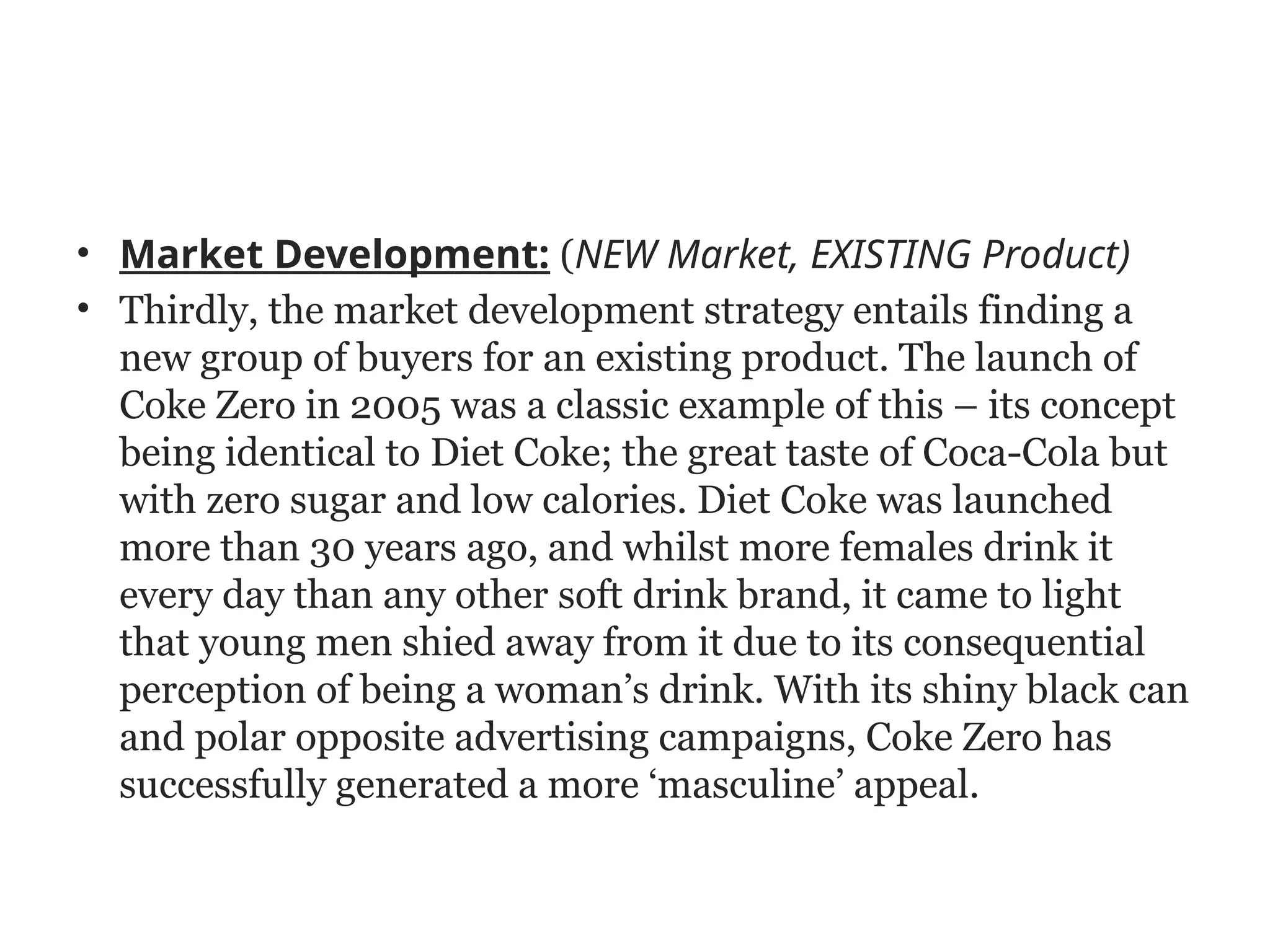
• Market Development: (NEW Market, EXISTING Product)
• Thirdly, the market development strategy entails finding a
new group of buyers for an existing product. The launch of
Coke Zero in 2005 was a classic example of this – its concept
being identical to Diet Coke; the great taste of Coca-Cola but
with zero sugar and low calories. Diet Coke was launched
more than 30 years ago, and whilst more females drink it
every day than any other soft drink brand, it came to light
that young men shied away from it due to its consequential
perception of being a woman’s drink. With its shiny black can
and polar opposite advertising campaigns, Coke Zero has
successfully generated a more ‘masculine’ appeal.
• Related Diversification: (NEW Market, NEW
Product)
• This involves the production of a new category of
goods that complements the existing portfolio, in
order to penetrate a new but related market. In 2007,
Coca-Cola spent $4.1 billion to acquire Glaceau,
including its health drink brand Vitamin water. With
a year-on-year decline in sales of carbonated soft
drinks like Coca-Cola, the brand anticipates the
drinks market may be heading less-sugary future – so
has jumped on board the growing health drink sector.
• Unrelated Diversification: (NEW Market, NEW
Product)
• Finally, unrelated diversification entails entry into a
new industry that lacks important similarities with
the company’s existing markets. Coca-Cola generally
avoids risky adventures into unknown territories and
can instead utilise its brand strength to continue
growing within the drinks industry. That said, Coca-
Cola offers official merchandise from pens and
glasses to fridges, therefore exploiting its strong
brand advocacy through this strategy.
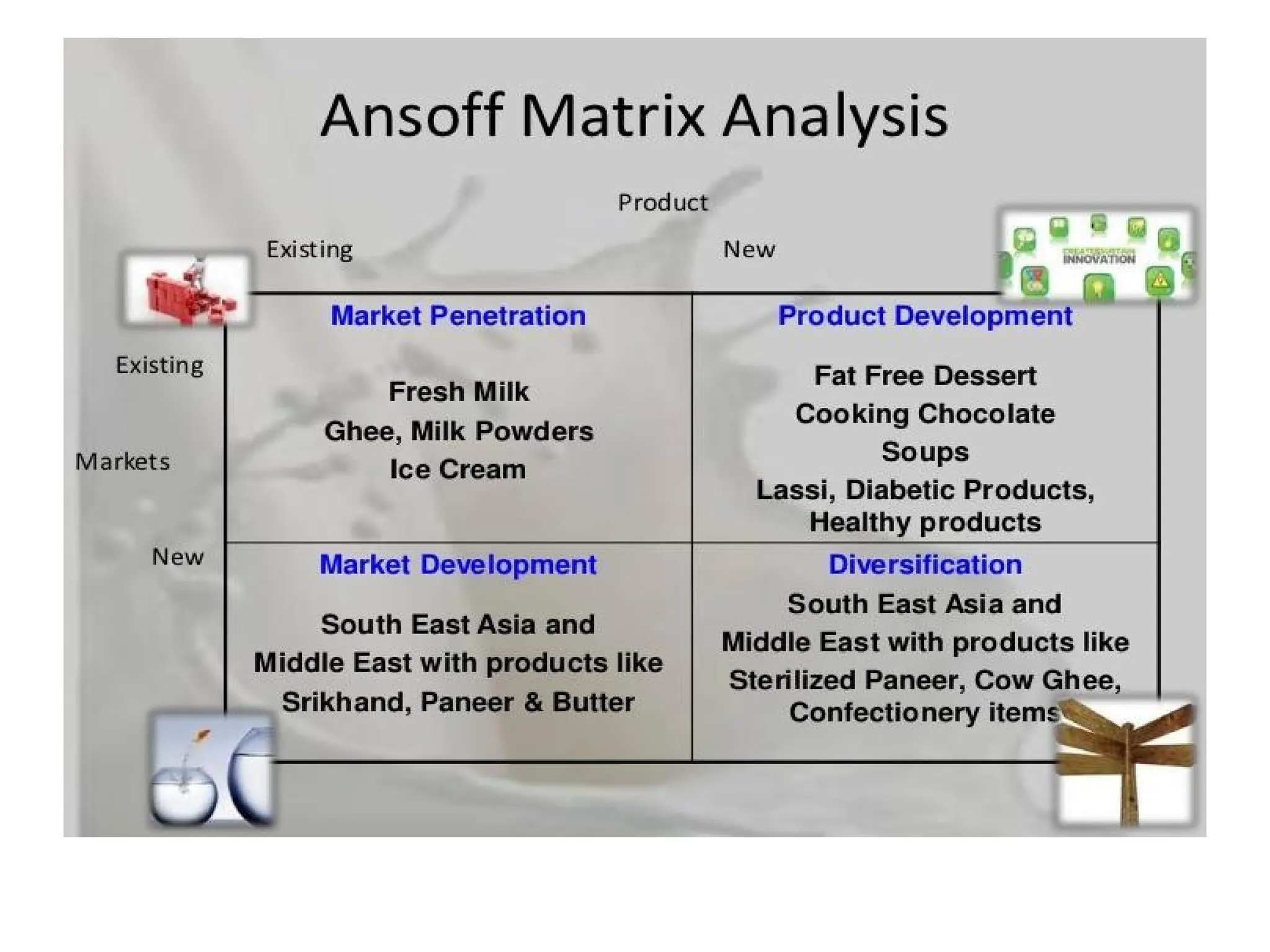
• Nestle adopts an aggressive marketing and
promotional strategies to penetrate a market. Nestle
focuses on launching different sizes of products to
increase their customer base. It helps Nestle to
acquire customers who cannot afford large-size
packages. They also regularly introduce new flavours
for its customers to increase their sales. Nestle also
focuses on giving huge discounts on large-size
products and promotes its offerings on multiple
marketing channels. So, all these market penetration
strategies help Nestle to sell its products consistently
in an existing market.
• When Nestle enters a new market, they make sure that the products
are readily available to the customers at affordable prices. So, Nestle
heavily invests on efficient distribution channels. Also, the company
believes in giving excellent quality products to its customers at
affordable prices. It helps in winning customers trusts and results in
brand loyalty. The company also heavily invests in advertisements to
aggressively market its presence in the new region. It also focuses
on modifying its products according to the market need by changing
the packaging or offering a product variant.
• However, high brand equity helps brands like Nestle, Nike or
McDonalds to enter a new market. So, if a product has the backing of
a reputed brand name, it gets easier to win the customers trust. But,
if the product is not rooted in the current market, it is not
recommended to implement the market development strategy.
• A part of the success enjoyed
by McDonald’s stems from its product
development strategy. To succeed
internationally, McDonald’s creates several
products to meet customers demands in the
local markets. They also adapt and modify their
products to fit local tastes of that specific region.
For example, In India, McDonald’s changed their
Big Mac to Maharaja Mac which contains no
beef, to satisfy their local customers.
• Although Honda motor company has its core competencies in cars
and trucks, they started in the motorcycle business. Honda
flourished in their new business because they were successfully
leveraging their core competencies through related diversification.
• The best example for unrelated diversification can
be Tata and Reliance. The two giants started with a single product
but then successfully expanded into a completely unrelated
segment. However, not every irrelevant diversification end in a
happy ending. For instance, Harley Davidson tried to enter the
branded bottled water business but resulted in a disaster.
• So, from all the four strategies we can interpret that the greater the
level of newness, the higher the risk. Thus, Ansoff Matrix can help
firms to understand their products and market scenario and
calculate the risk.
Ansoff Matrix of Tata Motors The Ansoff Matrix is a strategic tool used
to analyze and plan a company's growth strategy by examining the
options available for expanding into new markets and developing new
products. Let's explore how Tata Motors, an Indian automobile
manufacturing company, can apply the Ansoff Matrix to its product
offerings:
• Market Penetration: Existing Product: Tata
Motors can focus on increasing its market share
for its current product line, such as passenger
cars (e.g., Tata Tiago, Tata Nexon) and
commercial vehicles (e.g., Tata Ace, Tata Prima).
• Strategies: Tata Motors can engage in aggressive
marketing campaigns, offer competitive pricing,
improve distribution channels, and enhance
customer service to attract more customers and
gain a larger share of the existing markets.
• Market Development: New Market:Tata Motors
can explore opportunities to introduce its
existing products into new geographic regions
or target new customer segments. Strategies:
Tata Motors can consider expanding into
emerging markets where there is a demand
for affordable vehicles, establishing
partnerships with local distributors or
dealerships, and adapting products to suit the
preferences and needs of the new markets.
• Product Development: New Product:Tata
Motors can focus on developing new
products to meet the evolving needs and
preferences of its existing customer base.
Strategies:Tata Motors can invest in research
and development to create innovative and
technologically advanced vehicles, introduce
electric or hybrid models, or expand its
product range to include luxury or high-
performance cars.
• Diversification: New Product + New Market:Tata
Motors can consider entering completely new
markets or introducing entirely new product
lines. Strategies:Tata Motors can explore
opportunities in related industries such as
electric mobility solutions, autonomous vehicles,
or alternative transportation modes like ride-
sharing or car subscription services. They can
also consider diversifying into non-automotive
sectors like renewable energy or technology
solutions.
Conclusion- It's important to note that the specific strategies and
initiatives Tata Motors should undertake will depend on factors such
as market research, competitive analysis, financial considerations,
and the company's overall strategic goals. The Ansoff Matrix
provides a framework to evaluate these options and make informed
decisions for growth

• https://www.google.com/search?
q=Ansoff+Matrix+video+in+english&sca_esv=5ab0a33a7a1c4e74&rlz=1C1UEAD_enIN99
4IN994&ei=9wOaZrSlL4yXjuMP97WesA4&ved=0ahUKEwj0_K24ubKHAxWMi2MGHfeaB-
YQ4dUDCA8&uact=5&oq=Ansoff+Matrix+video+in+english&gs_lp=Egxnd3Mtd2l6LXNlcn
AiHkFuc29mZiBNYXRyaXggdmlkZW8gaW4gZW5nbGlzaEiQjQFQ2gVYmYYBcAJ4AJABAJgB
uwKgAY5JqgEIMC41OC4xLjG4AQPIAQD4AQGYAhSgAvYYqAISwgIKEAAYsAMY1gQYR8ICBR
AhGKABwgIFECEYnwXCAgoQABiABBhDGIoFwgILEAAYgAQYkQIYigXCAgsQABiABBixAxiDA
cICERAuGIAEGLEDGNEDGIMBGMcBwgIUEAAYgAQY4wQYtAIY6QQY6gLYAQHCAhYQABgD
GLQCGOUCGOoCGIwDGI8B2AECwgIWEC4YAxi0AhjlAhjqAhiMAxiPAdgBAsICDhAuGIAEGL
EDGIMBGIoFwgIIEAAYgAQYsQPCAgsQLhiABBjRAxjHAcICChAuGIAEGEMYigXCAgsQLhiABB
ixAxiDAcICDhAAGIAEGLEDGIMBGIoFwgIXEC4YgAQYkQIYsQMY0QMYgwEYxwEYigXCAg0Q
ABiABBixAxhDGIoFwgIQEC4YgAQY0QMYQxjHARiKBcICJhAuGIAEGJECGLEDGNEDGIMBG
McBGIoFGJcFGNwEGN4EGOAE2AEDwgIOEAAYgAQYkQIYsQMYigXCAhAQLhiABBixAxhDGI
MBGIoFwgIFEAAYgATCAgYQABgWGB7CAgoQABgWGAoYHhgPwgIIEAAYFhgeGA_CAgsQA
BiABBiGAxiKBcICBRAAGO8FmAMGiAYBkAYIugYECAEYB7oGBggCEAEYCroGBggDEAEYFJIH
CDIuMTYuMS4xoAengwM&sclient=gws-wiz-
serp#fpstate=ive&vld=cid:57dee3a4,vid:HeIipDK2CVc,st:0

Ansoff Matrix for growth and Expansion in Strategic management

  • 2.
    • Igor Ansoffprovided a roadmap for firms to grow depending on whether they are launching new products or entering new markets or a combination of these options. • Its a Matrix that has four quadrants with the dimensions of products and markets which becomes the determinants of the strategies.
  • 3.
    • Market penetration •Market development • Product development • Diversification
  • 4.
    • The fourquadrants pertain to increasing market share through market penetration, • Venturing into new markets with the existing products or market development, • and launching new products in existing markets with product development, • and finally, diversification when firms seek to enter new markets with new products.
  • 6.
    • ANSOFF isa product-market growth framework that assists with the development of strategic plans. • This approach describes 4 alternatives for organizational growth in existing or new markets.
  • 7.
    1. Market Penetration:Develop strategies to promote existing products in the existing market. For example, price decrease, discounts, acquisition of competitors in same market, or small improvements. 2. Market Development: This approach focuses on expansion in different market segments like geographic or demographic. This growth strategy can be achieved by changing target customers, targeting commercial or consumers, explore foreign markets. 3. Product Development: New products or services to supply in existing markets. This requires expansion of product range by investing in research and development. Similarly, acquire rights to third-party products or resell under the brand. 4. Diversification: New products in a new market – This is the most risk-taking growth strategy. There are two types of diversifications, related and unrelated.
  • 13.
    Diversification • The riskiestgrowth strategy in the Ansoff Growth Matrix is diversification. This is because you need to invest in product and market development. Businesses deciding to diversify means they're developing new products to be distributed in a new, unfamiliar market.
  • 14.
    COCACOLA • To demonstratethe robustness and legitimacy of Ansoff’s Matrix, it has been applied to Coca-Cola, the most well-known trade name in the world and a company today operating in over 200 countries; and a brand that has undertaken countless growth strategies in its 100+ year history.
  • 16.
    • Market Penetration:(EXISTING Market, EXISTING Product) • This strategy involves an attempt to increase market share within existing industries, either by selling more product to established customers or by finding new customers within these markets – typically by adapting the ‘Promotion’ element of the Marketing Mix. Due to the incredible strength of Coca-Cola’s brand, the company has been able to utilise market penetration on an annual basis by creating an a ssociation between Coca-Cola and Christmas , such as through the infamous Coca-Cola Christmas advert, which has helped boost sales during the festive period.
  • 17.
    • Product Development:(EXISTING Market, NEW Product) • This involves developing new products for existing markets by thinking about how new products can meet customer needs more closely and outperform competitors. A prime example of this was the launch of Cherry Coke in 1985 – Coca-Cola’s first extension beyond its original recipe – and a strategy prompted by small-scale competitors who had identified a profitable opportunity to add cherry-flavoured syrup to Coca-Cola and resell it. The company has since gone on to successfully launch other flavoured variants including lime, lemon and vanilla.
  • 18.
    • Market Development:(NEW Market, EXISTING Product) • Thirdly, the market development strategy entails finding a new group of buyers for an existing product. The launch of Coke Zero in 2005 was a classic example of this – its concept being identical to Diet Coke; the great taste of Coca-Cola but with zero sugar and low calories. Diet Coke was launched more than 30 years ago, and whilst more females drink it every day than any other soft drink brand, it came to light that young men shied away from it due to its consequential perception of being a woman’s drink. With its shiny black can and polar opposite advertising campaigns, Coke Zero has successfully generated a more ‘masculine’ appeal.
  • 19.
    • Related Diversification:(NEW Market, NEW Product) • This involves the production of a new category of goods that complements the existing portfolio, in order to penetrate a new but related market. In 2007, Coca-Cola spent $4.1 billion to acquire Glaceau, including its health drink brand Vitamin water. With a year-on-year decline in sales of carbonated soft drinks like Coca-Cola, the brand anticipates the drinks market may be heading less-sugary future – so has jumped on board the growing health drink sector.
  • 20.
    • Unrelated Diversification:(NEW Market, NEW Product) • Finally, unrelated diversification entails entry into a new industry that lacks important similarities with the company’s existing markets. Coca-Cola generally avoids risky adventures into unknown territories and can instead utilise its brand strength to continue growing within the drinks industry. That said, Coca- Cola offers official merchandise from pens and glasses to fridges, therefore exploiting its strong brand advocacy through this strategy.
  • 22.
    • Nestle adoptsan aggressive marketing and promotional strategies to penetrate a market. Nestle focuses on launching different sizes of products to increase their customer base. It helps Nestle to acquire customers who cannot afford large-size packages. They also regularly introduce new flavours for its customers to increase their sales. Nestle also focuses on giving huge discounts on large-size products and promotes its offerings on multiple marketing channels. So, all these market penetration strategies help Nestle to sell its products consistently in an existing market.
  • 23.
    • When Nestleenters a new market, they make sure that the products are readily available to the customers at affordable prices. So, Nestle heavily invests on efficient distribution channels. Also, the company believes in giving excellent quality products to its customers at affordable prices. It helps in winning customers trusts and results in brand loyalty. The company also heavily invests in advertisements to aggressively market its presence in the new region. It also focuses on modifying its products according to the market need by changing the packaging or offering a product variant. • However, high brand equity helps brands like Nestle, Nike or McDonalds to enter a new market. So, if a product has the backing of a reputed brand name, it gets easier to win the customers trust. But, if the product is not rooted in the current market, it is not recommended to implement the market development strategy.
  • 24.
    • A partof the success enjoyed by McDonald’s stems from its product development strategy. To succeed internationally, McDonald’s creates several products to meet customers demands in the local markets. They also adapt and modify their products to fit local tastes of that specific region. For example, In India, McDonald’s changed their Big Mac to Maharaja Mac which contains no beef, to satisfy their local customers.
  • 25.
    • Although Hondamotor company has its core competencies in cars and trucks, they started in the motorcycle business. Honda flourished in their new business because they were successfully leveraging their core competencies through related diversification. • The best example for unrelated diversification can be Tata and Reliance. The two giants started with a single product but then successfully expanded into a completely unrelated segment. However, not every irrelevant diversification end in a happy ending. For instance, Harley Davidson tried to enter the branded bottled water business but resulted in a disaster. • So, from all the four strategies we can interpret that the greater the level of newness, the higher the risk. Thus, Ansoff Matrix can help firms to understand their products and market scenario and calculate the risk.
  • 26.
    Ansoff Matrix ofTata Motors The Ansoff Matrix is a strategic tool used to analyze and plan a company's growth strategy by examining the options available for expanding into new markets and developing new products. Let's explore how Tata Motors, an Indian automobile manufacturing company, can apply the Ansoff Matrix to its product offerings:
  • 27.
    • Market Penetration:Existing Product: Tata Motors can focus on increasing its market share for its current product line, such as passenger cars (e.g., Tata Tiago, Tata Nexon) and commercial vehicles (e.g., Tata Ace, Tata Prima). • Strategies: Tata Motors can engage in aggressive marketing campaigns, offer competitive pricing, improve distribution channels, and enhance customer service to attract more customers and gain a larger share of the existing markets.
  • 28.
    • Market Development:New Market:Tata Motors can explore opportunities to introduce its existing products into new geographic regions or target new customer segments. Strategies: Tata Motors can consider expanding into emerging markets where there is a demand for affordable vehicles, establishing partnerships with local distributors or dealerships, and adapting products to suit the preferences and needs of the new markets.
  • 29.
    • Product Development:New Product:Tata Motors can focus on developing new products to meet the evolving needs and preferences of its existing customer base. Strategies:Tata Motors can invest in research and development to create innovative and technologically advanced vehicles, introduce electric or hybrid models, or expand its product range to include luxury or high- performance cars.
  • 30.
    • Diversification: NewProduct + New Market:Tata Motors can consider entering completely new markets or introducing entirely new product lines. Strategies:Tata Motors can explore opportunities in related industries such as electric mobility solutions, autonomous vehicles, or alternative transportation modes like ride- sharing or car subscription services. They can also consider diversifying into non-automotive sectors like renewable energy or technology solutions.
  • 31.
    Conclusion- It's importantto note that the specific strategies and initiatives Tata Motors should undertake will depend on factors such as market research, competitive analysis, financial considerations, and the company's overall strategic goals. The Ansoff Matrix provides a framework to evaluate these options and make informed decisions for growth
  • 32.
    • https://www.google.com/search? q=Ansoff+Matrix+video+in+english&sca_esv=5ab0a33a7a1c4e74&rlz=1C1UEAD_enIN99 4IN994&ei=9wOaZrSlL4yXjuMP97WesA4&ved=0ahUKEwj0_K24ubKHAxWMi2MGHfeaB- YQ4dUDCA8&uact=5&oq=Ansoff+Matrix+video+in+english&gs_lp=Egxnd3Mtd2l6LXNlcn AiHkFuc29mZiBNYXRyaXggdmlkZW8gaW4gZW5nbGlzaEiQjQFQ2gVYmYYBcAJ4AJABAJgB uwKgAY5JqgEIMC41OC4xLjG4AQPIAQD4AQGYAhSgAvYYqAISwgIKEAAYsAMY1gQYR8ICBR AhGKABwgIFECEYnwXCAgoQABiABBhDGIoFwgILEAAYgAQYkQIYigXCAgsQABiABBixAxiDA cICERAuGIAEGLEDGNEDGIMBGMcBwgIUEAAYgAQY4wQYtAIY6QQY6gLYAQHCAhYQABgD GLQCGOUCGOoCGIwDGI8B2AECwgIWEC4YAxi0AhjlAhjqAhiMAxiPAdgBAsICDhAuGIAEGL EDGIMBGIoFwgIIEAAYgAQYsQPCAgsQLhiABBjRAxjHAcICChAuGIAEGEMYigXCAgsQLhiABB ixAxiDAcICDhAAGIAEGLEDGIMBGIoFwgIXEC4YgAQYkQIYsQMY0QMYgwEYxwEYigXCAg0Q ABiABBixAxhDGIoFwgIQEC4YgAQY0QMYQxjHARiKBcICJhAuGIAEGJECGLEDGNEDGIMBG McBGIoFGJcFGNwEGN4EGOAE2AEDwgIOEAAYgAQYkQIYsQMYigXCAhAQLhiABBixAxhDGI MBGIoFwgIFEAAYgATCAgYQABgWGB7CAgoQABgWGAoYHhgPwgIIEAAYFhgeGA_CAgsQA BiABBiGAxiKBcICBRAAGO8FmAMGiAYBkAYIugYECAEYB7oGBggCEAEYCroGBggDEAEYFJIH CDIuMTYuMS4xoAengwM&sclient=gws-wiz- serp#fpstate=ive&vld=cid:57dee3a4,vid:HeIipDK2CVc,st:0