Anomaly and parity odd transport
Subham Dutta Chowdhury
January 10, 2015
Work in progress, under the guidance of Dr. Justin David (CHEP, IISc)
CHEP In-house Symposium, 2015
Subham Dutta Chowdhury Anomaly and parity odd transport 1/23
Outline
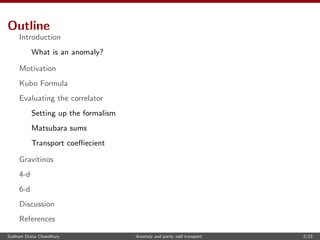
Introduction
What is an anomaly?
Motivation
Kubo Formula
Evaluating the correlator
Setting up the formalism
Matsubara sums
Transport coeffiecient
Gravitinos
4-d
6-d
Discussion
References
Subham Dutta Chowdhury Anomaly and parity odd transport 2/23
What is an anomaly?
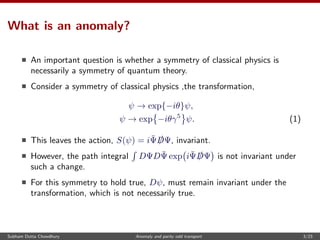
An important question is whether a symmetry of classical physics is
necessarily a symmetry of quantum theory.
Consider a symmetry of classical physics ,the transformation,
ψ → exp{−iθ}ψ,
ψ → exp −iθγ5
ψ. (1)
This leaves the action, S(ψ) = i¯Ψ /DΨ, invariant.
However, the path integral DΨD ¯Ψ exp i¯Ψ /DΨ is not invariant under
such a change.
For this symmetry to hold true, Dψ, must remain invariant under the
transformation, which is not necessarily true.
Subham Dutta Chowdhury Anomaly and parity odd transport 3/23
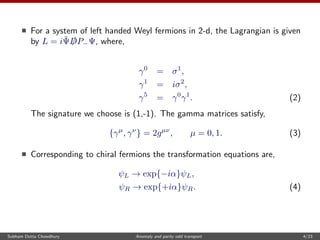
For a system of left handed Weyl fermions in 2-d, the Lagrangian is given
by L = i¯Ψ /DP−Ψ, where,
γ0
= σ1
,
γ1
= iσ2
,
γ5
= γ0
γ1
. (2)
The signature we choose is (1,-1). The gamma matrices satisfy,
{γµ
, γν
} = 2gµν
, µ = 0, 1. (3)
Corresponding to chiral fermions the transformation equations are,
ψL → exp{−iα}ψL,
ψR → exp{+iα}ψR. (4)
Subham Dutta Chowdhury Anomaly and parity odd transport 4/23
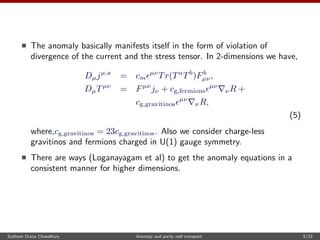
The anomaly basically manifests itself in the form of violation of
divergence of the current and the stress tensor. In 2-dimensions we have,
Dµjµ,a
= cm
µν
Tr(Ta
Tb
)Fb
µν,
DµTµν
= Fµν
jν + cg,fermions
µν
νR +
cg,gravitinos
µν
νR,
(5)
where,cg,gravitinos = 23cg,gravitinos. Also we consider charge-less
gravitinos and fermions charged in U(1) gauge symmetry.
There are ways (Loganayagam et al) to get the anomaly equations in a
consistent manner for higher dimensions.
Subham Dutta Chowdhury Anomaly and parity odd transport 5/23
Motivation
Recent studies by Minwalla et al have revealed their applications in
evaluation of hydrodynamical transport coefficients.
Kharzeev and Warringa [arXiv:0907.5007v1 [hep-th]],Lansteiner et al
[arXiv:1207.5808v1 [hep-th]] have shown that the zero external
momentum and zero frequency chiral magnetic conductivity of a parity
violating fluid ,at first order in derivative, is constrained by the anomaly
in 3+1 dimensions in finite temperature field theory.
Loganayagam et al [arXiv:1211.3850] showed that the coefficients of the
anomaly equations constrain the anomalous transport coefficients, using
a kinetic theory approach.
We look at the behaviour in 1+1 as well as 5+1 dimensions by explicit
calculations in a theory which has chiral fermions using finite temperature
field theory. We then extend the exercise to charge-less gravitinos.
Subham Dutta Chowdhury Anomaly and parity odd transport 6/23
Anomalous Transport Coefficients
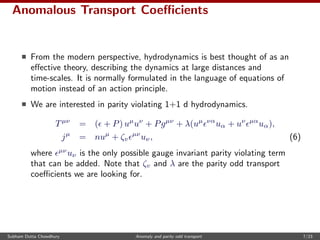
From the modern perspective, hydrodynamics is best thought of as an
effective theory, describing the dynamics at large distances and
time-scales. It is normally formulated in the language of equations of
motion instead of an action principle.
We are interested in parity violating 1+1 d hydrodynamics.
Tµν
= ( + P) uµ
uν
+ Pgµν
+ λ(uµ να
uα + uν µα
uα),
jµ
= nuµ
+ ζv
µν
uν, (6)
where µν
uν is the only possible gauge invariant parity violating term
that can be added. Note that ζv and λ are the parity odd transport
coefficients we are looking for.
Subham Dutta Chowdhury Anomaly and parity odd transport 7/23
Kubo formula from hydrodynamics
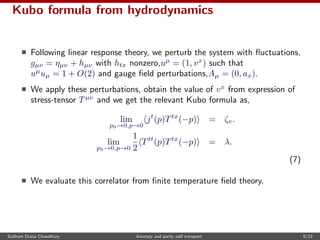
Following linear response theory, we perturb the system with fluctuations,
gµν = ηµν + hµν with htx nonzero,uµ
= (1, vx
) such that
uµ
uµ = 1 + O(2) and gauge field perturbations,Aµ = (0, ax).
We apply these perturbations, obtain the value of vx
from expression of
stress-tensor Tµν
and we get the relevant Kubo formula as,
lim
p0→0,p→0
jt
(p)Ttx
(−p) = ζv.
lim
p0→0,p→0
1
2
Ttt
(p)Ttx
(−p) = λ.
(7)
We evaluate this correlator from finite temperature field theory.
Subham Dutta Chowdhury Anomaly and parity odd transport 8/23
Evaluating the correlator
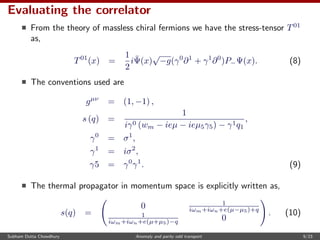
From the theory of massless chiral fermions we have the stress-tensor T01
as,
T01
(x) =
1
2
i¯Ψ(x)
√
−g(γ0
∂1
+ γ1
∂0
)P−Ψ(x). (8)
The conventions used are
gµν
= (1, −1) ,
s (q) =
1
iγ0 (wm − ieµ − ieµ5γ5) − γ1q1
,
γ0
= σ1
,
γ1
= iσ2
,
γ5 = γ0
γ1
. (9)
The thermal propagator in momentum space is explicitly written as,
s(q) =
0 1
iωm+iωn+e(µ−µ5)+q
1
iωm+iωn+e(µ+µ5)−q 0
. (10)
Subham Dutta Chowdhury Anomaly and parity odd transport 9/23
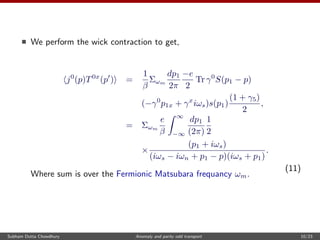
We perform the wick contraction to get,
j0
(p)T0x
(p ) =
1
β
Σωm
dp1
2π
−e
2
Tr γ0
S(p1 − p)
(−γ0
p1x + γx
iωs)s(p1)
(1 + γ5)
2
,
= Σωm
e
β
∞
−∞
dp1
(2π)
1
2
×
(p1 + iωs)
(iωs − iωn + p1 − p)(iωs + p1)
.
(11)
Where sum is over the Fermionic Matsubara frequancy ωm.
Subham Dutta Chowdhury Anomaly and parity odd transport 10/23
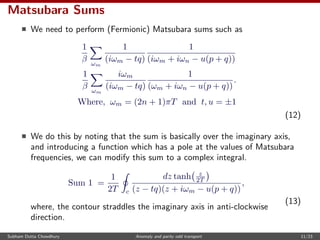
Matsubara Sums
We need to perform (Fermionic) Matsubara sums such as
1
β ωm
1
(iωm − tq)
1
(iωm + iωn − u(p + q))
1
β ωm
iωm
(iωm − tq)
1
(ωm + iωn − u(p + q))
.
Where, ωm = (2n + 1)πT and t, u = ±1
(12)
We do this by noting that the sum is basically over the imaginary axis,
and introducing a function which has a pole at the values of Matsubara
frequencies, we can modify this sum to a complex integral.
Sum 1 =
1
2T c
dz tanh z
2T
(z − tq)(z + iωm − u(p + q))
,
(13)
where, the contour straddles the imaginary axis in anti-clockwise
direction.
Subham Dutta Chowdhury Anomaly and parity odd transport 11/23
We get the results as,
j0
T01
=
∞
0
dp1
2π
e
(iωn + p)
[
−(p + iωn)
1
n(p1 − p + eµ − eµ5)
+
(p1)
1
n(p1 − p + eµ − eµ5)
−p1n(p1 + eµ − eµ5)
(p + iωn)n(p1 + p − eµ − eµ5) + p1(n(p1 + p − eµ + eµ5)
−n(p1 − eµ − eµ5)] (14)
Where n(q) = 1
(exp β(q)+1) = Fermi Dirac distribution.
Subham Dutta Chowdhury Anomaly and parity odd transport 12/23
We perform analytic continuation iωn → p0 + i and take the limit
p → 0, p0 → 0 to obtain,
j0
T01
=
∞
0
dp1
2π
[
e
2
n(p1 − eµ + eµ5) −
e
2
n(p1 + eµ − eµ5)]. (15)
We now use the following identities :-
Fs(x) = −Lis+1(−ex
),
Li1(x) = − log(1 − x).
(16)
Where,
Fs(x) =
1
Γ(s + 1)
∞
0
ts
(exp(t − x) + 1)
dt = Fermi-Dirac integral,
Lis(x) = Σk=∞
k=1
xk
ks
= The polylogarithm function.
(17)
Subham Dutta Chowdhury Anomaly and parity odd transport 13/23
Applying these identities, we get,
j0
T01
=
−(e2
µ − e2
µ5)
4π
, (18)
Similarly for the Ttt
Ttx
correlator we have,
λ =
−1
16π
[(e2
(µ − µ5)2
+
π2
T2
3
] (19)
Subham Dutta Chowdhury Anomaly and parity odd transport 14/23
Generalizing to the arbitrary global symmetry group,
λ = (
−1
16π
[(Tr(TaTb)(µ − µ5)a(µ − µ5)b + Σf
π2
T2
3
]),
ζv = −
Tr(TaTb)
4π
(µ − µ5)b, (20)
where, Ta, Tb are the generators of the gauge group and Σf indicates
sum over fermion species.
The coefficients have the same structure as that of the anomaly
coefficients.
Dµja,µ
= cm
µν
Tr(Ta
Tb
)Fb
µν,
DµTµν
= Fµν
jν + cg,fermions
µν
νR +
cg,gravitinos
µν
νR,
(21)
Subham Dutta Chowdhury Anomaly and parity odd transport 15/23
Contribution due to the gravitinos
The stress-tensor for the gravitino coupled to the metric is given by,
habTab
(x) = hab
i
2
¯Ψµ(γa
∂b
+ γb
∂a
)Ψµ
+
i
2
(∂σhab − ∂ahσb)¯Ψσ
γb
Ψa
+[a ⇐⇒ b] (22)
The stress tensor is obtained by extracting out the metric hab from this
expression.
From the second and third terms we see that owing to the total derivative
we have an extra factor of external momentum outside those two terms.
While evaluating the correlator we take the limit p0 → 0 and p → 0.
Thus we can see that in the Ttx
Ttt
correlator, we have no contribution
to the stress tensor terms from second and third line.
Subham Dutta Chowdhury Anomaly and parity odd transport 16/23
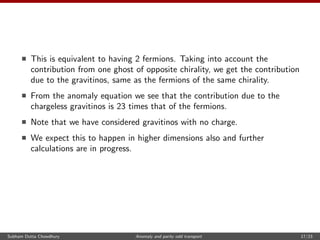
This is equivalent to having 2 fermions. Taking into account the
contribution from one ghost of opposite chirality, we get the contribution
due to the gravitinos, same as the fermions of the same chirality.
From the anomaly equation we see that the contribution due to the
chargeless gravitinos is 23 times that of the fermions.
Note that we have considered gravitinos with no charge.
We expect this to happen in higher dimensions also and further
calculations are in progress.
Subham Dutta Chowdhury Anomaly and parity odd transport 17/23
Transport coefficients in 4-d
The anomaly equation in 4-d is given by,
µTµν
= Fνµ
jµ +
cg
2
µ[ αβγδ
Tr Ta
Fa
αβRµν
γδ ],
µjµ,a
= c Tr Ta
Tb
, Tc
[ αβγδ
Fb
αβFc
γδ] +
cg
4
Tr Ta
[ αβγδ
Rµ
ναβRν
µγδ].
(23)
The relevant transport coefficients are given by
lim
kz→0
i
kz
jx
jy
=
1
4π2
Tr Ta
Tb
, Tc
µc
,
lim
kz→0
i
kz
T0x
jy
=
1
8π2
Tr Ta
Tb
, Tc
µb
µc
+
T2
24
ba
,
lim
kz→0
i
kz
T0x
T0y
=
1
12π2
Tr Ta
Tb
, Tc
µa
µb
µc
+
T2
12
Tr Ta
µa
.
(24)
Subham Dutta Chowdhury Anomaly and parity odd transport 18/23
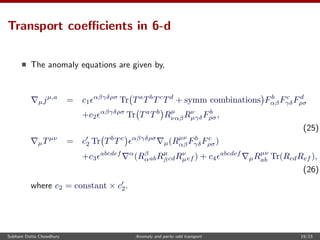
Transport coefficients in 6-d
The anomaly equations are given by,
µjµ,a
= c1
αβγδρσ
Tr Ta
Tb
Tc
Td
+ symm combinations Fb
αβFc
γδFd
ρσ
+c2
αβγδρσ
Tr Ta
Tb
Rµ
ναβRν
µγδFb
ρσ,
(25)
µTµν
= c2 Tr Tb
Tc αβγδρσ
µ(Rµν
αβFb
γδFc
ρσ)
+c3
abcdef α
(Rβ
αabRµ
βcdRν
µef ) + c4
abcdef
µRµν
ab Tr(RcdRef ),
(26)
where c2 = constant × c2.
Subham Dutta Chowdhury Anomaly and parity odd transport 19/23
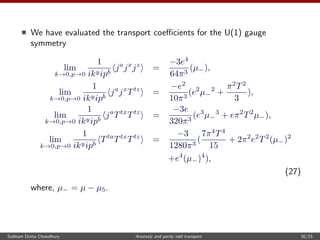
We have evaluated the transport coefficients for the U(1) gauge
symmetry
lim
k→0,p→0
1
ikyipb
ja
jx
jz
=
−3e4
64π3
(µ−),
lim
k→0,p→0
1
ikyipb
ja
jx
Ttz
=
−e2
10π3
(e2
µ−
2
+
π2
T2
3
),
lim
k→0,p→0
1
ikyipb
ja
Ttx
Ttz
=
−3e
320π3
(e3
µ−
3
+ eπ2
T2
µ−),
lim
k→0,p→0
1
ikyipb
Tta
Ttx
Ttz
=
−3
1280π3
(
7π4
T4
15
+ 2π2
e2
T2
(µ−)2
+e4
(µ−)4
),
(27)
where, µ− = µ − µ5.
Subham Dutta Chowdhury Anomaly and parity odd transport 20/23
Discussions
The method that we have developed is different from the methods found
in literature. We have reconfirmed the relations that have been already
established by other means.
There is also a better understanding regarding why gravitino doesnot
follow the usual relation between the anomalous transport coefficients and
the anomaly equation. It was noted that the chiral gravitinos may violate
the usual relationship by Loganayagam et al [arXiv:1211.3850[hep-th]]
The anomaly are one loop exact and transport coefficients are dictated by
them. Hence, we expect these relations to hold true in the strong
coupling limit.
Subham Dutta Chowdhury Anomaly and parity odd transport 21/23
References
Landsteiner, Karl and Megias, Eugenio and Pena-Benitez,”Anomalous
Transport from Kubo Formulae”,Lect.Notes Phys.,vol
871(2013),[arXiv:1207.5808[hep-th]].
Loganayagam, R. and Surowka, Piotr,”Anomaly/Transport in an Ideal
Weyl gas”,JHEP,vol 1204 (2012),[arXiv:1201.2812[hep-th]].
Kharzeev, Dmitri E. and Warringa, Harmen J,”Chiral Magnetic
conductivity”,Phys.Rev,vol D80 (2009),[arXiv:0907.5007].
Luis Alvarez-Gaume (Harvard U.) , Edward Witten (Princeton U.)
,”Gravitational anomalies”,Nucl.Phys.B234(1984)269-330.
Subham Dutta Chowdhury Anomaly and parity odd transport 22/23
Thank you.
Subham Dutta Chowdhury Anomaly and parity odd transport 23/23

Anomaly And Parity Odd Transport

  • 1.
    Anomaly and parityodd transport Subham Dutta Chowdhury January 10, 2015 Work in progress, under the guidance of Dr. Justin David (CHEP, IISc) CHEP In-house Symposium, 2015 Subham Dutta Chowdhury Anomaly and parity odd transport 1/23
  • 2.
    Outline Introduction What is ananomaly? Motivation Kubo Formula Evaluating the correlator Setting up the formalism Matsubara sums Transport coeffiecient Gravitinos 4-d 6-d Discussion References Subham Dutta Chowdhury Anomaly and parity odd transport 2/23
  • 3.
    What is ananomaly? An important question is whether a symmetry of classical physics is necessarily a symmetry of quantum theory. Consider a symmetry of classical physics ,the transformation, ψ → exp{−iθ}ψ, ψ → exp −iθγ5 ψ. (1) This leaves the action, S(ψ) = i¯Ψ /DΨ, invariant. However, the path integral DΨD ¯Ψ exp i¯Ψ /DΨ is not invariant under such a change. For this symmetry to hold true, Dψ, must remain invariant under the transformation, which is not necessarily true. Subham Dutta Chowdhury Anomaly and parity odd transport 3/23
  • 4.
    For a systemof left handed Weyl fermions in 2-d, the Lagrangian is given by L = i¯Ψ /DP−Ψ, where, γ0 = σ1 , γ1 = iσ2 , γ5 = γ0 γ1 . (2) The signature we choose is (1,-1). The gamma matrices satisfy, {γµ , γν } = 2gµν , µ = 0, 1. (3) Corresponding to chiral fermions the transformation equations are, ψL → exp{−iα}ψL, ψR → exp{+iα}ψR. (4) Subham Dutta Chowdhury Anomaly and parity odd transport 4/23
  • 5.
    The anomaly basicallymanifests itself in the form of violation of divergence of the current and the stress tensor. In 2-dimensions we have, Dµjµ,a = cm µν Tr(Ta Tb )Fb µν, DµTµν = Fµν jν + cg,fermions µν νR + cg,gravitinos µν νR, (5) where,cg,gravitinos = 23cg,gravitinos. Also we consider charge-less gravitinos and fermions charged in U(1) gauge symmetry. There are ways (Loganayagam et al) to get the anomaly equations in a consistent manner for higher dimensions. Subham Dutta Chowdhury Anomaly and parity odd transport 5/23
  • 6.
    Motivation Recent studies byMinwalla et al have revealed their applications in evaluation of hydrodynamical transport coefficients. Kharzeev and Warringa [arXiv:0907.5007v1 [hep-th]],Lansteiner et al [arXiv:1207.5808v1 [hep-th]] have shown that the zero external momentum and zero frequency chiral magnetic conductivity of a parity violating fluid ,at first order in derivative, is constrained by the anomaly in 3+1 dimensions in finite temperature field theory. Loganayagam et al [arXiv:1211.3850] showed that the coefficients of the anomaly equations constrain the anomalous transport coefficients, using a kinetic theory approach. We look at the behaviour in 1+1 as well as 5+1 dimensions by explicit calculations in a theory which has chiral fermions using finite temperature field theory. We then extend the exercise to charge-less gravitinos. Subham Dutta Chowdhury Anomaly and parity odd transport 6/23
  • 7.
    Anomalous Transport Coefficients Fromthe modern perspective, hydrodynamics is best thought of as an effective theory, describing the dynamics at large distances and time-scales. It is normally formulated in the language of equations of motion instead of an action principle. We are interested in parity violating 1+1 d hydrodynamics. Tµν = ( + P) uµ uν + Pgµν + λ(uµ να uα + uν µα uα), jµ = nuµ + ζv µν uν, (6) where µν uν is the only possible gauge invariant parity violating term that can be added. Note that ζv and λ are the parity odd transport coefficients we are looking for. Subham Dutta Chowdhury Anomaly and parity odd transport 7/23
  • 8.
    Kubo formula fromhydrodynamics Following linear response theory, we perturb the system with fluctuations, gµν = ηµν + hµν with htx nonzero,uµ = (1, vx ) such that uµ uµ = 1 + O(2) and gauge field perturbations,Aµ = (0, ax). We apply these perturbations, obtain the value of vx from expression of stress-tensor Tµν and we get the relevant Kubo formula as, lim p0→0,p→0 jt (p)Ttx (−p) = ζv. lim p0→0,p→0 1 2 Ttt (p)Ttx (−p) = λ. (7) We evaluate this correlator from finite temperature field theory. Subham Dutta Chowdhury Anomaly and parity odd transport 8/23
  • 9.
    Evaluating the correlator Fromthe theory of massless chiral fermions we have the stress-tensor T01 as, T01 (x) = 1 2 i¯Ψ(x) √ −g(γ0 ∂1 + γ1 ∂0 )P−Ψ(x). (8) The conventions used are gµν = (1, −1) , s (q) = 1 iγ0 (wm − ieµ − ieµ5γ5) − γ1q1 , γ0 = σ1 , γ1 = iσ2 , γ5 = γ0 γ1 . (9) The thermal propagator in momentum space is explicitly written as, s(q) = 0 1 iωm+iωn+e(µ−µ5)+q 1 iωm+iωn+e(µ+µ5)−q 0 . (10) Subham Dutta Chowdhury Anomaly and parity odd transport 9/23
  • 10.
    We perform thewick contraction to get, j0 (p)T0x (p ) = 1 β Σωm dp1 2π −e 2 Tr γ0 S(p1 − p) (−γ0 p1x + γx iωs)s(p1) (1 + γ5) 2 , = Σωm e β ∞ −∞ dp1 (2π) 1 2 × (p1 + iωs) (iωs − iωn + p1 − p)(iωs + p1) . (11) Where sum is over the Fermionic Matsubara frequancy ωm. Subham Dutta Chowdhury Anomaly and parity odd transport 10/23
  • 11.
    Matsubara Sums We needto perform (Fermionic) Matsubara sums such as 1 β ωm 1 (iωm − tq) 1 (iωm + iωn − u(p + q)) 1 β ωm iωm (iωm − tq) 1 (ωm + iωn − u(p + q)) . Where, ωm = (2n + 1)πT and t, u = ±1 (12) We do this by noting that the sum is basically over the imaginary axis, and introducing a function which has a pole at the values of Matsubara frequencies, we can modify this sum to a complex integral. Sum 1 = 1 2T c dz tanh z 2T (z − tq)(z + iωm − u(p + q)) , (13) where, the contour straddles the imaginary axis in anti-clockwise direction. Subham Dutta Chowdhury Anomaly and parity odd transport 11/23
  • 12.
    We get theresults as, j0 T01 = ∞ 0 dp1 2π e (iωn + p) [ −(p + iωn) 1 n(p1 − p + eµ − eµ5) + (p1) 1 n(p1 − p + eµ − eµ5) −p1n(p1 + eµ − eµ5) (p + iωn)n(p1 + p − eµ − eµ5) + p1(n(p1 + p − eµ + eµ5) −n(p1 − eµ − eµ5)] (14) Where n(q) = 1 (exp β(q)+1) = Fermi Dirac distribution. Subham Dutta Chowdhury Anomaly and parity odd transport 12/23
  • 13.
    We perform analyticcontinuation iωn → p0 + i and take the limit p → 0, p0 → 0 to obtain, j0 T01 = ∞ 0 dp1 2π [ e 2 n(p1 − eµ + eµ5) − e 2 n(p1 + eµ − eµ5)]. (15) We now use the following identities :- Fs(x) = −Lis+1(−ex ), Li1(x) = − log(1 − x). (16) Where, Fs(x) = 1 Γ(s + 1) ∞ 0 ts (exp(t − x) + 1) dt = Fermi-Dirac integral, Lis(x) = Σk=∞ k=1 xk ks = The polylogarithm function. (17) Subham Dutta Chowdhury Anomaly and parity odd transport 13/23
  • 14.
    Applying these identities,we get, j0 T01 = −(e2 µ − e2 µ5) 4π , (18) Similarly for the Ttt Ttx correlator we have, λ = −1 16π [(e2 (µ − µ5)2 + π2 T2 3 ] (19) Subham Dutta Chowdhury Anomaly and parity odd transport 14/23
  • 15.
    Generalizing to thearbitrary global symmetry group, λ = ( −1 16π [(Tr(TaTb)(µ − µ5)a(µ − µ5)b + Σf π2 T2 3 ]), ζv = − Tr(TaTb) 4π (µ − µ5)b, (20) where, Ta, Tb are the generators of the gauge group and Σf indicates sum over fermion species. The coefficients have the same structure as that of the anomaly coefficients. Dµja,µ = cm µν Tr(Ta Tb )Fb µν, DµTµν = Fµν jν + cg,fermions µν νR + cg,gravitinos µν νR, (21) Subham Dutta Chowdhury Anomaly and parity odd transport 15/23
  • 16.
    Contribution due tothe gravitinos The stress-tensor for the gravitino coupled to the metric is given by, habTab (x) = hab i 2 ¯Ψµ(γa ∂b + γb ∂a )Ψµ + i 2 (∂σhab − ∂ahσb)¯Ψσ γb Ψa +[a ⇐⇒ b] (22) The stress tensor is obtained by extracting out the metric hab from this expression. From the second and third terms we see that owing to the total derivative we have an extra factor of external momentum outside those two terms. While evaluating the correlator we take the limit p0 → 0 and p → 0. Thus we can see that in the Ttx Ttt correlator, we have no contribution to the stress tensor terms from second and third line. Subham Dutta Chowdhury Anomaly and parity odd transport 16/23
  • 17.
    This is equivalentto having 2 fermions. Taking into account the contribution from one ghost of opposite chirality, we get the contribution due to the gravitinos, same as the fermions of the same chirality. From the anomaly equation we see that the contribution due to the chargeless gravitinos is 23 times that of the fermions. Note that we have considered gravitinos with no charge. We expect this to happen in higher dimensions also and further calculations are in progress. Subham Dutta Chowdhury Anomaly and parity odd transport 17/23
  • 18.
    Transport coefficients in4-d The anomaly equation in 4-d is given by, µTµν = Fνµ jµ + cg 2 µ[ αβγδ Tr Ta Fa αβRµν γδ ], µjµ,a = c Tr Ta Tb , Tc [ αβγδ Fb αβFc γδ] + cg 4 Tr Ta [ αβγδ Rµ ναβRν µγδ]. (23) The relevant transport coefficients are given by lim kz→0 i kz jx jy = 1 4π2 Tr Ta Tb , Tc µc , lim kz→0 i kz T0x jy = 1 8π2 Tr Ta Tb , Tc µb µc + T2 24 ba , lim kz→0 i kz T0x T0y = 1 12π2 Tr Ta Tb , Tc µa µb µc + T2 12 Tr Ta µa . (24) Subham Dutta Chowdhury Anomaly and parity odd transport 18/23
  • 19.
    Transport coefficients in6-d The anomaly equations are given by, µjµ,a = c1 αβγδρσ Tr Ta Tb Tc Td + symm combinations Fb αβFc γδFd ρσ +c2 αβγδρσ Tr Ta Tb Rµ ναβRν µγδFb ρσ, (25) µTµν = c2 Tr Tb Tc αβγδρσ µ(Rµν αβFb γδFc ρσ) +c3 abcdef α (Rβ αabRµ βcdRν µef ) + c4 abcdef µRµν ab Tr(RcdRef ), (26) where c2 = constant × c2. Subham Dutta Chowdhury Anomaly and parity odd transport 19/23
  • 20.
    We have evaluatedthe transport coefficients for the U(1) gauge symmetry lim k→0,p→0 1 ikyipb ja jx jz = −3e4 64π3 (µ−), lim k→0,p→0 1 ikyipb ja jx Ttz = −e2 10π3 (e2 µ− 2 + π2 T2 3 ), lim k→0,p→0 1 ikyipb ja Ttx Ttz = −3e 320π3 (e3 µ− 3 + eπ2 T2 µ−), lim k→0,p→0 1 ikyipb Tta Ttx Ttz = −3 1280π3 ( 7π4 T4 15 + 2π2 e2 T2 (µ−)2 +e4 (µ−)4 ), (27) where, µ− = µ − µ5. Subham Dutta Chowdhury Anomaly and parity odd transport 20/23
  • 21.
    Discussions The method thatwe have developed is different from the methods found in literature. We have reconfirmed the relations that have been already established by other means. There is also a better understanding regarding why gravitino doesnot follow the usual relation between the anomalous transport coefficients and the anomaly equation. It was noted that the chiral gravitinos may violate the usual relationship by Loganayagam et al [arXiv:1211.3850[hep-th]] The anomaly are one loop exact and transport coefficients are dictated by them. Hence, we expect these relations to hold true in the strong coupling limit. Subham Dutta Chowdhury Anomaly and parity odd transport 21/23
  • 22.
    References Landsteiner, Karl andMegias, Eugenio and Pena-Benitez,”Anomalous Transport from Kubo Formulae”,Lect.Notes Phys.,vol 871(2013),[arXiv:1207.5808[hep-th]]. Loganayagam, R. and Surowka, Piotr,”Anomaly/Transport in an Ideal Weyl gas”,JHEP,vol 1204 (2012),[arXiv:1201.2812[hep-th]]. Kharzeev, Dmitri E. and Warringa, Harmen J,”Chiral Magnetic conductivity”,Phys.Rev,vol D80 (2009),[arXiv:0907.5007]. Luis Alvarez-Gaume (Harvard U.) , Edward Witten (Princeton U.) ,”Gravitational anomalies”,Nucl.Phys.B234(1984)269-330. Subham Dutta Chowdhury Anomaly and parity odd transport 22/23
  • 23.
    Thank you. Subham DuttaChowdhury Anomaly and parity odd transport 23/23