Name and Surname: Date:
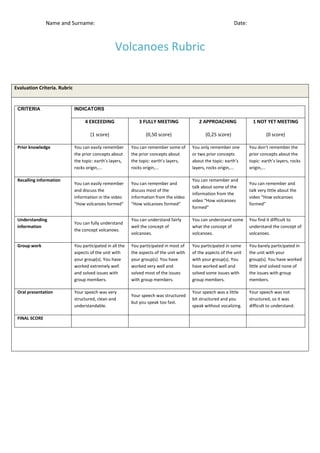
Volcanoes Rubric
Evaluation Criteria. Rubric
CRITERIA INDICATORS
4 EXCEEDING
(1 score)
3 FULLY MEETING
(0,50 score)
2 APPROACHING
(0,25 score)
1 NOT YET MEETING
(0 score)
Prior knowledge You can easily remember
the prior concepts about
the topic: earth’s layers,
rocks origin,...
You can remember some of
the prior concepts about
the topic: earth’s layers,
rocks origin,...
You only remember one
or two prior concepts
about the topic: earth’s
layers, rocks origin,...
You don’t remember the
prior concepts about the
topic: earth’s layers, rocks
origin,...
Recalling information
You can easily remember
and discuss the
information in the video
“How volcanoes formed”
You can remember and
discuss most of the
information from the video
“How volcanoes formed”
You can remember and
talk about some of the
information from the
video “How volcanoes
formed”
You can remember and
talk very little about the
video “How volcanoes
formed”
Understanding
information
You can fully understand
the concept volcanoes.
You can understand fairly
well the concept of
volcanoes.
You can understand some
what the concept of
volcanoes.
You find it difficult to
understand the concept of
volcanoes.
Group work You participated in all the
aspects of the unit with
your group(s). You have
worked extremely well
and solved issues with
group members.
You participated in most of
the aspects of the unit with
your group(s). You have
worked very well and
solved most of the issues
with group members.
You participated in some
of the aspects of the unit
with your group(s). You
have worked well and
solved some issues with
group members.
You barely participated in
the unit with your
group(s). You have worked
little and solved none of
the issues with group
members.
Oral presentation Your speech was very
structured, clean and
understandable.
Your speech was structured
but you speak too fast.
Your speech was a little
bit structured and you
speak without vocalizing.
Your speech was not
structured, so it was
difficult to understand.
FINAL SCORE
Name and Surname: Date:
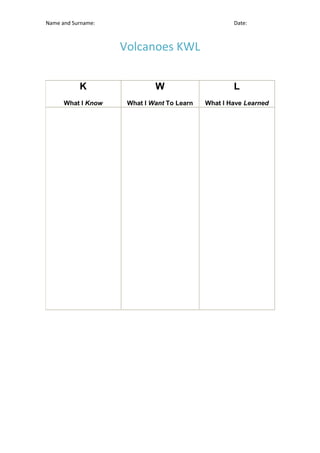
Volcanoes KWL
K
What I Know
W
What I Want To Learn
L
What I Have Learned
Name and Surname: Date:
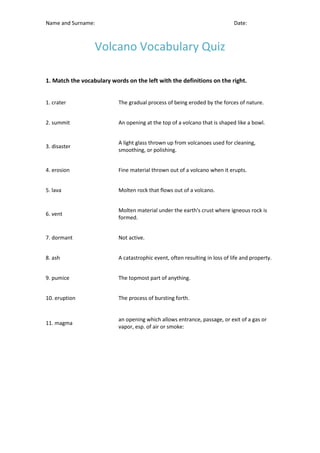
Volcano Vocabulary Quiz
1. Match the vocabulary words on the left with the definitions on the right.
1. crater The gradual process of being eroded by the forces of nature.
2. summit An opening at the top of a volcano that is shaped like a bowl.
3. disaster
A light glass thrown up from volcanoes used for cleaning,
smoothing, or polishing.
4. erosion Fine material thrown out of a volcano when it erupts.
5. lava Molten rock that flows out of a volcano.
6. vent
Molten material under the earth's crust where igneous rock is
formed.
7. dormant Not active.
8. ash A catastrophic event, often resulting in loss of life and property.
9. pumice The topmost part of anything.
10. eruption The process of bursting forth.
11. magma
an opening which allows entrance, passage, or exit of a gas or
vapor, esp. of air or smoke:
Name and Surname: Date:
Reading Comprehension
Volcano
The infamous volcano of Mt. Pelée looms over the village of St. Pierre on the French Caribbean Island
of Martinique. This sleepy little village shows little of the grandeur of turn-of-the-century St. Pierre,
which was a vibrant colonial city, known to European tourists as the "Paris of the West Indies." With its
red-tiled cottages, rambling streets, and tropical vegetation, this prosperous little city was renowned
for its beauty. In the official 1894 census, the population of St. Pierre was around 20,000. Although
most were native Martiniquans, the wealth and political power were controlled largely by Creoles and
a few French colonial officials and civil servants. No one at the time could have predicted the horror
that was to descend on this tropical paradise with the reawakening of Mt. Pelée in the Spring of 1902.
The violent eruption of Mt. Pelée on May 8, 1902 generated a pyroclastic flow that rapidly moved
down the River Blanche to destroy the small city of St. Pierre on the Island of Martinique. The
pyroclastic flow killed over 25,000 people.
1. Where is Mt. Pelée?
_________________________________
_________________________________
2. What is the tourist nickname
for St. Pierre?
_________________________________
3. Which country is credited for
the colonization of St. Pierre?
_________________________________
_________________________________
_________________________________
4. How many people died in the
eruption?
_________________________________
Name and Surname: Date:
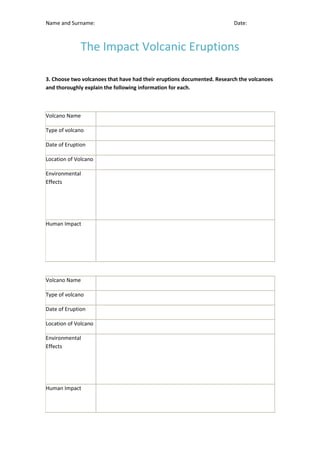
The Impact Volcanic Eruptions
3. Choose two volcanoes that have had their eruptions documented. Research the volcanoes
and thoroughly explain the following information for each.
Volcano Name
Type of volcano
Date of Eruption
Location of Volcano
Environmental
Effects
Human Impact
Volcano Name
Type of volcano
Date of Eruption
Location of Volcano
Environmental
Effects
Human Impact
Name and Surname: Date:
Volcano Name
Type of volcano
Date of Eruption
Location of Volcano
Environmental
Effects
Human Impact
Volcano Name
Type of volcano
Date of Eruption
Location of Volcano
Environmental
Effects
Human Impact
Name and Surname: Date:
Volcano VENN Diagram
The terms are really are referring to the same stuff (molten rock). It is just easier this way. If
someone is talking about magma you know they are talking about when it is still
underground but if they are talking about lava you know they are talking about after it has
erupted. The word lava comes from the Italian word for avalanche which is based on the Latin
word "labes" (a sliding down).
Magma is the molten material beneath the Earth’s
crust. It usually collects in a magma chamber
beneath a volcano, and can then be injected into
cracks in rocks or issue out of volcanoes in
eruptions. The temperature of magma ranges
between 700 C and 1300 C.
4. Using the VENN Diagram below show the similarities and differences between
magma and lava?
Magma Lava
Name and Surname: Date:
Baking Soda & Vinegar Volcano
Use baking soda and vinegar to create an awesome chemical reaction! Watch as it rapidly
fizzes over the container and make sure you've got some towels ready to clean up.
What you'll need:
Baking Soda (make sure it's not baking powder)
Vinegar
A container to hold everything and avoid a big mess!
Paper towels or a cloth (just in case)
Instructions:
Place some of the baking soda into your container.
Pour in some of the vinegar
Watch as the reaction takes place!
What's happening?
The baking soda (sodium bicarbonate) is a base while the vinegar (acetic acid) is an acid. When
they react together they form carbonic acid which is very unstable, it instantly breaks apart
into water and carbon dioxide, which creates all the fizzing as it escapes the solution.
For extra effect you can make a realistic looking volcano. It takes some craft skills but it will
make your vinegar and baking soda eruptions will look even more impressive!

Volcanoes project

  • 1.
    Name and Surname:Date: Volcanoes Rubric Evaluation Criteria. Rubric CRITERIA INDICATORS 4 EXCEEDING (1 score) 3 FULLY MEETING (0,50 score) 2 APPROACHING (0,25 score) 1 NOT YET MEETING (0 score) Prior knowledge You can easily remember the prior concepts about the topic: earth’s layers, rocks origin,... You can remember some of the prior concepts about the topic: earth’s layers, rocks origin,... You only remember one or two prior concepts about the topic: earth’s layers, rocks origin,... You don’t remember the prior concepts about the topic: earth’s layers, rocks origin,... Recalling information You can easily remember and discuss the information in the video “How volcanoes formed” You can remember and discuss most of the information from the video “How volcanoes formed” You can remember and talk about some of the information from the video “How volcanoes formed” You can remember and talk very little about the video “How volcanoes formed” Understanding information You can fully understand the concept volcanoes. You can understand fairly well the concept of volcanoes. You can understand some what the concept of volcanoes. You find it difficult to understand the concept of volcanoes. Group work You participated in all the aspects of the unit with your group(s). You have worked extremely well and solved issues with group members. You participated in most of the aspects of the unit with your group(s). You have worked very well and solved most of the issues with group members. You participated in some of the aspects of the unit with your group(s). You have worked well and solved some issues with group members. You barely participated in the unit with your group(s). You have worked little and solved none of the issues with group members. Oral presentation Your speech was very structured, clean and understandable. Your speech was structured but you speak too fast. Your speech was a little bit structured and you speak without vocalizing. Your speech was not structured, so it was difficult to understand. FINAL SCORE
  • 2.
    Name and Surname:Date: Volcanoes KWL K What I Know W What I Want To Learn L What I Have Learned
  • 3.
    Name and Surname:Date: Volcano Vocabulary Quiz 1. Match the vocabulary words on the left with the definitions on the right. 1. crater The gradual process of being eroded by the forces of nature. 2. summit An opening at the top of a volcano that is shaped like a bowl. 3. disaster A light glass thrown up from volcanoes used for cleaning, smoothing, or polishing. 4. erosion Fine material thrown out of a volcano when it erupts. 5. lava Molten rock that flows out of a volcano. 6. vent Molten material under the earth's crust where igneous rock is formed. 7. dormant Not active. 8. ash A catastrophic event, often resulting in loss of life and property. 9. pumice The topmost part of anything. 10. eruption The process of bursting forth. 11. magma an opening which allows entrance, passage, or exit of a gas or vapor, esp. of air or smoke:
  • 4.
    Name and Surname:Date: Reading Comprehension Volcano The infamous volcano of Mt. Pelée looms over the village of St. Pierre on the French Caribbean Island of Martinique. This sleepy little village shows little of the grandeur of turn-of-the-century St. Pierre, which was a vibrant colonial city, known to European tourists as the "Paris of the West Indies." With its red-tiled cottages, rambling streets, and tropical vegetation, this prosperous little city was renowned for its beauty. In the official 1894 census, the population of St. Pierre was around 20,000. Although most were native Martiniquans, the wealth and political power were controlled largely by Creoles and a few French colonial officials and civil servants. No one at the time could have predicted the horror that was to descend on this tropical paradise with the reawakening of Mt. Pelée in the Spring of 1902. The violent eruption of Mt. Pelée on May 8, 1902 generated a pyroclastic flow that rapidly moved down the River Blanche to destroy the small city of St. Pierre on the Island of Martinique. The pyroclastic flow killed over 25,000 people. 1. Where is Mt. Pelée? _________________________________ _________________________________ 2. What is the tourist nickname for St. Pierre? _________________________________ 3. Which country is credited for the colonization of St. Pierre? _________________________________ _________________________________ _________________________________ 4. How many people died in the eruption? _________________________________
  • 5.
    Name and Surname:Date: The Impact Volcanic Eruptions 3. Choose two volcanoes that have had their eruptions documented. Research the volcanoes and thoroughly explain the following information for each. Volcano Name Type of volcano Date of Eruption Location of Volcano Environmental Effects Human Impact Volcano Name Type of volcano Date of Eruption Location of Volcano Environmental Effects Human Impact
  • 6.
    Name and Surname:Date: Volcano Name Type of volcano Date of Eruption Location of Volcano Environmental Effects Human Impact Volcano Name Type of volcano Date of Eruption Location of Volcano Environmental Effects Human Impact
  • 7.
    Name and Surname:Date: Volcano VENN Diagram The terms are really are referring to the same stuff (molten rock). It is just easier this way. If someone is talking about magma you know they are talking about when it is still underground but if they are talking about lava you know they are talking about after it has erupted. The word lava comes from the Italian word for avalanche which is based on the Latin word "labes" (a sliding down). Magma is the molten material beneath the Earth’s crust. It usually collects in a magma chamber beneath a volcano, and can then be injected into cracks in rocks or issue out of volcanoes in eruptions. The temperature of magma ranges between 700 C and 1300 C. 4. Using the VENN Diagram below show the similarities and differences between magma and lava? Magma Lava
  • 8.
    Name and Surname:Date: Baking Soda & Vinegar Volcano Use baking soda and vinegar to create an awesome chemical reaction! Watch as it rapidly fizzes over the container and make sure you've got some towels ready to clean up. What you'll need: Baking Soda (make sure it's not baking powder) Vinegar A container to hold everything and avoid a big mess! Paper towels or a cloth (just in case) Instructions: Place some of the baking soda into your container. Pour in some of the vinegar Watch as the reaction takes place! What's happening? The baking soda (sodium bicarbonate) is a base while the vinegar (acetic acid) is an acid. When they react together they form carbonic acid which is very unstable, it instantly breaks apart into water and carbon dioxide, which creates all the fizzing as it escapes the solution. For extra effect you can make a realistic looking volcano. It takes some craft skills but it will make your vinegar and baking soda eruptions will look even more impressive!