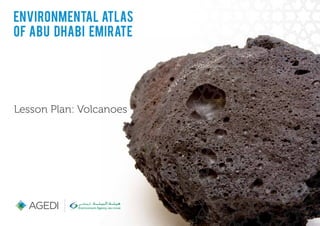
Lesson Plan: Volcanoes
Lesson Plan Content:
This lesson plan and slide presentation is to
be used in conjunction with::
1 x volcano teacher briefing
1 x volcano teacher fact sheet
1 x volcano class work sheet
Lesson Overview:
Students will gain an understanding of
volcanoes and volcanism.
Estimated Time Requirement:
One 60 minute session.
Learning Objectives:
Students will be able to:
> understand volcano formation and types
> identify key features of volcanic activity
> see images of real active volcanoes
> geographically locate 12 notable volcanoes
Skills:
This lesson plan can aid students to
demonstrate:
> Researching skills
> Classifying skills
> Communicating skills
> Observing skills
Preparation prior to the lesson:
Before commencing the lesson, download
and read through the teacher briefing, fact
sheet, work sheet and this presentation so
you are fully conversant with the content
and key terms. Also, ensure that the work
sheet activity is possible to undertake in
your classroom environment.
Lesson Sequence:
Here is a sequence of the lesson with
suggested timings:
Preparation (5mins)
Inform the students that today they are all
going to learn about volcanoes and take
part in some fun activity. Elicit from the
students some of the things they already
know about volcanoes.
Presentation (25mins)
Using a projector to present to the class,
progressively run through the slides to
impart all the key points about volcanoes.
Activity (25mins)
Having completed the presentation,
undertake the participation and discussion
exercise contained in the work sheet. This
activity enables students to discover for
themselves the notable volcanoes of the
world and some basic information about
each volcano.
Assessment (5mins)
Ask students to write and/or illustrate
what they did during this lesson and what
they learned from their participation in the
activity.
Close of Lesson
Closure: Ensure each group has corrected
any incorrectly identified volcano locations
or key facts.
Extending the Lesson: Encourage
students to do some research at homes on
volcanoes and discover other volcanoes
across the world.
Source of Lesson:
Abu Dhabi Global Environmental Data
Initiative.
All supporting material can be downloaded
freely at: www.environmentalatlas.ae
Classroom Presentation:
Volcanoes
Volcanoes
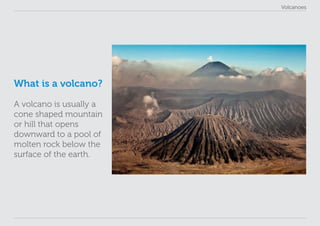
What is a volcano?
A volcano is usually a
cone shaped mountain
or hill that opens
downward to a pool of
molten rock below the
surface of the earth.
Volcanoes
What is a volcano?
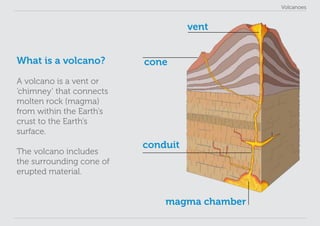
A volcano is a vent or
‘chimney’ that connects
molten rock (magma)
from within the Earth’s
crust to the Earth’s
surface.
The volcano includes
the surrounding cone of
erupted material.
vent
magma chamber
conduit
cone
Volcanoes
What is a volcano?
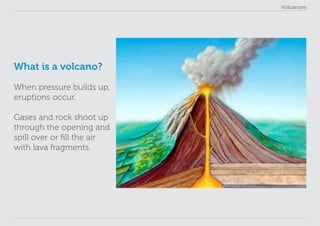
When pressure builds up,
eruptions occur.
Gases and rock shoot up
through the opening and
spill over or fill the air
with lava fragments.
Volcanoes
What is a volcano?
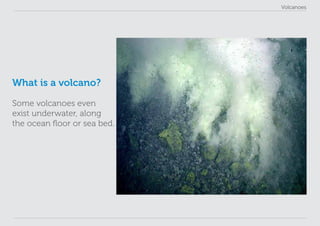
Some volcanoes even
exist underwater, along
the ocean floor or sea bed.
Volcanoes
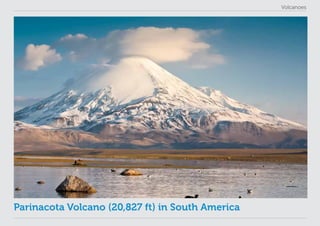
Parinacota Volcano (20,827 ft) in South America
Volcanoes
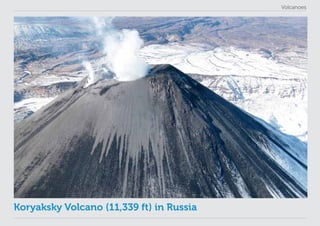
Koryaksky Volcano (11,339 ft) in Russia
Volcanoes
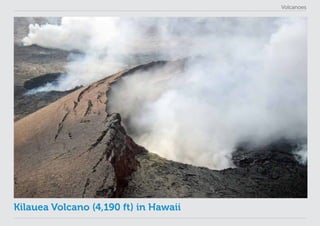
Kilauea Volcano (4,190 ft) in Hawaii
Volcanoes
How do
volcanoes form?
Volcanoes form when
magma reaches the
Earth’s surface, causing
eruptions of lava and ash.
They occur at destructive
and constructive plate
boundaries.
Volcanoes
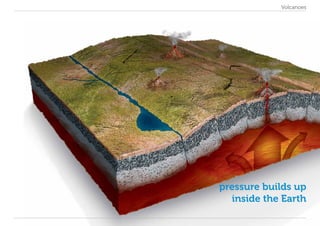
pressure builds up
inside the Earth
Volcanoes
How do
volcanoes form?
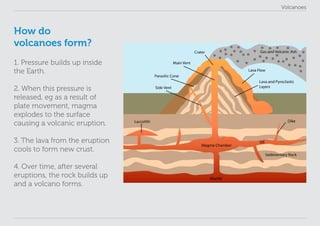
1. Pressure builds up inside
the Earth.
2. When this pressure is
released, eg as a result of
plate movement, magma
explodes to the surface
causing a volcanic eruption.
3. The lava from the eruption
cools to form new crust.
4. Over time, after several
eruptions, the rock builds up
and a volcano forms.
Volcanoes
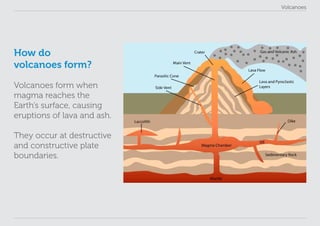
Inside a Volcano
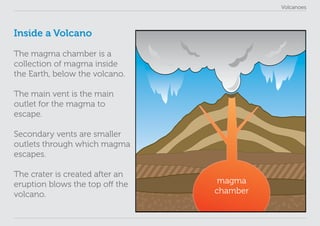
The magma chamber is a
collection of magma inside
the Earth, below the volcano.
The main vent is the main
outlet for the magma to
escape.
Secondary vents are smaller
outlets through which magma
escapes.
The crater is created after an
eruption blows the top off the
volcano.
magma
chamber
Volcanoes
States of a Volcano
Volcanoes can be
described in terms of
activity and can be:
> still active and erupt
frequently
> dormant (temporarily
inactive but not fully
extinct)
> extinct (never likely to
erupt again)
Volcanoes
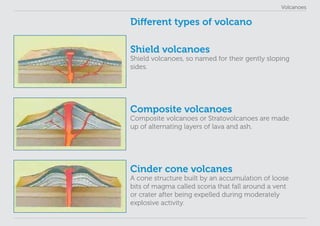
Composite volcanoes
Composite volcanoes or Stratovolcanoes are made
up of alternating layers of lava and ash.
Different types of volcano
Shield volcanoes
Shield volcanoes, so named for their gently sloping
sides.
Cinder cone volcanes
A cone structure built by an accumulation of loose
bits of magma called scoria that fall around a vent
or crater after being expelled during moderately
explosive activity.
Volcanoes
Volcanic Eruptions
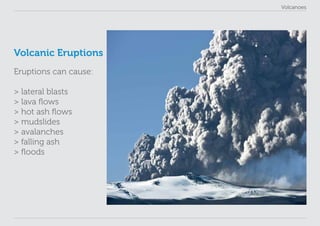
Eruptions can cause:
> lateral blasts
> lava flows
> hot ash flows
> mudslides
> avalanches
> falling ash
> floods
Volcanoes
Volcanic Eruptions
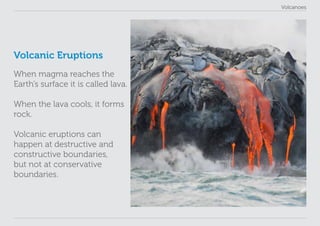
When magma reaches the
Earth’s surface it is called lava.
When the lava cools, it forms
rock.
Volcanic eruptions can
happen at destructive and
constructive boundaries,
but not at conservative
boundaries.
Volcanoes
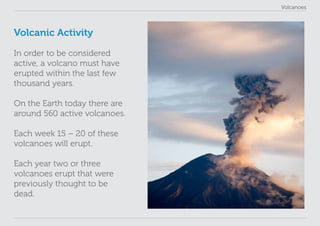
Volcanic Activity
In order to be considered
active, a volcano must have
erupted within the last few
thousand years.
On the Earth today there are
around 560 active volcanoes.
Each week 15 – 20 of these
volcanoes will erupt.
Each year two or three
volcanoes erupt that were
previously thought to be
dead.
Volcanoes
Volcanoes
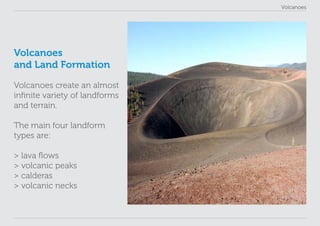
and Land Formation
Volcanoes create an almost
infinite variety of landforms
and terrain.
The main four landform
types are:
> lava flows
> volcanic peaks
> calderas
> volcanic necks
Volcanoes
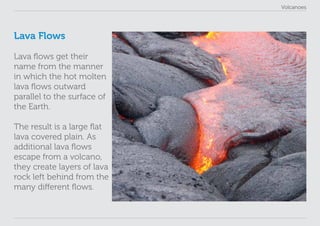
Lava Flows
Lava flows get their
name from the manner
in which the hot molten
lava flows outward
parallel to the surface of
the Earth.
The result is a large flat
lava covered plain. As
additional lava flows
escape from a volcano,
they create layers of lava
rock left behind from the
many different flows.
Volcanoes

Volcanoes

  • 1.
  • 2.
    Lesson Plan: Volcanoes LessonPlan Content: This lesson plan and slide presentation is to be used in conjunction with:: 1 x volcano teacher briefing 1 x volcano teacher fact sheet 1 x volcano class work sheet Lesson Overview: Students will gain an understanding of volcanoes and volcanism. Estimated Time Requirement: One 60 minute session. Learning Objectives: Students will be able to: > understand volcano formation and types > identify key features of volcanic activity > see images of real active volcanoes > geographically locate 12 notable volcanoes Skills: This lesson plan can aid students to demonstrate: > Researching skills > Classifying skills > Communicating skills > Observing skills Preparation prior to the lesson: Before commencing the lesson, download and read through the teacher briefing, fact sheet, work sheet and this presentation so you are fully conversant with the content and key terms. Also, ensure that the work sheet activity is possible to undertake in your classroom environment. Lesson Sequence: Here is a sequence of the lesson with suggested timings: Preparation (5mins) Inform the students that today they are all going to learn about volcanoes and take part in some fun activity. Elicit from the students some of the things they already know about volcanoes. Presentation (25mins) Using a projector to present to the class, progressively run through the slides to impart all the key points about volcanoes. Activity (25mins) Having completed the presentation, undertake the participation and discussion exercise contained in the work sheet. This activity enables students to discover for themselves the notable volcanoes of the world and some basic information about each volcano. Assessment (5mins) Ask students to write and/or illustrate what they did during this lesson and what they learned from their participation in the activity. Close of Lesson Closure: Ensure each group has corrected any incorrectly identified volcano locations or key facts. Extending the Lesson: Encourage students to do some research at homes on volcanoes and discover other volcanoes across the world. Source of Lesson: Abu Dhabi Global Environmental Data Initiative. All supporting material can be downloaded freely at: www.environmentalatlas.ae
  • 3.
  • 4.
    Volcanoes What is avolcano? A volcano is usually a cone shaped mountain or hill that opens downward to a pool of molten rock below the surface of the earth.
  • 5.
    Volcanoes What is avolcano? A volcano is a vent or ‘chimney’ that connects molten rock (magma) from within the Earth’s crust to the Earth’s surface. The volcano includes the surrounding cone of erupted material. vent magma chamber conduit cone
  • 6.
    Volcanoes What is avolcano? When pressure builds up, eruptions occur. Gases and rock shoot up through the opening and spill over or fill the air with lava fragments.
  • 7.
    Volcanoes What is avolcano? Some volcanoes even exist underwater, along the ocean floor or sea bed.
  • 8.
  • 9.
  • 10.
  • 11.
    Volcanoes How do volcanoes form? Volcanoesform when magma reaches the Earth’s surface, causing eruptions of lava and ash. They occur at destructive and constructive plate boundaries.
  • 12.
  • 13.
    Volcanoes How do volcanoes form? 1.Pressure builds up inside the Earth. 2. When this pressure is released, eg as a result of plate movement, magma explodes to the surface causing a volcanic eruption. 3. The lava from the eruption cools to form new crust. 4. Over time, after several eruptions, the rock builds up and a volcano forms.
  • 14.
    Volcanoes Inside a Volcano Themagma chamber is a collection of magma inside the Earth, below the volcano. The main vent is the main outlet for the magma to escape. Secondary vents are smaller outlets through which magma escapes. The crater is created after an eruption blows the top off the volcano. magma chamber
  • 15.
    Volcanoes States of aVolcano Volcanoes can be described in terms of activity and can be: > still active and erupt frequently > dormant (temporarily inactive but not fully extinct) > extinct (never likely to erupt again)
  • 16.
    Volcanoes Composite volcanoes Composite volcanoesor Stratovolcanoes are made up of alternating layers of lava and ash. Different types of volcano Shield volcanoes Shield volcanoes, so named for their gently sloping sides. Cinder cone volcanes A cone structure built by an accumulation of loose bits of magma called scoria that fall around a vent or crater after being expelled during moderately explosive activity.
  • 17.
    Volcanoes Volcanic Eruptions Eruptions cancause: > lateral blasts > lava flows > hot ash flows > mudslides > avalanches > falling ash > floods
  • 18.
    Volcanoes Volcanic Eruptions When magmareaches the Earth’s surface it is called lava. When the lava cools, it forms rock. Volcanic eruptions can happen at destructive and constructive boundaries, but not at conservative boundaries.
  • 19.
    Volcanoes Volcanic Activity In orderto be considered active, a volcano must have erupted within the last few thousand years. On the Earth today there are around 560 active volcanoes. Each week 15 – 20 of these volcanoes will erupt. Each year two or three volcanoes erupt that were previously thought to be dead.
  • 20.
    Volcanoes Volcanoes and Land Formation Volcanoescreate an almost infinite variety of landforms and terrain. The main four landform types are: > lava flows > volcanic peaks > calderas > volcanic necks
  • 21.
    Volcanoes Lava Flows Lava flowsget their name from the manner in which the hot molten lava flows outward parallel to the surface of the Earth. The result is a large flat lava covered plain. As additional lava flows escape from a volcano, they create layers of lava rock left behind from the many different flows.