
Improving processes of care and staff-patient interactions. Annie Laverty The King’s Fund Conference 6 December 2010.
Contents Our approach Patient perspective programme Understanding what matters most – in real time Driving improvements at team level The King’s Fund Hospital Pathways Programme Summary
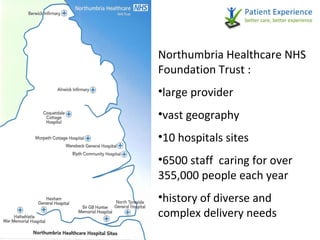
Northumbria Healthcare NHS Foundation Trust : large provider vast geography 10 hospitals sites 6500 staff  caring for over 355,000 people each year history of diverse and complex delivery needs
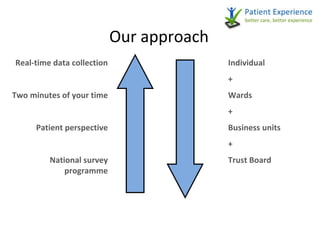
Our approach Real-time data collection Two minutes of your time Patient perspective National survey programme Individual + Wards + Business units + Trust Board
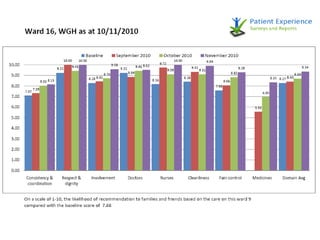
Ward by Ward performance to date Patient and family free text comments
Outpatient data views of 11,500 outpatients same approach at individual consultant level 8 domains that matter most to outpatients generating single score for appraisal
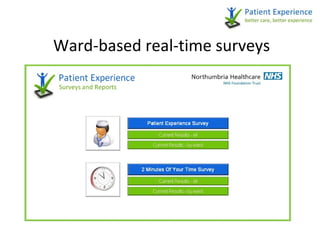
Ward-based real-time surveys
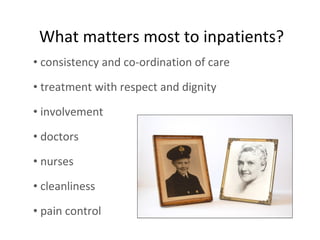
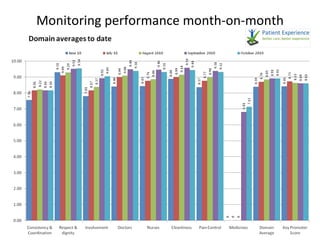
consistency and co-ordination of care treatment with respect and dignity involvement doctors nurses cleanliness pain control What matters most to inpatients?
Monitoring performance month-on-month
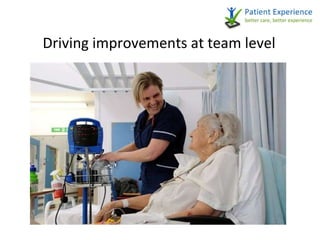
Driving improvements at team level
Working assumptions The bottom line is the bottom line Patient experience isn’t just an end point of care, it should be the start of improving care We work with different types of people these days Patient experience and staff experience are more similar than different Best care demands the best ways of improving care
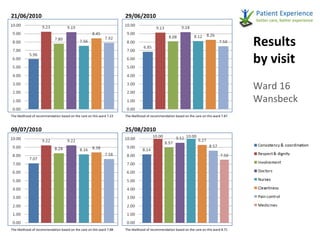
Results by visit Ward 16 Wansbeck 21/06/2010 29/06/2010 09/07/2010 25/08/2010 The likelihood of recommendation based on the care on this ward 8.71 The likelihood of recommendation based on the care on this ward 7.88 The likelihood of recommendation based on the care on this ward 7.87 The likelihood of recommendation based on the care on this ward 7.23
 
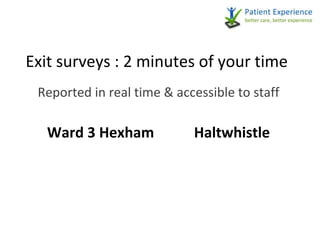
Reported in real time & accessible to staff Ward 3 Hexham  Haltwhistle Exit surveys : 2 minutes of your time
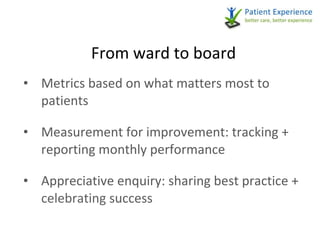
From ward to board Metrics based on what matters most to patients Measurement for improvement: tracking + reporting monthly performance Appreciative enquiry: sharing best practice +  celebrating  success
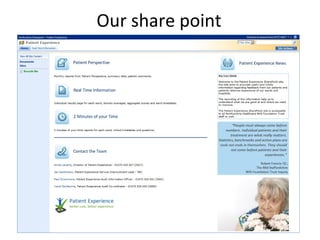
Our share point
Our gains Results are transparent and owned Individual teams delivering front-line led solutions Improved performance and reputation for all pilot teams Improved communication and collaboration Patients and families engaged at every level of service delivery, planning and improvement Important person-centred and staff-focused changes
Some things we’ve learnt The benefits of real-time reporting at team level Focusing on things that matter most has made sense Investing in improvement rather than measurement has helped Qualitative feedback appears particularly important to our teams The transparency of reporting is important Executive management team support is crucial Ensure patients and families are part of your improvement team
Collaborative 18 month project  designed to transform patient experience Part of The Point of Care Programme 5 participating hospitals 2 selected pathways each – elective and emergency Hospital Pathways Programme
Participating hospitals George Elliot   Respiratory Support and Abdominal Pain Pathway Royal Free Liver Surgery and Elderly Care Salisbury Cardiology and Trauma Pathway with Focus on  Elderly Care Taunton and Somerset Stroke and Elective Hip and Knee Replacements Northumbria   Dementia and Hip Fracture Care
Programme aims Improve patients’ experiences of care in hospital so that all patients receive a consistent and reliable quality of care. Improve relatives’ experiences so they can have confidence in the quality of care their loved ones’ receive. Demonstrate that the well-being of staff is important, not just for its own sake but for the sake of patients. Keep patient experience of care as high on the quality agenda as safety, clinical effectiveness and finance.
Themes 1) Leadership and values 2) Staff effectiveness and well-being 3) Patient and family-centred care 4) Reliable care processes (and environment) 5) Co-ordinated, collaborative, evidence-based care
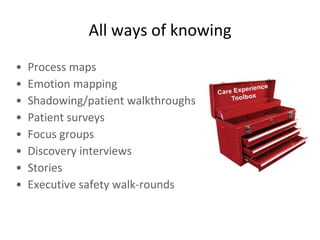
All ways of knowing Process maps Emotion mapping Shadowing/patient walkthroughs Patient surveys Focus groups Discovery interviews Stories Executive safety walk-rounds
 
Many opportunities Faculty support  −  special thanks to Annette Bartley Understanding the integration between staff engagement and patient involvement processes Ensuring continued investment in the internal family Creating structured processes for quality improvement Developing involvement tools that focus on co-production Celebrating achievements and acknowledging contributions Focus and challenge Sharing the learning
In summary ‘ People must always come before numbers. Individual patients and their treatment are what really matters. Statistics, benchmarks and action plans are tools not ends in themselves. They should not come before patients and their experiences.’ Robert Francis QC ,  The Mid Staffordshire NHS Foundation Trust Inquiry
Thanks for listening Any Questions ?

Annie Laverty on improving processes of care and staff-patient interactions in Northumbria

  • 1.
    Improving processes ofcare and staff-patient interactions. Annie Laverty The King’s Fund Conference 6 December 2010.
  • 2.
    Contents Our approachPatient perspective programme Understanding what matters most – in real time Driving improvements at team level The King’s Fund Hospital Pathways Programme Summary
  • 3.
    Northumbria Healthcare NHSFoundation Trust : large provider vast geography 10 hospitals sites 6500 staff caring for over 355,000 people each year history of diverse and complex delivery needs
  • 4.
    Our approach Real-timedata collection Two minutes of your time Patient perspective National survey programme Individual + Wards + Business units + Trust Board
  • 5.
    Ward by Wardperformance to date Patient and family free text comments
  • 6.
    Outpatient data viewsof 11,500 outpatients same approach at individual consultant level 8 domains that matter most to outpatients generating single score for appraisal
  • 7.
  • 8.
    consistency and co-ordinationof care treatment with respect and dignity involvement doctors nurses cleanliness pain control What matters most to inpatients?
  • 9.
  • 10.
  • 11.
    Working assumptions Thebottom line is the bottom line Patient experience isn’t just an end point of care, it should be the start of improving care We work with different types of people these days Patient experience and staff experience are more similar than different Best care demands the best ways of improving care
  • 12.
    Results by visitWard 16 Wansbeck 21/06/2010 29/06/2010 09/07/2010 25/08/2010 The likelihood of recommendation based on the care on this ward 8.71 The likelihood of recommendation based on the care on this ward 7.88 The likelihood of recommendation based on the care on this ward 7.87 The likelihood of recommendation based on the care on this ward 7.23
  • 13.
  • 14.
    Reported in realtime & accessible to staff Ward 3 Hexham Haltwhistle Exit surveys : 2 minutes of your time
  • 15.
    From ward toboard Metrics based on what matters most to patients Measurement for improvement: tracking + reporting monthly performance Appreciative enquiry: sharing best practice + celebrating success
  • 16.
  • 17.
    Our gains Resultsare transparent and owned Individual teams delivering front-line led solutions Improved performance and reputation for all pilot teams Improved communication and collaboration Patients and families engaged at every level of service delivery, planning and improvement Important person-centred and staff-focused changes
  • 18.
    Some things we’velearnt The benefits of real-time reporting at team level Focusing on things that matter most has made sense Investing in improvement rather than measurement has helped Qualitative feedback appears particularly important to our teams The transparency of reporting is important Executive management team support is crucial Ensure patients and families are part of your improvement team
  • 19.
    Collaborative 18 monthproject designed to transform patient experience Part of The Point of Care Programme 5 participating hospitals 2 selected pathways each – elective and emergency Hospital Pathways Programme
  • 20.
    Participating hospitals GeorgeElliot Respiratory Support and Abdominal Pain Pathway Royal Free Liver Surgery and Elderly Care Salisbury Cardiology and Trauma Pathway with Focus on Elderly Care Taunton and Somerset Stroke and Elective Hip and Knee Replacements Northumbria Dementia and Hip Fracture Care
  • 21.
    Programme aims Improvepatients’ experiences of care in hospital so that all patients receive a consistent and reliable quality of care. Improve relatives’ experiences so they can have confidence in the quality of care their loved ones’ receive. Demonstrate that the well-being of staff is important, not just for its own sake but for the sake of patients. Keep patient experience of care as high on the quality agenda as safety, clinical effectiveness and finance.
  • 22.
    Themes 1) Leadershipand values 2) Staff effectiveness and well-being 3) Patient and family-centred care 4) Reliable care processes (and environment) 5) Co-ordinated, collaborative, evidence-based care
  • 23.
    All ways ofknowing Process maps Emotion mapping Shadowing/patient walkthroughs Patient surveys Focus groups Discovery interviews Stories Executive safety walk-rounds
  • 24.
  • 25.
    Many opportunities Facultysupport − special thanks to Annette Bartley Understanding the integration between staff engagement and patient involvement processes Ensuring continued investment in the internal family Creating structured processes for quality improvement Developing involvement tools that focus on co-production Celebrating achievements and acknowledging contributions Focus and challenge Sharing the learning
  • 26.
    In summary ‘People must always come before numbers. Individual patients and their treatment are what really matters. Statistics, benchmarks and action plans are tools not ends in themselves. They should not come before patients and their experiences.’ Robert Francis QC , The Mid Staffordshire NHS Foundation Trust Inquiry
  • 27.
    Thanks for listeningAny Questions ?

Editor's Notes

  • #12 So id like to start right off the bat with a few assumptions that I think are fairly safe to make about the work im going to lead in the next few years. Not so much because I think these are high-minded principles that its my job to remind people like yourselves about (although we will need to be more and more principle led as our resources diminish and the expectations of us grow) but mainly because these are as I see them the most fundamental ideas that will shape they way we will have to think about patient experience going forward. This is the bottom line of patient experience if you like. The first thing is actually the bottom line. We don’t have new money, we will likely have less in the future and so we must be cost effective, be efficient, and deliver services which really meet patient and purchaser needs. In order therefore to truly only focus upon what patients need and will services they will use properly we will need to shift our thinking in terms of where our understanding of patient experience sits within the way we manage and improve services. Instead of just being a somewhat static endpoint of care used to measure some aspect of some service we have to better understand (and not just measure) whats happening with our service users at all points in their pathway and be much more nimble in the way we respond individually and also at a service and system level. Ill give a real example of that a little later on. As I move towards my middle age this is a bit of a hard thing to come to terms with but it’s a fact that the people we work with now are different to the people we used to be when we used to be them. Generation Y employees for want of a better term are demanding more work in teams, and in teams small enough to feel part of. They are also demanding greater empowerment and come to us as employers, managers and leaders with higher expectations of the ways in which they should be involved in change. This is a huge opportunity for us if we can adapt our ways of working to meet these changes and capitalise on this shift properly. Another working assumption id like to suggest to you is that the days or thinking of the people who use our services and the people who providing them as sitting in separate camps (or even worse one group “inside the tent” and some outside) are now gone. There is pretty good evidence to suggest that one of the best ways to improve staff experience is to improve patient experience and involvement and likewise having staff authentically drive service improvements alongside and through the eyes of patients will give us the best chance of rapid, effective and sustainable change. Finally this might seem a bit obvious but if what we are about is state of the art clinical care, then we will have to invest our intellectual capacity and also some resources into state of the art of improvement techniques. Its my contention that these techniques (such as a LEAN toolkit) not only have the best chance of results, but are very much aligned with the principles or assumptions ive just described.
  • #22 In this Collaborative, the mission of the King’s Fund Point of Care Programme and participating hospitals is to achieve in 18 months, a breakthrough in patient and family experience in two care pathways within each organisation. The Mission also includes the development of a means to spread the initial learning and improvement more widely within each organisation, as a means to bring about comprehensive change for the whole.
  • #25 No drastic action needed… Patient experience rated as both good and bad in most areas. Therefore we already deliver great service…just not reliably enough. Some evidence for greatest improvement opportunities around edges of care.