Where is the NHS now?


Anna Dixon, Director of Policy
A high-
performing
NHS?
A review of
progress
1997 –2010


Editors: Ruth Thorlby and Jo Maybin
http://www.kingsfund.org.uk/publications/a_highperforming_nh.html
Features of a high performing
health system
 -   Available and accessible
 -   Safe
 -   Promoting health
 -   Clinically effective
 -   Delivering a positive patient experience
 -   Equitable
 -   Efficient (offering value for money)
 -   Accountable
Key questions
 What was the situation in 1997?
 What policies did the Labour government
 introduce?
 What progress has been made?
 Where should the new government focus its
 efforts?
Availability & Access
A high-performing health system makes a comprehensive range of services available,
and ensures that people can access them in a timely and convenient manner.

  Successes:
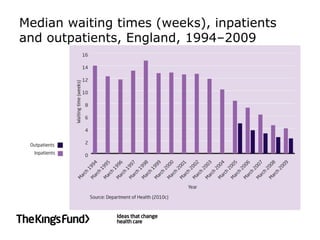
   – Waiting times for hospital care
     18 months to 18 weeks
   - Establishment of NSFs and NICE
  Weaknesses:
   - Access problems persist in some areas –
     community mental health, physiotherapy & out
     of hours
   - Shifting care out of hospital
Median waiting times (weeks), inpatients
and outpatients, England, 1994–2009
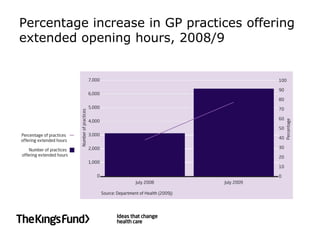
Percentage increase in GP practices offering
extended opening hours, 2008/9
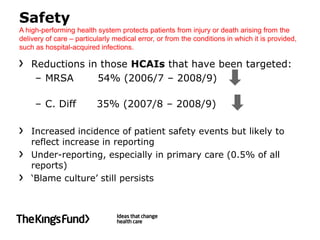
Safety
A high-performing health system protects patients from injury or death arising from the
delivery of care – particularly medical error, or from the conditions in which it is provided,
such as hospital-acquired infections.

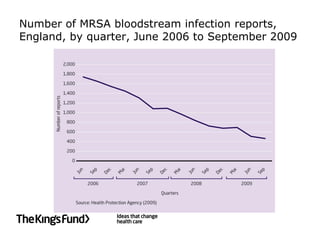
    Reductions in those HCAIs that have been targeted:
     – MRSA      54% (2006/7 – 2008/9)

     – C. Diff            35% (2007/8 – 2008/9)

    Increased incidence of patient safety events but likely to
    reflect increase in reporting
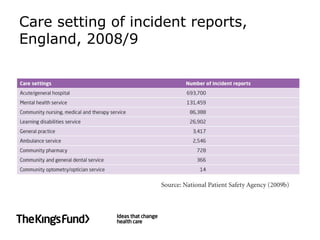
    Under-reporting, especially in primary care (0.5% of all
    reports)
    ‘Blame culture’ still persists
Number of MRSA bloodstream infection reports,
England, by quarter, June 2006 to September 2009
Care setting of incident reports,
England, 2008/9
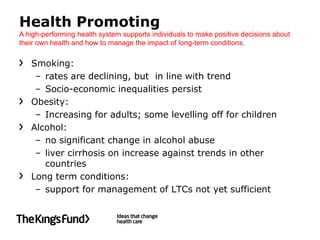
Health Promoting
A high-performing health system supports individuals to make positive decisions about
their own health and how to manage the impact of long-term conditions.


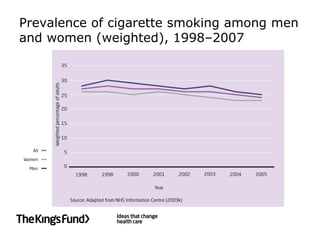
   Smoking:
    – rates are declining, but in line with trend
    – Socio-economic inequalities persist
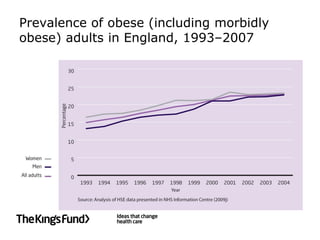
   Obesity:
    – Increasing for adults; some levelling off for children
   Alcohol:
    – no significant change in alcohol abuse
    – liver cirrhosis on increase against trends in other
      countries
   Long term conditions:
    – support for management of LTCs not yet sufficient
Prevalence of cigarette smoking among men
and women (weighted), 1998–2007
Prevalence of obese (including morbidly
obese) adults in England, 1993–2007
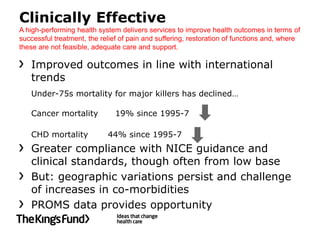
Clinically Effective
A high-performing health system delivers services to improve health outcomes in terms of
successful treatment, the relief of pain and suffering, restoration of functions and, where
these are not feasible, adequate care and support.

   Improved outcomes in line with international
   trends
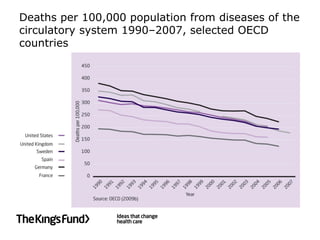
   Under-75s mortality for major killers has declined…

   Cancer mortality            19% since 1995-7

   CHD mortality            44% since 1995-7
   Greater compliance with NICE guidance and
   clinical standards, though often from low base
   But: geographic variations persist and challenge
   of increases in co-morbidities
   PROMS data provides opportunity
Deaths per 100,000 population from diseases of the
circulatory system 1990–2007, selected OECD
countries
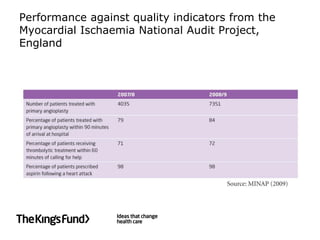
Performance against quality indicators from the
Myocardial Ischaemia National Audit Project,
England
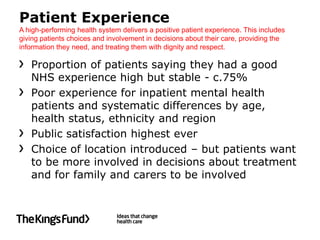
Patient Experience
A high-performing health system delivers a positive patient experience. This includes
giving patients choices and involvement in decisions about their care, providing the
information they need, and treating them with dignity and respect.

   Proportion of patients saying they had a good
   NHS experience high but stable - c.75%
   Poor experience for inpatient mental health
   patients and systematic differences by age,
   health status, ethnicity and region
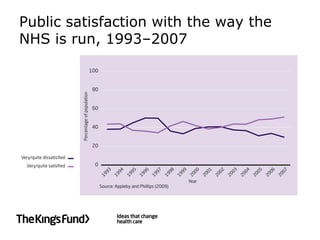
   Public satisfaction highest ever
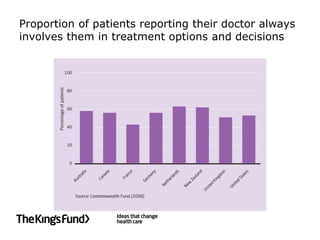
   Choice of location introduced – but patients want
   to be more involved in decisions about treatment
   and for family and carers to be involved
Public satisfaction with the way the
NHS is run, 1993–2007
Proportion of patients reporting their doctor always
involves them in treatment options and decisions
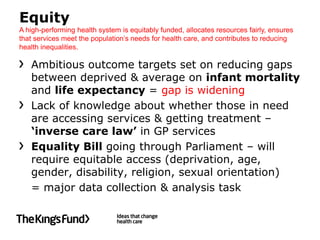
Equity
A high-performing health system is equitably funded, allocates resources fairly, ensures
that services meet the population’s needs for health care, and contributes to reducing
health inequalities.

   Ambitious outcome targets set on reducing gaps
   between deprived & average on infant mortality
   and life expectancy = gap is widening
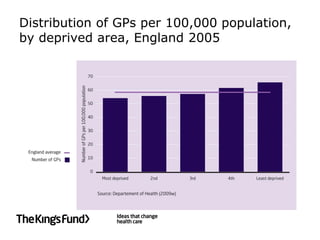
   Lack of knowledge about whether those in need
   are accessing services & getting treatment –
   ‘inverse care law’ in GP services
   Equality Bill going through Parliament – will
   require equitable access (deprivation, age,
   gender, disability, religion, sexual orientation)
   = major data collection & analysis task
Distribution of GPs per 100,000 population,
by deprived area, England 2005
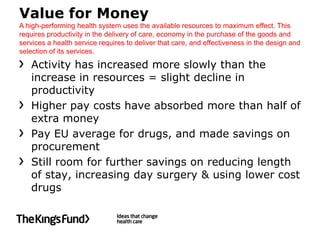
Value for Money
A high-performing health system uses the available resources to maximum effect. This
requires productivity in the delivery of care, economy in the purchase of the goods and
services a health service requires to deliver that care, and effectiveness in the design and
selection of its services.

   Activity has increased more slowly than the
   increase in resources = slight decline in
   productivity
   Higher pay costs have absorbed more than half of
   extra money
   Pay EU average for drugs, and made savings on
   procurement
   Still room for further savings on reducing length
   of stay, increasing day surgery & using lower cost
   drugs
Accountability
A high-performing health system can demonstrate that it is achieving high standards of
care, taking into account the views of those who it serves and that it has in place effective
systems to remedy poor performance.


   ‘Targets and terror’ : have they worked? What has been the
   cost?
   Decentralisation to commissioners but performance still
   judged to be ‘weak’
   Public involvement and accountability to local
   communities
    – Repeated changes to local structures PPI, LINks
    – Variable levels of engagement by FT members
   Introduced quasi-independent regulators of organisations
    – Burden of multiple agencies & data requests
Looking forward . . .

 Still unwarranted variations in access to & quality of
 care
 Need to ensure patients’ experiences have an impact
 on quality of care locally
 Need to deliver improvements & investment in
 prevention and management of chronic disease
 Trade-offs inevitable, especially in light of tighter
 budgets

Where is the NHS now?

  • 1.
    Where is theNHS now? Anna Dixon, Director of Policy
  • 2.
    A high- performing NHS? A reviewof progress 1997 –2010 Editors: Ruth Thorlby and Jo Maybin http://www.kingsfund.org.uk/publications/a_highperforming_nh.html
  • 3.
    Features of ahigh performing health system - Available and accessible - Safe - Promoting health - Clinically effective - Delivering a positive patient experience - Equitable - Efficient (offering value for money) - Accountable
  • 4.
    Key questions Whatwas the situation in 1997? What policies did the Labour government introduce? What progress has been made? Where should the new government focus its efforts?
  • 5.
    Availability & Access Ahigh-performing health system makes a comprehensive range of services available, and ensures that people can access them in a timely and convenient manner. Successes: – Waiting times for hospital care 18 months to 18 weeks - Establishment of NSFs and NICE Weaknesses: - Access problems persist in some areas – community mental health, physiotherapy & out of hours - Shifting care out of hospital
  • 6.
    Median waiting times(weeks), inpatients and outpatients, England, 1994–2009
  • 7.
    Percentage increase inGP practices offering extended opening hours, 2008/9
  • 8.
    Safety A high-performing healthsystem protects patients from injury or death arising from the delivery of care – particularly medical error, or from the conditions in which it is provided, such as hospital-acquired infections. Reductions in those HCAIs that have been targeted: – MRSA 54% (2006/7 – 2008/9) – C. Diff 35% (2007/8 – 2008/9) Increased incidence of patient safety events but likely to reflect increase in reporting Under-reporting, especially in primary care (0.5% of all reports) ‘Blame culture’ still persists
  • 9.
    Number of MRSAbloodstream infection reports, England, by quarter, June 2006 to September 2009
  • 10.
    Care setting ofincident reports, England, 2008/9
  • 11.
    Health Promoting A high-performinghealth system supports individuals to make positive decisions about their own health and how to manage the impact of long-term conditions. Smoking: – rates are declining, but in line with trend – Socio-economic inequalities persist Obesity: – Increasing for adults; some levelling off for children Alcohol: – no significant change in alcohol abuse – liver cirrhosis on increase against trends in other countries Long term conditions: – support for management of LTCs not yet sufficient
  • 12.
    Prevalence of cigarettesmoking among men and women (weighted), 1998–2007
  • 13.
    Prevalence of obese(including morbidly obese) adults in England, 1993–2007
  • 14.
    Clinically Effective A high-performinghealth system delivers services to improve health outcomes in terms of successful treatment, the relief of pain and suffering, restoration of functions and, where these are not feasible, adequate care and support. Improved outcomes in line with international trends Under-75s mortality for major killers has declined… Cancer mortality 19% since 1995-7 CHD mortality 44% since 1995-7 Greater compliance with NICE guidance and clinical standards, though often from low base But: geographic variations persist and challenge of increases in co-morbidities PROMS data provides opportunity
  • 15.
    Deaths per 100,000population from diseases of the circulatory system 1990–2007, selected OECD countries
  • 16.
    Performance against qualityindicators from the Myocardial Ischaemia National Audit Project, England
  • 17.
    Patient Experience A high-performinghealth system delivers a positive patient experience. This includes giving patients choices and involvement in decisions about their care, providing the information they need, and treating them with dignity and respect. Proportion of patients saying they had a good NHS experience high but stable - c.75% Poor experience for inpatient mental health patients and systematic differences by age, health status, ethnicity and region Public satisfaction highest ever Choice of location introduced – but patients want to be more involved in decisions about treatment and for family and carers to be involved
  • 18.
    Public satisfaction withthe way the NHS is run, 1993–2007
  • 19.
    Proportion of patientsreporting their doctor always involves them in treatment options and decisions
  • 20.
    Equity A high-performing healthsystem is equitably funded, allocates resources fairly, ensures that services meet the population’s needs for health care, and contributes to reducing health inequalities. Ambitious outcome targets set on reducing gaps between deprived & average on infant mortality and life expectancy = gap is widening Lack of knowledge about whether those in need are accessing services & getting treatment – ‘inverse care law’ in GP services Equality Bill going through Parliament – will require equitable access (deprivation, age, gender, disability, religion, sexual orientation) = major data collection & analysis task
  • 21.
    Distribution of GPsper 100,000 population, by deprived area, England 2005
  • 22.
    Value for Money Ahigh-performing health system uses the available resources to maximum effect. This requires productivity in the delivery of care, economy in the purchase of the goods and services a health service requires to deliver that care, and effectiveness in the design and selection of its services. Activity has increased more slowly than the increase in resources = slight decline in productivity Higher pay costs have absorbed more than half of extra money Pay EU average for drugs, and made savings on procurement Still room for further savings on reducing length of stay, increasing day surgery & using lower cost drugs
  • 23.
    Accountability A high-performing healthsystem can demonstrate that it is achieving high standards of care, taking into account the views of those who it serves and that it has in place effective systems to remedy poor performance. ‘Targets and terror’ : have they worked? What has been the cost? Decentralisation to commissioners but performance still judged to be ‘weak’ Public involvement and accountability to local communities – Repeated changes to local structures PPI, LINks – Variable levels of engagement by FT members Introduced quasi-independent regulators of organisations – Burden of multiple agencies & data requests
  • 24.
    Looking forward .. . Still unwarranted variations in access to & quality of care Need to ensure patients’ experiences have an impact on quality of care locally Need to deliver improvements & investment in prevention and management of chronic disease Trade-offs inevitable, especially in light of tighter budgets