National Healthcare Conference 2011  24 March 2011  Presentation by Mr Michael Scanlan, Secretary General, Department of Health & Children
Outline Opening remarks Where are we  Where do we want to go How do we get there Concluding comments
A better debate Do we want to be self-critical or just critical Searching for learning or heads on a plate “ Vested interests” or “Stakeholders” Emotive or “science based” No one has all the answers  We all have a responsibility
Performance Framework To keep people healthy To povide the care people need To deliver high quality services To get the best value for health system resources
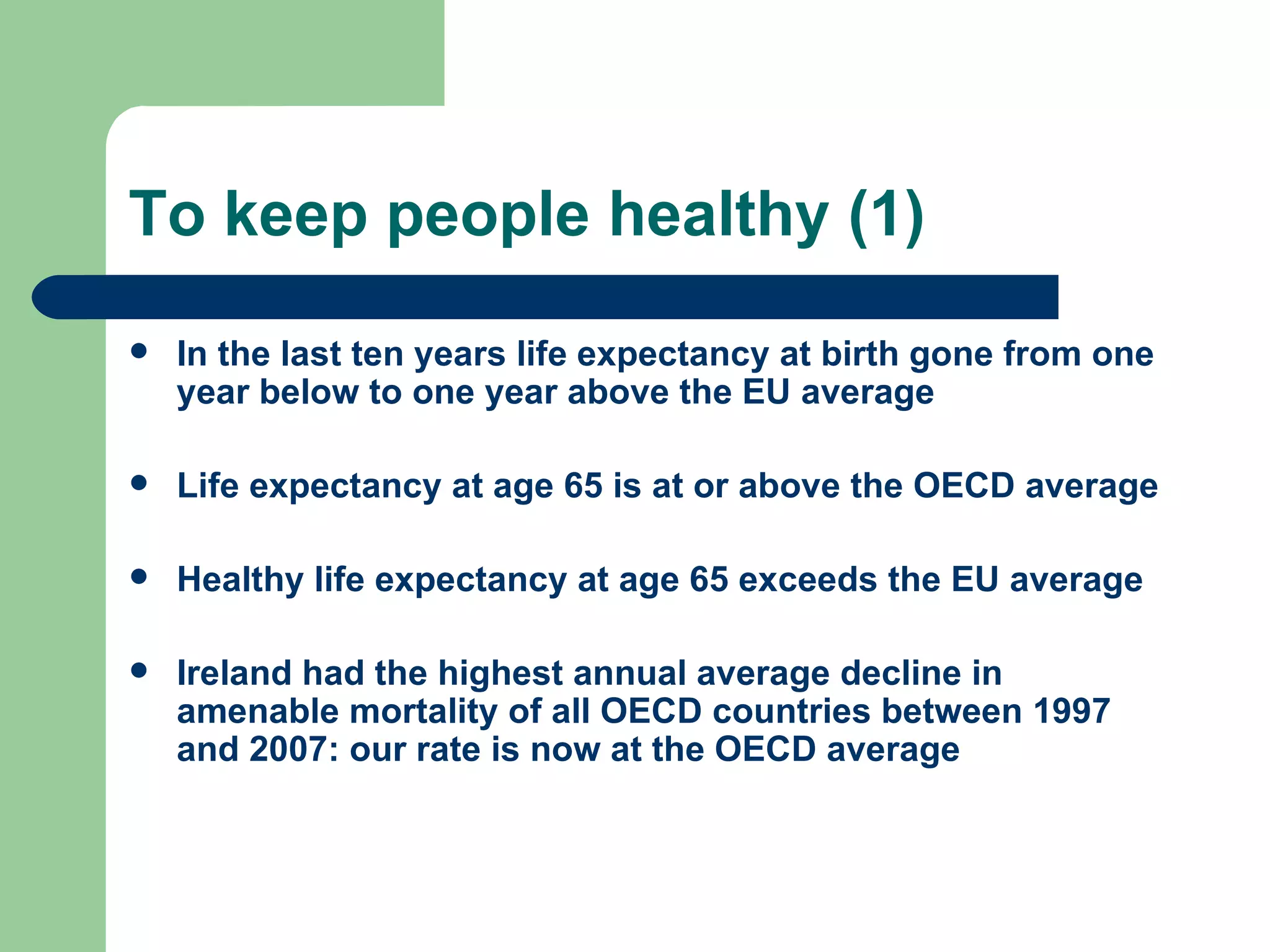
To keep people healthy (1) In the last ten years life expectancy at birth gone from one year below to one year above the EU average Life expectancy at age 65 is at or above the OECD average Healthy life expectancy at age 65 exceeds the EU average Ireland had the highest annual average decline in amenable mortality of all OECD countries between 1997 and 2007: our rate is now at the OECD average
To keep people healthy (2) Self-perceived health status in Ireland highest of EU27 One of the lowest mortality rates from stroke Infant mortality rate 3.2 per 1,000 live births in 2009 compared to 2008 EU average of 4.6 All cancer mortality rate same as the OECD average – 212 per 100,000: in 2000 it was 195 compared to an OECD average of 179 Breastcheck, cervical check and forthcoming colorectal cancer screening
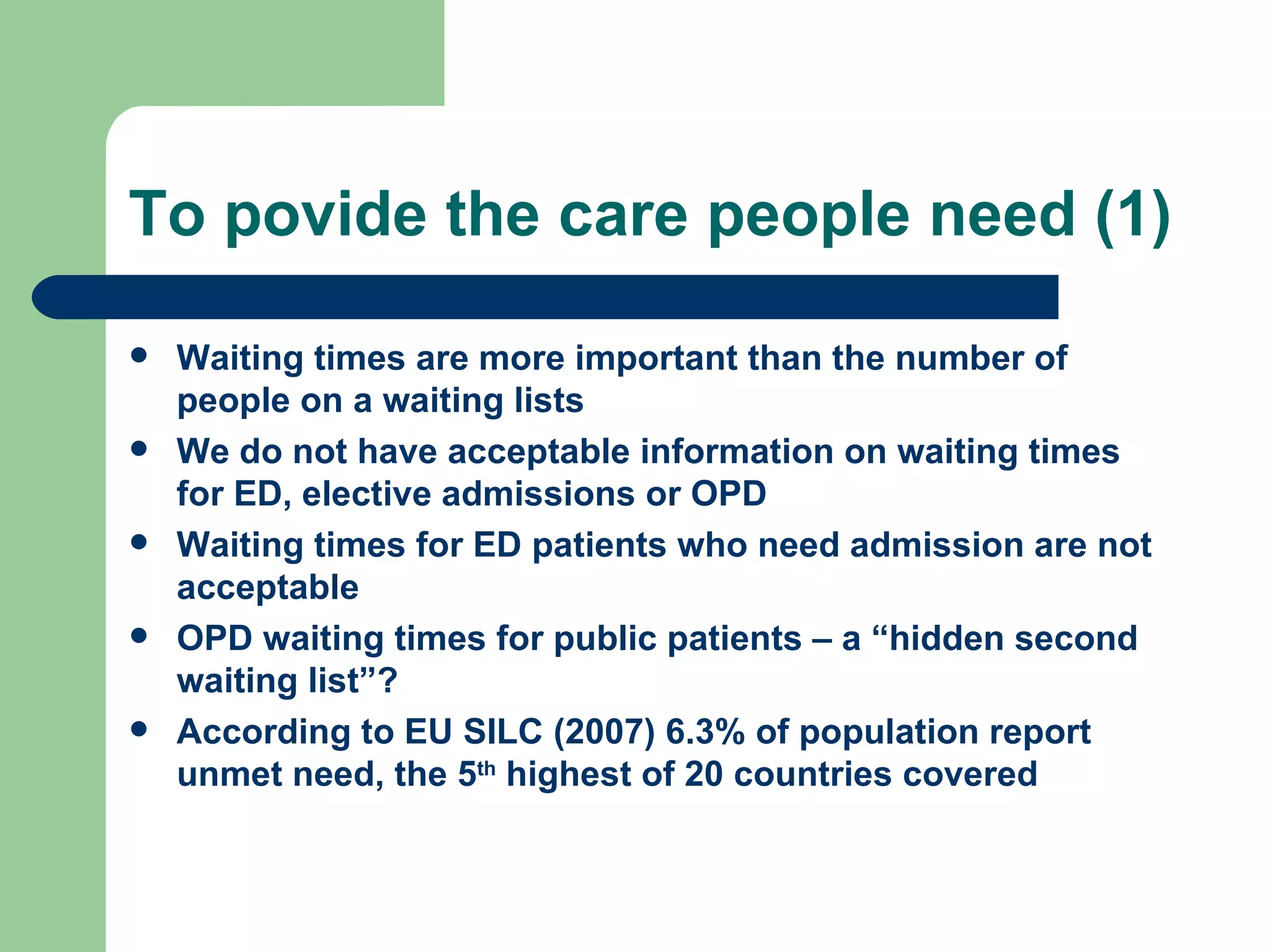
To povide the care people need (1) Waiting times are more important than the number of people on a waiting lists We do not have acceptable information on waiting times for ED, elective admissions or OPD Waiting times for ED patients who need admission are not acceptable  OPD waiting times for public patients – a “hidden second waiting list”? According to EU SILC (2007) 6.3% of population report unmet need, the 5 th  highest of 20 countries covered
To povide the care people need (2) Number of people waiting for surgical procedure fell from 7.4 per 1,000 pop in 2002 to 4.3 in 2008 At the end of Dec 2010 there were 50,582 people reported as waiting for an elective procedure on the National Treatment Register, of whom 10,000 were outside the target time for treatment – 3 months for children and 6 months for adults  Over 95% of urgent and non-urgent referrals for symptomatic breast services are seen within 2 and 12 weeks respectively About 98% of urgent colonoscopies seen within 28 days
To deliver high quality services (1) HIQA established Protected disclosures Updated legislation on professional regulation Madden Commission Drop of 40% in MRSA bloodstream infection cases between 2006 and 2009 Nursing homes registration Mental Health Commission/Tribunals
To deliver high quality services (2) Cancer control programme - trade off between quality and geographical access Competency assurance, adverse event reporting & open disclosure  Licensing Clinical effectiveness guidelines
Best value from resources (1) An increase of 139% in the number of day cases in public hospitals since 2000 The Irish are with the exception of the Mexicans by far the lowest users of medical care within OECD countries GPs per 1,000 population 0.5 compared to 0.9 OECD average Global health employment in Ireland (30.8 per 1,000 inhabitants) remains just below the average of OECD countries but….
Best value from resources (2) … . in absolute terms, hospital employment (17.5 per 1,000) puts Ireland in the highest rank. Nurses per 1,000 population 15.5 compared to 9.6 OECD average OECD commented that the cost of medical manpower is expensive in Ireland compared to other OECD countries. OECD figures (2007) showed hospital nurses remuneration in Ireland is substantially above the OECD average (5 th  highest) but ...... measured as ratio to average wage it was the 5 th  lowest
Where do we want to go? (1) There is no destination – change is a constant Reach/exceed the EU/OECD average despite (a) aging population and  (b) increased burden of chronic diseases/risks  associated with lifestyle factors Faster and fairer access Better balance between primary care and hospital care
Where do we want to go? (2) More consistent quality Appropriate balance between local access and quality care Economy/efficiency/effectiveness but also affordability/choices   Provide the best care possible for the available resources
Enablers (1) It is all about behaviour Clarity of purpose and performance Clear policy goals Standards/pathways/protocols/processes  Chronic disease management, clinical effectiveness guielines, integrated care Information ICT Governance/accountability
Enablers (2) Capacity A whole system approach Changes in professional/work practices User involvement/empowerment Funding/financing mechanisms Structures Aligning the incentives Centralise standards but decentralise delivery
Finally We are not alone  It is the hard slog of implementation that really matters Nothing wrong with a “hard nosed business” approach Transparency is the cure, if it doesn’t kill you first Can’t “boil the ocean” but can do everything better We all have a role and a responsibility

Michael scanlon march 2011 national healthcare conference slides

  • 1.
    National Healthcare Conference2011 24 March 2011 Presentation by Mr Michael Scanlan, Secretary General, Department of Health & Children
  • 2.
    Outline Opening remarksWhere are we Where do we want to go How do we get there Concluding comments
  • 3.
    A better debateDo we want to be self-critical or just critical Searching for learning or heads on a plate “ Vested interests” or “Stakeholders” Emotive or “science based” No one has all the answers We all have a responsibility
  • 4.
    Performance Framework Tokeep people healthy To povide the care people need To deliver high quality services To get the best value for health system resources
  • 5.
    To keep peoplehealthy (1) In the last ten years life expectancy at birth gone from one year below to one year above the EU average Life expectancy at age 65 is at or above the OECD average Healthy life expectancy at age 65 exceeds the EU average Ireland had the highest annual average decline in amenable mortality of all OECD countries between 1997 and 2007: our rate is now at the OECD average
  • 6.
    To keep peoplehealthy (2) Self-perceived health status in Ireland highest of EU27 One of the lowest mortality rates from stroke Infant mortality rate 3.2 per 1,000 live births in 2009 compared to 2008 EU average of 4.6 All cancer mortality rate same as the OECD average – 212 per 100,000: in 2000 it was 195 compared to an OECD average of 179 Breastcheck, cervical check and forthcoming colorectal cancer screening
  • 7.
    To povide thecare people need (1) Waiting times are more important than the number of people on a waiting lists We do not have acceptable information on waiting times for ED, elective admissions or OPD Waiting times for ED patients who need admission are not acceptable OPD waiting times for public patients – a “hidden second waiting list”? According to EU SILC (2007) 6.3% of population report unmet need, the 5 th highest of 20 countries covered
  • 8.
    To povide thecare people need (2) Number of people waiting for surgical procedure fell from 7.4 per 1,000 pop in 2002 to 4.3 in 2008 At the end of Dec 2010 there were 50,582 people reported as waiting for an elective procedure on the National Treatment Register, of whom 10,000 were outside the target time for treatment – 3 months for children and 6 months for adults Over 95% of urgent and non-urgent referrals for symptomatic breast services are seen within 2 and 12 weeks respectively About 98% of urgent colonoscopies seen within 28 days
  • 9.
    To deliver highquality services (1) HIQA established Protected disclosures Updated legislation on professional regulation Madden Commission Drop of 40% in MRSA bloodstream infection cases between 2006 and 2009 Nursing homes registration Mental Health Commission/Tribunals
  • 10.
    To deliver highquality services (2) Cancer control programme - trade off between quality and geographical access Competency assurance, adverse event reporting & open disclosure Licensing Clinical effectiveness guidelines
  • 11.
    Best value fromresources (1) An increase of 139% in the number of day cases in public hospitals since 2000 The Irish are with the exception of the Mexicans by far the lowest users of medical care within OECD countries GPs per 1,000 population 0.5 compared to 0.9 OECD average Global health employment in Ireland (30.8 per 1,000 inhabitants) remains just below the average of OECD countries but….
  • 12.
    Best value fromresources (2) … . in absolute terms, hospital employment (17.5 per 1,000) puts Ireland in the highest rank. Nurses per 1,000 population 15.5 compared to 9.6 OECD average OECD commented that the cost of medical manpower is expensive in Ireland compared to other OECD countries. OECD figures (2007) showed hospital nurses remuneration in Ireland is substantially above the OECD average (5 th highest) but ...... measured as ratio to average wage it was the 5 th lowest
  • 13.
    Where do wewant to go? (1) There is no destination – change is a constant Reach/exceed the EU/OECD average despite (a) aging population and (b) increased burden of chronic diseases/risks associated with lifestyle factors Faster and fairer access Better balance between primary care and hospital care
  • 14.
    Where do wewant to go? (2) More consistent quality Appropriate balance between local access and quality care Economy/efficiency/effectiveness but also affordability/choices Provide the best care possible for the available resources
  • 15.
    Enablers (1) Itis all about behaviour Clarity of purpose and performance Clear policy goals Standards/pathways/protocols/processes Chronic disease management, clinical effectiveness guielines, integrated care Information ICT Governance/accountability
  • 16.
    Enablers (2) CapacityA whole system approach Changes in professional/work practices User involvement/empowerment Funding/financing mechanisms Structures Aligning the incentives Centralise standards but decentralise delivery
  • 17.
    Finally We arenot alone It is the hard slog of implementation that really matters Nothing wrong with a “hard nosed business” approach Transparency is the cure, if it doesn’t kill you first Can’t “boil the ocean” but can do everything better We all have a role and a responsibility