S
Orthopedic Injuries in
Collegiate Sports
Blake Narron
UNC Charlotte Kinesiology
Exercise Science
NCAA 2009-2014
S Over 5 years from 1,113 schools
S 19,334 teams
S 478,869 athletes
S 1,053,370 estimated injuries during 176.7 million
estimated “exposures to injury” (# of athlete's X # of
practices and games)
Men’s Football
S Largest average of annual injuries
S 47,199 injuries
S Highest competition injury rate
S 39.9 injuries per 1,000 athlete exposures
S Football has more athletes per team then other sports
Most Common Injury
S Ankle Sprain
S Lateral ligaments are weaker than the Medial Deltoid Ligament.
S Due to a torqueing force, the ankle undergoes excessive
eversion causing injury to:
S Calcaneofibular Ligament
S Anterior Talofibular Ligament
S Depending on severity of the sprain, recovery can span from 2-
12 weeks.
S 7.5 percent of all injuries resulted in surgery
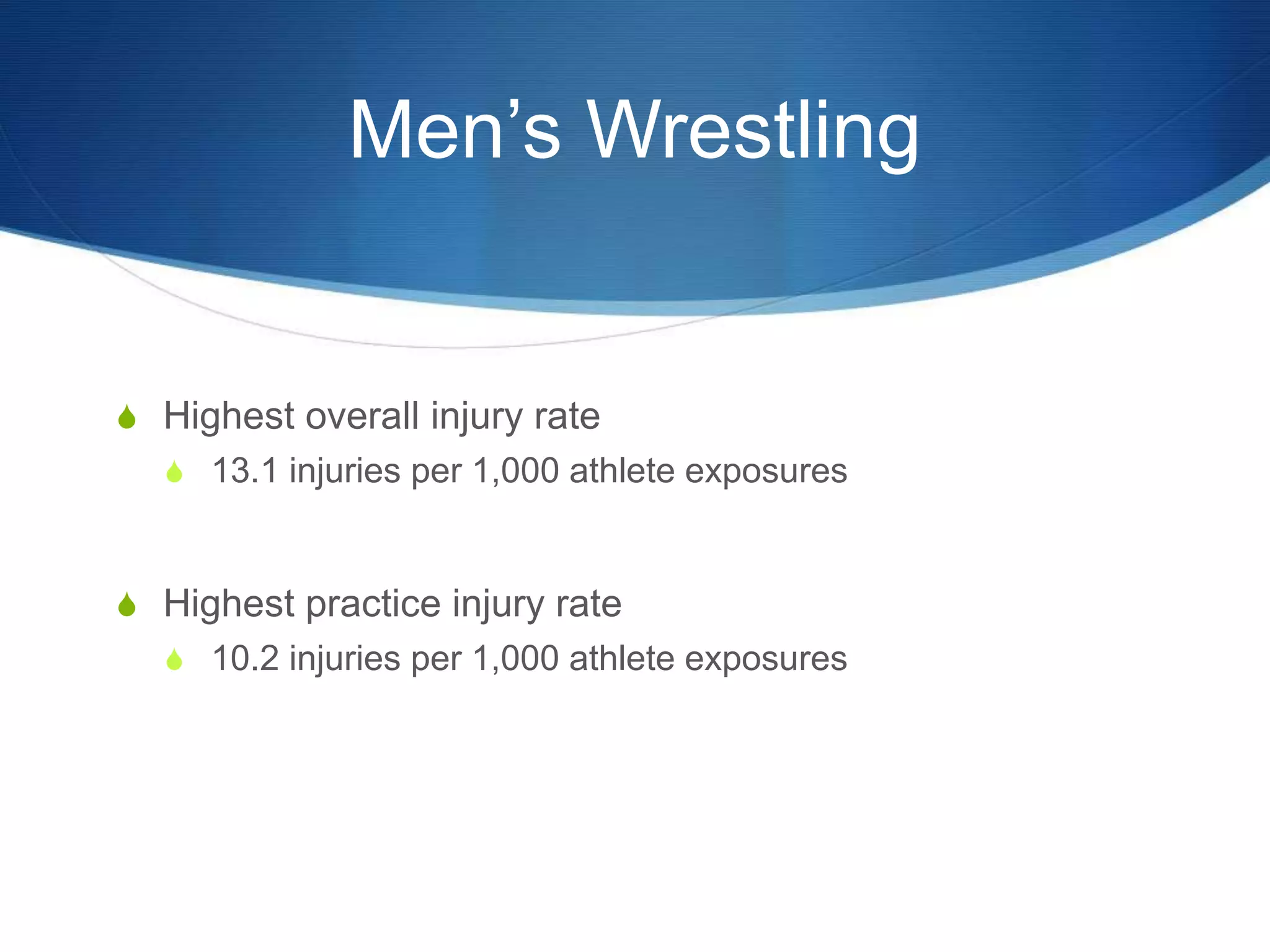
Men’s Wrestling
S Highest overall injury rate
S 13.1 injuries per 1,000 athlete exposures
S Highest practice injury rate
S 10.2 injuries per 1,000 athlete exposures
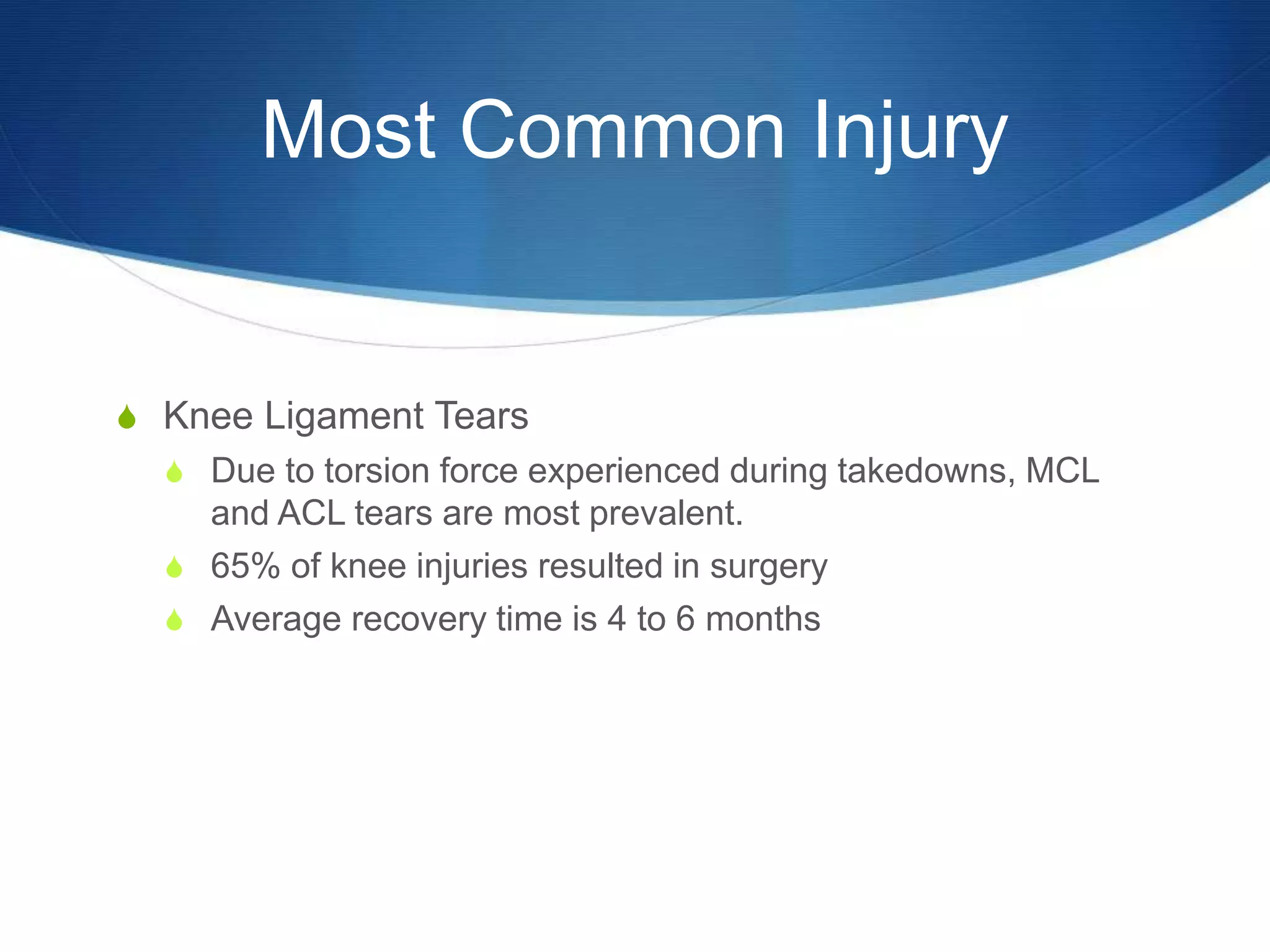
Most Common Injury
S Knee Ligament Tears
S Due to torsion force experienced during takedowns, MCL
and ACL tears are most prevalent.
S 65% of knee injuries resulted in surgery
S Average recovery time is 4 to 6 months
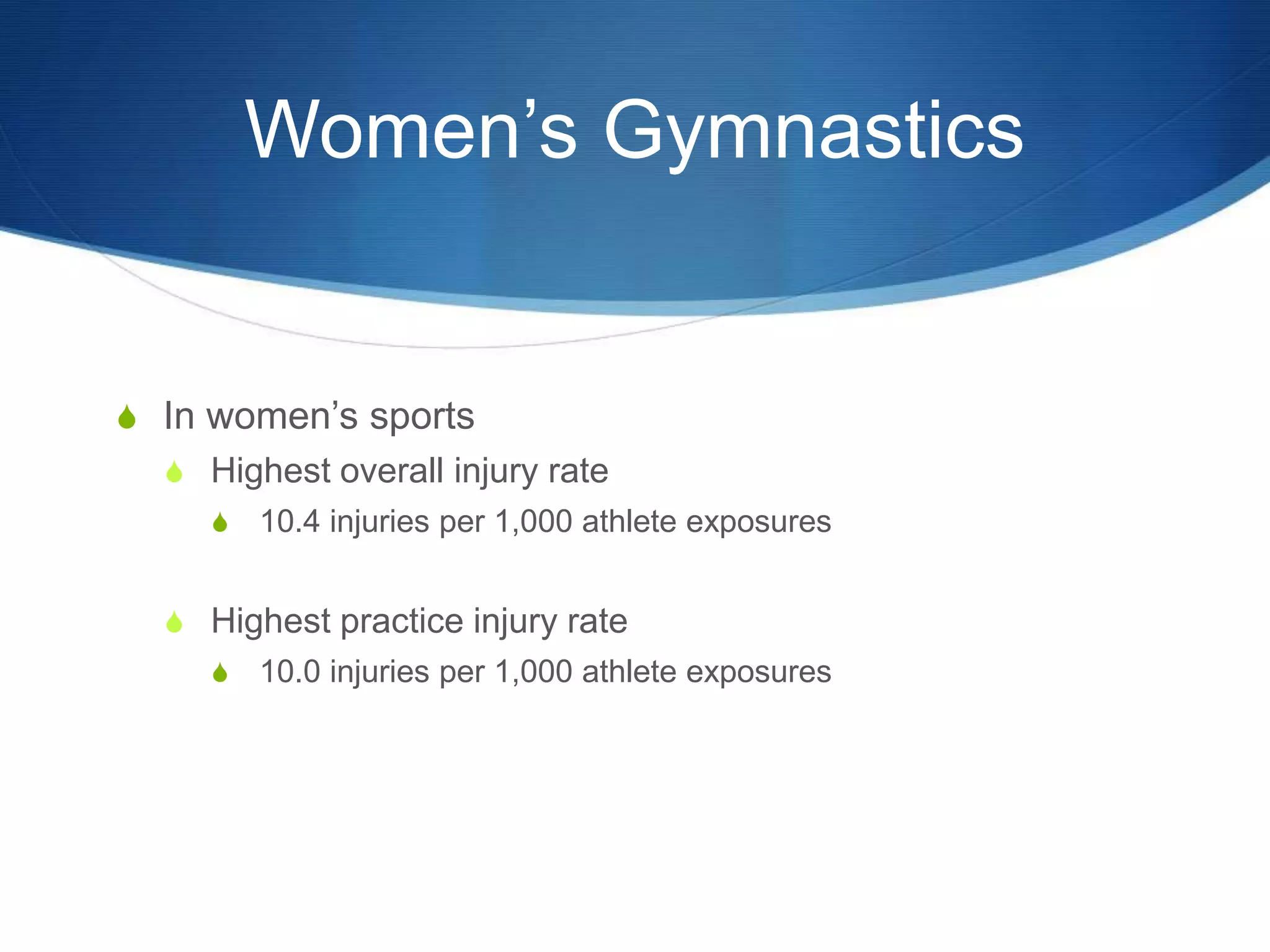
Women’s Gymnastics
S In women’s sports
S Highest overall injury rate
S 10.4 injuries per 1,000 athlete exposures
S Highest practice injury rate
S 10.0 injuries per 1,000 athlete exposures
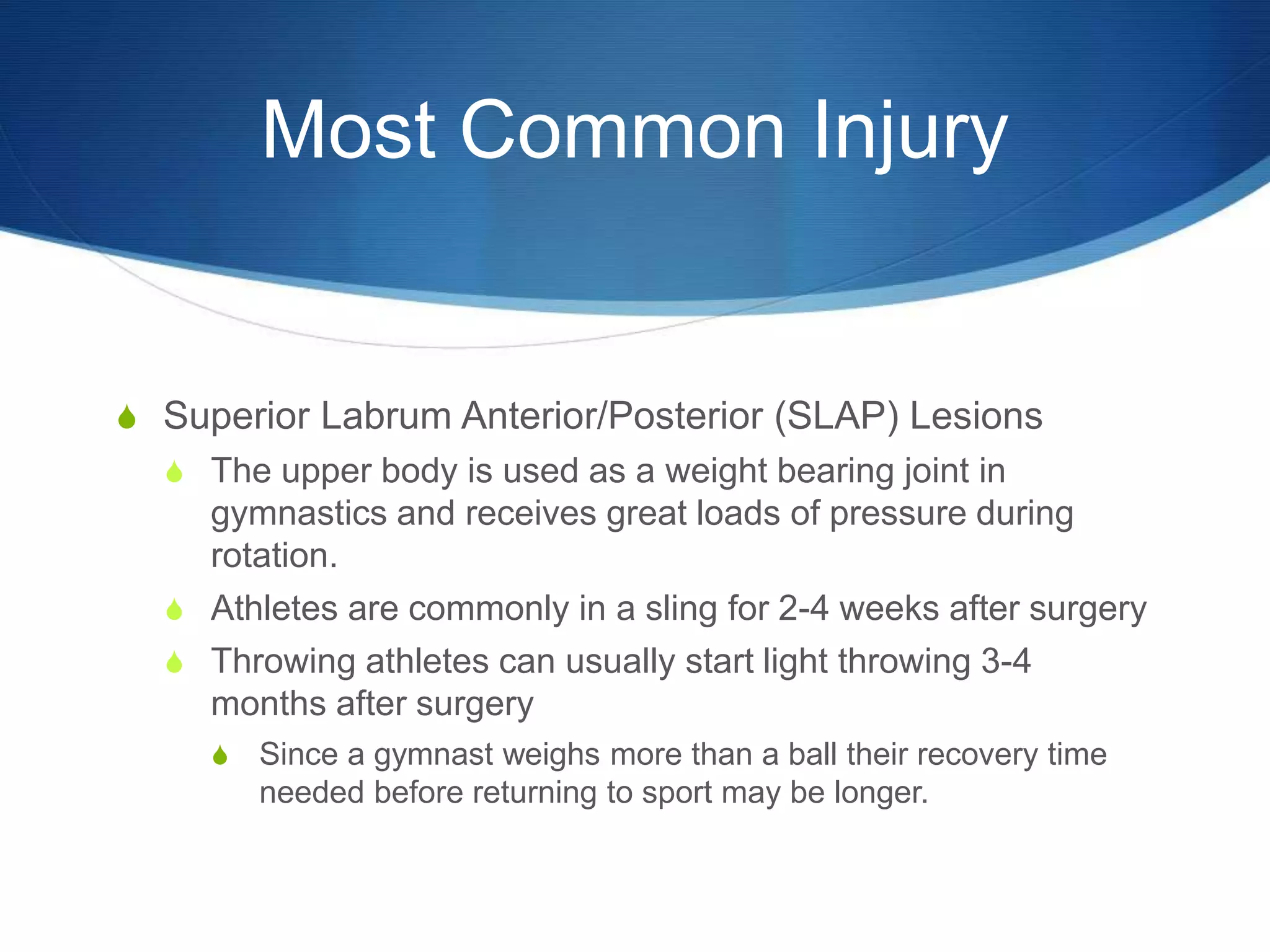
Most Common Injury
S Superior Labrum Anterior/Posterior (SLAP) Lesions
S The upper body is used as a weight bearing joint in
gymnastics and receives great loads of pressure during
rotation.
S Athletes are commonly in a sling for 2-4 weeks after surgery
S Throwing athletes can usually start light throwing 3-4
months after surgery
S Since a gymnast weighs more than a ball their recovery time
needed before returning to sport may be longer.
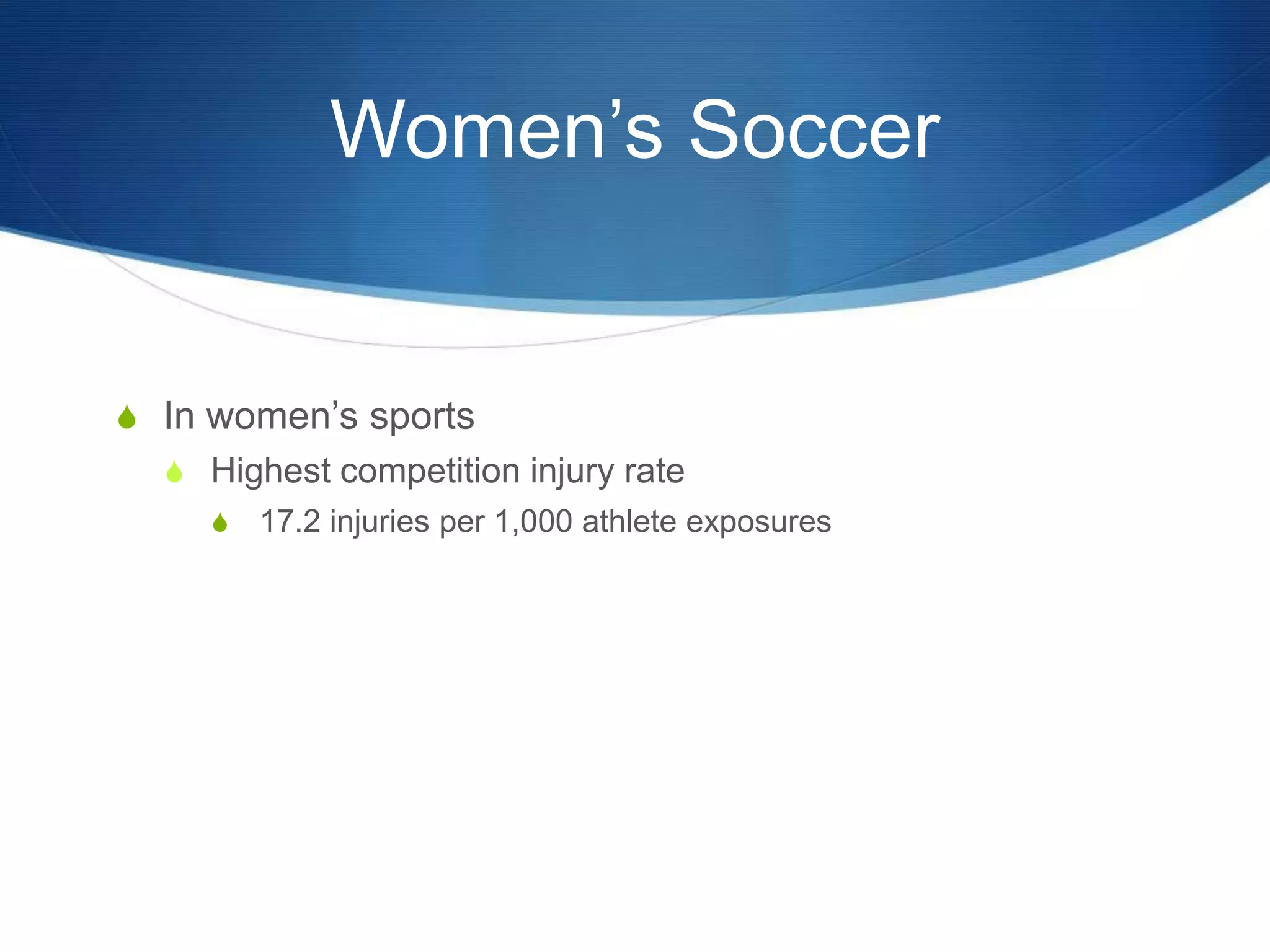
Women’s Soccer
S In women’s sports
S Highest competition injury rate
S 17.2 injuries per 1,000 athlete exposures
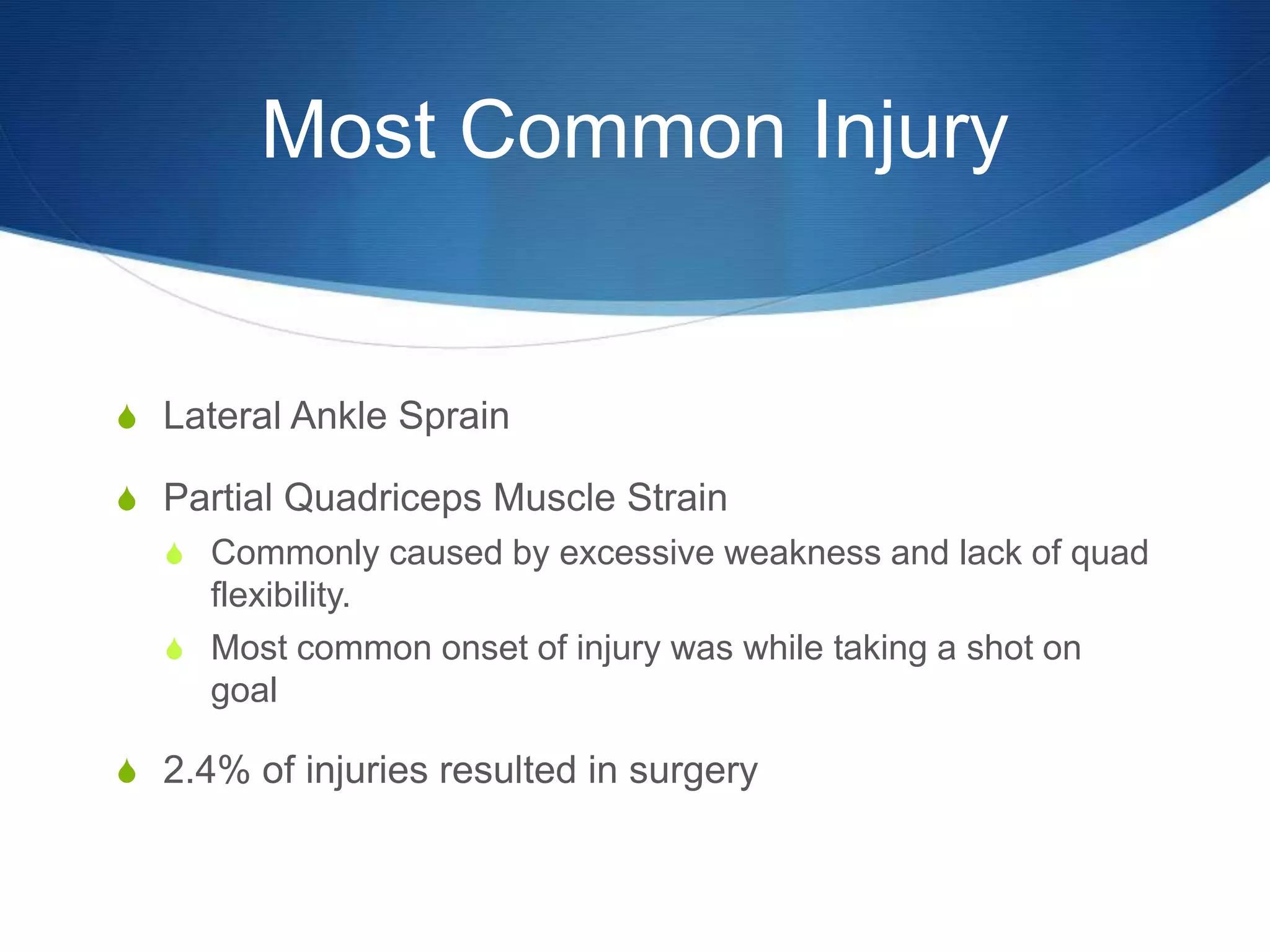
Most Common Injury
S Lateral Ankle Sprain
S Partial Quadriceps Muscle Strain
S Commonly caused by excessive weakness and lack of quad
flexibility.
S Most common onset of injury was while taking a shot on
goal
S 2.4% of injuries resulted in surgery
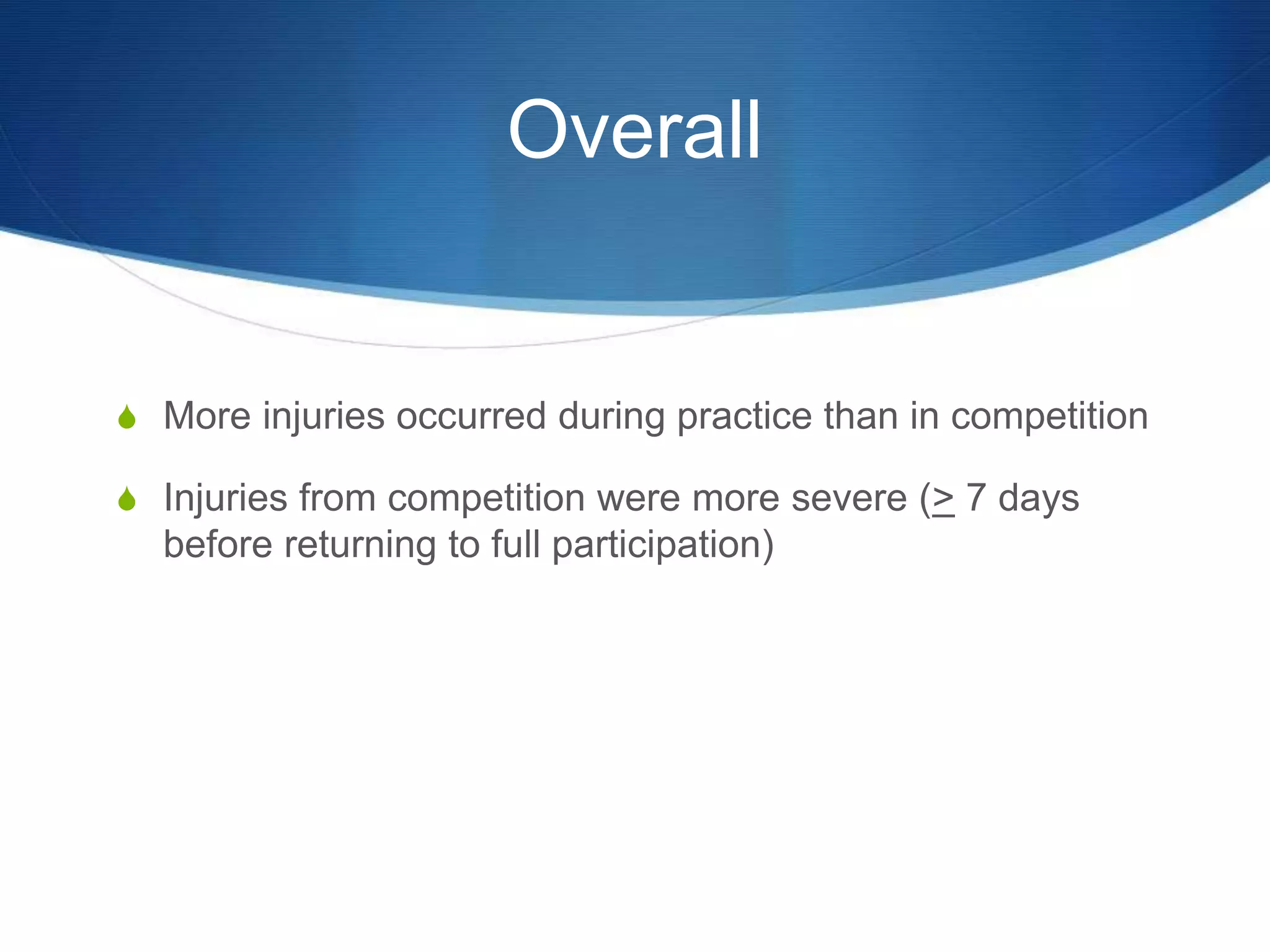
Overall
S More injuries occurred during practice than in competition
S Injuries from competition were more severe (> 7 days
before returning to full participation)
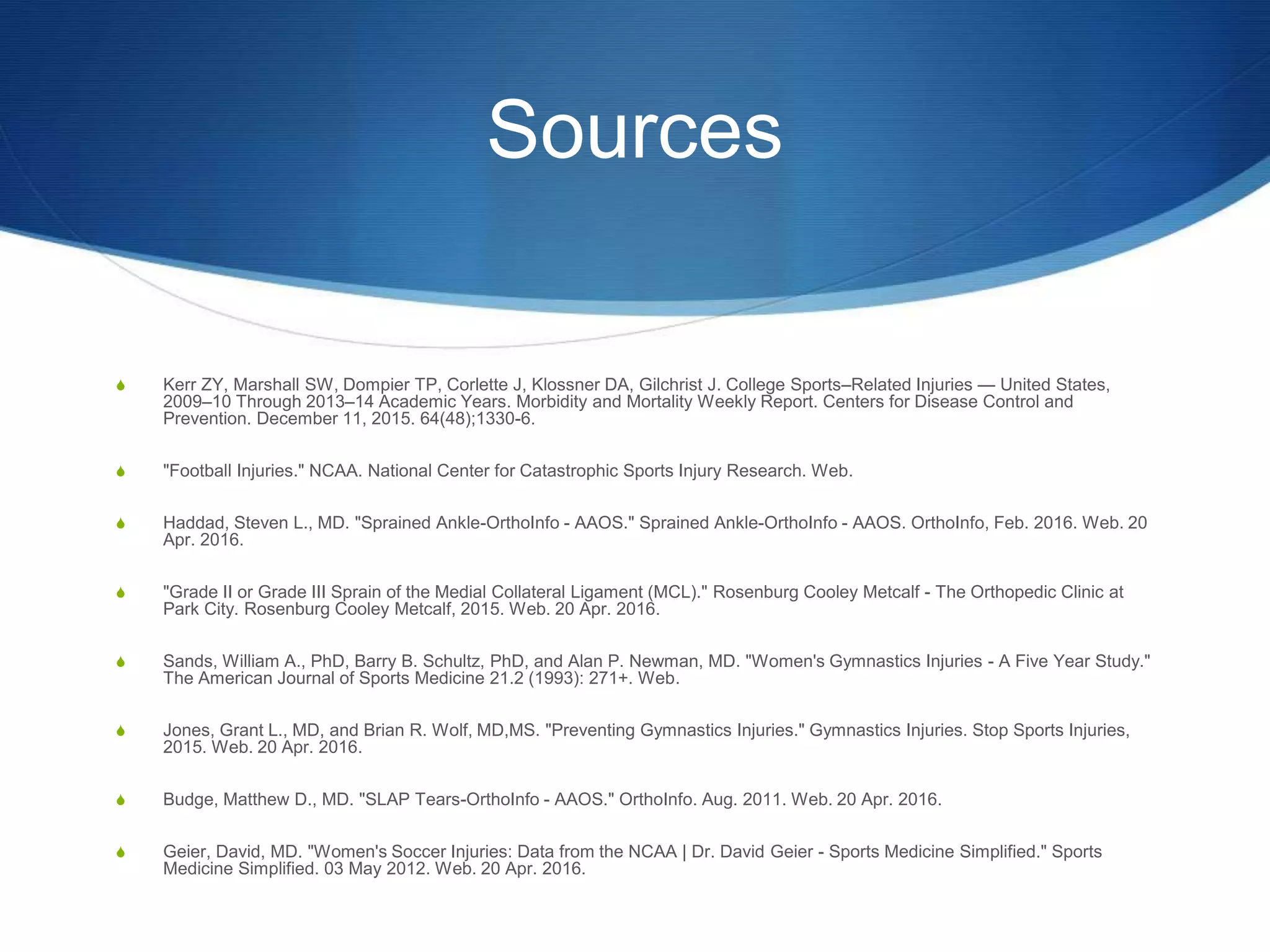
Sources
S Kerr ZY, Marshall SW, Dompier TP, Corlette J, Klossner DA, Gilchrist J. College Sports–Related Injuries — United States,
2009–10 Through 2013–14 Academic Years. Morbidity and Mortality Weekly Report. Centers for Disease Control and
Prevention. December 11, 2015. 64(48);1330-6.
S "Football Injuries." NCAA. National Center for Catastrophic Sports Injury Research. Web.
S Haddad, Steven L., MD. "Sprained Ankle-OrthoInfo - AAOS." Sprained Ankle-OrthoInfo - AAOS. OrthoInfo, Feb. 2016. Web. 20
Apr. 2016.
S "Grade II or Grade III Sprain of the Medial Collateral Ligament (MCL)." Rosenburg Cooley Metcalf - The Orthopedic Clinic at
Park City. Rosenburg Cooley Metcalf, 2015. Web. 20 Apr. 2016.
S Sands, William A., PhD, Barry B. Schultz, PhD, and Alan P. Newman, MD. "Women's Gymnastics Injuries - A Five Year Study."
The American Journal of Sports Medicine 21.2 (1993): 271+. Web.
S Jones, Grant L., MD, and Brian R. Wolf, MD,MS. "Preventing Gymnastics Injuries." Gymnastics Injuries. Stop Sports Injuries,
2015. Web. 20 Apr. 2016.
S Budge, Matthew D., MD. "SLAP Tears-OrthoInfo - AAOS." OrthoInfo. Aug. 2011. Web. 20 Apr. 2016.
S Geier, David, MD. "Women's Soccer Injuries: Data from the NCAA | Dr. David Geier - Sports Medicine Simplified." Sports
Medicine Simplified. 03 May 2012. Web. 20 Apr. 2016.

Internship Project

  • 1.
    S Orthopedic Injuries in CollegiateSports Blake Narron UNC Charlotte Kinesiology Exercise Science
  • 2.
    NCAA 2009-2014 S Over5 years from 1,113 schools S 19,334 teams S 478,869 athletes S 1,053,370 estimated injuries during 176.7 million estimated “exposures to injury” (# of athlete's X # of practices and games)
  • 3.
    Men’s Football S Largestaverage of annual injuries S 47,199 injuries S Highest competition injury rate S 39.9 injuries per 1,000 athlete exposures S Football has more athletes per team then other sports
  • 4.
    Most Common Injury SAnkle Sprain S Lateral ligaments are weaker than the Medial Deltoid Ligament. S Due to a torqueing force, the ankle undergoes excessive eversion causing injury to: S Calcaneofibular Ligament S Anterior Talofibular Ligament S Depending on severity of the sprain, recovery can span from 2- 12 weeks. S 7.5 percent of all injuries resulted in surgery
  • 5.
    Men’s Wrestling S Highestoverall injury rate S 13.1 injuries per 1,000 athlete exposures S Highest practice injury rate S 10.2 injuries per 1,000 athlete exposures
  • 6.
    Most Common Injury SKnee Ligament Tears S Due to torsion force experienced during takedowns, MCL and ACL tears are most prevalent. S 65% of knee injuries resulted in surgery S Average recovery time is 4 to 6 months
  • 7.
    Women’s Gymnastics S Inwomen’s sports S Highest overall injury rate S 10.4 injuries per 1,000 athlete exposures S Highest practice injury rate S 10.0 injuries per 1,000 athlete exposures
  • 8.
    Most Common Injury SSuperior Labrum Anterior/Posterior (SLAP) Lesions S The upper body is used as a weight bearing joint in gymnastics and receives great loads of pressure during rotation. S Athletes are commonly in a sling for 2-4 weeks after surgery S Throwing athletes can usually start light throwing 3-4 months after surgery S Since a gymnast weighs more than a ball their recovery time needed before returning to sport may be longer.
  • 9.
    Women’s Soccer S Inwomen’s sports S Highest competition injury rate S 17.2 injuries per 1,000 athlete exposures
  • 10.
    Most Common Injury SLateral Ankle Sprain S Partial Quadriceps Muscle Strain S Commonly caused by excessive weakness and lack of quad flexibility. S Most common onset of injury was while taking a shot on goal S 2.4% of injuries resulted in surgery
  • 11.
    Overall S More injuriesoccurred during practice than in competition S Injuries from competition were more severe (> 7 days before returning to full participation)
  • 12.
    Sources S Kerr ZY,Marshall SW, Dompier TP, Corlette J, Klossner DA, Gilchrist J. College Sports–Related Injuries — United States, 2009–10 Through 2013–14 Academic Years. Morbidity and Mortality Weekly Report. Centers for Disease Control and Prevention. December 11, 2015. 64(48);1330-6. S "Football Injuries." NCAA. National Center for Catastrophic Sports Injury Research. Web. S Haddad, Steven L., MD. "Sprained Ankle-OrthoInfo - AAOS." Sprained Ankle-OrthoInfo - AAOS. OrthoInfo, Feb. 2016. Web. 20 Apr. 2016. S "Grade II or Grade III Sprain of the Medial Collateral Ligament (MCL)." Rosenburg Cooley Metcalf - The Orthopedic Clinic at Park City. Rosenburg Cooley Metcalf, 2015. Web. 20 Apr. 2016. S Sands, William A., PhD, Barry B. Schultz, PhD, and Alan P. Newman, MD. "Women's Gymnastics Injuries - A Five Year Study." The American Journal of Sports Medicine 21.2 (1993): 271+. Web. S Jones, Grant L., MD, and Brian R. Wolf, MD,MS. "Preventing Gymnastics Injuries." Gymnastics Injuries. Stop Sports Injuries, 2015. Web. 20 Apr. 2016. S Budge, Matthew D., MD. "SLAP Tears-OrthoInfo - AAOS." OrthoInfo. Aug. 2011. Web. 20 Apr. 2016. S Geier, David, MD. "Women's Soccer Injuries: Data from the NCAA | Dr. David Geier - Sports Medicine Simplified." Sports Medicine Simplified. 03 May 2012. Web. 20 Apr. 2016.