
Getting the proper shapesBrandi Smith-Young, PTPerfect 10.0 Physical TherapyFellowship trained manual therapistBoard certified orthopedic specialistwww.perfect10physicaltherapy.comperfect10pt@gmail.com
IntroductionCompetitive gymnastTwo  time USAG Collegiate National Champions at TWUBachelors in Kinesiology at TWUMasters in Physical Therapy at Tx St
Practicing for 5 yearsFellowship trained in Orthopedic manual physical therapyBoard certified orthopedic specialist in PTOne of 300 therapist in the US with these certifications
My passion:Bring sport specific quality care to gymnastDecrease the number of injuries in gymnastImprove performance, recovery time, decrease time lost in the gym, and improve return to sport statusPerformance Enhancement
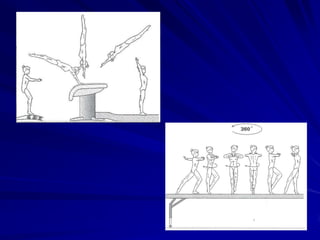
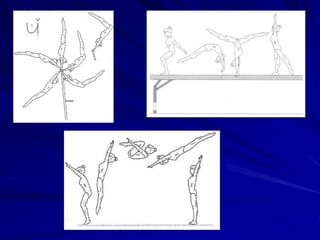
What’s the most common shape found in gymnastics?
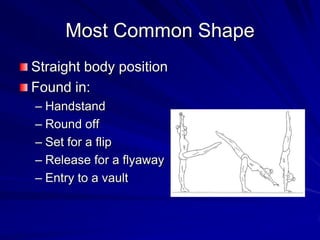
Most Common ShapeStraight body positionFound in:HandstandRound offSet for a flipRelease for a flyawayEntry to a vault
Due to the stringent requirements placed on gymnast certain muscles naturally tend to develop stronger than othersCertain muscles get weakOther muscles develop tighterAnd some develop stretched
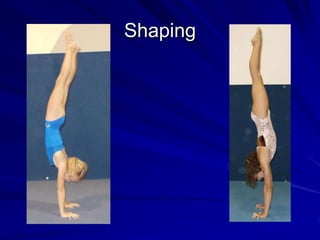
Shaping
What cause poor shaping?Decreased rib cage range of motionPOOR CORE CONTROL!!!!!Decreased shoulder “flexibility” (ROM) and controlDecreased hip “flexibility” (ROM) and control
Muscle imbalanceSome muscles are strongWhile opposing muscles are weakSome muscles are stretched outWhile opposing muscles are too tight.
Common muscle imbalancesContribute to poor shapingWeak abdominals/core Contribute to rib cage motionContribute to controlWeak shoulder musclesWeak hip musclesTight Lats and pecsTight hip muscles
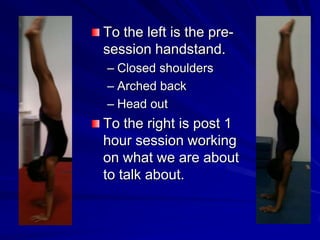
To the left is the pre-session handstand.Closed shouldersArched backHead outTo the right is post 1 hour session working on what we are about to talk about.
Demonstration Time
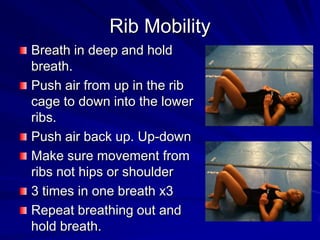
Rib MobilityBreath in deep and hold breath.Push air from up in the rib cage to down into the lower ribs.Push air back up. Up-downMake sure movement from ribs not hips or shoulder3 times in one breath x3Repeat breathing out and hold breath.
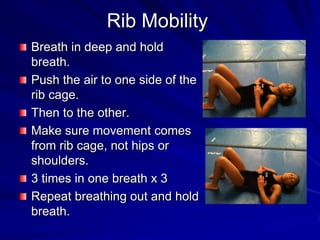
Rib MobilityBreath in deep and hold breath.Push the air to one side of the rib cage.Then to the other.Make sure movement comes from rib cage, not hips or shoulders.3 times in one breath x 3Repeat breathing out and hold breath.
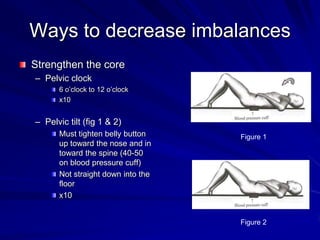
Ways to decrease imbalancesStrengthen the corePelvic clock6 o’clock to 12 o’clockx10Pelvic tilt (fig 1 & 2)Must tighten belly button up toward the nose and in  toward the spine (40-50 on blood pressure cuff)Not straight down into the floorx10Figure 1Figure 2
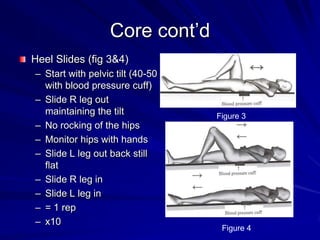
Core cont’dHeel Slides (fig 3&4)Start with pelvic tilt (40-50 with blood pressure cuff)Slide R leg out maintaining the tiltNo rocking of the hipsMonitor hips with handsSlide L leg out back still flatSlide R leg inSlide L leg in= 1 repx10Figure 3Figure 4
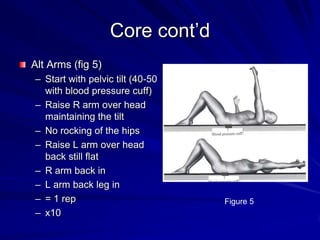
Core cont’dAlt Arms (fig 5)Start with pelvic tilt (40-50 with blood pressure cuff)Raise R arm over head maintaining the tiltNo rocking of the hipsRaise L arm over head back still flatR arm back inL arm back leg in= 1 repx10Figure 4Figure 5
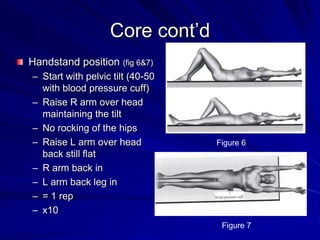
Core cont’dHandstand position (fig 6&7)Start with pelvic tilt (40-50 with blood pressure cuff)Raise R arm over head maintaining the tiltNo rocking of the hipsRaise L arm over head back still flatR arm back inL arm back leg in= 1 repx10Figure 4Figure 6Figure 7
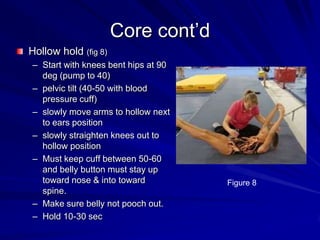
Core cont’dHollow hold (fig 8)Start with knees bent hips at 90 deg (pump to 40)pelvic tilt (40-50 with blood pressure cuff)slowly move arms to hollow next to ears positionslowly straighten knees out to hollow positionMust keep cuff between 50-60 and belly button must stay up toward nose & into toward spine.Make sure belly not pooch out.Hold 10-30 secFigure 8
Tweaking current conditioningGymnast are great at compensatingMake sure they remain hollow, flat back when doing core exercisesDo not allow an arch throughout the entire exerciseIe. V-ups on floor or from the bars, hollow holds, sit-ups, crunches, hanging sit ups, etcDo not allow belly to pooch outIf can’t keep form decrease lever arm.
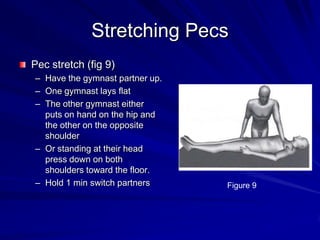
Stretching PecsPec stretch (fig 9)Have the gymnast partner up.One gymnast lays flatThe other gymnast either puts on hand on the hip and the other on the opposite shoulderOr standing at their head press down on both shoulders toward the floor.Hold 1 min switch partnersFigure 9
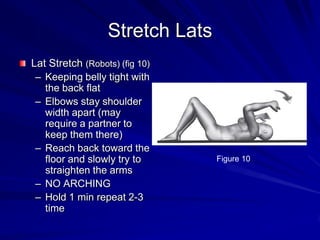
Stretch LatsLat Stretch (Robots) (fig 10)Keeping belly tight with the back flatElbows stay shoulder width apart (may require a partner to keep them there)Reach back toward the floor and slowly try to straighten the armsNO ARCHINGHold 1 min repeat 2-3 timeFigure 10
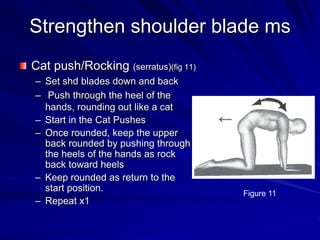
Strengthen shoulder blade msCat push/Rocking (serratus)(fig 11)Set shd blades down and back Push through the heel of the hands, rounding out like a catStart in the Cat PushesOnce rounded, keep the upper back rounded by pushing through the heels of the hands as rock back toward heelsKeep rounded as return to the start position.Repeat x1Figure 11
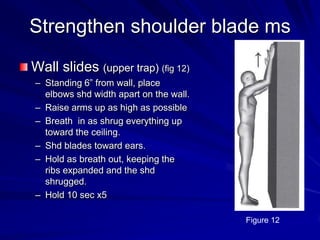
Strengthen shoulder blade msWall slides (upper trap) (fig 12)Standing 6” from wall, place elbows shd width apart on the wall.Raise arms up as high as possibleBreath  in as shrug everything up toward the ceiling.Shd blades toward ears.Hold as breath out, keeping the ribs expanded and the shd shrugged.Hold 10 sec x5Figure 12
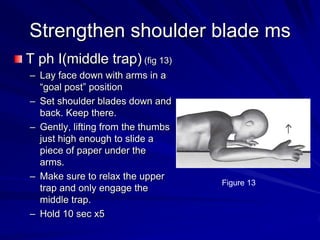
Strengthen shoulder blade msT ph I(middle trap) (fig 13)Lay face down with arms in a “goal post” positionSet shoulder blades down and back. Keep there.Gently, lifting from the thumbs just high enough to slide a piece of paper under the arms.Make sure to relax the upper trap and only engage the middle trap.Hold 10 sec x5Figure 13
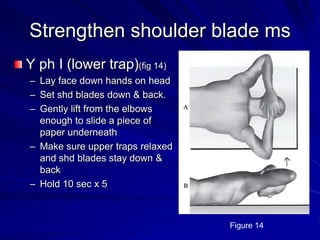
Strengthen shoulder blade msY ph I (lower trap)(fig 14)Lay face down hands on headSet shd blades down & back.Gently lift from the elbows enough to slide a piece of paper underneathMake sure upper traps relaxed and shd blades stay down & backHold 10 sec x 5Figure 14
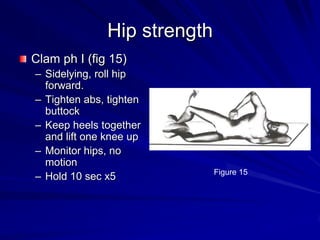
Hip strengthClam ph I (fig 15)Sidelying, roll hip forward.Tighten abs, tighten buttockKeep heels together and lift one knee upMonitor hips, no motionHold 10 sec x5Figure 15
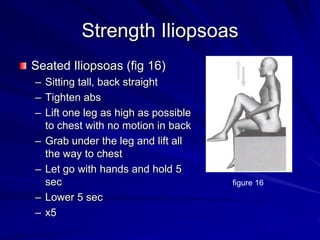
Strength IliopsoasSeated Iliopsoas (fig 16)Sitting tall, back straightTighten absLift one leg as high as possible to chest with no motion in back Grab under the leg and lift all the way to chestLet go with hands and hold 5 secLower 5 secx5figure 16
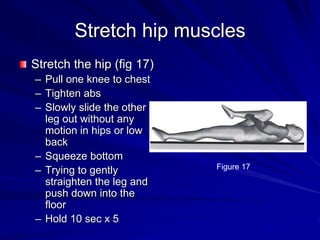
Stretch hip musclesStretch the hip (fig 17)Pull one knee to chestTighten absSlowly slide the other leg out without any motion in hips or low backSqueeze bottomTrying to gently straighten the leg and push down into the floorHold 10 sec x 5Figure 17
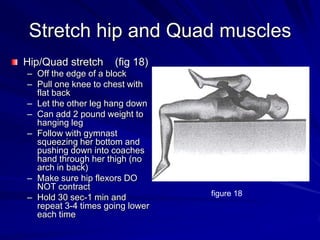
Stretch hip and Quad musclesHip/Quad stretch    (fig 18)Off the edge of a blockPull one knee to chest with flat backLet the other leg hang downCan add 2 pound weight to hanging legFollow with gymnast squeezing her bottom and pushing down into coaches hand through her thigh (no arch in back)Make sure hip flexors DO NOT contractHold 30 sec-1 min and repeat 3-4 times going lower each timefigure 18
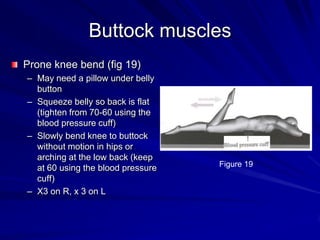
Buttock musclesProne knee bend (fig 19)May need a pillow under belly buttonSqueeze belly so back is flat (tighten from 70-60 using the blood pressure cuff)Slowly bend knee to buttock without motion in hips or arching at the low back (keep at 60 using the blood pressure cuff)X3 on R, x 3 on LFigure 19
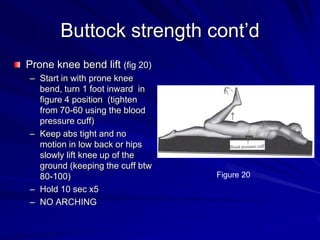
Buttock strength cont’dProne knee bend lift (fig 20)Start in with prone knee bend, turn 1 foot inward  in figure 4 position  (tighten from 70-60 using the blood pressure cuff)Keep abs tight and no motion in low back or hips slowly lift knee up of the ground (keeping the cuff btw 80-100)Hold 10 sec x5NO ARCHINGFigure 20
WHEN DO I STRETCH?The end of workout when the tissue has been heated through the workout which increased core temperature.This is when you will get your greatest changes.You must stretch within 24 hours to maintain the changes or the tissue will creep back to prior length.Latest research is showing greatest changes with stretching with vibration at 30 Hz (ie. Massager) Showing that stretching tolerance is the key to increased flexibility.The vibration tricks the nerves that feel pain into relaxing and allows for a stretch without the defensive muscle contraction.
Contact InformationPerfect 10.0 Physical Therapy             & Performance Trainingwww.perfect10physicaltherapy.comperfect10pt@gmail.com512-426-6593Follow  Perfect10PT  on gymanstike, facebook, and twitter
All information from:The Manual Therapy Institutehttp://www.mtitx.com/Shirley Sahrmann.Diagnosis and Treatment of Movement Impairment Syndrome.

Shapes For Gymnastics

  • 1.
    Getting the propershapesBrandi Smith-Young, PTPerfect 10.0 Physical TherapyFellowship trained manual therapistBoard certified orthopedic specialistwww.perfect10physicaltherapy.comperfect10pt@gmail.com
  • 2.
    IntroductionCompetitive gymnastTwo time USAG Collegiate National Champions at TWUBachelors in Kinesiology at TWUMasters in Physical Therapy at Tx St
  • 3.
    Practicing for 5yearsFellowship trained in Orthopedic manual physical therapyBoard certified orthopedic specialist in PTOne of 300 therapist in the US with these certifications
  • 4.
    My passion:Bring sportspecific quality care to gymnastDecrease the number of injuries in gymnastImprove performance, recovery time, decrease time lost in the gym, and improve return to sport statusPerformance Enhancement
  • 5.
    What’s the mostcommon shape found in gymnastics?
  • 8.
    Most Common ShapeStraightbody positionFound in:HandstandRound offSet for a flipRelease for a flyawayEntry to a vault
  • 9.
    Due to thestringent requirements placed on gymnast certain muscles naturally tend to develop stronger than othersCertain muscles get weakOther muscles develop tighterAnd some develop stretched
  • 10.
  • 11.
    What cause poorshaping?Decreased rib cage range of motionPOOR CORE CONTROL!!!!!Decreased shoulder “flexibility” (ROM) and controlDecreased hip “flexibility” (ROM) and control
  • 12.
    Muscle imbalanceSome musclesare strongWhile opposing muscles are weakSome muscles are stretched outWhile opposing muscles are too tight.
  • 13.
    Common muscle imbalancesContributeto poor shapingWeak abdominals/core Contribute to rib cage motionContribute to controlWeak shoulder musclesWeak hip musclesTight Lats and pecsTight hip muscles
  • 14.
    To the leftis the pre-session handstand.Closed shouldersArched backHead outTo the right is post 1 hour session working on what we are about to talk about.
  • 15.
  • 16.
    Rib MobilityBreath indeep and hold breath.Push air from up in the rib cage to down into the lower ribs.Push air back up. Up-downMake sure movement from ribs not hips or shoulder3 times in one breath x3Repeat breathing out and hold breath.
  • 17.
    Rib MobilityBreath indeep and hold breath.Push the air to one side of the rib cage.Then to the other.Make sure movement comes from rib cage, not hips or shoulders.3 times in one breath x 3Repeat breathing out and hold breath.
  • 18.
    Ways to decreaseimbalancesStrengthen the corePelvic clock6 o’clock to 12 o’clockx10Pelvic tilt (fig 1 & 2)Must tighten belly button up toward the nose and in toward the spine (40-50 on blood pressure cuff)Not straight down into the floorx10Figure 1Figure 2
  • 19.
    Core cont’dHeel Slides(fig 3&4)Start with pelvic tilt (40-50 with blood pressure cuff)Slide R leg out maintaining the tiltNo rocking of the hipsMonitor hips with handsSlide L leg out back still flatSlide R leg inSlide L leg in= 1 repx10Figure 3Figure 4
  • 20.
    Core cont’dAlt Arms(fig 5)Start with pelvic tilt (40-50 with blood pressure cuff)Raise R arm over head maintaining the tiltNo rocking of the hipsRaise L arm over head back still flatR arm back inL arm back leg in= 1 repx10Figure 4Figure 5
  • 21.
    Core cont’dHandstand position(fig 6&7)Start with pelvic tilt (40-50 with blood pressure cuff)Raise R arm over head maintaining the tiltNo rocking of the hipsRaise L arm over head back still flatR arm back inL arm back leg in= 1 repx10Figure 4Figure 6Figure 7
  • 22.
    Core cont’dHollow hold(fig 8)Start with knees bent hips at 90 deg (pump to 40)pelvic tilt (40-50 with blood pressure cuff)slowly move arms to hollow next to ears positionslowly straighten knees out to hollow positionMust keep cuff between 50-60 and belly button must stay up toward nose & into toward spine.Make sure belly not pooch out.Hold 10-30 secFigure 8
  • 23.
    Tweaking current conditioningGymnastare great at compensatingMake sure they remain hollow, flat back when doing core exercisesDo not allow an arch throughout the entire exerciseIe. V-ups on floor or from the bars, hollow holds, sit-ups, crunches, hanging sit ups, etcDo not allow belly to pooch outIf can’t keep form decrease lever arm.
  • 24.
    Stretching PecsPec stretch(fig 9)Have the gymnast partner up.One gymnast lays flatThe other gymnast either puts on hand on the hip and the other on the opposite shoulderOr standing at their head press down on both shoulders toward the floor.Hold 1 min switch partnersFigure 9
  • 25.
    Stretch LatsLat Stretch(Robots) (fig 10)Keeping belly tight with the back flatElbows stay shoulder width apart (may require a partner to keep them there)Reach back toward the floor and slowly try to straighten the armsNO ARCHINGHold 1 min repeat 2-3 timeFigure 10
  • 26.
    Strengthen shoulder blademsCat push/Rocking (serratus)(fig 11)Set shd blades down and back Push through the heel of the hands, rounding out like a catStart in the Cat PushesOnce rounded, keep the upper back rounded by pushing through the heels of the hands as rock back toward heelsKeep rounded as return to the start position.Repeat x1Figure 11
  • 27.
    Strengthen shoulder blademsWall slides (upper trap) (fig 12)Standing 6” from wall, place elbows shd width apart on the wall.Raise arms up as high as possibleBreath in as shrug everything up toward the ceiling.Shd blades toward ears.Hold as breath out, keeping the ribs expanded and the shd shrugged.Hold 10 sec x5Figure 12
  • 28.
    Strengthen shoulder blademsT ph I(middle trap) (fig 13)Lay face down with arms in a “goal post” positionSet shoulder blades down and back. Keep there.Gently, lifting from the thumbs just high enough to slide a piece of paper under the arms.Make sure to relax the upper trap and only engage the middle trap.Hold 10 sec x5Figure 13
  • 29.
    Strengthen shoulder blademsY ph I (lower trap)(fig 14)Lay face down hands on headSet shd blades down & back.Gently lift from the elbows enough to slide a piece of paper underneathMake sure upper traps relaxed and shd blades stay down & backHold 10 sec x 5Figure 14
  • 30.
    Hip strengthClam phI (fig 15)Sidelying, roll hip forward.Tighten abs, tighten buttockKeep heels together and lift one knee upMonitor hips, no motionHold 10 sec x5Figure 15
  • 31.
    Strength IliopsoasSeated Iliopsoas(fig 16)Sitting tall, back straightTighten absLift one leg as high as possible to chest with no motion in back Grab under the leg and lift all the way to chestLet go with hands and hold 5 secLower 5 secx5figure 16
  • 32.
    Stretch hip musclesStretchthe hip (fig 17)Pull one knee to chestTighten absSlowly slide the other leg out without any motion in hips or low backSqueeze bottomTrying to gently straighten the leg and push down into the floorHold 10 sec x 5Figure 17
  • 33.
    Stretch hip andQuad musclesHip/Quad stretch (fig 18)Off the edge of a blockPull one knee to chest with flat backLet the other leg hang downCan add 2 pound weight to hanging legFollow with gymnast squeezing her bottom and pushing down into coaches hand through her thigh (no arch in back)Make sure hip flexors DO NOT contractHold 30 sec-1 min and repeat 3-4 times going lower each timefigure 18
  • 34.
    Buttock musclesProne kneebend (fig 19)May need a pillow under belly buttonSqueeze belly so back is flat (tighten from 70-60 using the blood pressure cuff)Slowly bend knee to buttock without motion in hips or arching at the low back (keep at 60 using the blood pressure cuff)X3 on R, x 3 on LFigure 19
  • 35.
    Buttock strength cont’dProneknee bend lift (fig 20)Start in with prone knee bend, turn 1 foot inward in figure 4 position (tighten from 70-60 using the blood pressure cuff)Keep abs tight and no motion in low back or hips slowly lift knee up of the ground (keeping the cuff btw 80-100)Hold 10 sec x5NO ARCHINGFigure 20
  • 36.
    WHEN DO ISTRETCH?The end of workout when the tissue has been heated through the workout which increased core temperature.This is when you will get your greatest changes.You must stretch within 24 hours to maintain the changes or the tissue will creep back to prior length.Latest research is showing greatest changes with stretching with vibration at 30 Hz (ie. Massager) Showing that stretching tolerance is the key to increased flexibility.The vibration tricks the nerves that feel pain into relaxing and allows for a stretch without the defensive muscle contraction.
  • 37.
    Contact InformationPerfect 10.0Physical Therapy & Performance Trainingwww.perfect10physicaltherapy.comperfect10pt@gmail.com512-426-6593Follow Perfect10PT on gymanstike, facebook, and twitter
  • 38.
    All information from:TheManual Therapy Institutehttp://www.mtitx.com/Shirley Sahrmann.Diagnosis and Treatment of Movement Impairment Syndrome.