By Solid State Workshop
An introduction to
Simple Electric Circuits
3rd Edition
Objectives
In this video, we will…
1. Walk through an analogy
2. Compare the analogy to an electric circuit
3. Discuss the underlying physics (high-level view)
4. Introduce a fundamental equation (easy!)
5. Relate new circuit knowledge to the real world
6. Learn how to make measurements in the lab
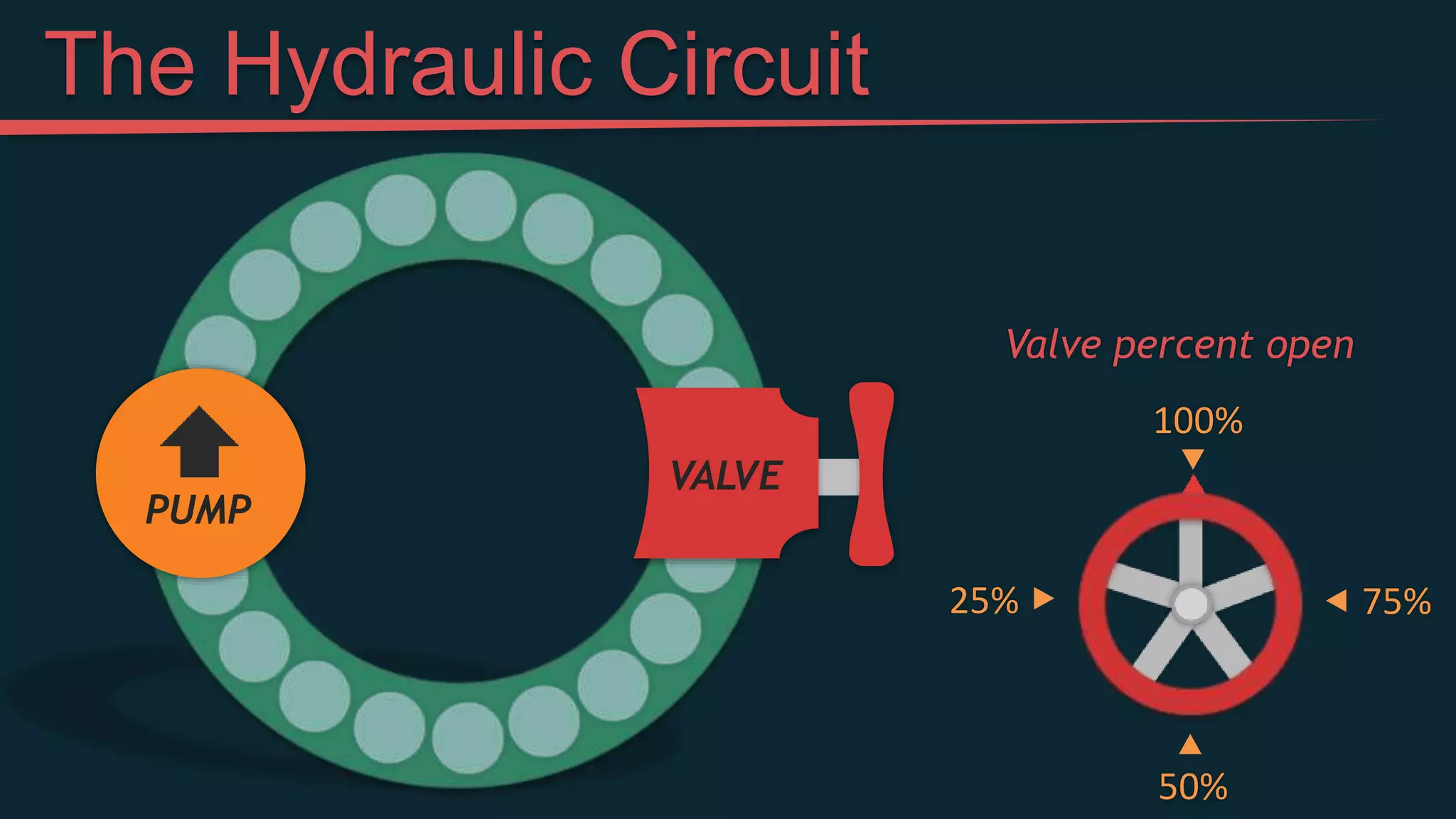
VALVE
PUMP
100%
50%
75%
25%
Valve percent open
The Hydraulic Circuit
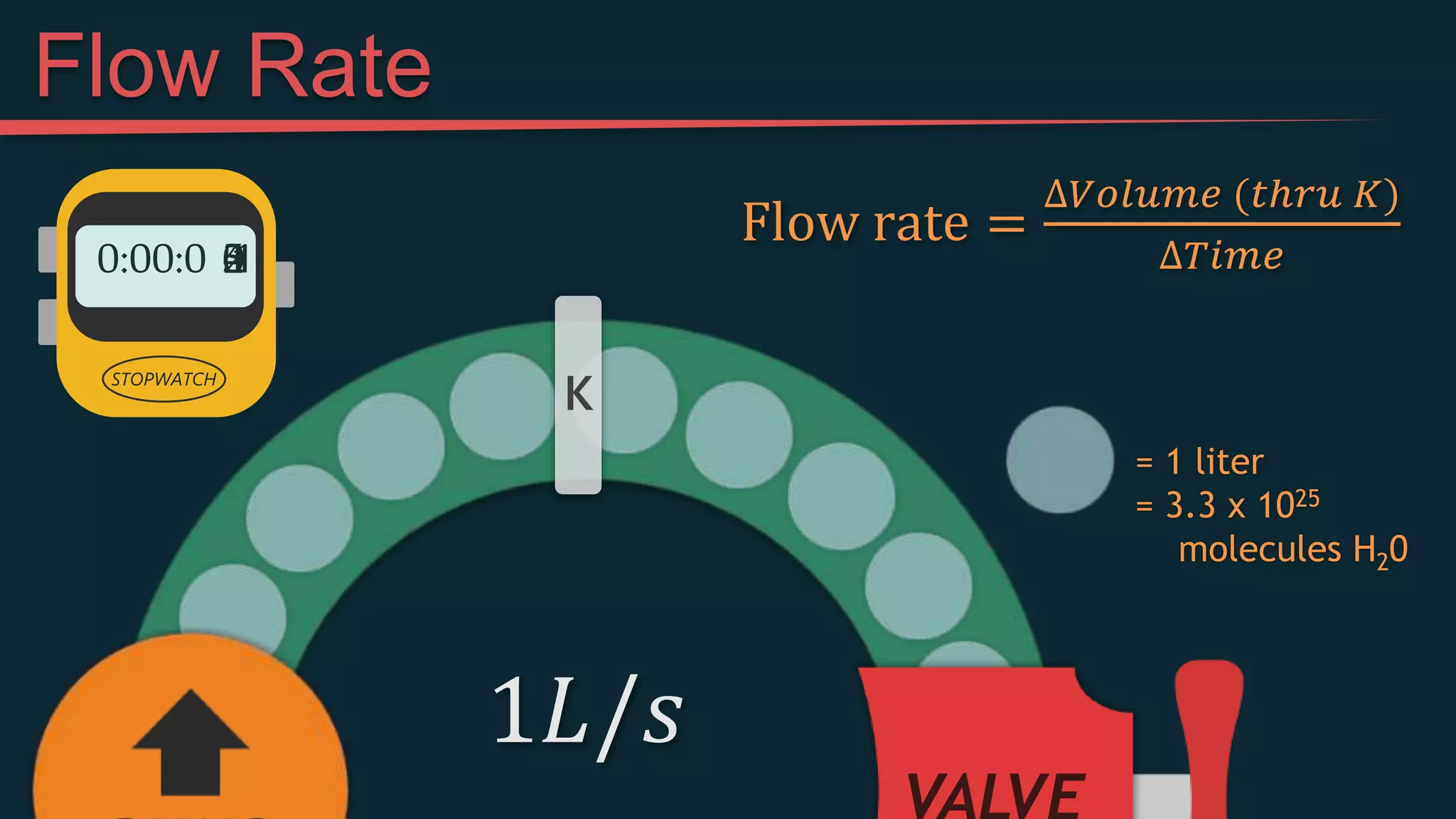
= 1 liter
= 3.3 x 1025
molecules H20
Flow rate =
∆𝑉𝑜𝑙𝑢𝑚𝑒 (𝑡ℎ𝑟𝑢 𝐾)
∆𝑇𝑖𝑚𝑒
K
Flow Rate
STOPWATCH
0:00:0 0
1
2
3
4
5
1𝐿/𝑠
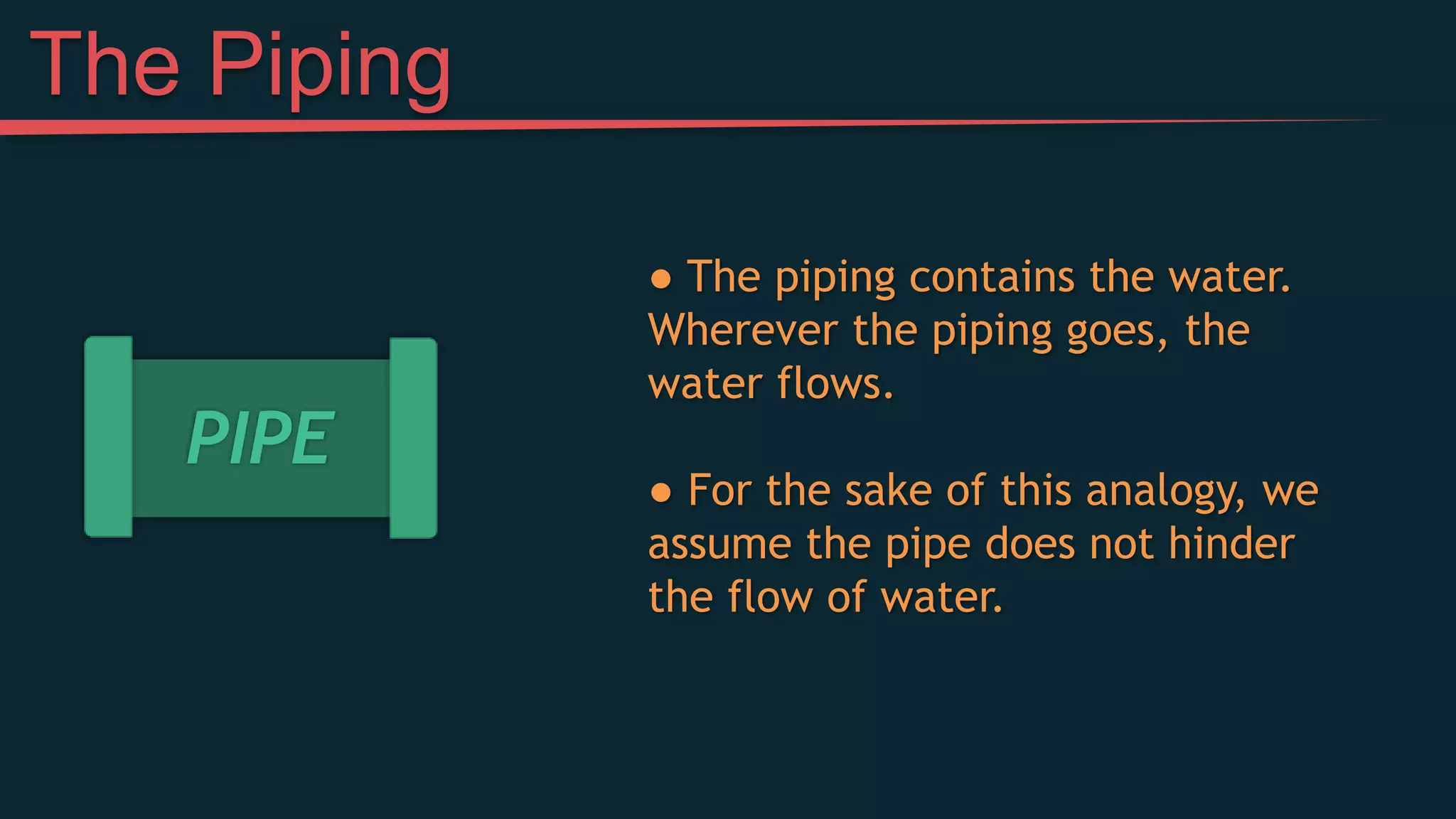
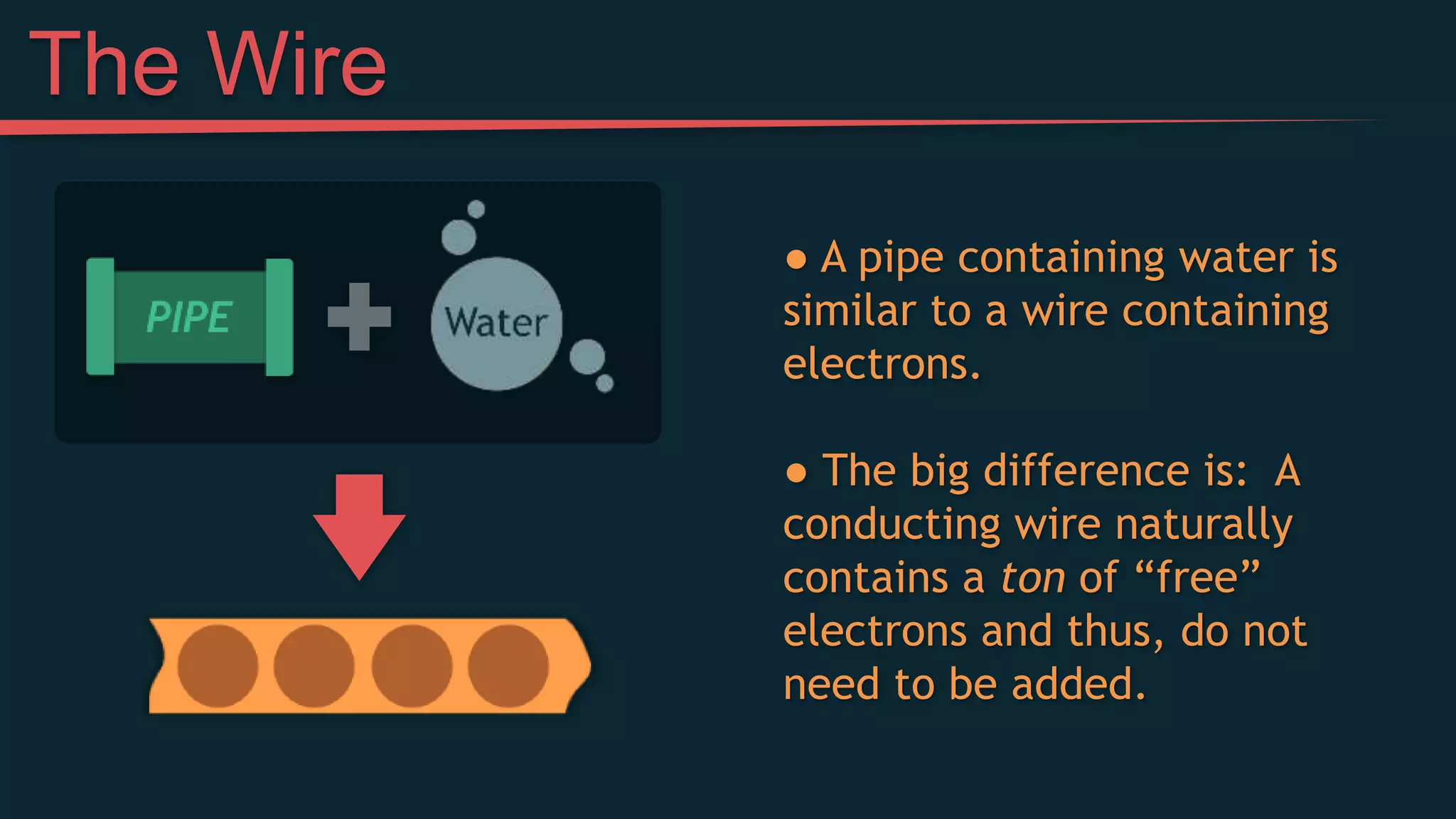
PIPE
● The piping contains the water.
Wherever the piping goes, the
water flows.
● For the sake of this analogy, we
assume the pipe does not hinder
the flow of water.
The Piping
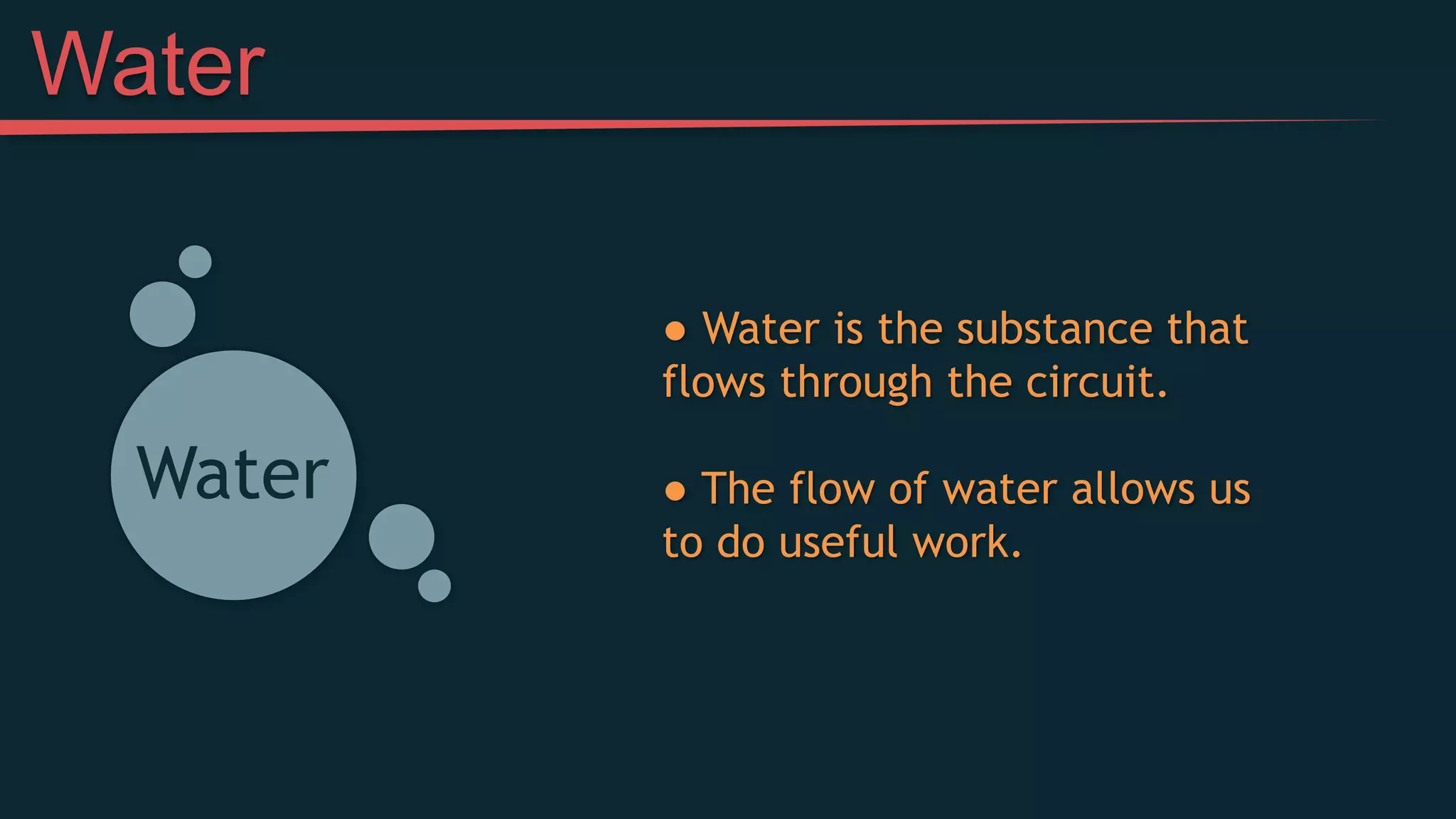
Water
● Water is the substance that
flows through the circuit.
● The flow of water allows us
to do useful work.
Water
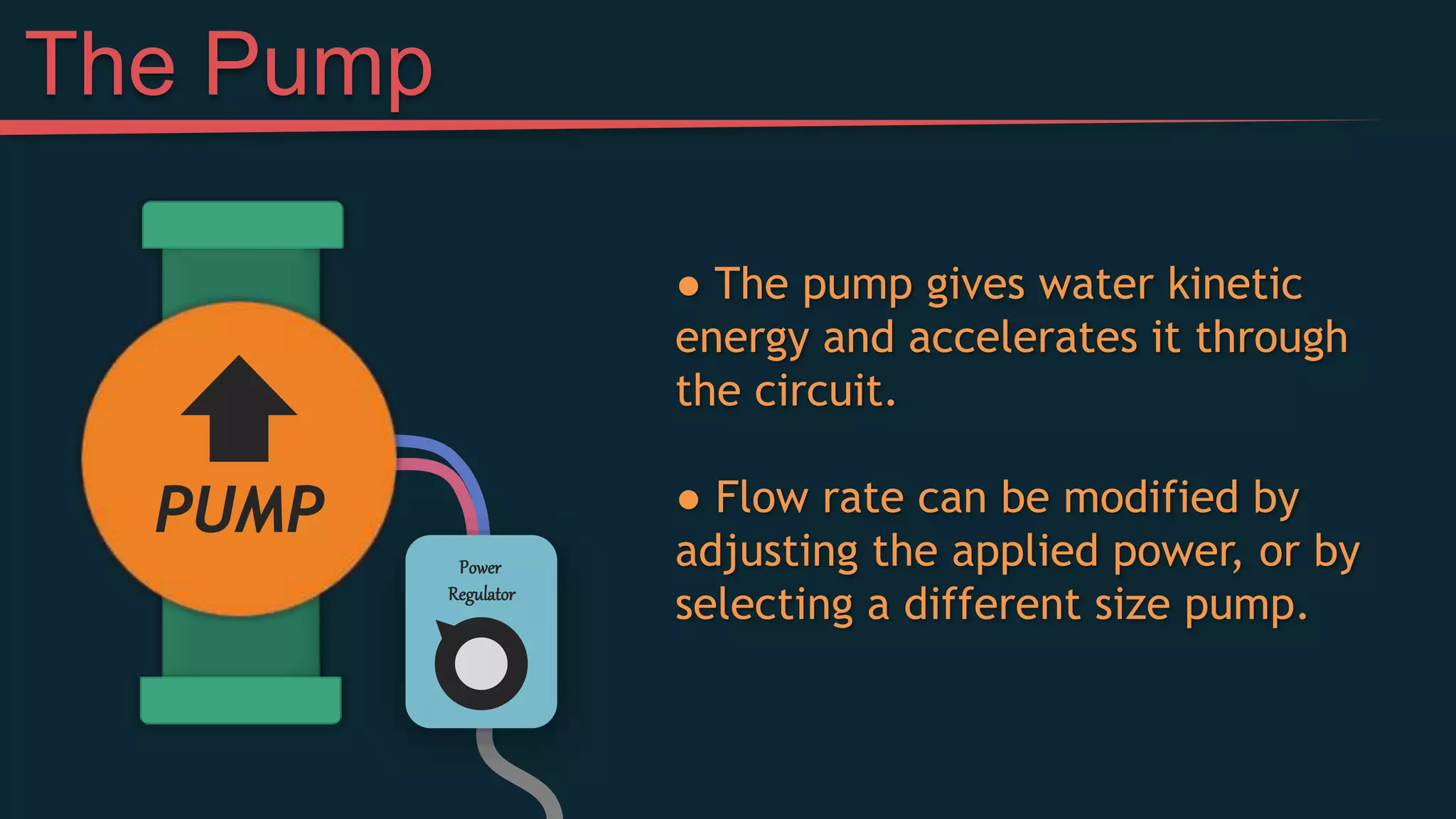
● The pump gives water kinetic
energy and accelerates it through
the circuit.
● Flow rate can be modified by
adjusting the applied power, or by
selecting a different size pump.
PUMP
Power
Regulator
The Pump
VALVE
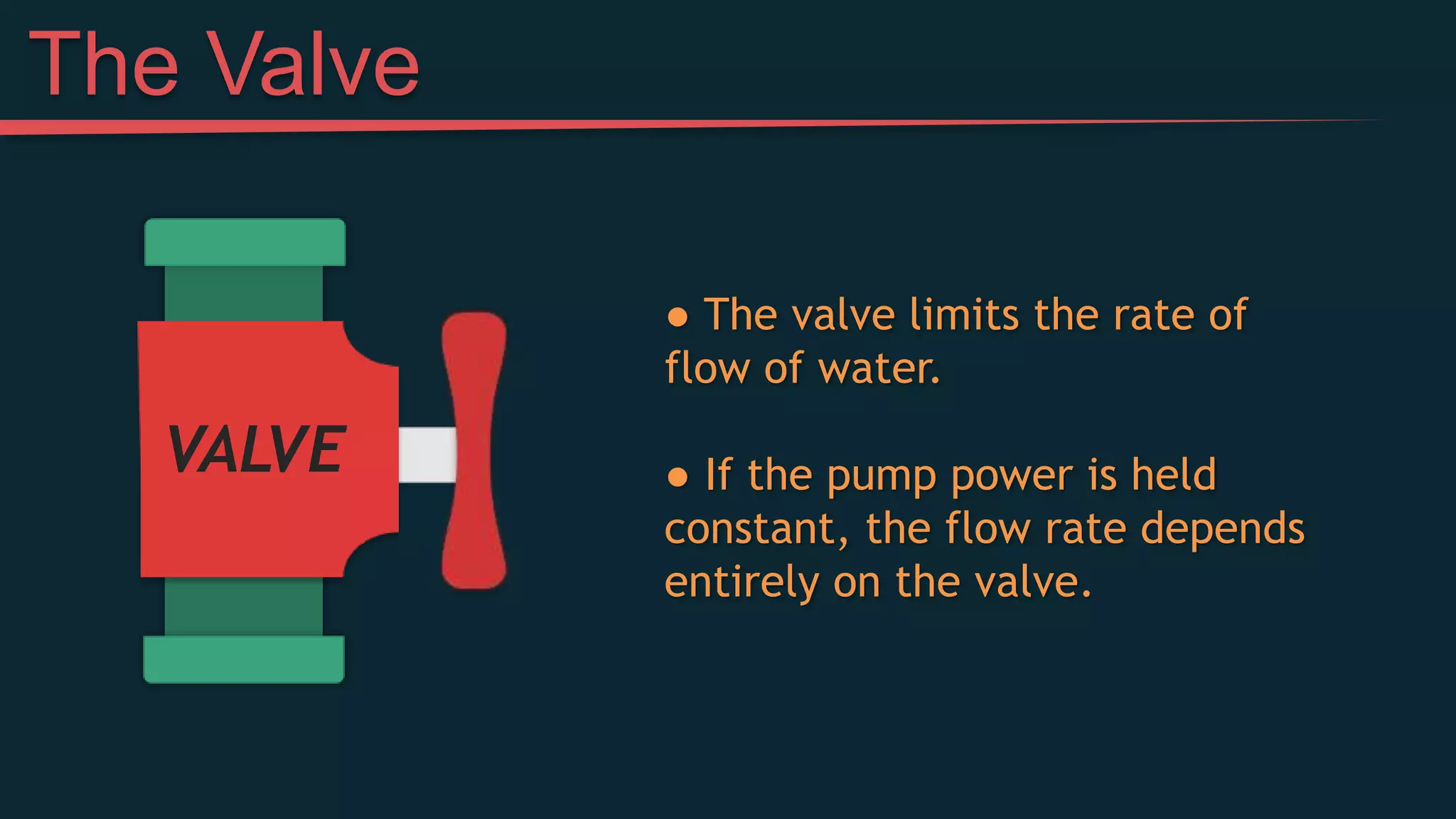
● The valve limits the rate of
flow of water.
● If the pump power is held
constant, the flow rate depends
entirely on the valve.
The Valve
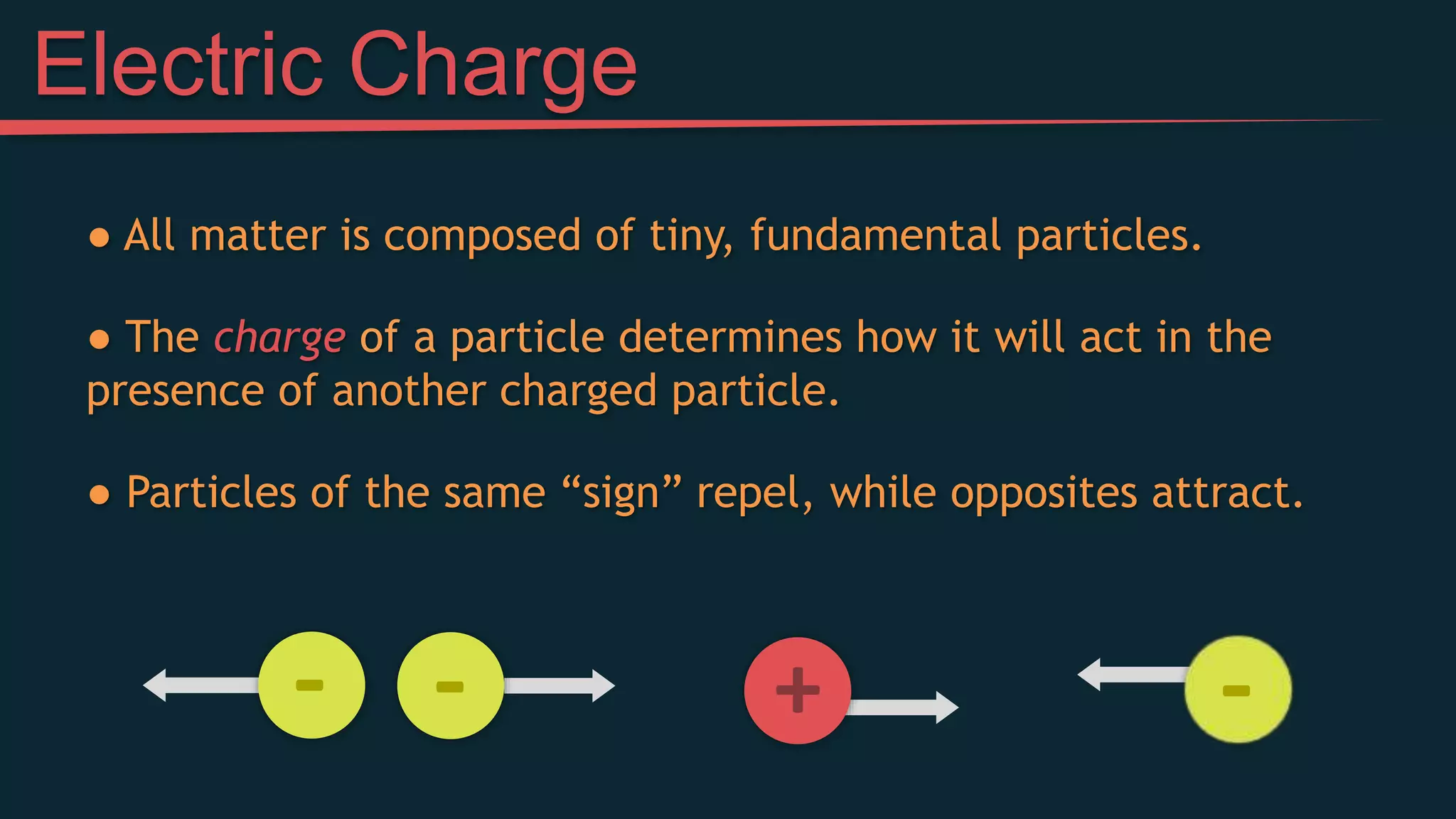
● All matter is composed of tiny, fundamental particles.
● The charge of a particle determines how it will act in the
presence of another charged particle.
● Particles of the same “sign” repel, while opposites attract.
+ -
Electric Charge
- -
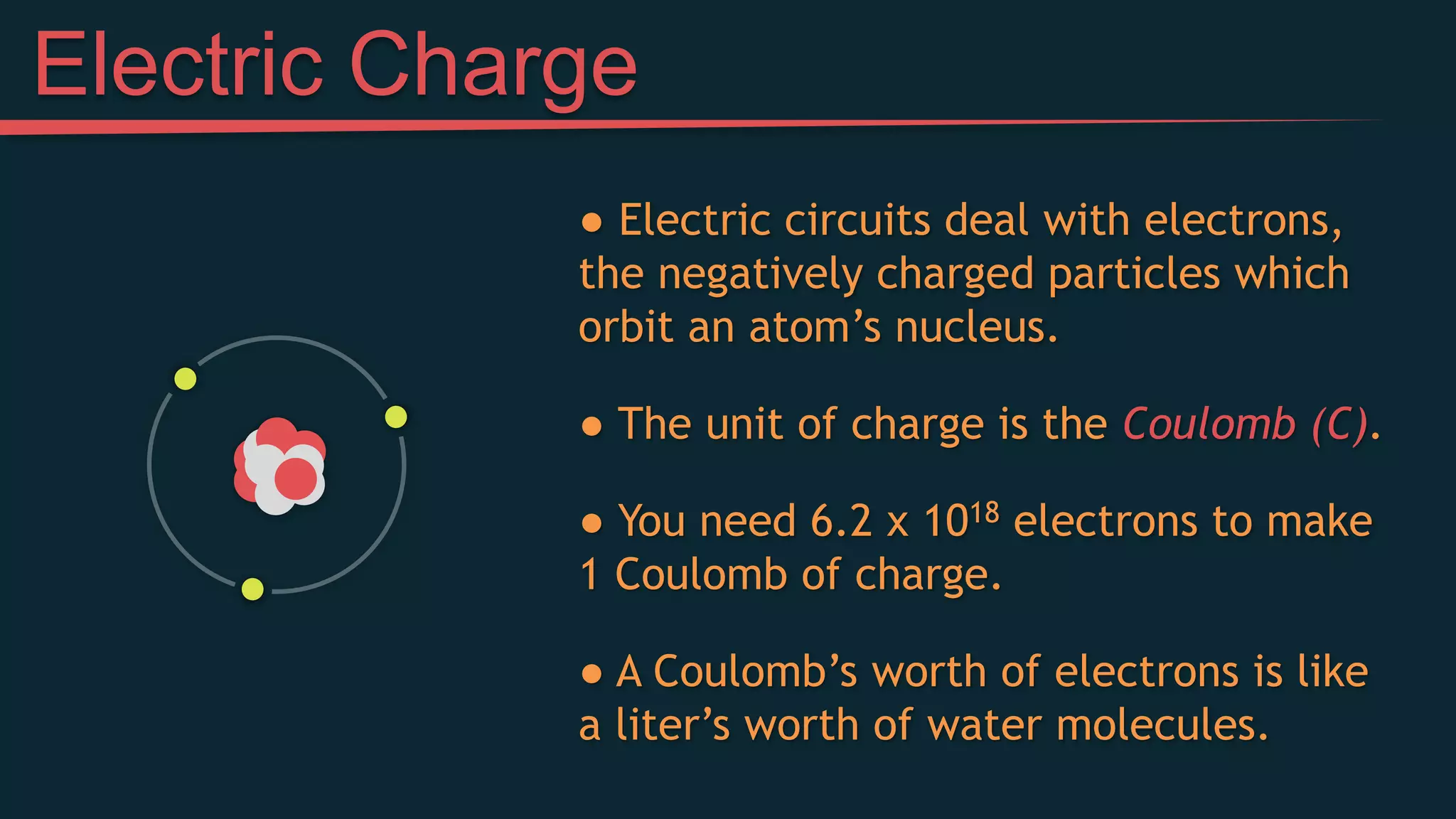
● Electric circuits deal with electrons,
the negatively charged particles which
orbit an atom’s nucleus.
● The unit of charge is the Coulomb (C).
● You need 6.2 x 10¹⁸ electrons to make
1 Coulomb of charge.
● A Coulomb’s worth of electrons is like
a liter’s worth of water molecules.
Electric Charge
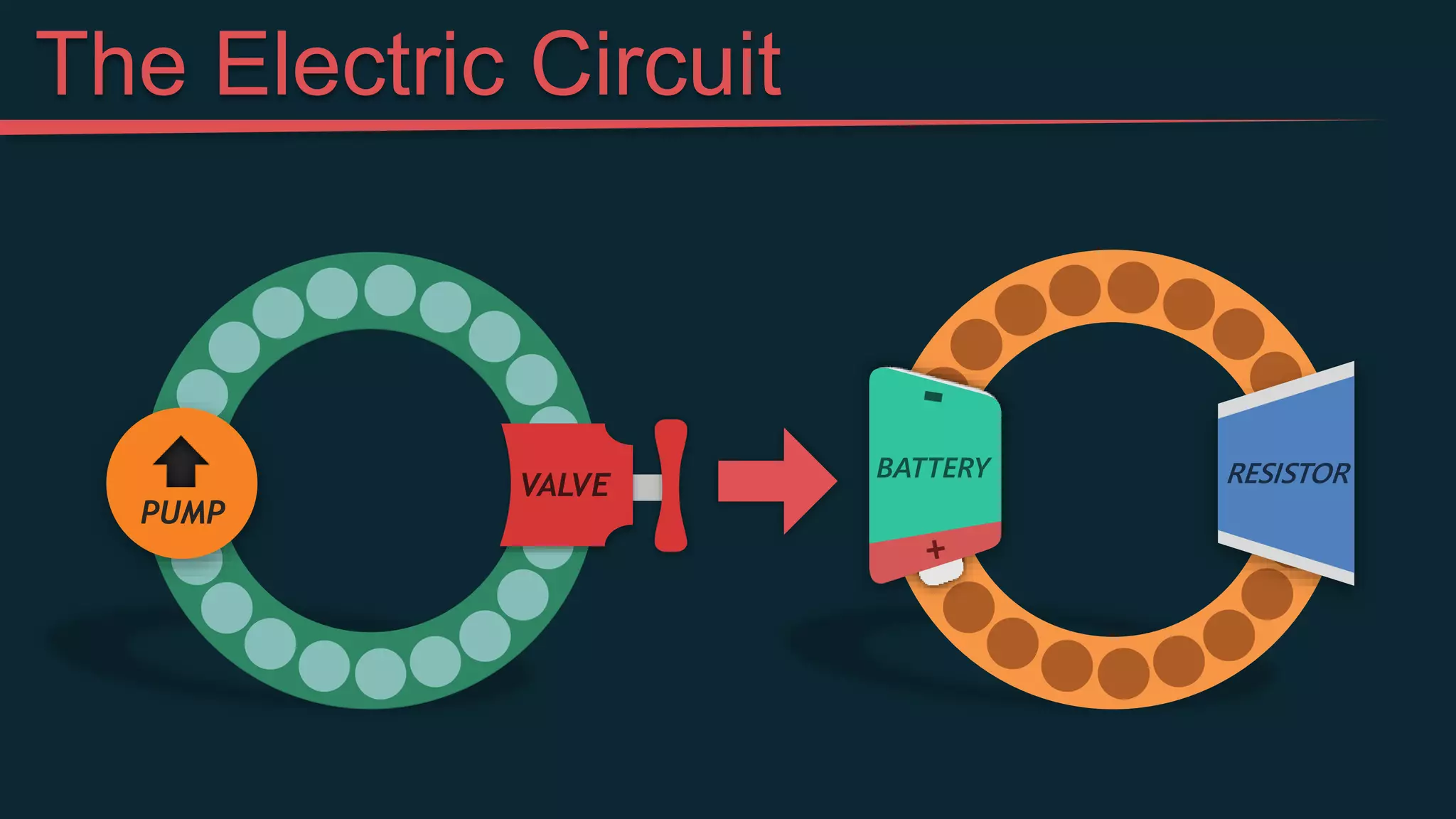
VALVE
PUMP
RESISTOR
BATTERY
The Electric Circuit
● A pipe containing water is
similar to a wire containing
electrons.
● The big difference is: A
conducting wire naturally
contains a ton of “free”
electrons and thus, do not
need to be added.
The Wire
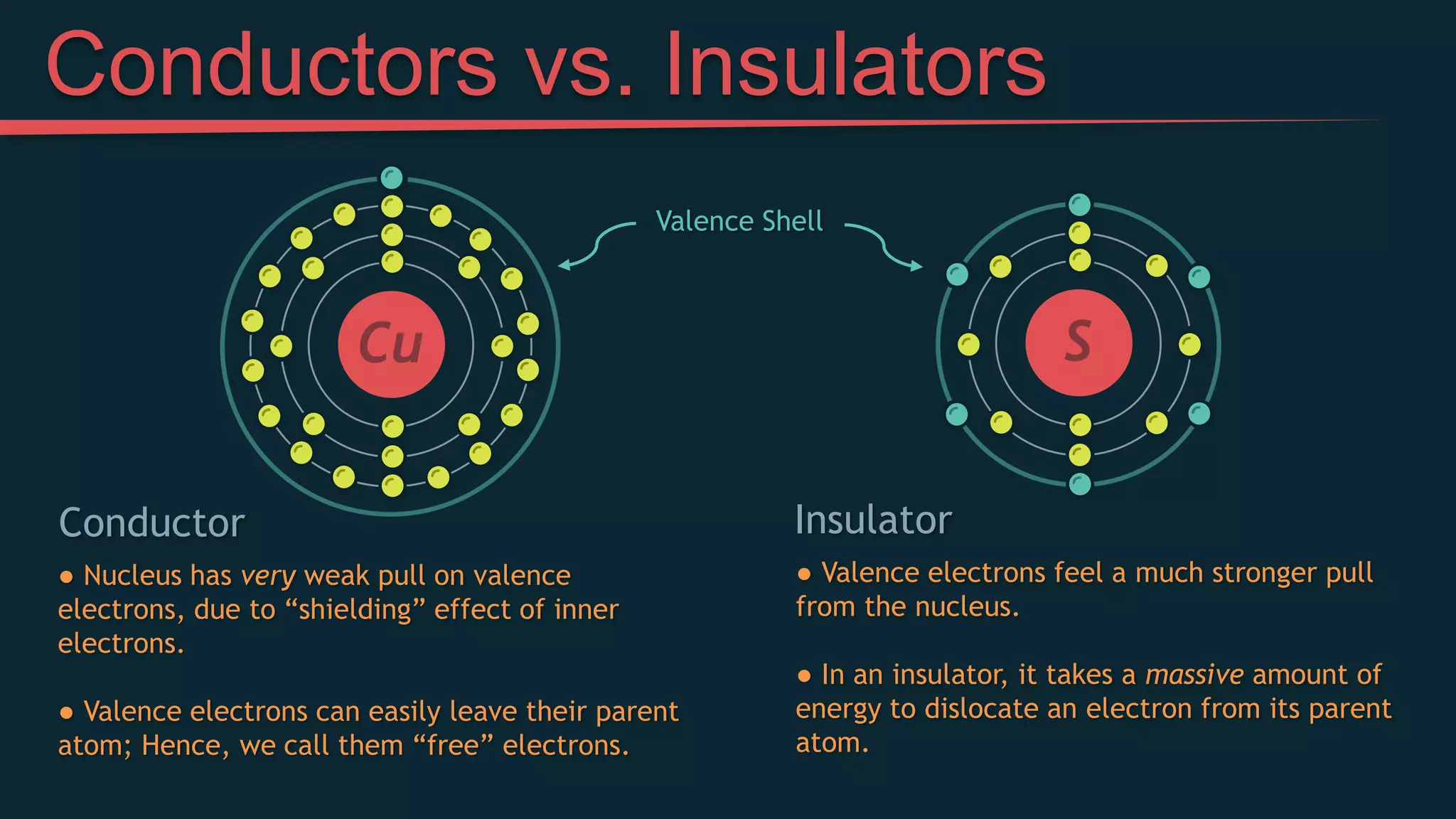
Conductors vs. Insulators
● Nucleus has very weak pull on valence
electrons, due to “shielding” effect of inner
electrons.
● Valence electrons can easily leave their parent
atom; Hence, we call them “free” electrons.
S
● Valence electrons feel a much stronger pull
from the nucleus.
● In an insulator, it takes a massive amount of
energy to dislocate an electron from its parent
atom.
Conductor Insulator
Cu
Valence Shell
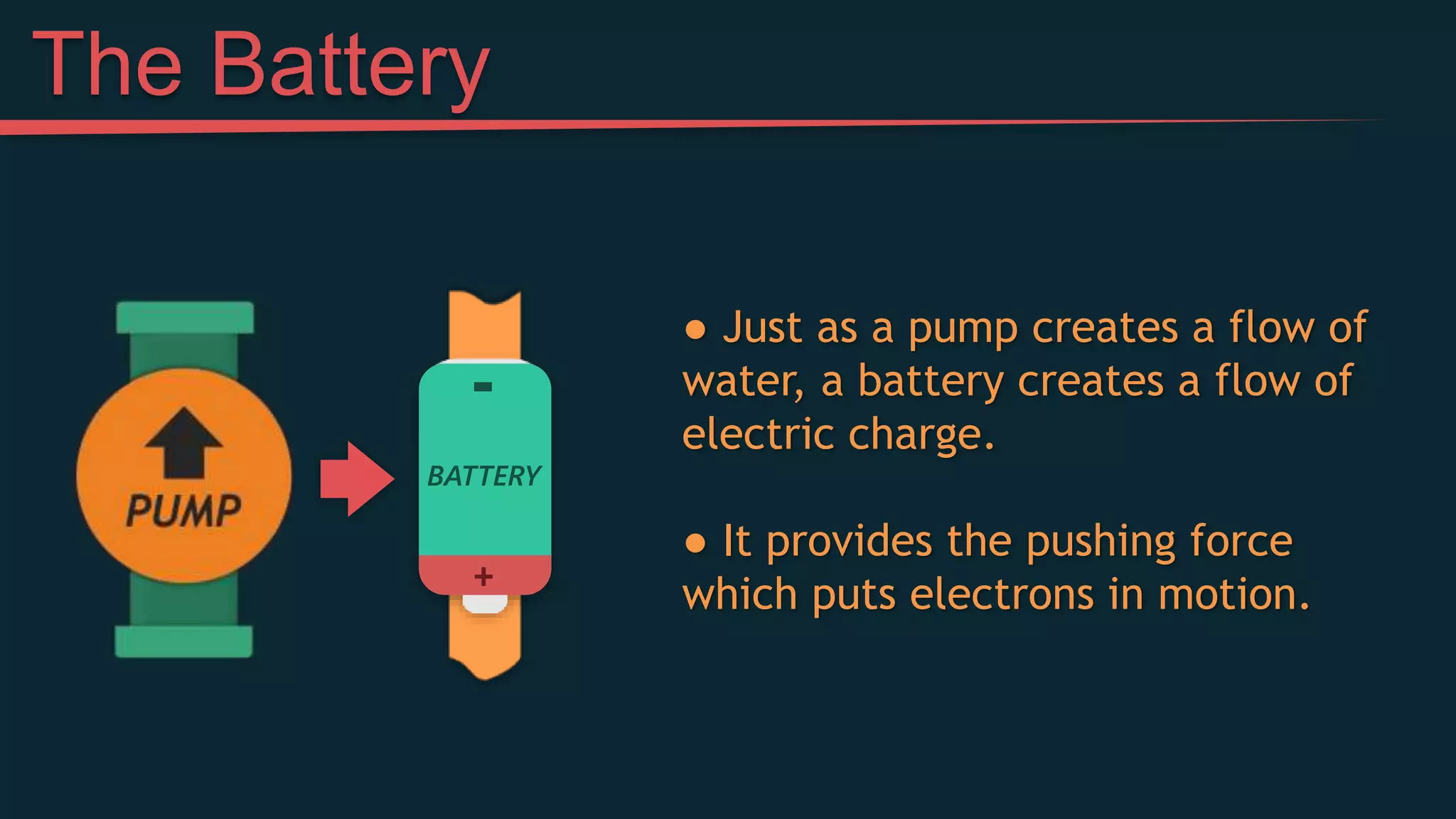
● Just as a pump creates a flow of
water, a battery creates a flow of
electric charge.
● It provides the pushing force
which puts electrons in motion.
-
The Battery
BATTERY
+
-
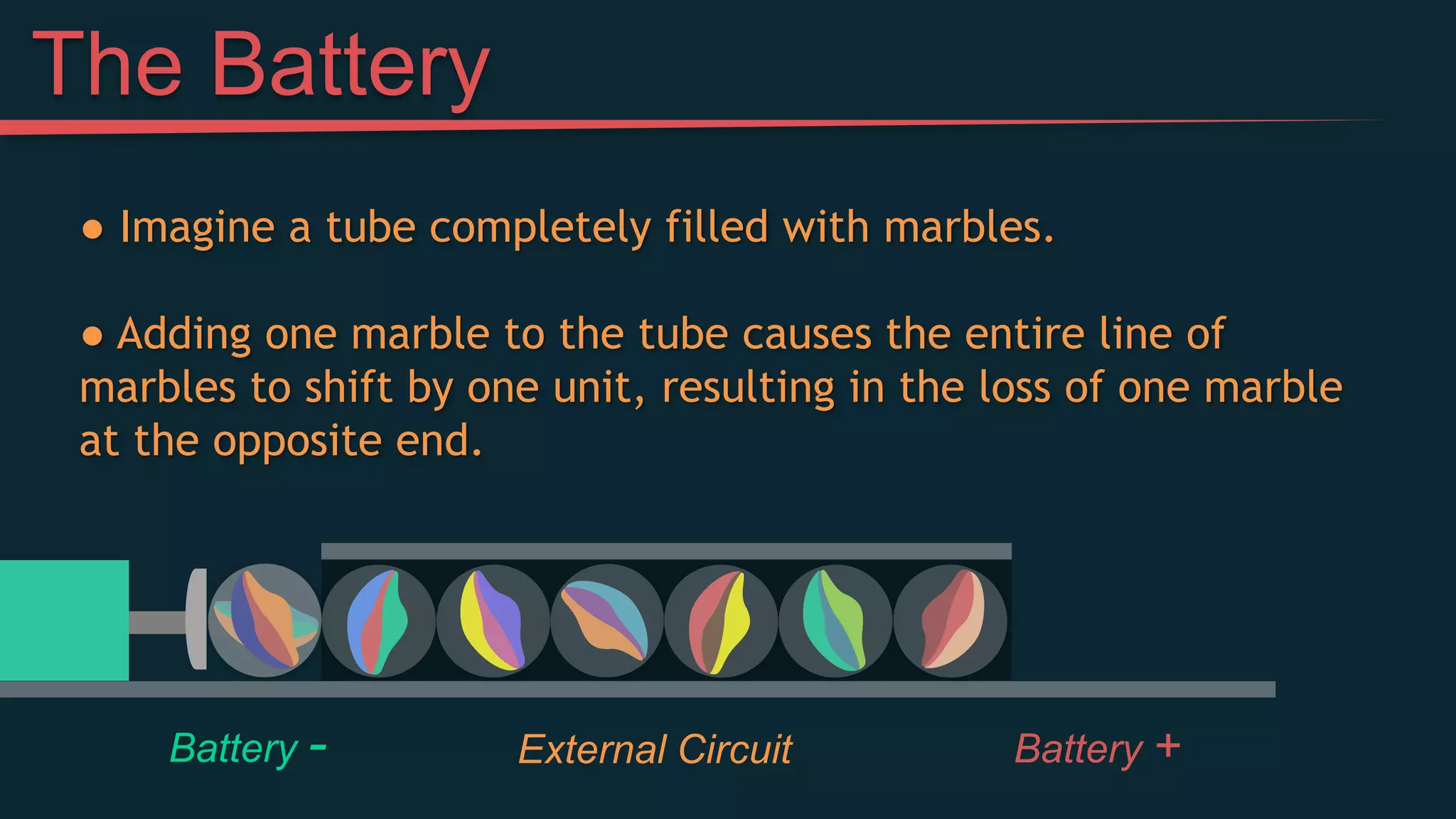
The Battery
Battery - Battery +
External Circuit
● Imagine a tube completely filled with marbles.
● Adding one marble to the tube causes the entire line of
marbles to shift by one unit, resulting in the loss of one marble
at the opposite end.
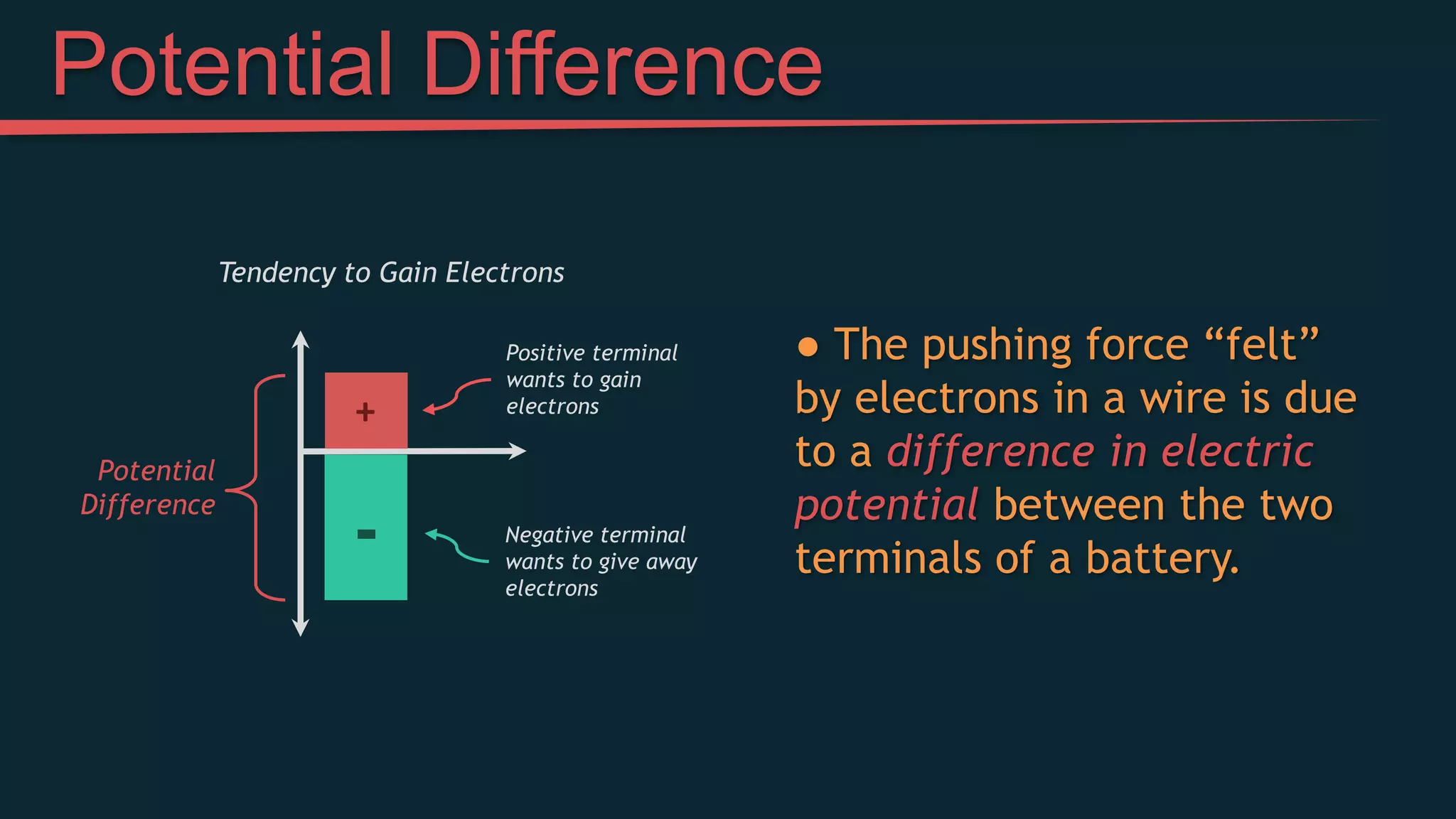
● The pushing force “felt”
by electrons in a wire is due
to a difference in electric
potential between the two
terminals of a battery.
Potential Difference
Tendency to Gain Electrons
+
Positive terminal
wants to gain
electrons
- Negative terminal
wants to give away
electrons
Potential
Difference
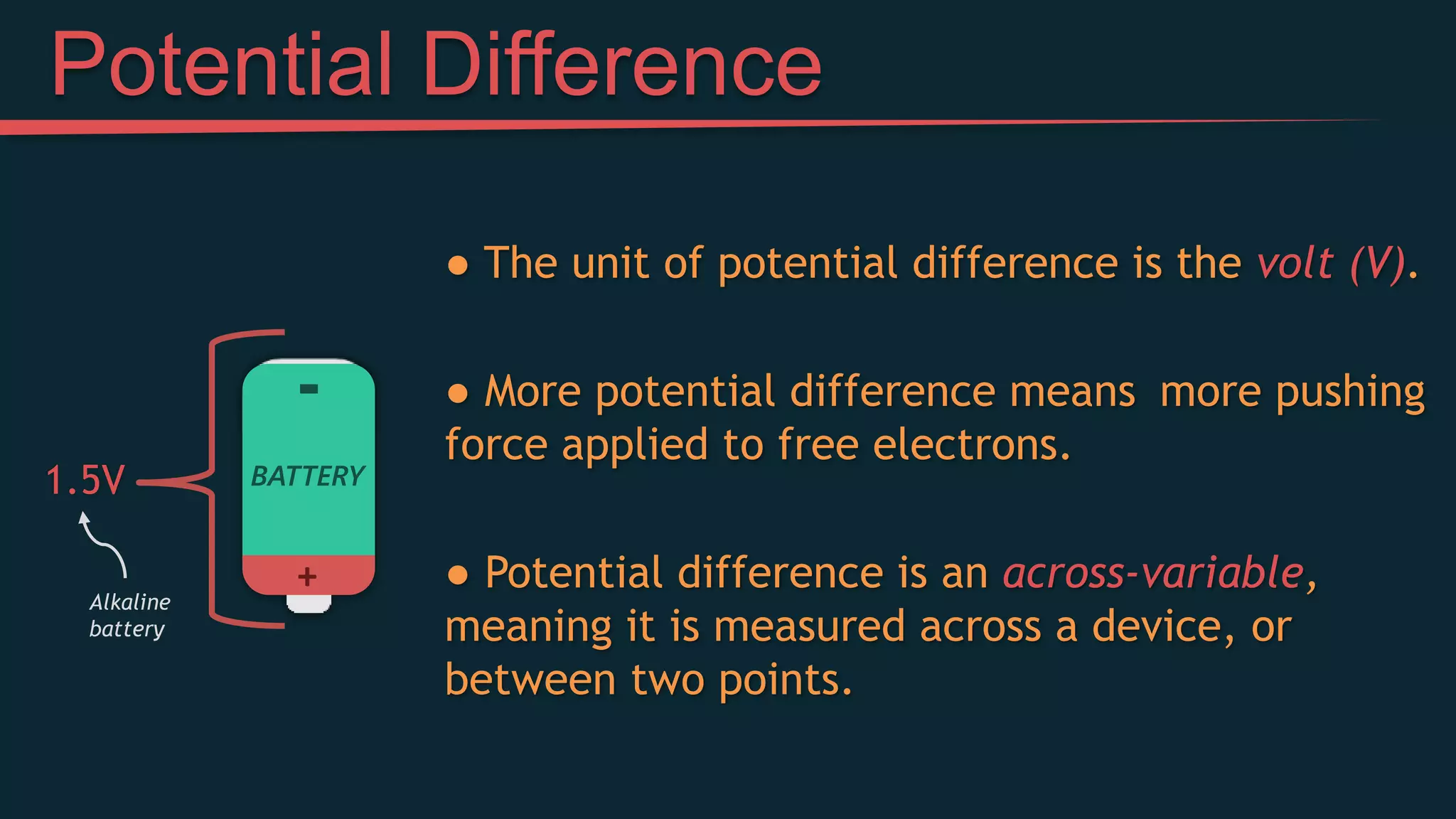
● The unit of potential difference is the volt (V).
● More potential difference means more pushing
force applied to free electrons.
● Potential difference is an across-variable,
meaning it is measured across a device, or
between two points.
1.5V BATTERY
-
+
Potential Difference
Alkaline
battery
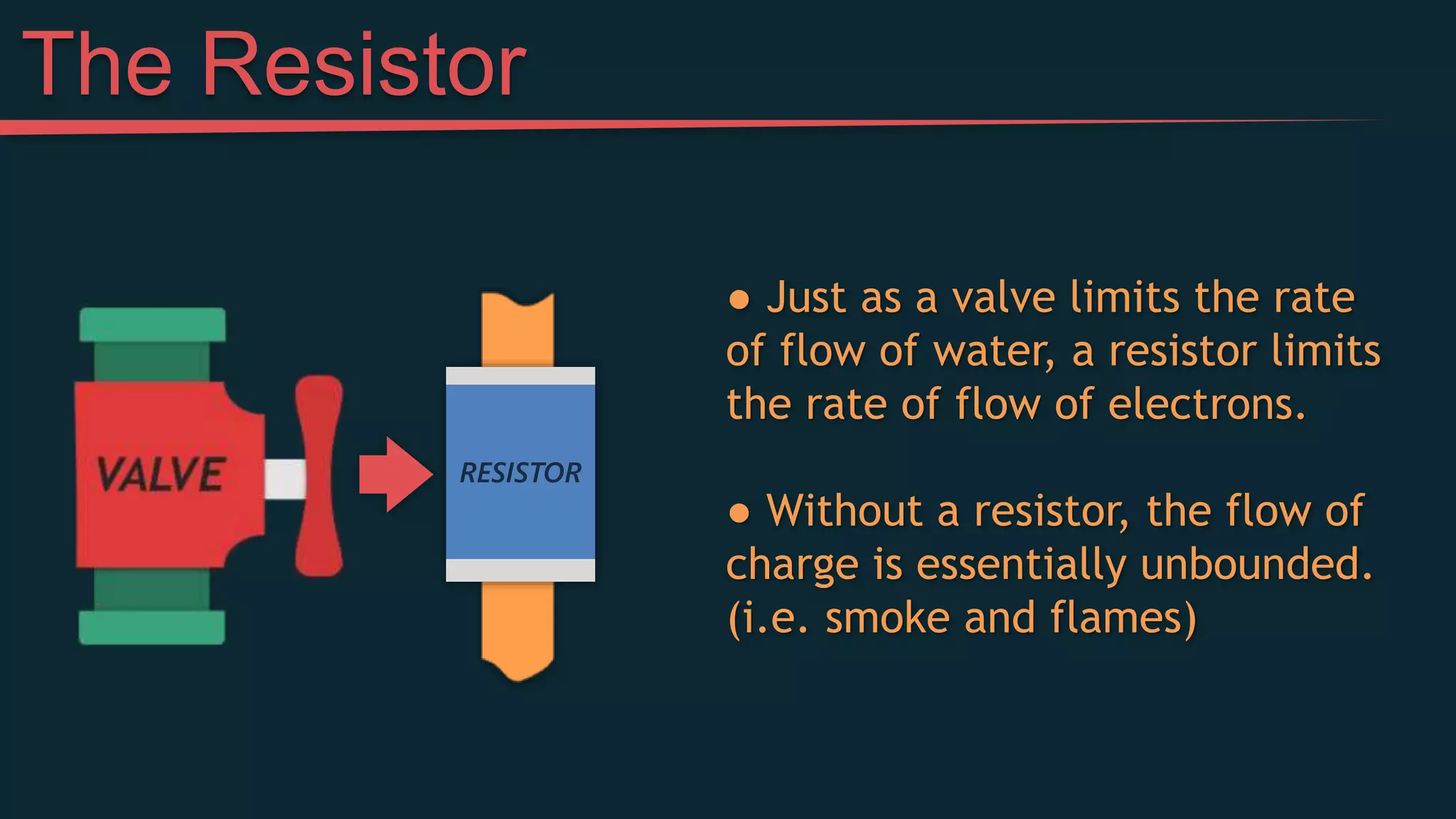
● Just as a valve limits the rate
of flow of water, a resistor limits
the rate of flow of electrons.
● Without a resistor, the flow of
charge is essentially unbounded.
(i.e. smoke and flames)
RESISTOR
The Resistor
Resistance
RES
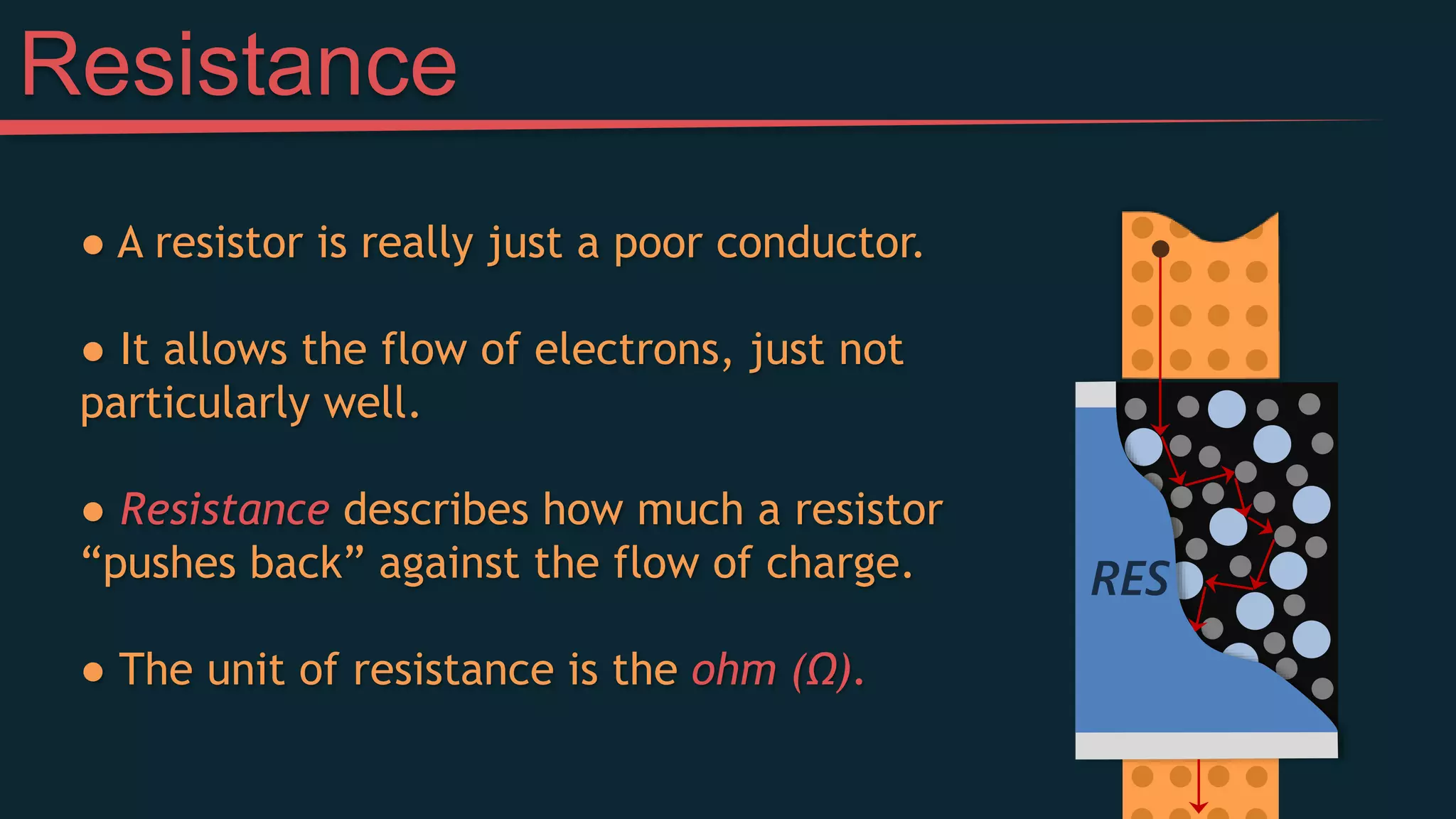
● A resistor is really just a poor conductor.
● It allows the flow of electrons, just not
particularly well.
● Resistance describes how much a resistor
“pushes back” against the flow of charge.
● The unit of resistance is the ohm (Ω).
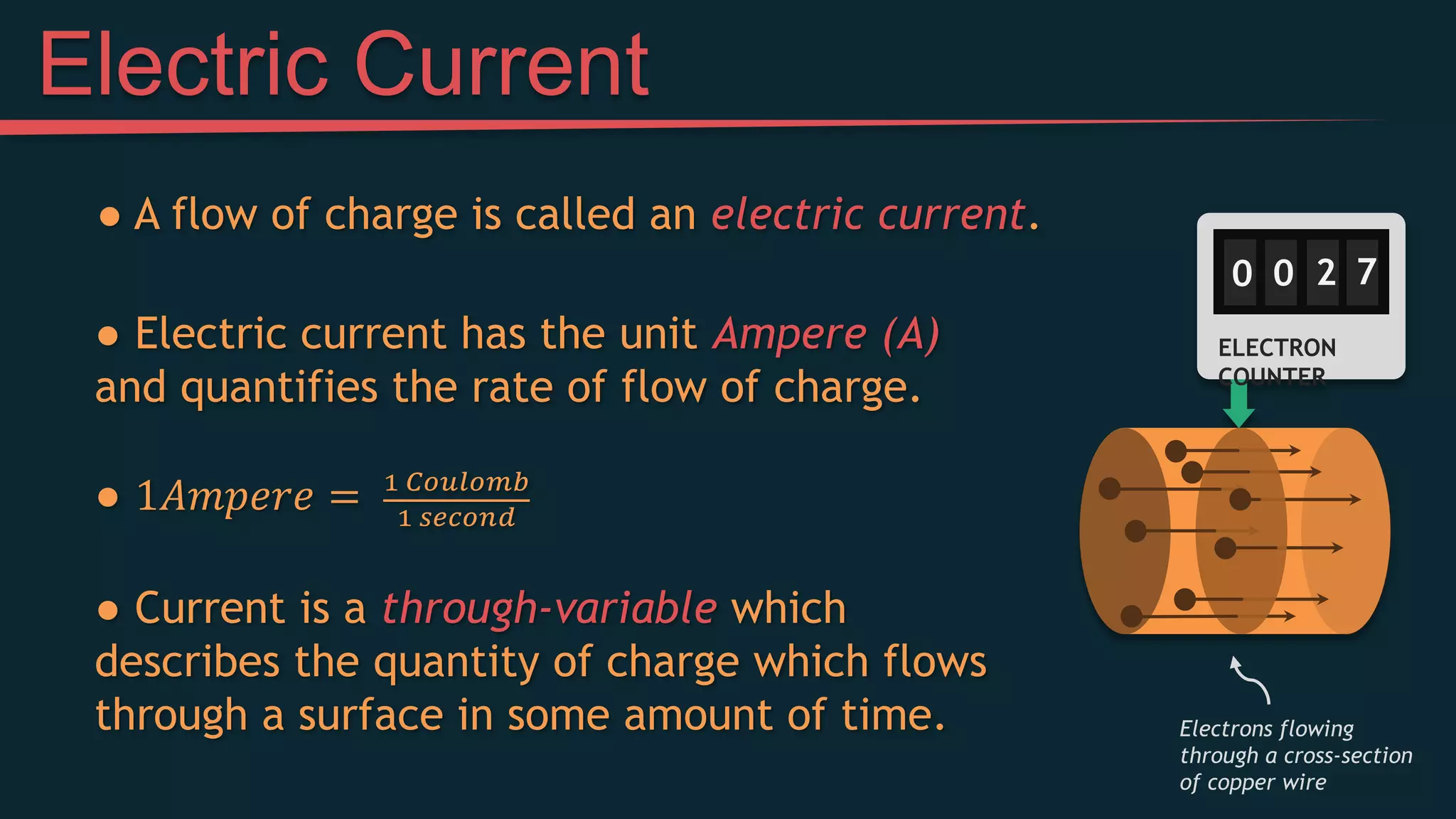
● Electric current has the unit Ampere (A)
and quantifies the rate of flow of charge.
● 1𝐴𝑚𝑝𝑒𝑟𝑒 = 1 𝐶𝑜𝑢𝑙𝑜𝑚𝑏
1 𝑠𝑒𝑐𝑜𝑛𝑑
● Current is a through-variable which
describes the quantity of charge which flows
through a surface in some amount of time.
Electric Current
Electrons flowing
through a cross-section
of copper wire
ELECTRON
COUNTER
0 0 2 7
● A flow of charge is called an electric current.
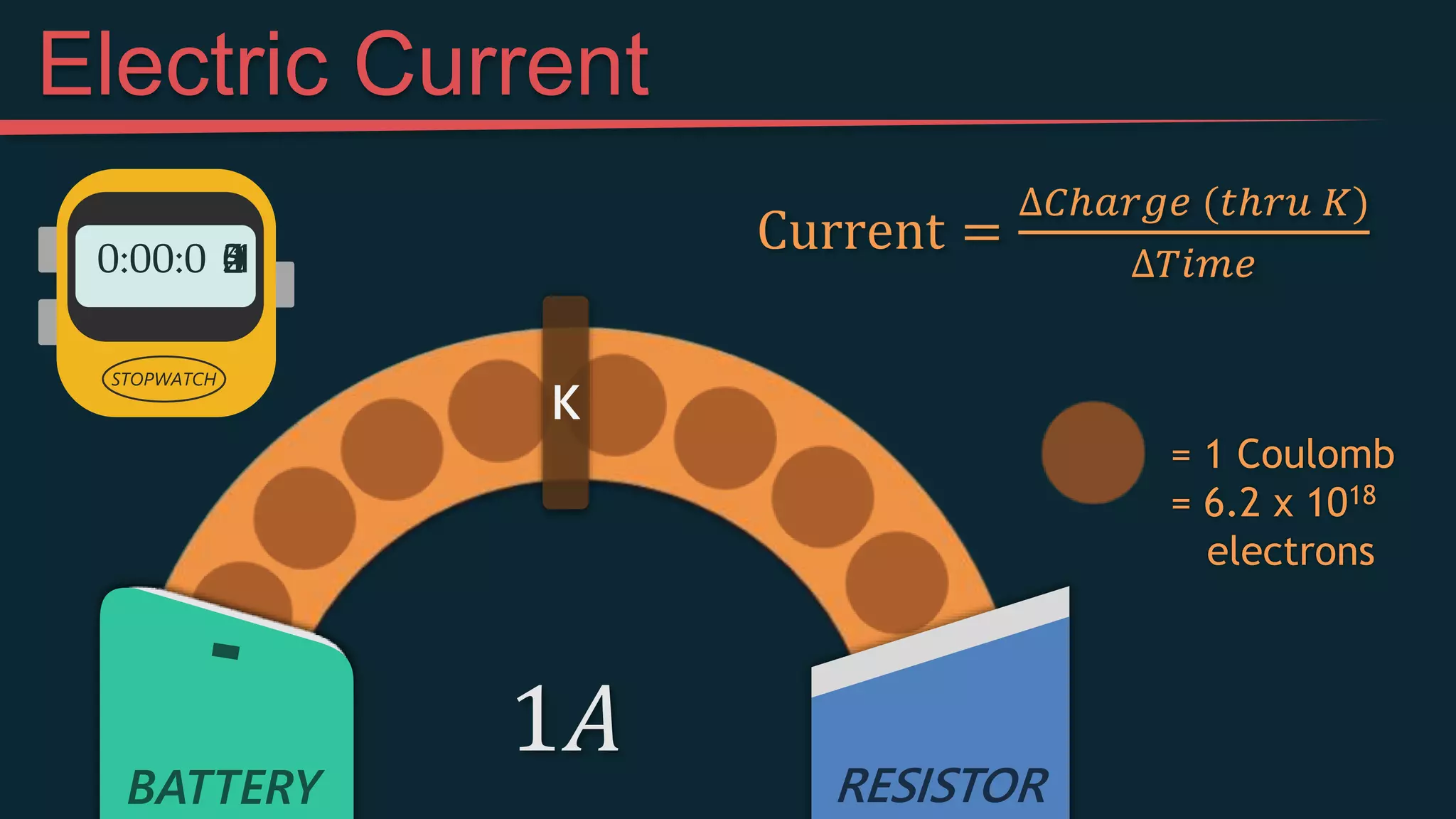
K
Current =
∆𝐶ℎ𝑎𝑟𝑔𝑒 (𝑡ℎ𝑟𝑢 𝐾)
∆𝑇𝑖𝑚𝑒
= 1 Coulomb
= 6.2 x 10¹⁸
electrons
BATTERY RESISTOR
Electric Current
STOPWATCH
0:00:0 0
1
2
3
4
5
1𝐴
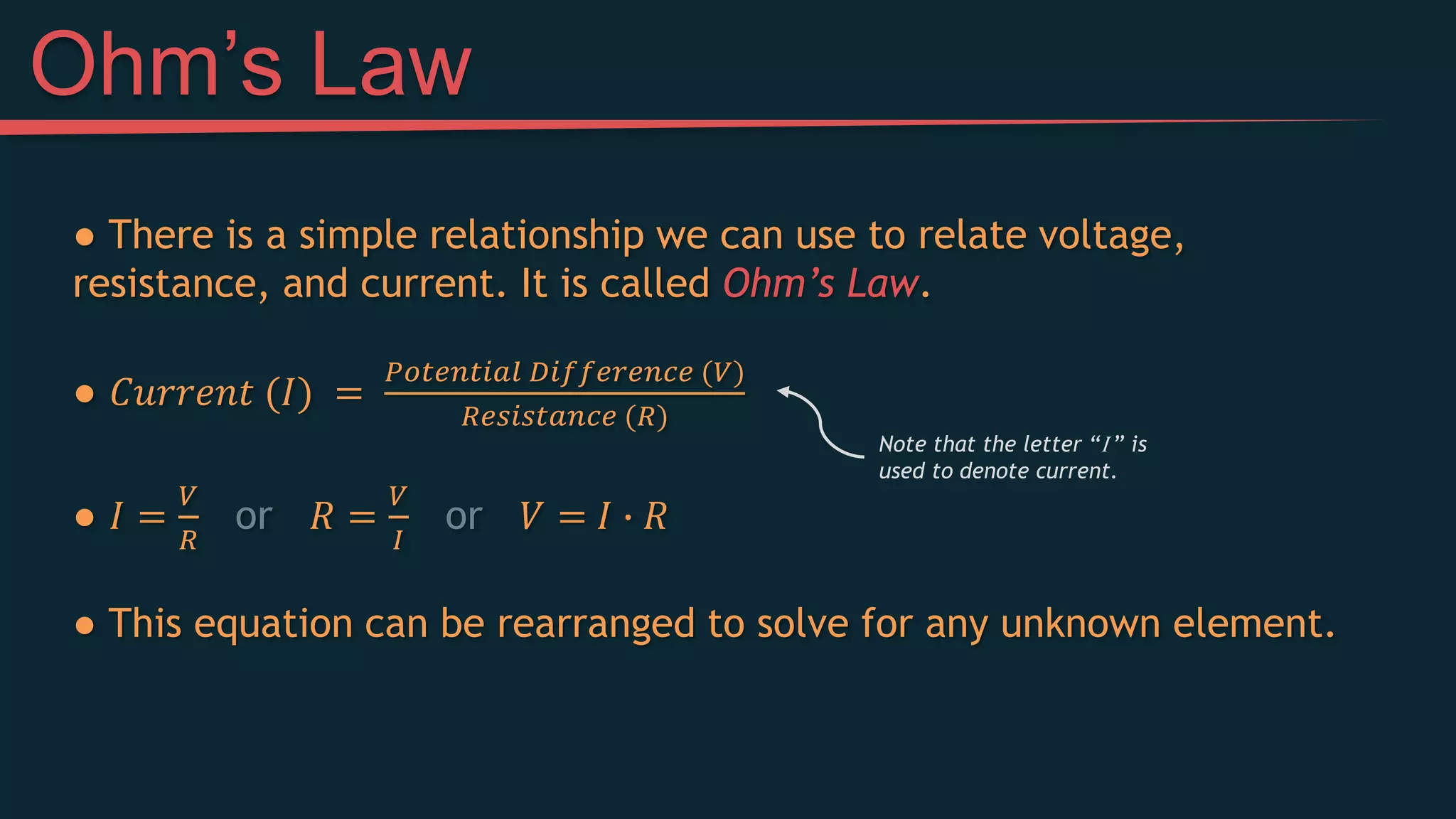
● There is a simple relationship we can use to relate voltage,
resistance, and current. It is called Ohm’s Law.
● 𝐶𝑢𝑟𝑟𝑒𝑛𝑡 (𝐼) =
𝑃𝑜𝑡𝑒𝑛𝑡𝑖𝑎𝑙 𝐷𝑖𝑓𝑓𝑒𝑟𝑒𝑛𝑐𝑒 (𝑉)
𝑅𝑒𝑠𝑖𝑠𝑡𝑎𝑛𝑐𝑒 (𝑅)
● 𝐼 =
𝑉
𝑅
or 𝑅 =
𝑉
𝐼
or 𝑉 = 𝐼 ∙ 𝑅
● This equation can be rearranged to solve for any unknown element.
Ohm’s Law
Note that the letter “I ” is
used to denote current.
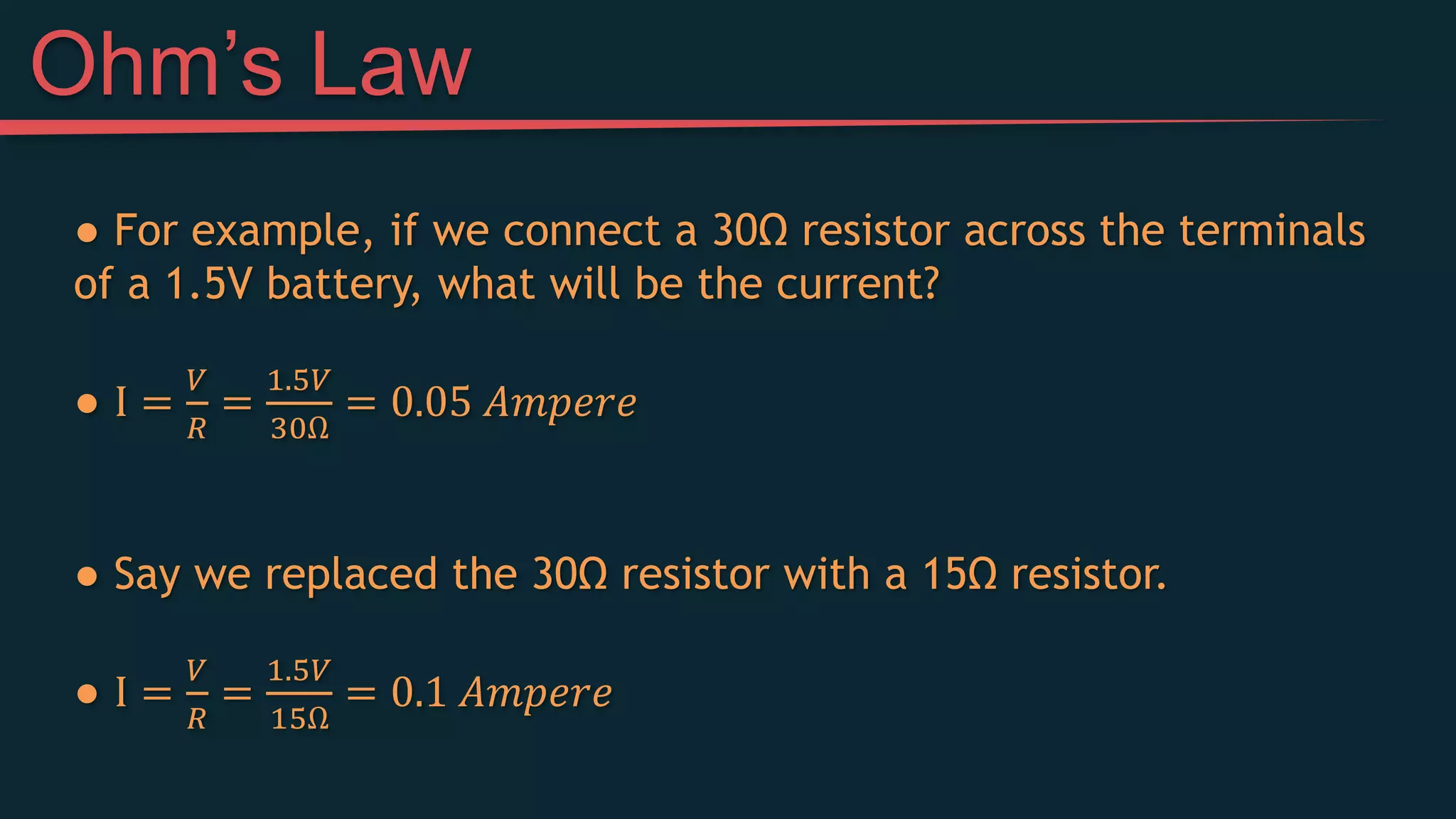
● For example, if we connect a 30Ω resistor across the terminals
of a 1.5V battery, what will be the current?
● I =
𝑉
𝑅
=
1.5𝑉
30Ω
= 0.05 𝐴𝑚𝑝𝑒𝑟𝑒
● Say we replaced the 30Ω resistor with a 15Ω resistor.
● I =
𝑉
𝑅
=
1.5𝑉
15Ω
= 0.1 𝐴𝑚𝑝𝑒𝑟𝑒
Ohm’s Law
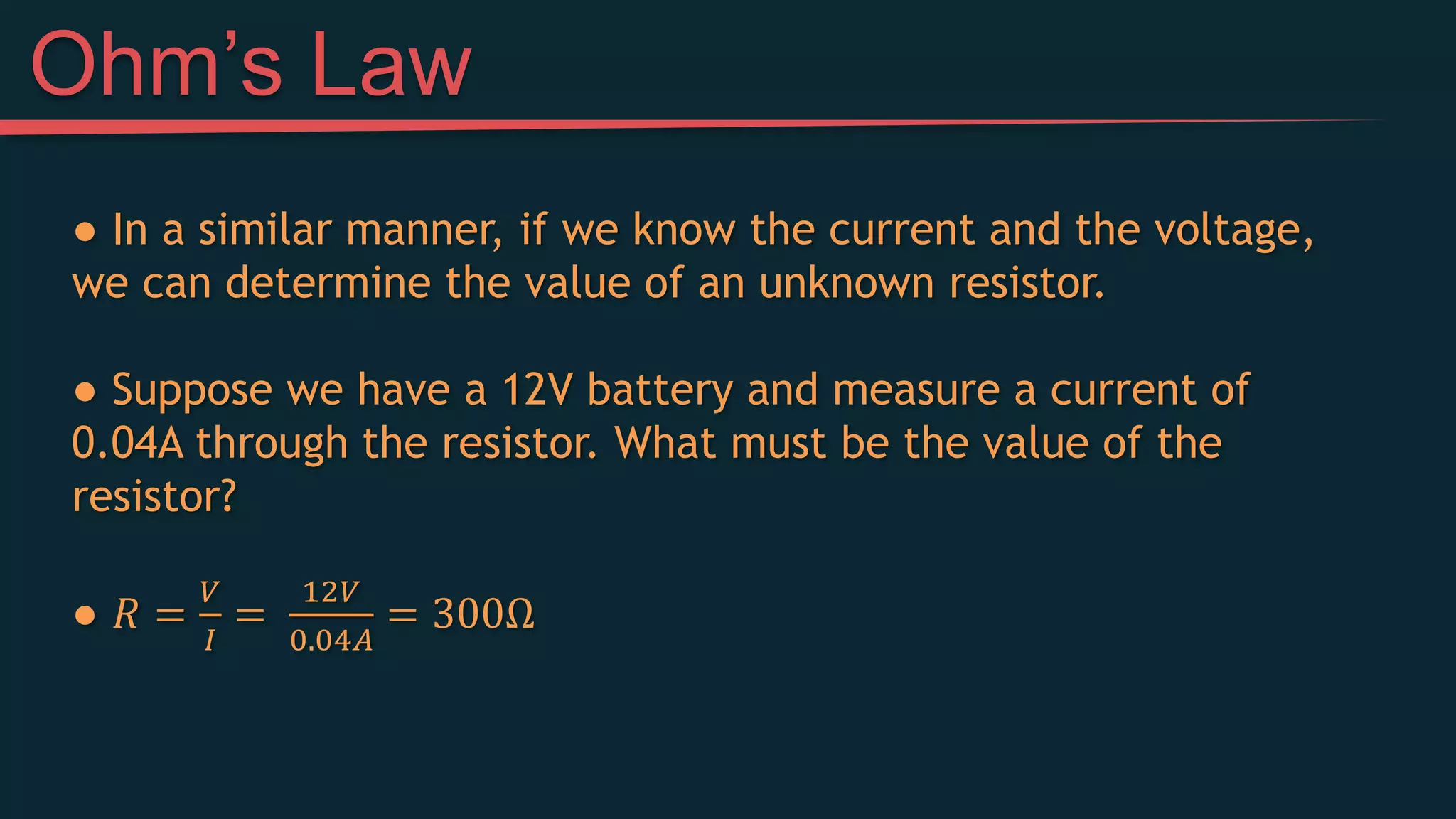
● In a similar manner, if we know the current and the voltage,
we can determine the value of an unknown resistor.
● Suppose we have a 12V battery and measure a current of
0.04A through the resistor. What must be the value of the
resistor?
● 𝑅 =
𝑉
𝐼
=
12𝑉
0.04𝐴
= 300Ω
Ohm’s Law
Resistors…What’s the Point?
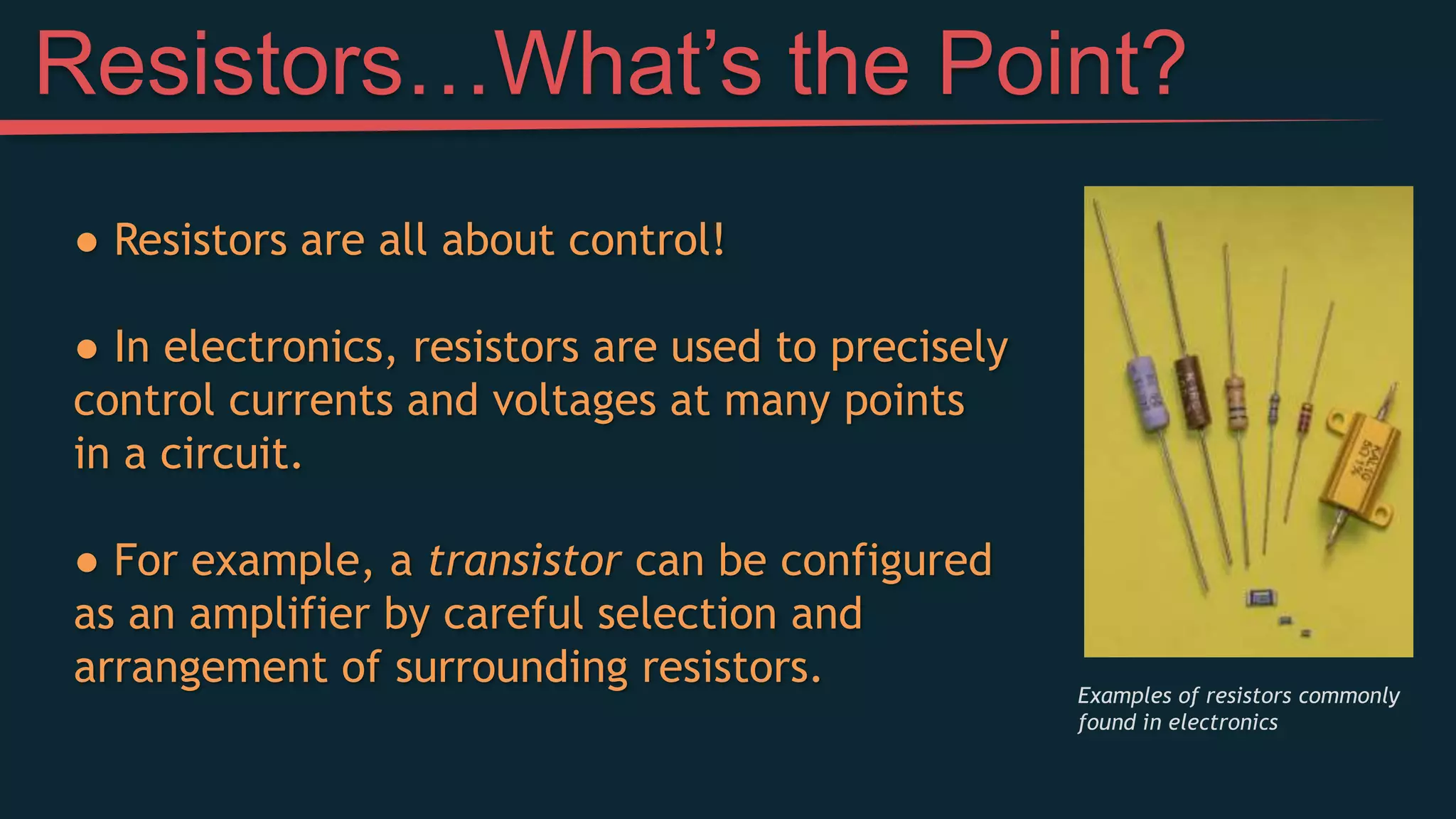
● Resistors are all about control!
● In electronics, resistors are used to precisely
control currents and voltages at many points
in a circuit.
● For example, a transistor can be configured
as an amplifier by careful selection and
arrangement of surrounding resistors. Examples of resistors commonly
found in electronics
Electrical Loads
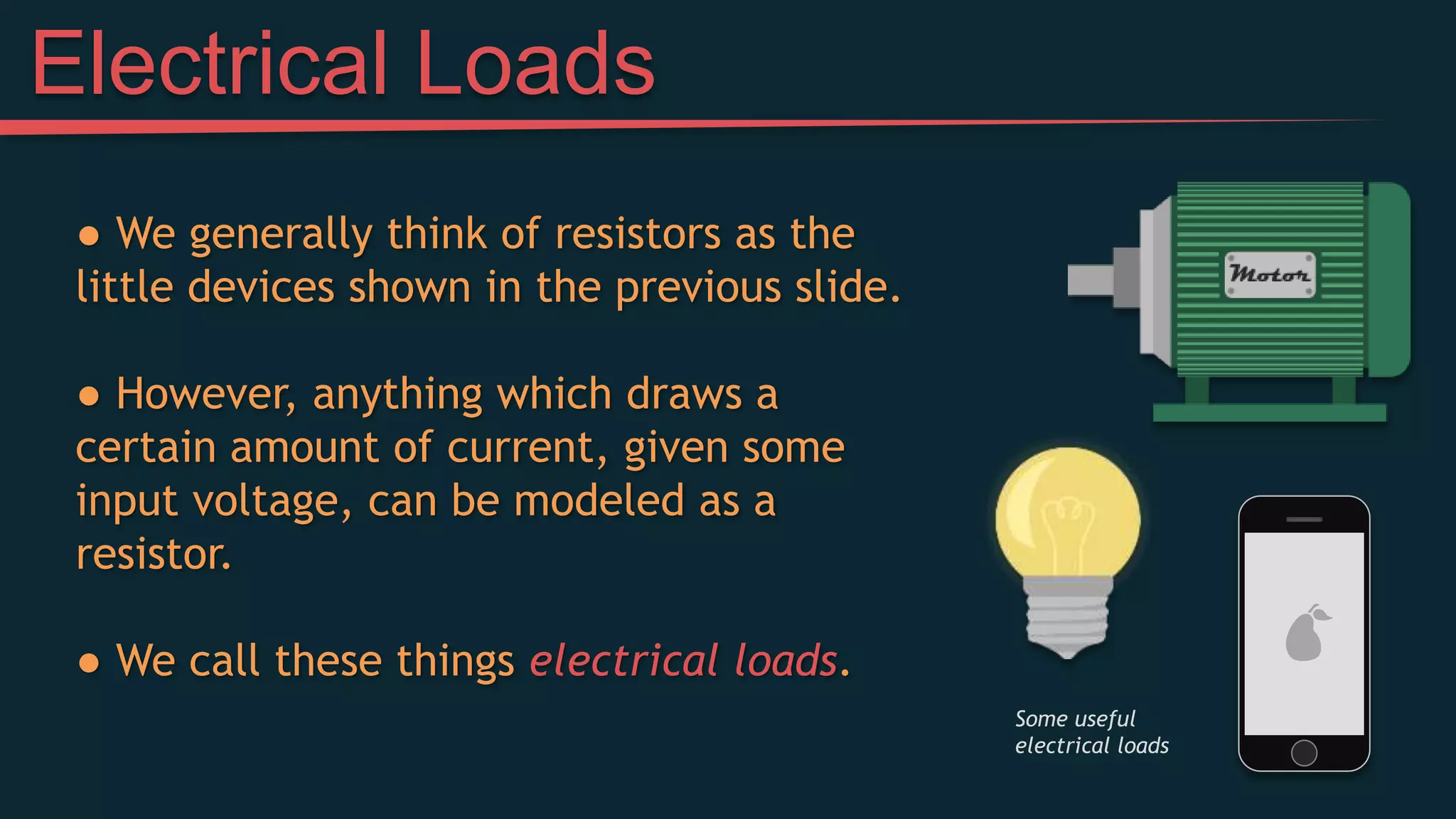
● We generally think of resistors as the
little devices shown in the previous slide.
● However, anything which draws a
certain amount of current, given some
input voltage, can be modeled as a
resistor.
● We call these things electrical loads.
Some useful
electrical loads
V
A COM
MULTIMETER
1.500
DIGITAL
V
A
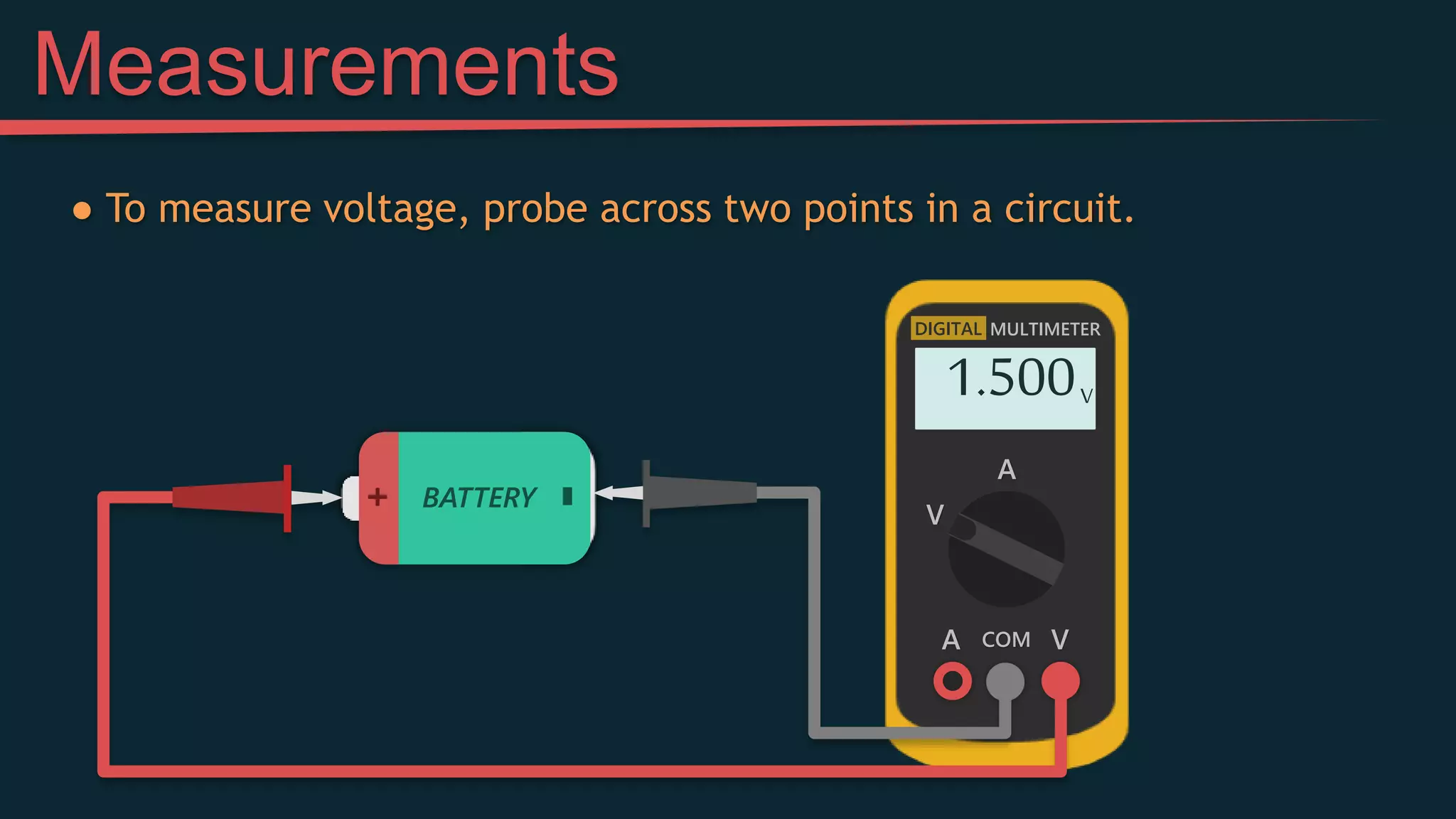
● To measure voltage, probe across two points in a circuit.
BATTERY
-
+
Measurements
V
V
A COM
MULTIMETER
0.050
DIGITAL
V
A
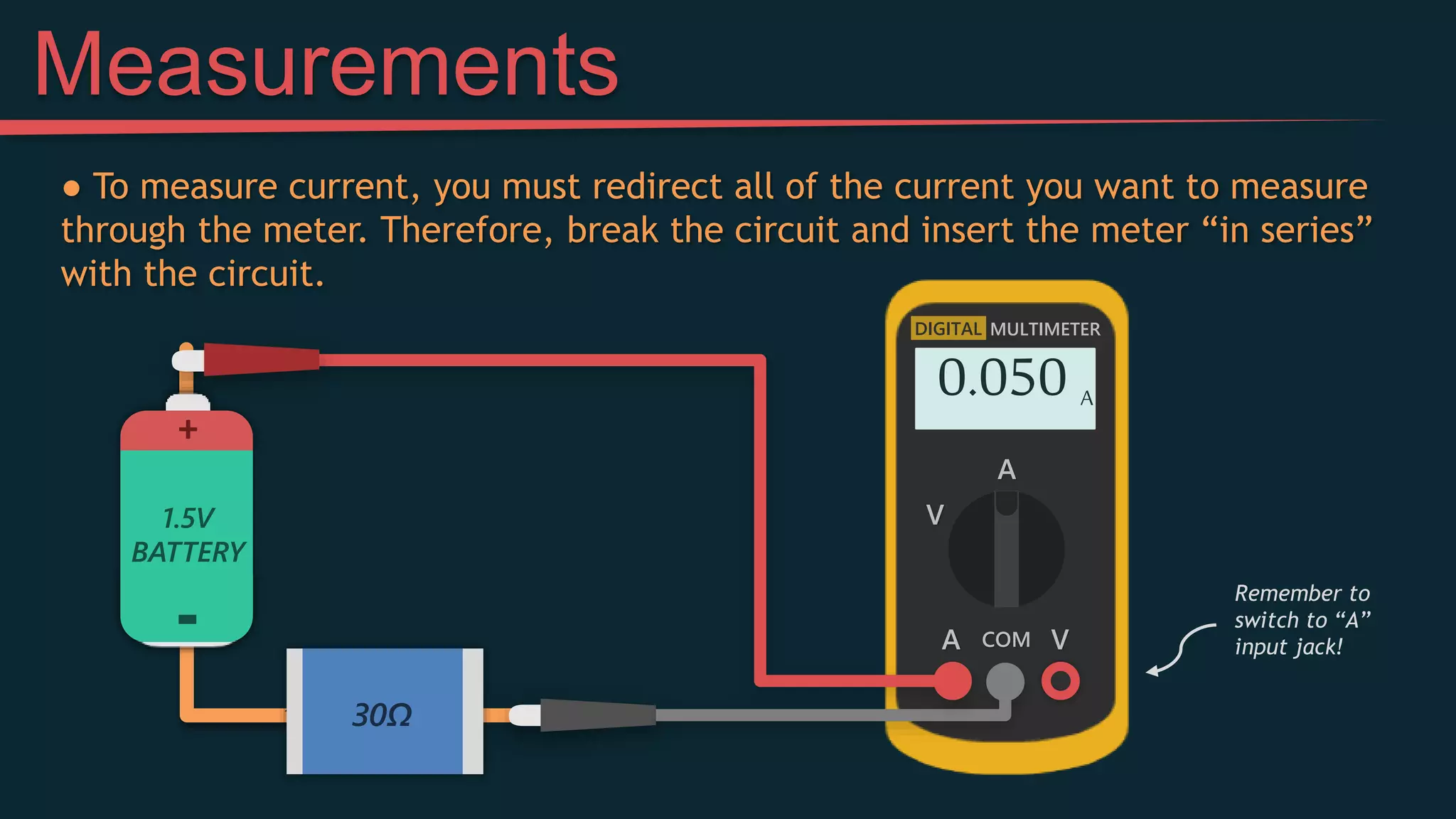
● To measure current, you must redirect all of the current you want to measure
through the meter. Therefore, break the circuit and insert the meter “in series”
with the circuit.
Measurements
30Ω
A
1.5V
BATTERY
-
+
Remember to
switch to “A”
input jack!
Thanks for watching!
I’d love to hear your feedback!
Subscribe

An_Introduction_to_Simple_Electric_Circuits_3rd_Edition.pptx

  • 1.
    By Solid StateWorkshop An introduction to Simple Electric Circuits 3rd Edition
  • 2.
    Objectives In this video,we will… 1. Walk through an analogy 2. Compare the analogy to an electric circuit 3. Discuss the underlying physics (high-level view) 4. Introduce a fundamental equation (easy!) 5. Relate new circuit knowledge to the real world 6. Learn how to make measurements in the lab
  • 3.
  • 4.
    = 1 liter =3.3 x 1025 molecules H20 Flow rate = ∆𝑉𝑜𝑙𝑢𝑚𝑒 (𝑡ℎ𝑟𝑢 𝐾) ∆𝑇𝑖𝑚𝑒 K Flow Rate STOPWATCH 0:00:0 0 1 2 3 4 5 1𝐿/𝑠
  • 5.
    PIPE ● The pipingcontains the water. Wherever the piping goes, the water flows. ● For the sake of this analogy, we assume the pipe does not hinder the flow of water. The Piping
  • 6.
    Water ● Water isthe substance that flows through the circuit. ● The flow of water allows us to do useful work. Water
  • 7.
    ● The pumpgives water kinetic energy and accelerates it through the circuit. ● Flow rate can be modified by adjusting the applied power, or by selecting a different size pump. PUMP Power Regulator The Pump
  • 8.
    VALVE ● The valvelimits the rate of flow of water. ● If the pump power is held constant, the flow rate depends entirely on the valve. The Valve
  • 9.
    ● All matteris composed of tiny, fundamental particles. ● The charge of a particle determines how it will act in the presence of another charged particle. ● Particles of the same “sign” repel, while opposites attract. + - Electric Charge - -
  • 10.
    ● Electric circuitsdeal with electrons, the negatively charged particles which orbit an atom’s nucleus. ● The unit of charge is the Coulomb (C). ● You need 6.2 x 10¹⁸ electrons to make 1 Coulomb of charge. ● A Coulomb’s worth of electrons is like a liter’s worth of water molecules. Electric Charge
  • 11.
  • 12.
    ● A pipecontaining water is similar to a wire containing electrons. ● The big difference is: A conducting wire naturally contains a ton of “free” electrons and thus, do not need to be added. The Wire
  • 13.
    Conductors vs. Insulators ●Nucleus has very weak pull on valence electrons, due to “shielding” effect of inner electrons. ● Valence electrons can easily leave their parent atom; Hence, we call them “free” electrons. S ● Valence electrons feel a much stronger pull from the nucleus. ● In an insulator, it takes a massive amount of energy to dislocate an electron from its parent atom. Conductor Insulator Cu Valence Shell
  • 14.
    ● Just asa pump creates a flow of water, a battery creates a flow of electric charge. ● It provides the pushing force which puts electrons in motion. - The Battery BATTERY + -
  • 15.
    The Battery Battery -Battery + External Circuit ● Imagine a tube completely filled with marbles. ● Adding one marble to the tube causes the entire line of marbles to shift by one unit, resulting in the loss of one marble at the opposite end.
  • 16.
    ● The pushingforce “felt” by electrons in a wire is due to a difference in electric potential between the two terminals of a battery. Potential Difference Tendency to Gain Electrons + Positive terminal wants to gain electrons - Negative terminal wants to give away electrons Potential Difference
  • 17.
    ● The unitof potential difference is the volt (V). ● More potential difference means more pushing force applied to free electrons. ● Potential difference is an across-variable, meaning it is measured across a device, or between two points. 1.5V BATTERY - + Potential Difference Alkaline battery
  • 18.
    ● Just asa valve limits the rate of flow of water, a resistor limits the rate of flow of electrons. ● Without a resistor, the flow of charge is essentially unbounded. (i.e. smoke and flames) RESISTOR The Resistor
  • 19.
    Resistance RES ● A resistoris really just a poor conductor. ● It allows the flow of electrons, just not particularly well. ● Resistance describes how much a resistor “pushes back” against the flow of charge. ● The unit of resistance is the ohm (Ω).
  • 20.
    ● Electric currenthas the unit Ampere (A) and quantifies the rate of flow of charge. ● 1𝐴𝑚𝑝𝑒𝑟𝑒 = 1 𝐶𝑜𝑢𝑙𝑜𝑚𝑏 1 𝑠𝑒𝑐𝑜𝑛𝑑 ● Current is a through-variable which describes the quantity of charge which flows through a surface in some amount of time. Electric Current Electrons flowing through a cross-section of copper wire ELECTRON COUNTER 0 0 2 7 ● A flow of charge is called an electric current.
  • 21.
    K Current = ∆𝐶ℎ𝑎𝑟𝑔𝑒 (𝑡ℎ𝑟𝑢𝐾) ∆𝑇𝑖𝑚𝑒 = 1 Coulomb = 6.2 x 10¹⁸ electrons BATTERY RESISTOR Electric Current STOPWATCH 0:00:0 0 1 2 3 4 5 1𝐴
  • 22.
    ● There isa simple relationship we can use to relate voltage, resistance, and current. It is called Ohm’s Law. ● 𝐶𝑢𝑟𝑟𝑒𝑛𝑡 (𝐼) = 𝑃𝑜𝑡𝑒𝑛𝑡𝑖𝑎𝑙 𝐷𝑖𝑓𝑓𝑒𝑟𝑒𝑛𝑐𝑒 (𝑉) 𝑅𝑒𝑠𝑖𝑠𝑡𝑎𝑛𝑐𝑒 (𝑅) ● 𝐼 = 𝑉 𝑅 or 𝑅 = 𝑉 𝐼 or 𝑉 = 𝐼 ∙ 𝑅 ● This equation can be rearranged to solve for any unknown element. Ohm’s Law Note that the letter “I ” is used to denote current.
  • 23.
    ● For example,if we connect a 30Ω resistor across the terminals of a 1.5V battery, what will be the current? ● I = 𝑉 𝑅 = 1.5𝑉 30Ω = 0.05 𝐴𝑚𝑝𝑒𝑟𝑒 ● Say we replaced the 30Ω resistor with a 15Ω resistor. ● I = 𝑉 𝑅 = 1.5𝑉 15Ω = 0.1 𝐴𝑚𝑝𝑒𝑟𝑒 Ohm’s Law
  • 24.
    ● In asimilar manner, if we know the current and the voltage, we can determine the value of an unknown resistor. ● Suppose we have a 12V battery and measure a current of 0.04A through the resistor. What must be the value of the resistor? ● 𝑅 = 𝑉 𝐼 = 12𝑉 0.04𝐴 = 300Ω Ohm’s Law
  • 25.
    Resistors…What’s the Point? ●Resistors are all about control! ● In electronics, resistors are used to precisely control currents and voltages at many points in a circuit. ● For example, a transistor can be configured as an amplifier by careful selection and arrangement of surrounding resistors. Examples of resistors commonly found in electronics
  • 26.
    Electrical Loads ● Wegenerally think of resistors as the little devices shown in the previous slide. ● However, anything which draws a certain amount of current, given some input voltage, can be modeled as a resistor. ● We call these things electrical loads. Some useful electrical loads
  • 27.
    V A COM MULTIMETER 1.500 DIGITAL V A ● Tomeasure voltage, probe across two points in a circuit. BATTERY - + Measurements V
  • 28.
    V A COM MULTIMETER 0.050 DIGITAL V A ● Tomeasure current, you must redirect all of the current you want to measure through the meter. Therefore, break the circuit and insert the meter “in series” with the circuit. Measurements 30Ω A 1.5V BATTERY - + Remember to switch to “A” input jack!
  • 29.
    Thanks for watching! I’dlove to hear your feedback! Subscribe