 
Omeccas Juvy Claire A.
Pamittan Marinel
Palarca Rica Mae
 Genetic engineering based on recombination
was pioneered in 1973 by American biochemists
Stanley N. Cohen N. Herbert W. Boyer, who
were among the first to cut DNA into fragments,
rejoin fragments and insert the new genes into
E. coli bacteria which then reproduced.
 Genetic engineering is the science of
manipulating genetic material of an organism.
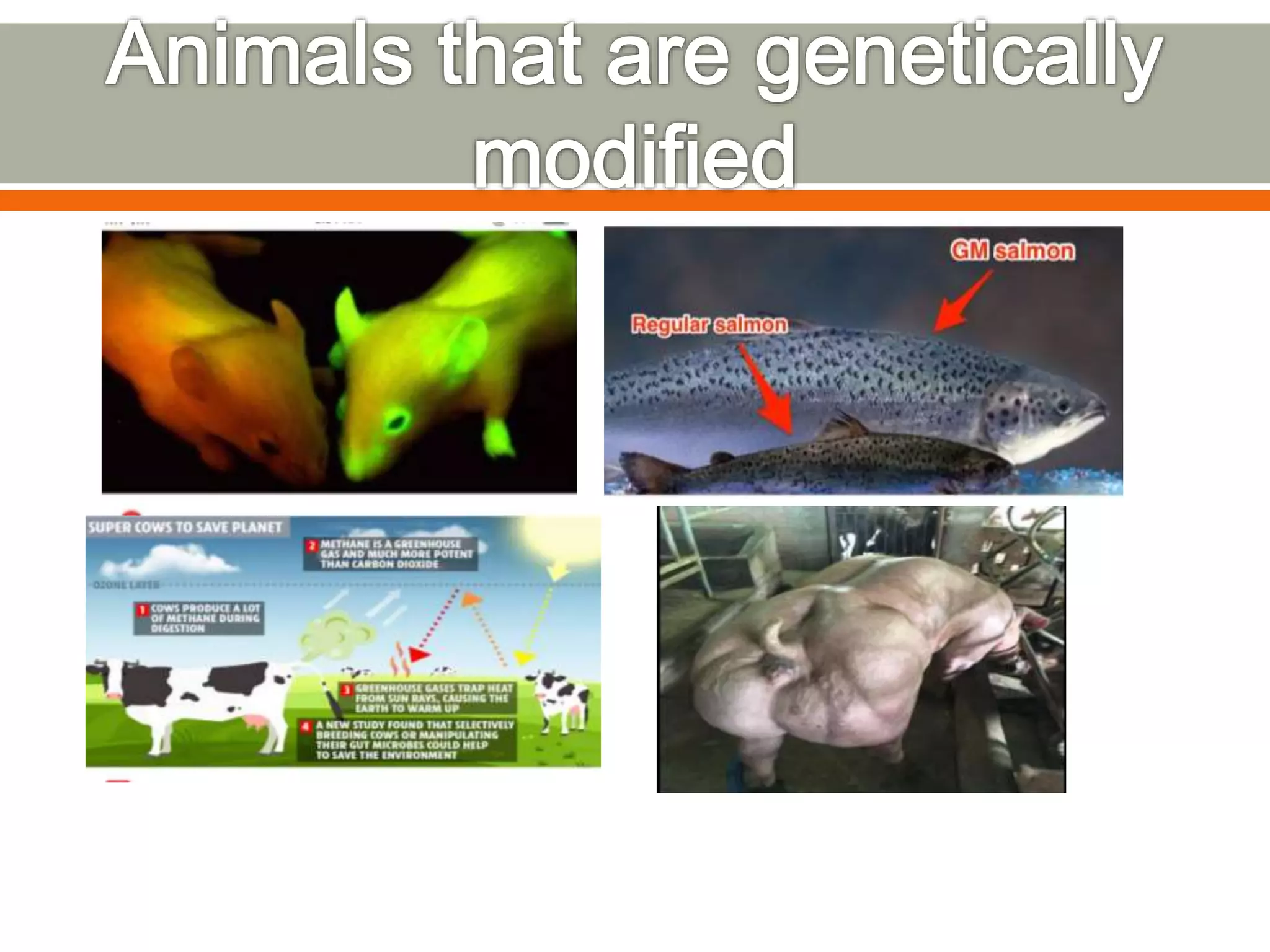
 The first genetically modified animal was a
mouse created in 1974 by Rudolf Jaenisch.
 Invasiveness procedures –often involves the sacrifice
of some animals and surgical procedures on others.
 Large numbers of animals required- Many of the
embryos that undergo genetic engineering procedures
do not survive and of those that do survive only a small
proportion carry the genetic interest.
 Unanticipated welfare concerns- Little data has been
collected on the net welfare impacts to genetically
engineered animals or to those animals required for their
creation, and genetic engineering techniques have been
described as both unpredictable and inefficient.
 Genetic manipulation in animal for higher productivity is
also called genetic engineering, refers to the alteration of
the genes of an organism.
 It involves manually adding new DNA to an organism to
add new traits.
 Genetic engineering is the name of a group of
techniques used to identify, replicate, modify and transfer
the genetic material of cells, tissues or complete
organisms.
 Genetic engineering
 Public acceptance The uncertainty of con-sumers’
reaction is the largest issue in assessing the
potential of animal biotechnologies worldwide
(Caswell et al., 2003). The framework suggested for
adopting technology, there-fore, takes the consumer
as a starting point. Consumers’ attitude (positive vs.
negative) and concerns (health, food safety,
unnaturalness, ethical, environmental, animal health
and welfare, etc
 Human health- Human health considerations include
the potential effects on consumers of GM animal-
derived foods as well as humans, such as farmers,
coming into contact with the animals.
 Animal welfare-The impact on the health and
welfare of the GM animals themselves are also a
focus of attention. This includes the health of
founder animals, selected further for desirable traits
and absence of other adverse symptoms and used for
commercial production as well as the first generations
after genetic modification.
 Environmental impact -1) the possible effects on wild
populations, such as introgression or replacement
(once the GM animal is released into the
environment) and 2) the impact on the eco-system
as a whole. These effects can be caused by either
or both of two factors; the behaviour of the GM
animal itself once released into the environment
 Genetic Contamination/Interbreeding- Introduced
GMO’s may interbred with the wild type or sexually
compatible relatives. The novel trait may disappear in
wild types unless it confers a selective advantage to the
recipient. However, tolerance abilities of wild types may
also develop, thus altering the native species ecological
relationship and behavior.
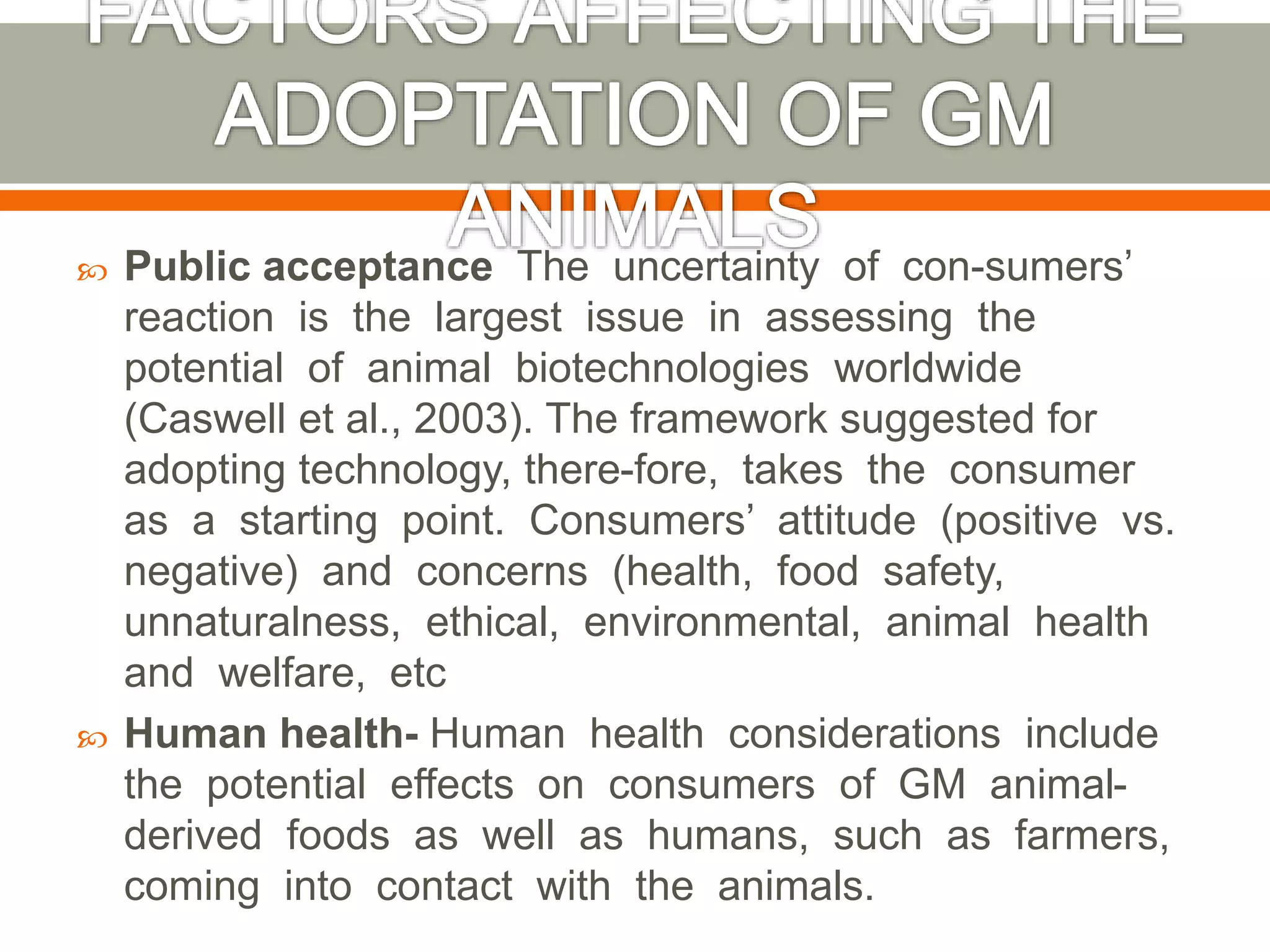
 Competition with natural species- Faster growth of
GMO’s can enable them to have a competition
advantage over the native organisms. This may allow
them to be invasive, to spread into new habitats, and
cause ecological and economic damage.
 Ecosystem impacts-The effects of changes in a single
species may extend well beyond to the ecosystem.
Single impacts are always joined by the risk of
ecosystem damage and destruction.
 Adverse effects on the health of people or the
environment
1. Expansion of the size of the effective population.
Restrictions in the number of offspring per parent. Mating
schemes to control and manage relationships.
2.Division of resources by species to help avoid
competition in an ecological niche.
3. Avoid eating GM foods
Genetic engineering has the potential to greatly improve
the health and welfare of agricultural animals.
GE animals may be:
 disease resistant,
 parasite resistant
 withstand stress.
The beneficial trait can likely improve their well being
because they will be more productive.
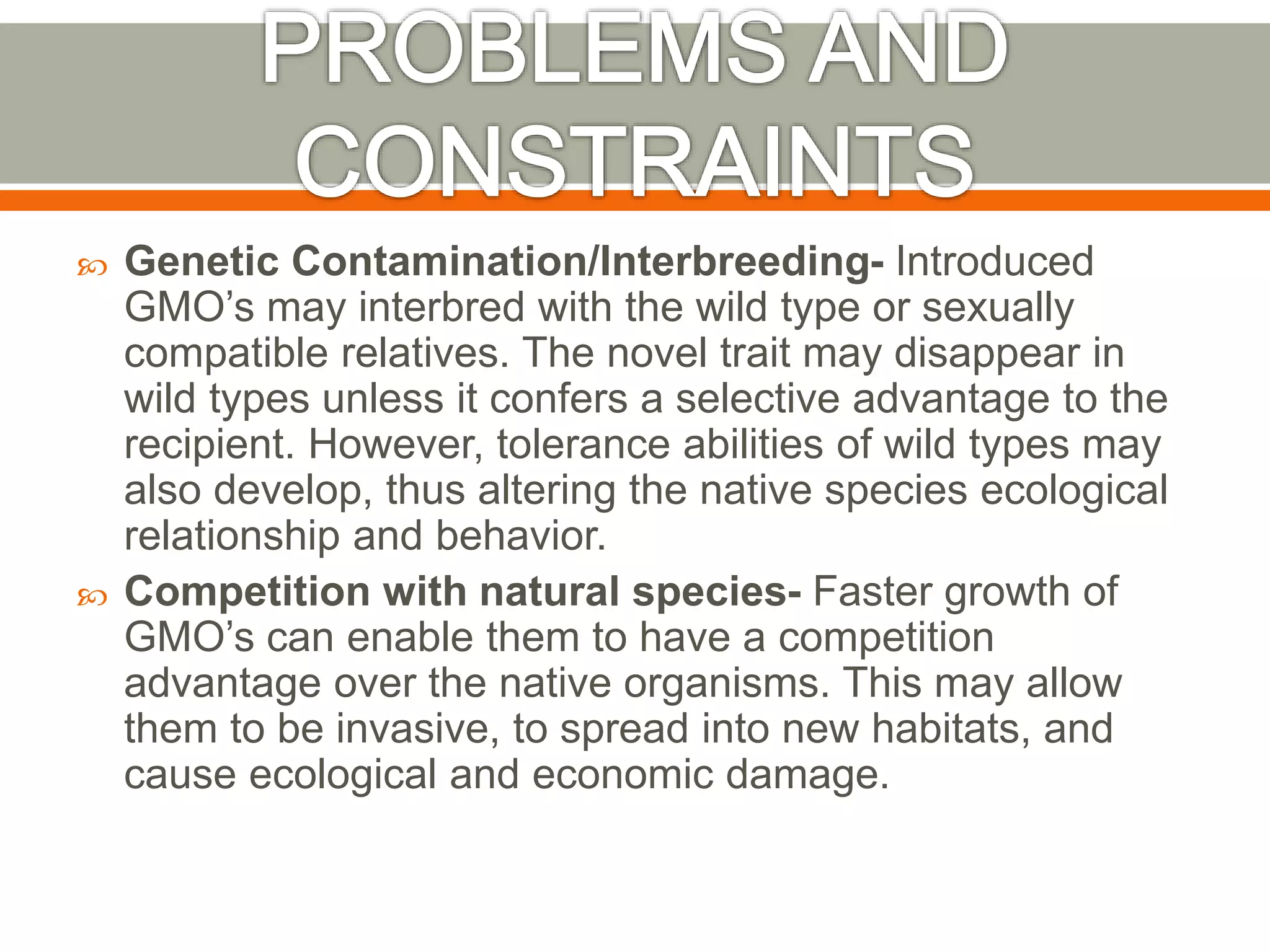
The production or transgenic livestock
has the opportunity to significantly
improve human health, enhance
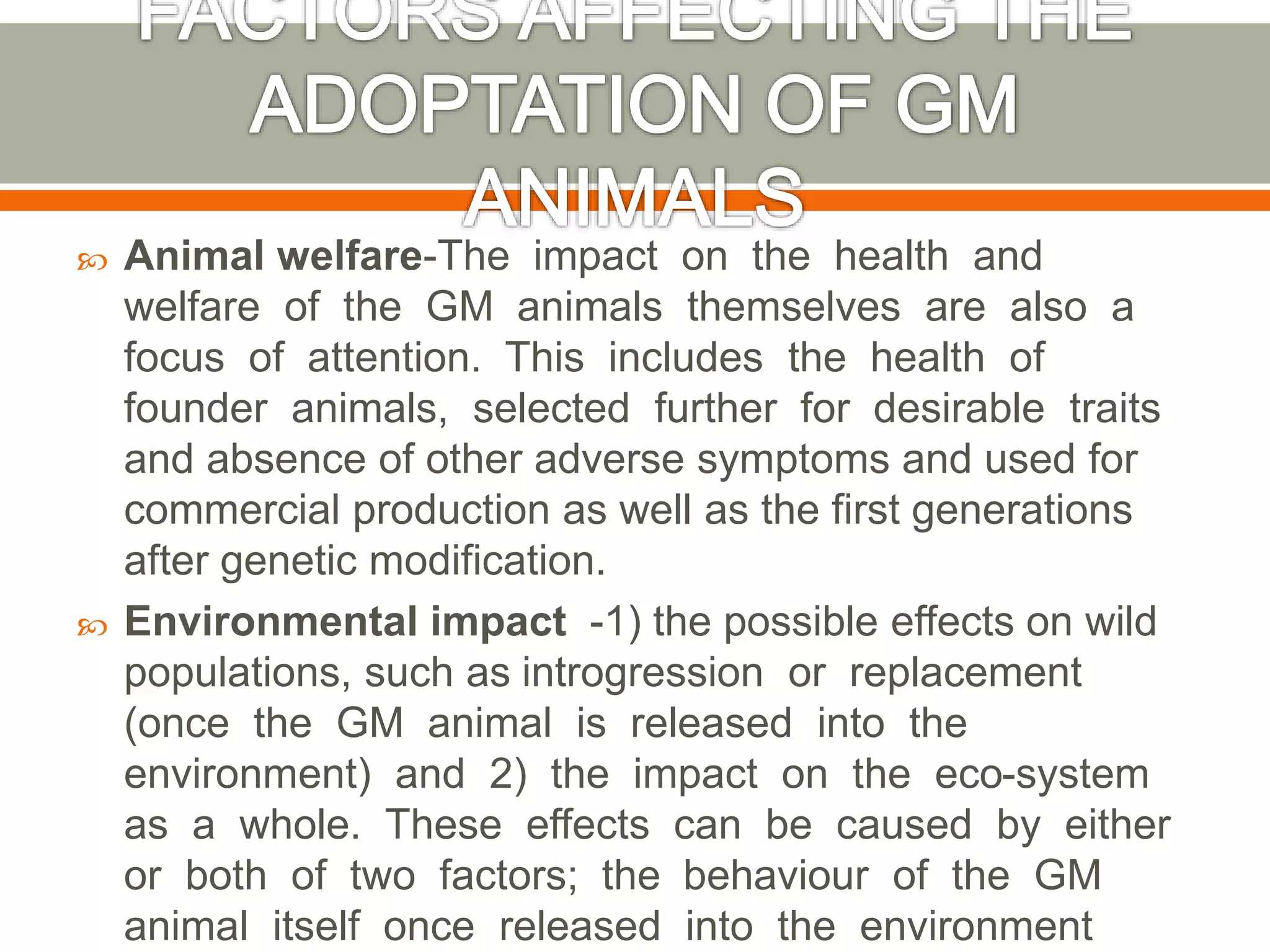
nutrition, protect the environment,
increase animal welfare and
decrease livestock disease.
 In a genetically modified animal, DNA sequences have
been inserted, removed or modified in order to introduce
a new trait or change a characteristics such as the
disease resistance of an animal. DNA is the genetic
material of an organism and carries the instructions for
all the characteristics that an organism inherits.
 Analytical Genetic Engineering- This is the research
branch of genetic engineering in which virtual genetic
models are created using computer software. Various
computer programs are used to theoretically study the
implications of various genetic engineering activities if
they are to be carried out in practice.
 Applied Genetic Engineering
Applied genetic engineering, as the name suggests, is that
field of genetic engineering which pertains to practical
application of genetic engineering tools to manipulate the
genes of living organisms for making genetic copies of
them or to introduce certain different characteristics in them
Chemical Genetic Engineering- Chemical
genetic engineering can be called the grass root
level of applied genetic engineering as it deals
with separating, classifying and graphing genes to
prepare them for applied genetic engineering
activities and experiments. Chemical genetic
engineering includes genetic mapping, studying
genetic interaction and genetic coding.
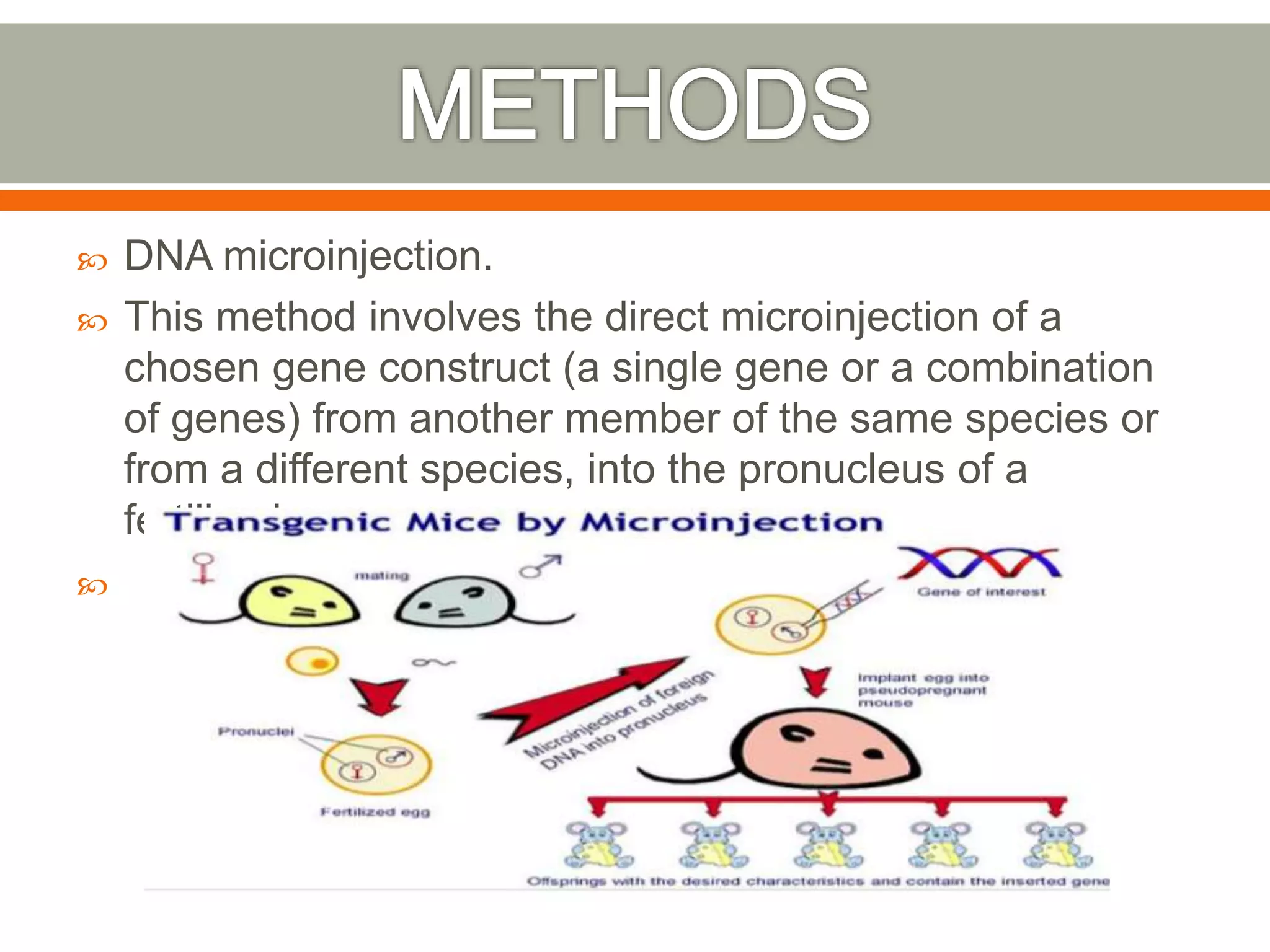
 DNA microinjection.
 This method involves the direct microinjection of a
chosen gene construct (a single gene or a combination
of genes) from another member of the same species or
from a different species, into the pronucleus of a
fertilized ovum.

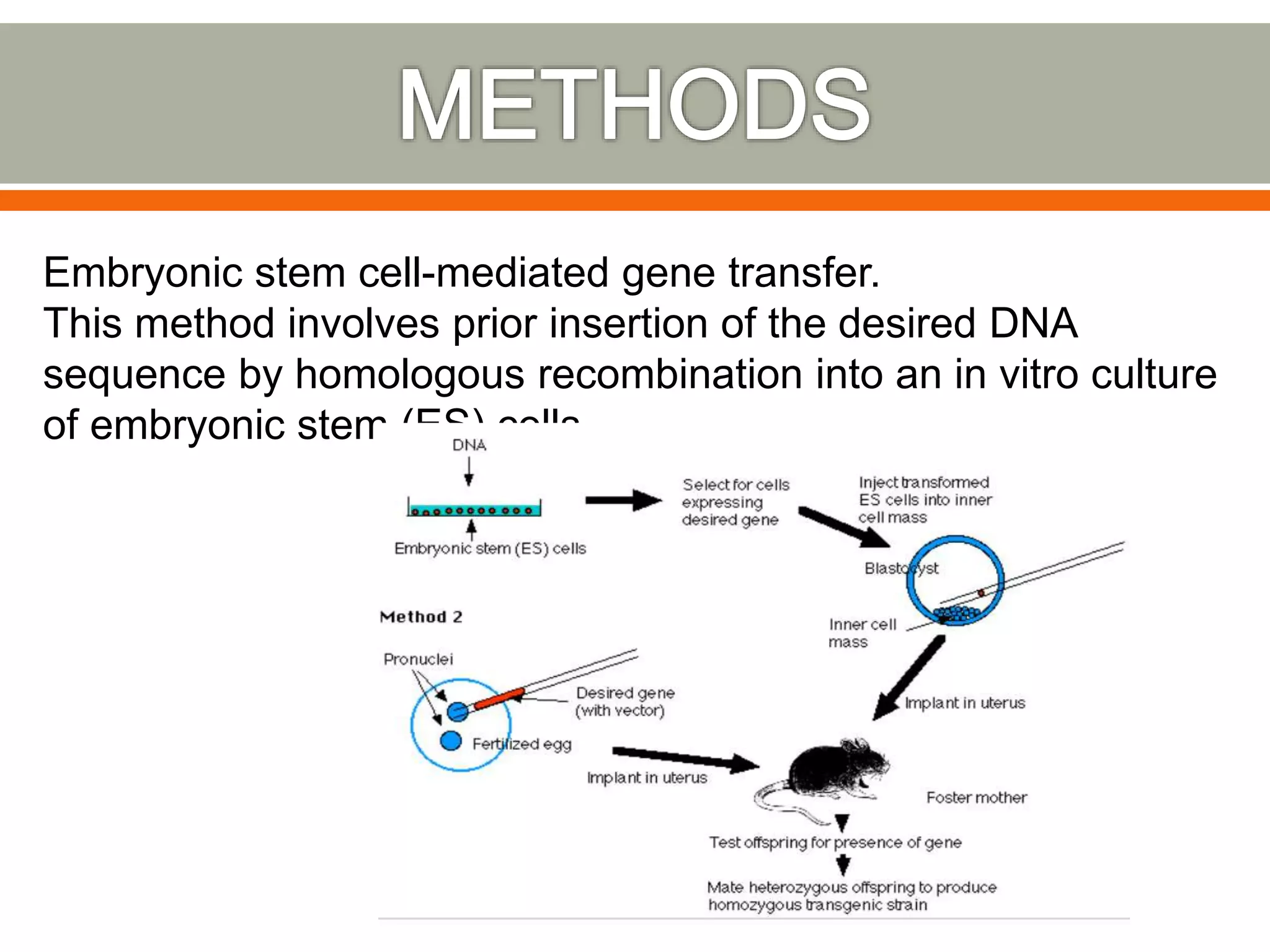
Embryonic stem cell-mediated gene transfer.
This method involves prior insertion of the desired DNA
sequence by homologous recombination into an in vitro culture
of embryonic stem (ES) cells.
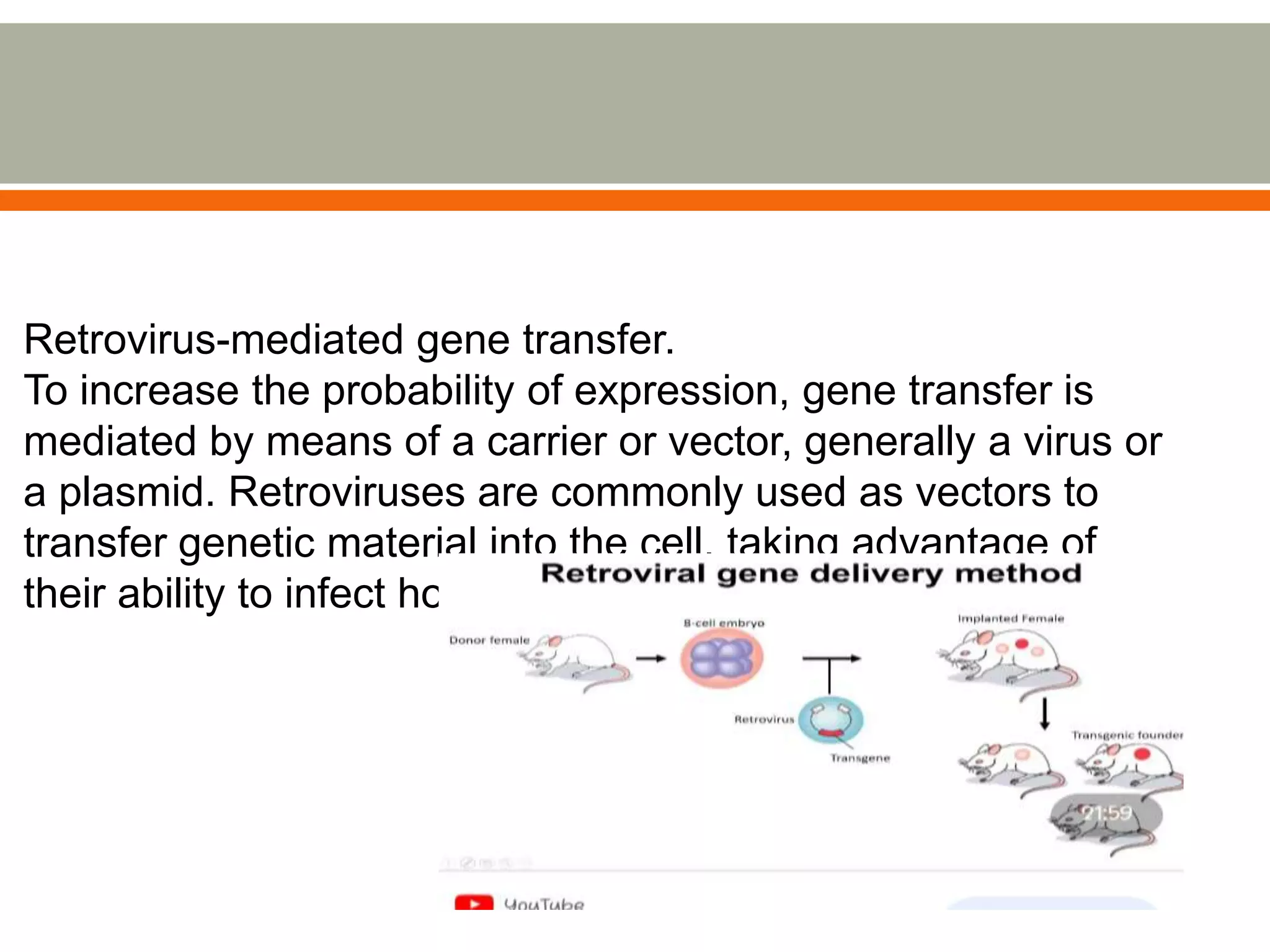
Retrovirus-mediated gene transfer.
To increase the probability of expression, gene transfer is
mediated by means of a carrier or vector, generally a virus or
a plasmid. Retroviruses are commonly used as vectors to
transfer genetic material into the cell, taking advantage of
their ability to infect host cells in this way.
1. Enhanced Nutrition
2. Reduced Environmental impact
3. Enhancing milk
4. Enhancing growth rate and carcass composition
5. Enhance animal welfare through improved disease
resistance
 Genetic engineering is a process that uses laboratory
based technologies to alter the DNA makeup of
an organism. This may involve changing a single base
pair, deleting a region of DNA or adding a new segment
of DNA.
 Genetic engineering in animal production has a growing
number of practical benefits, such as in the production of
transgenic animals resistant to disease, increasing the
productivity of animals, in the treatment of genetic
disorders and the production of vaccines.
 https://www.ucalgary.ca/~browder/transgenic.html
 https://www.efsa.europa.eu/en/topics/topic/genetically-
modified-
animals#:~:text=Genetic%20modification%20involves%20
the%20altering,disease%20resistance%20of%20an%20a
nimal.
 https://www.ncbi.nlm.nih.gov/pmc/articles/PMC3078015
 https://archive.bio.org/articles/genetically-engineered-
animals-frequently-asked-
questions#:~:text=Genetic%20engineering%20of%20anim
als%20offers,of%20cutting%20edge%20industrial%20appl
ications.
Animals-in-Genetic-Engineering-6.pptx

Animals-in-Genetic-Engineering-6.pptx

  • 1.
      Omeccas JuvyClaire A. Pamittan Marinel Palarca Rica Mae
  • 2.
     Genetic engineeringbased on recombination was pioneered in 1973 by American biochemists Stanley N. Cohen N. Herbert W. Boyer, who were among the first to cut DNA into fragments, rejoin fragments and insert the new genes into E. coli bacteria which then reproduced.  Genetic engineering is the science of manipulating genetic material of an organism.  The first genetically modified animal was a mouse created in 1974 by Rudolf Jaenisch.
  • 3.
     Invasiveness procedures–often involves the sacrifice of some animals and surgical procedures on others.  Large numbers of animals required- Many of the embryos that undergo genetic engineering procedures do not survive and of those that do survive only a small proportion carry the genetic interest.  Unanticipated welfare concerns- Little data has been collected on the net welfare impacts to genetically engineered animals or to those animals required for their creation, and genetic engineering techniques have been described as both unpredictable and inefficient.
  • 4.
     Genetic manipulationin animal for higher productivity is also called genetic engineering, refers to the alteration of the genes of an organism.  It involves manually adding new DNA to an organism to add new traits.  Genetic engineering is the name of a group of techniques used to identify, replicate, modify and transfer the genetic material of cells, tissues or complete organisms.  Genetic engineering
  • 6.
     Public acceptanceThe uncertainty of con-sumers’ reaction is the largest issue in assessing the potential of animal biotechnologies worldwide (Caswell et al., 2003). The framework suggested for adopting technology, there-fore, takes the consumer as a starting point. Consumers’ attitude (positive vs. negative) and concerns (health, food safety, unnaturalness, ethical, environmental, animal health and welfare, etc  Human health- Human health considerations include the potential effects on consumers of GM animal- derived foods as well as humans, such as farmers, coming into contact with the animals.
  • 7.
     Animal welfare-Theimpact on the health and welfare of the GM animals themselves are also a focus of attention. This includes the health of founder animals, selected further for desirable traits and absence of other adverse symptoms and used for commercial production as well as the first generations after genetic modification.  Environmental impact -1) the possible effects on wild populations, such as introgression or replacement (once the GM animal is released into the environment) and 2) the impact on the eco-system as a whole. These effects can be caused by either or both of two factors; the behaviour of the GM animal itself once released into the environment
  • 8.
     Genetic Contamination/Interbreeding-Introduced GMO’s may interbred with the wild type or sexually compatible relatives. The novel trait may disappear in wild types unless it confers a selective advantage to the recipient. However, tolerance abilities of wild types may also develop, thus altering the native species ecological relationship and behavior.  Competition with natural species- Faster growth of GMO’s can enable them to have a competition advantage over the native organisms. This may allow them to be invasive, to spread into new habitats, and cause ecological and economic damage.
  • 9.
     Ecosystem impacts-Theeffects of changes in a single species may extend well beyond to the ecosystem. Single impacts are always joined by the risk of ecosystem damage and destruction.  Adverse effects on the health of people or the environment
  • 10.
    1. Expansion ofthe size of the effective population. Restrictions in the number of offspring per parent. Mating schemes to control and manage relationships. 2.Division of resources by species to help avoid competition in an ecological niche. 3. Avoid eating GM foods
  • 11.
    Genetic engineering hasthe potential to greatly improve the health and welfare of agricultural animals. GE animals may be:  disease resistant,  parasite resistant  withstand stress. The beneficial trait can likely improve their well being because they will be more productive.
  • 12.
    The production ortransgenic livestock has the opportunity to significantly improve human health, enhance nutrition, protect the environment, increase animal welfare and decrease livestock disease.
  • 13.
     In agenetically modified animal, DNA sequences have been inserted, removed or modified in order to introduce a new trait or change a characteristics such as the disease resistance of an animal. DNA is the genetic material of an organism and carries the instructions for all the characteristics that an organism inherits.
  • 14.
     Analytical GeneticEngineering- This is the research branch of genetic engineering in which virtual genetic models are created using computer software. Various computer programs are used to theoretically study the implications of various genetic engineering activities if they are to be carried out in practice.  Applied Genetic Engineering Applied genetic engineering, as the name suggests, is that field of genetic engineering which pertains to practical application of genetic engineering tools to manipulate the genes of living organisms for making genetic copies of them or to introduce certain different characteristics in them
  • 15.
    Chemical Genetic Engineering-Chemical genetic engineering can be called the grass root level of applied genetic engineering as it deals with separating, classifying and graphing genes to prepare them for applied genetic engineering activities and experiments. Chemical genetic engineering includes genetic mapping, studying genetic interaction and genetic coding.
  • 16.
     DNA microinjection. This method involves the direct microinjection of a chosen gene construct (a single gene or a combination of genes) from another member of the same species or from a different species, into the pronucleus of a fertilized ovum. 
  • 17.
    Embryonic stem cell-mediatedgene transfer. This method involves prior insertion of the desired DNA sequence by homologous recombination into an in vitro culture of embryonic stem (ES) cells.
  • 18.
    Retrovirus-mediated gene transfer. Toincrease the probability of expression, gene transfer is mediated by means of a carrier or vector, generally a virus or a plasmid. Retroviruses are commonly used as vectors to transfer genetic material into the cell, taking advantage of their ability to infect host cells in this way.
  • 20.
    1. Enhanced Nutrition 2.Reduced Environmental impact 3. Enhancing milk 4. Enhancing growth rate and carcass composition 5. Enhance animal welfare through improved disease resistance
  • 21.
     Genetic engineeringis a process that uses laboratory based technologies to alter the DNA makeup of an organism. This may involve changing a single base pair, deleting a region of DNA or adding a new segment of DNA.  Genetic engineering in animal production has a growing number of practical benefits, such as in the production of transgenic animals resistant to disease, increasing the productivity of animals, in the treatment of genetic disorders and the production of vaccines.
  • 22.
     https://www.ucalgary.ca/~browder/transgenic.html  https://www.efsa.europa.eu/en/topics/topic/genetically- modified- animals#:~:text=Genetic%20modification%20involves%20 the%20altering,disease%20resistance%20of%20an%20a nimal. https://www.ncbi.nlm.nih.gov/pmc/articles/PMC3078015  https://archive.bio.org/articles/genetically-engineered- animals-frequently-asked- questions#:~:text=Genetic%20engineering%20of%20anim als%20offers,of%20cutting%20edge%20industrial%20appl ications.