EARTH AND LIFE
SCIENCE
Prepared by: MRS. ANGELI Y. DULLO, RN. LPT
Describe the different ways in
which representative animals
reproduce.
OBJECTIVES
1. Define what is “Reproduction.”
2. Identify the advantages and
disadvantages of the different methods
of reproduction.
3. Appreciate the importance of
reproduction.
REVIEWING
UNIFYING THEMES OF LIFE
1. Biological systems
2. The cellular basis of life
3. Structure and Function
4. Reproduction and Inheritance
5. Environmental Interactions
REVIEWING
UNIFYING THEMES OF LIFE
6. Energy and Life
7. Regulation
8. Evolution and Diversity
9. Scientific Inquiry
10. Science Technology and
Society
1. Why do organisms reproduce?
2. What would happen to a species if
every individual from that species
suddenly lost the ability to
reproduce?
ACTIVITY
TIME
Instructions
1) A gallery of pictures and descriptions of
animals and their reproductive strategies.
2) In groups, students rotate around the
gallery, discussing each animal’s
reproduction method.
3) After the walk, groups present one
unique reproductive strategy to the class.
ANALYSIS
1) What are the different reproductive
strategies observed in the gallery?
2) How do these strategies help the species
survive?
3) Can you compare two different reproductive
methods and their advantages?
Reproduction is the biological process by
which organisms create offspring,
ensuring the continuation of their
species. It's a fundamental aspect of life,
and different species have developed a
variety of strategies to reproduce
successfully.
Methods Of Reproduction
A. Sexual Reproduction
It is the mode of reproduction in which
gamete cells from two organisms, one
male and one female, combine to form a
singular zygote. This zygote shares half of
its genetic information with the father and the
other half with the mother.
Sexual reproduction allows some of
the genetic information from each
parent to mix, producing offspring that
resemble their parents but are not
identical to them. In this way, sexual
reproduction leads to variety in the
offspring. Animals and plants can
reproduce using sexual reproduction.
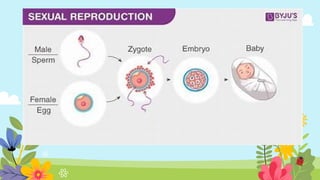
In sexual reproduction, new organisms
are produced from the fusion of a male
sex cell with a female sex cell. This fusion
of gametes is called fertilization.
Sex cells are also known as gametes.
Male gametes are made by male
reproductive structures. Female gametes
are made by female reproductive
structures.
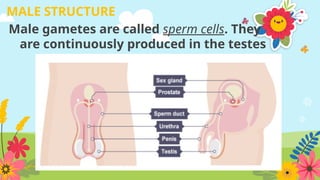
MALE STRUCTURE
Male gametes are called sperm cells. They
are continuously produced in the testes
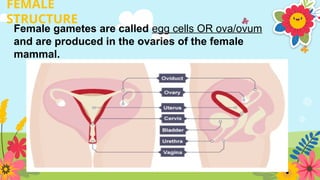
FEMALE
STRUCTURE
Female gametes are called egg cells OR ova/ovum
and are produced in the ovaries of the female
mammal.
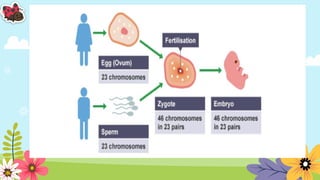
In human beings, each gamete contains 23
chromosomes, half the number found in the
other cells of the body. When the male and
female gametes fuse, they become a zygote
containing the full 46 chromosomes, half of
which came from the father and half from the
mother.
Sexual Reproduction in Plants
Plants that reproduce sexually have sex parts
which we know as flowers. The process of
reproduction involves the fusion of male
gametes, namely, pollen with the female
gamete, also known as ovules. This fusion
results in the formation of a zygote and an
endosperm nucleus, which grow into seeds and
fruits respectively.
Advantages:
Genetic Diversity: Creates offspring with
unique combinations of traits, enhancing
adaptability to changing environments.
Disease Resistance: Genetic diversity can
make populations less susceptible to
diseases.
Evolutionary Advantage: Provides the raw
material for natural selection, driving
evolution.
Disadvantages:
Time-Consuming: Requires finding a mate
and the complex process of gamete
production and fertilization.
Resource-Intensive: Can require significant
energy and resources for courtship, mating,
and offspring care.
Reduced Population Growth: Compared to
asexual reproduction, sexual reproduction
can lead to slower population growth.
B. Asexual Reproduction
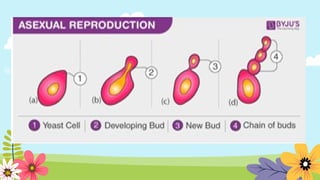
It is the mode of reproduction which
involves only one organism. The offspring
that is produced is genetically identical to
the mother and almost always has the
same number of chromosomes. Hence,
they are called clones. Moreover, they are
exact copies of their parent cell.
Entities prefer to reproduce asexually by
different means. Few asexual methods
are budding (e.g. Hydra), binary fission
(e.g. Amoeba, bacteria), spore formation
(e.g. ferns), fragmentation (e.g.
Planaria), and vegetative propagation
(e.g. Onion).
Asexual Reproduction in Plants
Some plants have the ability to
reproduce asexually, that is, without
the help of flowers or pollens. There
are different modes of asexual
reproduction in plants, both natural
and human-induced.
In the natural mode of asexual
reproduction, a plant can give rise to an
offspring with the help of roots. Certain
plants also use budding and cutting to
reproduce asexually.
Human-induced asexual reproduction in
plants includes grafting, layering, cutting
and micropropagation.
Asexual Reproduction in Animals
Some simple animals, many of which are
single-celled, reproduce asexually.
The different modes of asexual reproduction
in animals include gemmules (sponges),
fragmentation (planarians), regeneration
(echinoderms) and parthenogenesis (ants,
wasps)
Advantages:
Rapid Population Growth: Can produce large
numbers of offspring quickly, especially in
favorable conditions.
Energy Efficient: Requires less energy and
resources compared to sexual reproduction.
Preservation of Traits: Offspring are genetically
identical to the parent, preserving beneficial traits.
Disadvantages:
Lack of Genetic Diversity: This can make
populations more vulnerable to diseases or
environmental changes.
Reduced Adaptability: Limited genetic variation
can hinder a species' ability to adapt to new
conditions.
Accumulation of Harmful Mutations: Over time,
harmful mutations can accumulate in a population.
APPLICATION
Problem-Based
Create a presentation comparing two
animals with different reproductive
strategies, discussing how these strategies
affect their survival and adaptation.
Rubric
- Participation in discussion - 5 pts.
- Clarity of presentation - 5 pts.
- Engagement with peers - 5 pts.
Assessment
1. What defines sexual reproduction,
and how does it differ from asexual
reproduction?
2. How do environmental factors
influence reproductive
strategies in animals?
A picture is worth a thousand words

LESSON 5 (WEEK 3).pptx Sexual Reproduction Method

  • 1.
    EARTH AND LIFE SCIENCE Preparedby: MRS. ANGELI Y. DULLO, RN. LPT
  • 2.
    Describe the differentways in which representative animals reproduce.
  • 3.
    OBJECTIVES 1. Define whatis “Reproduction.” 2. Identify the advantages and disadvantages of the different methods of reproduction. 3. Appreciate the importance of reproduction.
  • 4.
    REVIEWING UNIFYING THEMES OFLIFE 1. Biological systems 2. The cellular basis of life 3. Structure and Function 4. Reproduction and Inheritance 5. Environmental Interactions
  • 5.
    REVIEWING UNIFYING THEMES OFLIFE 6. Energy and Life 7. Regulation 8. Evolution and Diversity 9. Scientific Inquiry 10. Science Technology and Society
  • 6.
    1. Why doorganisms reproduce? 2. What would happen to a species if every individual from that species suddenly lost the ability to reproduce?
  • 7.
  • 8.
    Instructions 1) A galleryof pictures and descriptions of animals and their reproductive strategies. 2) In groups, students rotate around the gallery, discussing each animal’s reproduction method. 3) After the walk, groups present one unique reproductive strategy to the class.
  • 9.
    ANALYSIS 1) What arethe different reproductive strategies observed in the gallery? 2) How do these strategies help the species survive? 3) Can you compare two different reproductive methods and their advantages?
  • 10.
    Reproduction is thebiological process by which organisms create offspring, ensuring the continuation of their species. It's a fundamental aspect of life, and different species have developed a variety of strategies to reproduce successfully.
  • 11.
    Methods Of Reproduction A.Sexual Reproduction It is the mode of reproduction in which gamete cells from two organisms, one male and one female, combine to form a singular zygote. This zygote shares half of its genetic information with the father and the other half with the mother.
  • 13.
    Sexual reproduction allowssome of the genetic information from each parent to mix, producing offspring that resemble their parents but are not identical to them. In this way, sexual reproduction leads to variety in the offspring. Animals and plants can reproduce using sexual reproduction.
  • 14.
    In sexual reproduction,new organisms are produced from the fusion of a male sex cell with a female sex cell. This fusion of gametes is called fertilization. Sex cells are also known as gametes. Male gametes are made by male reproductive structures. Female gametes are made by female reproductive structures.
  • 15.
    MALE STRUCTURE Male gametesare called sperm cells. They are continuously produced in the testes
  • 16.
    FEMALE STRUCTURE Female gametes arecalled egg cells OR ova/ovum and are produced in the ovaries of the female mammal.
  • 18.
    In human beings,each gamete contains 23 chromosomes, half the number found in the other cells of the body. When the male and female gametes fuse, they become a zygote containing the full 46 chromosomes, half of which came from the father and half from the mother.
  • 19.
    Sexual Reproduction inPlants Plants that reproduce sexually have sex parts which we know as flowers. The process of reproduction involves the fusion of male gametes, namely, pollen with the female gamete, also known as ovules. This fusion results in the formation of a zygote and an endosperm nucleus, which grow into seeds and fruits respectively.
  • 20.
    Advantages: Genetic Diversity: Createsoffspring with unique combinations of traits, enhancing adaptability to changing environments. Disease Resistance: Genetic diversity can make populations less susceptible to diseases. Evolutionary Advantage: Provides the raw material for natural selection, driving evolution.
  • 21.
    Disadvantages: Time-Consuming: Requires findinga mate and the complex process of gamete production and fertilization. Resource-Intensive: Can require significant energy and resources for courtship, mating, and offspring care. Reduced Population Growth: Compared to asexual reproduction, sexual reproduction can lead to slower population growth.
  • 22.
    B. Asexual Reproduction Itis the mode of reproduction which involves only one organism. The offspring that is produced is genetically identical to the mother and almost always has the same number of chromosomes. Hence, they are called clones. Moreover, they are exact copies of their parent cell.
  • 24.
    Entities prefer toreproduce asexually by different means. Few asexual methods are budding (e.g. Hydra), binary fission (e.g. Amoeba, bacteria), spore formation (e.g. ferns), fragmentation (e.g. Planaria), and vegetative propagation (e.g. Onion).
  • 25.
    Asexual Reproduction inPlants Some plants have the ability to reproduce asexually, that is, without the help of flowers or pollens. There are different modes of asexual reproduction in plants, both natural and human-induced.
  • 26.
    In the naturalmode of asexual reproduction, a plant can give rise to an offspring with the help of roots. Certain plants also use budding and cutting to reproduce asexually. Human-induced asexual reproduction in plants includes grafting, layering, cutting and micropropagation.
  • 27.
    Asexual Reproduction inAnimals Some simple animals, many of which are single-celled, reproduce asexually. The different modes of asexual reproduction in animals include gemmules (sponges), fragmentation (planarians), regeneration (echinoderms) and parthenogenesis (ants, wasps)
  • 28.
    Advantages: Rapid Population Growth:Can produce large numbers of offspring quickly, especially in favorable conditions. Energy Efficient: Requires less energy and resources compared to sexual reproduction. Preservation of Traits: Offspring are genetically identical to the parent, preserving beneficial traits.
  • 29.
    Disadvantages: Lack of GeneticDiversity: This can make populations more vulnerable to diseases or environmental changes. Reduced Adaptability: Limited genetic variation can hinder a species' ability to adapt to new conditions. Accumulation of Harmful Mutations: Over time, harmful mutations can accumulate in a population.
  • 30.
    APPLICATION Problem-Based Create a presentationcomparing two animals with different reproductive strategies, discussing how these strategies affect their survival and adaptation.
  • 31.
    Rubric - Participation indiscussion - 5 pts. - Clarity of presentation - 5 pts. - Engagement with peers - 5 pts.
  • 32.
    Assessment 1. What definessexual reproduction, and how does it differ from asexual reproduction? 2. How do environmental factors influence reproductive strategies in animals?
  • 33.
    A picture isworth a thousand words

Editor's Notes

  • #2 Biological systems- Living things work as a system, at the same time they cannot be separated from non-living things. Since they are both operating as a system All living organisms are made up of cells. The structure determines the function, the functions reflect structure. Technically they are inseparable. Like begets like-similar things produce similar results. So traits of a parent organism passed from generation to generation. No organism is completely isolated. This means that living things cannot live alone. So their survival will depend on how they interact with the environment.
  • #3 Biological systems- Living things work as a system, at the same time they cannot be separated from non-living things. Since they are both operating as a system All living organisms are made up of cells. The structure determines the function, the functions reflect structure. Technically they are inseparable. Like begets like-similar things produce similar results. So traits of a parent organism passed from generation to generation. No organism is completely isolated. This means that living things cannot live alone. So their survival will depend on how they interact with the environment.
  • #4 Biological systems- Living things work as a system, at the same time they cannot be separated from non-living things. Since they are both operating as a system All living organisms are made up of cells. The structure determines the function, the functions reflect structure. Technically they are inseparable. Like begets like-similar things produce similar results. So traits of a parent organism passed from generation to generation. No organism is completely isolated. This means that living things cannot live alone. So their survival will depend on how they interact with the environment.
  • #5 6. Life requires energy Autotrophs- Some living organisms capture light energy and convert it into chemical energy. Heterotrophs-Some living things use chemical energy stored in molecules obtained from food 7. Organisms must maintain homeostasis to survive in diverse environments 8. Evolution- the change in living things over time. It is the process by which different kinds of living organisms are thought to have developed and diversified from earlier forms during the history of the Earth. 9. Involves asking questions about nature and then using observation and experiments to find the possible answers. 10. Through science humans learn to find solutions to the problem. Technology produced machinery to lengthen the perishable goods
  • #6 Organisms reproduce for two primary reasons: Survival of the Species: Reproduction ensures the continuation of a species by creating new individuals. This helps to maintain genetic diversity and adapt to changing environmental conditions. Propagation of Genetic Material: Reproduction allows organisms to pass on their genetic information to the next generation. This ensures that their traits and characteristics are preserved and can be further evolved. 2. If every individual from a species suddenly lost the ability to reproduce, that species would face extinction.
  • #9 Genetic Diversity: Adaptability: Diverse genetic makeup allows species to adapt to changing environmental conditions. Disease Resistance: Genetic variation can increase resistance to diseases and parasites. Evolution: Genetic diversity provides the raw material for evolution, enabling species to evolve new traits and better suit their environments. 2. Population Growth: Survival: A larger population increases the chances of survival in the face of threats like predation, disease, and environmental hazards. Resource Utilization: A larger population can more effectively exploit available resources. 3. Colonization: New Habitats: Reproductive strategies that allow for dispersal, such as producing winged offspring or creating new colonies, enable species to colonize new habitats and expand their range. Reduced Competition: Colonizing new areas can reduce competition for resources with existing populations. 4. Resilience: Recovery: Reproductive strategies that allow for rapid population growth can help species recover from population declines caused by factors like predation, disease, or natural disasters. Persistence: A resilient species is better able to withstand environmental challenges and continue to thrive.
  • #12 Humans reproduce sexually by the fusion of sperm with the egg (ovum) to produce a zygote called fertilization. Fertilization is the crucial stage of sexual reproduction. Without fertilization, sexual reproduction will not be complete.
  • #16 During sexual intercourse sperm cells travel through the sperm duct, into the urethra and are released out of the end of the penis.
  • #17 The zygote divides to form two new cells, which then continue to divide many times. Many of the new cells produced become specialised to perform particular functions and form all the body tissues of the new individual.
  • #23 Yeast are microscopic fungi that play a crucial role in various industries and ecosystems. They are single-celled organisms that can reproduce both sexually and asexually.