Animal Classification

What makes a fish a fish? Do all birds
fly? How do we organize animals into
          different groups?
What is animal classification?
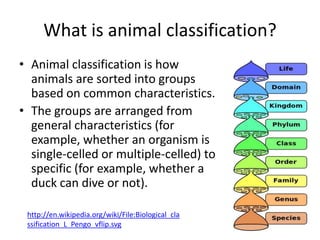
• Animal classification is how
  animals are sorted into groups
  based on common characteristics.
• The groups are arranged from
  general characteristics (for
  example, whether an organism is
  single-celled or multiple-celled) to
  specific (for example, whether a
  duck can dive or not).

 http://en.wikipedia.org/wiki/File:Biological_cla
 ssification_L_Pengo_vflip.svg
Kingdom Animalia
• The animal kingdom is the kingdom that we
  belong to.
• Each member of the animal kingdom:
  – Is made up of many cells
  – Eats other organisms to get energy
  – Can move its body
  – Reacts to stimuli

            http://hyperphysics.phy-
            astr.gsu.edu/hbase/biology/animal.html
Phylum
• The next level of organization after kingdom.
• Organized by body structure (symmetry,
  segmentation).
• There are 35 phyla within the animal kingdom.
• Includes vertebrates, or animals with
  backbones, and invertebrates, which do not
  have backbones.

           http://waynesword.palomar.edu/trnov01.htm
Classes
• There are five main classes of vertebrates in
  the animal kingdom:
  – Mammals
  – Birds
  – Reptiles
  – Amphibians
  – Fish
Mammals
•   Best-developed brain
•   Warm-blooded
•   Live birth
•   Has fur or hair
•   Drinks milk
•   Maternal care
                           Photo courtesy of Clip Art
Which of these would be classified as a
              mammal?
•   Red-winged blackbird
•   Bobcat
•   House fly
•   Goldfish
If you said a
bobcat, you are
    correct!
Mammals you might find in Michigan:
• Little Brown Bat
• Whitetail deer
• Beaver

Other interesting mammals:
• The duck-billed platypus and the echidna are
  the only mammals that lay eggs.
• Bats are the only mammals that can fly!
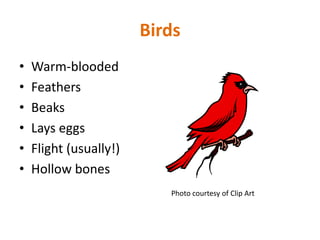
Birds
•   Warm-blooded
•   Feathers
•   Beaks
•   Lays eggs
•   Flight (usually!)
•   Hollow bones
                           Photo courtesy of Clip Art
A bird’s active part in breathing is
   the exhale (breathing out).


     True or False?
True!
Unlike humans, birds must consciously
 breathe in, while their exhale occurs
            without effort.
Michigan birds:
•   Pileated woodpecker
•   Mallard duck
•   Common loon
•   Eastern bluebird

Other interesting birds:
• Emus, ostriches, and penguins cannot fly.
• The northern shrike impales its larger prey upon thorns
  for ease of eating.
• An owl compensates for its immovable eyes by rotating
  its head almost completely around.
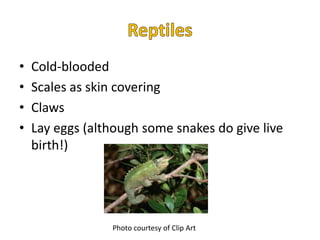
•   Cold-blooded
•   Scales as skin covering
•   Claws
•   Lay eggs (although some snakes do give live
    birth!)


                 Photo courtesy of Clip Art
Because reptiles are cold-blooded, they cannot
      survive the cold Michigan winters.

             True or False?
False!
Many reptiles sleep through the winter in a state
                 called brumation.


          http://en.wikipedia.org/wiki/Dormancy#Brum
          ation
Michigan reptiles:
• Garter snake
• Hognose snake
• Five-lined skink (the only lizard in Michigan)

Other interesting reptiles:
• The corn snake has a false rattle that it uses as
  a defense mechanism.
• The king cobra lays its eggs in a nest.
             http://nationalzoo.si.edu/Animals/ReptilesAm
             phibians/Facts/default.cfm
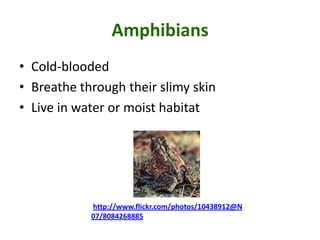
Amphibians
• Cold-blooded
• Breathe through their slimy skin
• Live in water or moist habitat


            http://www.flickr.com/photos/10438912@N
            07/8084268885
An example of an amphibian is:
•   A lizard
•   A vampire
•   A salamander
•   A rabbit
A salamander is
    correct.
Amphibians you might find in
                   Michigan:
•   Red-backed salamander
•   Green frog
•   Spring peeper
•   American toad

Other interesting amphibians:
• The barking tree frog has a call that sounds like a bark.
• The red-backed salamander has a home range of just
  24 meters.
http://www.tnaqua.org/OurAnimals/Amphibians.aspx?gclid=CNL1qPSO_7ICFegWMgodWnEA6A
http://amphibiaweb.org/cgi/amphib_query?where-genus=Plethodon&where-species=cinereus
Fish
•   Cold-blooded
•   Live in water
•   Have scales
•   Breathe using gills


                                 Courtesy of Clip Art
Fish cannot control how close they are to the
  surface of the water – they must depend on
 the waves to bring them deeper or shallower.


             True or False?
False!
Fish control their level of depth by inflating or
 deflating their air bladder, which allows them
         to float (when inflated) or sink.
Michigan fish:
•   Rainbow trout
•   Bluegill
•   Large-mouth bass
•   Northern pike

Other interesting fish:
• The Sharpnose Puffer inflates itself to appear
  larger and more formidable.
• The Mushroom Scorpionfish is covered in
  venomous spines.
             http://www.seasky.org/reeflife/sea2h.html

Animal classification (slideshare version - no hyperlinks)

  • 1.
    Animal Classification What makesa fish a fish? Do all birds fly? How do we organize animals into different groups?
  • 2.
    What is animalclassification? • Animal classification is how animals are sorted into groups based on common characteristics. • The groups are arranged from general characteristics (for example, whether an organism is single-celled or multiple-celled) to specific (for example, whether a duck can dive or not). http://en.wikipedia.org/wiki/File:Biological_cla ssification_L_Pengo_vflip.svg
  • 3.
    Kingdom Animalia • Theanimal kingdom is the kingdom that we belong to. • Each member of the animal kingdom: – Is made up of many cells – Eats other organisms to get energy – Can move its body – Reacts to stimuli http://hyperphysics.phy- astr.gsu.edu/hbase/biology/animal.html
  • 4.
    Phylum • The nextlevel of organization after kingdom. • Organized by body structure (symmetry, segmentation). • There are 35 phyla within the animal kingdom. • Includes vertebrates, or animals with backbones, and invertebrates, which do not have backbones. http://waynesword.palomar.edu/trnov01.htm
  • 5.
    Classes • There arefive main classes of vertebrates in the animal kingdom: – Mammals – Birds – Reptiles – Amphibians – Fish
  • 6.
    Mammals • Best-developed brain • Warm-blooded • Live birth • Has fur or hair • Drinks milk • Maternal care Photo courtesy of Clip Art
  • 7.
    Which of thesewould be classified as a mammal? • Red-winged blackbird • Bobcat • House fly • Goldfish
  • 8.
    If you saida bobcat, you are correct!
  • 9.
    Mammals you mightfind in Michigan: • Little Brown Bat • Whitetail deer • Beaver Other interesting mammals: • The duck-billed platypus and the echidna are the only mammals that lay eggs. • Bats are the only mammals that can fly!
  • 10.
    Birds • Warm-blooded • Feathers • Beaks • Lays eggs • Flight (usually!) • Hollow bones Photo courtesy of Clip Art
  • 11.
    A bird’s activepart in breathing is the exhale (breathing out). True or False?
  • 12.
    True! Unlike humans, birdsmust consciously breathe in, while their exhale occurs without effort.
  • 13.
    Michigan birds: • Pileated woodpecker • Mallard duck • Common loon • Eastern bluebird Other interesting birds: • Emus, ostriches, and penguins cannot fly. • The northern shrike impales its larger prey upon thorns for ease of eating. • An owl compensates for its immovable eyes by rotating its head almost completely around.
  • 14.
    Cold-blooded • Scales as skin covering • Claws • Lay eggs (although some snakes do give live birth!) Photo courtesy of Clip Art
  • 15.
    Because reptiles arecold-blooded, they cannot survive the cold Michigan winters. True or False?
  • 16.
    False! Many reptiles sleepthrough the winter in a state called brumation. http://en.wikipedia.org/wiki/Dormancy#Brum ation
  • 17.
    Michigan reptiles: • Gartersnake • Hognose snake • Five-lined skink (the only lizard in Michigan) Other interesting reptiles: • The corn snake has a false rattle that it uses as a defense mechanism. • The king cobra lays its eggs in a nest. http://nationalzoo.si.edu/Animals/ReptilesAm phibians/Facts/default.cfm
  • 18.
    Amphibians • Cold-blooded • Breathethrough their slimy skin • Live in water or moist habitat http://www.flickr.com/photos/10438912@N 07/8084268885
  • 19.
    An example ofan amphibian is: • A lizard • A vampire • A salamander • A rabbit
  • 20.
  • 21.
    Amphibians you mightfind in Michigan: • Red-backed salamander • Green frog • Spring peeper • American toad Other interesting amphibians: • The barking tree frog has a call that sounds like a bark. • The red-backed salamander has a home range of just 24 meters. http://www.tnaqua.org/OurAnimals/Amphibians.aspx?gclid=CNL1qPSO_7ICFegWMgodWnEA6A http://amphibiaweb.org/cgi/amphib_query?where-genus=Plethodon&where-species=cinereus
  • 22.
    Fish • Cold-blooded • Live in water • Have scales • Breathe using gills Courtesy of Clip Art
  • 23.
    Fish cannot controlhow close they are to the surface of the water – they must depend on the waves to bring them deeper or shallower. True or False?
  • 24.
    False! Fish control theirlevel of depth by inflating or deflating their air bladder, which allows them to float (when inflated) or sink.
  • 25.
    Michigan fish: • Rainbow trout • Bluegill • Large-mouth bass • Northern pike Other interesting fish: • The Sharpnose Puffer inflates itself to appear larger and more formidable. • The Mushroom Scorpionfish is covered in venomous spines. http://www.seasky.org/reeflife/sea2h.html