ANGLES
SOL 5.12
The student will classify and
measure right, acute, obtuse, and
straight angles.
No not
angels!!
You will learn to classify
angles as acute,
obtuse, right, or
straight.
Extra Learning Goals
This is an ambitious lesson but I think we
can extend our learning to include…
1. Becoming familiar with a protractor.
2. Learn how to measure angles and identify
their measures in degrees.
Lets get started!
Check out these angles from famous artist
Pablo Picasso
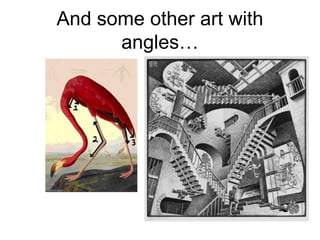
And some other art with
angles…
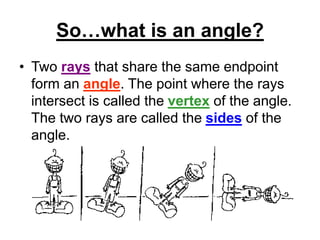
So…what is an angle?
• Two rays that share the same endpoint
form an angle. The point where the rays
intersect is called the vertex of the angle.
The two rays are called the sides of the
angle.
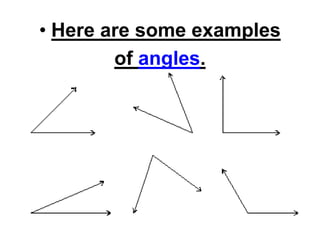
• Here are some examples
of angles.
• We can identify an angle by using a point
on each ray and the vertex. The angle
below may be identified as angle ABC or as
angle CBA; you may also see this written
as ∠ABC or as ∠CBA. The vertex point
is always in the middle.
Angle Measurements
• We measure the size of an angle using
degrees.
• Here are some examples of angles and
their degree measurements.
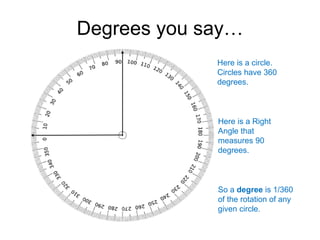
Degrees you say…
Here is a circle.
Circles have 360
degrees.
Here is a Right
Angle that
measures 90
degrees.
So a degree is 1/360
of the rotation of any
given circle.
Acute Angles
• An acute angle is an angle measuring
between 0 and 90 degrees.
• The following angles are all acute angles.
Obtuse Angles
• An obtuse angle is an angle measuring
between 90 and 180 degrees.
• The following angles are all obtuse.
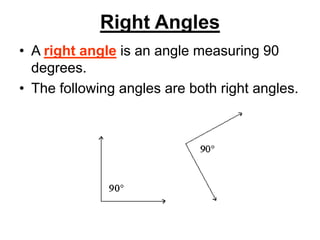
Right Angles
• A right angle is an angle measuring 90
degrees.
• The following angles are both right angles.
Straight Angle
• A straight angle is 180 degrees.
GAME TIME!
• The object of the game is to
know your angles. Write your
answer on a white board and
after a few moments everyone
will flip them up high.
• The correct answer for each will be on
the following slide!!
• Good luck!
Acute
Angle
Obtuse
Angle
Right
Angle
Straight
Angle
GREAT
JOB!!

angles.pp.ppt

  • 1.
    ANGLES SOL 5.12 The studentwill classify and measure right, acute, obtuse, and straight angles. No not angels!!
  • 2.
    You will learnto classify angles as acute, obtuse, right, or straight.
  • 3.
    Extra Learning Goals Thisis an ambitious lesson but I think we can extend our learning to include… 1. Becoming familiar with a protractor. 2. Learn how to measure angles and identify their measures in degrees. Lets get started!
  • 4.
    Check out theseangles from famous artist Pablo Picasso
  • 5.
    And some otherart with angles…
  • 6.
    So…what is anangle? • Two rays that share the same endpoint form an angle. The point where the rays intersect is called the vertex of the angle. The two rays are called the sides of the angle.
  • 7.
    • Here aresome examples of angles.
  • 8.
    • We canidentify an angle by using a point on each ray and the vertex. The angle below may be identified as angle ABC or as angle CBA; you may also see this written as ∠ABC or as ∠CBA. The vertex point is always in the middle.
  • 9.
    Angle Measurements • Wemeasure the size of an angle using degrees. • Here are some examples of angles and their degree measurements.
  • 10.
    Degrees you say… Hereis a circle. Circles have 360 degrees. Here is a Right Angle that measures 90 degrees. So a degree is 1/360 of the rotation of any given circle.
  • 11.
    Acute Angles • Anacute angle is an angle measuring between 0 and 90 degrees. • The following angles are all acute angles.
  • 12.
    Obtuse Angles • Anobtuse angle is an angle measuring between 90 and 180 degrees. • The following angles are all obtuse.
  • 13.
    Right Angles • Aright angle is an angle measuring 90 degrees. • The following angles are both right angles.
  • 14.
    Straight Angle • Astraight angle is 180 degrees.
  • 15.
    GAME TIME! • Theobject of the game is to know your angles. Write your answer on a white board and after a few moments everyone will flip them up high. • The correct answer for each will be on the following slide!! • Good luck!
  • 17.
  • 19.
  • 21.
  • 23.
  • 24.