Presented at:

College Of Nursing
Shifa Tameer-e-Millat University
By: Muhammad Farooq
RN, BSN, Dip Card.
 At the end of this presentation, the audience will

know:
 What is Anemia
 Causes of Anemia
 What are different Types/classification of Anemia
 Clinical feature of anemia
 Diagnosis/investigation Of Anemia
 Treatment Of Anemia
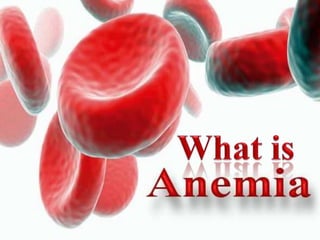
 Taken from Greek language (an meaning absence

& hemia meaning blood), the term Anemia is use
to describe a reduction in the hemoglobin

concentration or in the number of circulating
RBCs below the level considered normal for the
person's age, sex and locality.
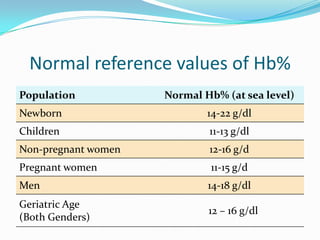
Normal reference values of Hb%
Population

Normal Hb% (at sea level)

Newborn

14-22 g/dl

Children

11-13 g/dl

Non-pregnant women

12-16 g/d

Pregnant women

11-15 g/d

Men

14-18 g/dl

Geriatric Age
(Both Genders)

12 – 16 g/dl
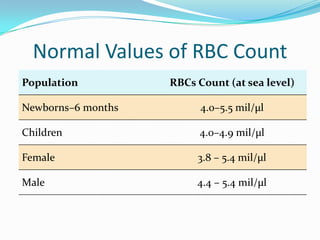
Normal Values of RBC Count
Population

RBCs Count (at sea level)

Newborns–6 months

4.0–5.5 mil/µl

Children

4.0–4.9 mil/µl

Female

3.8 – 5.4 mil/µl

Male

4.4 – 5.4 mil/µl
Causes Of
Anemia
 There are many diseases, conditions and other

factors causes anemia, few of which are:
 Nutritional deficiencies i.e. Iron, vit B12, folate etc.
 Hemolytic disorders e.g. Hypersplenism
 Acute or chronic Blood loss e.g. from G.I Tract,

Hemorrhage
 Bone marrow disorder

 Chronic Diseases e.g. Renal failure, Liver disease and

Malignancies
Causes Of Anemia (Cont….)
 Infections and inflammation e.g. Malaria, Cl.

Tetani
 Toxicity (from drugs, metals and poisons)

e.g. Lead Poisoning
 Autoimmune disorders .e.g. SLE,

 Heredity defect e.g. Thalassemia
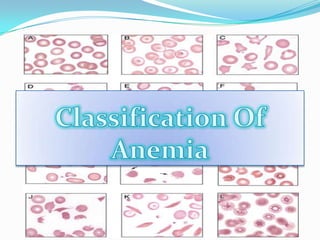
Classification Of Anemia
 Classification of anemia can be made the bases of
 RBCs Morphology

 Etiology
Morphological Classification
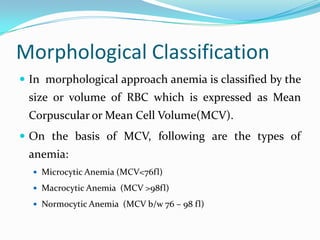
 In morphological approach anemia is classified by the

size or volume of RBC which is expressed as Mean
Corpuscular or Mean Cell Volume(MCV).
 On the basis of MCV, following are the types of

anemia:
 Microcytic Anemia (MCV<76fl)
 Macrocytic Anemia (MCV >98fl)
 Normocytic Anemia (MCV b/w 76 – 98 fl)
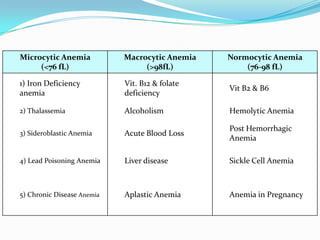
Microcytic Anemia
(<76 fL)

Macrocytic Anemia
(>98fL)

Normocytic Anemia
(76-98 fL)

1) Iron Deficiency
anemia

Vit. B12 & folate
deficiency

Vit B2 & B6

2) Thalassemia

Alcoholism

Hemolytic Anemia

3) Sideroblastic Anemia

Acute Blood Loss

Post Hemorrhagic
Anemia

4) Lead Poisoning Anemia

Liver disease

Sickle Cell Anemia

5) Chronic Disease Anemia

Aplastic Anemia

Anemia in Pregnancy
Etiological Classification
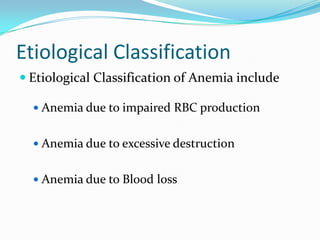
 Etiological Classification of Anemia include
 Anemia due to impaired RBC production

 Anemia due to excessive destruction
 Anemia due to Blood loss
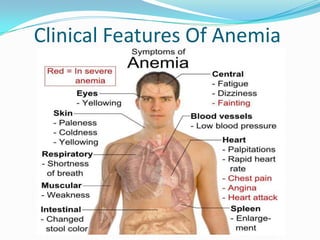
Clinical Features Of Anemia
Clinical Manifestations
 The clinical features of Anemia can result from

following factors.
1.

Tissue Hypoxia

2.

Compensatory Mechanism

3.

Rate of blood loss/destruction of RBCs

4. Causes of Anemia
Symptoms of Tissue Hypoxia
Largely affect Central Nervous System,
Cardio-vascular system and Muscular
system as their Oxygen requirement is
high than other.
Neurological Symptoms:
 Dizziness, fainting, lack of concentration
 Blurred or diminished vision

 Headache, tinnitus, Vertigo
 Paraesthesia in the fingers and toes

 Insomnia, irritability, confusion
Cardio Vascular Symptoms
 Dyspnea

 Palpitation
 Angina

On exertion or
at rest (in sever cases)

 Intermittent claudication
 Heart Failure (high output)

 Orthostatic Hypotension

CV Signs includes
 Tachycardia, bounding pulse
 Loud HS with S3 over mitral or tricuspid area
 Systolic murmur
 Raised JVP
Musculoskeletal symptoms
 Exercise intolerance
 Easy fatigability

 Tiredness
 Generalized Muscular weakness
Other Features
 Pallor of the skin, sclera and mucous membranes
 Jaundice
 Lymphadenopathy

 Hepatosplenomegally
 Bony Pain
 Petechiae
 Hair Loss
 Anorexia, Weight Loss
Compensatory Mechanism
1. Increase Cardiac Output (to maximize O2 delivery to tissue)
 Tachycardia, bounding pulse
2. Increase Erythropoiesis
 Liver and Yellow Bone marrow
3. Increase Plasma Volume
4. Redistribution of blood to more vital organs
 By selective vasoconstriction to non-vital organs
Specific Symptom due to
Underlying Cause
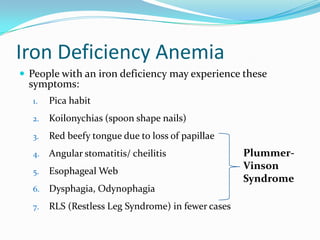
Iron Deficiency Anemia
 People with an iron deficiency may experience these

symptoms:
1.

Pica habit

2.

Koilonychias (spoon shape nails)

3.

Red beefy tongue due to loss of papillae

4.

Angular stomatitis/ cheilitis

5.

Esophageal Web

6.

Dysphagia, Odynophagia

7.

RLS (Restless Leg Syndrome) in fewer cases

PlummerVinson
Syndrome
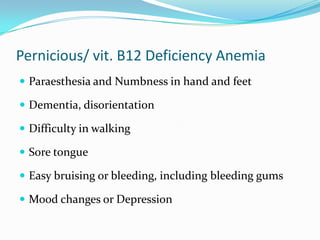
Pernicious/ vit. B12 Deficiency Anemia
 Paraesthesia and Numbness in hand and feet
 Dementia, disorientation
 Difficulty in walking
 Sore tongue
 Easy bruising or bleeding, including bleeding gums

 Mood changes or Depression
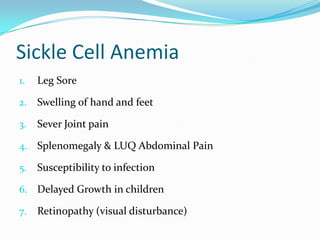
Sickle Cell Anemia
1.

Leg Sore

2.

Swelling of hand and feet

3.

Sever Joint pain

4. Splenomegaly & LUQ Abdominal Pain
5.

Susceptibility to infection

6. Delayed Growth in children
7.

Retinopathy (visual disturbance)
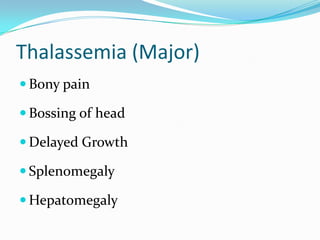
Thalassemia (Major)
 Bony pain
 Bossing of head
 Delayed Growth
 Splenomegaly

 Hepatomegaly
Aplastic Anemia
 Frequent or prolonged infections
 Unexplained or easy bruising
 Nose & Gums bleeding
 Prolonged bleeding from cuts
 Skin rash
How To Diagnose Anemia
History
Physical examination
Lab investigations
History Taking
 Diet (pure vegetarian)
 Fever
 Family history
 Related symptom
 Sign of other cytopenia
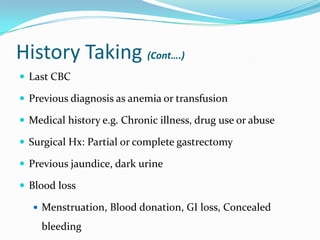
History Taking (Cont….)
 Last CBC
 Previous diagnosis as anemia or transfusion
 Medical history e.g. Chronic illness, drug use or abuse

 Surgical Hx: Partial or complete gastrectomy
 Previous jaundice, dark urine
 Blood loss
 Menstruation, Blood donation, GI loss, Concealed

bleeding
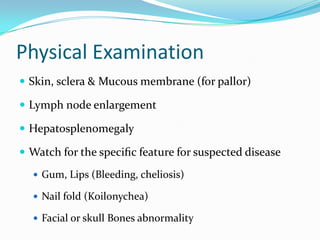
Physical Examination
 Skin, sclera & Mucous membrane (for pallor)
 Lymph node enlargement
 Hepatosplenomegaly
 Watch for the specific feature for suspected disease
 Gum, Lips (Bleeding, cheliosis)

 Nail fold (Koilonychea)
 Facial or skull Bones abnormality
Lab Investigations
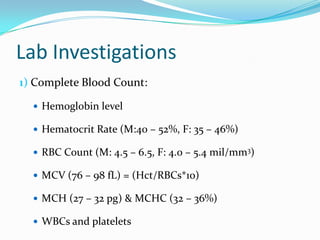
Lab Investigations
1) Complete Blood Count:
 Hemoglobin level
 Hematocrit Rate (M:40 – 52%, F: 35 – 46%)
 RBC Count (M: 4.5 – 6.5, F: 4.0 – 5.4 mil/mm3)
 MCV (76 – 98 fL) = (Hct/RBCs*10)

 MCH (27 – 32 pg) & MCHC (32 – 36%)
 WBCs and platelets
Lab Investigations
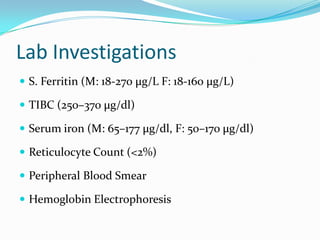
 S. Ferritin (M: 18-270 μg/L F: 18-160 μg/L)
 TIBC (250–370 μg/dl)
 Serum iron (M: 65–177 μg/dl, F: 50–170 μg/dl)
 Reticulocyte Count (<2%)
 Peripheral Blood Smear

 Hemoglobin Electrophoresis
Other Lab Investigations
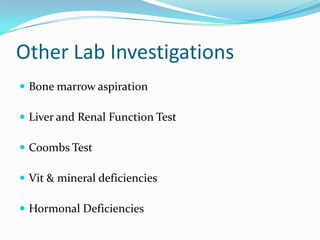
 Bone marrow aspiration
 Liver and Renal Function Test

 Coombs Test
 Vit & mineral deficiencies

 Hormonal Deficiencies
How To Treat Anemia
Treatment
 Depends on Type, cause and severity
 Goal is to increase Oxygenation to tissue and to treat the

underlying cause
 Certain modes of treatment include:
 Dietary Changes or Supplemental Diet
 Medicine
 Procedures
 Surgical Measurement
Treatment
 Dietary Changes & Supplements
 To correct the deficient vitamin or mineral, the low level

causes anemia.
 Diet Rich in Minerals & Vitamins (B12, Vit C, folate)
 Oral or Injectable supplement of these substance

 Medicine including
 Antibiotics / Anti-parasitic for infection or infestation
 Hormones (Erythropoietin, Progesterone and
Androgen)
Procedures
 Blood Transfusion
 Usually used to treat severely anemic patients as in
thalassemia major or sickle cell disease or to replace the
blood loss after injuries or surgeries.
 For multiple transfusion, Iron Chelation agent
(Deferasirox) should be given to prevent iron over dose.
 Allogeneic Bone Marrow Transplant
 Surgical Measurement include repair or removal of G.I part

causing blood loss and splenectomy.
Anemia (By Farooq Marwat)

Anemia (By Farooq Marwat)

  • 1.
    Presented at: College OfNursing Shifa Tameer-e-Millat University By: Muhammad Farooq RN, BSN, Dip Card.
  • 3.
     At theend of this presentation, the audience will know:  What is Anemia  Causes of Anemia  What are different Types/classification of Anemia  Clinical feature of anemia  Diagnosis/investigation Of Anemia  Treatment Of Anemia
  • 5.
     Taken fromGreek language (an meaning absence & hemia meaning blood), the term Anemia is use to describe a reduction in the hemoglobin concentration or in the number of circulating RBCs below the level considered normal for the person's age, sex and locality.
  • 6.
    Normal reference valuesof Hb% Population Normal Hb% (at sea level) Newborn 14-22 g/dl Children 11-13 g/dl Non-pregnant women 12-16 g/d Pregnant women 11-15 g/d Men 14-18 g/dl Geriatric Age (Both Genders) 12 – 16 g/dl
  • 7.
    Normal Values ofRBC Count Population RBCs Count (at sea level) Newborns–6 months 4.0–5.5 mil/µl Children 4.0–4.9 mil/µl Female 3.8 – 5.4 mil/µl Male 4.4 – 5.4 mil/µl
  • 8.
  • 9.
     There aremany diseases, conditions and other factors causes anemia, few of which are:  Nutritional deficiencies i.e. Iron, vit B12, folate etc.  Hemolytic disorders e.g. Hypersplenism  Acute or chronic Blood loss e.g. from G.I Tract, Hemorrhage  Bone marrow disorder  Chronic Diseases e.g. Renal failure, Liver disease and Malignancies
  • 10.
    Causes Of Anemia(Cont….)  Infections and inflammation e.g. Malaria, Cl. Tetani  Toxicity (from drugs, metals and poisons) e.g. Lead Poisoning  Autoimmune disorders .e.g. SLE,  Heredity defect e.g. Thalassemia
  • 12.
    Classification Of Anemia Classification of anemia can be made the bases of  RBCs Morphology  Etiology
  • 13.
    Morphological Classification  Inmorphological approach anemia is classified by the size or volume of RBC which is expressed as Mean Corpuscular or Mean Cell Volume(MCV).  On the basis of MCV, following are the types of anemia:  Microcytic Anemia (MCV<76fl)  Macrocytic Anemia (MCV >98fl)  Normocytic Anemia (MCV b/w 76 – 98 fl)
  • 14.
    Microcytic Anemia (<76 fL) MacrocyticAnemia (>98fL) Normocytic Anemia (76-98 fL) 1) Iron Deficiency anemia Vit. B12 & folate deficiency Vit B2 & B6 2) Thalassemia Alcoholism Hemolytic Anemia 3) Sideroblastic Anemia Acute Blood Loss Post Hemorrhagic Anemia 4) Lead Poisoning Anemia Liver disease Sickle Cell Anemia 5) Chronic Disease Anemia Aplastic Anemia Anemia in Pregnancy
  • 15.
    Etiological Classification  EtiologicalClassification of Anemia include  Anemia due to impaired RBC production  Anemia due to excessive destruction  Anemia due to Blood loss
  • 16.
  • 17.
    Clinical Manifestations  Theclinical features of Anemia can result from following factors. 1. Tissue Hypoxia 2. Compensatory Mechanism 3. Rate of blood loss/destruction of RBCs 4. Causes of Anemia
  • 18.
    Symptoms of TissueHypoxia Largely affect Central Nervous System, Cardio-vascular system and Muscular system as their Oxygen requirement is high than other.
  • 19.
    Neurological Symptoms:  Dizziness,fainting, lack of concentration  Blurred or diminished vision  Headache, tinnitus, Vertigo  Paraesthesia in the fingers and toes  Insomnia, irritability, confusion
  • 20.
    Cardio Vascular Symptoms Dyspnea  Palpitation  Angina On exertion or at rest (in sever cases)  Intermittent claudication  Heart Failure (high output)  Orthostatic Hypotension CV Signs includes  Tachycardia, bounding pulse  Loud HS with S3 over mitral or tricuspid area  Systolic murmur  Raised JVP
  • 21.
    Musculoskeletal symptoms  Exerciseintolerance  Easy fatigability  Tiredness  Generalized Muscular weakness
  • 22.
    Other Features  Pallorof the skin, sclera and mucous membranes  Jaundice  Lymphadenopathy  Hepatosplenomegally  Bony Pain  Petechiae  Hair Loss  Anorexia, Weight Loss
  • 23.
    Compensatory Mechanism 1. IncreaseCardiac Output (to maximize O2 delivery to tissue)  Tachycardia, bounding pulse 2. Increase Erythropoiesis  Liver and Yellow Bone marrow 3. Increase Plasma Volume 4. Redistribution of blood to more vital organs  By selective vasoconstriction to non-vital organs
  • 24.
    Specific Symptom dueto Underlying Cause
  • 25.
    Iron Deficiency Anemia People with an iron deficiency may experience these symptoms: 1. Pica habit 2. Koilonychias (spoon shape nails) 3. Red beefy tongue due to loss of papillae 4. Angular stomatitis/ cheilitis 5. Esophageal Web 6. Dysphagia, Odynophagia 7. RLS (Restless Leg Syndrome) in fewer cases PlummerVinson Syndrome
  • 26.
    Pernicious/ vit. B12Deficiency Anemia  Paraesthesia and Numbness in hand and feet  Dementia, disorientation  Difficulty in walking  Sore tongue  Easy bruising or bleeding, including bleeding gums  Mood changes or Depression
  • 27.
    Sickle Cell Anemia 1. LegSore 2. Swelling of hand and feet 3. Sever Joint pain 4. Splenomegaly & LUQ Abdominal Pain 5. Susceptibility to infection 6. Delayed Growth in children 7. Retinopathy (visual disturbance)
  • 28.
    Thalassemia (Major)  Bonypain  Bossing of head  Delayed Growth  Splenomegaly  Hepatomegaly
  • 29.
    Aplastic Anemia  Frequentor prolonged infections  Unexplained or easy bruising  Nose & Gums bleeding  Prolonged bleeding from cuts  Skin rash
  • 30.
  • 31.
    How To DiagnoseAnemia History Physical examination Lab investigations
  • 32.
    History Taking  Diet(pure vegetarian)  Fever  Family history  Related symptom  Sign of other cytopenia
  • 33.
    History Taking (Cont….) Last CBC  Previous diagnosis as anemia or transfusion  Medical history e.g. Chronic illness, drug use or abuse  Surgical Hx: Partial or complete gastrectomy  Previous jaundice, dark urine  Blood loss  Menstruation, Blood donation, GI loss, Concealed bleeding
  • 34.
    Physical Examination  Skin,sclera & Mucous membrane (for pallor)  Lymph node enlargement  Hepatosplenomegaly  Watch for the specific feature for suspected disease  Gum, Lips (Bleeding, cheliosis)  Nail fold (Koilonychea)  Facial or skull Bones abnormality
  • 35.
  • 36.
    Lab Investigations 1) CompleteBlood Count:  Hemoglobin level  Hematocrit Rate (M:40 – 52%, F: 35 – 46%)  RBC Count (M: 4.5 – 6.5, F: 4.0 – 5.4 mil/mm3)  MCV (76 – 98 fL) = (Hct/RBCs*10)  MCH (27 – 32 pg) & MCHC (32 – 36%)  WBCs and platelets
  • 37.
    Lab Investigations  S.Ferritin (M: 18-270 μg/L F: 18-160 μg/L)  TIBC (250–370 μg/dl)  Serum iron (M: 65–177 μg/dl, F: 50–170 μg/dl)  Reticulocyte Count (<2%)  Peripheral Blood Smear  Hemoglobin Electrophoresis
  • 38.
    Other Lab Investigations Bone marrow aspiration  Liver and Renal Function Test  Coombs Test  Vit & mineral deficiencies  Hormonal Deficiencies
  • 39.
  • 40.
    Treatment  Depends onType, cause and severity  Goal is to increase Oxygenation to tissue and to treat the underlying cause  Certain modes of treatment include:  Dietary Changes or Supplemental Diet  Medicine  Procedures  Surgical Measurement
  • 41.
    Treatment  Dietary Changes& Supplements  To correct the deficient vitamin or mineral, the low level causes anemia.  Diet Rich in Minerals & Vitamins (B12, Vit C, folate)  Oral or Injectable supplement of these substance  Medicine including  Antibiotics / Anti-parasitic for infection or infestation  Hormones (Erythropoietin, Progesterone and Androgen)
  • 42.
    Procedures  Blood Transfusion Usually used to treat severely anemic patients as in thalassemia major or sickle cell disease or to replace the blood loss after injuries or surgeries.  For multiple transfusion, Iron Chelation agent (Deferasirox) should be given to prevent iron over dose.  Allogeneic Bone Marrow Transplant  Surgical Measurement include repair or removal of G.I part causing blood loss and splenectomy.