ANDROID DEVELOPMENT
CONTENTS
 What’s Android
 Android architecture
 Android software development
 ‘Hello World’ on Android
 More…
2
3
WHAT’S ANDROID
ANDROID PHONES
4
MOBILE DEVICES
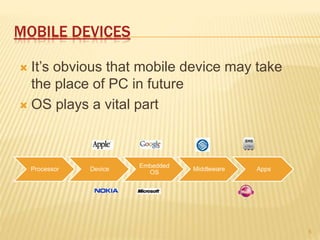
 It’s obvious that mobile device may take
the place of PC in future
 OS plays a vital part
5
Processor Device
Embedded
OS
Middleware Apps
WHAT’S ANDROID
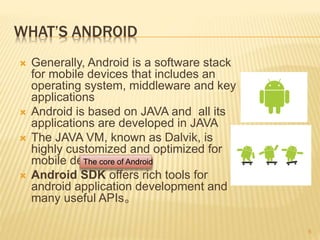
 Generally, Android is a software stack
for mobile devices that includes an
operating system, middleware and key
applications
 Android is based on JAVA and all its
applications are developed in JAVA
 The JAVA VM, known as Dalvik, is
highly customized and optimized for
mobile devices
 Android SDK offers rich tools for
android application development and
many useful APIs。
6
The core of Android
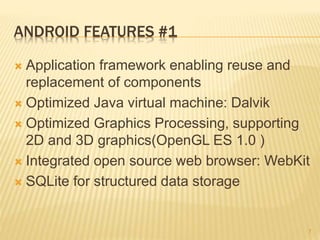
ANDROID FEATURES #1
 Application framework enabling reuse and
replacement of components
 Optimized Java virtual machine: Dalvik
 Optimized Graphics Processing, supporting
2D and 3D graphics(OpenGL ES 1.0 )
 Integrated open source web browser: WebKit
 SQLite for structured data storage
7
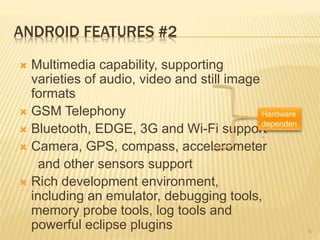
ANDROID FEATURES #2
 Multimedia capability, supporting
varieties of audio, video and still image
formats
 GSM Telephony
 Bluetooth, EDGE, 3G and Wi-Fi support
 Camera, GPS, compass, accelerometer
and other sensors support
 Rich development environment,
including an emulator, debugging tools,
memory probe tools, log tools and
powerful eclipse plugins 8
Hardware
dependen
t
9
ANDROID ARCHITECTURE
10
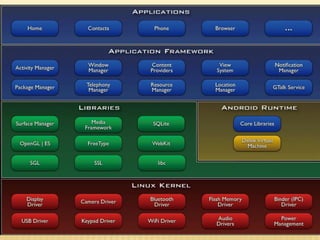
LINUX KERNEL
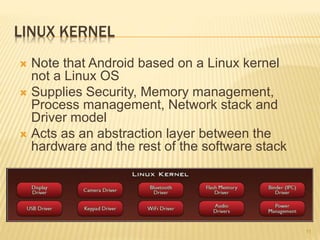
 Note that Android based on a Linux kernel
not a Linux OS
 Supplies Security, Memory management,
Process management, Network stack and
Driver model
 Acts as an abstraction layer between the
hardware and the rest of the software stack
11
LIBRARIES
 Run in system background
 Using C/C++ Language
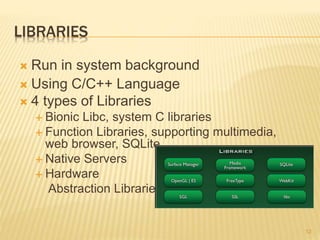
 4 types of Libraries
 Bionic Libc, system C libraries
 Function Libraries, supporting multimedia,
web browser, SQLite...
 Native Servers
 Hardware
Abstraction Libraries
12
ANDOID RUNTIME
 The core of Android platform
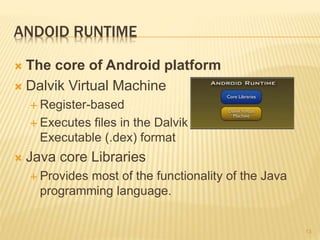
 Dalvik Virtual Machine
 Register-based
 Executes files in the Dalvik
Executable (.dex) format
 Java core Libraries
 Provides most of the functionality of the Java
programming language.
13
 The functions of Java core libraries rely on
the Dalvik VM and the underlying Linux
kernel
 Multiple Dalvik VMs may run at the same
time
 Every Android application runs in its own
process, with its own instance of the Dalvik
virtual machine
 The "dx" tool in Android SDK can transform
compiled JAVA class into the .dex format 14
DALVIK VIRTUAL MACHINE
 Android custom implementation virtual machine
 Provides application portability and runtime consistency
 Runs optimized file format (.dex) and Dalvik bytecode
 Java .class / .jar files converted to .dex at build time
 Designed for embedded environment
 Supports multiple virtual machine processes per device
 Highly CPU-optimized bytecode interpreter
 Efficiently Using runtime memory
 Core Libraries
 Core APIs for Java language provide a powerful, yet
simple and familiar development platform
15
DVM VS. JVM
 DVM
 Google
 Dalvik executable
 Only supports a subset of standard Java Library
 JVM
 Sun
 Java bytecode
 Some worries that Java world may be divided
into different communities, each has its own
Java standard
16
APPLICATION FRAMEWORK
 Simplify the reuse of components
 Applications can publish their capabilities and any
other application may then make use of those
capabilities
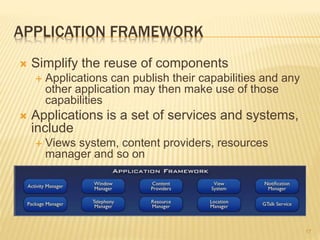
 Applications is a set of services and systems,
include
 Views system, content providers, resources
manager and so on
17
THANK U SO MUCH!
18

Android development process- thorsignia

  • 1.
  • 2.
    CONTENTS  What’s Android Android architecture  Android software development  ‘Hello World’ on Android  More… 2
  • 3.
  • 4.
  • 5.
    MOBILE DEVICES  It’sobvious that mobile device may take the place of PC in future  OS plays a vital part 5 Processor Device Embedded OS Middleware Apps
  • 6.
    WHAT’S ANDROID  Generally,Android is a software stack for mobile devices that includes an operating system, middleware and key applications  Android is based on JAVA and all its applications are developed in JAVA  The JAVA VM, known as Dalvik, is highly customized and optimized for mobile devices  Android SDK offers rich tools for android application development and many useful APIs。 6 The core of Android
  • 7.
    ANDROID FEATURES #1 Application framework enabling reuse and replacement of components  Optimized Java virtual machine: Dalvik  Optimized Graphics Processing, supporting 2D and 3D graphics(OpenGL ES 1.0 )  Integrated open source web browser: WebKit  SQLite for structured data storage 7
  • 8.
    ANDROID FEATURES #2 Multimedia capability, supporting varieties of audio, video and still image formats  GSM Telephony  Bluetooth, EDGE, 3G and Wi-Fi support  Camera, GPS, compass, accelerometer and other sensors support  Rich development environment, including an emulator, debugging tools, memory probe tools, log tools and powerful eclipse plugins 8 Hardware dependen t
  • 9.
  • 10.
  • 11.
    LINUX KERNEL  Notethat Android based on a Linux kernel not a Linux OS  Supplies Security, Memory management, Process management, Network stack and Driver model  Acts as an abstraction layer between the hardware and the rest of the software stack 11
  • 12.
    LIBRARIES  Run insystem background  Using C/C++ Language  4 types of Libraries  Bionic Libc, system C libraries  Function Libraries, supporting multimedia, web browser, SQLite...  Native Servers  Hardware Abstraction Libraries 12
  • 13.
    ANDOID RUNTIME  Thecore of Android platform  Dalvik Virtual Machine  Register-based  Executes files in the Dalvik Executable (.dex) format  Java core Libraries  Provides most of the functionality of the Java programming language. 13
  • 14.
     The functionsof Java core libraries rely on the Dalvik VM and the underlying Linux kernel  Multiple Dalvik VMs may run at the same time  Every Android application runs in its own process, with its own instance of the Dalvik virtual machine  The "dx" tool in Android SDK can transform compiled JAVA class into the .dex format 14
  • 15.
    DALVIK VIRTUAL MACHINE Android custom implementation virtual machine  Provides application portability and runtime consistency  Runs optimized file format (.dex) and Dalvik bytecode  Java .class / .jar files converted to .dex at build time  Designed for embedded environment  Supports multiple virtual machine processes per device  Highly CPU-optimized bytecode interpreter  Efficiently Using runtime memory  Core Libraries  Core APIs for Java language provide a powerful, yet simple and familiar development platform 15
  • 16.
    DVM VS. JVM DVM  Google  Dalvik executable  Only supports a subset of standard Java Library  JVM  Sun  Java bytecode  Some worries that Java world may be divided into different communities, each has its own Java standard 16
  • 17.
    APPLICATION FRAMEWORK  Simplifythe reuse of components  Applications can publish their capabilities and any other application may then make use of those capabilities  Applications is a set of services and systems, include  Views system, content providers, resources manager and so on 17
  • 18.
    THANK U SOMUCH! 18