SDK
• A software development kit enables developers to create
applications for the Android platform. It includes sample projects
with source code, development tools, an emulator, and required
libraries to build Android applications.
• Software Development kit contains all the:
• System Tools
• System Images
• Source Codes
• All Documentations
ANDROID
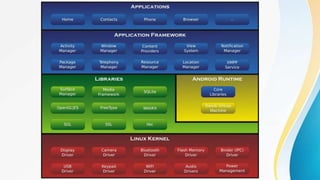
Android operating system is a stack of software
components which is roughly divided into five sections and
four main layers as shown below in the architecture
diagram.
Linux Kernel
• At the bottom of the layers is Linux - Linux 3.6 with
approximately 115 patches. T
• This provides a level of abstraction between the device
hardware and it contains all the essential hardware
drivers like camera, keypad, display etc.
• Also, the kernel handles all the things that Linux is really
good at such as networking and a vast array of device
drivers, which take the pain out of interfacing to peripheral
hardware.
Libraries
On top of Linux kernel there is a set of libraries including
open-source Web browser engine WebKit, well known
library libc, SQLite database which is a useful repository for
storage and sharing of application data, libraries to play and
record audio and video, SSL libraries responsible for
Internet security etc.
Android Runtime
• This is the third section of the architecture and available
on the second layer from the bottom. This section
provides a key component called Dalvik Virtual Machine
which is a kind of Java Virtual Machine specially designed
and optimized for Android.
• The Android runtime also provides a set of core libraries
which enable Android application developers to write
Android applications using standard Java programming
language.
Android Framework
The Application Framework layer provides many higher-level services to applications in the form
of Java classes. Application developers are allowed to make use of these services in their
applications.
The Android framework includes the following key services −
• Activity Manager − Controls all aspects of the application lifecycle and activity stack.
• Content Providers − Allows applications to publish and share data with other applications.
• Resource Manager − Provides access to non-code embedded resources such as strings,
color settings and user interface layouts.
• Notifications Manager − Allows applications to display alerts and notifications to the user.
• View System − An extensible set of views used to create application user interfaces.
Applications
You will find all the Android application at the top layer. You
will write your application to be installed on this layer only.
Examples of such applications are Contacts Books,
Browser, Games etc.
Windows OS
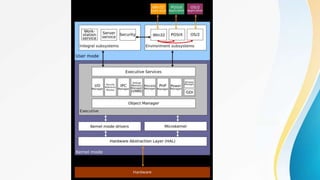
The architecture of Windows NT, a line of operating
systems produced and sold by Microsoft, is a layered
design that consists of two main components, user
mode and kernel mode.
Modes of Windows operating system
• Protected mode/Kernel mode — HAL,
kernel, executive. kernel mode has
unrestricted access to the system memory
and external devices
• User mode — collection of subsystems.
User mode has limited in term of system
resources they have access
Hardware Abstraction Layer
• It is a layer of software or programming that hides
(Abstraction) the hardware differences from the
operating system.
• This allows Windows 2000 to be portable from one
hardware platform to another.
• The HAL consists of a series of function that hides or
abstract differences between hardware platforms.
Kernel
• Windows Kernel is known as hybrid kernel.
• The Kernel works very closely with the HAL
• It schedules the activities to be performed by the CPU.
kernel synchronizes activity among processors to optimize
performance.
Kernel mode stops user mode services and applications
from accessing critical areas of the operating system that
should not have access to.
Kernel mode drivers exist in three levels.
1) Highest level drivers
2) Intermediate level drivers
3) Low level drivers
Executive Services
• The Executive Services, which includes the kernel
and the HAL, provides a set of common services that
the user can use. This section interacts with
Input/output devices, object management,
process management and the system security.
• Each group of services is managed by one of the
components of the executive services, which are as
follows:
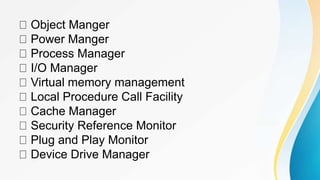
Object Manger
Power Manger
Process Manager
I/O Manager
Virtual memory management
Local Procedure Call Facility
Cache Manager
Security Reference Monitor
Plug and Play Monitor
Device Drive Manager
Environment subsystem
• Environment subsystem allow Window2000 to run
application written for different operating system. The
environment subsystem accept the API call made by the
application, convert the API call into a format that is
understood by Window 2000, and then pass the converted
• API to executive components running in Kernel mode.
Main three environment subsystem
The Win32 subsystem
An OS/2 subsystem
POSIX subsystem
Android Vs Windows Phone
• OS
Android is an open source platform, meaning
that the operating system is available for
modification by manufacturers to suit their
respective needs and phones.
• User Interface
Android Jelly Bean features an interface with
multiple home-screens that can be fully
customized with widgets and shortcuts
• Handsets
Android is ahead than the windows phone.
They are a huge number of Android phones
offered by multiple device manufactures like
Samsung, LG, Motorola, HTC, Huawei, etc.
• OS
Microsoft Windows Phone is closed-sourced,
meaning that it is owned and managed by
Microsoft and developers do not have direct
access to the operating system programming
code.
• User Interface
Windows Phone 8 has a single home-screen
populated with Live Tiles.
• Handsets
Windows phone has been offered by only a
few manufactures with limited handsets.
Manufactures like Nokia and HTC are known
to make high quality mobile device for
Windows phone.
• Apps
Android clearly wins with over
one million apps
• Security
While in Android, you can install any
apps from outside of Google play
store. So people tend to add more
cracked softwares which carry a lot of
viruses or malware. However, you can
prevent it by never installing any apps
from unknown sources.
• Apps
Windows Phone have only about
160,000 apps with a few 25,000 being
added every few weeks.
• Security
Windows phone is more secure than
android. The reason for this is that
windows phone doesn’t allow
installation of apps from unknown
sources. You are only allowed to
install applications which are available
in its app stores.

Android and windows os

  • 1.
    SDK • A softwaredevelopment kit enables developers to create applications for the Android platform. It includes sample projects with source code, development tools, an emulator, and required libraries to build Android applications. • Software Development kit contains all the: • System Tools • System Images • Source Codes • All Documentations
  • 2.
    ANDROID Android operating systemis a stack of software components which is roughly divided into five sections and four main layers as shown below in the architecture diagram.
  • 4.
    Linux Kernel • Atthe bottom of the layers is Linux - Linux 3.6 with approximately 115 patches. T • This provides a level of abstraction between the device hardware and it contains all the essential hardware drivers like camera, keypad, display etc. • Also, the kernel handles all the things that Linux is really good at such as networking and a vast array of device drivers, which take the pain out of interfacing to peripheral hardware.
  • 5.
    Libraries On top ofLinux kernel there is a set of libraries including open-source Web browser engine WebKit, well known library libc, SQLite database which is a useful repository for storage and sharing of application data, libraries to play and record audio and video, SSL libraries responsible for Internet security etc.
  • 6.
    Android Runtime • Thisis the third section of the architecture and available on the second layer from the bottom. This section provides a key component called Dalvik Virtual Machine which is a kind of Java Virtual Machine specially designed and optimized for Android. • The Android runtime also provides a set of core libraries which enable Android application developers to write Android applications using standard Java programming language.
  • 7.
    Android Framework The ApplicationFramework layer provides many higher-level services to applications in the form of Java classes. Application developers are allowed to make use of these services in their applications. The Android framework includes the following key services − • Activity Manager − Controls all aspects of the application lifecycle and activity stack. • Content Providers − Allows applications to publish and share data with other applications. • Resource Manager − Provides access to non-code embedded resources such as strings, color settings and user interface layouts. • Notifications Manager − Allows applications to display alerts and notifications to the user. • View System − An extensible set of views used to create application user interfaces.
  • 8.
    Applications You will findall the Android application at the top layer. You will write your application to be installed on this layer only. Examples of such applications are Contacts Books, Browser, Games etc.
  • 9.
    Windows OS The architectureof Windows NT, a line of operating systems produced and sold by Microsoft, is a layered design that consists of two main components, user mode and kernel mode.
  • 11.
    Modes of Windowsoperating system • Protected mode/Kernel mode — HAL, kernel, executive. kernel mode has unrestricted access to the system memory and external devices • User mode — collection of subsystems. User mode has limited in term of system resources they have access
  • 12.
    Hardware Abstraction Layer •It is a layer of software or programming that hides (Abstraction) the hardware differences from the operating system. • This allows Windows 2000 to be portable from one hardware platform to another. • The HAL consists of a series of function that hides or abstract differences between hardware platforms.
  • 13.
    Kernel • Windows Kernelis known as hybrid kernel. • The Kernel works very closely with the HAL • It schedules the activities to be performed by the CPU. kernel synchronizes activity among processors to optimize performance. Kernel mode stops user mode services and applications from accessing critical areas of the operating system that should not have access to. Kernel mode drivers exist in three levels. 1) Highest level drivers 2) Intermediate level drivers 3) Low level drivers
  • 14.
    Executive Services • TheExecutive Services, which includes the kernel and the HAL, provides a set of common services that the user can use. This section interacts with Input/output devices, object management, process management and the system security. • Each group of services is managed by one of the components of the executive services, which are as follows:
  • 15.
    Object Manger Power Manger ProcessManager I/O Manager Virtual memory management Local Procedure Call Facility Cache Manager Security Reference Monitor Plug and Play Monitor Device Drive Manager
  • 16.
    Environment subsystem • Environmentsubsystem allow Window2000 to run application written for different operating system. The environment subsystem accept the API call made by the application, convert the API call into a format that is understood by Window 2000, and then pass the converted • API to executive components running in Kernel mode. Main three environment subsystem The Win32 subsystem An OS/2 subsystem POSIX subsystem
  • 17.
    Android Vs WindowsPhone • OS Android is an open source platform, meaning that the operating system is available for modification by manufacturers to suit their respective needs and phones. • User Interface Android Jelly Bean features an interface with multiple home-screens that can be fully customized with widgets and shortcuts • Handsets Android is ahead than the windows phone. They are a huge number of Android phones offered by multiple device manufactures like Samsung, LG, Motorola, HTC, Huawei, etc. • OS Microsoft Windows Phone is closed-sourced, meaning that it is owned and managed by Microsoft and developers do not have direct access to the operating system programming code. • User Interface Windows Phone 8 has a single home-screen populated with Live Tiles. • Handsets Windows phone has been offered by only a few manufactures with limited handsets. Manufactures like Nokia and HTC are known to make high quality mobile device for Windows phone.
  • 18.
    • Apps Android clearlywins with over one million apps • Security While in Android, you can install any apps from outside of Google play store. So people tend to add more cracked softwares which carry a lot of viruses or malware. However, you can prevent it by never installing any apps from unknown sources. • Apps Windows Phone have only about 160,000 apps with a few 25,000 being added every few weeks. • Security Windows phone is more secure than android. The reason for this is that windows phone doesn’t allow installation of apps from unknown sources. You are only allowed to install applications which are available in its app stores.