Java Operating
System
Represented By
Roll No 6745
Roll No 67==
JavaOS
 JavaOS is an operating system with
a java virtual machine as a
fundamental component, originally
developed by sun Microsystems.
 Unlike Windows, Mac
OS, Unix or Unix-like systems which
are primarily written in
the C programming language, JavaOS
is primarily written in Java.
 It is now considered a legacy system.
History
 JavaOS was originally announced in 1996
by Sun's Java Soft subsidiary as a
compact OS designed to run "in anything
from net computers to pagers
 It supports a password protected login,
own device drivers, has its own window
system and API and can execute several
Java applets at the same time
History
 Java Soft has granted licenses to more
than 25 manufacturers, including Oracle
Corp, Acer Inc., Xerox, Toshiba Corp and
Nokia.
 In 1999, Sun and IBM announced the
end of the JavaOS project.As early as
2003, Sun materials referred to JavaOS
as a "legacy technology", recommending
migration to Java ME, leaving the choice
of specific OS and Java environment to
the implementer.
Design
 The system is based on a hardware
architecture native microkernel
 The Java virtual machine runs on top of
the microkernel.
 Platforms that the kernel runs on include:
 ARM
 PowerPC
 SPARC
 Strong ARM
 IA-32
Design
 All device drivers are written in Java
and executed by the virtual machine.
 A graphics and windowing system is
also written in Java
Applications
 JavaOS was designed to run
on embedded systems and has
applications in devices such as set top
boxes, networking infrastructure
and ATMs. It's also the operating
system that comes with the Java
Station.
JexeOS
 JexeOS is a personal computer
operating system from Toshiba
Information Systems of Japan that is
dedicated to running Java applications
on x86-based systems.
 A 1.0 beta version was available as of
late 1997
JX (operating system)
 JX is a microkernel operating system
with both the kernel and applications
implemented using
the Java programming language.
 JX is implemented as an extended Java
Virtual Machine adding support to the
Java system for necessary features such
as protection domains and hardware
access, along with a number of
components written in Java that provide
kernel facilities to applications running on
the computer
Advantages of JX(OS)
 The primary benefits of JX include:
 a small trusted computing base results
in a high security system
 lack of address space switching
enables high performance compared
to most microkernel systems
SavaJe
 SavaJe Technologies (pronounced
savage) was the developer of
the SavaJe OS, a Java OS for advanced
mobile phones.
 . The SavaJe Java platform included a
full implementation of Java Swing,
enabling developers to create
applications with richer user interfaces.
 In September 2010, the Mass High Tech
Journal reported that the inspiration
of Android technology has strong ties to
the creation and development of the
SavaJe platform.
Vino (operating system)
 Vino was a now-inactive project at
Harvard University that sought to
develop an extensible-kernel
operating system based
Java Desktop System
 Java Desktop System, briefly known
as Open Solaris Desktop, is a desktop
environment developed first by Sun
Microsystems and then by Oracl
Corporation after the 2010 Oracle
acquisition of Sun.
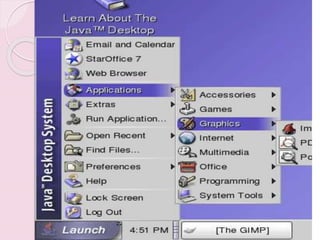
 Java Desktop System aims to provide a
system familiar to the average computer
user with a full suite of office productivity
software such as an office suite, a web
browser, email, calendaring, and instant
messaging .
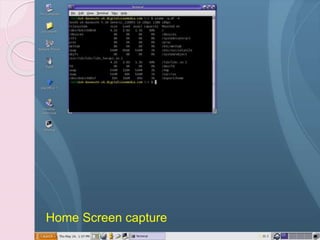
Home Screen capture
Java Desktop System
 The Java Desktop System, it is not
actually written in Java. Rather, it is
built around a tweaked version of
GNOME along with other common
free software projects, which are
written mostly in C and C++.
Versions Of
Java Desktop System
 Sun first bundled a preview release of
GNOME 1.4 on a separate CD for
Solaris 8.
 JDS version 2
 Real Player and Mozila are the
famous apps .

Java operating system

  • 1.
  • 2.
    JavaOS  JavaOS isan operating system with a java virtual machine as a fundamental component, originally developed by sun Microsystems.  Unlike Windows, Mac OS, Unix or Unix-like systems which are primarily written in the C programming language, JavaOS is primarily written in Java.  It is now considered a legacy system.
  • 3.
    History  JavaOS wasoriginally announced in 1996 by Sun's Java Soft subsidiary as a compact OS designed to run "in anything from net computers to pagers  It supports a password protected login, own device drivers, has its own window system and API and can execute several Java applets at the same time
  • 4.
    History  Java Softhas granted licenses to more than 25 manufacturers, including Oracle Corp, Acer Inc., Xerox, Toshiba Corp and Nokia.  In 1999, Sun and IBM announced the end of the JavaOS project.As early as 2003, Sun materials referred to JavaOS as a "legacy technology", recommending migration to Java ME, leaving the choice of specific OS and Java environment to the implementer.
  • 5.
    Design  The systemis based on a hardware architecture native microkernel  The Java virtual machine runs on top of the microkernel.  Platforms that the kernel runs on include:  ARM  PowerPC  SPARC  Strong ARM  IA-32
  • 6.
    Design  All devicedrivers are written in Java and executed by the virtual machine.  A graphics and windowing system is also written in Java
  • 7.
    Applications  JavaOS wasdesigned to run on embedded systems and has applications in devices such as set top boxes, networking infrastructure and ATMs. It's also the operating system that comes with the Java Station.
  • 8.
    JexeOS  JexeOS isa personal computer operating system from Toshiba Information Systems of Japan that is dedicated to running Java applications on x86-based systems.  A 1.0 beta version was available as of late 1997
  • 9.
    JX (operating system) JX is a microkernel operating system with both the kernel and applications implemented using the Java programming language.  JX is implemented as an extended Java Virtual Machine adding support to the Java system for necessary features such as protection domains and hardware access, along with a number of components written in Java that provide kernel facilities to applications running on the computer
  • 10.
    Advantages of JX(OS) The primary benefits of JX include:  a small trusted computing base results in a high security system  lack of address space switching enables high performance compared to most microkernel systems
  • 11.
    SavaJe  SavaJe Technologies(pronounced savage) was the developer of the SavaJe OS, a Java OS for advanced mobile phones.  . The SavaJe Java platform included a full implementation of Java Swing, enabling developers to create applications with richer user interfaces.  In September 2010, the Mass High Tech Journal reported that the inspiration of Android technology has strong ties to the creation and development of the SavaJe platform.
  • 12.
    Vino (operating system) Vino was a now-inactive project at Harvard University that sought to develop an extensible-kernel operating system based
  • 13.
    Java Desktop System Java Desktop System, briefly known as Open Solaris Desktop, is a desktop environment developed first by Sun Microsystems and then by Oracl Corporation after the 2010 Oracle acquisition of Sun.  Java Desktop System aims to provide a system familiar to the average computer user with a full suite of office productivity software such as an office suite, a web browser, email, calendaring, and instant messaging .
  • 14.
  • 15.
    Java Desktop System The Java Desktop System, it is not actually written in Java. Rather, it is built around a tweaked version of GNOME along with other common free software projects, which are written mostly in C and C++.
  • 17.
    Versions Of Java DesktopSystem  Sun first bundled a preview release of GNOME 1.4 on a separate CD for Solaris 8.  JDS version 2  Real Player and Mozila are the famous apps .