Features of Successful Inclining
Block Water Conservation Rate
Structures
Presented by:
Andrew Burnham, Senior Vice President
March 6, 2015 @ 9:00 – 9:30AM
TEXAS WATER CONSERVATION ASSOCIATION
71ST ANNUAL CONVENTION
SHERATON AUSTIN HOTEL @ THE CAPITOL (AUSTIN, TEXAS)
Understanding the Fundamental
Challenge of Water Ratemaking
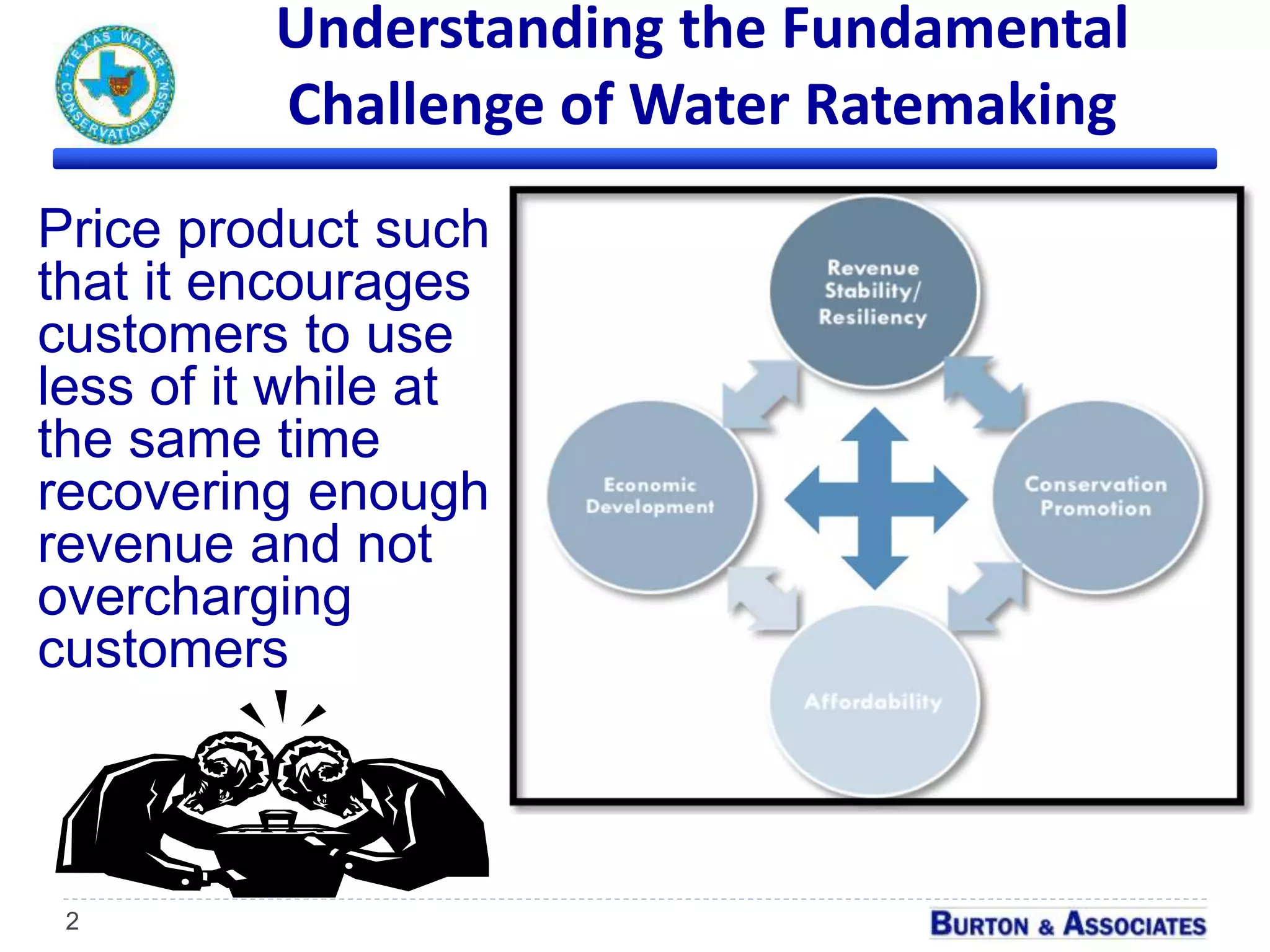
Price product such
that it encourages
customers to use
less of it while at
the same time
recovering enough
revenue and not
overcharging
customers
2
3
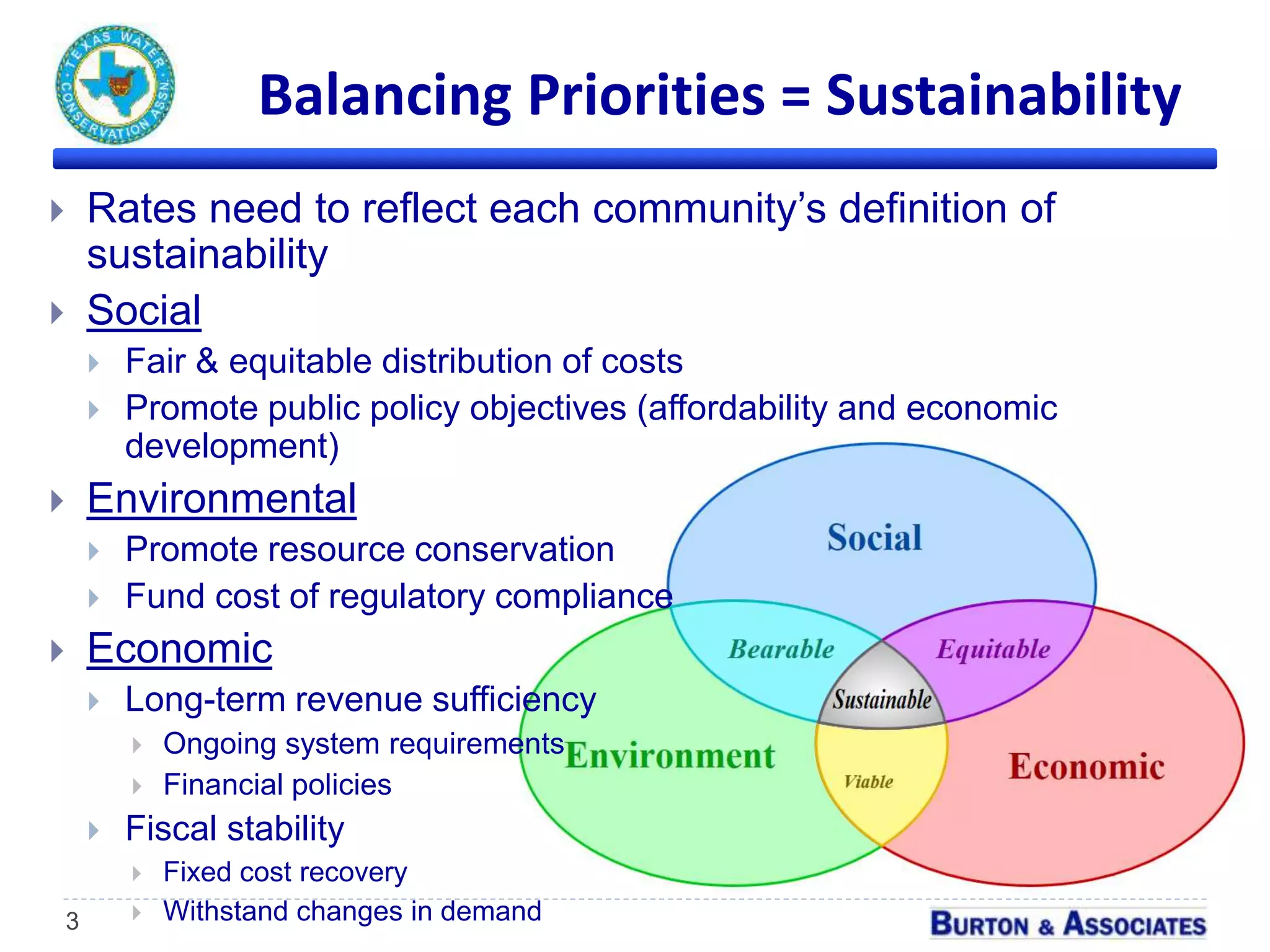
Balancing Priorities = Sustainability
 Rates need to reflect each community’s definition of
sustainability
 Social
 Fair & equitable distribution of costs
 Promote public policy objectives (affordability and economic
development)
 Environmental
 Promote resource conservation
 Fund cost of regulatory compliance
 Economic
 Long-term revenue sufficiency
 Ongoing system requirements
 Financial policies
 Fiscal stability
 Fixed cost recovery
 Withstand changes in demand
Overview of the Ratemaking Process
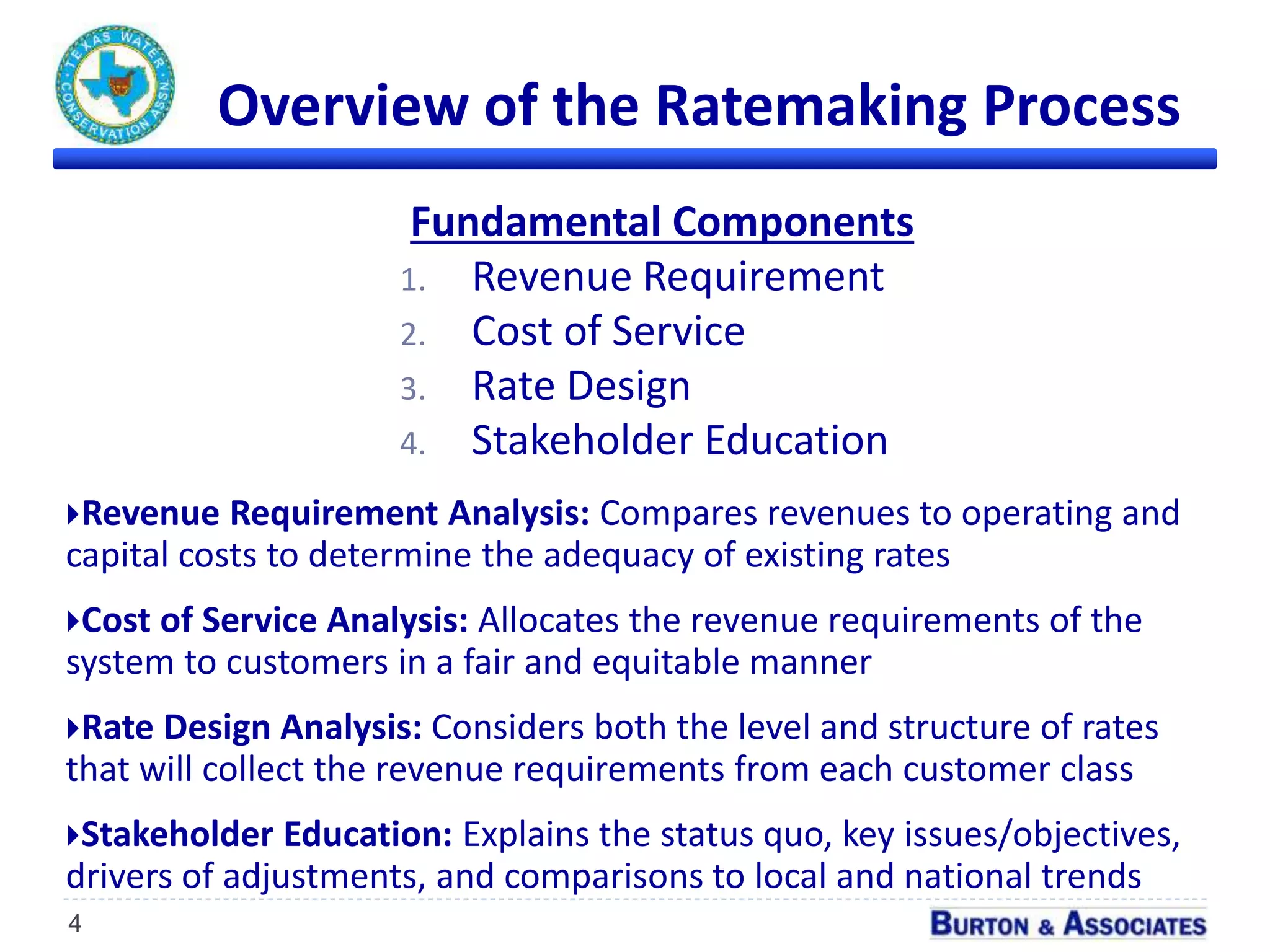
Fundamental Components
1. Revenue Requirement
2. Cost of Service
3. Rate Design
4. Stakeholder Education
4
Revenue Requirement Analysis: Compares revenues to operating and
capital costs to determine the adequacy of existing rates
Cost of Service Analysis: Allocates the revenue requirements of the
system to customers in a fair and equitable manner
Rate Design Analysis: Considers both the level and structure of rates
that will collect the revenue requirements from each customer class
Stakeholder Education: Explains the status quo, key issues/objectives,
drivers of adjustments, and comparisons to local and national trends
Before Developing Conservation
Rates, Understand the Cost of Service
5
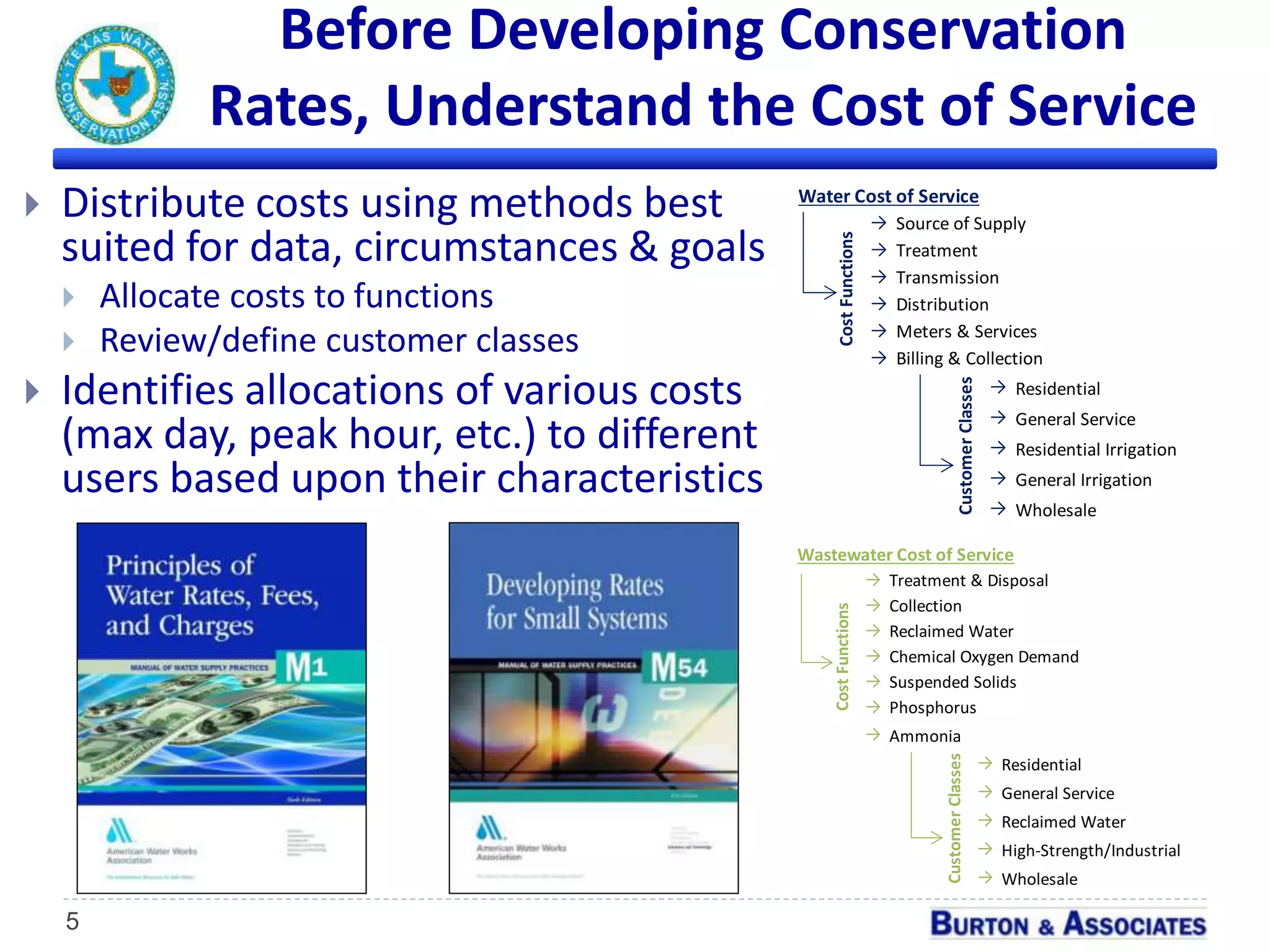
 Distribute costs using methods best
suited for data, circumstances & goals
 Allocate costs to functions
 Review/define customer classes
 Identifies allocations of various costs
(max day, peak hour, etc.) to different
users based upon their characteristics
Water Cost of Service Wastewater Cost of Service
→ Source of Supply → Treatment & Disposal
→ Treatment → Collection
→ Transmission → Reclaimed Water
→ Distribution → Chemical Oxygen Demand
→ Meters & Services → Suspended Solids
→ Billing & Collection → Phosphorus
→ Residential → Ammonia
→ General Service → Residential
→ Residential Irrigation → General Service
→ General Irrigation → Reclaimed Water
→ Wholesale → High-Strength/Industrial
→ Wholesale
CostFunctions
CostFunctions
CustomerClasses
CustomerClasses
Water Cost of Service Wa
→ Source of Supply
→ Treatment
→ Transmission
→ Distribution
→ Meters & Services
→ Billing & Collection
→ Residential
→ General Service
→ Residential Irrigation
→ General Irrigation
→ Wholesale
CostFunctions
CustomerClasses
Cost of Service Analysis Establishes
Guideposts for Developing Rates
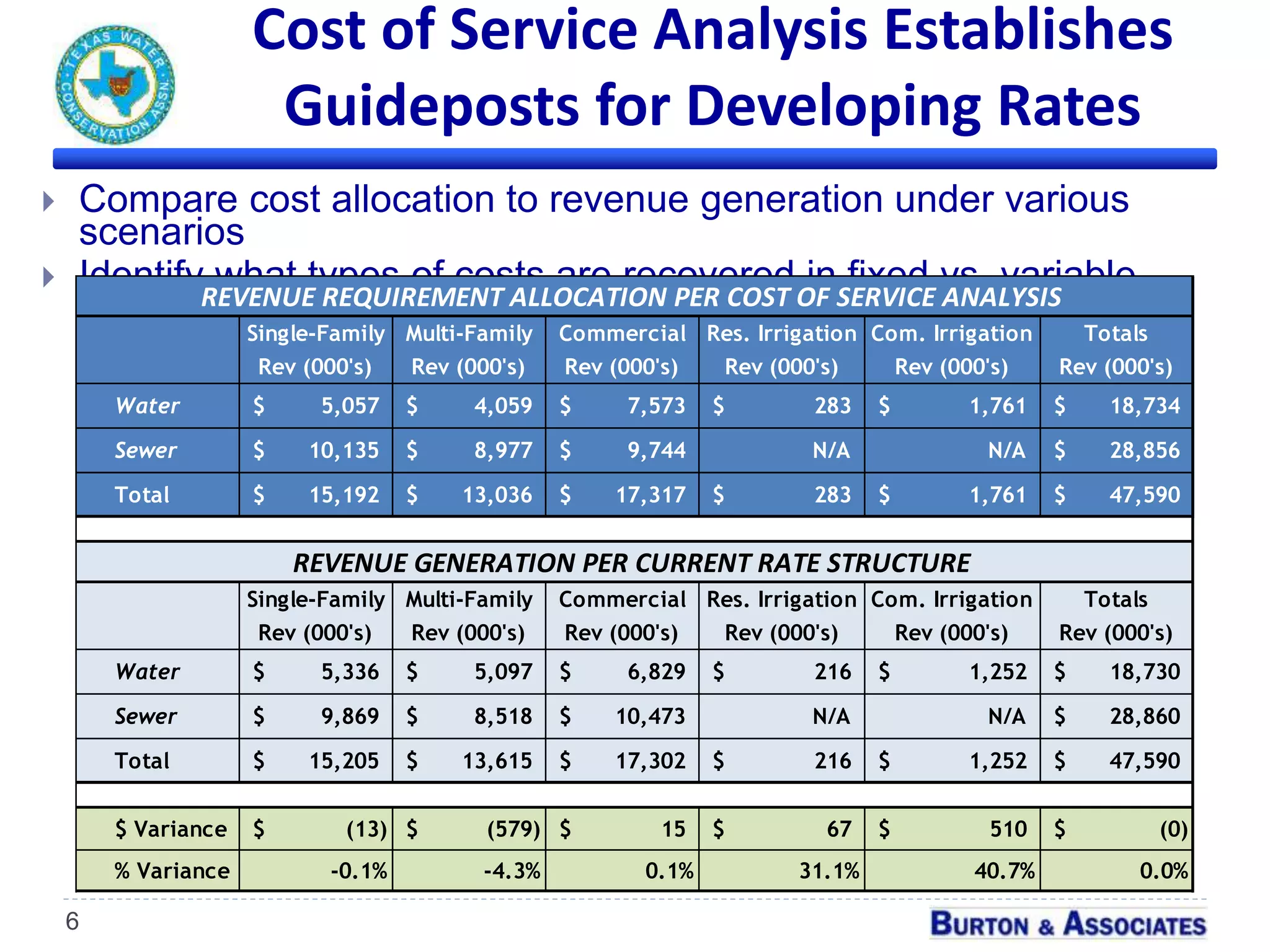
 Compare cost allocation to revenue generation under various
scenarios
 Identify what types of costs are recovered in fixed vs. variable
charges
6
Single-Family Multi-Family Commercial Res. Irrigation Com. Irrigation Totals
Rev (000's) Rev (000's) Rev (000's) Rev (000's) Rev (000's) Rev (000's)
Water 5,057$ 4,059$ 7,573$ 283$ 1,761$ 18,734$
Sewer 10,135$ 8,977$ 9,744$ N/A N/A 28,856$
Total 15,192$ 13,036$ 17,317$ 283$ 1,761$ 47,590$
Single-Family Multi-Family Commercial Res. Irrigation Com. Irrigation Totals
Rev (000's) Rev (000's) Rev (000's) Rev (000's) Rev (000's) Rev (000's)
Water 5,336$ 5,097$ 6,829$ 216$ 1,252$ 18,730$
Sewer 9,869$ 8,518$ 10,473$ N/A N/A 28,860$
Total 15,205$ 13,615$ 17,302$ 216$ 1,252$ 47,590$
$ Variance (13)$ (579)$ 15$ 67$ 510$ (0)$
% Variance -0.1% -4.3% 0.1% 31.1% 40.7% 0.0%
REVENUE REQUIREMENT ALLOCATION PER COST OF SERVICE ANALYSIS
REVENUE GENERATION PER CURRENT RATE STRUCTURE
Approach to Rate Structure Analysis
7
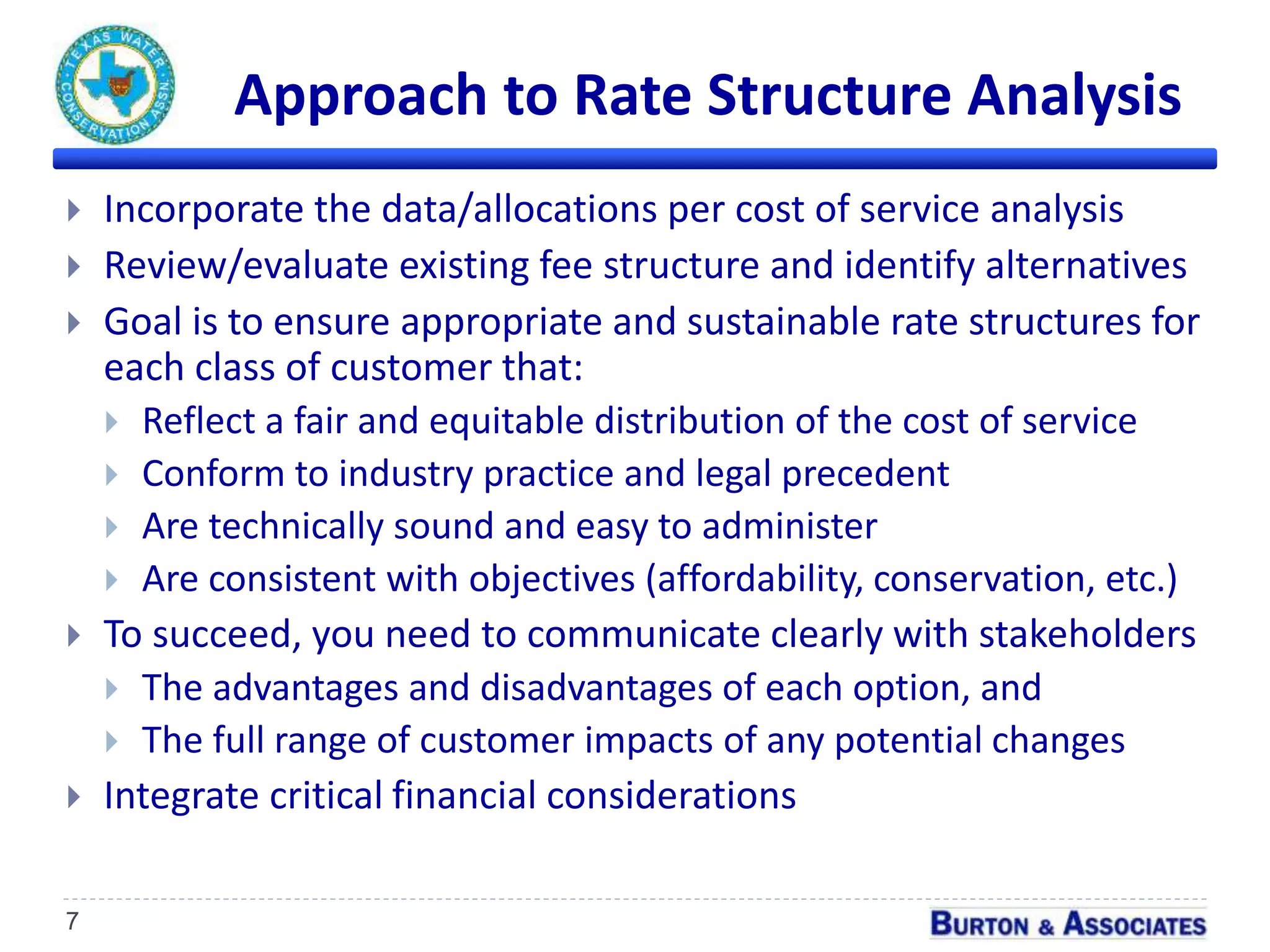
 Incorporate the data/allocations per cost of service analysis
 Review/evaluate existing fee structure and identify alternatives
 Goal is to ensure appropriate and sustainable rate structures for
each class of customer that:
 Reflect a fair and equitable distribution of the cost of service
 Conform to industry practice and legal precedent
 Are technically sound and easy to administer
 Are consistent with objectives (affordability, conservation, etc.)
 To succeed, you need to communicate clearly with stakeholders
 The advantages and disadvantages of each option, and
 The full range of customer impacts of any potential changes
 Integrate critical financial considerations
Key Financial Consideration:
Establishing Sound Reserve Policies
8
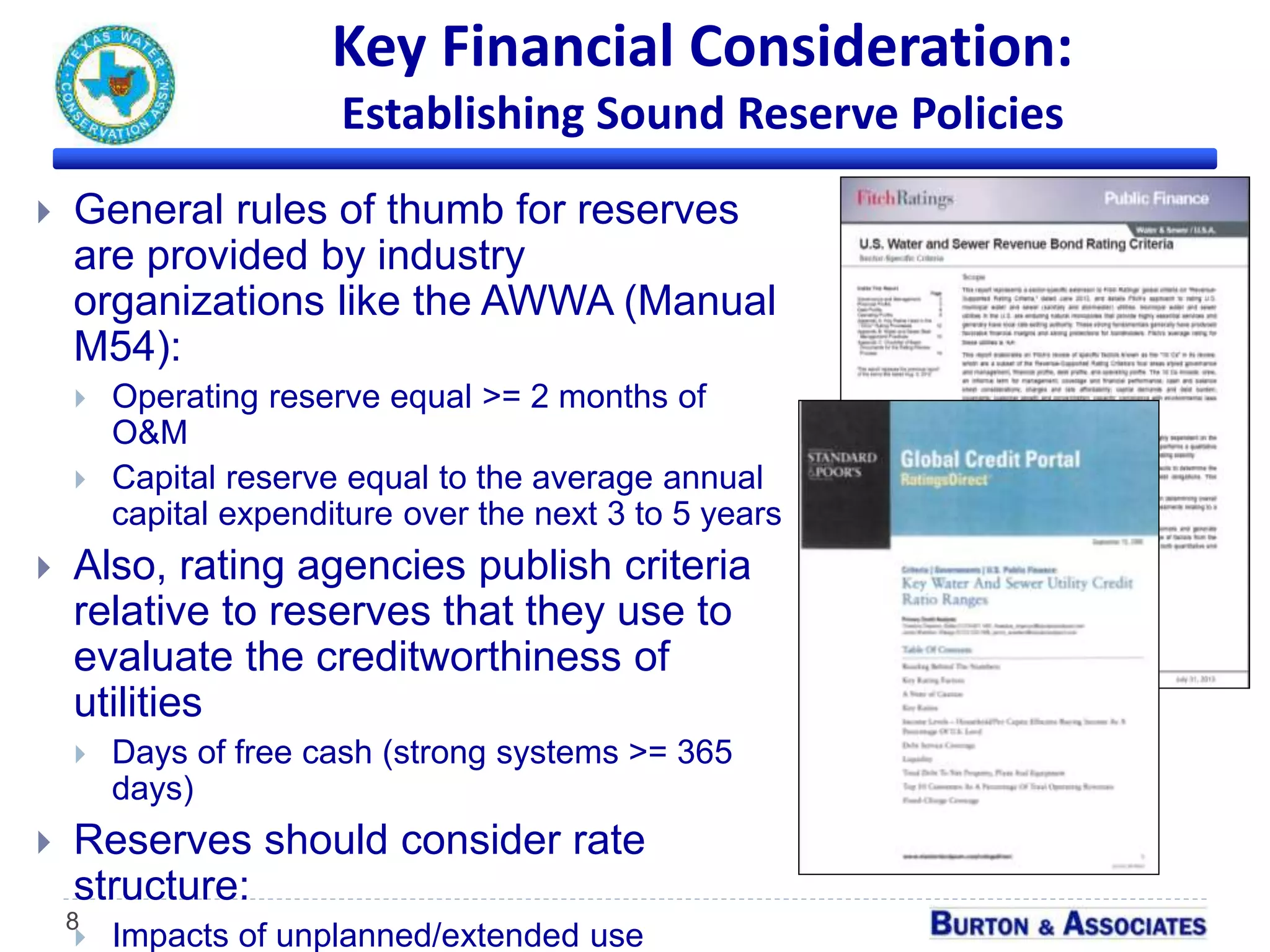
 General rules of thumb for reserves
are provided by industry
organizations like the AWWA (Manual
M54):
 Operating reserve equal >= 2 months of
O&M
 Capital reserve equal to the average annual
capital expenditure over the next 3 to 5 years
 Also, rating agencies publish criteria
relative to reserves that they use to
evaluate the creditworthiness of
utilities
 Days of free cash (strong systems >= 365
days)
 Reserves should consider rate
structure:
 Impacts of unplanned/extended use
Key Financial Consideration:
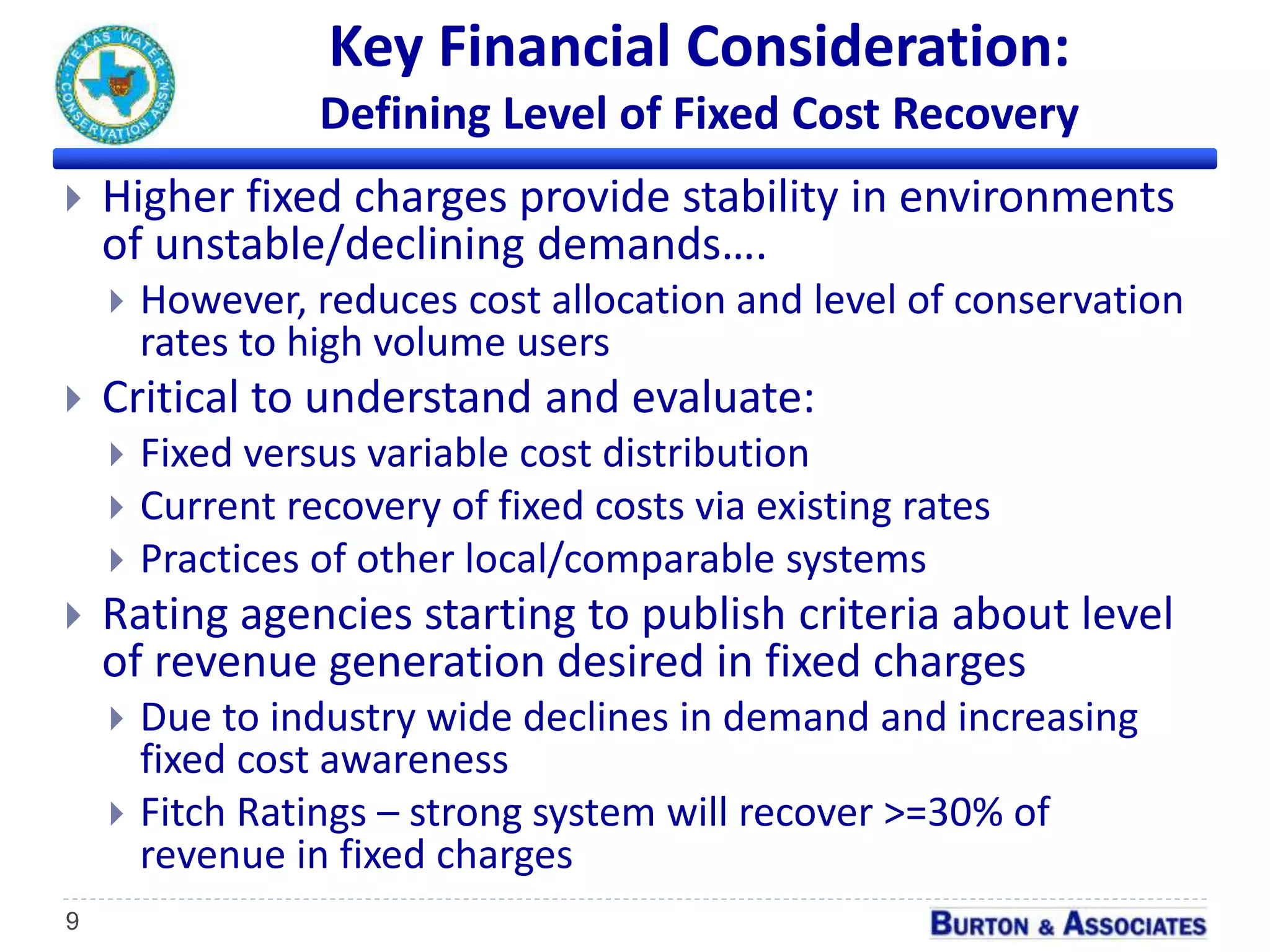
Defining Level of Fixed Cost Recovery
9
 Higher fixed charges provide stability in environments
of unstable/declining demands….
 However, reduces cost allocation and level of conservation
rates to high volume users
 Critical to understand and evaluate:
 Fixed versus variable cost distribution
 Current recovery of fixed costs via existing rates
 Practices of other local/comparable systems
 Rating agencies starting to publish criteria about level
of revenue generation desired in fixed charges
 Due to industry wide declines in demand and increasing
fixed cost awareness
 Fitch Ratings – strong system will recover >=30% of
revenue in fixed charges
10
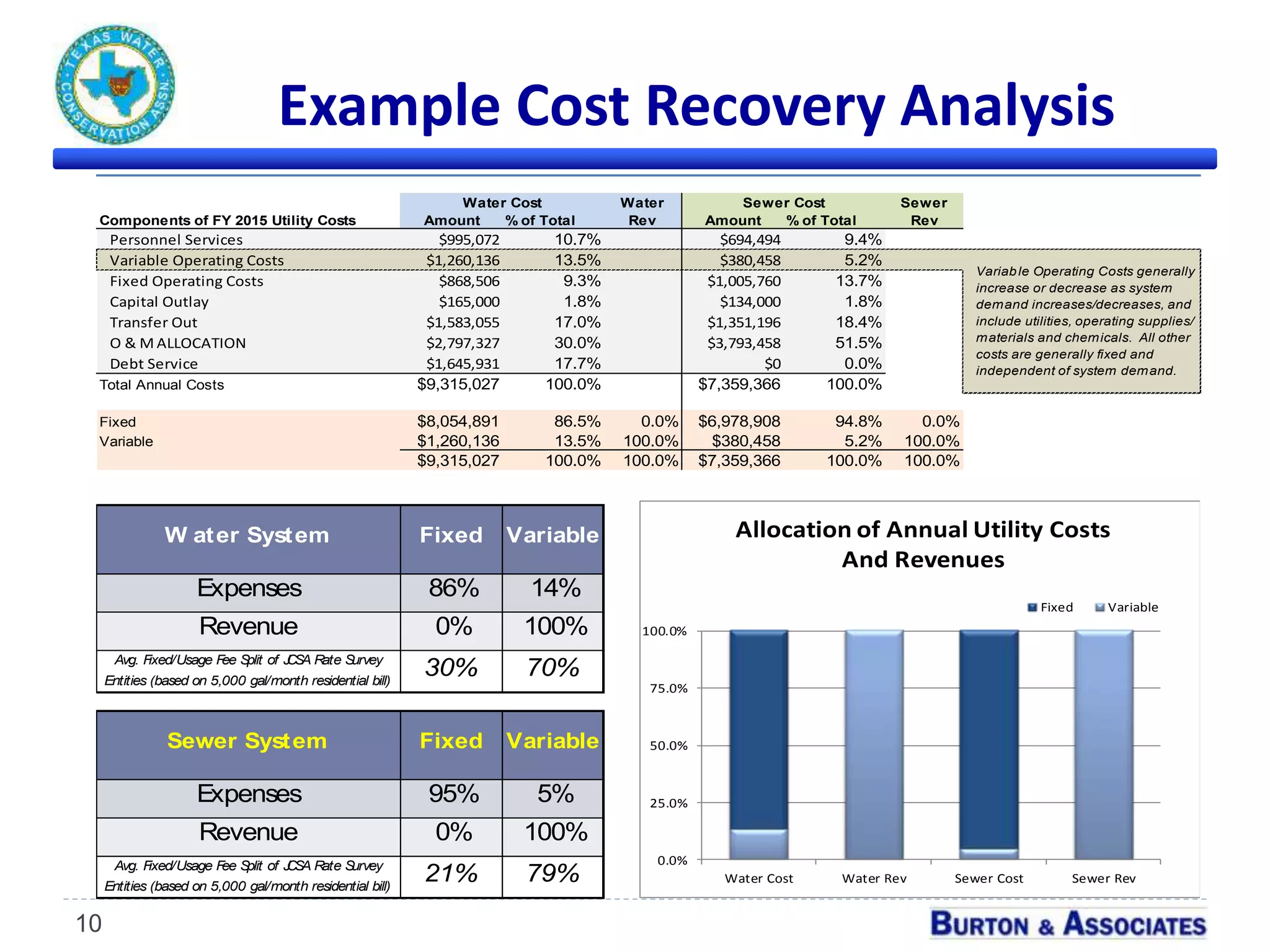
Example Cost Recovery Analysis
Components of FY 2015 Utility Costs Amount % of Total Amount % of Total
Personnel Services $995,072 10.7% $694,494 9.4%
Variable Operating Costs $1,260,136 13.5% $380,458 5.2%
Fixed Operating Costs $868,506 9.3% $1,005,760 13.7%
Capital Outlay $165,000 1.8% $134,000 1.8%
Transfer Out $1,583,055 17.0% $1,351,196 18.4%
O & M ALLOCATION $2,797,327 30.0% $3,793,458 51.5%
Debt Service $1,645,931 17.7% $0 0.0%
Total Annual Costs $9,315,027 100.0% $7,359,366 100.0%
Fixed $8,054,891 86.5% 0.0% $6,978,908 94.8% 0.0%
Variable $1,260,136 13.5% 100.0% $380,458 5.2% 100.0%
$9,315,027 100.0% 100.0% $7,359,366 100.0% 100.0%
W ater System Fixed Variable
Expenses 86% 14%
Revenue 0% 100%
Avg. Fixed/Usage Fee Split of JCSA Rate Survey
Entities (based on 5,000 gal/month residential bill)
30% 70%
Sewer System Fixed Variable
Expenses 95% 5%
Revenue 0% 100%
Avg. Fixed/Usage Fee Split of JCSA Rate Survey
Entities (based on 5,000 gal/month residential bill)
21% 79%
Variable Operating Costs generally
increase or decrease as system
demand increases/decreases, and
include utilities, operating supplies/
materials and chemicals. All other
costs are generally fixed and
independent of system demand.
Water Cost Water
Rev
Sewer Cost Sewer
Rev
0.0%
25.0%
50.0%
75.0%
100.0%
Water Cost Water Rev Sewer Cost Sewer Rev
Allocation of Annual Utility Costs
And Revenues
Fixed Variable
INCLINING BLOCK SIZING AND
PRICING EXAMPLES
11
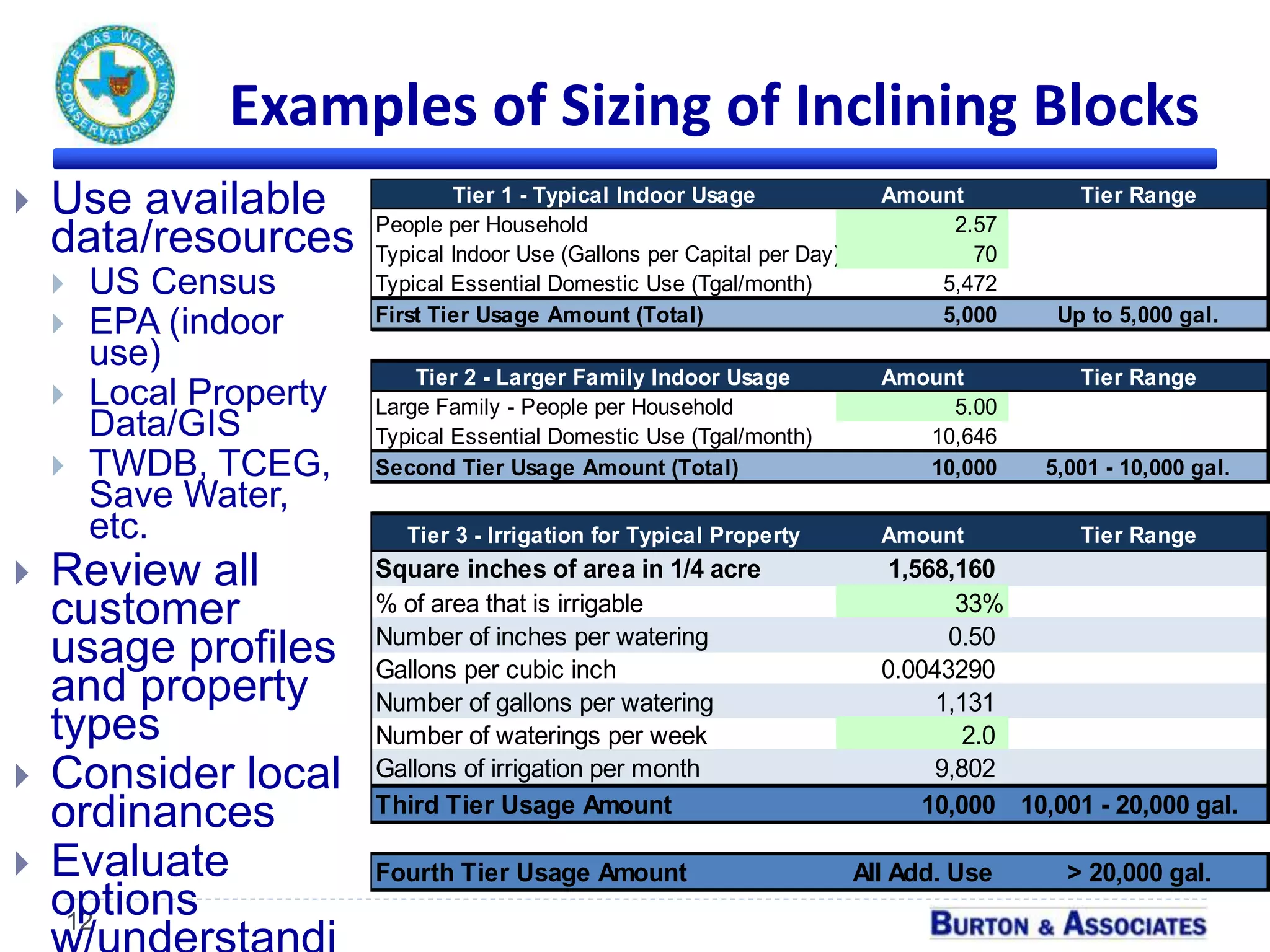
Examples of Sizing of Inclining Blocks
Tier 1 - Typical Indoor Usage Amount Tier Range
People per Household 2.57
Typical Indoor Use (Gallons per Capital per Day) 70
Typical Essential Domestic Use (Tgal/month) 5,472
First Tier Usage Amount (Total) 5,000 Up to 5,000 gal.
Tier 2 - Larger Family Indoor Usage Amount Tier Range
Large Family - People per Household 5.00
Typical Essential Domestic Use (Tgal/month) 10,646
Second Tier Usage Amount (Total) 10,000 5,001 - 10,000 gal.
Tier 3 - Irrigation for Typical Property Amount Tier Range
Square inches of area in 1/4 acre 1,568,160
% of area that is irrigable 33%
Number of inches per watering 0.50
Gallons per cubic inch 0.0043290
Number of gallons per watering 1,131
Number of waterings per week 2.0
Gallons of irrigation per month 9,802
Third Tier Usage Amount 10,000 10,001 - 20,000 gal.
Fourth Tier Usage Amount All Add. Use > 20,000 gal.
12
 Use available
data/resources
 US Census
 EPA (indoor
use)
 Local Property
Data/GIS
 TWDB, TCEG,
Save Water,
etc.
 Review all
customer
usage profiles
and property
types
 Consider local
ordinances
 Evaluate
options
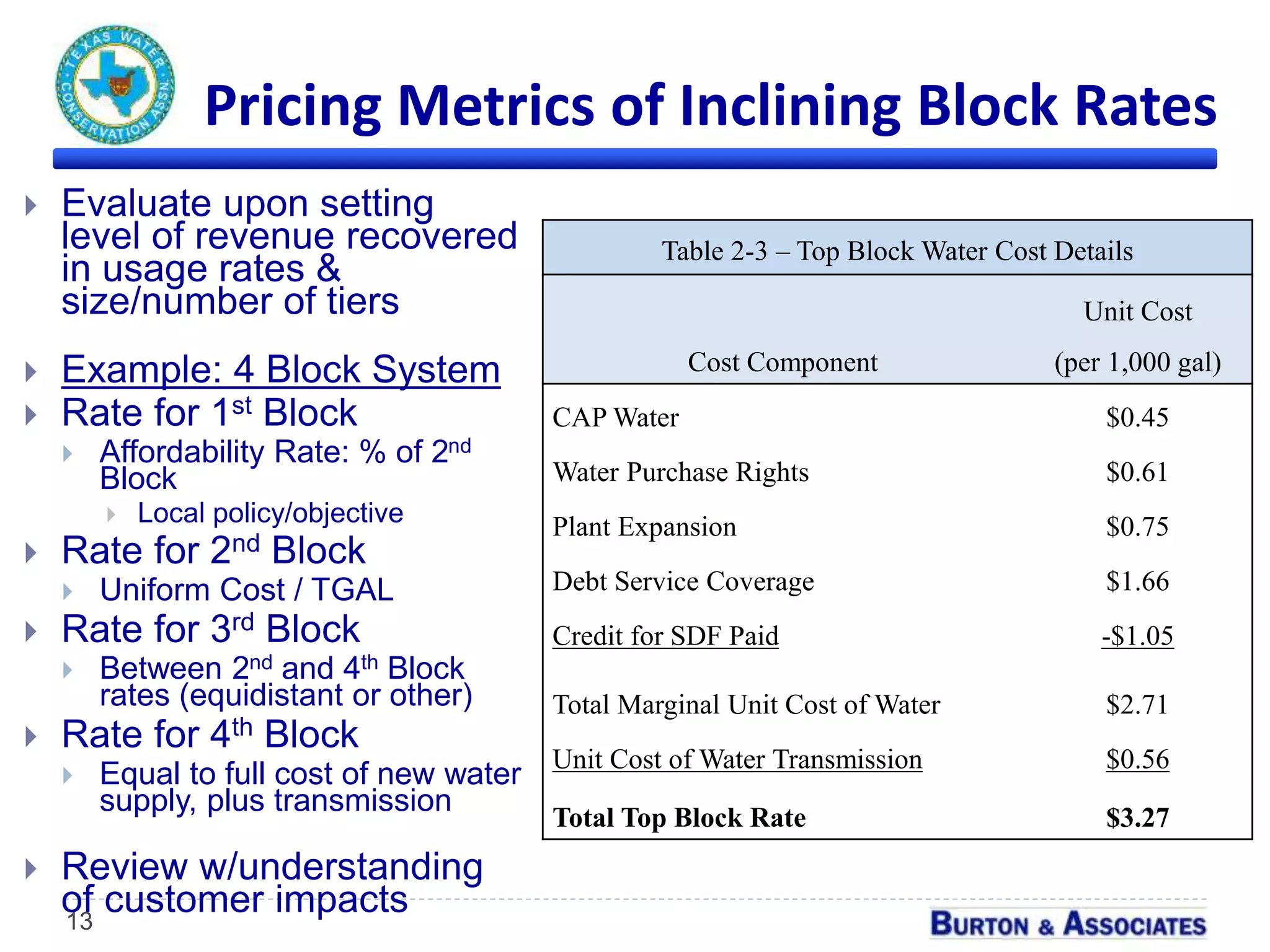
Pricing Metrics of Inclining Block Rates
 Evaluate upon setting
level of revenue recovered
in usage rates &
size/number of tiers
 Example: 4 Block System
 Rate for 1st Block
 Affordability Rate: % of 2nd
Block
 Local policy/objective
 Rate for 2nd Block
 Uniform Cost / TGAL
 Rate for 3rd Block
 Between 2nd and 4th Block
rates (equidistant or other)
 Rate for 4th Block
 Equal to full cost of new water
supply, plus transmission
 Review w/understanding
of customer impacts13
Table 2-3 – Top Block Water Cost Details
Cost Component
Unit Cost
(per 1,000 gal)
CAP Water $0.45
Water Purchase Rights $0.61
Plant Expansion $0.75
Debt Service Coverage $1.66
Credit for SDF Paid -$1.05
Total Marginal Unit Cost of Water $2.71
Unit Cost of Water Transmission $0.56
Total Top Block Rate $3.27
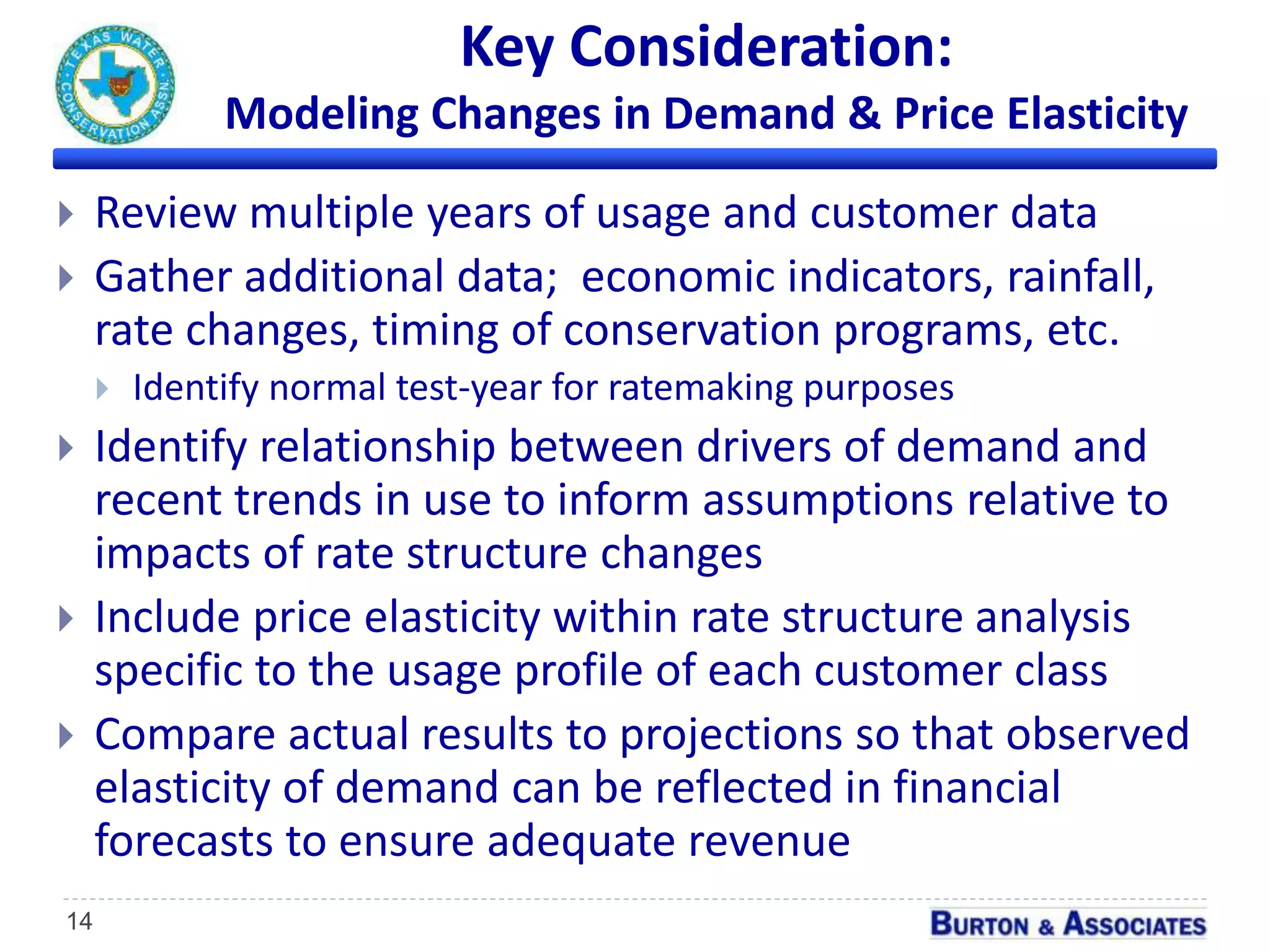
Key Consideration:
Modeling Changes in Demand & Price Elasticity
14
 Review multiple years of usage and customer data
 Gather additional data; economic indicators, rainfall,
rate changes, timing of conservation programs, etc.
 Identify normal test-year for ratemaking purposes
 Identify relationship between drivers of demand and
recent trends in use to inform assumptions relative to
impacts of rate structure changes
 Include price elasticity within rate structure analysis
specific to the usage profile of each customer class
 Compare actual results to projections so that observed
elasticity of demand can be reflected in financial
forecasts to ensure adequate revenue
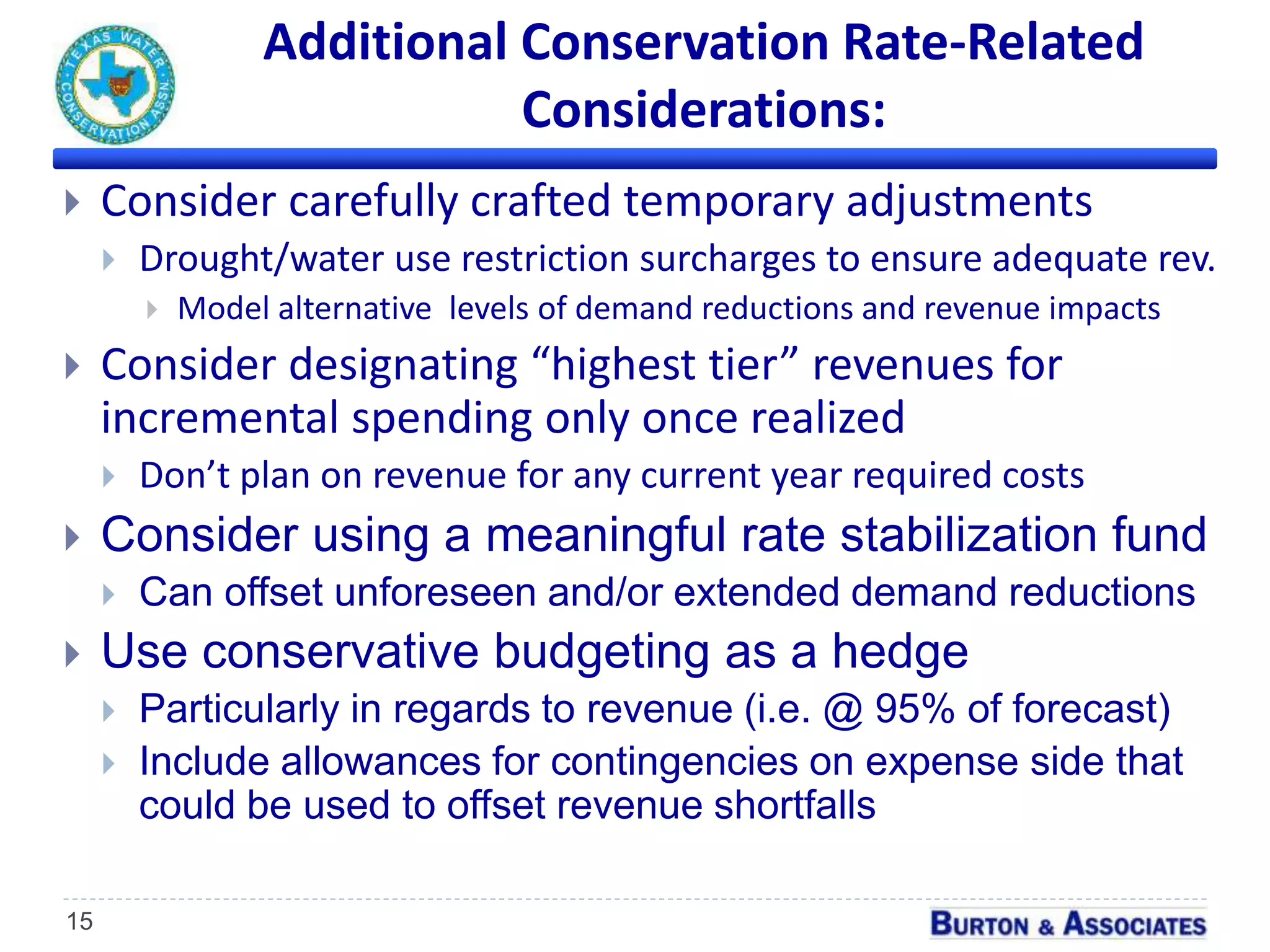
Additional Conservation Rate-Related
Considerations:
15
 Consider carefully crafted temporary adjustments
 Drought/water use restriction surcharges to ensure adequate rev.
 Model alternative levels of demand reductions and revenue impacts
 Consider designating “highest tier” revenues for
incremental spending only once realized
 Don’t plan on revenue for any current year required costs
 Consider using a meaningful rate stabilization fund
 Can offset unforeseen and/or extended demand reductions
 Use conservative budgeting as a hedge
 Particularly in regards to revenue (i.e. @ 95% of forecast)
 Include allowances for contingencies on expense side that
could be used to offset revenue shortfalls
STAKEHOLDER
COMMUNICATION STRATEGIES
16
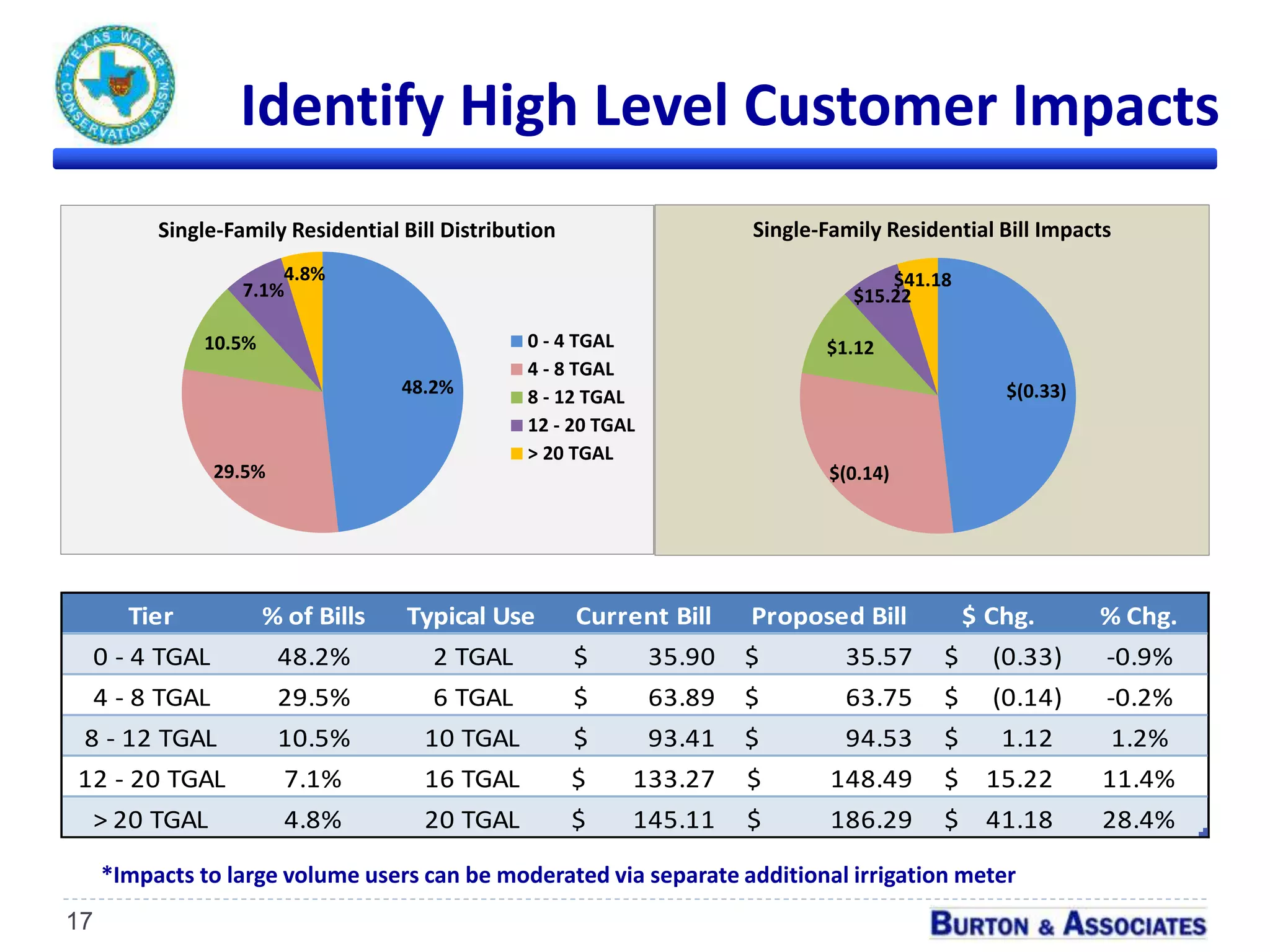
17
Tier % of Bills Typical Use Current Bill Proposed Bill $ Chg. % Chg.
0 - 4 TGAL 48.2% 2 TGAL 35.90$ 35.57$ (0.33)$ -0.9%
4 - 8 TGAL 29.5% 6 TGAL 63.89$ 63.75$ (0.14)$ -0.2%
8 - 12 TGAL 10.5% 10 TGAL 93.41$ 94.53$ 1.12$ 1.2%
12 - 20 TGAL 7.1% 16 TGAL 133.27$ 148.49$ 15.22$ 11.4%
> 20 TGAL 4.8% 20 TGAL 145.11$ 186.29$ 41.18$ 28.4%
*Impacts to large volume users can be moderated via separate additional irrigation meter
48.2%
29.5%
10.5%
7.1%
4.8%
Single-Family Residential Bill Distribution
0 - 4 TGAL
4 - 8 TGAL
8 - 12 TGAL
12 - 20 TGAL
> 20 TGAL
$(0.33)
$(0.14)
$1.12
$15.22
$41.18
Single-Family Residential Bill Impacts
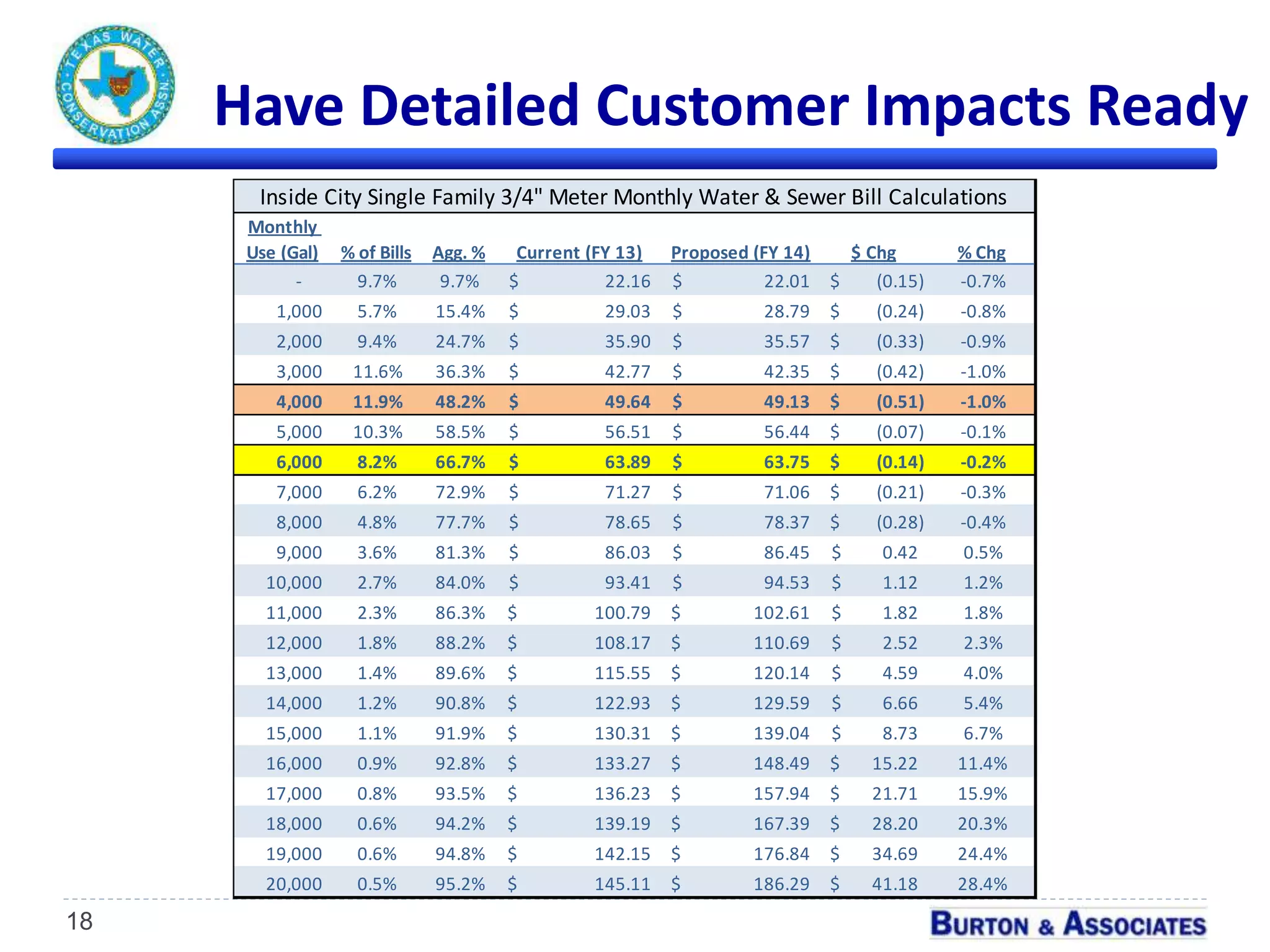
Identify High Level Customer Impacts
Monthly
Use (Gal) % of Bills Agg. % Current (FY 13) Proposed (FY 14) $ Chg % Chg
- 9.7% 9.7% 22.16$ 22.01$ (0.15)$ -0.7%
1,000 5.7% 15.4% 29.03$ 28.79$ (0.24)$ -0.8%
2,000 9.4% 24.7% 35.90$ 35.57$ (0.33)$ -0.9%
3,000 11.6% 36.3% 42.77$ 42.35$ (0.42)$ -1.0%
4,000 11.9% 48.2% 49.64$ 49.13$ (0.51)$ -1.0%
5,000 10.3% 58.5% 56.51$ 56.44$ (0.07)$ -0.1%
6,000 8.2% 66.7% 63.89$ 63.75$ (0.14)$ -0.2%
7,000 6.2% 72.9% 71.27$ 71.06$ (0.21)$ -0.3%
8,000 4.8% 77.7% 78.65$ 78.37$ (0.28)$ -0.4%
9,000 3.6% 81.3% 86.03$ 86.45$ 0.42$ 0.5%
10,000 2.7% 84.0% 93.41$ 94.53$ 1.12$ 1.2%
11,000 2.3% 86.3% 100.79$ 102.61$ 1.82$ 1.8%
12,000 1.8% 88.2% 108.17$ 110.69$ 2.52$ 2.3%
13,000 1.4% 89.6% 115.55$ 120.14$ 4.59$ 4.0%
14,000 1.2% 90.8% 122.93$ 129.59$ 6.66$ 5.4%
15,000 1.1% 91.9% 130.31$ 139.04$ 8.73$ 6.7%
16,000 0.9% 92.8% 133.27$ 148.49$ 15.22$ 11.4%
17,000 0.8% 93.5% 136.23$ 157.94$ 21.71$ 15.9%
18,000 0.6% 94.2% 139.19$ 167.39$ 28.20$ 20.3%
19,000 0.6% 94.8% 142.15$ 176.84$ 34.69$ 24.4%
20,000 0.5% 95.2% 145.11$ 186.29$ 41.18$ 28.4%
Inside City Single Family 3/4" Meter Monthly Water & Sewer Bill Calculations
Have Detailed Customer Impacts Ready
18
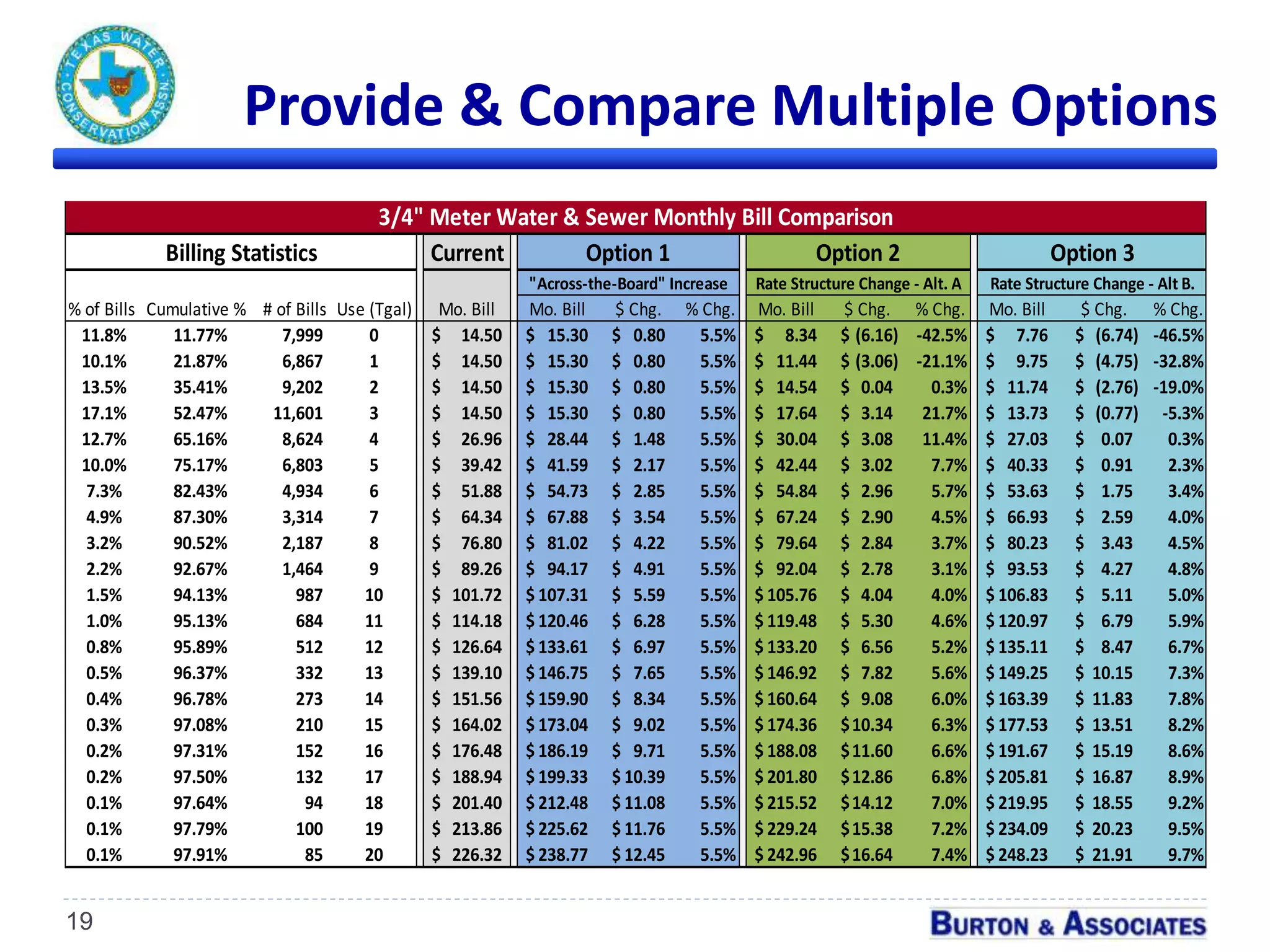
Provide & Compare Multiple Options
19
Current
% of Bills Cumulative % # of Bills Use (Tgal) Mo. Bill Mo. Bill $ Chg. % Chg. Mo. Bill $ Chg. % Chg. Mo. Bill $ Chg. % Chg.
11.8% 11.77% 7,999 0 14.50$ 15.30$ 0.80$ 5.5% 8.34$ (6.16)$ -42.5% 7.76$ (6.74)$ -46.5%
10.1% 21.87% 6,867 1 14.50$ 15.30$ 0.80$ 5.5% 11.44$ (3.06)$ -21.1% 9.75$ (4.75)$ -32.8%
13.5% 35.41% 9,202 2 14.50$ 15.30$ 0.80$ 5.5% 14.54$ 0.04$ 0.3% 11.74$ (2.76)$ -19.0%
17.1% 52.47% 11,601 3 14.50$ 15.30$ 0.80$ 5.5% 17.64$ 3.14$ 21.7% 13.73$ (0.77)$ -5.3%
12.7% 65.16% 8,624 4 26.96$ 28.44$ 1.48$ 5.5% 30.04$ 3.08$ 11.4% 27.03$ 0.07$ 0.3%
10.0% 75.17% 6,803 5 39.42$ 41.59$ 2.17$ 5.5% 42.44$ 3.02$ 7.7% 40.33$ 0.91$ 2.3%
7.3% 82.43% 4,934 6 51.88$ 54.73$ 2.85$ 5.5% 54.84$ 2.96$ 5.7% 53.63$ 1.75$ 3.4%
4.9% 87.30% 3,314 7 64.34$ 67.88$ 3.54$ 5.5% 67.24$ 2.90$ 4.5% 66.93$ 2.59$ 4.0%
3.2% 90.52% 2,187 8 76.80$ 81.02$ 4.22$ 5.5% 79.64$ 2.84$ 3.7% 80.23$ 3.43$ 4.5%
2.2% 92.67% 1,464 9 89.26$ 94.17$ 4.91$ 5.5% 92.04$ 2.78$ 3.1% 93.53$ 4.27$ 4.8%
1.5% 94.13% 987 10 101.72$ 107.31$ 5.59$ 5.5% 105.76$ 4.04$ 4.0% 106.83$ 5.11$ 5.0%
1.0% 95.13% 684 11 114.18$ 120.46$ 6.28$ 5.5% 119.48$ 5.30$ 4.6% 120.97$ 6.79$ 5.9%
0.8% 95.89% 512 12 126.64$ 133.61$ 6.97$ 5.5% 133.20$ 6.56$ 5.2% 135.11$ 8.47$ 6.7%
0.5% 96.37% 332 13 139.10$ 146.75$ 7.65$ 5.5% 146.92$ 7.82$ 5.6% 149.25$ 10.15$ 7.3%
0.4% 96.78% 273 14 151.56$ 159.90$ 8.34$ 5.5% 160.64$ 9.08$ 6.0% 163.39$ 11.83$ 7.8%
0.3% 97.08% 210 15 164.02$ 173.04$ 9.02$ 5.5% 174.36$ 10.34$ 6.3% 177.53$ 13.51$ 8.2%
0.2% 97.31% 152 16 176.48$ 186.19$ 9.71$ 5.5% 188.08$ 11.60$ 6.6% 191.67$ 15.19$ 8.6%
0.2% 97.50% 132 17 188.94$ 199.33$ 10.39$ 5.5% 201.80$ 12.86$ 6.8% 205.81$ 16.87$ 8.9%
0.1% 97.64% 94 18 201.40$ 212.48$ 11.08$ 5.5% 215.52$ 14.12$ 7.0% 219.95$ 18.55$ 9.2%
0.1% 97.79% 100 19 213.86$ 225.62$ 11.76$ 5.5% 229.24$ 15.38$ 7.2% 234.09$ 20.23$ 9.5%
0.1% 97.91% 85 20 226.32$ 238.77$ 12.45$ 5.5% 242.96$ 16.64$ 7.4% 248.23$ 21.91$ 9.7%
Note: All options reflect a 5.5% water and sewer revenue increase.
Note: 95% of all customers are served with a 3/4" meter.
"Across-the-Board" Increase Rate Structure Change - Alt. A Rate Structure Change - Alt B.
3/4" Meter Water & Sewer Monthly Bill Comparison
Billing Statistics Option 1 Option 2 Option 3
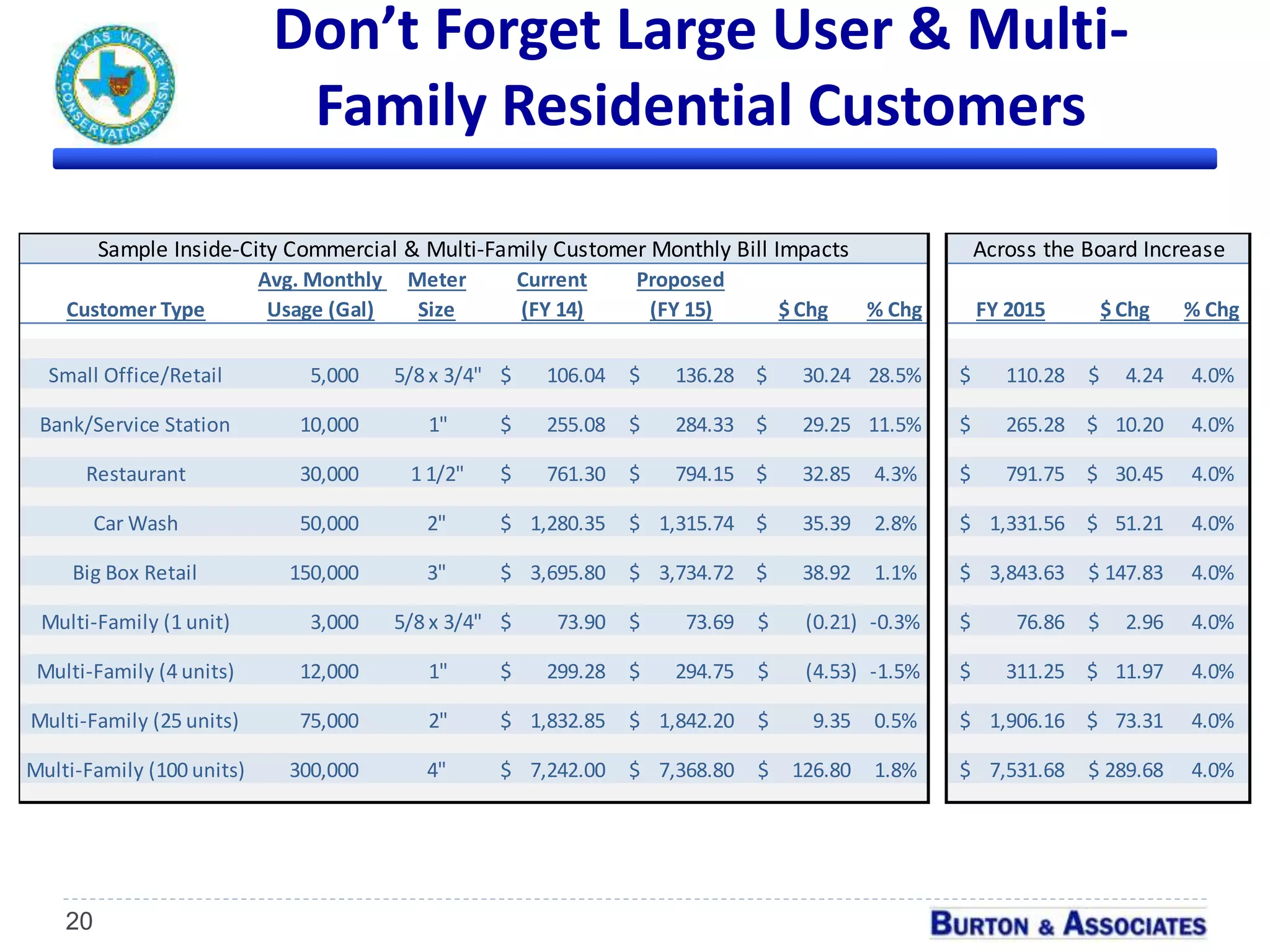
Don’t Forget Large User & Multi-
Family Residential Customers
20
Customer Type
Avg. Monthly
Usage (Gal)
Meter
Size
Current
(FY 14)
Proposed
(FY 15) $ Chg % Chg FY 2015 $ Chg % Chg
Small Office/Retail 5,000 5/8 x 3/4" 106.04$ 136.28$ 30.24$ 28.5% 110.28$ 4.24$ 4.0%
Bank/Service Station 10,000 1" 255.08$ 284.33$ 29.25$ 11.5% 265.28$ 10.20$ 4.0%
Restaurant 30,000 1 1/2" 761.30$ 794.15$ 32.85$ 4.3% 791.75$ 30.45$ 4.0%
Car Wash 50,000 2" 1,280.35$ 1,315.74$ 35.39$ 2.8% 1,331.56$ 51.21$ 4.0%
Big Box Retail 150,000 3" 3,695.80$ 3,734.72$ 38.92$ 1.1% 3,843.63$ 147.83$ 4.0%
Multi-Family (1 unit) 3,000 5/8 x 3/4" 73.90$ 73.69$ (0.21)$ -0.3% 76.86$ 2.96$ 4.0%
Multi-Family (4 units) 12,000 1" 299.28$ 294.75$ (4.53)$ -1.5% 311.25$ 11.97$ 4.0%
Multi-Family (25 units) 75,000 2" 1,832.85$ 1,842.20$ 9.35$ 0.5% 1,906.16$ 73.31$ 4.0%
Multi-Family (100 units) 300,000 4" 7,242.00$ 7,368.80$ 126.80$ 1.8% 7,531.68$ 289.68$ 4.0%
Sample Inside-City Commercial & Multi-Family Customer Monthly Bill Impacts Across the Board Increase
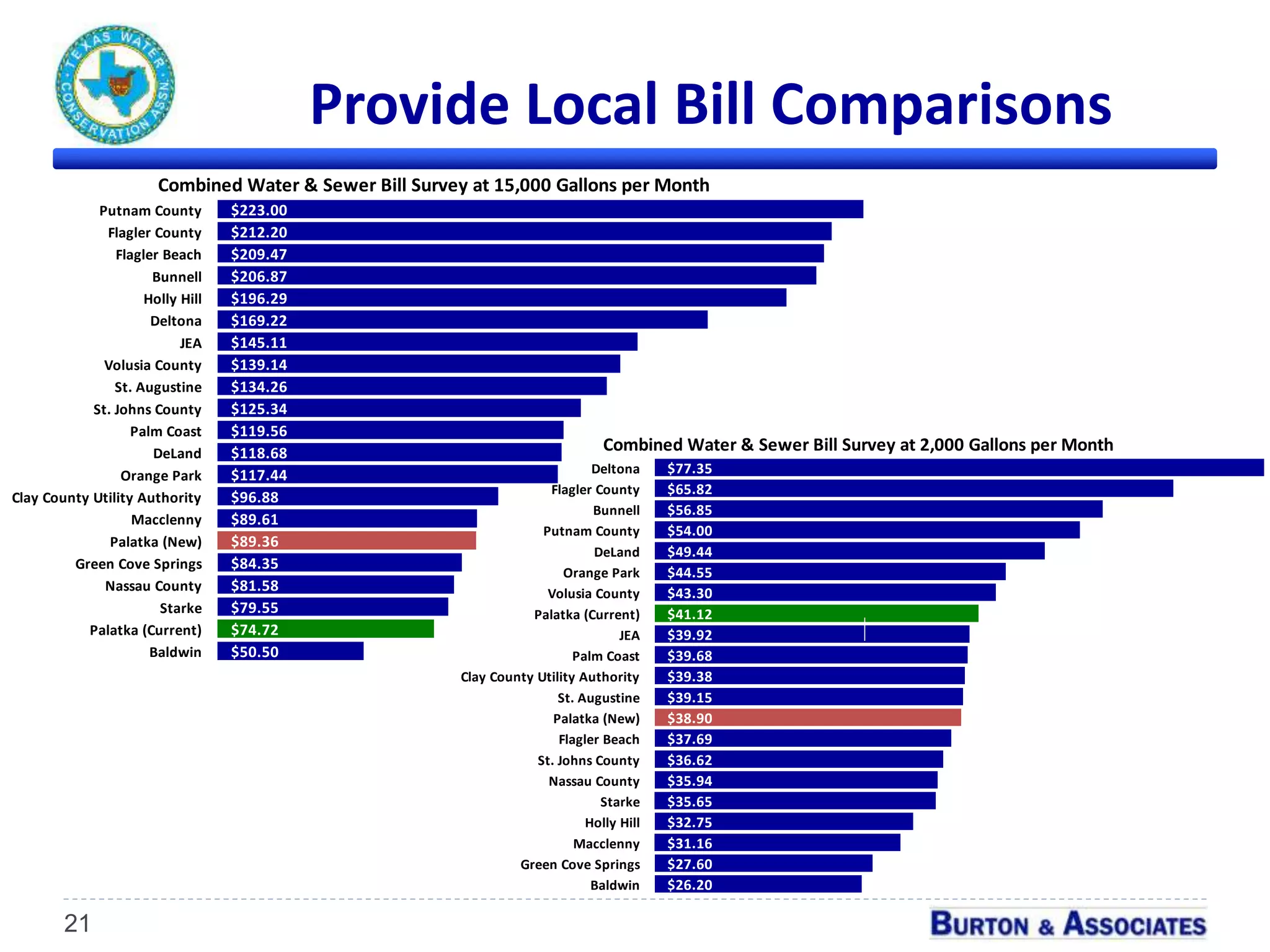
Deltona $77.35
Flagler County $65.82
Bunnell $56.85
Putnam County $54.00
DeLand $49.44
Orange Park $44.55
Volusia County $43.30
Palatka (Current) $41.12
JEA $39.92
Palm Coast $39.68
Clay County Utility Authority $39.38
St. Augustine $39.15
Palatka (New) $38.90
Flagler Beach $37.69
St. Johns County $36.62
Nassau County $35.94
Starke $35.65
Holly Hill $32.75
Macclenny $31.16
Green Cove Springs $27.60
Baldwin $26.20
Combined Water & Sewer Bill Survey at 2,000 Gallons per Month
Provide Local Bill Comparisons
21
Putnam County $223.00
Flagler County $212.20
Flagler Beach $209.47
Bunnell $206.87
Holly Hill $196.29
Deltona $169.22
JEA $145.11
Volusia County $139.14
St. Augustine $134.26
St. Johns County $125.34
Palm Coast $119.56
DeLand $118.68
Orange Park $117.44
Clay County Utility Authority $96.88
Macclenny $89.61
Palatka (New) $89.36
Green Cove Springs $84.35
Nassau County $81.58
Starke $79.55
Palatka (Current) $74.72
Baldwin $50.50
Combined Water & Sewer Bill Survey at 15,000 Gallons per Month
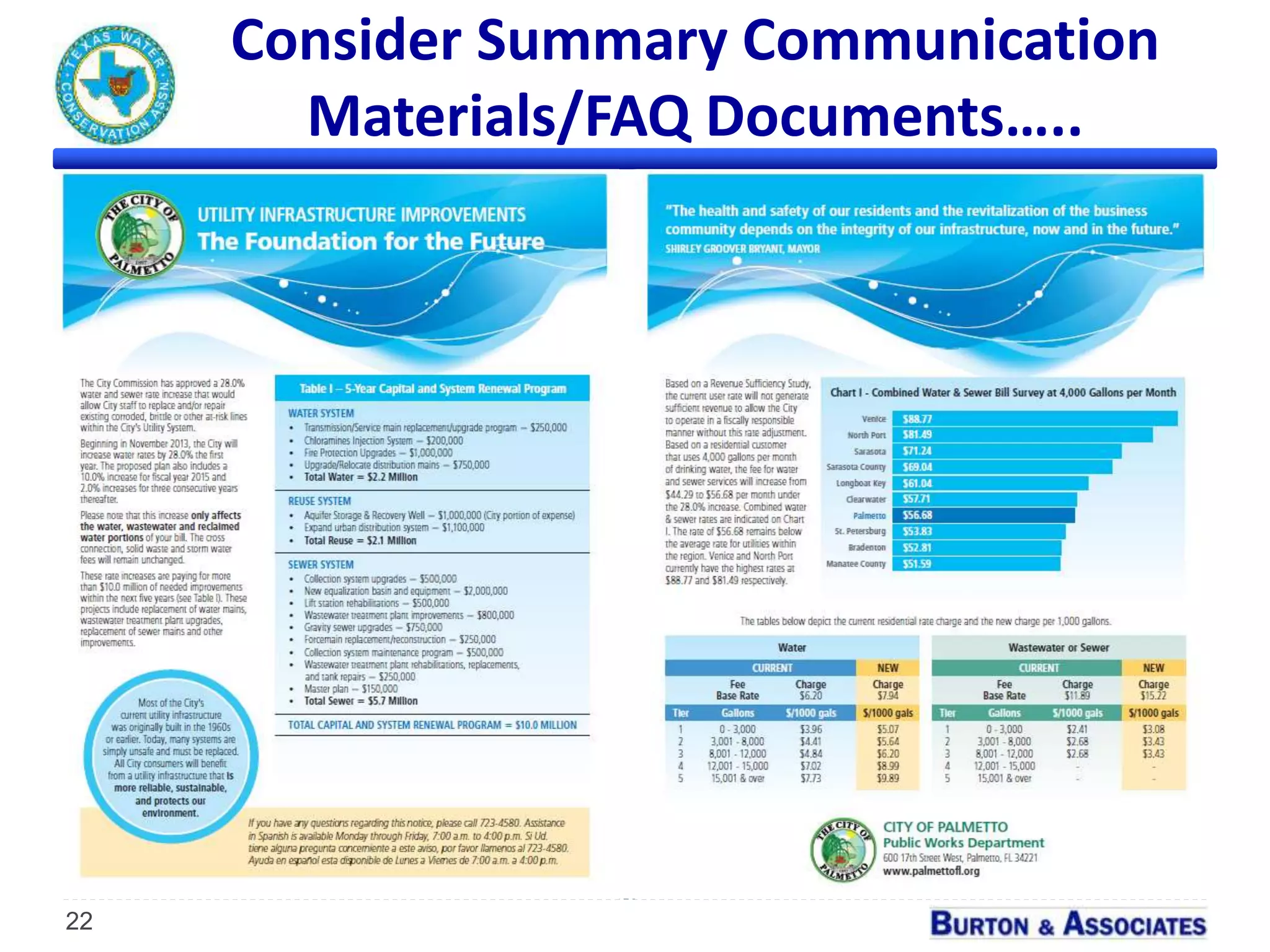
Consider Summary Communication
Materials/FAQ Documents…..
22
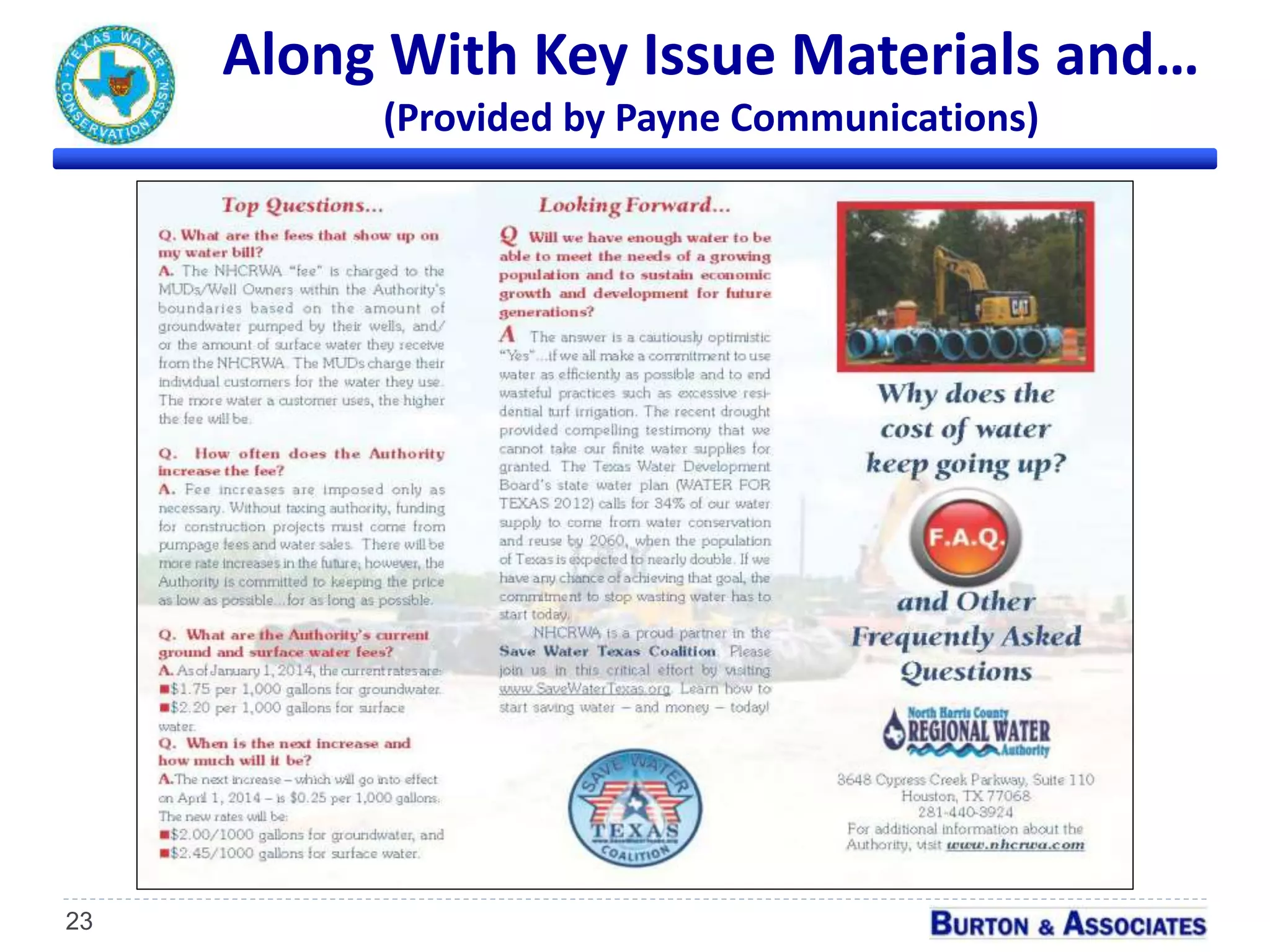
Along With Key Issue Materials and…
(Provided by Payne Communications)
23
Supplemental Conservation Materials
(Provided by Payne Communications)
24
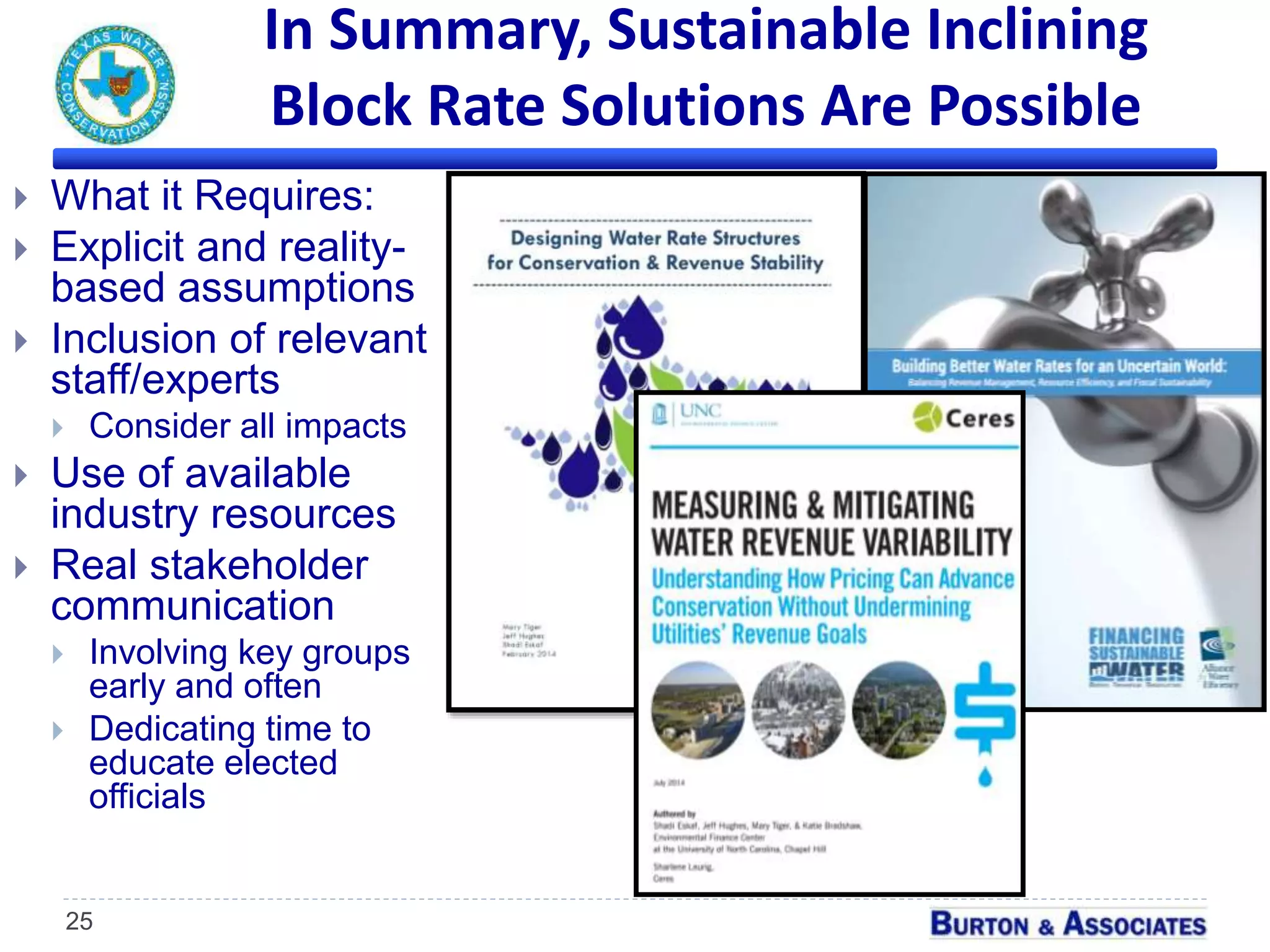
In Summary, Sustainable Inclining
Block Rate Solutions Are Possible
 What it Requires:
 Explicit and reality-
based assumptions
 Inclusion of relevant
staff/experts
 Consider all impacts
 Use of available
industry resources
 Real stakeholder
communication
 Involving key groups
early and often
 Dedicating time to
educate elected
officials
25
26
Questions & Discussion
PROVIDING SOLUTIONS
THROUGH CLEAR VISION
Presentation By:
Andrew Burnham
Senior Vice President
Office: 813-443-5138
Mobile: 904-631-5109
Email: aburnham@burtonandassociates.com

Features of Successful Inclining Block Water Conservation Rate Structures

  • 1.
    Features of SuccessfulInclining Block Water Conservation Rate Structures Presented by: Andrew Burnham, Senior Vice President March 6, 2015 @ 9:00 – 9:30AM TEXAS WATER CONSERVATION ASSOCIATION 71ST ANNUAL CONVENTION SHERATON AUSTIN HOTEL @ THE CAPITOL (AUSTIN, TEXAS)
  • 2.
    Understanding the Fundamental Challengeof Water Ratemaking Price product such that it encourages customers to use less of it while at the same time recovering enough revenue and not overcharging customers 2
  • 3.
    3 Balancing Priorities =Sustainability  Rates need to reflect each community’s definition of sustainability  Social  Fair & equitable distribution of costs  Promote public policy objectives (affordability and economic development)  Environmental  Promote resource conservation  Fund cost of regulatory compliance  Economic  Long-term revenue sufficiency  Ongoing system requirements  Financial policies  Fiscal stability  Fixed cost recovery  Withstand changes in demand
  • 4.
    Overview of theRatemaking Process Fundamental Components 1. Revenue Requirement 2. Cost of Service 3. Rate Design 4. Stakeholder Education 4 Revenue Requirement Analysis: Compares revenues to operating and capital costs to determine the adequacy of existing rates Cost of Service Analysis: Allocates the revenue requirements of the system to customers in a fair and equitable manner Rate Design Analysis: Considers both the level and structure of rates that will collect the revenue requirements from each customer class Stakeholder Education: Explains the status quo, key issues/objectives, drivers of adjustments, and comparisons to local and national trends
  • 5.
    Before Developing Conservation Rates,Understand the Cost of Service 5  Distribute costs using methods best suited for data, circumstances & goals  Allocate costs to functions  Review/define customer classes  Identifies allocations of various costs (max day, peak hour, etc.) to different users based upon their characteristics Water Cost of Service Wastewater Cost of Service → Source of Supply → Treatment & Disposal → Treatment → Collection → Transmission → Reclaimed Water → Distribution → Chemical Oxygen Demand → Meters & Services → Suspended Solids → Billing & Collection → Phosphorus → Residential → Ammonia → General Service → Residential → Residential Irrigation → General Service → General Irrigation → Reclaimed Water → Wholesale → High-Strength/Industrial → Wholesale CostFunctions CostFunctions CustomerClasses CustomerClasses Water Cost of Service Wa → Source of Supply → Treatment → Transmission → Distribution → Meters & Services → Billing & Collection → Residential → General Service → Residential Irrigation → General Irrigation → Wholesale CostFunctions CustomerClasses
  • 6.
    Cost of ServiceAnalysis Establishes Guideposts for Developing Rates  Compare cost allocation to revenue generation under various scenarios  Identify what types of costs are recovered in fixed vs. variable charges 6 Single-Family Multi-Family Commercial Res. Irrigation Com. Irrigation Totals Rev (000's) Rev (000's) Rev (000's) Rev (000's) Rev (000's) Rev (000's) Water 5,057$ 4,059$ 7,573$ 283$ 1,761$ 18,734$ Sewer 10,135$ 8,977$ 9,744$ N/A N/A 28,856$ Total 15,192$ 13,036$ 17,317$ 283$ 1,761$ 47,590$ Single-Family Multi-Family Commercial Res. Irrigation Com. Irrigation Totals Rev (000's) Rev (000's) Rev (000's) Rev (000's) Rev (000's) Rev (000's) Water 5,336$ 5,097$ 6,829$ 216$ 1,252$ 18,730$ Sewer 9,869$ 8,518$ 10,473$ N/A N/A 28,860$ Total 15,205$ 13,615$ 17,302$ 216$ 1,252$ 47,590$ $ Variance (13)$ (579)$ 15$ 67$ 510$ (0)$ % Variance -0.1% -4.3% 0.1% 31.1% 40.7% 0.0% REVENUE REQUIREMENT ALLOCATION PER COST OF SERVICE ANALYSIS REVENUE GENERATION PER CURRENT RATE STRUCTURE
  • 7.
    Approach to RateStructure Analysis 7  Incorporate the data/allocations per cost of service analysis  Review/evaluate existing fee structure and identify alternatives  Goal is to ensure appropriate and sustainable rate structures for each class of customer that:  Reflect a fair and equitable distribution of the cost of service  Conform to industry practice and legal precedent  Are technically sound and easy to administer  Are consistent with objectives (affordability, conservation, etc.)  To succeed, you need to communicate clearly with stakeholders  The advantages and disadvantages of each option, and  The full range of customer impacts of any potential changes  Integrate critical financial considerations
  • 8.
    Key Financial Consideration: EstablishingSound Reserve Policies 8  General rules of thumb for reserves are provided by industry organizations like the AWWA (Manual M54):  Operating reserve equal >= 2 months of O&M  Capital reserve equal to the average annual capital expenditure over the next 3 to 5 years  Also, rating agencies publish criteria relative to reserves that they use to evaluate the creditworthiness of utilities  Days of free cash (strong systems >= 365 days)  Reserves should consider rate structure:  Impacts of unplanned/extended use
  • 9.
    Key Financial Consideration: DefiningLevel of Fixed Cost Recovery 9  Higher fixed charges provide stability in environments of unstable/declining demands….  However, reduces cost allocation and level of conservation rates to high volume users  Critical to understand and evaluate:  Fixed versus variable cost distribution  Current recovery of fixed costs via existing rates  Practices of other local/comparable systems  Rating agencies starting to publish criteria about level of revenue generation desired in fixed charges  Due to industry wide declines in demand and increasing fixed cost awareness  Fitch Ratings – strong system will recover >=30% of revenue in fixed charges
  • 10.
    10 Example Cost RecoveryAnalysis Components of FY 2015 Utility Costs Amount % of Total Amount % of Total Personnel Services $995,072 10.7% $694,494 9.4% Variable Operating Costs $1,260,136 13.5% $380,458 5.2% Fixed Operating Costs $868,506 9.3% $1,005,760 13.7% Capital Outlay $165,000 1.8% $134,000 1.8% Transfer Out $1,583,055 17.0% $1,351,196 18.4% O & M ALLOCATION $2,797,327 30.0% $3,793,458 51.5% Debt Service $1,645,931 17.7% $0 0.0% Total Annual Costs $9,315,027 100.0% $7,359,366 100.0% Fixed $8,054,891 86.5% 0.0% $6,978,908 94.8% 0.0% Variable $1,260,136 13.5% 100.0% $380,458 5.2% 100.0% $9,315,027 100.0% 100.0% $7,359,366 100.0% 100.0% W ater System Fixed Variable Expenses 86% 14% Revenue 0% 100% Avg. Fixed/Usage Fee Split of JCSA Rate Survey Entities (based on 5,000 gal/month residential bill) 30% 70% Sewer System Fixed Variable Expenses 95% 5% Revenue 0% 100% Avg. Fixed/Usage Fee Split of JCSA Rate Survey Entities (based on 5,000 gal/month residential bill) 21% 79% Variable Operating Costs generally increase or decrease as system demand increases/decreases, and include utilities, operating supplies/ materials and chemicals. All other costs are generally fixed and independent of system demand. Water Cost Water Rev Sewer Cost Sewer Rev 0.0% 25.0% 50.0% 75.0% 100.0% Water Cost Water Rev Sewer Cost Sewer Rev Allocation of Annual Utility Costs And Revenues Fixed Variable
  • 11.
    INCLINING BLOCK SIZINGAND PRICING EXAMPLES 11
  • 12.
    Examples of Sizingof Inclining Blocks Tier 1 - Typical Indoor Usage Amount Tier Range People per Household 2.57 Typical Indoor Use (Gallons per Capital per Day) 70 Typical Essential Domestic Use (Tgal/month) 5,472 First Tier Usage Amount (Total) 5,000 Up to 5,000 gal. Tier 2 - Larger Family Indoor Usage Amount Tier Range Large Family - People per Household 5.00 Typical Essential Domestic Use (Tgal/month) 10,646 Second Tier Usage Amount (Total) 10,000 5,001 - 10,000 gal. Tier 3 - Irrigation for Typical Property Amount Tier Range Square inches of area in 1/4 acre 1,568,160 % of area that is irrigable 33% Number of inches per watering 0.50 Gallons per cubic inch 0.0043290 Number of gallons per watering 1,131 Number of waterings per week 2.0 Gallons of irrigation per month 9,802 Third Tier Usage Amount 10,000 10,001 - 20,000 gal. Fourth Tier Usage Amount All Add. Use > 20,000 gal. 12  Use available data/resources  US Census  EPA (indoor use)  Local Property Data/GIS  TWDB, TCEG, Save Water, etc.  Review all customer usage profiles and property types  Consider local ordinances  Evaluate options
  • 13.
    Pricing Metrics ofInclining Block Rates  Evaluate upon setting level of revenue recovered in usage rates & size/number of tiers  Example: 4 Block System  Rate for 1st Block  Affordability Rate: % of 2nd Block  Local policy/objective  Rate for 2nd Block  Uniform Cost / TGAL  Rate for 3rd Block  Between 2nd and 4th Block rates (equidistant or other)  Rate for 4th Block  Equal to full cost of new water supply, plus transmission  Review w/understanding of customer impacts13 Table 2-3 – Top Block Water Cost Details Cost Component Unit Cost (per 1,000 gal) CAP Water $0.45 Water Purchase Rights $0.61 Plant Expansion $0.75 Debt Service Coverage $1.66 Credit for SDF Paid -$1.05 Total Marginal Unit Cost of Water $2.71 Unit Cost of Water Transmission $0.56 Total Top Block Rate $3.27
  • 14.
    Key Consideration: Modeling Changesin Demand & Price Elasticity 14  Review multiple years of usage and customer data  Gather additional data; economic indicators, rainfall, rate changes, timing of conservation programs, etc.  Identify normal test-year for ratemaking purposes  Identify relationship between drivers of demand and recent trends in use to inform assumptions relative to impacts of rate structure changes  Include price elasticity within rate structure analysis specific to the usage profile of each customer class  Compare actual results to projections so that observed elasticity of demand can be reflected in financial forecasts to ensure adequate revenue
  • 15.
    Additional Conservation Rate-Related Considerations: 15 Consider carefully crafted temporary adjustments  Drought/water use restriction surcharges to ensure adequate rev.  Model alternative levels of demand reductions and revenue impacts  Consider designating “highest tier” revenues for incremental spending only once realized  Don’t plan on revenue for any current year required costs  Consider using a meaningful rate stabilization fund  Can offset unforeseen and/or extended demand reductions  Use conservative budgeting as a hedge  Particularly in regards to revenue (i.e. @ 95% of forecast)  Include allowances for contingencies on expense side that could be used to offset revenue shortfalls
  • 16.
  • 17.
    17 Tier % ofBills Typical Use Current Bill Proposed Bill $ Chg. % Chg. 0 - 4 TGAL 48.2% 2 TGAL 35.90$ 35.57$ (0.33)$ -0.9% 4 - 8 TGAL 29.5% 6 TGAL 63.89$ 63.75$ (0.14)$ -0.2% 8 - 12 TGAL 10.5% 10 TGAL 93.41$ 94.53$ 1.12$ 1.2% 12 - 20 TGAL 7.1% 16 TGAL 133.27$ 148.49$ 15.22$ 11.4% > 20 TGAL 4.8% 20 TGAL 145.11$ 186.29$ 41.18$ 28.4% *Impacts to large volume users can be moderated via separate additional irrigation meter 48.2% 29.5% 10.5% 7.1% 4.8% Single-Family Residential Bill Distribution 0 - 4 TGAL 4 - 8 TGAL 8 - 12 TGAL 12 - 20 TGAL > 20 TGAL $(0.33) $(0.14) $1.12 $15.22 $41.18 Single-Family Residential Bill Impacts Identify High Level Customer Impacts
  • 18.
    Monthly Use (Gal) %of Bills Agg. % Current (FY 13) Proposed (FY 14) $ Chg % Chg - 9.7% 9.7% 22.16$ 22.01$ (0.15)$ -0.7% 1,000 5.7% 15.4% 29.03$ 28.79$ (0.24)$ -0.8% 2,000 9.4% 24.7% 35.90$ 35.57$ (0.33)$ -0.9% 3,000 11.6% 36.3% 42.77$ 42.35$ (0.42)$ -1.0% 4,000 11.9% 48.2% 49.64$ 49.13$ (0.51)$ -1.0% 5,000 10.3% 58.5% 56.51$ 56.44$ (0.07)$ -0.1% 6,000 8.2% 66.7% 63.89$ 63.75$ (0.14)$ -0.2% 7,000 6.2% 72.9% 71.27$ 71.06$ (0.21)$ -0.3% 8,000 4.8% 77.7% 78.65$ 78.37$ (0.28)$ -0.4% 9,000 3.6% 81.3% 86.03$ 86.45$ 0.42$ 0.5% 10,000 2.7% 84.0% 93.41$ 94.53$ 1.12$ 1.2% 11,000 2.3% 86.3% 100.79$ 102.61$ 1.82$ 1.8% 12,000 1.8% 88.2% 108.17$ 110.69$ 2.52$ 2.3% 13,000 1.4% 89.6% 115.55$ 120.14$ 4.59$ 4.0% 14,000 1.2% 90.8% 122.93$ 129.59$ 6.66$ 5.4% 15,000 1.1% 91.9% 130.31$ 139.04$ 8.73$ 6.7% 16,000 0.9% 92.8% 133.27$ 148.49$ 15.22$ 11.4% 17,000 0.8% 93.5% 136.23$ 157.94$ 21.71$ 15.9% 18,000 0.6% 94.2% 139.19$ 167.39$ 28.20$ 20.3% 19,000 0.6% 94.8% 142.15$ 176.84$ 34.69$ 24.4% 20,000 0.5% 95.2% 145.11$ 186.29$ 41.18$ 28.4% Inside City Single Family 3/4" Meter Monthly Water & Sewer Bill Calculations Have Detailed Customer Impacts Ready 18
  • 19.
    Provide & CompareMultiple Options 19 Current % of Bills Cumulative % # of Bills Use (Tgal) Mo. Bill Mo. Bill $ Chg. % Chg. Mo. Bill $ Chg. % Chg. Mo. Bill $ Chg. % Chg. 11.8% 11.77% 7,999 0 14.50$ 15.30$ 0.80$ 5.5% 8.34$ (6.16)$ -42.5% 7.76$ (6.74)$ -46.5% 10.1% 21.87% 6,867 1 14.50$ 15.30$ 0.80$ 5.5% 11.44$ (3.06)$ -21.1% 9.75$ (4.75)$ -32.8% 13.5% 35.41% 9,202 2 14.50$ 15.30$ 0.80$ 5.5% 14.54$ 0.04$ 0.3% 11.74$ (2.76)$ -19.0% 17.1% 52.47% 11,601 3 14.50$ 15.30$ 0.80$ 5.5% 17.64$ 3.14$ 21.7% 13.73$ (0.77)$ -5.3% 12.7% 65.16% 8,624 4 26.96$ 28.44$ 1.48$ 5.5% 30.04$ 3.08$ 11.4% 27.03$ 0.07$ 0.3% 10.0% 75.17% 6,803 5 39.42$ 41.59$ 2.17$ 5.5% 42.44$ 3.02$ 7.7% 40.33$ 0.91$ 2.3% 7.3% 82.43% 4,934 6 51.88$ 54.73$ 2.85$ 5.5% 54.84$ 2.96$ 5.7% 53.63$ 1.75$ 3.4% 4.9% 87.30% 3,314 7 64.34$ 67.88$ 3.54$ 5.5% 67.24$ 2.90$ 4.5% 66.93$ 2.59$ 4.0% 3.2% 90.52% 2,187 8 76.80$ 81.02$ 4.22$ 5.5% 79.64$ 2.84$ 3.7% 80.23$ 3.43$ 4.5% 2.2% 92.67% 1,464 9 89.26$ 94.17$ 4.91$ 5.5% 92.04$ 2.78$ 3.1% 93.53$ 4.27$ 4.8% 1.5% 94.13% 987 10 101.72$ 107.31$ 5.59$ 5.5% 105.76$ 4.04$ 4.0% 106.83$ 5.11$ 5.0% 1.0% 95.13% 684 11 114.18$ 120.46$ 6.28$ 5.5% 119.48$ 5.30$ 4.6% 120.97$ 6.79$ 5.9% 0.8% 95.89% 512 12 126.64$ 133.61$ 6.97$ 5.5% 133.20$ 6.56$ 5.2% 135.11$ 8.47$ 6.7% 0.5% 96.37% 332 13 139.10$ 146.75$ 7.65$ 5.5% 146.92$ 7.82$ 5.6% 149.25$ 10.15$ 7.3% 0.4% 96.78% 273 14 151.56$ 159.90$ 8.34$ 5.5% 160.64$ 9.08$ 6.0% 163.39$ 11.83$ 7.8% 0.3% 97.08% 210 15 164.02$ 173.04$ 9.02$ 5.5% 174.36$ 10.34$ 6.3% 177.53$ 13.51$ 8.2% 0.2% 97.31% 152 16 176.48$ 186.19$ 9.71$ 5.5% 188.08$ 11.60$ 6.6% 191.67$ 15.19$ 8.6% 0.2% 97.50% 132 17 188.94$ 199.33$ 10.39$ 5.5% 201.80$ 12.86$ 6.8% 205.81$ 16.87$ 8.9% 0.1% 97.64% 94 18 201.40$ 212.48$ 11.08$ 5.5% 215.52$ 14.12$ 7.0% 219.95$ 18.55$ 9.2% 0.1% 97.79% 100 19 213.86$ 225.62$ 11.76$ 5.5% 229.24$ 15.38$ 7.2% 234.09$ 20.23$ 9.5% 0.1% 97.91% 85 20 226.32$ 238.77$ 12.45$ 5.5% 242.96$ 16.64$ 7.4% 248.23$ 21.91$ 9.7% Note: All options reflect a 5.5% water and sewer revenue increase. Note: 95% of all customers are served with a 3/4" meter. "Across-the-Board" Increase Rate Structure Change - Alt. A Rate Structure Change - Alt B. 3/4" Meter Water & Sewer Monthly Bill Comparison Billing Statistics Option 1 Option 2 Option 3
  • 20.
    Don’t Forget LargeUser & Multi- Family Residential Customers 20 Customer Type Avg. Monthly Usage (Gal) Meter Size Current (FY 14) Proposed (FY 15) $ Chg % Chg FY 2015 $ Chg % Chg Small Office/Retail 5,000 5/8 x 3/4" 106.04$ 136.28$ 30.24$ 28.5% 110.28$ 4.24$ 4.0% Bank/Service Station 10,000 1" 255.08$ 284.33$ 29.25$ 11.5% 265.28$ 10.20$ 4.0% Restaurant 30,000 1 1/2" 761.30$ 794.15$ 32.85$ 4.3% 791.75$ 30.45$ 4.0% Car Wash 50,000 2" 1,280.35$ 1,315.74$ 35.39$ 2.8% 1,331.56$ 51.21$ 4.0% Big Box Retail 150,000 3" 3,695.80$ 3,734.72$ 38.92$ 1.1% 3,843.63$ 147.83$ 4.0% Multi-Family (1 unit) 3,000 5/8 x 3/4" 73.90$ 73.69$ (0.21)$ -0.3% 76.86$ 2.96$ 4.0% Multi-Family (4 units) 12,000 1" 299.28$ 294.75$ (4.53)$ -1.5% 311.25$ 11.97$ 4.0% Multi-Family (25 units) 75,000 2" 1,832.85$ 1,842.20$ 9.35$ 0.5% 1,906.16$ 73.31$ 4.0% Multi-Family (100 units) 300,000 4" 7,242.00$ 7,368.80$ 126.80$ 1.8% 7,531.68$ 289.68$ 4.0% Sample Inside-City Commercial & Multi-Family Customer Monthly Bill Impacts Across the Board Increase
  • 21.
    Deltona $77.35 Flagler County$65.82 Bunnell $56.85 Putnam County $54.00 DeLand $49.44 Orange Park $44.55 Volusia County $43.30 Palatka (Current) $41.12 JEA $39.92 Palm Coast $39.68 Clay County Utility Authority $39.38 St. Augustine $39.15 Palatka (New) $38.90 Flagler Beach $37.69 St. Johns County $36.62 Nassau County $35.94 Starke $35.65 Holly Hill $32.75 Macclenny $31.16 Green Cove Springs $27.60 Baldwin $26.20 Combined Water & Sewer Bill Survey at 2,000 Gallons per Month Provide Local Bill Comparisons 21 Putnam County $223.00 Flagler County $212.20 Flagler Beach $209.47 Bunnell $206.87 Holly Hill $196.29 Deltona $169.22 JEA $145.11 Volusia County $139.14 St. Augustine $134.26 St. Johns County $125.34 Palm Coast $119.56 DeLand $118.68 Orange Park $117.44 Clay County Utility Authority $96.88 Macclenny $89.61 Palatka (New) $89.36 Green Cove Springs $84.35 Nassau County $81.58 Starke $79.55 Palatka (Current) $74.72 Baldwin $50.50 Combined Water & Sewer Bill Survey at 15,000 Gallons per Month
  • 22.
  • 23.
    Along With KeyIssue Materials and… (Provided by Payne Communications) 23
  • 24.
  • 25.
    In Summary, SustainableInclining Block Rate Solutions Are Possible  What it Requires:  Explicit and reality- based assumptions  Inclusion of relevant staff/experts  Consider all impacts  Use of available industry resources  Real stakeholder communication  Involving key groups early and often  Dedicating time to educate elected officials 25
  • 26.
    26 Questions & Discussion PROVIDINGSOLUTIONS THROUGH CLEAR VISION Presentation By: Andrew Burnham Senior Vice President Office: 813-443-5138 Mobile: 904-631-5109 Email: aburnham@burtonandassociates.com