Reflective Writing and the Revision Process   Group: Andrea Diego  Diogo Marco Antonio Michelle Miriam
“ Reflection” and “reflective writing” are umbrella terms that refer to any activity that asks you to think about your own thinking. Reflection records a “student’s process of thinking about what she or he is doing while in the process of that doing ”.
A writer´s experience Writing a process note In the first process note the author had no idea of how to make it The author received some suggestions
My letter to the Reader Assignment Reflective writing Talk to yourself about your own ideas. Essay:  First draft  letter to the reader  final draft
Instructions for the Letter Date and address Develop 3 paragraphs: 1) Intention, purpose, effect, reader(s) 2) process of working on the essay: topics, planning, steps, changes, decisions, peers’ helps. Sign the letter Compare your letter and essay Hand them together
For the teaching moment Identify: Particular problems Target audience Use generate ideas – organize them Clear on purpose or strategy Solve “false information” Results: Develop more insight,  make more effective decisions
Intentions Intentions: a sense of audience and purpose and of what the writers wants the essay to do. Intentions are essential in a communicative writing.
What to do to help? Reflective activities Self-assessing activities
Examples from Real Students Depends on what do you have by REAL.
Below the students whose the examples we will see. Joshua Dawson  Haley Moore Chelsie Mathis  Daniel White Josh Autry  D’Amber Walker Nigel Ellington
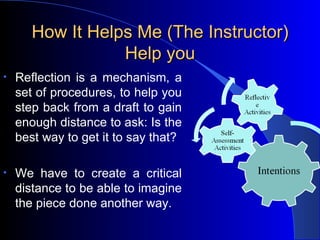
How It Helps Me (The Instructor) Help you Reflection is a mechanism, a set of procedures, to help you step back from a draft to gain enough distance to ask: Is the best way to get it to say that? We have to create a critical distance to be able to imagine the piece done another way.
Winegardner had us create what he called the “process memo”. He uses the memo mainly as a tool to help the workshop instructor know how to respond to the writer’s story. Reflective pieces show teachers what your intentions for your writing actually are, which lets us respond to your writing accurately, rather than responding to what we think your intentions might be.
Reflective Writing is: experiences, opinions, events or new information thoughts and feelings a way of thinking to explore your learning self-knowledge clarity and better understanding of what you are learning a chance to develop and reinforce writing skills making out of what you study
Types of Reflective Writings Journal Learning diary group participation Log book Reflective note Essay diary Peer review Self-assessment
Reference ZEMLIANSKY, Pavel, LOWE, Charles (ed.). Writing Spaces: Readings on Writing. Indiana: Parlour Press, 2010.  Vol.1

Andrea's changes for slides

  • 1.
    Reflective Writing andthe Revision Process Group: Andrea Diego Diogo Marco Antonio Michelle Miriam
  • 2.
    “ Reflection” and“reflective writing” are umbrella terms that refer to any activity that asks you to think about your own thinking. Reflection records a “student’s process of thinking about what she or he is doing while in the process of that doing ”.
  • 3.
    A writer´s experienceWriting a process note In the first process note the author had no idea of how to make it The author received some suggestions
  • 4.
    My letter tothe Reader Assignment Reflective writing Talk to yourself about your own ideas. Essay: First draft letter to the reader final draft
  • 5.
    Instructions for theLetter Date and address Develop 3 paragraphs: 1) Intention, purpose, effect, reader(s) 2) process of working on the essay: topics, planning, steps, changes, decisions, peers’ helps. Sign the letter Compare your letter and essay Hand them together
  • 6.
    For the teachingmoment Identify: Particular problems Target audience Use generate ideas – organize them Clear on purpose or strategy Solve “false information” Results: Develop more insight, make more effective decisions
  • 7.
    Intentions Intentions: asense of audience and purpose and of what the writers wants the essay to do. Intentions are essential in a communicative writing.
  • 8.
    What to doto help? Reflective activities Self-assessing activities
  • 9.
    Examples from RealStudents Depends on what do you have by REAL.
  • 10.
    Below the studentswhose the examples we will see. Joshua Dawson Haley Moore Chelsie Mathis Daniel White Josh Autry D’Amber Walker Nigel Ellington
  • 11.
    How It HelpsMe (The Instructor) Help you Reflection is a mechanism, a set of procedures, to help you step back from a draft to gain enough distance to ask: Is the best way to get it to say that? We have to create a critical distance to be able to imagine the piece done another way.
  • 12.
    Winegardner had uscreate what he called the “process memo”. He uses the memo mainly as a tool to help the workshop instructor know how to respond to the writer’s story. Reflective pieces show teachers what your intentions for your writing actually are, which lets us respond to your writing accurately, rather than responding to what we think your intentions might be.
  • 13.
    Reflective Writing is:experiences, opinions, events or new information thoughts and feelings a way of thinking to explore your learning self-knowledge clarity and better understanding of what you are learning a chance to develop and reinforce writing skills making out of what you study
  • 14.
    Types of ReflectiveWritings Journal Learning diary group participation Log book Reflective note Essay diary Peer review Self-assessment
  • 15.
    Reference ZEMLIANSKY, Pavel,LOWE, Charles (ed.). Writing Spaces: Readings on Writing. Indiana: Parlour Press, 2010. Vol.1