Business Models as Systemic Instruments? Andrea Cocchi PhD Student Newcastle University Business School [email_address]
Contents The context Rise of Innovation Intermediaries  Business Models and Systemic Instrument Conclusions Cocchi_8th ENEF Meeting 7-8 Sept. 2011
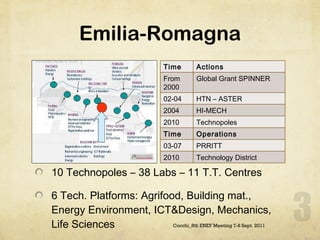
Emilia-Romagna 10 Technopoles – 38 Labs – 11 T.T. Centres 6 Tech. Platforms: Agrifood, Building mat., Energy Environment, ICT&Design, Mechanics, Life Sciences Cocchi_8th ENEF Meeting 7-8 Sept. 2011 Time Actions From 2000 Global Grant SPINNER 02-04 HTN – ASTER 2004 HI-MECH 2010 Technopoles Time Operations 03-07 PRRITT 2010 Technology District
Aim and Focus Aim: highlight the generative function of business models, here as market devices, in stimulating the co-evolution of Intermediary and target firms’ strategies.  Focus: potential role of Innovation Intermediaries in a traditional cluster  “ Network Labs”: independent research organisations composed by universities, firms, associations and municipalities Cocchi_8th ENEF Meeting 7-8 Sept. 2011
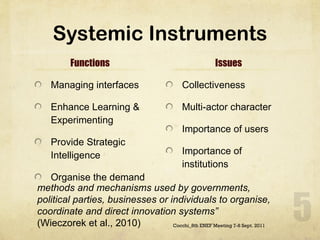
Systemic Instruments Functions Managing interfaces Enhance Learning & Experimenting Provide Strategic Intelligence Organise the demand Issues Collectiveness  Multi-actor character  Importance of users  Importance of institutions  Cocchi_8th ENEF Meeting 7-8 Sept. 2011 methods and mechanisms used by governments, political parties, businesses or individuals to organise, coordinate and direct innovation systems”  (Wieczorek et al., 2010)
Some Example Foresight: develop a common vision, strategy Focus groups: Stakeholder analysis and learning Cluster Policies: Specialised Networks demand/supply Demonstration and transfer initiatives: learning and experimentation Thematic Platforms: brokerage systems, supply/demand analysis, subsidise specific actors/organisations BUSINESS MODELS?  Cocchi_8th ENEF Meeting 7-8 Sept. 2011
BM what they do Structure and organise the capacities and capabilities Give direction and meaning to the system of relationships Define the vision and enact strategies Helps to contextualise the value proposition and adapt to the environment  Market device  the material and discursive assemblages that intervene in the construction of markets  Cocchi_8th ENEF Meeting 7-8 Sept. 2011
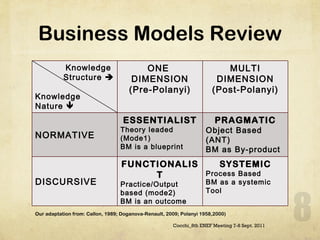
Business Models Review Cocchi_8th ENEF Meeting 7-8 Sept. 2011 Our adaptation from: Callon, 1989; Doganova-Renault, 2009; Polanyi 1958,2000)  Knowledge  Structure   Knowledge Nature   ONE  DIMENSION (Pre-Polanyi) MULTI DIMENSION (Post-Polanyi) NORMATIVE ESSENTIALIST Theory leaded (Mode1) BM is a blueprint PRAGMATIC Object Based (ANT) BM as By-product DISCURSIVE FUNCTIONALIST Practice/Output based (mode2) BM is an outcome SYSTEMIC Process Based  BM as a systemic Tool
BM as Systemic Tool Their specificity: guide for development of common understanding between different agents/actors. Active between different epistemic communities and governance levels They uniqueness: come from the time related dimension (path-dependency). Generation of specific knowledge bases, organisational and relational structures. The dynamic dimension of BM can be seen as a systemic tool. Cocchi_8th ENEF Meeting 7-8 Sept. 2011
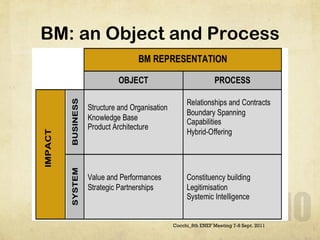
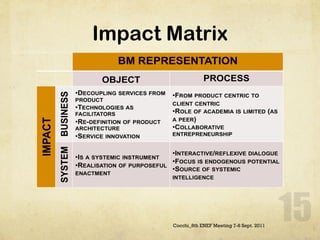
BM: an Object and Process Cocchi_8th ENEF Meeting 7-8 Sept. 2011
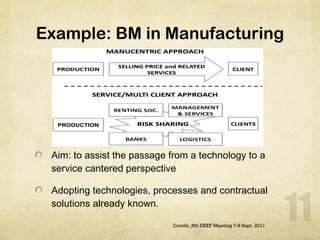
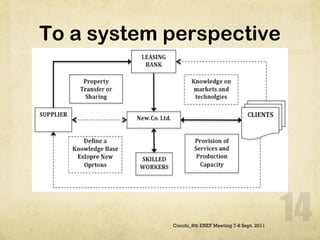
Example: BM in Manufacturing Aim: to assist the passage from a technology to a service cantered perspective Adopting technologies, processes and contractual solutions already known. Cocchi_8th ENEF Meeting 7-8 Sept. 2011
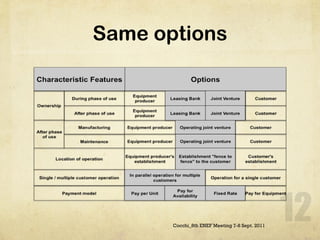
Same options Cocchi_8th ENEF Meeting 7-8 Sept. 2011
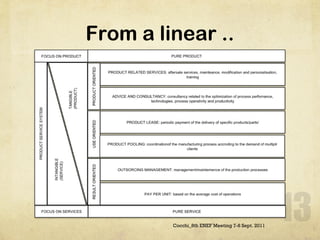
From a linear .. Cocchi_8th ENEF Meeting 7-8 Sept. 2011
To a system perspective Cocchi_8th ENEF Meeting 7-8 Sept. 2011
Impact Matrix Cocchi_8th ENEF Meeting 7-8 Sept. 2011
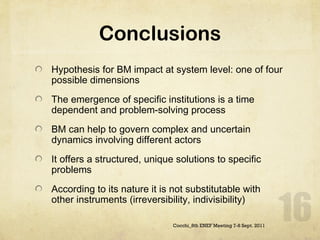
Conclusions Hypothesis for BM impact at system level: one of four possible dimensions The emergence of specific institutions is a time dependent and problem-solving process BM can help to govern complex and uncertain dynamics involving different actors  It offers a structured, unique solutions to specific problems According to its nature it is not substitutable with other instruments (irreversibility, indivisibility)  Cocchi_8th ENEF Meeting 7-8 Sept. 2011

Business Modles as Systemic Instruments?

  • 1.
    Business Models asSystemic Instruments? Andrea Cocchi PhD Student Newcastle University Business School [email_address]
  • 2.
    Contents The contextRise of Innovation Intermediaries Business Models and Systemic Instrument Conclusions Cocchi_8th ENEF Meeting 7-8 Sept. 2011
  • 3.
    Emilia-Romagna 10 Technopoles– 38 Labs – 11 T.T. Centres 6 Tech. Platforms: Agrifood, Building mat., Energy Environment, ICT&Design, Mechanics, Life Sciences Cocchi_8th ENEF Meeting 7-8 Sept. 2011 Time Actions From 2000 Global Grant SPINNER 02-04 HTN – ASTER 2004 HI-MECH 2010 Technopoles Time Operations 03-07 PRRITT 2010 Technology District
  • 4.
    Aim and FocusAim: highlight the generative function of business models, here as market devices, in stimulating the co-evolution of Intermediary and target firms’ strategies. Focus: potential role of Innovation Intermediaries in a traditional cluster “ Network Labs”: independent research organisations composed by universities, firms, associations and municipalities Cocchi_8th ENEF Meeting 7-8 Sept. 2011
  • 5.
    Systemic Instruments FunctionsManaging interfaces Enhance Learning & Experimenting Provide Strategic Intelligence Organise the demand Issues Collectiveness Multi-actor character Importance of users Importance of institutions Cocchi_8th ENEF Meeting 7-8 Sept. 2011 methods and mechanisms used by governments, political parties, businesses or individuals to organise, coordinate and direct innovation systems” (Wieczorek et al., 2010)
  • 6.
    Some Example Foresight:develop a common vision, strategy Focus groups: Stakeholder analysis and learning Cluster Policies: Specialised Networks demand/supply Demonstration and transfer initiatives: learning and experimentation Thematic Platforms: brokerage systems, supply/demand analysis, subsidise specific actors/organisations BUSINESS MODELS? Cocchi_8th ENEF Meeting 7-8 Sept. 2011
  • 7.
    BM what theydo Structure and organise the capacities and capabilities Give direction and meaning to the system of relationships Define the vision and enact strategies Helps to contextualise the value proposition and adapt to the environment Market device the material and discursive assemblages that intervene in the construction of markets Cocchi_8th ENEF Meeting 7-8 Sept. 2011
  • 8.
    Business Models ReviewCocchi_8th ENEF Meeting 7-8 Sept. 2011 Our adaptation from: Callon, 1989; Doganova-Renault, 2009; Polanyi 1958,2000) Knowledge Structure  Knowledge Nature  ONE DIMENSION (Pre-Polanyi) MULTI DIMENSION (Post-Polanyi) NORMATIVE ESSENTIALIST Theory leaded (Mode1) BM is a blueprint PRAGMATIC Object Based (ANT) BM as By-product DISCURSIVE FUNCTIONALIST Practice/Output based (mode2) BM is an outcome SYSTEMIC Process Based BM as a systemic Tool
  • 9.
    BM as SystemicTool Their specificity: guide for development of common understanding between different agents/actors. Active between different epistemic communities and governance levels They uniqueness: come from the time related dimension (path-dependency). Generation of specific knowledge bases, organisational and relational structures. The dynamic dimension of BM can be seen as a systemic tool. Cocchi_8th ENEF Meeting 7-8 Sept. 2011
  • 10.
    BM: an Objectand Process Cocchi_8th ENEF Meeting 7-8 Sept. 2011
  • 11.
    Example: BM inManufacturing Aim: to assist the passage from a technology to a service cantered perspective Adopting technologies, processes and contractual solutions already known. Cocchi_8th ENEF Meeting 7-8 Sept. 2011
  • 12.
    Same options Cocchi_8thENEF Meeting 7-8 Sept. 2011
  • 13.
    From a linear.. Cocchi_8th ENEF Meeting 7-8 Sept. 2011
  • 14.
    To a systemperspective Cocchi_8th ENEF Meeting 7-8 Sept. 2011
  • 15.
    Impact Matrix Cocchi_8thENEF Meeting 7-8 Sept. 2011
  • 16.
    Conclusions Hypothesis forBM impact at system level: one of four possible dimensions The emergence of specific institutions is a time dependent and problem-solving process BM can help to govern complex and uncertain dynamics involving different actors It offers a structured, unique solutions to specific problems According to its nature it is not substitutable with other instruments (irreversibility, indivisibility) Cocchi_8th ENEF Meeting 7-8 Sept. 2011