“Supporting digital innovation
to power sustained economic
growth in the UK”
Name: Neil Crockett
Title: CEO
Twitter name: @CDECatapult
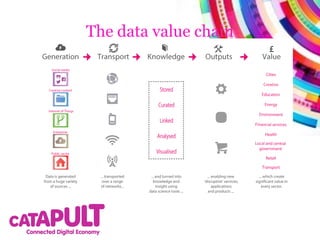
The data value chain
Following the heat
3 initial sectors
•Creative & Media
•Digital Health
•Digitally Enabled Cities
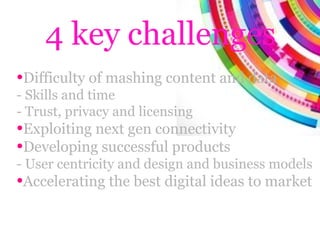
4 key challenges
•Difficulty of mashing content and data
- Skills and time
- Trust, privacy and licensing

•Exploiting next gen connectivity
•Developing successful products

- User centricity and design and business models

•Accelerating the best digital ideas to market
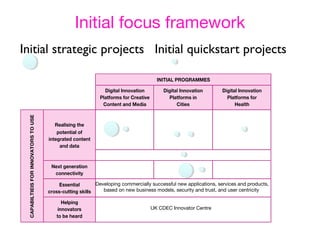
Initial focus framework
Initial strategic projects Initial quickstart projects

Developing commercially successful new applications, services and products,
based on new business models, security and trust, and user centricity
UK CDEC Innovator Centre
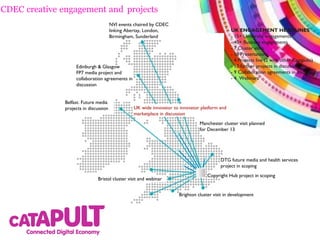
CDEC creative engagement and projects
NVI events chaired by CDEC
linking Abertay, London,
Birmingham, Sunderland

UK ENGAGEMENT HEADLINES
- 15+ University engagements
- 40+ Business engagements
- 7 Cluster visits
- 18 Presentations
- 4 Projects live (2 with other Catapults)
- 10 further projects in discussion
- 9 Collaboration agreements in discussion
- 4 Webinars

Edinburgh & Glasgow
FP7 media project and
collaboration agreements in
discussion
Belfast. Future media
projects in discussion

UK wide innovator to innovator platform and
marketplace in discussion
Manchester cluster visit planned
for December 13

DTG future media and health services
project in scoping
Bristol cluster visit and webinar

Copyright Hub project in scoping

Brighton cluster visit in development
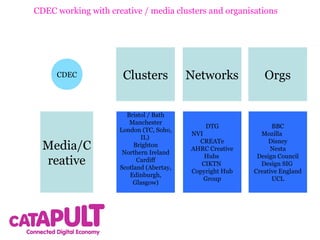
CDEC working with creative / media clusters and organisations

CDEC

Media/C
reative

Clusters
Bristol / Bath
Manchester
London (TC, Soho,
IL)
Brighton
Northern Ireland
Cardiff
Scotland (Abertay,
Edinburgh,
Glasgow)

Networks

Orgs

DTG

BBC
Mozilla
Disney
Nesta
Design Council
Design SIG
Creative England
UCL

NVI
CREATe
AHRC Creative
Hubs
CIKTN
Copyright Hub
Group
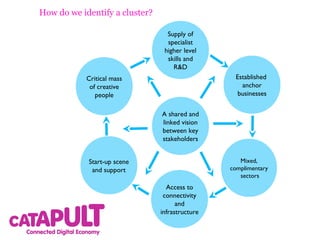
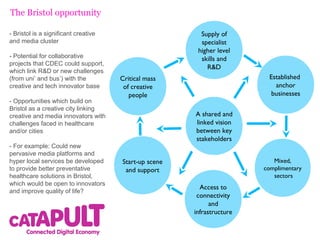
How do we identify a cluster?
Supply of
specialist
higher level
skills and
R&D
Established
anchor
businesses

Critical mass
of creative
people
A shared and
linked vision
between key
stakeholders

Mixed,
complimentary
sectors

Start-up scene
and support
Access to
connectivity
and
infrastructure
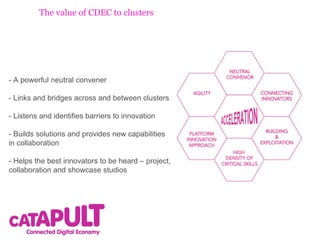
The value of CDEC to clusters

- A powerful neutral convener
- Links and bridges across and between clusters
- Listens and identifies barriers to innovation
- Builds solutions and provides new capabilities
in collaboration
- Helps the best innovators to be heard – project,
collaboration and showcase studios
The Bristol opportunity
Supply of
specialist
higher level
skills and
R&D

- Bristol is a significant creative
and media cluster
- Potential for collaborative
projects that CDEC could support,
which link R&D or new challenges
(from uni’ and bus’) with the
creative and tech innovator base
- Opportunities which build on
Bristol as a creative city linking
creative and media innovators with
challenges faced in healthcare
and/or cities
- For example: Could new
pervasive media platforms and
hyper local services be developed
to provide better preventative
healthcare solutions in Bristol,
which would be open to innovators
and improve quality of life?

Established
anchor
businesses

Critical mass
of creative
people
A shared and
linked vision
between key
stakeholders

Mixed,
complimentary
sectors

Start-up scene
and support
Access to
connectivity
and
infrastructure
The Bristol opportunity

Come to us with collaborative proposals (new or existing) that fit
our criteria:
1. In the data value chain
2. Do not duplicate but add value
3. Convening ratio of at least £2 to £1
4. The market would not solve in a timely manner
5. Open to innovators
6. Can scale
@CDECatapult
@cgthompson
Info@cde.catapult.org.uk
Questions?

♯cdecbristol
@CDECatapult

Cdec bristol

  • 1.
    “Supporting digital innovation topower sustained economic growth in the UK” Name: Neil Crockett Title: CEO Twitter name: @CDECatapult
  • 2.
  • 3.
    Following the heat 3initial sectors •Creative & Media •Digital Health •Digitally Enabled Cities
  • 4.
    4 key challenges •Difficultyof mashing content and data - Skills and time - Trust, privacy and licensing •Exploiting next gen connectivity •Developing successful products - User centricity and design and business models •Accelerating the best digital ideas to market
  • 5.
    Initial focus framework Initialstrategic projects Initial quickstart projects Developing commercially successful new applications, services and products, based on new business models, security and trust, and user centricity UK CDEC Innovator Centre
  • 6.
    CDEC creative engagementand projects NVI events chaired by CDEC linking Abertay, London, Birmingham, Sunderland UK ENGAGEMENT HEADLINES - 15+ University engagements - 40+ Business engagements - 7 Cluster visits - 18 Presentations - 4 Projects live (2 with other Catapults) - 10 further projects in discussion - 9 Collaboration agreements in discussion - 4 Webinars Edinburgh & Glasgow FP7 media project and collaboration agreements in discussion Belfast. Future media projects in discussion UK wide innovator to innovator platform and marketplace in discussion Manchester cluster visit planned for December 13 DTG future media and health services project in scoping Bristol cluster visit and webinar Copyright Hub project in scoping Brighton cluster visit in development
  • 7.
    CDEC working withcreative / media clusters and organisations CDEC Media/C reative Clusters Bristol / Bath Manchester London (TC, Soho, IL) Brighton Northern Ireland Cardiff Scotland (Abertay, Edinburgh, Glasgow) Networks Orgs DTG BBC Mozilla Disney Nesta Design Council Design SIG Creative England UCL NVI CREATe AHRC Creative Hubs CIKTN Copyright Hub Group
  • 8.
    How do weidentify a cluster? Supply of specialist higher level skills and R&D Established anchor businesses Critical mass of creative people A shared and linked vision between key stakeholders Mixed, complimentary sectors Start-up scene and support Access to connectivity and infrastructure
  • 9.
    The value ofCDEC to clusters - A powerful neutral convener - Links and bridges across and between clusters - Listens and identifies barriers to innovation - Builds solutions and provides new capabilities in collaboration - Helps the best innovators to be heard – project, collaboration and showcase studios
  • 10.
    The Bristol opportunity Supplyof specialist higher level skills and R&D - Bristol is a significant creative and media cluster - Potential for collaborative projects that CDEC could support, which link R&D or new challenges (from uni’ and bus’) with the creative and tech innovator base - Opportunities which build on Bristol as a creative city linking creative and media innovators with challenges faced in healthcare and/or cities - For example: Could new pervasive media platforms and hyper local services be developed to provide better preventative healthcare solutions in Bristol, which would be open to innovators and improve quality of life? Established anchor businesses Critical mass of creative people A shared and linked vision between key stakeholders Mixed, complimentary sectors Start-up scene and support Access to connectivity and infrastructure
  • 11.
    The Bristol opportunity Cometo us with collaborative proposals (new or existing) that fit our criteria: 1. In the data value chain 2. Do not duplicate but add value 3. Convening ratio of at least £2 to £1 4. The market would not solve in a timely manner 5. Open to innovators 6. Can scale @CDECatapult @cgthompson Info@cde.catapult.org.uk
  • 12.

Editor's Notes

  • #3 As the video in the last slide hinted, the data value chain is potentially enormous and in CDEC we have put a lot of thought into trying to map that value chain to see what would be the most useful entry point for us as an organisation and where might we be able to add the most value ourselves. It’s a smorgasboard of potential value - cities, transport, energy, government, culture, education, health - so we have defined the areas where we feel we can initially add most value as these three areas.
  • #4 Creative Media, Health and Digitally Enabled Cities. And when addressing these three areas we have identified four key challenges that we are structuring our project approach to address. These are….
  • #5 The difficulty of integrating and mashing up different data sets and sources. These involve skill sets that don’t always reside in the SME community, or that can be costly for them to access and deploy or difficult for them to know where to access. We can offer help here with our technology capability and access to R&D and Academic communities. Exploiting next generation connectivity. Horizon scanning and keeping abreast of the next big thing is an important element of entrepreneurship and innovation. But often smaller companies don’t have the time or space to play and experiment with what is coming next to better understand how they may need to configure or iterate their products to remain relevant. We can give them that opportunity by providing a physical space where they can come and test and experiment with a community of their peers. Developing successful products and services. We know that our innovator and technology community are completely adept at creating new ideas and bootstrapping their businesses with ingenuity and skill. But sometimes the start-up runway is tight. Many of the revolutionary technologies that made the iPhone and other services “smart” were actually the result of government funding. The Internet, GPS, touchscreen displays as well as Siri did not just benefit from government-funded research activity but also received early stage finance from the US government Small Business Investment Company Program. In these cases the venture capitalists entered only after government research funding had gotten these companies to the critical proof of concept. Google’s algorithm, don’t forget, was funded by the National Science Foundation. So, we feel that CDEC can play its part by supporting our innovators in the UK in much the same way. We can help scale, we can provide a place to play and experiment and we can network SME’s into bigger business, R&D and Academia to help make that runway a little bit longer.
  • #6 SOME KICK OFF ALREADY – WE ARE GETTING GOING STRATEGIC AND QUICKSTART – PORTFOLIO EXPLAIN DCX AND WHITESPACE AS LARGE STRATEGIC DOTS EXPLAIN TRUSTED DATA SANDPIT – HORIZONTAL CAPABILITY – EXPLAIN THE BIG COMPANIES ENGAGED SOME STEADY CAPABILITIES AND FACILITIES BUILT - TO ADDRESS BOTTOM TWO CHALLENGES EXPLAIN INNOVATOR CENTER
  • #7 The difficulty of integrating and mashing up different data sets and sources. These involve skill sets that don’t always reside in the SME community, or that can be costly for them to access and deploy or difficult for them to know where to access. We can offer help here with our technology capability and access to R&D and Academic communities. Exploiting next generation connectivity. Horizon scanning and keeping abreast of the next big thing is an important element of entrepreneurship and innovation. But often smaller companies don’t have the time or space to play and experiment with what is coming next to better understand how they may need to configure or iterate their products to remain relevant. We can give them that opportunity by providing a physical space where they can come and test and experiment with a community of their peers. Developing successful products and services. We know that our innovator and technology community are completely adept at creating new ideas and bootstrapping their businesses with ingenuity and skill. But sometimes the start-up runway is tight. Many of the revolutionary technologies that made the iPhone and other services “smart” were actually the result of government funding. The Internet, GPS, touchscreen displays as well as Siri did not just benefit from government-funded research activity but also received early stage finance from the US government Small Business Investment Company Program. In these cases the venture capitalists entered only after government research funding had gotten these companies to the critical proof of concept. Google’s algorithm, don’t forget, was funded by the National Science Foundation. So, we feel that CDEC can play its part by supporting our innovators in the UK in much the same way. We can help scale, we can provide a place to play and experiment and we can network SME’s into bigger business, R&D and Academia to help make that runway a little bit longer.
  • #8 The difficulty of integrating and mashing up different data sets and sources. These involve skill sets that don’t always reside in the SME community, or that can be costly for them to access and deploy or difficult for them to know where to access. We can offer help here with our technology capability and access to R&D and Academic communities. Exploiting next generation connectivity. Horizon scanning and keeping abreast of the next big thing is an important element of entrepreneurship and innovation. But often smaller companies don’t have the time or space to play and experiment with what is coming next to better understand how they may need to configure or iterate their products to remain relevant. We can give them that opportunity by providing a physical space where they can come and test and experiment with a community of their peers. Developing successful products and services. We know that our innovator and technology community are completely adept at creating new ideas and bootstrapping their businesses with ingenuity and skill. But sometimes the start-up runway is tight. Many of the revolutionary technologies that made the iPhone and other services “smart” were actually the result of government funding. The Internet, GPS, touchscreen displays as well as Siri did not just benefit from government-funded research activity but also received early stage finance from the US government Small Business Investment Company Program. In these cases the venture capitalists entered only after government research funding had gotten these companies to the critical proof of concept. Google’s algorithm, don’t forget, was funded by the National Science Foundation. So, we feel that CDEC can play its part by supporting our innovators in the UK in much the same way. We can help scale, we can provide a place to play and experiment and we can network SME’s into bigger business, R&D and Academia to help make that runway a little bit longer.
  • #9 The difficulty of integrating and mashing up different data sets and sources. These involve skill sets that don’t always reside in the SME community, or that can be costly for them to access and deploy or difficult for them to know where to access. We can offer help here with our technology capability and access to R&D and Academic communities. Exploiting next generation connectivity. Horizon scanning and keeping abreast of the next big thing is an important element of entrepreneurship and innovation. But often smaller companies don’t have the time or space to play and experiment with what is coming next to better understand how they may need to configure or iterate their products to remain relevant. We can give them that opportunity by providing a physical space where they can come and test and experiment with a community of their peers. Developing successful products and services. We know that our innovator and technology community are completely adept at creating new ideas and bootstrapping their businesses with ingenuity and skill. But sometimes the start-up runway is tight. Many of the revolutionary technologies that made the iPhone and other services “smart” were actually the result of government funding. The Internet, GPS, touchscreen displays as well as Siri did not just benefit from government-funded research activity but also received early stage finance from the US government Small Business Investment Company Program. In these cases the venture capitalists entered only after government research funding had gotten these companies to the critical proof of concept. Google’s algorithm, don’t forget, was funded by the National Science Foundation. So, we feel that CDEC can play its part by supporting our innovators in the UK in much the same way. We can help scale, we can provide a place to play and experiment and we can network SME’s into bigger business, R&D and Academia to help make that runway a little bit longer.
  • #10 The difficulty of integrating and mashing up different data sets and sources. These involve skill sets that don’t always reside in the SME community, or that can be costly for them to access and deploy or difficult for them to know where to access. We can offer help here with our technology capability and access to R&D and Academic communities. Exploiting next generation connectivity. Horizon scanning and keeping abreast of the next big thing is an important element of entrepreneurship and innovation. But often smaller companies don’t have the time or space to play and experiment with what is coming next to better understand how they may need to configure or iterate their products to remain relevant. We can give them that opportunity by providing a physical space where they can come and test and experiment with a community of their peers. Developing successful products and services. We know that our innovator and technology community are completely adept at creating new ideas and bootstrapping their businesses with ingenuity and skill. But sometimes the start-up runway is tight. Many of the revolutionary technologies that made the iPhone and other services “smart” were actually the result of government funding. The Internet, GPS, touchscreen displays as well as Siri did not just benefit from government-funded research activity but also received early stage finance from the US government Small Business Investment Company Program. In these cases the venture capitalists entered only after government research funding had gotten these companies to the critical proof of concept. Google’s algorithm, don’t forget, was funded by the National Science Foundation. So, we feel that CDEC can play its part by supporting our innovators in the UK in much the same way. We can help scale, we can provide a place to play and experiment and we can network SME’s into bigger business, R&D and Academia to help make that runway a little bit longer.
  • #11 The difficulty of integrating and mashing up different data sets and sources. These involve skill sets that don’t always reside in the SME community, or that can be costly for them to access and deploy or difficult for them to know where to access. We can offer help here with our technology capability and access to R&D and Academic communities. Exploiting next generation connectivity. Horizon scanning and keeping abreast of the next big thing is an important element of entrepreneurship and innovation. But often smaller companies don’t have the time or space to play and experiment with what is coming next to better understand how they may need to configure or iterate their products to remain relevant. We can give them that opportunity by providing a physical space where they can come and test and experiment with a community of their peers. Developing successful products and services. We know that our innovator and technology community are completely adept at creating new ideas and bootstrapping their businesses with ingenuity and skill. But sometimes the start-up runway is tight. Many of the revolutionary technologies that made the iPhone and other services “smart” were actually the result of government funding. The Internet, GPS, touchscreen displays as well as Siri did not just benefit from government-funded research activity but also received early stage finance from the US government Small Business Investment Company Program. In these cases the venture capitalists entered only after government research funding had gotten these companies to the critical proof of concept. Google’s algorithm, don’t forget, was funded by the National Science Foundation. So, we feel that CDEC can play its part by supporting our innovators in the UK in much the same way. We can help scale, we can provide a place to play and experiment and we can network SME’s into bigger business, R&D and Academia to help make that runway a little bit longer.