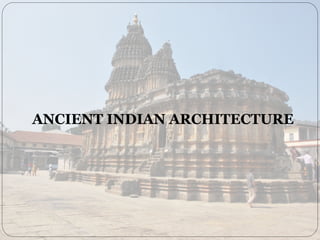
ANCIENT INDIAN ARCHITECTURE
INTRODUCTION
Indian architecture is as old as the history of the civilization. The earliest remains
of recognizable building activity in the India dates back to the Indus Valley cities.
Indian architecture is rooted in its history, culture and religion. Among a number
of architectural styles and traditions, the best-known include the many varieties of
Hindu temple architecture, Indo-Islamic architecture, and Rajput architecture.
Some of the major architectural styles are the following :
Pallava
Rajput
Chola
Gupta
Gandhara School of Art
Kushan art
Pallava
• The Pallava dynasty was an Indian dynasty that existed from 275 CE to 897 CE,
ruling a portion of southern India.
• Pallavas are most noted for their patronage of architecture, the finest example
being the Shore Temple, a UNESCO World Heritage Site in Mahabalipuram.
•The Pallavas, who left behind magnificent sculptures and temples, established
the foundations of medieval South Indian architecture.
• Pallava architecture can be sub-divided into two phases - the rock cut phase and
the structural phase.
• rock cut phase :
Mahendra Group, A.D. 610 to 640
Mamalla Group, A.D. 640 to 690.
• structural phase :
Rajasimha Group, A.D. 690 to 800
Nandivarman Group, c. A.D. 800 to c. 900
Rock cut phase
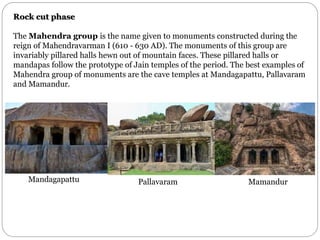
The Mahendra group is the name given to monuments constructed during the
reign of Mahendravarman I (610 - 630 AD). The monuments of this group are
invariably pillared halls hewn out of mountain faces. These pillared halls or
mandapas follow the prototype of Jain temples of the period. The best examples of
Mahendra group of monuments are the cave temples at Mandagapattu, Pallavaram
and Mamandur.
Mandagapattu Pallavaram Mamandur
The Structural Phase
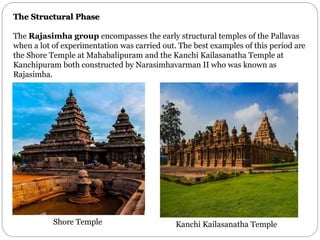
The Rajasimha group encompasses the early structural temples of the Pallavas
when a lot of experimentation was carried out. The best examples of this period are
the Shore Temple at Mahabalipuram and the Kanchi Kailasanatha Temple at
Kanchipuram both constructed by Narasimhavarman II who was known as
Rajasimha.
Shore Temple Kanchi Kailasanatha Temple
Rajput
•Rajput architecture is a architectural style notable for the forts and palaces of the
many Rajput rulers, which are popular tourist attractions, many of the Rajput forts
are UNESCO World Heritage Site.
•Rajput architecture represents different types of buildings, which may broadly
be classed either as religious; which include temples, forts, stepwells, gardens, and
palaces.
•Due to the Islamic invasions, the forts were specially built for defense and
military purposes.
• Mughal architecture had a significant impact on indigenous Rajput art and
architecture.
• Islamic elements influenced by Mughal architecture, as well as local cultural
styles, coexist in Rajput architecture.
Temples Built by Rajputs
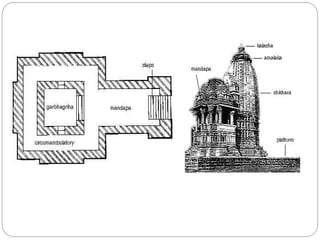
•The garbhagriha, the vimana, the shikhara and the amalaka are the key features
of Rajput temple architecture.
• As far as the temples architecture is concerned a 'sabha mandap' was mandatory
for every shrine.
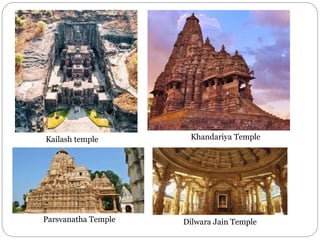
•In temples like Vishwanath and the Khandariya Mahadeva Temples, Surya
Temple at Konark, Tejpala Temple at Mt. Abu and others such features are easily
found.
• These temples, though built by other rulers, were built during the Rajput period
and followed the Rajput idiom.
Kailash temple Khandariya Temple
Parsvanatha Temple Dilwara Jain Temple
Forts and Palaces of Rajputs
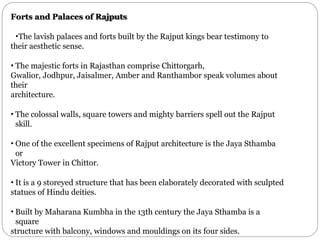
•The lavish palaces and forts built by the Rajput kings bear testimony to
their aesthetic sense.
• The majestic forts in Rajasthan comprise Chittorgarh,
Gwalior, Jodhpur, Jaisalmer, Amber and Ranthambor speak volumes about
their
architecture.
• The colossal walls, square towers and mighty barriers spell out the Rajput
skill.
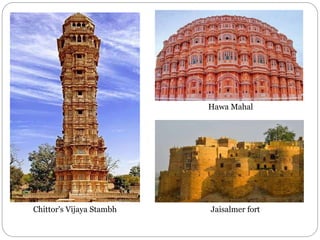
• One of the excellent specimens of Rajput architecture is the Jaya Sthamba
or
Victory Tower in Chittor.
• It is a 9 storeyed structure that has been elaborately decorated with sculpted
statues of Hindu deities.
• Built by Maharana Kumbha in the 13th century the Jaya Sthamba is a
square
structure with balcony, windows and mouldings on its four sides.
Chittor's Vijaya Stambh
Hawa Mahal
Jaisalmer fort
Chola
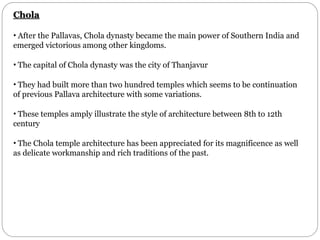
• After the Pallavas, Chola dynasty became the main power of Southern India and
emerged victorious among other kingdoms.
• The capital of Chola dynasty was the city of Thanjavur
• They had built more than two hundred temples which seems to be continuation
of previous Pallava architecture with some variations.
• These temples amply illustrate the style of architecture between 8th to 12th
century
• The Chola temple architecture has been appreciated for its magnificence as well
as delicate workmanship and rich traditions of the past.
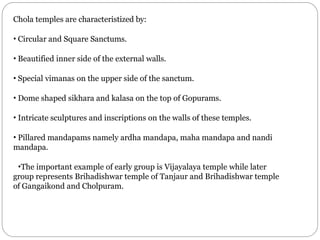
Chola temples are characteristized by:
• Circular and Square Sanctums.
• Beautified inner side of the external walls.
• Special vimanas on the upper side of the sanctum.
• Dome shaped sikhara and kalasa on the top of Gopurams.
• Intricate sculptures and inscriptions on the walls of these temples.
• Pillared mandapams namely ardha mandapa, maha mandapa and nandi
mandapa.
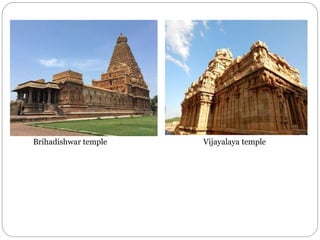
•The important example of early group is Vijayalaya temple while later
group represents Brihadishwar temple of Tanjaur and Brihadishwar temple
of Gangaikond and Cholpuram.
Vijayalaya temple
Brihadishwar temple
Art of Mathura
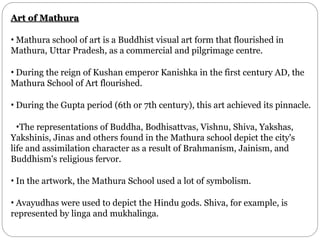
• Mathura school of art is a Buddhist visual art form that flourished in
Mathura, Uttar Pradesh, as a commercial and pilgrimage centre.
• During the reign of Kushan emperor Kanishka in the first century AD, the
Mathura School of Art flourished.
• During the Gupta period (6th or 7th century), this art achieved its pinnacle.
•The representations of Buddha, Bodhisattvas, Vishnu, Shiva, Yakshas,
Yakshinis, Jinas and others found in the Mathura school depict the city's
life and assimilation character as a result of Brahmanism, Jainism, and
Buddhism's religious fervor.
• In the artwork, the Mathura School used a lot of symbolism.
• Avayudhas were used to depict the Hindu gods. Shiva, for example, is
represented by linga and mukhalinga.
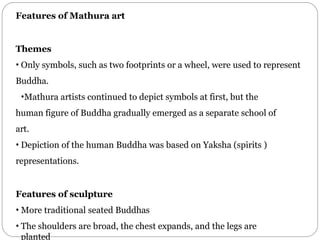
Features of Mathura art
Themes
• Only symbols, such as two footprints or a wheel, were used to represent
Buddha.
•Mathura artists continued to depict symbols at first, but the
human figure of Buddha gradually emerged as a separate school of
art.
• Depiction of the human Buddha was based on Yaksha (spirits )
representations.
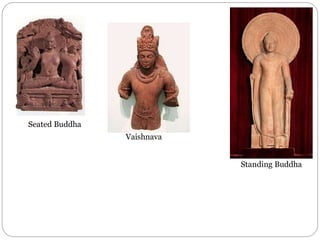
Features of sculpture
• More traditional seated Buddhas
• The shoulders are broad, the chest expands, and the legs are
planted
Seated Buddha
Vaishnava
Standing Buddha
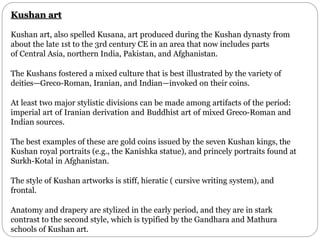
Kushan art
Kushan art, also spelled Kusana, art produced during the Kushan dynasty from
about the late 1st to the 3rd century CE in an area that now includes parts
of Central Asia, northern India, Pakistan, and Afghanistan.
The Kushans fostered a mixed culture that is best illustrated by the variety of
deities—Greco-Roman, Iranian, and Indian—invoked on their coins.
At least two major stylistic divisions can be made among artifacts of the period:
imperial art of Iranian derivation and Buddhist art of mixed Greco-Roman and
Indian sources.
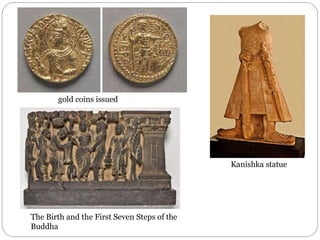
The best examples of these are gold coins issued by the seven Kushan kings, the
Kushan royal portraits (e.g., the Kanishka statue), and princely portraits found at
Surkh-Kotal in Afghanistan.
The style of Kushan artworks is stiff, hieratic ( cursive writing system), and
frontal.
Anatomy and drapery are stylized in the early period, and they are in stark
contrast to the second style, which is typified by the Gandhara and Mathura
schools of Kushan art.
gold coins issued
Kanishka statue
The Birth and the First Seven Steps of the
Buddha
THANK YOU

Ancient IndianArchitecture..........pptx

  • 1.
  • 2.
    INTRODUCTION Indian architecture isas old as the history of the civilization. The earliest remains of recognizable building activity in the India dates back to the Indus Valley cities. Indian architecture is rooted in its history, culture and religion. Among a number of architectural styles and traditions, the best-known include the many varieties of Hindu temple architecture, Indo-Islamic architecture, and Rajput architecture.
  • 3.
    Some of themajor architectural styles are the following : Pallava Rajput Chola Gupta Gandhara School of Art Kushan art
  • 4.
    Pallava • The Pallavadynasty was an Indian dynasty that existed from 275 CE to 897 CE, ruling a portion of southern India. • Pallavas are most noted for their patronage of architecture, the finest example being the Shore Temple, a UNESCO World Heritage Site in Mahabalipuram. •The Pallavas, who left behind magnificent sculptures and temples, established the foundations of medieval South Indian architecture. • Pallava architecture can be sub-divided into two phases - the rock cut phase and the structural phase. • rock cut phase : Mahendra Group, A.D. 610 to 640 Mamalla Group, A.D. 640 to 690. • structural phase : Rajasimha Group, A.D. 690 to 800 Nandivarman Group, c. A.D. 800 to c. 900
  • 5.
    Rock cut phase TheMahendra group is the name given to monuments constructed during the reign of Mahendravarman I (610 - 630 AD). The monuments of this group are invariably pillared halls hewn out of mountain faces. These pillared halls or mandapas follow the prototype of Jain temples of the period. The best examples of Mahendra group of monuments are the cave temples at Mandagapattu, Pallavaram and Mamandur. Mandagapattu Pallavaram Mamandur
  • 6.
    The Structural Phase TheRajasimha group encompasses the early structural temples of the Pallavas when a lot of experimentation was carried out. The best examples of this period are the Shore Temple at Mahabalipuram and the Kanchi Kailasanatha Temple at Kanchipuram both constructed by Narasimhavarman II who was known as Rajasimha. Shore Temple Kanchi Kailasanatha Temple
  • 7.
    Rajput •Rajput architecture isa architectural style notable for the forts and palaces of the many Rajput rulers, which are popular tourist attractions, many of the Rajput forts are UNESCO World Heritage Site. •Rajput architecture represents different types of buildings, which may broadly be classed either as religious; which include temples, forts, stepwells, gardens, and palaces. •Due to the Islamic invasions, the forts were specially built for defense and military purposes. • Mughal architecture had a significant impact on indigenous Rajput art and architecture. • Islamic elements influenced by Mughal architecture, as well as local cultural styles, coexist in Rajput architecture.
  • 8.
    Temples Built byRajputs •The garbhagriha, the vimana, the shikhara and the amalaka are the key features of Rajput temple architecture. • As far as the temples architecture is concerned a 'sabha mandap' was mandatory for every shrine. •In temples like Vishwanath and the Khandariya Mahadeva Temples, Surya Temple at Konark, Tejpala Temple at Mt. Abu and others such features are easily found. • These temples, though built by other rulers, were built during the Rajput period and followed the Rajput idiom.
  • 10.
    Kailash temple KhandariyaTemple Parsvanatha Temple Dilwara Jain Temple
  • 11.
    Forts and Palacesof Rajputs •The lavish palaces and forts built by the Rajput kings bear testimony to their aesthetic sense. • The majestic forts in Rajasthan comprise Chittorgarh, Gwalior, Jodhpur, Jaisalmer, Amber and Ranthambor speak volumes about their architecture. • The colossal walls, square towers and mighty barriers spell out the Rajput skill. • One of the excellent specimens of Rajput architecture is the Jaya Sthamba or Victory Tower in Chittor. • It is a 9 storeyed structure that has been elaborately decorated with sculpted statues of Hindu deities. • Built by Maharana Kumbha in the 13th century the Jaya Sthamba is a square structure with balcony, windows and mouldings on its four sides.
  • 12.
    Chittor's Vijaya Stambh HawaMahal Jaisalmer fort
  • 13.
    Chola • After thePallavas, Chola dynasty became the main power of Southern India and emerged victorious among other kingdoms. • The capital of Chola dynasty was the city of Thanjavur • They had built more than two hundred temples which seems to be continuation of previous Pallava architecture with some variations. • These temples amply illustrate the style of architecture between 8th to 12th century • The Chola temple architecture has been appreciated for its magnificence as well as delicate workmanship and rich traditions of the past.
  • 14.
    Chola temples arecharacteristized by: • Circular and Square Sanctums. • Beautified inner side of the external walls. • Special vimanas on the upper side of the sanctum. • Dome shaped sikhara and kalasa on the top of Gopurams. • Intricate sculptures and inscriptions on the walls of these temples. • Pillared mandapams namely ardha mandapa, maha mandapa and nandi mandapa. •The important example of early group is Vijayalaya temple while later group represents Brihadishwar temple of Tanjaur and Brihadishwar temple of Gangaikond and Cholpuram.
  • 15.
  • 16.
    Art of Mathura •Mathura school of art is a Buddhist visual art form that flourished in Mathura, Uttar Pradesh, as a commercial and pilgrimage centre. • During the reign of Kushan emperor Kanishka in the first century AD, the Mathura School of Art flourished. • During the Gupta period (6th or 7th century), this art achieved its pinnacle. •The representations of Buddha, Bodhisattvas, Vishnu, Shiva, Yakshas, Yakshinis, Jinas and others found in the Mathura school depict the city's life and assimilation character as a result of Brahmanism, Jainism, and Buddhism's religious fervor. • In the artwork, the Mathura School used a lot of symbolism. • Avayudhas were used to depict the Hindu gods. Shiva, for example, is represented by linga and mukhalinga.
  • 17.
    Features of Mathuraart Themes • Only symbols, such as two footprints or a wheel, were used to represent Buddha. •Mathura artists continued to depict symbols at first, but the human figure of Buddha gradually emerged as a separate school of art. • Depiction of the human Buddha was based on Yaksha (spirits ) representations. Features of sculpture • More traditional seated Buddhas • The shoulders are broad, the chest expands, and the legs are planted
  • 18.
  • 19.
    Kushan art Kushan art,also spelled Kusana, art produced during the Kushan dynasty from about the late 1st to the 3rd century CE in an area that now includes parts of Central Asia, northern India, Pakistan, and Afghanistan. The Kushans fostered a mixed culture that is best illustrated by the variety of deities—Greco-Roman, Iranian, and Indian—invoked on their coins. At least two major stylistic divisions can be made among artifacts of the period: imperial art of Iranian derivation and Buddhist art of mixed Greco-Roman and Indian sources. The best examples of these are gold coins issued by the seven Kushan kings, the Kushan royal portraits (e.g., the Kanishka statue), and princely portraits found at Surkh-Kotal in Afghanistan. The style of Kushan artworks is stiff, hieratic ( cursive writing system), and frontal. Anatomy and drapery are stylized in the early period, and they are in stark contrast to the second style, which is typified by the Gandhara and Mathura schools of Kushan art.
  • 20.
    gold coins issued Kanishkastatue The Birth and the First Seven Steps of the Buddha
  • 21.