XBOSoft, Inc. All Rights Reserved. 1
Not Your Grandfather’s
Requirements-Based Testing:
Do Agile User Stories or ATDD Fix It?
with Robin Goldsmith
#TestCaseTips
XBOSoft
Dedicated to Software Quality Improvement
Founded in 2006
We speed products to market with our expert:
• Software QA consulting
• Software testing
Global team with offices in San Francisco & Beijing
“Thorough, accurate and fast”
XBOSoft, Inc. All Rights Reserved. 2
House Rules
 Participants other than the speakers are muted
 Ask questions in the GoToWebinar control on the
right side of your screen or through Twitter
@XBOSoft
 Questions may be asked throughout the webinar -
we’ll try to answer them at the end
 You’ll receive info on recording after the webinar
Webinar Hashtag: #TestCaseTips
XBOSoft, Inc. All Rights Reserved. 3
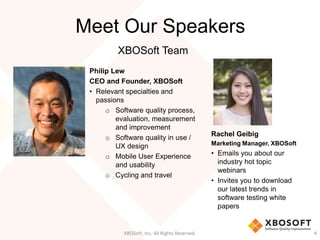
Meet Our Speakers
Philip Lew
CEO and Founder, XBOSoft
• Relevant specialties and
passions
o Software quality process,
evaluation, measurement
and improvement
o Software quality in use /
UX design
o Mobile User Experience
and usability
o Cycling and travel
XBOSoft, Inc. All Rights Reserved. 4
Rachel Geibig
Marketing Manager, XBOSoft
• Emails you about our
industry hot topic
webinars
• Invites you to download
our latest trends in
software testing white
papers
XBOSoft Team
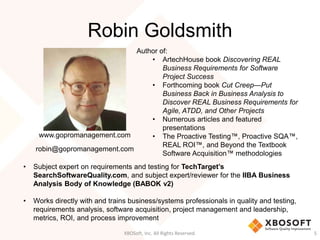
Robin Goldsmith
XBOSoft, Inc. All Rights Reserved. 5
Author of:
• ArtechHouse book Discovering REAL
Business Requirements for Software
Project Success
• Forthcoming book Cut Creep—Put
Business Back in Business Analysis to
Discover REAL Business Requirements for
Agile, ATDD, and Other Projects
• Numerous articles and featured
presentations
• The Proactive Testing™, Proactive SQA™,
REAL ROI™, and Beyond the Textbook
Software Acquisition™ methodologies
• Subject expert on requirements and testing for TechTarget’s
SearchSoftwareQuality.com, and subject expert/reviewer for the IIBA Business
Analysis Body of Knowledge (BABOK v2)
• Works directly with and trains business/systems professionals in quality and testing,
requirements analysis, software acquisition, project management and leadership,
metrics, ROI, and process improvement
www.gopromanagement.com
robin@gopromanagement.com
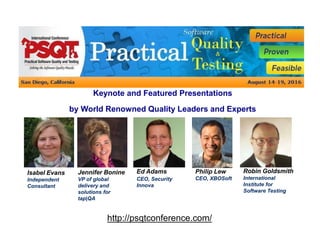
http://psqtconference.com/
Keynote and Featured Presentations
by World Renowned Quality Leaders and Experts
Ed Adams
CEO, Security
Innova
Jennifer Bonine
VP of global
delivery and
solutions for
tap|QA
Isabel Evans
Independent
Consultant
Philip Lew
CEO, XBOSoft
Robin Goldsmith
International
Institute for
Software Testing
XBOSoft, Inc. All Rights Reserved. 7
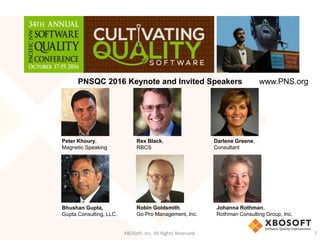
Bhushan Gupta,
Gupta Consulting, LLC.
Robin Goldsmith,
Go Pro Management, Inc.
Johanna Rothman,
Rothman Consulting Group, Inc.
Peter Khoury,
Magnetic Speaking
Rex Black,
RBCS
Darlene Greene,
Consultant
PNSQC 2016 Keynote and Invited Speakers www.PNS.org
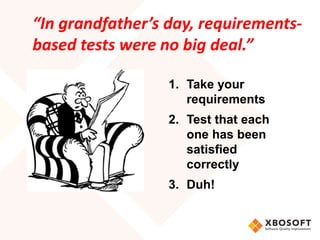
1. Take your
requirements
2. Test that each
one has been
satisfied
correctly
3. Duh!
“In grandfather’s day, requirements-
based tests were no big deal.”
Why We’re Here
XBOSoft, Inc. All Rights Reserved. 9
Requirements-based tests
• Are fundamental
• Seem obvious
Except
1. What requirements?
2. What are requirements?
3. How to identify tests based on requirements?
Objectives
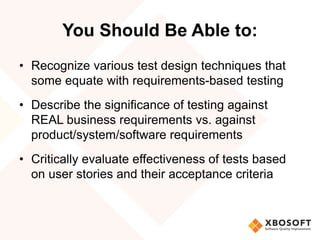
You should be able to:
• Recognize various test design techniques that
some equate with requirements-based testing
• Describe the significance of testing against REAL
business requirements vs. against
product/system/software requirements
• Critically evaluate effectiveness of tests based on
user stories and their acceptance criteria
Is one of your issues testing that
requirements are met?
Awareness is a start.
XBOSoft, Inc. All Rights Reserved. 11
Agenda
XBOSoft, Inc. All Rights Reserved. 12
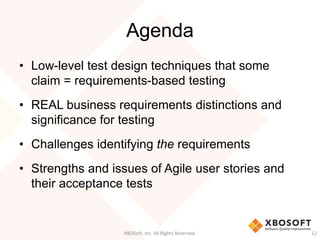
• Low-level test design techniques that some
claim = requirements-based testing
• REAL business requirements distinctions and
significance for testing
• Challenges identifying the requirements
• Strengths and issues of Agile user stories and
their acceptance tests
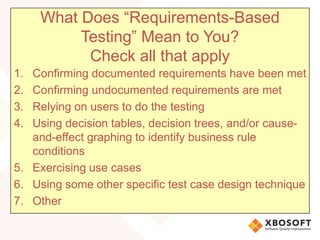
What Does “Requirements-Based
Testing” Mean to You?
Check all that apply
1. Confirming documented requirements have been met
2. Confirming undocumented requirements are met
3. Relying on users to do the testing
4. Using decision tables, decision trees, and/or cause-
and-effect graphing to identify business rule
conditions
5. Exercising use cases
6. Using some other specific test case design technique
7. Other
Pitfall:
Gurus Equate RBT with Particular
(Low-Level) Techniques
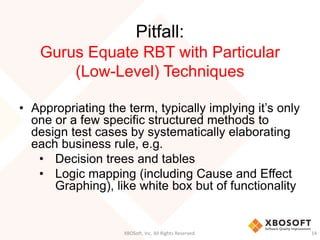
• Appropriating the term, typically implying it’s only
one or a few specific structured methods to
design test cases by systematically elaborating
each business rule, e.g.
• Decision trees and tables
• Logic mapping (including Cause and Effect
Graphing), like white box but of functionality
XBOSoft, Inc. All Rights Reserved. 14
Pitfall (continued)
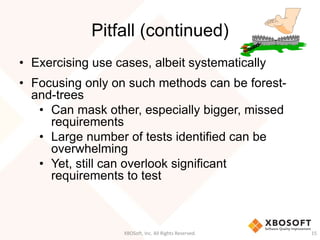
• Exercising use cases, albeit systematically
• Focusing only on such methods can be forest-
and-trees
• Can mask other, especially bigger, missed
requirements
• Large number of tests identified can be
overwhelming
• Yet, still can overlook significant
requirements to test
XBOSoft, Inc. All Rights Reserved. 15
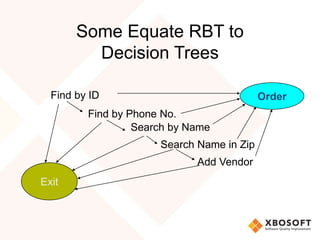
Some Equate RBT to
Decision Trees
Find by ID Order
Exit
Find by Phone No.
Search by Name
Search Name in Zip
Add Vendor
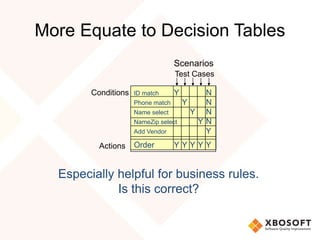
More Equate to Decision Tables
Especially helpful for business rules.
Is this correct?
Conditions
Actions
Test Cases
Scenarios
ID match Y N
Phone match Y N
Name select Y N
NameZip select Y N
Add Vendor Y
Order Y Y Y Y Y
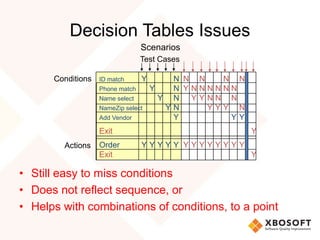
Decision Tables Issues
• Still easy to miss conditions
• Does not reflect sequence, or
• Helps with combinations of conditions, to a point
Conditions
Actions
Test Cases
Scenarios
ID match Y N N N N N
Phone match Y N Y N N N N N N
Name select Y N Y Y N N N
NameZip select Y N Y Y Y N
Add Vendor Y Y Y
Exit Y
Order Y Y Y Y Y Y Y Y Y Y Y Y Y
Exit Y
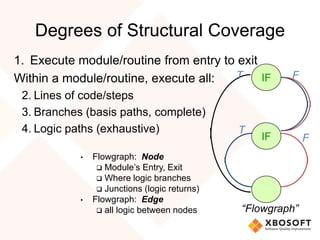
Degrees of Structural Coverage
1. Execute module/routine from entry to exit
Within a module/routine, execute all:
2. Lines of code/steps
3. Branches (basis paths, complete)
4. Logic paths (exhaustive)
• Flowgraph: Node
 Module’s Entry, Exit
 Where logic branches
 Junctions (logic returns)
• Flowgraph: Edge
 all logic between nodes
IF
IF
T F
T
F
“Flowgraph”
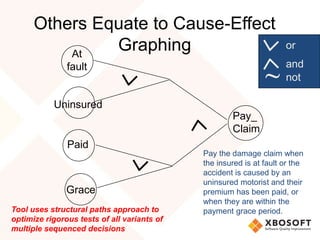
Others Equate to Cause-Effect
Graphing
Paid
Grace
At
fault
Uninsured
Pay_
Claim
or
and
~ not
Pay the damage claim when
the insured is at fault or the
accident is caused by an
uninsured motorist and their
premium has been paid, or
when they are within the
payment grace period.Tool uses structural paths approach to
optimize rigorous tests of all variants of
multiple sequenced decisions
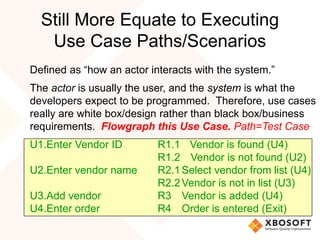
Still More Equate to Executing
Use Case Paths/Scenarios
Defined as “how an actor interacts with the system.”
The actor is usually the user, and the system is what the
developers expect to be programmed. Therefore, use cases
really are white box/design rather than black box/business
requirements. Flowgraph this Use Case. Path=Test Case
U1.Enter Vendor ID R1.1 Vendor is found (U4)
R1.2 Vendor is not found (U2)
U2.Enter vendor name R2.1Select vendor from list (U4)
R2.2Vendor is not in list (U3)
U3.Add vendor R3 Vendor is added (U4)
U4.Enter order R4 Order is entered (Exit)
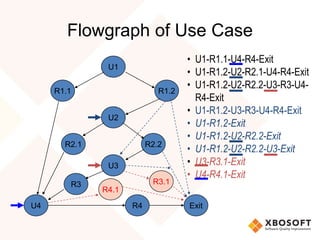
Flowgraph of Use Case
U1
R2.2
Exit
U3
R3
R1.2R1.1
U4
R2.1
U2
R4
• U1-R1.1-U4-R4-Exit
• U1-R1.2-U2-R2.1-U4-R4-Exit
• U1-R1.2-U2-R2.2-U3-R3-U4-
R4-Exit
• U1-R1.2-U3-R3-U4-R4-Exit
• U1-R1.2-Exit
• U1-R1.2-U2-R2.2-Exit
• U1-R1.2-U2-R2.2-U3-Exit
• U3-R3.1-Exit
• U4-R4.1-Exit
R3.1
R4.1
Equating to Any Specific (Typically
Business Rule-Oriented) Technique
• Can’t be right—excludes requirements and/or tests
identified by other claimed techniques
• Does not address other types of requirements
– Functionality
– Calculations, formulas, algorithms
– Data variants and database structure
– Quality factor “-ilities,” e.g., usability, security,
performance, reliability, maintainability, etc.
• Irrelevant for overlooked requirements
XBOSoft, Inc. All Rights Reserved. 23
Pitfall:
RBTs Are Only as Good as the
Requirements
• Most organizations’ aren’t very good – unclear, wrong,
incomplete – and are actually even worse than realized
because most miss REAL requirements
• The REAL requirements aren’t what you happened to write
down, they’re what you ought to have known about and
captured so they aren’t forgotten, including things like
quality factors and performance levels.
• Most of what people call “requirements” actually are design.
Design doesn’t have to be engineering or technical. A
product or system one intends to create is a design, albeit
high-level.
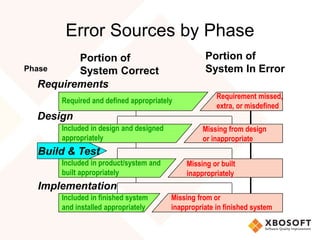
Error Sources by Phase
Portion of
System Correct
Portion of
System In ErrorPhase
Requirement missed,
extra, or misdefined
Requirements
Required and defined appropriately
Included in design and designed
appropriately
Design
Included in product/system and
built appropriately
Build & Test
Included in finished system
and installed appropriately
Implementation
Missing from design
or inappropriate
Missing or built
inappropriately
Missing from or
inappropriate in finished system
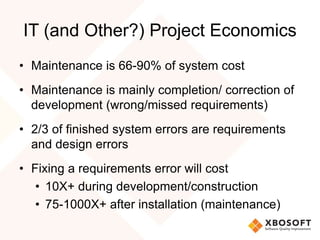
IT (and Other?) Project Economics
• Maintenance is 66-90% of system cost
• Maintenance is mainly completion/ correction of
development (wrong/missed requirements)
• 2/3 of finished system errors are requirements
and design errors
• Fixing a requirements error will cost
• 10X+ during development/construction
• 75-1000X+ after installation (maintenance)
Do your organization’s routine
measures show these effects?
What’s the relevance to
requirements-based tests?
XBOSoft, Inc. All Rights Reserved. 27
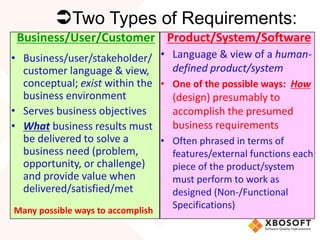
Two Types of Requirements:
Business/User/Customer Product/System/Software
• Business/user/stakeholder/
customer language & view,
conceptual; exist within the
business environment
• Serves business objectives
• What business results must
be delivered to solve a
business need (problem,
opportunity, or challenge)
and provide value when
delivered/satisfied/met
• Language & view of a human-
defined product/system
• One of the possible ways: How
(design) presumably to
accomplish the presumed
business requirements
• Often phrased in terms of
features/external functions each
piece of the product/system
must perform to work as
designed (Non-/Functional
Specifications)Many possible ways to accomplish
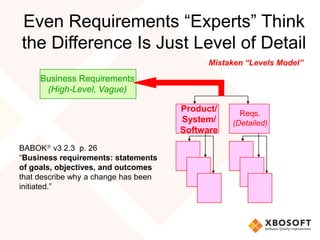
Even Requirements “Experts” Think
the Difference Is Just Level of Detail
Business Requirements
(High-Level, Vague)
Product/
System/
Software
Reqs.
(Detailed)
BABOK v3 2.3 p. 26
“Business requirements: statements
of goals, objectives, and outcomes
that describe why a change has been
initiated.”
Mistaken “Levels Model”
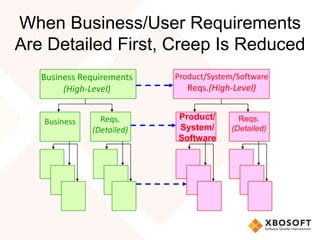
When Business/User Requirements
Are Detailed First, Creep Is Reduced
Business Requirements
(High-Level)
Business
Product/System/Software
Reqs.(High-Level)
Reqs.
(Detailed)
Reqs.
(Detailed)
Product/
System/
Software
Requirements Overview
Stakeholders
Business needs,
problems, value
Discovery
Analysis
High-Level & Detailed
REAL Business/
Stakeholder Requirements
Deliverable Whats  Value
Product/System
/ Software
Requirements
Features Hows
Respond to
Functional Requirements
Use Cases
Software Requirements Specifications
[Non-Functional Requirements]
Quality Factors, Attributes, ‘Ilities’
(Supplemental Specifications)
User/
(Usage)
High-Level
Detailed
Technical/
Engineering
Design
Code
Tests Based on Product/System/
Software Features/Requirements
• What’s usually meant by “requirements”
• Necessary but not sufficient
• Can pass even though product is not right
XBOSoft, Inc. All Rights Reserved. 32
“Conventional We’s Dumb”
More Effective Tests Are Based on
REAL Business Requirements
• Demonstrate that the
• Product/system/software how’s
• Satisfy the REAL business requirements
deliverable what’s
• And thereby provide REAL value by
achieving objectives
XBOSoft, Inc. All Rights Reserved. 33
“Unconventional Wisdom”
Pitfall:
Just User Story Requirements
and Their Acceptance Test
• Assuming all that’s needed is writing user
stories and acceptance tests for them
• User story brevity means lots of requirements content
may be taken for granted or simply overlooked
• Ditto for user story acceptance criteria/tests, easily not
as accurate or thorough as assumed
• Several common Agile dynamics can cause user story
requirements content to deteriorate
• Consider effects of discarding
• And…
Requirements in Agile Are
Generally Considered User Stories
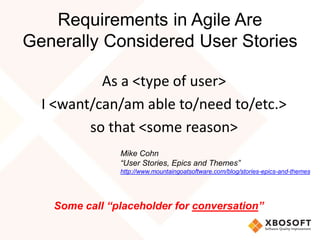
As a <type of user>
I <want/can/am able to/need to/etc.>
so that <some reason>
Mike Cohn
“User Stories, Epics and Themes”
http://www.mountaingoatsoftware.com/blog/stories-epics-and-themes
Some call “placeholder for conversation”
User Stories Theory
Stakeholders
Business needs,
problems, value
Discovery
Analysis
High-Level & Detailed
REAL Business/
Stakeholder Requirements
Deliverable Whats  Value
Product/System
/ Software
Requirements
Features Hows
Respond to
Functional Requirements
Use Cases
Software Requirements Specifications
[Non-Functional Requirements]
Quality Factors, Attributes, ‘-ilities’
(Supplemental Specifications)
User/
(Usage)
High-Level
Detailed
Technical/
Engineering
Design
Code
User
Stories
C
O
N
V
E
R
S
A
T
I
O
N
S
User Stories Actually Are a Bit
More
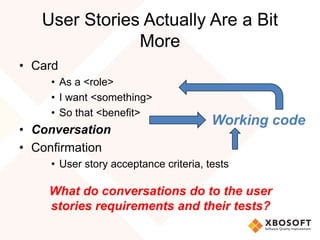
• Card
• As a <role>
• I want <something>
• So that <benefit>
• Conversation
• Confirmation
• User story acceptance criteria, tests
What do conversations do to the user
stories requirements and their tests?
Working code
Too Often User Stories Practice
Stakeholders
Business needs,
problems, value
Discovery
Analysis
High-Level & Detailed
REAL Business/
Stakeholder Requirements
Deliverable Whats  Value
Product/System
/ Software
Requirements
Features Hows
Respond to
Functional Requirements
Use Cases
Software Requirements Specifications
[Non-Functional Requirements]
Quality Factors, Attributes, ‘Ilities’
(Supplemental Specifications)
User/
(Usage)
High-Level
Detailed
Technical/
Engineering
Design
Code
User
Stories
Conver
sation
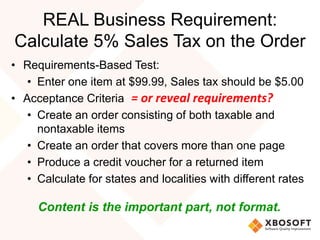
REAL Business Requirement:
Calculate 5% Sales Tax on the Order
• Requirements-Based Test:
• Enter one item at $99.99, Sales tax should be $5.00
• Acceptance Criteria
• Create an order consisting of both taxable and
nontaxable items
• Create an order that covers more than one page
• Produce a credit voucher for a returned item
• Calculate for states and localities with different rates
Content is the important part, not format.
= or reveal requirements?
You Should Be Able to:
• Recognize various test design techniques that
some equate with requirements-based testing
• Describe the significance of testing against
REAL business requirements vs. against
product/system/software requirements
• Critically evaluate effectiveness of tests based
on user stories and their acceptance criteria
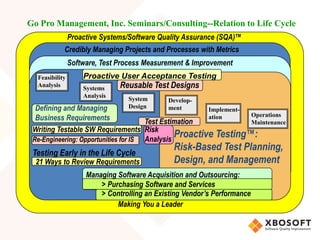
Go Pro Management, Inc. Seminars/Consulting--Relation to Life Cycle
Proactive Systems/Software Quality Assurance (SQA)™
Software, Test Process Measurement & Improvement
Feasibility
Analysis
Systems
Analysis
System
Design
Develop-
ment Implement-
ation Operations
Maintenance
Proactive Testing™:
Risk-Based Test Planning,
Design, and Management
Testing Early in the Life Cycle
Re-Engineering: Opportunities for IS
Credibly Managing Projects and Processes with Metrics
21 Ways to Review Requirements
Making You a Leader
Managing Software Acquisition and Outsourcing:
> Purchasing Software and Services
> Controlling an Existing Vendor’s Performance
Proactive User Acceptance Testing
Reusable Test Designs
Test Estimation
Risk
Analysis
Defining and Managing
Business Requirements
Writing Testable SW Requirements
Post your webinar questions on Twitter @XBOSoft
Registrants will receive an email with information on where to view the recording
and slides from today’s webinar.
Join us to keep updated on all our webinars, reports and white papers:
facebook.com/xbosoft
+xbosoft
linkedin.com/company/xbosoft
Check out our blog: http://xbosoft.com/software-quality-blog/
Download our free white papers: http://xbosoft.com/knowledge-center/
Email us with ideas for future webinars or questions regarding our services!
services@xbosoft.com
Thank you!
Q+A
www.xbosoft.com

Not Your Grandfather's Requirements-Based Testing Webinar – Robin Goldsmith, Philip Lew

  • 1.
    XBOSoft, Inc. AllRights Reserved. 1 Not Your Grandfather’s Requirements-Based Testing: Do Agile User Stories or ATDD Fix It? with Robin Goldsmith #TestCaseTips
  • 2.
    XBOSoft Dedicated to SoftwareQuality Improvement Founded in 2006 We speed products to market with our expert: • Software QA consulting • Software testing Global team with offices in San Francisco & Beijing “Thorough, accurate and fast” XBOSoft, Inc. All Rights Reserved. 2
  • 3.
    House Rules  Participantsother than the speakers are muted  Ask questions in the GoToWebinar control on the right side of your screen or through Twitter @XBOSoft  Questions may be asked throughout the webinar - we’ll try to answer them at the end  You’ll receive info on recording after the webinar Webinar Hashtag: #TestCaseTips XBOSoft, Inc. All Rights Reserved. 3
  • 4.
    Meet Our Speakers PhilipLew CEO and Founder, XBOSoft • Relevant specialties and passions o Software quality process, evaluation, measurement and improvement o Software quality in use / UX design o Mobile User Experience and usability o Cycling and travel XBOSoft, Inc. All Rights Reserved. 4 Rachel Geibig Marketing Manager, XBOSoft • Emails you about our industry hot topic webinars • Invites you to download our latest trends in software testing white papers XBOSoft Team
  • 5.
    Robin Goldsmith XBOSoft, Inc.All Rights Reserved. 5 Author of: • ArtechHouse book Discovering REAL Business Requirements for Software Project Success • Forthcoming book Cut Creep—Put Business Back in Business Analysis to Discover REAL Business Requirements for Agile, ATDD, and Other Projects • Numerous articles and featured presentations • The Proactive Testing™, Proactive SQA™, REAL ROI™, and Beyond the Textbook Software Acquisition™ methodologies • Subject expert on requirements and testing for TechTarget’s SearchSoftwareQuality.com, and subject expert/reviewer for the IIBA Business Analysis Body of Knowledge (BABOK v2) • Works directly with and trains business/systems professionals in quality and testing, requirements analysis, software acquisition, project management and leadership, metrics, ROI, and process improvement www.gopromanagement.com robin@gopromanagement.com
  • 6.
    http://psqtconference.com/ Keynote and FeaturedPresentations by World Renowned Quality Leaders and Experts Ed Adams CEO, Security Innova Jennifer Bonine VP of global delivery and solutions for tap|QA Isabel Evans Independent Consultant Philip Lew CEO, XBOSoft Robin Goldsmith International Institute for Software Testing
  • 7.
    XBOSoft, Inc. AllRights Reserved. 7 Bhushan Gupta, Gupta Consulting, LLC. Robin Goldsmith, Go Pro Management, Inc. Johanna Rothman, Rothman Consulting Group, Inc. Peter Khoury, Magnetic Speaking Rex Black, RBCS Darlene Greene, Consultant PNSQC 2016 Keynote and Invited Speakers www.PNS.org
  • 8.
    1. Take your requirements 2.Test that each one has been satisfied correctly 3. Duh! “In grandfather’s day, requirements- based tests were no big deal.”
  • 9.
    Why We’re Here XBOSoft,Inc. All Rights Reserved. 9 Requirements-based tests • Are fundamental • Seem obvious Except 1. What requirements? 2. What are requirements? 3. How to identify tests based on requirements?
  • 10.
    Objectives You should beable to: • Recognize various test design techniques that some equate with requirements-based testing • Describe the significance of testing against REAL business requirements vs. against product/system/software requirements • Critically evaluate effectiveness of tests based on user stories and their acceptance criteria
  • 11.
    Is one ofyour issues testing that requirements are met? Awareness is a start. XBOSoft, Inc. All Rights Reserved. 11
  • 12.
    Agenda XBOSoft, Inc. AllRights Reserved. 12 • Low-level test design techniques that some claim = requirements-based testing • REAL business requirements distinctions and significance for testing • Challenges identifying the requirements • Strengths and issues of Agile user stories and their acceptance tests
  • 13.
    What Does “Requirements-Based Testing”Mean to You? Check all that apply 1. Confirming documented requirements have been met 2. Confirming undocumented requirements are met 3. Relying on users to do the testing 4. Using decision tables, decision trees, and/or cause- and-effect graphing to identify business rule conditions 5. Exercising use cases 6. Using some other specific test case design technique 7. Other
  • 14.
    Pitfall: Gurus Equate RBTwith Particular (Low-Level) Techniques • Appropriating the term, typically implying it’s only one or a few specific structured methods to design test cases by systematically elaborating each business rule, e.g. • Decision trees and tables • Logic mapping (including Cause and Effect Graphing), like white box but of functionality XBOSoft, Inc. All Rights Reserved. 14
  • 15.
    Pitfall (continued) • Exercisinguse cases, albeit systematically • Focusing only on such methods can be forest- and-trees • Can mask other, especially bigger, missed requirements • Large number of tests identified can be overwhelming • Yet, still can overlook significant requirements to test XBOSoft, Inc. All Rights Reserved. 15
  • 16.
    Some Equate RBTto Decision Trees Find by ID Order Exit Find by Phone No. Search by Name Search Name in Zip Add Vendor
  • 17.
    More Equate toDecision Tables Especially helpful for business rules. Is this correct? Conditions Actions Test Cases Scenarios ID match Y N Phone match Y N Name select Y N NameZip select Y N Add Vendor Y Order Y Y Y Y Y
  • 18.
    Decision Tables Issues •Still easy to miss conditions • Does not reflect sequence, or • Helps with combinations of conditions, to a point Conditions Actions Test Cases Scenarios ID match Y N N N N N Phone match Y N Y N N N N N N Name select Y N Y Y N N N NameZip select Y N Y Y Y N Add Vendor Y Y Y Exit Y Order Y Y Y Y Y Y Y Y Y Y Y Y Y Exit Y
  • 19.
    Degrees of StructuralCoverage 1. Execute module/routine from entry to exit Within a module/routine, execute all: 2. Lines of code/steps 3. Branches (basis paths, complete) 4. Logic paths (exhaustive) • Flowgraph: Node  Module’s Entry, Exit  Where logic branches  Junctions (logic returns) • Flowgraph: Edge  all logic between nodes IF IF T F T F “Flowgraph”
  • 20.
    Others Equate toCause-Effect Graphing Paid Grace At fault Uninsured Pay_ Claim or and ~ not Pay the damage claim when the insured is at fault or the accident is caused by an uninsured motorist and their premium has been paid, or when they are within the payment grace period.Tool uses structural paths approach to optimize rigorous tests of all variants of multiple sequenced decisions
  • 21.
    Still More Equateto Executing Use Case Paths/Scenarios Defined as “how an actor interacts with the system.” The actor is usually the user, and the system is what the developers expect to be programmed. Therefore, use cases really are white box/design rather than black box/business requirements. Flowgraph this Use Case. Path=Test Case U1.Enter Vendor ID R1.1 Vendor is found (U4) R1.2 Vendor is not found (U2) U2.Enter vendor name R2.1Select vendor from list (U4) R2.2Vendor is not in list (U3) U3.Add vendor R3 Vendor is added (U4) U4.Enter order R4 Order is entered (Exit)
  • 22.
    Flowgraph of UseCase U1 R2.2 Exit U3 R3 R1.2R1.1 U4 R2.1 U2 R4 • U1-R1.1-U4-R4-Exit • U1-R1.2-U2-R2.1-U4-R4-Exit • U1-R1.2-U2-R2.2-U3-R3-U4- R4-Exit • U1-R1.2-U3-R3-U4-R4-Exit • U1-R1.2-Exit • U1-R1.2-U2-R2.2-Exit • U1-R1.2-U2-R2.2-U3-Exit • U3-R3.1-Exit • U4-R4.1-Exit R3.1 R4.1
  • 23.
    Equating to AnySpecific (Typically Business Rule-Oriented) Technique • Can’t be right—excludes requirements and/or tests identified by other claimed techniques • Does not address other types of requirements – Functionality – Calculations, formulas, algorithms – Data variants and database structure – Quality factor “-ilities,” e.g., usability, security, performance, reliability, maintainability, etc. • Irrelevant for overlooked requirements XBOSoft, Inc. All Rights Reserved. 23
  • 24.
    Pitfall: RBTs Are Onlyas Good as the Requirements • Most organizations’ aren’t very good – unclear, wrong, incomplete – and are actually even worse than realized because most miss REAL requirements • The REAL requirements aren’t what you happened to write down, they’re what you ought to have known about and captured so they aren’t forgotten, including things like quality factors and performance levels. • Most of what people call “requirements” actually are design. Design doesn’t have to be engineering or technical. A product or system one intends to create is a design, albeit high-level.
  • 25.
    Error Sources byPhase Portion of System Correct Portion of System In ErrorPhase Requirement missed, extra, or misdefined Requirements Required and defined appropriately Included in design and designed appropriately Design Included in product/system and built appropriately Build & Test Included in finished system and installed appropriately Implementation Missing from design or inappropriate Missing or built inappropriately Missing from or inappropriate in finished system
  • 26.
    IT (and Other?)Project Economics • Maintenance is 66-90% of system cost • Maintenance is mainly completion/ correction of development (wrong/missed requirements) • 2/3 of finished system errors are requirements and design errors • Fixing a requirements error will cost • 10X+ during development/construction • 75-1000X+ after installation (maintenance)
  • 27.
    Do your organization’sroutine measures show these effects? What’s the relevance to requirements-based tests? XBOSoft, Inc. All Rights Reserved. 27
  • 28.
    Two Types ofRequirements: Business/User/Customer Product/System/Software • Business/user/stakeholder/ customer language & view, conceptual; exist within the business environment • Serves business objectives • What business results must be delivered to solve a business need (problem, opportunity, or challenge) and provide value when delivered/satisfied/met • Language & view of a human- defined product/system • One of the possible ways: How (design) presumably to accomplish the presumed business requirements • Often phrased in terms of features/external functions each piece of the product/system must perform to work as designed (Non-/Functional Specifications)Many possible ways to accomplish
  • 29.
    Even Requirements “Experts”Think the Difference Is Just Level of Detail Business Requirements (High-Level, Vague) Product/ System/ Software Reqs. (Detailed) BABOK v3 2.3 p. 26 “Business requirements: statements of goals, objectives, and outcomes that describe why a change has been initiated.” Mistaken “Levels Model”
  • 30.
    When Business/User Requirements AreDetailed First, Creep Is Reduced Business Requirements (High-Level) Business Product/System/Software Reqs.(High-Level) Reqs. (Detailed) Reqs. (Detailed) Product/ System/ Software
  • 31.
    Requirements Overview Stakeholders Business needs, problems,value Discovery Analysis High-Level & Detailed REAL Business/ Stakeholder Requirements Deliverable Whats  Value Product/System / Software Requirements Features Hows Respond to Functional Requirements Use Cases Software Requirements Specifications [Non-Functional Requirements] Quality Factors, Attributes, ‘Ilities’ (Supplemental Specifications) User/ (Usage) High-Level Detailed Technical/ Engineering Design Code
  • 32.
    Tests Based onProduct/System/ Software Features/Requirements • What’s usually meant by “requirements” • Necessary but not sufficient • Can pass even though product is not right XBOSoft, Inc. All Rights Reserved. 32 “Conventional We’s Dumb”
  • 33.
    More Effective TestsAre Based on REAL Business Requirements • Demonstrate that the • Product/system/software how’s • Satisfy the REAL business requirements deliverable what’s • And thereby provide REAL value by achieving objectives XBOSoft, Inc. All Rights Reserved. 33 “Unconventional Wisdom”
  • 34.
    Pitfall: Just User StoryRequirements and Their Acceptance Test • Assuming all that’s needed is writing user stories and acceptance tests for them • User story brevity means lots of requirements content may be taken for granted or simply overlooked • Ditto for user story acceptance criteria/tests, easily not as accurate or thorough as assumed • Several common Agile dynamics can cause user story requirements content to deteriorate • Consider effects of discarding • And…
  • 35.
    Requirements in AgileAre Generally Considered User Stories As a <type of user> I <want/can/am able to/need to/etc.> so that <some reason> Mike Cohn “User Stories, Epics and Themes” http://www.mountaingoatsoftware.com/blog/stories-epics-and-themes Some call “placeholder for conversation”
  • 36.
    User Stories Theory Stakeholders Businessneeds, problems, value Discovery Analysis High-Level & Detailed REAL Business/ Stakeholder Requirements Deliverable Whats  Value Product/System / Software Requirements Features Hows Respond to Functional Requirements Use Cases Software Requirements Specifications [Non-Functional Requirements] Quality Factors, Attributes, ‘-ilities’ (Supplemental Specifications) User/ (Usage) High-Level Detailed Technical/ Engineering Design Code User Stories C O N V E R S A T I O N S
  • 37.
    User Stories ActuallyAre a Bit More • Card • As a <role> • I want <something> • So that <benefit> • Conversation • Confirmation • User story acceptance criteria, tests What do conversations do to the user stories requirements and their tests? Working code
  • 38.
    Too Often UserStories Practice Stakeholders Business needs, problems, value Discovery Analysis High-Level & Detailed REAL Business/ Stakeholder Requirements Deliverable Whats  Value Product/System / Software Requirements Features Hows Respond to Functional Requirements Use Cases Software Requirements Specifications [Non-Functional Requirements] Quality Factors, Attributes, ‘Ilities’ (Supplemental Specifications) User/ (Usage) High-Level Detailed Technical/ Engineering Design Code User Stories Conver sation
  • 39.
    REAL Business Requirement: Calculate5% Sales Tax on the Order • Requirements-Based Test: • Enter one item at $99.99, Sales tax should be $5.00 • Acceptance Criteria • Create an order consisting of both taxable and nontaxable items • Create an order that covers more than one page • Produce a credit voucher for a returned item • Calculate for states and localities with different rates Content is the important part, not format. = or reveal requirements?
  • 40.
    You Should BeAble to: • Recognize various test design techniques that some equate with requirements-based testing • Describe the significance of testing against REAL business requirements vs. against product/system/software requirements • Critically evaluate effectiveness of tests based on user stories and their acceptance criteria
  • 41.
    Go Pro Management,Inc. Seminars/Consulting--Relation to Life Cycle Proactive Systems/Software Quality Assurance (SQA)™ Software, Test Process Measurement & Improvement Feasibility Analysis Systems Analysis System Design Develop- ment Implement- ation Operations Maintenance Proactive Testing™: Risk-Based Test Planning, Design, and Management Testing Early in the Life Cycle Re-Engineering: Opportunities for IS Credibly Managing Projects and Processes with Metrics 21 Ways to Review Requirements Making You a Leader Managing Software Acquisition and Outsourcing: > Purchasing Software and Services > Controlling an Existing Vendor’s Performance Proactive User Acceptance Testing Reusable Test Designs Test Estimation Risk Analysis Defining and Managing Business Requirements Writing Testable SW Requirements
  • 42.
    Post your webinarquestions on Twitter @XBOSoft Registrants will receive an email with information on where to view the recording and slides from today’s webinar. Join us to keep updated on all our webinars, reports and white papers: facebook.com/xbosoft +xbosoft linkedin.com/company/xbosoft Check out our blog: http://xbosoft.com/software-quality-blog/ Download our free white papers: http://xbosoft.com/knowledge-center/ Email us with ideas for future webinars or questions regarding our services! services@xbosoft.com Thank you! Q+A www.xbosoft.com