




Anatomy of KnowledgeA Grounded Theory Investigation Towards a Knowledge Emergence Model for High-Tech Organizationsby Debra A JasinskiAugust 2, 2005
V2 - 4/15/2010Copyright 2005@DAJasinski2OverviewKnowledge EmergenceThe processes, conditions, interactions, and influences surrounding the creation, conversion, sharing, transfer, and use of knowledge in organizational settings (Kakihara & Sorensen, 2002; Nonaka et al., 2001). Knowledge Emergence EnvironmentThe physical and social aspects of formal and informal systems conducive to knowledge creation and transfer (Kakihara & Sorensen, 2002; Nonaka et al., 2001).
V2 - 4/15/2010Copyright 2005@DAJasinski3OverviewJobs are becoming more information intensiveOrganizations are becoming repositories of knowledge (collective knowledge)Problems are too complex – must be solved by teamsTeams need to be effective, high performing, &  must minimize duplication of effortThe key to all of these issues is effective Knowledge Emergence
V2 - 4/15/2010Copyright 2005@DAJasinski4Background of ProblemTacit vs. Explicit KnowledgePolanyi (1958)Tacit knowledge is subconscious/hard to verbalizeForms the basis of explicit knowledgeNontransferable
V2 - 4/15/2010Copyright 2005@DAJasinski5Background of ProblemIntellectual Capital & Knowledge ManagementSveiby (1987)Value of knowledgeCompetitive advantage of knowledgeEmployees whose value lies more in what they know than in their skillsTechniques for capturing and controlling knowledge
V2 - 4/15/2010Copyright 2005@DAJasinski6Background of ProblemKnowledge Cycle & EnvironmentNonaka, Takeuchi, Nishiguchi (1995)Explicit to Tacit  to Explicit knowledge transferSECI: Socialization, Externalization, Combination, InternalizationEffect of work environment on knowledge cycle – “ba”
V2 - 4/15/2010Copyright 2005@DAJasinski7Background of ProblemCommunities of PracticeWenger (1996)Spontaneity & passion from common interestNo management influenceNo competitive influences
V2 - 4/15/2010Copyright 2005@DAJasinski8Problem StatementThere is no single, comprehensive model or instrument by which leaders and managers can establish, assess and/or develop high-tech knowledge emergence environments appropriate to their particular needsLeaders/managers:Must wade through collections of theories, approaches, tools, and barriers From which they each must distill a method To establish, assess and/or develop their KE environmentsBecause no knowledge emergence environment model or instruments currently exists
V2 - 4/15/2010Copyright 2005@DAJasinski9Purpose of the StudyThe objective of this studyThe development of a high-tech KE model that will provide a systemic and comprehensive perspective from which to establish, assess and/or develop effective knowledge emergence environments.
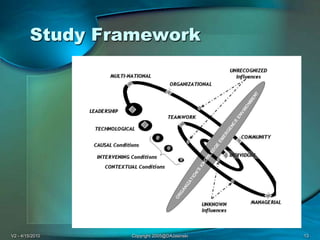
V2 - 4/15/2010Copyright 2005@DAJasinski10Significance of the StudyDiffered from previous research in 3 aspectsThe study focused exclusively on high-tech organizations. The researcher examined the entire spectrum of the knowledge emergence phenomenon as opposed to the narrow focus of many previous studies. Strauss and Corbin’s conditional matrix (1990) formed the framework for the study, assuring comprehensive coverage of the phenomenon from the perspectives of the individual, team, management, leadership and the intervening organizations structures.
V2 - 4/15/2010Copyright 2005@DAJasinski11Significance to LeadershipCurrentLarge set of loosely related and simplified or generic proposals (Neef, 1999). IssueNo comprehensive view of their knowledge emergence needs in order to choose between the abundance of potential solutions presented. SignificanceProvide leaders and managers with the ability to correlate knowledge attributes and methods with the existing processes and structures of their corporate environment.
V2 - 4/15/2010Copyright 2005@DAJasinski12Theoretical FrameworkIndividualsTeamsManagementCommunitiesOrganizationsMultinational ElementsLeadershipTechnology
V2 - 4/15/2010Copyright 2005@DAJasinski13Study Framework
V2 - 4/15/2010Copyright 2005@DAJasinski14Sampling ProcedureConvenience SamplingSnowball SamplingPurposive Sampling Theoretical evolution and data saturation determined the final sample size of the study
V2 - 4/15/2010Copyright 2005@DAJasinski15Data CollectionData collection and analysis are not separate functions in grounded theory research Interviewing is the predominate form of grounded theory data collection (Auerbach & Silverstein, 2003; Glaser, 2004; Strauss & Corbin, 1990, 1998).
V2 - 4/15/2010Copyright 2005@DAJasinski16Data AnalysisA combination of open, axial, selective, and process coding Formulation and testing of provisional hypothesis and theoriesStudy the structure of each category, the “conditional context in which a category (phenomenon) is situated” (Strauss & Corbin, 1998, p. 123).Conditions: casual, intervening and contextual.
V2 - 4/15/2010Copyright 2005@DAJasinski17Demographic DataParticipant demographicsPersonal AgeGenderEducation level Professional Position in the companyNumber of years of high-tech experienceNumber of years at the companyCorporate demographics.
V2 - 4/15/2010Copyright 2005@DAJasinski18Presentation & Analysis of DataObservations about the knowledge emergence environmentsInfluence of leadershipInfluence of managementInfluence of teamsinfluence of individualsInfluence of the organizational structureInfluence of communitiesInfluence of multi-national elementsInfluence of technologyOther influences.
V2 - 4/15/2010Copyright 2005@DAJasinski19ConclusionsTwo categories of themesThe combined significance of each of the framework elements to knowledge emergenceThe common characteristics of each element
V2 - 4/15/2010Copyright 2005@DAJasinski20Theme 1Management was the primary influence on knowledge emergence in large organizations.The attitudes and skills of the manager were the primary elements in the effectiveness of knowledge emergence processes.Management as an interpretor Create clarity of goals per Bailey and Clark (2001). Formal leaders were far removed from the main body of employeesManagers controlled the goals, success criteria, rewards. Knowledge workers must be rewarded for sharing knowledge (Kyriakidou, 2004)
V2 - 4/15/2010Copyright 2005@DAJasinski21Theme 2In small organizations, the formal leadership was the primary source of knowledge emergence influenceLeader drove or formulated the organization’s culture (De Long & Davenport, 2003; De Long & Fahey, 2000) An organization’s culture was a reflection of its leadership (Corno et al., 1999)The line between formal leadership and management was nearly indistinguishable in small organizationsThe participants spoke of leaders and managers interchangeablyFormal leaders were very active and visible within the organizationVisibility may have accounted for the close association in the small organizations Close association might also have assured that management mimicked the knowledge emergence values of the leadership
V2 - 4/15/2010Copyright 2005@DAJasinski22Theme 3All significant knowledge emergence work occurred in the team environmentReasonsThe complexity of the high-tech environmentThe nature of the problems addressed required a large variety of information Success required more knowledge than any one person could provideIt took a team to fully develop an individual’s ideaInteractionsCombination process -- the integration of knowledge from multiple source to create new knowledge (Nonaka et al.’s, 1998, 2000) The synergy that can happen in teamsLack of political interference when a group works together as equals
V2 - 4/15/2010Copyright 2005@DAJasinski23Theme 4Individuals and Organizational Structures were important contributors to knowledge emergence effectivenessKnowledge exists in the mind of the individualIn the work environment, value was not realized until the knowledge was shared and transformed into a work product“Knowledge is not produced by passively perceiving individuals, but by interacting social groups engaged in particular activities” (Arthur & Parker, 2002, p. 38)The organizational structure was the physical manifestation of the knowledge emergence values of the companyHiring policies, reward and recognition policies, communication policies, departmentalization, and financial accounting all reflect the importance that the company placed on knowledge emergence effectivenessOrganizational structures could not inspire creativity or innovation
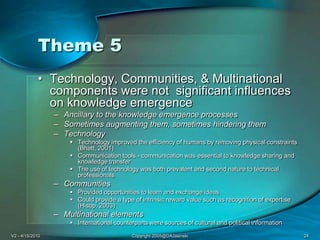
V2 - 4/15/2010Copyright 2005@DAJasinski24Theme 5Technology, Communities, & Multinational components were not  significant influences on knowledge emergenceAncillary to the knowledge emergence processesSometimes augmenting them, sometimes hindering themTechnologyTechnology improved the efficiency of humans by removing physical constraints (Bhatt, 2001)Communication tools - communication was essential to knowledge sharing and knowledge transferThe use of technology was both prevalent and second nature to technical professionalsCommunitiesProvided opportunities to learn and exchange ideas Could provide a type of intrinsic reward value such as recognition of expertise (Hisop, 2003)Multinational elements International counterparts were sources of cultural and political information
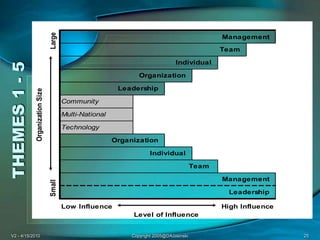
V2 - 4/15/2010Copyright 2005@DAJasinski25THEMES 1 - 5
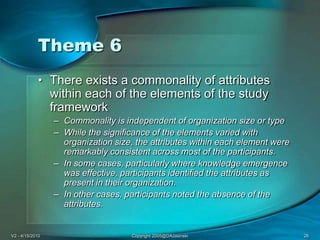
V2 - 4/15/2010Copyright 2005@DAJasinski26Theme 6There exists a commonality of attributes within each of the elements of the study frameworkCommonality is independent of organization size or typeWhile the significance of the elements varied with organization size, the attributes within each element were remarkably consistent across most of the participants. In some cases, particularly where knowledge emergence was effective, participants identified the attributes as present in their organization. In other cases, participants noted the absence of the attributes.
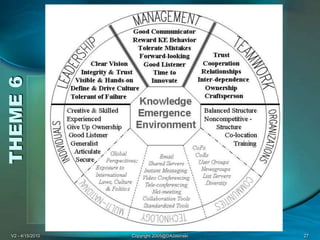
V2 - 4/15/2010Copyright 2005@DAJasinski27THEME 6
V2 - 4/15/2010Copyright 2005@DAJasinski28LimitationsThe Participants The ScopeThe Subjective Nature of the knowledge emergence process
V2 - 4/15/2010Copyright 2005@DAJasinski29Conclusions5 Themes evolved from study frameworkOrganization size was the primary data differentiatorCommonality of attributes is the 6th ThemeAttributes were independent of organization size.
V2 - 4/15/2010Copyright 2005@DAJasinski30Leadership ImplicationsWhen knowledge emergence is critical or important to the success of the companyKnowledge emergence values were an integral part of the corporate visionKnowledge emergence behaviors were evident throughout the companyIn small organizations, knowledge emergence values emanated directly from the formal leadership and were mimicked by managementIn large organizations, the values most directly felt by knowledge workers were those of managementIf the manager supported knowledge emergence behaviors, then creativity and innovation could flourishIf the manager was primarily task-focused, then knowledge emergence was severely hinderedLeaders assured that knowledge work was team-oriented
V2 - 4/15/2010Copyright 2005@DAJasinski31Leadership ImplicationsLeaders must determine how important knowledge emergence is to the long-term success of their organizationLeaders must assure that the appropriate level of knowledge emergence values are an integral component of the corporate valuesLeaders must assure that the organizational structure mirrors those values, most critically at the managerial levelLeaders must assure that the organization supports a team-oriented structure for its knowledge work
V2 - 4/15/2010Copyright 2005@DAJasinski32RecommendationsExpanded beyond the United States to determine if the models hold true internationallyMid-sized organizations warrant a closer examinationA mixed quantitative/quantitative approach using the same framework Focus groups Two possible case studiesExamination of an effective knowledge emergence organization using the same framework encompassing a larger population of people from each framework elementA comparative study of an organization examining knowledge emergence effectiveness before and after application of the models developed in this study
V2 - 4/15/2010Copyright 2005@DAJasinski33SummaryThe findings provide high-tech leaders and manager with a familiar framework for addressing knowledge emergence in their organizationsFigure 2 serves as a guide for knowledge emergence in each area of focus based on organizational size and relative level of potential influenceFigure 3 provides a summary of common attributes for successful knowledge emergence organizations for each element of frameworkWith these two models, a leader can formulate a plan for developing the knowledge emergence effectiveness of their organization
V2 - 4/15/2010Copyright 2005@DAJasinski34ReferencesArthur, M., & Parker, P. (2002). Technology, community, and the practice of HRM. Human Resource Planning, 38 - 46. Auerbach, c., & Silverstein, L. (2003). Qualitative data. N.Y.: New York University Press. Bailey, C., & Clarke, M. (2001). Managing knowledge for personal and organisational benefit. Journal of Knowledge Management, 32, 58. Bhatt, G. (2001). Knowledge management in organizations: Examining the interaction between technologies, techniques and people. Journal of Knowledge Management, 5, 68-75. Corno, F., Reinmoeller, P., & Nonaka, I. (1999). Knowledge creation within industrial systems. Journal of Management & Governance, 3, 379.De Long, D. W., & Davenport, T. (2003). Better practices for retaining organizational knowledge: Lessons from the leading edge. Employment Relations Today, 30, 51.De Long, D. W., & Fahey, L. (2000). Diagnosing cultural barriers to knowledge management. The Academy of Management Executive, 14, 113.
V2 - 4/15/2010Copyright 2005@DAJasinski35ReferencesGlaser, B. (2002). Conceptualization: On theory and theorizing using grounded theory. International Journal of Qualitative Methods, 1, 1-32. Hisop, D. (2003). The complex relations between communities of practice and the implementation of technological innovations. International Journal of innovation management, 7, 163--188.Kakihara, M., & Sorensen, C. (2002). Exploring knowledge emergence: From chaos to organizational knowledge. Journal of Global Information Technology Management, 5, 48. Kyriakidou, O. (2004). Developing a knowledge sharing culture. Management Services, 48, 22-24. Neef, D. (1999). Making the case for knowledge management: the bigger picture. Management Decision, 37, 72-78. Nonaka, I., Konno, N., & Toyama, R. (2001). Emergence of "ba". In I. Nonaka & T. Nishiguchi (Eds.), Knowledge emergence: Social, technical and evolutionary dimensions of knowledge creation. N.Y.: Oxford University Press.
V2 - 4/15/2010Copyright 2005@DAJasinski36ReferencesNonaka, I., & Takeuchi, H. (1995). The knowledge-creating company: How Japanese companies create the dynamics of innovation. N.Y.: Oxford University Press. Polanyi, M. F. D. (1966). The tacit dimension. Glouchester, Ma.: Doubleday & Company, Inc. Strauss, A., & Corbin, J. (1990). Basics of qualitative research. Techniques and procedures for developing grounded theory. Thousand Oaks, Ca.: Sage Publications. Strauss, A., & Corbin, J. (1998). Basics of qualitative research. Techniques and procedures for developing grounded theory (2nd ed.). Thousand Oaks, Ca.: Sage Publications. Sveiby, K. E., & Lloyd, T. (1987). Managing know-how: Increase profits by harnessing the creativity in your company. London: Bloomsbury Publishing Limited. Wenger, E. (1996). Communities of practice: The social fabric of a learning organization. The Healthcare Forum Journal, 39, 20.
V2 - 4/15/2010Copyright 2005@DAJasinski37Thank-you

Anatomy Of Knowledge

  • 1.
    Anatomy of KnowledgeAGrounded Theory Investigation Towards a Knowledge Emergence Model for High-Tech Organizationsby Debra A JasinskiAugust 2, 2005
  • 2.
    V2 - 4/15/2010Copyright2005@DAJasinski2OverviewKnowledge EmergenceThe processes, conditions, interactions, and influences surrounding the creation, conversion, sharing, transfer, and use of knowledge in organizational settings (Kakihara & Sorensen, 2002; Nonaka et al., 2001). Knowledge Emergence EnvironmentThe physical and social aspects of formal and informal systems conducive to knowledge creation and transfer (Kakihara & Sorensen, 2002; Nonaka et al., 2001).
  • 3.
    V2 - 4/15/2010Copyright2005@DAJasinski3OverviewJobs are becoming more information intensiveOrganizations are becoming repositories of knowledge (collective knowledge)Problems are too complex – must be solved by teamsTeams need to be effective, high performing, & must minimize duplication of effortThe key to all of these issues is effective Knowledge Emergence
  • 4.
    V2 - 4/15/2010Copyright2005@DAJasinski4Background of ProblemTacit vs. Explicit KnowledgePolanyi (1958)Tacit knowledge is subconscious/hard to verbalizeForms the basis of explicit knowledgeNontransferable
  • 5.
    V2 - 4/15/2010Copyright2005@DAJasinski5Background of ProblemIntellectual Capital & Knowledge ManagementSveiby (1987)Value of knowledgeCompetitive advantage of knowledgeEmployees whose value lies more in what they know than in their skillsTechniques for capturing and controlling knowledge
  • 6.
    V2 - 4/15/2010Copyright2005@DAJasinski6Background of ProblemKnowledge Cycle & EnvironmentNonaka, Takeuchi, Nishiguchi (1995)Explicit to Tacit to Explicit knowledge transferSECI: Socialization, Externalization, Combination, InternalizationEffect of work environment on knowledge cycle – “ba”
  • 7.
    V2 - 4/15/2010Copyright2005@DAJasinski7Background of ProblemCommunities of PracticeWenger (1996)Spontaneity & passion from common interestNo management influenceNo competitive influences
  • 8.
    V2 - 4/15/2010Copyright2005@DAJasinski8Problem StatementThere is no single, comprehensive model or instrument by which leaders and managers can establish, assess and/or develop high-tech knowledge emergence environments appropriate to their particular needsLeaders/managers:Must wade through collections of theories, approaches, tools, and barriers From which they each must distill a method To establish, assess and/or develop their KE environmentsBecause no knowledge emergence environment model or instruments currently exists
  • 9.
    V2 - 4/15/2010Copyright2005@DAJasinski9Purpose of the StudyThe objective of this studyThe development of a high-tech KE model that will provide a systemic and comprehensive perspective from which to establish, assess and/or develop effective knowledge emergence environments.
  • 10.
    V2 - 4/15/2010Copyright2005@DAJasinski10Significance of the StudyDiffered from previous research in 3 aspectsThe study focused exclusively on high-tech organizations. The researcher examined the entire spectrum of the knowledge emergence phenomenon as opposed to the narrow focus of many previous studies. Strauss and Corbin’s conditional matrix (1990) formed the framework for the study, assuring comprehensive coverage of the phenomenon from the perspectives of the individual, team, management, leadership and the intervening organizations structures.
  • 11.
    V2 - 4/15/2010Copyright2005@DAJasinski11Significance to LeadershipCurrentLarge set of loosely related and simplified or generic proposals (Neef, 1999). IssueNo comprehensive view of their knowledge emergence needs in order to choose between the abundance of potential solutions presented. SignificanceProvide leaders and managers with the ability to correlate knowledge attributes and methods with the existing processes and structures of their corporate environment.
  • 12.
    V2 - 4/15/2010Copyright2005@DAJasinski12Theoretical FrameworkIndividualsTeamsManagementCommunitiesOrganizationsMultinational ElementsLeadershipTechnology
  • 13.
    V2 - 4/15/2010Copyright2005@DAJasinski13Study Framework
  • 14.
    V2 - 4/15/2010Copyright2005@DAJasinski14Sampling ProcedureConvenience SamplingSnowball SamplingPurposive Sampling Theoretical evolution and data saturation determined the final sample size of the study
  • 15.
    V2 - 4/15/2010Copyright2005@DAJasinski15Data CollectionData collection and analysis are not separate functions in grounded theory research Interviewing is the predominate form of grounded theory data collection (Auerbach & Silverstein, 2003; Glaser, 2004; Strauss & Corbin, 1990, 1998).
  • 16.
    V2 - 4/15/2010Copyright2005@DAJasinski16Data AnalysisA combination of open, axial, selective, and process coding Formulation and testing of provisional hypothesis and theoriesStudy the structure of each category, the “conditional context in which a category (phenomenon) is situated” (Strauss & Corbin, 1998, p. 123).Conditions: casual, intervening and contextual.
  • 17.
    V2 - 4/15/2010Copyright2005@DAJasinski17Demographic DataParticipant demographicsPersonal AgeGenderEducation level Professional Position in the companyNumber of years of high-tech experienceNumber of years at the companyCorporate demographics.
  • 18.
    V2 - 4/15/2010Copyright2005@DAJasinski18Presentation & Analysis of DataObservations about the knowledge emergence environmentsInfluence of leadershipInfluence of managementInfluence of teamsinfluence of individualsInfluence of the organizational structureInfluence of communitiesInfluence of multi-national elementsInfluence of technologyOther influences.
  • 19.
    V2 - 4/15/2010Copyright2005@DAJasinski19ConclusionsTwo categories of themesThe combined significance of each of the framework elements to knowledge emergenceThe common characteristics of each element
  • 20.
    V2 - 4/15/2010Copyright2005@DAJasinski20Theme 1Management was the primary influence on knowledge emergence in large organizations.The attitudes and skills of the manager were the primary elements in the effectiveness of knowledge emergence processes.Management as an interpretor Create clarity of goals per Bailey and Clark (2001). Formal leaders were far removed from the main body of employeesManagers controlled the goals, success criteria, rewards. Knowledge workers must be rewarded for sharing knowledge (Kyriakidou, 2004)
  • 21.
    V2 - 4/15/2010Copyright2005@DAJasinski21Theme 2In small organizations, the formal leadership was the primary source of knowledge emergence influenceLeader drove or formulated the organization’s culture (De Long & Davenport, 2003; De Long & Fahey, 2000) An organization’s culture was a reflection of its leadership (Corno et al., 1999)The line between formal leadership and management was nearly indistinguishable in small organizationsThe participants spoke of leaders and managers interchangeablyFormal leaders were very active and visible within the organizationVisibility may have accounted for the close association in the small organizations Close association might also have assured that management mimicked the knowledge emergence values of the leadership
  • 22.
    V2 - 4/15/2010Copyright2005@DAJasinski22Theme 3All significant knowledge emergence work occurred in the team environmentReasonsThe complexity of the high-tech environmentThe nature of the problems addressed required a large variety of information Success required more knowledge than any one person could provideIt took a team to fully develop an individual’s ideaInteractionsCombination process -- the integration of knowledge from multiple source to create new knowledge (Nonaka et al.’s, 1998, 2000) The synergy that can happen in teamsLack of political interference when a group works together as equals
  • 23.
    V2 - 4/15/2010Copyright2005@DAJasinski23Theme 4Individuals and Organizational Structures were important contributors to knowledge emergence effectivenessKnowledge exists in the mind of the individualIn the work environment, value was not realized until the knowledge was shared and transformed into a work product“Knowledge is not produced by passively perceiving individuals, but by interacting social groups engaged in particular activities” (Arthur & Parker, 2002, p. 38)The organizational structure was the physical manifestation of the knowledge emergence values of the companyHiring policies, reward and recognition policies, communication policies, departmentalization, and financial accounting all reflect the importance that the company placed on knowledge emergence effectivenessOrganizational structures could not inspire creativity or innovation
  • 24.
    V2 - 4/15/2010Copyright2005@DAJasinski24Theme 5Technology, Communities, & Multinational components were not significant influences on knowledge emergenceAncillary to the knowledge emergence processesSometimes augmenting them, sometimes hindering themTechnologyTechnology improved the efficiency of humans by removing physical constraints (Bhatt, 2001)Communication tools - communication was essential to knowledge sharing and knowledge transferThe use of technology was both prevalent and second nature to technical professionalsCommunitiesProvided opportunities to learn and exchange ideas Could provide a type of intrinsic reward value such as recognition of expertise (Hisop, 2003)Multinational elements International counterparts were sources of cultural and political information
  • 25.
    V2 - 4/15/2010Copyright2005@DAJasinski25THEMES 1 - 5
  • 26.
    V2 - 4/15/2010Copyright2005@DAJasinski26Theme 6There exists a commonality of attributes within each of the elements of the study frameworkCommonality is independent of organization size or typeWhile the significance of the elements varied with organization size, the attributes within each element were remarkably consistent across most of the participants. In some cases, particularly where knowledge emergence was effective, participants identified the attributes as present in their organization. In other cases, participants noted the absence of the attributes.
  • 27.
    V2 - 4/15/2010Copyright2005@DAJasinski27THEME 6
  • 28.
    V2 - 4/15/2010Copyright2005@DAJasinski28LimitationsThe Participants The ScopeThe Subjective Nature of the knowledge emergence process
  • 29.
    V2 - 4/15/2010Copyright2005@DAJasinski29Conclusions5 Themes evolved from study frameworkOrganization size was the primary data differentiatorCommonality of attributes is the 6th ThemeAttributes were independent of organization size.
  • 30.
    V2 - 4/15/2010Copyright2005@DAJasinski30Leadership ImplicationsWhen knowledge emergence is critical or important to the success of the companyKnowledge emergence values were an integral part of the corporate visionKnowledge emergence behaviors were evident throughout the companyIn small organizations, knowledge emergence values emanated directly from the formal leadership and were mimicked by managementIn large organizations, the values most directly felt by knowledge workers were those of managementIf the manager supported knowledge emergence behaviors, then creativity and innovation could flourishIf the manager was primarily task-focused, then knowledge emergence was severely hinderedLeaders assured that knowledge work was team-oriented
  • 31.
    V2 - 4/15/2010Copyright2005@DAJasinski31Leadership ImplicationsLeaders must determine how important knowledge emergence is to the long-term success of their organizationLeaders must assure that the appropriate level of knowledge emergence values are an integral component of the corporate valuesLeaders must assure that the organizational structure mirrors those values, most critically at the managerial levelLeaders must assure that the organization supports a team-oriented structure for its knowledge work
  • 32.
    V2 - 4/15/2010Copyright2005@DAJasinski32RecommendationsExpanded beyond the United States to determine if the models hold true internationallyMid-sized organizations warrant a closer examinationA mixed quantitative/quantitative approach using the same framework Focus groups Two possible case studiesExamination of an effective knowledge emergence organization using the same framework encompassing a larger population of people from each framework elementA comparative study of an organization examining knowledge emergence effectiveness before and after application of the models developed in this study
  • 33.
    V2 - 4/15/2010Copyright2005@DAJasinski33SummaryThe findings provide high-tech leaders and manager with a familiar framework for addressing knowledge emergence in their organizationsFigure 2 serves as a guide for knowledge emergence in each area of focus based on organizational size and relative level of potential influenceFigure 3 provides a summary of common attributes for successful knowledge emergence organizations for each element of frameworkWith these two models, a leader can formulate a plan for developing the knowledge emergence effectiveness of their organization
  • 34.
    V2 - 4/15/2010Copyright2005@DAJasinski34ReferencesArthur, M., & Parker, P. (2002). Technology, community, and the practice of HRM. Human Resource Planning, 38 - 46. Auerbach, c., & Silverstein, L. (2003). Qualitative data. N.Y.: New York University Press. Bailey, C., & Clarke, M. (2001). Managing knowledge for personal and organisational benefit. Journal of Knowledge Management, 32, 58. Bhatt, G. (2001). Knowledge management in organizations: Examining the interaction between technologies, techniques and people. Journal of Knowledge Management, 5, 68-75. Corno, F., Reinmoeller, P., & Nonaka, I. (1999). Knowledge creation within industrial systems. Journal of Management & Governance, 3, 379.De Long, D. W., & Davenport, T. (2003). Better practices for retaining organizational knowledge: Lessons from the leading edge. Employment Relations Today, 30, 51.De Long, D. W., & Fahey, L. (2000). Diagnosing cultural barriers to knowledge management. The Academy of Management Executive, 14, 113.
  • 35.
    V2 - 4/15/2010Copyright2005@DAJasinski35ReferencesGlaser, B. (2002). Conceptualization: On theory and theorizing using grounded theory. International Journal of Qualitative Methods, 1, 1-32. Hisop, D. (2003). The complex relations between communities of practice and the implementation of technological innovations. International Journal of innovation management, 7, 163--188.Kakihara, M., & Sorensen, C. (2002). Exploring knowledge emergence: From chaos to organizational knowledge. Journal of Global Information Technology Management, 5, 48. Kyriakidou, O. (2004). Developing a knowledge sharing culture. Management Services, 48, 22-24. Neef, D. (1999). Making the case for knowledge management: the bigger picture. Management Decision, 37, 72-78. Nonaka, I., Konno, N., & Toyama, R. (2001). Emergence of "ba". In I. Nonaka & T. Nishiguchi (Eds.), Knowledge emergence: Social, technical and evolutionary dimensions of knowledge creation. N.Y.: Oxford University Press.
  • 36.
    V2 - 4/15/2010Copyright2005@DAJasinski36ReferencesNonaka, I., & Takeuchi, H. (1995). The knowledge-creating company: How Japanese companies create the dynamics of innovation. N.Y.: Oxford University Press. Polanyi, M. F. D. (1966). The tacit dimension. Glouchester, Ma.: Doubleday & Company, Inc. Strauss, A., & Corbin, J. (1990). Basics of qualitative research. Techniques and procedures for developing grounded theory. Thousand Oaks, Ca.: Sage Publications. Strauss, A., & Corbin, J. (1998). Basics of qualitative research. Techniques and procedures for developing grounded theory (2nd ed.). Thousand Oaks, Ca.: Sage Publications. Sveiby, K. E., & Lloyd, T. (1987). Managing know-how: Increase profits by harnessing the creativity in your company. London: Bloomsbury Publishing Limited. Wenger, E. (1996). Communities of practice: The social fabric of a learning organization. The Healthcare Forum Journal, 39, 20.
  • 37.
    V2 - 4/15/2010Copyright2005@DAJasinski37Thank-you