




THE ANATOMY OF A LARGE SCALE-HYPER
    TEXTUAL WEB SEARCH ENGINE


 ASIM FROM UNIVERSITY PESAHAWAR.


 Author: Sergey Brin, Lawrence Page
ABSTRACT
 Google  Search Engine as Prototype
 Anatomy
 Web Users: Queries (tens of millions)

 Academic research

 Building a large scale search engine
 Heavy use of hyper textual information
  (anchor links, hyperlinks)
INTRODUCTION

   Web (as a dynamic entity)

   Irrelevant Search Results

   Human maintained Indices, Table of Contents

   Too many low quality research

   Address many problems of users (Page Ranking)
CONT…

Google:       Scaling with the Web
    Google’s Fast Crawling Technology

    Storage space availability

    Indexing system processing 100’s of Gigabytes
     Data

    Minimized Queries Response Time
DESIGN GOALS

   Improved Search Quality.

   Indexing does not provide Relevant Search Results.

   Making the percentage of Junks Results as low as possible.

   Users show interest in top ranked results.

   Notion is to provide relevant results.

   Google make uses of Link structure & anchor text.
CONT…

   Academic search engine results.

   User Accessibility & Availability of the desired

    results.

   Supports Novel Research.

   All problem solving solutions to be given in a single

    place.
SYSTEM FEATURES

   Google search engine has two important features.

   Link structure of the web(page ranking).

   Utilization Links(anchor text) to improve search
    results.
       <A href="http://www.yahoo.com/">Yahoo!</A>
    Besides the text of a hyperlink (anchor text) is
associated with the page that the link is on,
it is also associated with the page the link
points to.
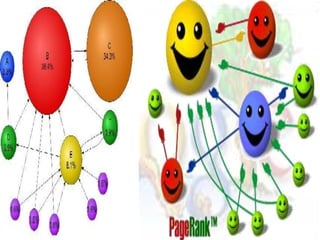
PAGE RANK
 Page Rank: bringing order to the web
 Academic citation literature is applied to calculate
  page rank

   PR(A) = (1-d) + d(PR(t1)/C(t1) + ... + PR(tn)/C(tn))

   In the equation 't1 - tn' are pages linking to page A,
    'C' is the number of outbound links that a page has
    and 'd' is a damping factor, usually set to 0.85.
PAGE RANK (INTUITIVE JUSTIFICATION)
 Many pages that point to a single page
 A page having high PageRank that points to
  another page
 Broken Links are not listed on Higher Page Ranked
  sites
 Text of the link provides more description, Google
  utilizes such information
       Provides more accurate results for images, graphs,
        databases
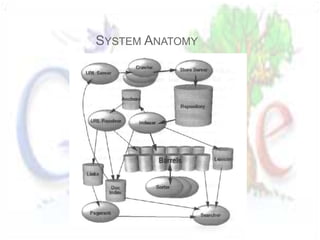
SYSTEM ANATOMY
SYSTEM ANATOMY
   URL Server:
        provides list of URLs to the Crawlers for fetching
        information from web
 Distributed Crawlers (Downloading WebPages)
 Store Server:
     Compression and Storage in Repository
     docID’s are used to distinguish WebPages
   Indexer
     Indexing, Sorting, Uncompressing, Parsing
     Hits
         records word occurences, position, text formate information in
          documents
         Hits are organized into barrels which creates partially sorted
          forward index
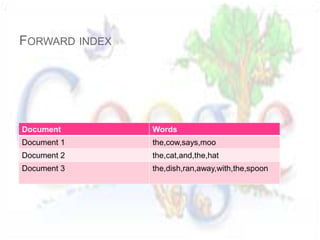
FORWARD INDEX


Document        Words
Document 1      the,cow,says,moo
Document 2      the,cat,and,the,hat
Document 3      the,dish,ran,away,with,the,spoon
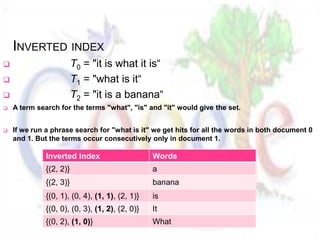
INVERTED INDEX
                        T0 = "it is what it is“
                        T1 = "what is it“
                        T2 = "it is a banana“
   A term search for the terms "what", "is" and "it" would give the set.


   If we run a phrase search for "what is it" we get hits for all the words in both document 0
    and 1. But the terms occur consecutively only in document 1.

              Inverted Index                     Words
              {(2, 2)}                           a
              {(2, 3)}                           banana
              {(0, 1), (0, 4), (1, 1), (2, 1)}   is
              {(0, 0), (0, 3), (1, 2), (2, 0)}   It
              {(0, 2), (1, 0)}                   What
CONT…
   Indexer:
       Anchor files as a result of parsing possessing links
        information (in & out links)
   URL resolver:
     Reads anchor files, converts relative to absolute URLs
      and inturn into docIDs
     Puts anchor text in forward index
     Database of links, necessary to compute PageRanks
   Sorter :
      Takes the barrels which are sorted by docID and
      resorts them by wordID to generate inverted index.
     It produces a list of wordIDs and offsets into the inverted
      index.
CONT…
   DumpLexicon
       A program DumpLexicon takes this list together with the
        lexicon produced by the indexer and generates a new
        lexicon to be used by the searcher.


   Searcher:
       The searcher is run by a web server and uses the
        lexicon built by DumpLexicon together with the inverted
        index and the PageRanks to answer queries.
CONT…
   Major data structures
       Data is stored in BigFiles which are virtual files and it
        supports compression.
       Half of the storage used by raw html repository.
       Having compressed html of every page and its small
        header.
       Document index keep information of each document.
       The ISAM(Index sequential access mode) index is
        ordered by docID.
       Each stored entry includes information of current
        status, pointer into the repository, document checksum,
        URL and title information.
       They all are memory-based hash tables with varying
        values attached with each word.
CONT…
   Hit lits encoding
       Uses compact encoding(a hand optimized)
       It requires less space and less bit manipulation.
       It uses two bytes for every hits.
       For saving space the length of a hit list is combined with
        the wordID in the forward index and the docID in the
        inverted index.
       Forward index is stored in the number of barrels(64).
       Each barrels holds word IDs
       Words falling in particular barrel, the DocIDs is recorded
        into the barrel followed by the List of WordIDs with
        Hitlists which corresponds to those words
CONT…
 The inverted index consist of the same barrels as
  the forward index. Inverted index is processed by
  the sorter
 Pointer is used for pointing to wordID in barrels.

 Pointer points to List of docIDs and Hit list, this is
  called docList
CRAWLING

   Web Crawling (downloading pages)

   Crawlers (3 to 4)

   Each crawler contains three hundred open

    connections

   Social issues

   Efficiency
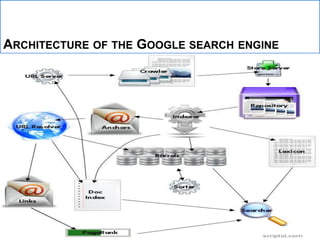
ARCHITECTURE OF THE GOOGLE SEARCH ENGINE
DESCRIPTION OF THE PICTORIAL COMPONENTS
Components     Description

Crawlers       There are several distributed crawlers, they parse the pages and
               extract links and keywords.

URL Server     Provides to crawlers a list of URLs to scan. The crawlers sends
               collected data to a store server.

Server Store   It compresses the pages and places them in the repository. Each
               page is stored with an identifier, a docID.

Repository     Contains a copy of the pages and images, allowing comparisons and
               caching.

Indexer        It decompresses documents and converts them into sets of words
               called "hits". It distributes hits among a set of "barrels". This provides
               an index partially sorted. It also creates a list of URLs on each page.
               A hit contains the following information: the word, its position in the
               document, font size, capitalization.

Barrels        These "barrels" are databases that classify documents by docID.
               They are created by the indexer and used by the sorter.
Anchors        The bank of anchors created by the indexer contains internal links
               and text associated with each link.
CONT…
Components   Description
URL          It takes the contents of anchors, converts relative URLs into absolute
Resolver     addresses and finds or creates a docID.
             It builds an index of documents and a database of links.

Doc Index    Contains the text relative to each URL.

             The database of links associates each one with a docID (and so to a
Links
             real document on the Web).

             The software uses the database of links to define the PageRank of each
PageRank
             page.

             It interacts with barrels. It includes documents classified by docID and
Sorter
             creates an inverted list sorted by wordID.

             A software called DumpLexicon takes the list provided by the sorter
             (classified by wordID), and also includes the lexicon created by the
Lexicon
             indexer (the sets of keywords in each page), and produces a new
             lexicon to the searcher.

             It runs on a web server in a datacenter, uses the lexicon built by
Searcher     DumpLexicon in combination with the index classified by wordID,
             taking into account the PageRank, and produces a results page.
RESULTS, PROBLEMS & CONCLUSION
   Most important issue is quality of search results
   Google performance is better compared to other
    commercial engines
   Need of Relevant and exact Query Results
   Up to date information processing
   Performing search queries
   Crawling technologies
   Google employs a number of techniques to improve
    search quality including page rank, anchor text, and
    proximity information.
   “The ultimate search engine would understand exactly
    what you mean and give back exactly what you want.”
    by Larry Page
   “The ultimate search engine would understand exactly what you
    mean and give back exactly what you want.” by Larry Page


   “The absolute search engine’s query generation would be based
    on information, not based on the repository records and query
    results will be real timed, and it will change the whole internet
    and web architecture.” by asim
Thanks!

Anatomy of google

  • 1.
    THE ANATOMY OFA LARGE SCALE-HYPER TEXTUAL WEB SEARCH ENGINE ASIM FROM UNIVERSITY PESAHAWAR. Author: Sergey Brin, Lawrence Page
  • 7.
    ABSTRACT  Google Search Engine as Prototype  Anatomy  Web Users: Queries (tens of millions)  Academic research  Building a large scale search engine  Heavy use of hyper textual information (anchor links, hyperlinks)
  • 8.
    INTRODUCTION  Web (as a dynamic entity)  Irrelevant Search Results  Human maintained Indices, Table of Contents  Too many low quality research  Address many problems of users (Page Ranking)
  • 9.
    CONT… Google: Scaling with the Web  Google’s Fast Crawling Technology  Storage space availability  Indexing system processing 100’s of Gigabytes Data  Minimized Queries Response Time
  • 10.
    DESIGN GOALS  Improved Search Quality.  Indexing does not provide Relevant Search Results.  Making the percentage of Junks Results as low as possible.  Users show interest in top ranked results.  Notion is to provide relevant results.  Google make uses of Link structure & anchor text.
  • 11.
    CONT…  Academic search engine results.  User Accessibility & Availability of the desired results.  Supports Novel Research.  All problem solving solutions to be given in a single place.
  • 12.
    SYSTEM FEATURES  Google search engine has two important features.  Link structure of the web(page ranking).  Utilization Links(anchor text) to improve search results.  <A href="http://www.yahoo.com/">Yahoo!</A> Besides the text of a hyperlink (anchor text) is associated with the page that the link is on, it is also associated with the page the link points to.
  • 13.
    PAGE RANK  PageRank: bringing order to the web  Academic citation literature is applied to calculate page rank  PR(A) = (1-d) + d(PR(t1)/C(t1) + ... + PR(tn)/C(tn))  In the equation 't1 - tn' are pages linking to page A, 'C' is the number of outbound links that a page has and 'd' is a damping factor, usually set to 0.85.
  • 14.
    PAGE RANK (INTUITIVEJUSTIFICATION)  Many pages that point to a single page  A page having high PageRank that points to another page  Broken Links are not listed on Higher Page Ranked sites  Text of the link provides more description, Google utilizes such information  Provides more accurate results for images, graphs, databases
  • 16.
  • 17.
    SYSTEM ANATOMY  URL Server:  provides list of URLs to the Crawlers for fetching information from web  Distributed Crawlers (Downloading WebPages)  Store Server:  Compression and Storage in Repository  docID’s are used to distinguish WebPages  Indexer  Indexing, Sorting, Uncompressing, Parsing  Hits  records word occurences, position, text formate information in documents  Hits are organized into barrels which creates partially sorted forward index
  • 18.
    FORWARD INDEX Document Words Document 1 the,cow,says,moo Document 2 the,cat,and,the,hat Document 3 the,dish,ran,away,with,the,spoon
  • 19.
    INVERTED INDEX  T0 = "it is what it is“  T1 = "what is it“  T2 = "it is a banana“  A term search for the terms "what", "is" and "it" would give the set.  If we run a phrase search for "what is it" we get hits for all the words in both document 0 and 1. But the terms occur consecutively only in document 1. Inverted Index Words {(2, 2)} a {(2, 3)} banana {(0, 1), (0, 4), (1, 1), (2, 1)} is {(0, 0), (0, 3), (1, 2), (2, 0)} It {(0, 2), (1, 0)} What
  • 20.
    CONT…  Indexer:  Anchor files as a result of parsing possessing links information (in & out links)  URL resolver:  Reads anchor files, converts relative to absolute URLs and inturn into docIDs  Puts anchor text in forward index  Database of links, necessary to compute PageRanks  Sorter :  Takes the barrels which are sorted by docID and resorts them by wordID to generate inverted index.  It produces a list of wordIDs and offsets into the inverted index.
  • 21.
    CONT…  DumpLexicon  A program DumpLexicon takes this list together with the lexicon produced by the indexer and generates a new lexicon to be used by the searcher.  Searcher:  The searcher is run by a web server and uses the lexicon built by DumpLexicon together with the inverted index and the PageRanks to answer queries.
  • 22.
    CONT…  Major data structures  Data is stored in BigFiles which are virtual files and it supports compression.  Half of the storage used by raw html repository.  Having compressed html of every page and its small header.  Document index keep information of each document.  The ISAM(Index sequential access mode) index is ordered by docID.  Each stored entry includes information of current status, pointer into the repository, document checksum, URL and title information.  They all are memory-based hash tables with varying values attached with each word.
  • 23.
    CONT…  Hit lits encoding  Uses compact encoding(a hand optimized)  It requires less space and less bit manipulation.  It uses two bytes for every hits.  For saving space the length of a hit list is combined with the wordID in the forward index and the docID in the inverted index.  Forward index is stored in the number of barrels(64).  Each barrels holds word IDs  Words falling in particular barrel, the DocIDs is recorded into the barrel followed by the List of WordIDs with Hitlists which corresponds to those words
  • 24.
    CONT…  The invertedindex consist of the same barrels as the forward index. Inverted index is processed by the sorter  Pointer is used for pointing to wordID in barrels.  Pointer points to List of docIDs and Hit list, this is called docList
  • 25.
    CRAWLING  Web Crawling (downloading pages)  Crawlers (3 to 4)  Each crawler contains three hundred open connections  Social issues  Efficiency
  • 26.
    ARCHITECTURE OF THEGOOGLE SEARCH ENGINE
  • 27.
    DESCRIPTION OF THEPICTORIAL COMPONENTS Components Description Crawlers There are several distributed crawlers, they parse the pages and extract links and keywords. URL Server Provides to crawlers a list of URLs to scan. The crawlers sends collected data to a store server. Server Store It compresses the pages and places them in the repository. Each page is stored with an identifier, a docID. Repository Contains a copy of the pages and images, allowing comparisons and caching. Indexer It decompresses documents and converts them into sets of words called "hits". It distributes hits among a set of "barrels". This provides an index partially sorted. It also creates a list of URLs on each page. A hit contains the following information: the word, its position in the document, font size, capitalization. Barrels These "barrels" are databases that classify documents by docID. They are created by the indexer and used by the sorter. Anchors The bank of anchors created by the indexer contains internal links and text associated with each link.
  • 28.
    CONT… Components Description URL It takes the contents of anchors, converts relative URLs into absolute Resolver addresses and finds or creates a docID. It builds an index of documents and a database of links. Doc Index Contains the text relative to each URL. The database of links associates each one with a docID (and so to a Links real document on the Web). The software uses the database of links to define the PageRank of each PageRank page. It interacts with barrels. It includes documents classified by docID and Sorter creates an inverted list sorted by wordID. A software called DumpLexicon takes the list provided by the sorter (classified by wordID), and also includes the lexicon created by the Lexicon indexer (the sets of keywords in each page), and produces a new lexicon to the searcher. It runs on a web server in a datacenter, uses the lexicon built by Searcher DumpLexicon in combination with the index classified by wordID, taking into account the PageRank, and produces a results page.
  • 29.
    RESULTS, PROBLEMS &CONCLUSION  Most important issue is quality of search results  Google performance is better compared to other commercial engines  Need of Relevant and exact Query Results  Up to date information processing  Performing search queries  Crawling technologies  Google employs a number of techniques to improve search quality including page rank, anchor text, and proximity information.  “The ultimate search engine would understand exactly what you mean and give back exactly what you want.” by Larry Page
  • 30.
    “The ultimate search engine would understand exactly what you mean and give back exactly what you want.” by Larry Page  “The absolute search engine’s query generation would be based on information, not based on the repository records and query results will be real timed, and it will change the whole internet and web architecture.” by asim
  • 31.