ATLANTIC MAGAZINE, JULY 1945
By Vannevar Bush
 Introduction
 War effects
 Progress in recording
 Technological Predictions
 Progress in writing
 Associative thinking
 Memex
   Growing amount of research
   however, our methods of transmitting and
    reviewing the results of research are old
   scientific efforts should make all previous
    collected human knowledge more accessible
    through machine
   Visionary article from 1945
     Intended to set the direction for research in the post-war
      period
   Concerned with the problem of finding
    information
     Existing technology hopelessly out of date:
      ▪ The amount of information is being “expanded at a prodigious
        rate”, but the means we use to find it is “the same as was used in
        the days of square-rigged ships”
     The solution is to get away from hierarchical systems of
      organization and adopt new techniques that reflect how
      the brain works
   Bush had been part of the Manhattan Project,
    which produced the atomic bomb
   After the war, he wanted to direct attention
    to other possibilities for science
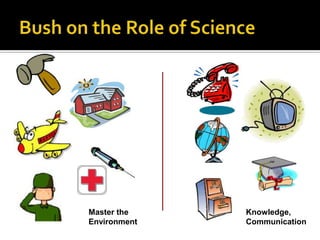
Master the    Knowledge,
Environment   Communication
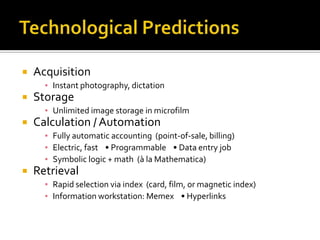
   Acquisition
      ▪ Instant photography, dictation
   Storage
      ▪ Unlimited image storage in microfilm
   Calculation / Automation
      ▪ Fully automatic accounting (point-of-sale, billing)
      ▪ Electric, fast • Programmable • Data entry job
      ▪ Symbolic logic + math (à la Mathematica)
   Retrieval
      ▪ Rapid selection via index (card, film, or magnetic index)
      ▪ Information workstation: Memex • Hyperlinks
 dry photography
  - used in facsimile transmission
 microfilm
  - The Encyclopedia Britannica could be
  reduced to the volume of a matchbox
 tiny camera fitted with universal-focus lens
 - move freely and record the worthy
 Voder
  - emits recognizable speech of stroked key
 Vocoder
  - converse of Voder
 Vannevar Bush predict a new machine:
 - take dictation
 - type it automatically
 - talk back if the author wants to review what he
  just said
 creative aspect of thinking
 involve the entire process by which man profits
  by his inheritance of acquired knowledge
 automatic telephone exchange etc.
 the way human mind works
  - association
  - things are connected by association of
  thoughts
      “The human mind … operates by
    association. With one item in its grasp, it
    snaps instantly to the next that is suggested
    by the association of thoughts, in accordance
    with some intricate web of trails carried by
    the cells of the brain… The speed of action,
    the intricacy of trails, the detail of mental
    pictures, is awe-inspiring beyond all else in
    nature.”
       Vannevar Bush: As We May Think (1945)
   an electromechanical device
   an individual desk with screens, a keyboard,
    buttons, levers
   a user can store all his books, records, and
    communications as microfilm
   a user could add or remove microfilm reels at
    will
   personal computer, online encyclopedias
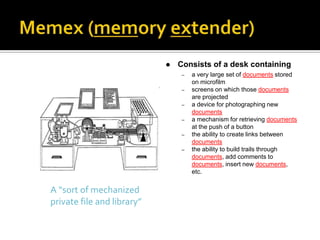
   Consists of a desk containing
                                 –   a very large set of documents stored
                                     on microfilm
                                 –   screens on which those documents
                                     are projected
                                 –   a device for photographing new
                                     documents
                                 –   a mechanism for retrieving documents
                                     at the push of a button
                                 –   the ability to create links between
                                     documents
                                 –   the ability to build trails through
                                     documents, add comments to
                                     documents, insert new documents,
                                     etc.


A “sort of mechanized
private file and library”
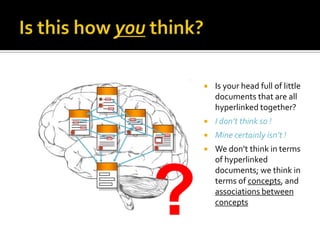
   Is your head full of little
        documents that are all
        hyperlinked together?
       I don’t think so !
       Mine certainly isn’t !
       We don’t think in terms
        of hyperlinked


?
        documents; we think in
        terms of concepts, and
        associations between
        concepts
WWW


          Berners-Lee     Engelbart
  Bush

                                         Hypertext
As We May Think             AUGMENT
                  MEMEX

              Nelson                  Xanadu

                  NLS


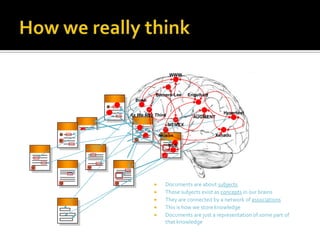
               Documents are about subjects
               Those subjects exist as concepts in our brains
               They are connected by a network of associations
               This is how we store knowledge
               Documents are just a representation of some part of
                that knowledge
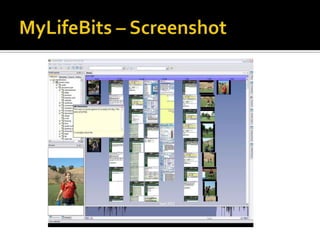
   System for storing personal digital media:
    documents, images, sounds, and videos
   Four principles of MyLifeBits
   Unique features:
     Interactive Story By Query
     Time interval property
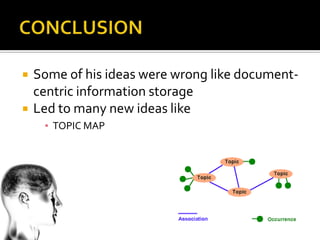
   Some of his ideas were wrong like document-
    centric information storage
   Led to many new ideas like
     ▪ TOPIC MAP
AS WE MAY THINK

As we may think

  • 1.
    ATLANTIC MAGAZINE, JULY1945 By Vannevar Bush
  • 2.
     Introduction  Wareffects  Progress in recording  Technological Predictions  Progress in writing  Associative thinking  Memex
  • 3.
    Growing amount of research  however, our methods of transmitting and reviewing the results of research are old  scientific efforts should make all previous collected human knowledge more accessible through machine
  • 4.
    Visionary article from 1945  Intended to set the direction for research in the post-war period  Concerned with the problem of finding information  Existing technology hopelessly out of date: ▪ The amount of information is being “expanded at a prodigious rate”, but the means we use to find it is “the same as was used in the days of square-rigged ships”  The solution is to get away from hierarchical systems of organization and adopt new techniques that reflect how the brain works
  • 5.
    Bush had been part of the Manhattan Project, which produced the atomic bomb  After the war, he wanted to direct attention to other possibilities for science
  • 6.
    Master the Knowledge, Environment Communication
  • 7.
    Acquisition ▪ Instant photography, dictation  Storage ▪ Unlimited image storage in microfilm  Calculation / Automation ▪ Fully automatic accounting (point-of-sale, billing) ▪ Electric, fast • Programmable • Data entry job ▪ Symbolic logic + math (à la Mathematica)  Retrieval ▪ Rapid selection via index (card, film, or magnetic index) ▪ Information workstation: Memex • Hyperlinks
  • 8.
     dry photography - used in facsimile transmission  microfilm - The Encyclopedia Britannica could be reduced to the volume of a matchbox  tiny camera fitted with universal-focus lens - move freely and record the worthy
  • 9.
     Voder - emits recognizable speech of stroked key  Vocoder - converse of Voder  Vannevar Bush predict a new machine: - take dictation - type it automatically - talk back if the author wants to review what he just said
  • 10.
     creative aspectof thinking  involve the entire process by which man profits by his inheritance of acquired knowledge  automatic telephone exchange etc.  the way human mind works - association - things are connected by association of thoughts
  • 11.
    “The human mind … operates by association. With one item in its grasp, it snaps instantly to the next that is suggested by the association of thoughts, in accordance with some intricate web of trails carried by the cells of the brain… The speed of action, the intricacy of trails, the detail of mental pictures, is awe-inspiring beyond all else in nature.” Vannevar Bush: As We May Think (1945)
  • 12.
    an electromechanical device  an individual desk with screens, a keyboard, buttons, levers  a user can store all his books, records, and communications as microfilm  a user could add or remove microfilm reels at will  personal computer, online encyclopedias
  • 13.
    Consists of a desk containing – a very large set of documents stored on microfilm – screens on which those documents are projected – a device for photographing new documents – a mechanism for retrieving documents at the push of a button – the ability to create links between documents – the ability to build trails through documents, add comments to documents, insert new documents, etc. A “sort of mechanized private file and library”
  • 14.
    Is your head full of little documents that are all hyperlinked together?  I don’t think so !  Mine certainly isn’t !  We don’t think in terms of hyperlinked ? documents; we think in terms of concepts, and associations between concepts
  • 15.
    WWW Berners-Lee Engelbart Bush Hypertext As We May Think AUGMENT MEMEX Nelson Xanadu NLS  Documents are about subjects  Those subjects exist as concepts in our brains  They are connected by a network of associations  This is how we store knowledge  Documents are just a representation of some part of that knowledge
  • 16.
    System for storing personal digital media: documents, images, sounds, and videos  Four principles of MyLifeBits  Unique features:  Interactive Story By Query  Time interval property
  • 18.
    Some of his ideas were wrong like document- centric information storage  Led to many new ideas like ▪ TOPIC MAP
  • 19.
    AS WE MAYTHINK