#Think BIG
Center for Professional Enhancement
#Think BIG
Analytical skills
#Think BIG
Analytical skills
 Analytical skills are kind of problem solving skill.
 They allow you to evaluate simple or complex problems.
 This skill incorporates many skills like critical thinking ability,
decision making, and researching skills in order to analyze an
question or problem and reach a solution.
#Think BIG
Why Analytical skills….Asked
in Maximum entrance Exams
 Analytical skills are important because it allows you to find
solutions to common problems and make decisions about what
actions to take next.
 Understanding problems and analyzing the situation for viable
solutions is a key skill in every position at every level.
 Developing this ability can improve your work, help you achieve
company goals and eventually support your personal career goals.
#Think BIG
Analytical skills Examples….
1. Critical thinking:
 Critical thinking is your ability to evaluate a situation or a problem
with an independent mind. Critical thinking means that you don’t
accept arguments or assumptions without question. This requires
you to break down an argument or the steps in a process, and make
independent evaluations.
 Critical thinkers are capable of identifying all aspects of a problem
and understanding why a problem exists. They will take the time to
fully understand a problem in order to develop a workable solution.
#Think BIG
2. Decision making:
 Decision making involves selecting a specific object or course of
action from various alternatives. This skill requires careful evaluation
of the situation in order to predict which choice will result in the
best outcome.
3. Researching skills:
 Conducting effective research requires analytical skills. You must be
able to consider a problem in order to make a plan and define your
research and collect data. You should be able to analyze your
information and draw conclusions.
#Think BIG
5. Problem solving:
 Problem-solving skills help you determine the source of a problem
and find an effective solution.
 Problem-solving skills are important in every career at every level.
 Some key problem-solving skills include:
• Active listening
• Analysis
• Creativity
• Communication
• Dependability
#Think BIG
How to improve your analytical skills….
 Improving your analytical skills can help you achieve various career
goals.
 To improve your analytical skills, consider taking some of the
following steps:
• Take on leadership roles that require the use of critical analytical
skills
• Practice key analytical skills in your current role
• Take classes that emphasize the use of analytical skills
• Participate in activities that require the use of analytical skills such
as team sports, games or reading
• Seek advice or mentorship from professionals in your field or desired
industry
• Improve your subject-matter knowledge, which is essential to faster
problem-solving
#Think BIG
Important part of Exams like….
 Placement in Corporate- Wipro, TCS, Cognizant,
Capgemini, Ashok Leyland and almost all the companies
hiring fresher's(Engineers, MBA, Biotech etc.)
 Government Exams like SSC CGL, Banking sector
 UPSC(CSAT), IES, NET, State level exams
 GATE, CAT, MAT, GMAT, GRE etc.
 AMCAT, CoCubes, eLitmus etc.
#Think BIG
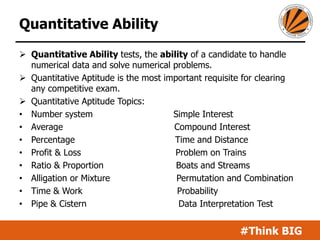
Quantitative Ability
 Quantitative Ability tests, the ability of a candidate to handle
numerical data and solve numerical problems.
 Quantitative Aptitude is the most important requisite for clearing
any competitive exam.
 Quantitative Aptitude Topics:
• Number system Simple Interest
• Average Compound Interest
• Percentage Time and Distance
• Profit & Loss Problem on Trains
• Ratio & Proportion Boats and Streams
• Alligation or Mixture Permutation and Combination
• Time & Work Probability
• Pipe & Cistern Data Interpretation Test
#Think BIG
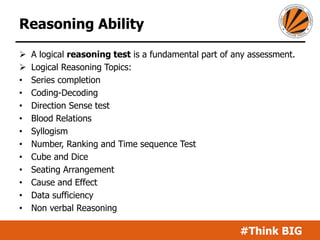
Reasoning Ability
 A logical reasoning test is a fundamental part of any assessment.
 Logical Reasoning Topics:
• Series completion
• Coding-Decoding
• Direction Sense test
• Blood Relations
• Syllogism
• Number, Ranking and Time sequence Test
• Cube and Dice
• Seating Arrangement
• Cause and Effect
• Data sufficiency
• Non verbal Reasoning
#Think BIG

Analytical-Skills.ppt

  • 1.
    #Think BIG Center forProfessional Enhancement
  • 2.
  • 3.
    #Think BIG Analytical skills Analytical skills are kind of problem solving skill.  They allow you to evaluate simple or complex problems.  This skill incorporates many skills like critical thinking ability, decision making, and researching skills in order to analyze an question or problem and reach a solution.
  • 4.
    #Think BIG Why Analyticalskills….Asked in Maximum entrance Exams  Analytical skills are important because it allows you to find solutions to common problems and make decisions about what actions to take next.  Understanding problems and analyzing the situation for viable solutions is a key skill in every position at every level.  Developing this ability can improve your work, help you achieve company goals and eventually support your personal career goals.
  • 5.
    #Think BIG Analytical skillsExamples…. 1. Critical thinking:  Critical thinking is your ability to evaluate a situation or a problem with an independent mind. Critical thinking means that you don’t accept arguments or assumptions without question. This requires you to break down an argument or the steps in a process, and make independent evaluations.  Critical thinkers are capable of identifying all aspects of a problem and understanding why a problem exists. They will take the time to fully understand a problem in order to develop a workable solution.
  • 6.
    #Think BIG 2. Decisionmaking:  Decision making involves selecting a specific object or course of action from various alternatives. This skill requires careful evaluation of the situation in order to predict which choice will result in the best outcome. 3. Researching skills:  Conducting effective research requires analytical skills. You must be able to consider a problem in order to make a plan and define your research and collect data. You should be able to analyze your information and draw conclusions.
  • 7.
    #Think BIG 5. Problemsolving:  Problem-solving skills help you determine the source of a problem and find an effective solution.  Problem-solving skills are important in every career at every level.  Some key problem-solving skills include: • Active listening • Analysis • Creativity • Communication • Dependability
  • 8.
    #Think BIG How toimprove your analytical skills….  Improving your analytical skills can help you achieve various career goals.  To improve your analytical skills, consider taking some of the following steps: • Take on leadership roles that require the use of critical analytical skills • Practice key analytical skills in your current role • Take classes that emphasize the use of analytical skills • Participate in activities that require the use of analytical skills such as team sports, games or reading • Seek advice or mentorship from professionals in your field or desired industry • Improve your subject-matter knowledge, which is essential to faster problem-solving
  • 9.
    #Think BIG Important partof Exams like….  Placement in Corporate- Wipro, TCS, Cognizant, Capgemini, Ashok Leyland and almost all the companies hiring fresher's(Engineers, MBA, Biotech etc.)  Government Exams like SSC CGL, Banking sector  UPSC(CSAT), IES, NET, State level exams  GATE, CAT, MAT, GMAT, GRE etc.  AMCAT, CoCubes, eLitmus etc.
  • 10.
    #Think BIG Quantitative Ability Quantitative Ability tests, the ability of a candidate to handle numerical data and solve numerical problems.  Quantitative Aptitude is the most important requisite for clearing any competitive exam.  Quantitative Aptitude Topics: • Number system Simple Interest • Average Compound Interest • Percentage Time and Distance • Profit & Loss Problem on Trains • Ratio & Proportion Boats and Streams • Alligation or Mixture Permutation and Combination • Time & Work Probability • Pipe & Cistern Data Interpretation Test
  • 11.
    #Think BIG Reasoning Ability A logical reasoning test is a fundamental part of any assessment.  Logical Reasoning Topics: • Series completion • Coding-Decoding • Direction Sense test • Blood Relations • Syllogism • Number, Ranking and Time sequence Test • Cube and Dice • Seating Arrangement • Cause and Effect • Data sufficiency • Non verbal Reasoning
  • 12.