RPS
Recovery Portfolio Services Ltd.
Analytical Credit Dataset – AnaCredit – Update March 2016
© RPS Recovery Portfolio Services Ltd. – www.recovery-portfolio-services.co.uk
Glossary
©RPSRecoveryPortfolioServicesLtd.–www.recovery-portfolio-services.co.uk
Single Supervisory Mechanism
Supervisory Risk Assessment
Asset Quality Review
Statistics Committee
European Reporting Framework (‚primary reporting framework‘ or ‚output layer‘
Balance Sheet Items
Register of Institutions and Affiliates Database
Legal Entity Identifier
Nomenclature statistique des activités économiques dans la Communauté européenne
International Standard Industrial Classification of all Economic Activities
Supervisory Review and Evaluation Process
Non-performing exposure
National Competent Authority
Bank Lending Survey
SSM
SRA
AQR
STC
ERF
BSI
RIAD
LEI
NACE
ISIC
SREP
NPE
NCA
BLS
 Council Regulation EC 2533/1998 (European collection of statistical information)
 Recommendation of the European Central Bank of 24 February 2014 on the
organisation of preparatory measures for the collection of granular credit data by the
European System of Central Banks (ECB/2014/7)
 Decision of the European Central Bank of 24 February 2014 on the organisation of
preparatory measures for the collection of granular credit data by the European
System of Central Banks (ECB/2014/6)
 EU Commission’s opinion on the draft regulation of the European Central Bank
concerning the collection of granular credit and credit risk data (2015/C261/01 - 8
August 2015)
 Draft Regulation of the European Central Bank concerning the collection of granular
credit and credit risk data (Finalisation of this regulation expected in late summer)
 Regulation (EU) No 549/2013 of the European Parliament and the Council of 21 May
2013 on the European system of national and regional accounts in the European
Union
Legal documents, opinions and working papers of the supervisory
authorities and the European Central Bank (not limited)
©RPSRecoveryPortfolioServicesLtd.–www.recovery-portfolio-services.co.uk
ECB Analytical Credit Dataset – ANACREDIT
Starting point
ESCB - European System of Central Banks
composed by the European Central Bank and the 28 member states of the European
Union
Countries which don't have the Euro as currency have a special status. They are allowed
to conduct their respective national monetary policies but they do not take part of the
decision-making with regard to the monetary policy for the euro-area and the
implementation of such decisions.
Scope is to establish in a stepwise manner a long-term framework for the collection of
granular credit data based on harmonised ECB statistical reporting requirements.
ECB objective: Comprehensive Data Warehouse!
©RPSRecoveryPortfolioServicesLtd.–www.recovery-portfolio-services.co.uk
To provide complete, accurate, high-quality and timely information on debtors and their
respective credits. i.e.
 type of credit,
 outstanding debt,
 number of days past due date,
 date of origination and contractual maturity,
 type of interest rate,
 currency of the credit.
To provide information on any risk mitigation measures securing the credits e.g.
 credit derivatives,
 guarantors,
 financial collateral received (is useful to estimate the severity of losses in the event of default).
To support reliable debtor identification e.g.
 full name and unique ID number,
 address or location,
 type of obligor (SME or corporate obligor) as unique identification is essential for capturing the total
indebtedness of debtors accurately, especially if there are
cross-border exposures.
AnaCredit Objectives
©RPSRecoveryPortfolioServicesLtd.–www.recovery-portfolio-services.co.uk
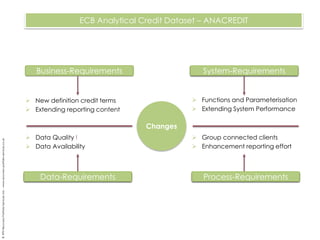
ECB Analytical Credit Dataset – ANACREDIT
Business-Requirements
Changes
 Data Quality !
 Data Availability
 New definition credit terms
 Extending reporting content
 Group connected clients
 Enhancement reporting effort
 Functions and Parameterisation
 Extending System Performance
System-Requirements
Data-Requirements Process-Requirements
©RPSRecoveryPortfolioServicesLtd.–www.recovery-portfolio-services.co.uk
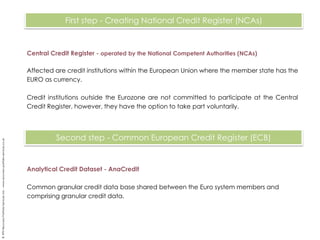
Central Credit Register - operated by the National Competent Authorities (NCAs)
Affected are credit institutions within the European Union where the member state has the
EURO as currency.
Credit institutions outside the Eurozone are not committed to participate at the Central
Credit Register, however, they have the option to take part voluntarily.
Analytical Credit Dataset - AnaCredit
Common granular credit data base shared between the Euro system members and
comprising granular credit data.
First step - Creating National Credit Register (NCAs)
Second step - Common European Credit Register (ECB)
©RPSRecoveryPortfolioServicesLtd.–www.recovery-portfolio-services.co.uk
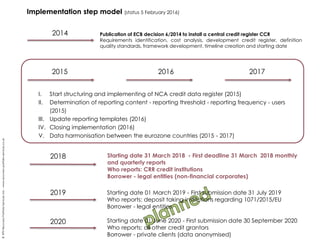
Implementation step model (status 5 February 2016)
2014
2015 2016 2017
2018
2019
Publication of ECB decision 6/2014 to install a central credit register CCR
Requirements identification, cost analysis, development credit register, definition
quality standards, framework development, timeline creation and starting date
I. Start structuring and implementing of NCA credit data register (2015)
II. Determination of reporting content - reporting threshold - reporting frequency - users
(2015)
III. Update reporting templates (2016)
IV. Closing implementation (2016)
V. Data harmonisation between the eurozone countries (2015 - 2017)
Starting date 31 March 2018 - First deadline 31 March 2018 monthly
and quarterly reports
Who reports: CRR credit institutions
Borrower - legal entities (non-financial corporates)
Starting date 01 March 2019 - First submission date 31 July 2019
Who reports: deposit taking institutions regarding 1071/2015/EU
Borrower - legal entities
2020 Starting date 01 June 2020 - First submission date 30 September 2020
Who reports: all other credit grantors
Borrower - private clients (data anonymised)
©RPSRecoveryPortfolioServicesLtd.–www.recovery-portfolio-services.co.uk
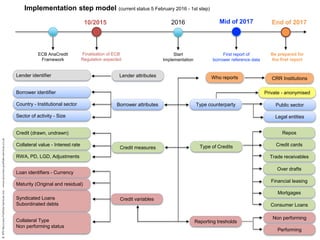
Implementation step model (current status 5 February 2016 - 1st step)
10/2015
Finalisation of ECB
Regulation expected
ECB AnaCredit
Framework
2016
Start
Implementation
End of 2017
Be prepared for
the first report
Credit (drawn, undrawn)
Collateral value - Interest rate
RWA, PD, LGD, Adjustments
Credit measures
Syndicated Loans
Subordinated debts
Loan identifiers - Currency
Maturity (Original and residual)
Collateral Type
Non performing status
Credit variables
Type counterparty
Who reports CRR Institutions
Reporting tresholds
Type of Credits
Public sector
Legal entities
Non performing
Performing
Repos
Credit cards
Trade receivables
Over drafts
Financial leasing
Mortgages
Consumer Loans
Borrower attributes
Borrower identifier
Sector of activity - Size
Country - Institutional sector
Lender identifier Lender attributes
Mid of 2017
First report of
borrower reference data
Private - anonymised
©RPSRecoveryPortfolioServicesLtd.–www.recovery-portfolio-services.co.uk
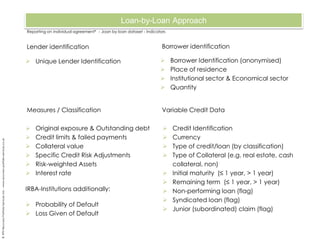
Lender identification Borrower identification
Measures / Classification Variable Credit Data
 Unique Lender Identification  Borrower Identification (anonymised)
 Place of residence
 Institutional sector & Economical sector
 Quantity
 Original exposure & Outstanding debt
 Credit limits & failed payments
 Collateral value
 Specific Credit Risk Adjustments
 Risk-weighted Assets
 Interest rate
IRBA-Institutions additionally:
 Probability of Default
 Loss Given of Default
 Credit Identification
 Currency
 Type of credit/loan (by classification)
 Type of Collateral (e.g. real estate, cash
collateral, non)
 Initial maturity (≤ 1 year, > 1 year)
 Remaining term (≤ 1 year, > 1 year)
 Non-performing loan (flag)
 Syndicated loan (flag)
 Junior (subordinated) claim (flag)
Reporting on individual agreement* - ‚loan by loan dataset - Indicators
Loan-by-Loan Approach
©RPSRecoveryPortfolioServicesLtd.–www.recovery-portfolio-services.co.uk
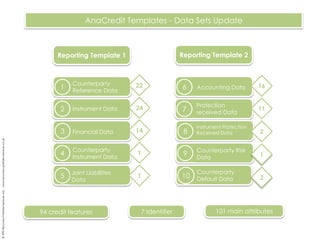
AnaCredit Templates - Data Sets Update
Reporting Template 1 Reporting Template 2
1
2
3
4
5
6
7
8
Counterparty
Reference Data
Instrument Data
Financial Data
Counterparty
Instrument Data
Joint Liabilities
Data
Accounting Data
Protection
received Data
Instrument Protection
Received Data
22
24
16
11
214
1
1
9 Counterparty Risk
Data 1
10
Counterparty
Default Data 2
101 main attributes7 Identifier94 credit features
©RPSRecoveryPortfolioServicesLtd.–www.recovery-portfolio-services.co.uk
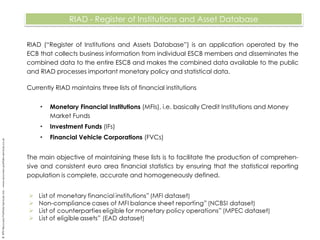
RIAD - Register of Institutions and Asset Database
RIAD (“Register of Institutions and Assets Database”) is an application operated by the
ECB that collects business information from individual ESCB members and disseminates the
combined data to the entire ESCB and makes the combined data available to the public
and RIAD processes important monetary policy and statistical data.
Currently RIAD maintains three lists of financial institutions
‣ Monetary Financial Institutions (MFIs), i.e. basically Credit Institutions and Money
Market Funds
‣ Investment Funds (IFs)
‣ Financial Vehicle Corporations (FVCs)
The main objective of maintaining these lists is to facilitate the production of comprehen-
sive and consistent euro area financial statistics by ensuring that the statistical reporting
population is complete, accurate and homogeneously defined.
©RPSRecoveryPortfolioServicesLtd.–www.recovery-portfolio-services.co.uk
Be brilliant together.
www.recovery-portfolio-services.co.uk
anacredit@recovery-portfolio-services.co.uk

Analytical Credit Dataset - Update March 2016

  • 1.
    RPS Recovery Portfolio ServicesLtd. Analytical Credit Dataset – AnaCredit – Update March 2016 © RPS Recovery Portfolio Services Ltd. – www.recovery-portfolio-services.co.uk
  • 2.
    Glossary ©RPSRecoveryPortfolioServicesLtd.–www.recovery-portfolio-services.co.uk Single Supervisory Mechanism SupervisoryRisk Assessment Asset Quality Review Statistics Committee European Reporting Framework (‚primary reporting framework‘ or ‚output layer‘ Balance Sheet Items Register of Institutions and Affiliates Database Legal Entity Identifier Nomenclature statistique des activités économiques dans la Communauté européenne International Standard Industrial Classification of all Economic Activities Supervisory Review and Evaluation Process Non-performing exposure National Competent Authority Bank Lending Survey SSM SRA AQR STC ERF BSI RIAD LEI NACE ISIC SREP NPE NCA BLS
  • 3.
     Council RegulationEC 2533/1998 (European collection of statistical information)  Recommendation of the European Central Bank of 24 February 2014 on the organisation of preparatory measures for the collection of granular credit data by the European System of Central Banks (ECB/2014/7)  Decision of the European Central Bank of 24 February 2014 on the organisation of preparatory measures for the collection of granular credit data by the European System of Central Banks (ECB/2014/6)  EU Commission’s opinion on the draft regulation of the European Central Bank concerning the collection of granular credit and credit risk data (2015/C261/01 - 8 August 2015)  Draft Regulation of the European Central Bank concerning the collection of granular credit and credit risk data (Finalisation of this regulation expected in late summer)  Regulation (EU) No 549/2013 of the European Parliament and the Council of 21 May 2013 on the European system of national and regional accounts in the European Union Legal documents, opinions and working papers of the supervisory authorities and the European Central Bank (not limited) ©RPSRecoveryPortfolioServicesLtd.–www.recovery-portfolio-services.co.uk
  • 4.
    ECB Analytical CreditDataset – ANACREDIT Starting point ESCB - European System of Central Banks composed by the European Central Bank and the 28 member states of the European Union Countries which don't have the Euro as currency have a special status. They are allowed to conduct their respective national monetary policies but they do not take part of the decision-making with regard to the monetary policy for the euro-area and the implementation of such decisions. Scope is to establish in a stepwise manner a long-term framework for the collection of granular credit data based on harmonised ECB statistical reporting requirements. ECB objective: Comprehensive Data Warehouse! ©RPSRecoveryPortfolioServicesLtd.–www.recovery-portfolio-services.co.uk
  • 5.
    To provide complete,accurate, high-quality and timely information on debtors and their respective credits. i.e.  type of credit,  outstanding debt,  number of days past due date,  date of origination and contractual maturity,  type of interest rate,  currency of the credit. To provide information on any risk mitigation measures securing the credits e.g.  credit derivatives,  guarantors,  financial collateral received (is useful to estimate the severity of losses in the event of default). To support reliable debtor identification e.g.  full name and unique ID number,  address or location,  type of obligor (SME or corporate obligor) as unique identification is essential for capturing the total indebtedness of debtors accurately, especially if there are cross-border exposures. AnaCredit Objectives ©RPSRecoveryPortfolioServicesLtd.–www.recovery-portfolio-services.co.uk
  • 6.
    ECB Analytical CreditDataset – ANACREDIT Business-Requirements Changes  Data Quality !  Data Availability  New definition credit terms  Extending reporting content  Group connected clients  Enhancement reporting effort  Functions and Parameterisation  Extending System Performance System-Requirements Data-Requirements Process-Requirements ©RPSRecoveryPortfolioServicesLtd.–www.recovery-portfolio-services.co.uk
  • 7.
    Central Credit Register- operated by the National Competent Authorities (NCAs) Affected are credit institutions within the European Union where the member state has the EURO as currency. Credit institutions outside the Eurozone are not committed to participate at the Central Credit Register, however, they have the option to take part voluntarily. Analytical Credit Dataset - AnaCredit Common granular credit data base shared between the Euro system members and comprising granular credit data. First step - Creating National Credit Register (NCAs) Second step - Common European Credit Register (ECB) ©RPSRecoveryPortfolioServicesLtd.–www.recovery-portfolio-services.co.uk
  • 8.
    Implementation step model(status 5 February 2016) 2014 2015 2016 2017 2018 2019 Publication of ECB decision 6/2014 to install a central credit register CCR Requirements identification, cost analysis, development credit register, definition quality standards, framework development, timeline creation and starting date I. Start structuring and implementing of NCA credit data register (2015) II. Determination of reporting content - reporting threshold - reporting frequency - users (2015) III. Update reporting templates (2016) IV. Closing implementation (2016) V. Data harmonisation between the eurozone countries (2015 - 2017) Starting date 31 March 2018 - First deadline 31 March 2018 monthly and quarterly reports Who reports: CRR credit institutions Borrower - legal entities (non-financial corporates) Starting date 01 March 2019 - First submission date 31 July 2019 Who reports: deposit taking institutions regarding 1071/2015/EU Borrower - legal entities 2020 Starting date 01 June 2020 - First submission date 30 September 2020 Who reports: all other credit grantors Borrower - private clients (data anonymised) ©RPSRecoveryPortfolioServicesLtd.–www.recovery-portfolio-services.co.uk
  • 9.
    Implementation step model(current status 5 February 2016 - 1st step) 10/2015 Finalisation of ECB Regulation expected ECB AnaCredit Framework 2016 Start Implementation End of 2017 Be prepared for the first report Credit (drawn, undrawn) Collateral value - Interest rate RWA, PD, LGD, Adjustments Credit measures Syndicated Loans Subordinated debts Loan identifiers - Currency Maturity (Original and residual) Collateral Type Non performing status Credit variables Type counterparty Who reports CRR Institutions Reporting tresholds Type of Credits Public sector Legal entities Non performing Performing Repos Credit cards Trade receivables Over drafts Financial leasing Mortgages Consumer Loans Borrower attributes Borrower identifier Sector of activity - Size Country - Institutional sector Lender identifier Lender attributes Mid of 2017 First report of borrower reference data Private - anonymised ©RPSRecoveryPortfolioServicesLtd.–www.recovery-portfolio-services.co.uk
  • 10.
    Lender identification Borroweridentification Measures / Classification Variable Credit Data  Unique Lender Identification  Borrower Identification (anonymised)  Place of residence  Institutional sector & Economical sector  Quantity  Original exposure & Outstanding debt  Credit limits & failed payments  Collateral value  Specific Credit Risk Adjustments  Risk-weighted Assets  Interest rate IRBA-Institutions additionally:  Probability of Default  Loss Given of Default  Credit Identification  Currency  Type of credit/loan (by classification)  Type of Collateral (e.g. real estate, cash collateral, non)  Initial maturity (≤ 1 year, > 1 year)  Remaining term (≤ 1 year, > 1 year)  Non-performing loan (flag)  Syndicated loan (flag)  Junior (subordinated) claim (flag) Reporting on individual agreement* - ‚loan by loan dataset - Indicators Loan-by-Loan Approach ©RPSRecoveryPortfolioServicesLtd.–www.recovery-portfolio-services.co.uk
  • 11.
    AnaCredit Templates -Data Sets Update Reporting Template 1 Reporting Template 2 1 2 3 4 5 6 7 8 Counterparty Reference Data Instrument Data Financial Data Counterparty Instrument Data Joint Liabilities Data Accounting Data Protection received Data Instrument Protection Received Data 22 24 16 11 214 1 1 9 Counterparty Risk Data 1 10 Counterparty Default Data 2 101 main attributes7 Identifier94 credit features ©RPSRecoveryPortfolioServicesLtd.–www.recovery-portfolio-services.co.uk
  • 12.
    RIAD - Registerof Institutions and Asset Database RIAD (“Register of Institutions and Assets Database”) is an application operated by the ECB that collects business information from individual ESCB members and disseminates the combined data to the entire ESCB and makes the combined data available to the public and RIAD processes important monetary policy and statistical data. Currently RIAD maintains three lists of financial institutions ‣ Monetary Financial Institutions (MFIs), i.e. basically Credit Institutions and Money Market Funds ‣ Investment Funds (IFs) ‣ Financial Vehicle Corporations (FVCs) The main objective of maintaining these lists is to facilitate the production of comprehen- sive and consistent euro area financial statistics by ensuring that the statistical reporting population is complete, accurate and homogeneously defined. ©RPSRecoveryPortfolioServicesLtd.–www.recovery-portfolio-services.co.uk
  • 13.