Analgesics
Centrally acting
analgesics
Narcotic
analgesics
OPIOIDS
Morphine
Peripherally
acting analgesics
Non-narcotic
analgesics
NSAIDs
Aspirin
Prototype drug
OPIOIDS
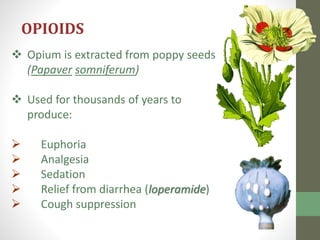
 Opium is extracted from poppy seeds
(Papaver somniferum)
 Used for thousands of years to
produce:
 Euphoria
 Analgesia
 Sedation
 Relief from diarrhea (loperamide)
 Cough suppression
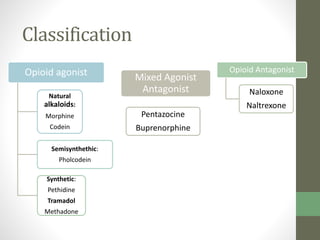
Classification
Opioid agonist
Natural
alkaloids:
Morphine
Codein
Semisynthethic:
Pholcodein
Synthetic:
Pethidine
Tramadol
Methadone
Opioid Antagonist
Naloxone
Naltrexone
Pentazocine
Buprenorphine
Mixed Agonist
Antagonist
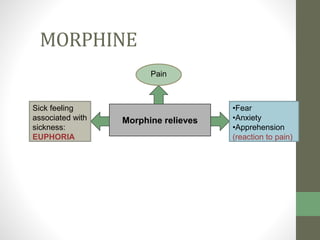
MORPHINE
Morphine relieves
Pain
Sick feeling
associated with
sickness:
EUPHORIA
•Fear
•Anxiety
•Apprehension
(reaction to pain)
MORPHINE : Pharmacologicalaction
CNS DEPRESSANT EFFECTS:
Analgesic effect: Perception
of pain & reaction to pain :
fear, anxiety
Euphoria: Feeling of well
being
Sedation: drowsiness
Respiratory depression:
opioid poisoning : death
Cough suppression: Cough
center in medulla
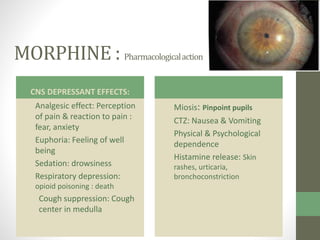
Miosis: Pinpoint pupils
CTZ: Nausea & Vomiting
Physical & Psychological
dependence
Histamine release: Skin
rashes, urticaria,
bronchoconstriction
MORPHINE : Pharmacologicalaction
• CVS
• Vasodilatation  fall
in BP
• Bradycardia: stimulation
of vagal center in the
brain
• GIT: Constipation
• Urinary Bladder: Urinary
retention
• Bronchia: Bronchospasm
Adverse effects
• Nausea, vomiting
• Constipation
• Respiratory depression
• In new born if administered to pregnant
• Hypotension
• Drowsiness
• Confusion, mental clouding
• Itching & skin rashes
• Difficulty in micturition
• Tolerance
• Dependence
• Treatment:
• Hospitalization
• Gradual withdrawal
• Substitution therapy : methadone
• Antagonist: naltrexone after detoxification  opioid
blockade  prevent relapse
• Psychotherapy, occupational therapy, community treatment
& rehabilitation
Morphine dependence
AcuteMorphine/OpioidPoisoning
Treatment:
 Hospitalization
 Maintain airway, breathing, circulation
 Ventilatory support
 Gastric lavage (KMNO4)
 Antidote: NALOXONE
 Short duration  repeated doses till easy respiration is
established
Contraindication of morphine
• Head injury:
• Increased intracranial pressure interferes with assessment of
progress
• Bronchial asthma:
• Histamine release  asthma attack
• COPD
• Hypotensive states
• Infants & old people: respiratory depression
• Undiagnosed acute abdominal pain
• Spasmogenic effect  aggravate pain
• Masks the pain if given before diagnosis
Therapeutic uses : Morphine
• ANALGESIC:
• Acut myocardial infarction
• Burns
• Pulmonary embolism
• Fracture of mandible and long bones
• Bullet wounds
• Renal & biliary colic [ + atropine to control spasmogenic effect of
morphine]
• Terminal stage of cancer
Therapeutic uses : Morphine
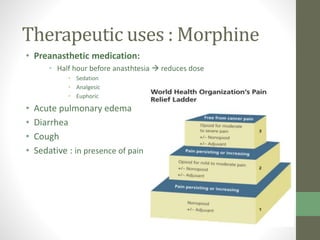
• Preanasthetic medication:
• Half hour before anasthtesia  reduces dose
• Sedation
• Analgesic
• Euphoric
• Acute pulmonary edema
• Diarrhea
• Cough
• Sedative : in presence of pain
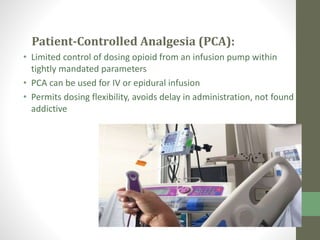
Patient-Controlled Analgesia (PCA):
• Limited control of dosing opioid from an infusion pump within
tightly mandated parameters
• PCA can be used for IV or epidural infusion
• Permits dosing flexibility, avoids delay in administration, not found
addictive
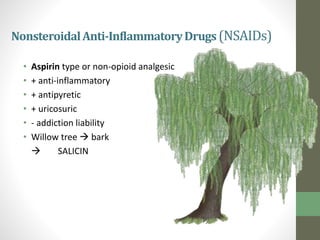
NonsteroidalAnti-InflammatoryDrugs(NSAIDs)
• Aspirin type or non-opioid analgesic
• + anti-inflammatory
• + antipyretic
• + uricosuric
• - addiction liability
• Willow tree  bark
 SALICIN
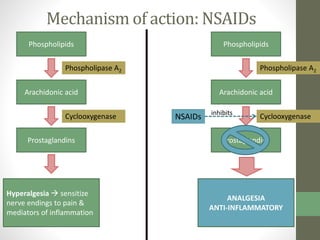
Phospholipids
Arachidonic acid
Prostaglandins
Hyperalgesia  sensitize
nerve endings to pain &
mediators of inflammation
Phospholipase A2
Cyclooxygenase
Phospholipids
Arachidonic acid
Prostaglandins
ANALGESIA
ANTI-INFLAMMATORY
Phospholipase A2
Cyclooxygenase
NSAIDs inhibits
Mechanism of action: NSAIDs
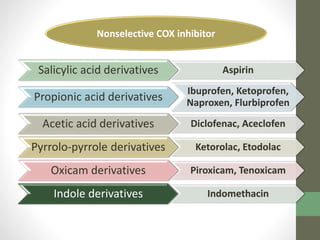
Salicylic acid derivatives Aspirin
Propionic acid derivatives
Ibuprofen, Ketoprofen,
Naproxen, Flurbiprofen
Acetic acid derivatives Diclofenac, Aceclofen
Pyrrolo-pyrrole derivatives Ketorolac, Etodolac
Oxicam derivatives Piroxicam, Tenoxicam
Indole derivatives Indomethacin
Nonselective COX inhibitor
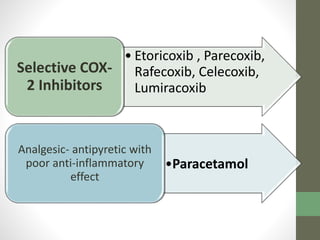
• Etoricoxib , Parecoxib,
Rafecoxib, Celecoxib,
Lumiracoxib
Selective COX-
2 Inhibitors
•Paracetamol
Analgesic- antipyretic with
poor anti-inflammatory
effect
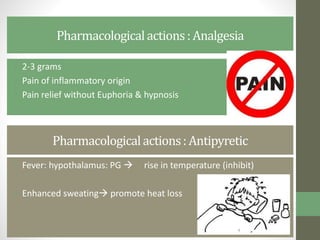
Pharmacologicalactions: Analgesia
• 2-3 grams
• Pain of inflammatory origin
• Pain relief without Euphoria & hypnosis
Pharmacologicalactions: Antipyretic
• Fever: hypothalamus: PG  rise in temperature (inhibit)
• Enhanced sweating promote heat loss
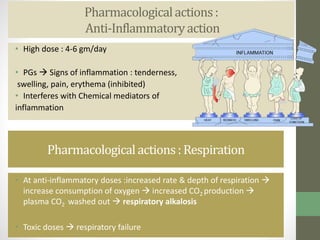
Pharmacologicalactions:
Anti-Inflammatoryaction
• High dose : 4-6 gm/day
• PGs  Signs of inflammation : tenderness,
swelling, pain, erythema (inhibited)
• Interferes with Chemical mediators of
inflammation
Pharmacologicalactions: Respiration
• At anti-inflammatory doses :increased rate & depth of respiration 
increase consumption of oxygen  increased CO2 production 
plasma CO2 washed out  respiratory alkalosis
• Toxic doses  respiratory failure
Pharmacologicalactions:
Acid- base& electrolytebalance
• Respiratory alkalosis  pH alkaline  increased excretion of
bicarbonates in urine
• Toxic doses  respiratory center depression  CO2 accumulation
 decrease in pH  acidosis
• Severe Dehydration + Acidosis
• Water loss in urine
• Increased sweating
• Hyperventilation
Pharmacologicalactions: GIT
• Gastric mucosal irritant  epigastric distress, nausea, vomiting
• Higher doses  gastric erosion, ulceration, GI bleeding
• Suppress protective effect of PGs
• Decreased platelet aggregation  increased chances of bleeding
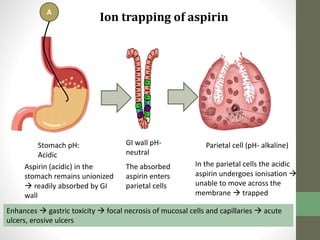
• Ion trapping of aspirin
Stomach pH:
Acidic
Parietal cell (pH- alkaline)
A
Aspirin (acidic) in the
stomach remains unionized
 readily absorbed by GI
wall
The absorbed
aspirin enters
parietal cells
In the parietal cells the acidic
aspirin undergoes ionisation 
unable to move across the
membrane  trapped
Ion trapping of aspirin
Enhances  gastric toxicity  focal necrosis of mucosal cells and capillaries  acute
ulcers, erosive ulcers
GI wall pH-
neutral
Pharmacologicalactions:
Uric acid excretion
• 1-2 gm/day : Decreases urate excretion  increase plasma urate
levels
• Cannot be used in treatment of GOUT : requires high doses 
severe A/E
Pharmacologicalactions: Blood
• Small doses : X TXA2 synthesis by platelets  platelet aggregation
 prolong bleeding time
Adverseeffects
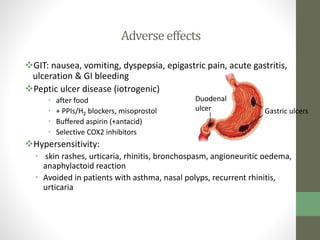
GIT: nausea, vomiting, dyspepsia, epigastric pain, acute gastritis,
ulceration & GI bleeding
Peptic ulcer disease (iotrogenic)
• after food
• + PPIs/H2 blockers, misoprostol
• Buffered aspirin (+antacid)
• Selective COX2 inhibitors
Hypersensitivity:
• skin rashes, urticaria, rhinitis, bronchospasm, angioneuritic oedema,
anaphylactoid reaction
• Avoided in patients with asthma, nasal polyps, recurrent rhinitis,
urticaria
Gastric ulcers
Duodenal
ulcer
Adverseeffect
Hepatotoxicity
Reye’s syndrome : children with viral infection  hepatic damage
Aspirin c/I in children with viral fever
Pregnancy : full term pregnancy : delay onset of labor ; increased
incidence of PPH
Contraindication
• Peptic ulcer
• Liver diseases
• bleeding tendencies
• Children with viral fever
• Pregnancy
• Before surgery : treatment be stopped one week prior
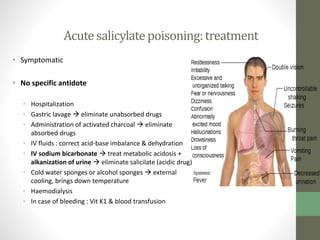
Acutesalicylatepoisoning:treatment
• Symptomatic
• No specific antidote
• Hospitalization
• Gastric lavage  eliminate unabsorbed drugs
• Administration of activated charcoal  eliminate
absorbed drugs
• IV fluids : correct acid-base imbalance & dehydration
• IV sodium bicarbonate  treat metabolic acidosis +
alkanization of urine  eliminate salicilate (acidic drug)
• Cold water sponges or alcohol sponges  external
cooling, brings down temperature
• Haemodialysis
• In case of bleeding : Vit K1 & blood transfusion
Therapeuticuses
• Analgesic : headache, backache. Myalgia, arthralgias, neuralgias,
toothache, dysmenorrhea
• Fever : symptomatic relief
• Inflammatory conditions : arthritis , fibromyositis
• Acute rheumatic fever : 4-6g/day : relief of signs & symptoms in 24-
48 hrs
TherapeuticUses
• Rheumatoid arthritis : analgesic & antiinflammatory : symptomatic
relief ; no stoppage of progression of disease
• 4-6 g/day in 4-6 devided doses
• Osteoarthritis : symptomatic relief
• Post myocardial infraction : aspirin low dose : platelet aggrgation
inhibition  prevent reinfraction
• Decrease incidence of stroke
• Delay labor
Acetaminophen/ Paracetamol: actions
• Analgesic
• Antipyretic
• Anti inflammatory : WEAK
• Peroxide at the site of inflammation : reduce cyclooxygenase degrading property
 poor antiinflammatory
• Does not stimulate respiration
• Has no action on acid-base balance, cellular metabolism, CVS, Platelet function
• Not uricosuric
• Mild gastric irritation
Paracetamol : Uses
• Analgesic in painful conditions like toothache, headache, Myalgia
Antipyretic in fever
Paracetamol: Adverseeffect
• Large doses : acute paracetamol poisoning
• 10-15g/day adults
• Nausea, vomiting, anorexia & abdominal pain
• Hepatotoxic : reversible
• 2-4 days
• Serum transaminase, jaundice, liver tenderness, prolonged
prothrombin time
•  liver failure
• Nephrotoxic  acute renal failure
Paracetamoltoxicity
• Hepatotoxicity
• Nausea, vomiting, diarrhae, abdominal pain, hypotension, coma
• Metabolized to toxic compound  N-acteyl p-benzoquinone-imine 
destroyed due to conjugation with glutathione
• Large doses , uses up all the glutathione & the metabolite levels increases
• NAPQI   proteins (liver &Kidney)  hepatic necrosis
• Chronic alcoholics & infants more prone
• Treatment for toxicity:
• Stomach wash
• Activated charcoal
• N-acetylcystein / oral methionine  replenish glutathione stores
Diclofenac
• Good tissue penetrability
• Good concentration in synovial fluids
• Mild A/E
• Dose: 50 mg BD-TDS
• Gel for topical application
• Ophthalmic preparations for post operative pain
• Uses:
• Rheumatoid arthritis
• Osteoarthritis
• Acute musculoskeletal pain
• Post operative : relief of pain & inflamation
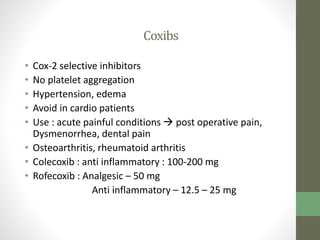
Coxibs
• Cox-2 selective inhibitors
• No platelet aggregation
• Hypertension, edema
• Avoid in cardio patients
• Use : acute painful conditions  post operative pain,
Dysmenorrhea, dental pain
• Osteoarthritis, rheumatoid arthritis
• Colecoxib : anti inflammatory : 100-200 mg
• Rofecoxib : Analgesic – 50 mg
Anti inflammatory – 12.5 – 25 mg
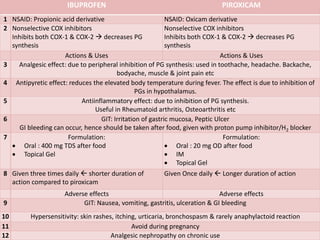
IBUPROFEN PIROXICAM
1 NSAID: Propionic acid derivative NSAID: Oxicam derivative
2 Nonselective COX inhibitors
Inhibits both COX-1 & COX-2  decreases PG
synthesis
Nonselective COX inhibitors
Inhibits both COX-1 & COX-2  decreases PG
synthesis
Actions & Uses Actions & Uses
3 Analgesic effect: due to peripheral inhibition of PG synthesis: used in toothache, headache. Backache,
bodyache, muscle & joint pain etc
4 Antipyretic effect: reduces the elevated body temperature during fever. The effect is due to inhibition of
PGs in hypothalamus.
5 Antiinflammatory effect: due to inhibition of PG synthesis.
Useful in Rheumatoid arthritis, Osteoarthritis etc
6 GIT: Irritation of gastric mucosa, Peptic Ulcer
GI bleeding can occur, hence should be taken after food, given with proton pump inhibitor/H2 blocker
7 Formulation:
 Oral : 400 mg TDS after food
 Topical Gel
Formulation:
 Oral : 20 mg OD after food
 IM
 Topical Gel
8 Given three times daily  shorter duration of
action compared to piroxicam
Given Once daily  Longer duration of action
Adverse effects Adverse effects
9 GIT: Nausea, vomiting, gastritis, ulceration & GI bleeding
10 Hypersensitivity: skin rashes, itching, urticaria, bronchospasm & rarely anaphylactoid reaction
11 Avoid during pregnancy
12 Analgesic nephropathy on chronic use
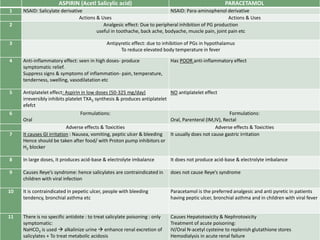
ASPIRIN (Acetl Salicylic acid) PARACETAMOL
1 NSAID: Salicylate derivative NSAID: Para-aminophenol derivative
Actions & Uses Actions & Uses
2 Analgesic effect: Due to peripheral inhibition of PG production
useful in toothache, back ache, bodyache, muscle pain, joint pain etc
3 Antipyretic effect: due to inhibition of PGs in hypothalamus
To reduce elevated body temperature in fever
4 Anti-inflammatory effect: seen in high doses- produce
symptomatic relief.
Suppress signs & symptoms of inflammation- pain, temperature,
tenderness, swelling, vasodilatation etc
Has POOR anti-inflammatory effect
5 Antiplatelet effect: Aspirin in low doses (50-325 mg/day)
irreversibly inhibits platelet TXA2 synthesis & produces antiplatelet
efefct
NO antiplatelet effect
6 Formulations:
Oral
Formulations:
Oral, Parenteral (IM,IV), Rectal
Adverse effects & Toxicities Adverse effects & Toxicities
7 It causes GI irritation : Nausea, vomiting, peptic ulcer & bleeding
Hence should be taken after food/ with Proton pump inhibitors or
H2 blocker
It usually does not cause gastric irritation
8 In large doses, it produces acid-base & electrolyte imbalance It does not produce acid-base & electrolyte imbalance
9 Causes Reye’s syndrome: hence salicylates are contraindicated in
children with viral infection
does not cause Reye’s syndrome
10 It is contraindicated in pepetic ulcer, people with bleeding
tendency, bronchial asthma etc
Paracetamol is the preferred analgesic and anti pyretic in patients
having peptic ulcer, bronchial asthma and in children with viral fever
11 There is no specific antidote : to treat salicylate poisoning : only
symptomatic:
NaHCO3 is used  alkalinize urine  enhance renal excretion of
salicylates + To treat metabolic acidosis
Causes Hepatotoxicity & Nephrotoxicity
Treatment of acute poisoning:
IV/Oral N-acetyl cysteine to replenish glutathione stores
Hemodialysis in acute renal failure

Analgesics opoids+ NSAIDs -nursing

  • 1.
  • 2.
    OPIOIDS  Opium isextracted from poppy seeds (Papaver somniferum)  Used for thousands of years to produce:  Euphoria  Analgesia  Sedation  Relief from diarrhea (loperamide)  Cough suppression
  • 3.
  • 4.
    MORPHINE Morphine relieves Pain Sick feeling associatedwith sickness: EUPHORIA •Fear •Anxiety •Apprehension (reaction to pain)
  • 5.
    MORPHINE : Pharmacologicalaction CNSDEPRESSANT EFFECTS: Analgesic effect: Perception of pain & reaction to pain : fear, anxiety Euphoria: Feeling of well being Sedation: drowsiness Respiratory depression: opioid poisoning : death Cough suppression: Cough center in medulla Miosis: Pinpoint pupils CTZ: Nausea & Vomiting Physical & Psychological dependence Histamine release: Skin rashes, urticaria, bronchoconstriction
  • 6.
    MORPHINE : Pharmacologicalaction •CVS • Vasodilatation  fall in BP • Bradycardia: stimulation of vagal center in the brain • GIT: Constipation • Urinary Bladder: Urinary retention • Bronchia: Bronchospasm
  • 7.
    Adverse effects • Nausea,vomiting • Constipation • Respiratory depression • In new born if administered to pregnant • Hypotension • Drowsiness • Confusion, mental clouding • Itching & skin rashes • Difficulty in micturition • Tolerance • Dependence
  • 8.
    • Treatment: • Hospitalization •Gradual withdrawal • Substitution therapy : methadone • Antagonist: naltrexone after detoxification  opioid blockade  prevent relapse • Psychotherapy, occupational therapy, community treatment & rehabilitation Morphine dependence AcuteMorphine/OpioidPoisoning Treatment:  Hospitalization  Maintain airway, breathing, circulation  Ventilatory support  Gastric lavage (KMNO4)  Antidote: NALOXONE  Short duration  repeated doses till easy respiration is established
  • 9.
    Contraindication of morphine •Head injury: • Increased intracranial pressure interferes with assessment of progress • Bronchial asthma: • Histamine release  asthma attack • COPD • Hypotensive states • Infants & old people: respiratory depression • Undiagnosed acute abdominal pain • Spasmogenic effect  aggravate pain • Masks the pain if given before diagnosis
  • 10.
    Therapeutic uses :Morphine • ANALGESIC: • Acut myocardial infarction • Burns • Pulmonary embolism • Fracture of mandible and long bones • Bullet wounds • Renal & biliary colic [ + atropine to control spasmogenic effect of morphine] • Terminal stage of cancer
  • 11.
    Therapeutic uses :Morphine • Preanasthetic medication: • Half hour before anasthtesia  reduces dose • Sedation • Analgesic • Euphoric • Acute pulmonary edema • Diarrhea • Cough • Sedative : in presence of pain
  • 12.
    Patient-Controlled Analgesia (PCA): •Limited control of dosing opioid from an infusion pump within tightly mandated parameters • PCA can be used for IV or epidural infusion • Permits dosing flexibility, avoids delay in administration, not found addictive
  • 13.
    NonsteroidalAnti-InflammatoryDrugs(NSAIDs) • Aspirin typeor non-opioid analgesic • + anti-inflammatory • + antipyretic • + uricosuric • - addiction liability • Willow tree  bark  SALICIN
  • 14.
    Phospholipids Arachidonic acid Prostaglandins Hyperalgesia sensitize nerve endings to pain & mediators of inflammation Phospholipase A2 Cyclooxygenase Phospholipids Arachidonic acid Prostaglandins ANALGESIA ANTI-INFLAMMATORY Phospholipase A2 Cyclooxygenase NSAIDs inhibits Mechanism of action: NSAIDs
  • 15.
    Salicylic acid derivativesAspirin Propionic acid derivatives Ibuprofen, Ketoprofen, Naproxen, Flurbiprofen Acetic acid derivatives Diclofenac, Aceclofen Pyrrolo-pyrrole derivatives Ketorolac, Etodolac Oxicam derivatives Piroxicam, Tenoxicam Indole derivatives Indomethacin Nonselective COX inhibitor
  • 16.
    • Etoricoxib ,Parecoxib, Rafecoxib, Celecoxib, Lumiracoxib Selective COX- 2 Inhibitors •Paracetamol Analgesic- antipyretic with poor anti-inflammatory effect
  • 17.
    Pharmacologicalactions: Analgesia • 2-3grams • Pain of inflammatory origin • Pain relief without Euphoria & hypnosis Pharmacologicalactions: Antipyretic • Fever: hypothalamus: PG  rise in temperature (inhibit) • Enhanced sweating promote heat loss
  • 18.
    Pharmacologicalactions: Anti-Inflammatoryaction • High dose: 4-6 gm/day • PGs  Signs of inflammation : tenderness, swelling, pain, erythema (inhibited) • Interferes with Chemical mediators of inflammation Pharmacologicalactions: Respiration • At anti-inflammatory doses :increased rate & depth of respiration  increase consumption of oxygen  increased CO2 production  plasma CO2 washed out  respiratory alkalosis • Toxic doses  respiratory failure
  • 19.
    Pharmacologicalactions: Acid- base& electrolytebalance •Respiratory alkalosis  pH alkaline  increased excretion of bicarbonates in urine • Toxic doses  respiratory center depression  CO2 accumulation  decrease in pH  acidosis • Severe Dehydration + Acidosis • Water loss in urine • Increased sweating • Hyperventilation
  • 20.
    Pharmacologicalactions: GIT • Gastricmucosal irritant  epigastric distress, nausea, vomiting • Higher doses  gastric erosion, ulceration, GI bleeding • Suppress protective effect of PGs • Decreased platelet aggregation  increased chances of bleeding • Ion trapping of aspirin
  • 21.
    Stomach pH: Acidic Parietal cell(pH- alkaline) A Aspirin (acidic) in the stomach remains unionized  readily absorbed by GI wall The absorbed aspirin enters parietal cells In the parietal cells the acidic aspirin undergoes ionisation  unable to move across the membrane  trapped Ion trapping of aspirin Enhances  gastric toxicity  focal necrosis of mucosal cells and capillaries  acute ulcers, erosive ulcers GI wall pH- neutral
  • 22.
    Pharmacologicalactions: Uric acid excretion •1-2 gm/day : Decreases urate excretion  increase plasma urate levels • Cannot be used in treatment of GOUT : requires high doses  severe A/E Pharmacologicalactions: Blood • Small doses : X TXA2 synthesis by platelets  platelet aggregation  prolong bleeding time
  • 23.
    Adverseeffects GIT: nausea, vomiting,dyspepsia, epigastric pain, acute gastritis, ulceration & GI bleeding Peptic ulcer disease (iotrogenic) • after food • + PPIs/H2 blockers, misoprostol • Buffered aspirin (+antacid) • Selective COX2 inhibitors Hypersensitivity: • skin rashes, urticaria, rhinitis, bronchospasm, angioneuritic oedema, anaphylactoid reaction • Avoided in patients with asthma, nasal polyps, recurrent rhinitis, urticaria Gastric ulcers Duodenal ulcer
  • 24.
    Adverseeffect Hepatotoxicity Reye’s syndrome :children with viral infection  hepatic damage Aspirin c/I in children with viral fever Pregnancy : full term pregnancy : delay onset of labor ; increased incidence of PPH Contraindication • Peptic ulcer • Liver diseases • bleeding tendencies • Children with viral fever • Pregnancy • Before surgery : treatment be stopped one week prior
  • 25.
    Acutesalicylatepoisoning:treatment • Symptomatic • Nospecific antidote • Hospitalization • Gastric lavage  eliminate unabsorbed drugs • Administration of activated charcoal  eliminate absorbed drugs • IV fluids : correct acid-base imbalance & dehydration • IV sodium bicarbonate  treat metabolic acidosis + alkanization of urine  eliminate salicilate (acidic drug) • Cold water sponges or alcohol sponges  external cooling, brings down temperature • Haemodialysis • In case of bleeding : Vit K1 & blood transfusion
  • 26.
    Therapeuticuses • Analgesic :headache, backache. Myalgia, arthralgias, neuralgias, toothache, dysmenorrhea • Fever : symptomatic relief • Inflammatory conditions : arthritis , fibromyositis • Acute rheumatic fever : 4-6g/day : relief of signs & symptoms in 24- 48 hrs
  • 27.
    TherapeuticUses • Rheumatoid arthritis: analgesic & antiinflammatory : symptomatic relief ; no stoppage of progression of disease • 4-6 g/day in 4-6 devided doses • Osteoarthritis : symptomatic relief • Post myocardial infraction : aspirin low dose : platelet aggrgation inhibition  prevent reinfraction • Decrease incidence of stroke • Delay labor
  • 28.
    Acetaminophen/ Paracetamol: actions •Analgesic • Antipyretic • Anti inflammatory : WEAK • Peroxide at the site of inflammation : reduce cyclooxygenase degrading property  poor antiinflammatory • Does not stimulate respiration • Has no action on acid-base balance, cellular metabolism, CVS, Platelet function • Not uricosuric • Mild gastric irritation Paracetamol : Uses • Analgesic in painful conditions like toothache, headache, Myalgia Antipyretic in fever
  • 29.
    Paracetamol: Adverseeffect • Largedoses : acute paracetamol poisoning • 10-15g/day adults • Nausea, vomiting, anorexia & abdominal pain • Hepatotoxic : reversible • 2-4 days • Serum transaminase, jaundice, liver tenderness, prolonged prothrombin time •  liver failure • Nephrotoxic  acute renal failure
  • 30.
    Paracetamoltoxicity • Hepatotoxicity • Nausea,vomiting, diarrhae, abdominal pain, hypotension, coma • Metabolized to toxic compound  N-acteyl p-benzoquinone-imine  destroyed due to conjugation with glutathione • Large doses , uses up all the glutathione & the metabolite levels increases • NAPQI   proteins (liver &Kidney)  hepatic necrosis • Chronic alcoholics & infants more prone • Treatment for toxicity: • Stomach wash • Activated charcoal • N-acetylcystein / oral methionine  replenish glutathione stores
  • 31.
    Diclofenac • Good tissuepenetrability • Good concentration in synovial fluids • Mild A/E • Dose: 50 mg BD-TDS • Gel for topical application • Ophthalmic preparations for post operative pain • Uses: • Rheumatoid arthritis • Osteoarthritis • Acute musculoskeletal pain • Post operative : relief of pain & inflamation
  • 32.
    Coxibs • Cox-2 selectiveinhibitors • No platelet aggregation • Hypertension, edema • Avoid in cardio patients • Use : acute painful conditions  post operative pain, Dysmenorrhea, dental pain • Osteoarthritis, rheumatoid arthritis • Colecoxib : anti inflammatory : 100-200 mg • Rofecoxib : Analgesic – 50 mg Anti inflammatory – 12.5 – 25 mg
  • 33.
    IBUPROFEN PIROXICAM 1 NSAID:Propionic acid derivative NSAID: Oxicam derivative 2 Nonselective COX inhibitors Inhibits both COX-1 & COX-2  decreases PG synthesis Nonselective COX inhibitors Inhibits both COX-1 & COX-2  decreases PG synthesis Actions & Uses Actions & Uses 3 Analgesic effect: due to peripheral inhibition of PG synthesis: used in toothache, headache. Backache, bodyache, muscle & joint pain etc 4 Antipyretic effect: reduces the elevated body temperature during fever. The effect is due to inhibition of PGs in hypothalamus. 5 Antiinflammatory effect: due to inhibition of PG synthesis. Useful in Rheumatoid arthritis, Osteoarthritis etc 6 GIT: Irritation of gastric mucosa, Peptic Ulcer GI bleeding can occur, hence should be taken after food, given with proton pump inhibitor/H2 blocker 7 Formulation:  Oral : 400 mg TDS after food  Topical Gel Formulation:  Oral : 20 mg OD after food  IM  Topical Gel 8 Given three times daily  shorter duration of action compared to piroxicam Given Once daily  Longer duration of action Adverse effects Adverse effects 9 GIT: Nausea, vomiting, gastritis, ulceration & GI bleeding 10 Hypersensitivity: skin rashes, itching, urticaria, bronchospasm & rarely anaphylactoid reaction 11 Avoid during pregnancy 12 Analgesic nephropathy on chronic use
  • 34.
    ASPIRIN (Acetl Salicylicacid) PARACETAMOL 1 NSAID: Salicylate derivative NSAID: Para-aminophenol derivative Actions & Uses Actions & Uses 2 Analgesic effect: Due to peripheral inhibition of PG production useful in toothache, back ache, bodyache, muscle pain, joint pain etc 3 Antipyretic effect: due to inhibition of PGs in hypothalamus To reduce elevated body temperature in fever 4 Anti-inflammatory effect: seen in high doses- produce symptomatic relief. Suppress signs & symptoms of inflammation- pain, temperature, tenderness, swelling, vasodilatation etc Has POOR anti-inflammatory effect 5 Antiplatelet effect: Aspirin in low doses (50-325 mg/day) irreversibly inhibits platelet TXA2 synthesis & produces antiplatelet efefct NO antiplatelet effect 6 Formulations: Oral Formulations: Oral, Parenteral (IM,IV), Rectal Adverse effects & Toxicities Adverse effects & Toxicities 7 It causes GI irritation : Nausea, vomiting, peptic ulcer & bleeding Hence should be taken after food/ with Proton pump inhibitors or H2 blocker It usually does not cause gastric irritation 8 In large doses, it produces acid-base & electrolyte imbalance It does not produce acid-base & electrolyte imbalance 9 Causes Reye’s syndrome: hence salicylates are contraindicated in children with viral infection does not cause Reye’s syndrome 10 It is contraindicated in pepetic ulcer, people with bleeding tendency, bronchial asthma etc Paracetamol is the preferred analgesic and anti pyretic in patients having peptic ulcer, bronchial asthma and in children with viral fever 11 There is no specific antidote : to treat salicylate poisoning : only symptomatic: NaHCO3 is used  alkalinize urine  enhance renal excretion of salicylates + To treat metabolic acidosis Causes Hepatotoxicity & Nephrotoxicity Treatment of acute poisoning: IV/Oral N-acetyl cysteine to replenish glutathione stores Hemodialysis in acute renal failure

Editor's Notes

  • #3 Morpheus ; greek God of dreams