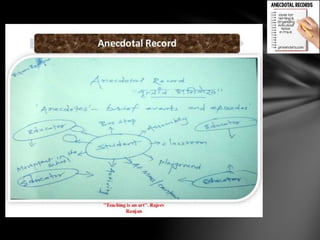
Anecdotal Record
By:- Prof. Paramjit Singh and Yudhpreet Singh
Assistant Professor
Khalsa College of Education, Ranjit
Avenue, Amritsar.
In Educational
Psychology there
are Tools and
Techniques.
Tools and techniques of Educational Psychology
Tools for data collection
The term tool refers to any device or
implement used collect factual information or data
required for the study of some phenomenon or a
problem.
Tools are used to systematically record
information or to precisely measure the data.
Tools and techniques of Educational Psychology
The important tools used for collecting
data in the field of Educational psychology
are the following:
 Tests
 Anecdotal Record
 Cumulative Record
 Check List
 Rating Scale
 Questionnaire
 Psychological Test
Tools and techniques of Educational Psychology
Anecdotal
Record
An anecdote is an
account of an event in a
child’s day. The record
of this event can be
detailed or brief. These
short reports describe,
in a factual way, the
incident, its context, and
what was said or done
by children.
INTRODUCTION:-
What is Anecdotal Record?
Objective account of pupil behaviour
Incidental (informal) observation
Specific description not generalised
Cater significant incidents
Tools and techniques of Educational Psychology
A factual record of an observation of a
single specific, significant incident in the
behavior of a student. It is a written
description of a specific incident for which a
teacher has observed.
According to Brown and Martin,
Anecdotes are descriptive
accounts of episodes or
occurrences in the daily life of the
student.
According to Raths Louis, An
Anecdotal record is a report of a
significant episode in the life of a
student.
Tools and techniques of Educational Psychology
According to Traxler, this record, as the
name implies, involves setting down an
Anecdote concerning some aspect of
pupil behaviour which seems significant
to the observer.
According to Zann, D. Willard, an
anecdotal record as a simple
statement of an incident deemed by
the observer to be significant with
respect to a given pupil.
Tools and techniques of Educational Psychology
contain a factual description of:-
what happened,
when it happened
under what circumstance
the behavior occurred.
contain a record of single
incident.
significant to the pupil’s
growth and development.
CHARACTERISTICS:-
Continued…
 Notes written by the teacher regarding student language
behavior, or learning.
Where teachers
document and
describe significant
daily events, and
relevant aspects of
student activity and
progress.
 Are taken during student activities or
at the end of the day.
 to provide
information
about students'
development
over an
extended
period of time.
to identify the instructional needs of students.
• Concentrate on only one on two behavior
observation should be selective.
• Record should be complete.
• They should be kept by all teacher and not only
by the student teacher.
• Record the incident or action as soon as possible
after it has happened
PRINCIPLES:-
• They should have a compiled and field.
• The teacher should have practice and training in making
observation and writing Anecdotal record.
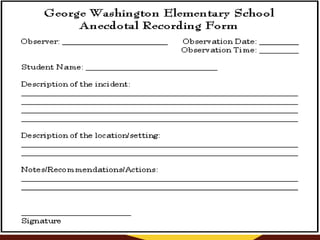
• Name of the student, class and school, date of
observation.
• Setting background of the incident.
• Recommendation concerning the behavior.
CONT..
Purpose of Anecdotal
Records
provide information regarding a student's
development over a period of time
provide ongoing records about
individual instructional needs
capture observations of significant
behaviors that might otherwise be lost
provide ongoing documentation of learning that may
be shared with students, parents and teachers.
ITEMS IN ANECDOTALRECORDS
• Torelate the incident correctly for drawing inferencesthe
following items to beincorporated.
• Thefirst part ofan anecdotal record should be factual, simple
and clear.
• Name of the students
• Unit/ ward/ department
• Date and time
• Brief report of whathappened.
Conti…
• Thesecond part of an anecdotal record may include
additional comments, analysis and conclusions basedon
interpretations andjudgments.
Advantages
Reasonablyeasyto do.
Do not stopyou from interacting with the child – can be
recorded later.
Useful for planning and learning.
You can focus on one area of development or skill at a
time.
No special training neededfor the observer.
Observer can catch an unexpected incident no matter
when it occurs, for it isusually recorded afterwards.
Theobservation can beusedtofocus specifically on the
behaviors of interest.
Disadvantages
Theobserver’sinvolvement may influence thechild’s
behavior.
Relieson the memory of theobserver.
Somedetail may beforgotten eg. Direct quotes.
Difficult tousefor researchpurposes.
Theobserver may overlook many crucial behaviors to
focus on a specific behavior.
Anacedotal record

Anacedotal record

  • 1.
    Anecdotal Record By:- Prof.Paramjit Singh and Yudhpreet Singh Assistant Professor Khalsa College of Education, Ranjit Avenue, Amritsar.
  • 2.
    In Educational Psychology there areTools and Techniques. Tools and techniques of Educational Psychology
  • 3.
    Tools for datacollection The term tool refers to any device or implement used collect factual information or data required for the study of some phenomenon or a problem. Tools are used to systematically record information or to precisely measure the data. Tools and techniques of Educational Psychology
  • 4.
    The important toolsused for collecting data in the field of Educational psychology are the following:  Tests  Anecdotal Record  Cumulative Record  Check List  Rating Scale  Questionnaire  Psychological Test Tools and techniques of Educational Psychology
  • 5.
  • 6.
    An anecdote isan account of an event in a child’s day. The record of this event can be detailed or brief. These short reports describe, in a factual way, the incident, its context, and what was said or done by children. INTRODUCTION:-
  • 7.
    What is AnecdotalRecord? Objective account of pupil behaviour Incidental (informal) observation Specific description not generalised Cater significant incidents Tools and techniques of Educational Psychology
  • 8.
    A factual recordof an observation of a single specific, significant incident in the behavior of a student. It is a written description of a specific incident for which a teacher has observed.
  • 10.
    According to Brownand Martin, Anecdotes are descriptive accounts of episodes or occurrences in the daily life of the student. According to Raths Louis, An Anecdotal record is a report of a significant episode in the life of a student. Tools and techniques of Educational Psychology
  • 11.
    According to Traxler,this record, as the name implies, involves setting down an Anecdote concerning some aspect of pupil behaviour which seems significant to the observer. According to Zann, D. Willard, an anecdotal record as a simple statement of an incident deemed by the observer to be significant with respect to a given pupil. Tools and techniques of Educational Psychology
  • 12.
    contain a factualdescription of:- what happened, when it happened under what circumstance the behavior occurred. contain a record of single incident. significant to the pupil’s growth and development. CHARACTERISTICS:-
  • 13.
    Continued…  Notes writtenby the teacher regarding student language behavior, or learning.
  • 14.
    Where teachers document and describesignificant daily events, and relevant aspects of student activity and progress.
  • 15.
     Are takenduring student activities or at the end of the day.
  • 16.
     to provide information aboutstudents' development over an extended period of time.
  • 17.
    to identify theinstructional needs of students.
  • 18.
    • Concentrate ononly one on two behavior observation should be selective. • Record should be complete. • They should be kept by all teacher and not only by the student teacher. • Record the incident or action as soon as possible after it has happened PRINCIPLES:-
  • 19.
    • They shouldhave a compiled and field. • The teacher should have practice and training in making observation and writing Anecdotal record. • Name of the student, class and school, date of observation. • Setting background of the incident. • Recommendation concerning the behavior. CONT..
  • 20.
  • 21.
    provide information regardinga student's development over a period of time
  • 22.
    provide ongoing recordsabout individual instructional needs
  • 23.
    capture observations ofsignificant behaviors that might otherwise be lost
  • 24.
    provide ongoing documentationof learning that may be shared with students, parents and teachers.
  • 25.
    ITEMS IN ANECDOTALRECORDS •Torelate the incident correctly for drawing inferencesthe following items to beincorporated. • Thefirst part ofan anecdotal record should be factual, simple and clear. • Name of the students • Unit/ ward/ department • Date and time • Brief report of whathappened.
  • 26.
    Conti… • Thesecond partof an anecdotal record may include additional comments, analysis and conclusions basedon interpretations andjudgments.
  • 35.
  • 36.
    Reasonablyeasyto do. Do notstopyou from interacting with the child – can be recorded later. Useful for planning and learning. You can focus on one area of development or skill at a time.
  • 37.
    No special trainingneededfor the observer. Observer can catch an unexpected incident no matter when it occurs, for it isusually recorded afterwards. Theobservation can beusedtofocus specifically on the behaviors of interest.
  • 38.
  • 39.
    Theobserver’sinvolvement may influencethechild’s behavior. Relieson the memory of theobserver. Somedetail may beforgotten eg. Direct quotes. Difficult tousefor researchpurposes. Theobserver may overlook many crucial behaviors to focus on a specific behavior.