Present simple tense
Use…
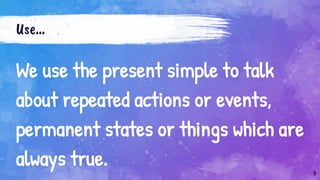
We use the present simple to talk
about repeated actions or events,
permanent states or things which are
always true. 2
How to form the simple present..
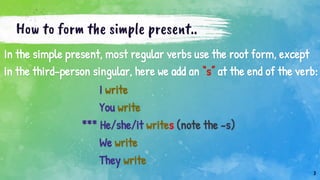
In the simple present, most regular verbs use the root form, except
in the third-person singular, here we add an “s” at the end of the verb:
I write
You write
*** He/she/it writes (note the -s)
We write
They write
3
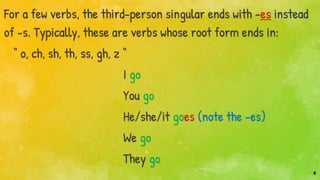
For a few verbs, the third-person singular ends with -es instead
of -s. Typically, these are verbs whose root form ends in:
“ o, ch, sh, th, ss, gh, z “
I go
You go
He/she/it goes (note the -es)
We go
They go
4
Be
I am
You are
He/she/it is
We are
They are
Irregular verbs:
5
Have
I have
You have
He/she/it has
We have
They have
6
How to make the simple present negative:
The formula for making a simple present verb negative is do/does +
not + root form of verb.
You can also use the contraction don’t or doesn’t
Examples:
Pauline does not want to share the pie.
She doesn’t think there is enough to go around.
Her friends do not agree.
I don’t want pie anyway.
7
To make the verb to be negative, the formula is:
be + not.
The verb to be is the only verb that does not require
an auxiliary in the negative form.
Examples:
I am not a pie lover, but Pauline sure is.
You aren’t ready for such delicious pie.
8
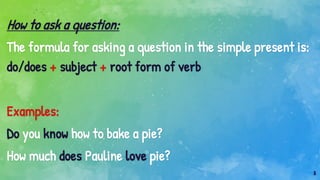
How to ask a question:
The formula for asking a question in the simple present is:
do/does + subject + root form of verb
Examples:
Do you know how to bake a pie?
How much does Pauline love pie?
9
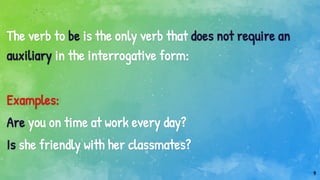
The verb to be is the only verb that does not require an
auxiliary in the interrogative form:
Examples:
Are you on time at work every day?
Is she friendly with her classmates?

Present simple tense rules English course

  • 1.
  • 2.
    Use… We use thepresent simple to talk about repeated actions or events, permanent states or things which are always true. 2
  • 3.
    How to formthe simple present.. In the simple present, most regular verbs use the root form, except in the third-person singular, here we add an “s” at the end of the verb: I write You write *** He/she/it writes (note the -s) We write They write 3
  • 4.
    For a fewverbs, the third-person singular ends with -es instead of -s. Typically, these are verbs whose root form ends in: “ o, ch, sh, th, ss, gh, z “ I go You go He/she/it goes (note the -es) We go They go 4
  • 5.
    Be I am You are He/she/itis We are They are Irregular verbs: 5 Have I have You have He/she/it has We have They have
  • 6.
    6 How to makethe simple present negative: The formula for making a simple present verb negative is do/does + not + root form of verb. You can also use the contraction don’t or doesn’t Examples: Pauline does not want to share the pie. She doesn’t think there is enough to go around. Her friends do not agree. I don’t want pie anyway.
  • 7.
    7 To make theverb to be negative, the formula is: be + not. The verb to be is the only verb that does not require an auxiliary in the negative form. Examples: I am not a pie lover, but Pauline sure is. You aren’t ready for such delicious pie.
  • 8.
    8 How to aska question: The formula for asking a question in the simple present is: do/does + subject + root form of verb Examples: Do you know how to bake a pie? How much does Pauline love pie?
  • 9.
    9 The verb tobe is the only verb that does not require an auxiliary in the interrogative form: Examples: Are you on time at work every day? Is she friendly with her classmates?