Bolivarian Republic of Venezuela
Polytechnic University Institute
"Santiago Marino"
San Cristobal Extension
School of Engineering of Industrial Design
Name: Romero kevin
C.I:25727931
Course: ingles I
San Cristóbal 14/02/2017
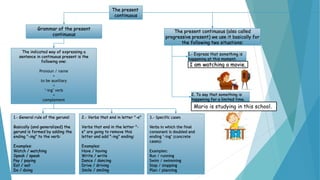
The present
continuous
The present continuous (also called
progressive present) we use it basically for
the following two situations:
1.- Express that something is
happening at this moment.
2. To say that something is
happening for a limited time.
Mario is studying in this school.
I am watching a movie.
Grammar of the present
continuous
The indicated way of expressing a
sentence in continuous present is the
following one:
Pronoun / name
+
to be auxiliary
+
"-ing" verb
+
complement
1.- General rule of the gerund:
Basically (and generalized) the
gerund is formed by adding the
ending "-ing" to the verb:
Examples:
Watch / watching
Speak / speak
Pay / paying
Eat / eat
Do / doing
2.- Verbs that end in letter "-e"
Verbs that end in the letter "-
e" are going to remove this
letter and add "-ing" ending:
Examples:
Have / having
Write / write
Dance / dancing
Drive / driving
Smile / smiling
3.- Specific cases
Verbs in which the final
consonant is doubled and
ending "-ing" (concrete
cases):
Examples:
Run / running
Swim / swimming
Stop / stopping
Plan / planning
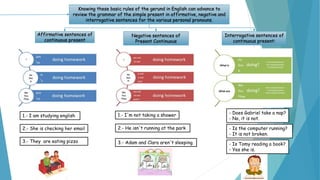
Knowing these basic rules of the gerund in English can advance to
review the grammar of the simple present in affirmative, negative and
interrogative sentences for the various personal pronouns.
Affirmative sentences of
continuous present
1.- I am studying english
2.- She is checking her email
3.- They are eating pizza
Negative sentences of
Present Continuous
1.- I'm not taking a shower
2.- He isn't running at the park
3.- Adam and Clara aren't sleeping.
Interrogative sentences of
continuous present:
- Does Gabriel take a nap?
- No, it is not.
- Is Tomy reading a book?
- Yes she is.
- Is the computer running?
- It is not broken.
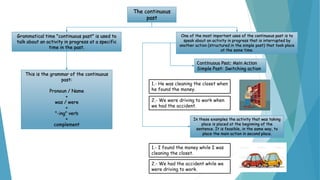
The continuous
past
Grammatical time "continuous past" is used to
talk about an activity in progress at a specific
time in the past.
This is the grammar of the continuous
past:
Pronoun / Name
+
was / were
+
"-ing" verb
+
complement
One of the most important uses of the continuous past is to
speak about an activity in progress that is interrupted by
another action (structured in the simple past) that took place
at the same time.
Continuous Past: Main Action
Simple Past: Switching action
1.- He was cleaning the closet when
he found the money.
2.- We were driving to work when
we had the accident.
In these examples the activity that was taking
place is placed at the beginning of the
sentence. It is feasible, in the same way, to
place the main action in second place.
1.- I found the money while I was
cleaning the closet.
2.- We had the accident while we
were driving to work.
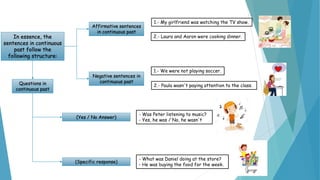
In essence, the
sentences in continuous
past follow the
following structure:
1.- My girlfriend was watching the TV show.
2.- Laura and Aaron were cooking dinner.
1.- We were not playing soccer.
2.- Paula wasn't paying attention to the class.
Affirmative sentences
in continuous past
Negative sentences in
continuous past
(Yes / No Answer)
- Was Peter listening to music?
- Yes, he was / No, he wasn't
(Specific response)
Questions in
continuous past
- What was Daniel doing at the store?
- He was buying the food for the week.

Ingles

  • 1.
    Bolivarian Republic ofVenezuela Polytechnic University Institute "Santiago Marino" San Cristobal Extension School of Engineering of Industrial Design Name: Romero kevin C.I:25727931 Course: ingles I San Cristóbal 14/02/2017
  • 2.
    The present continuous The presentcontinuous (also called progressive present) we use it basically for the following two situations: 1.- Express that something is happening at this moment. 2. To say that something is happening for a limited time. Mario is studying in this school. I am watching a movie. Grammar of the present continuous The indicated way of expressing a sentence in continuous present is the following one: Pronoun / name + to be auxiliary + "-ing" verb + complement 1.- General rule of the gerund: Basically (and generalized) the gerund is formed by adding the ending "-ing" to the verb: Examples: Watch / watching Speak / speak Pay / paying Eat / eat Do / doing 2.- Verbs that end in letter "-e" Verbs that end in the letter "- e" are going to remove this letter and add "-ing" ending: Examples: Have / having Write / write Dance / dancing Drive / driving Smile / smiling 3.- Specific cases Verbs in which the final consonant is doubled and ending "-ing" (concrete cases): Examples: Run / running Swim / swimming Stop / stopping Plan / planning
  • 3.
    Knowing these basicrules of the gerund in English can advance to review the grammar of the simple present in affirmative, negative and interrogative sentences for the various personal pronouns. Affirmative sentences of continuous present 1.- I am studying english 2.- She is checking her email 3.- They are eating pizza Negative sentences of Present Continuous 1.- I'm not taking a shower 2.- He isn't running at the park 3.- Adam and Clara aren't sleeping. Interrogative sentences of continuous present: - Does Gabriel take a nap? - No, it is not. - Is Tomy reading a book? - Yes she is. - Is the computer running? - It is not broken.
  • 4.
    The continuous past Grammatical time"continuous past" is used to talk about an activity in progress at a specific time in the past. This is the grammar of the continuous past: Pronoun / Name + was / were + "-ing" verb + complement One of the most important uses of the continuous past is to speak about an activity in progress that is interrupted by another action (structured in the simple past) that took place at the same time. Continuous Past: Main Action Simple Past: Switching action 1.- He was cleaning the closet when he found the money. 2.- We were driving to work when we had the accident. In these examples the activity that was taking place is placed at the beginning of the sentence. It is feasible, in the same way, to place the main action in second place. 1.- I found the money while I was cleaning the closet. 2.- We had the accident while we were driving to work.
  • 5.
    In essence, the sentencesin continuous past follow the following structure: 1.- My girlfriend was watching the TV show. 2.- Laura and Aaron were cooking dinner. 1.- We were not playing soccer. 2.- Paula wasn't paying attention to the class. Affirmative sentences in continuous past Negative sentences in continuous past (Yes / No Answer) - Was Peter listening to music? - Yes, he was / No, he wasn't (Specific response) Questions in continuous past - What was Daniel doing at the store? - He was buying the food for the week.