STUDY OF TALENT MANAGEMENT AT
TATA CONSULTANCY SERVICES
(TCS)
A
Presentation
ON
SUBMITTED BY
Mr. Swapnil A. Khobragade
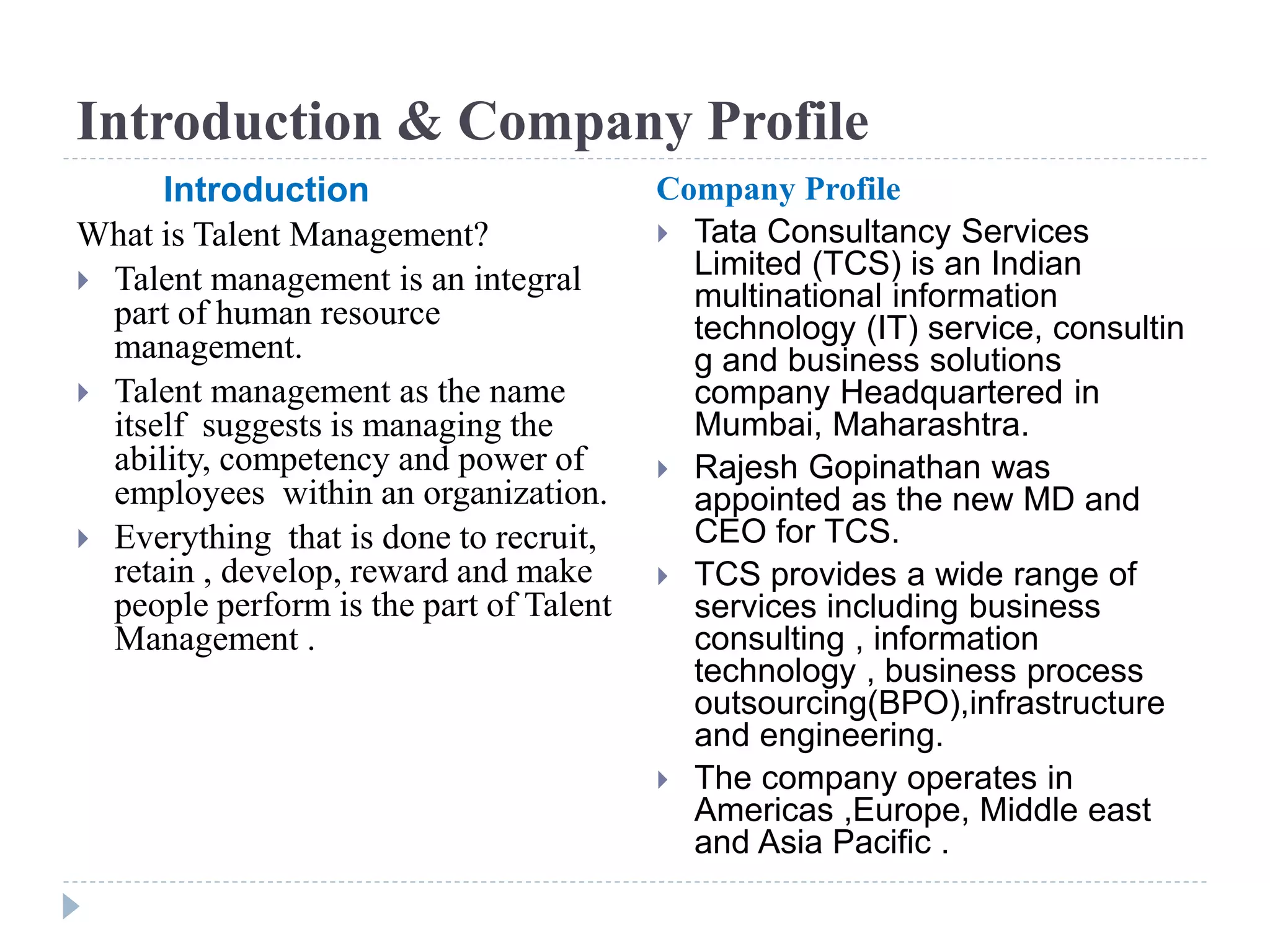
Introduction & Company Profile
Introduction
What is Talent Management?
 Talent management is an integral
part of human resource
management.
 Talent management as the name
itself suggests is managing the
ability, competency and power of
employees within an organization.
 Everything that is done to recruit,
retain , develop, reward and make
people perform is the part of Talent
Management .
Company Profile
 Tata Consultancy Services
Limited (TCS) is an Indian
multinational information
technology (IT) service, consultin
g and business solutions
company Headquartered in
Mumbai, Maharashtra.
 Rajesh Gopinathan was
appointed as the new MD and
CEO for TCS.
 TCS provides a wide range of
services including business
consulting , information
technology , business process
outsourcing(BPO),infrastructure
and engineering.
 The company operates in
Americas ,Europe, Middle east
and Asia Pacific .
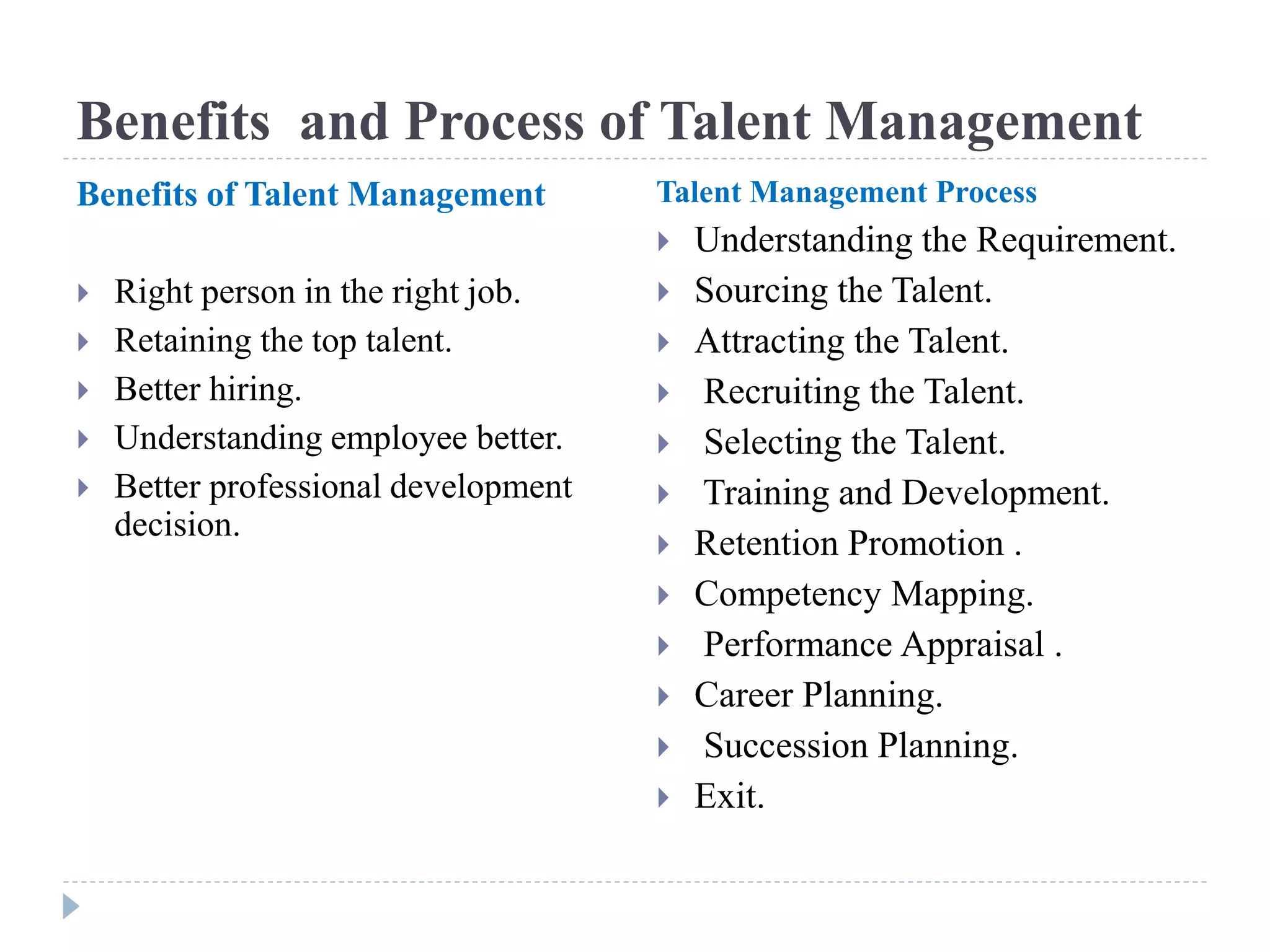
Benefits and Process of Talent Management
Benefits of Talent Management
 Right person in the right job.
 Retaining the top talent.
 Better hiring.
 Understanding employee better.
 Better professional development
decision.
Talent Management Process
 Understanding the Requirement.
 Sourcing the Talent.
 Attracting the Talent.
 Recruiting the Talent.
 Selecting the Talent.
 Training and Development.
 Retention Promotion .
 Competency Mapping.
 Performance Appraisal .
 Career Planning.
 Succession Planning.
 Exit.
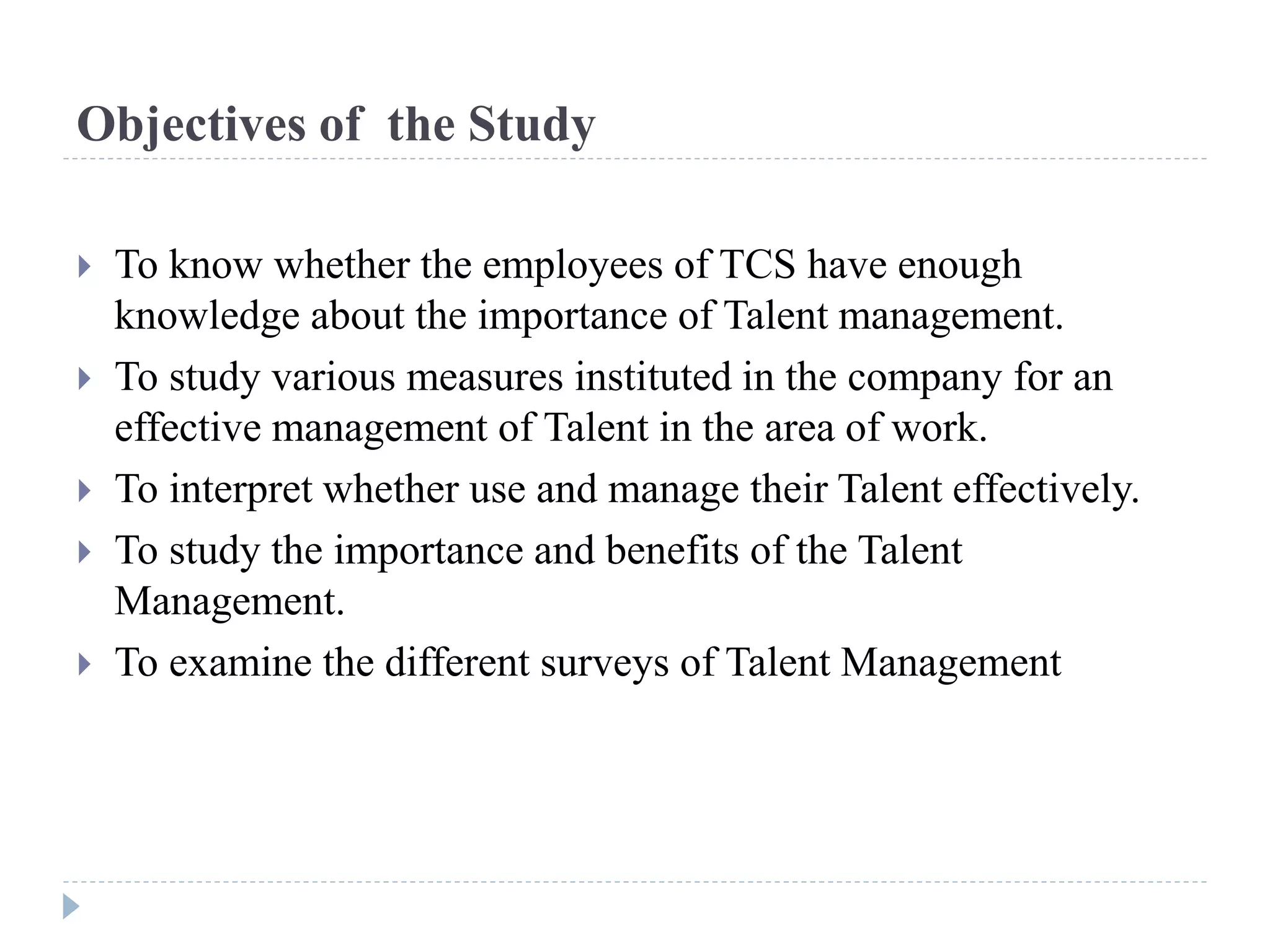
Objectives of the Study
 To know whether the employees of TCS have enough
knowledge about the importance of Talent management.
 To study various measures instituted in the company for an
effective management of Talent in the area of work.
 To interpret whether use and manage their Talent effectively.
 To study the importance and benefits of the Talent
Management.
 To examine the different surveys of Talent Management
Research Methodology
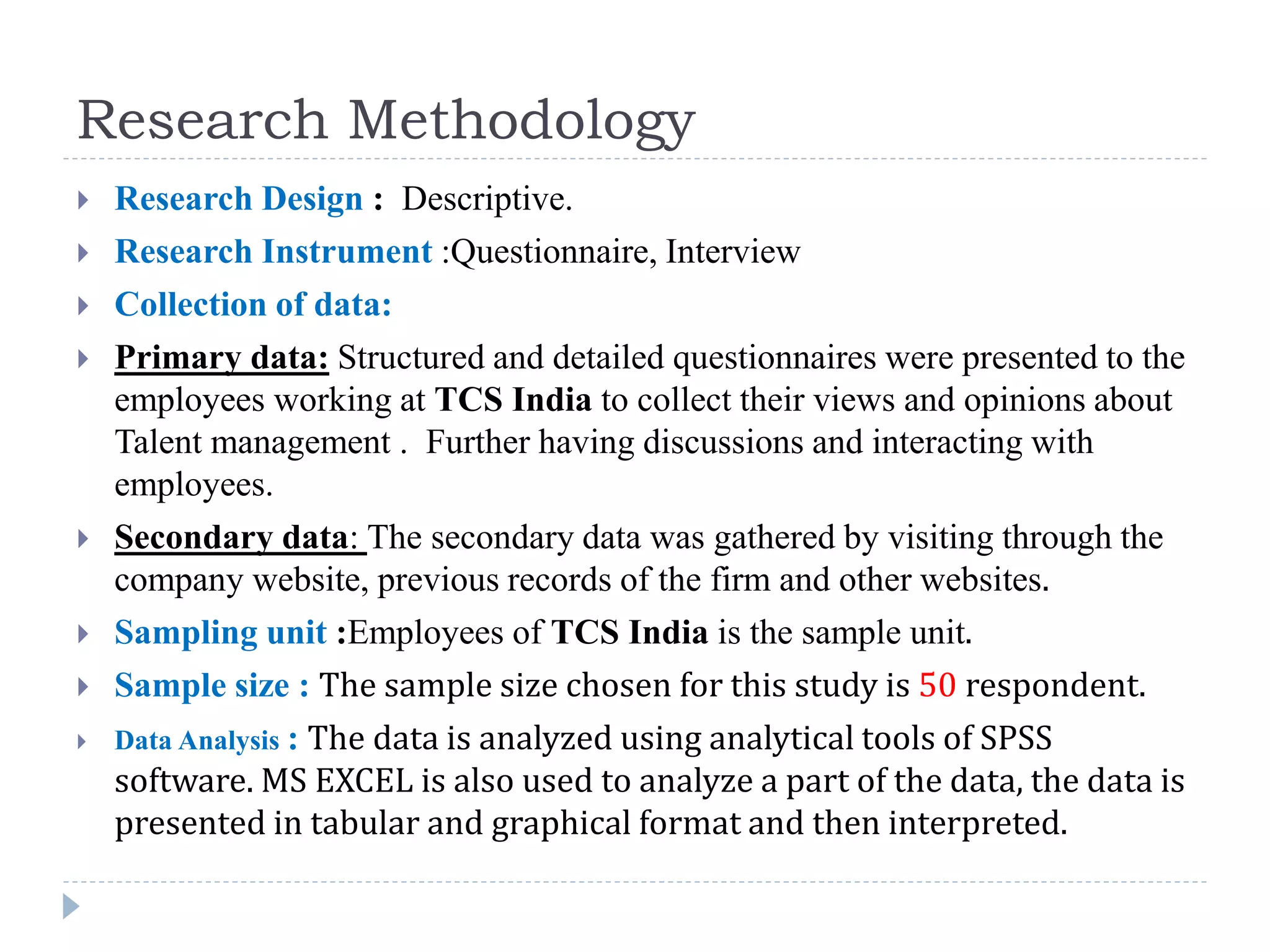
 Research Design : Descriptive.
 Research Instrument :Questionnaire, Interview
 Collection of data:
 Primary data: Structured and detailed questionnaires were presented to the
employees working at TCS India to collect their views and opinions about
Talent management . Further having discussions and interacting with
employees.
 Secondary data: The secondary data was gathered by visiting through the
company website, previous records of the firm and other websites.
 Sampling unit :Employees of TCS India is the sample unit.
 Sample size : The sample size chosen for this study is 50 respondent.
 Data Analysis : The data is analyzed using analytical tools of SPSS
software. MS EXCEL is also used to analyze a part of the data, the data is
presented in tabular and graphical format and then interpreted.
Data Analysis and Interpretation
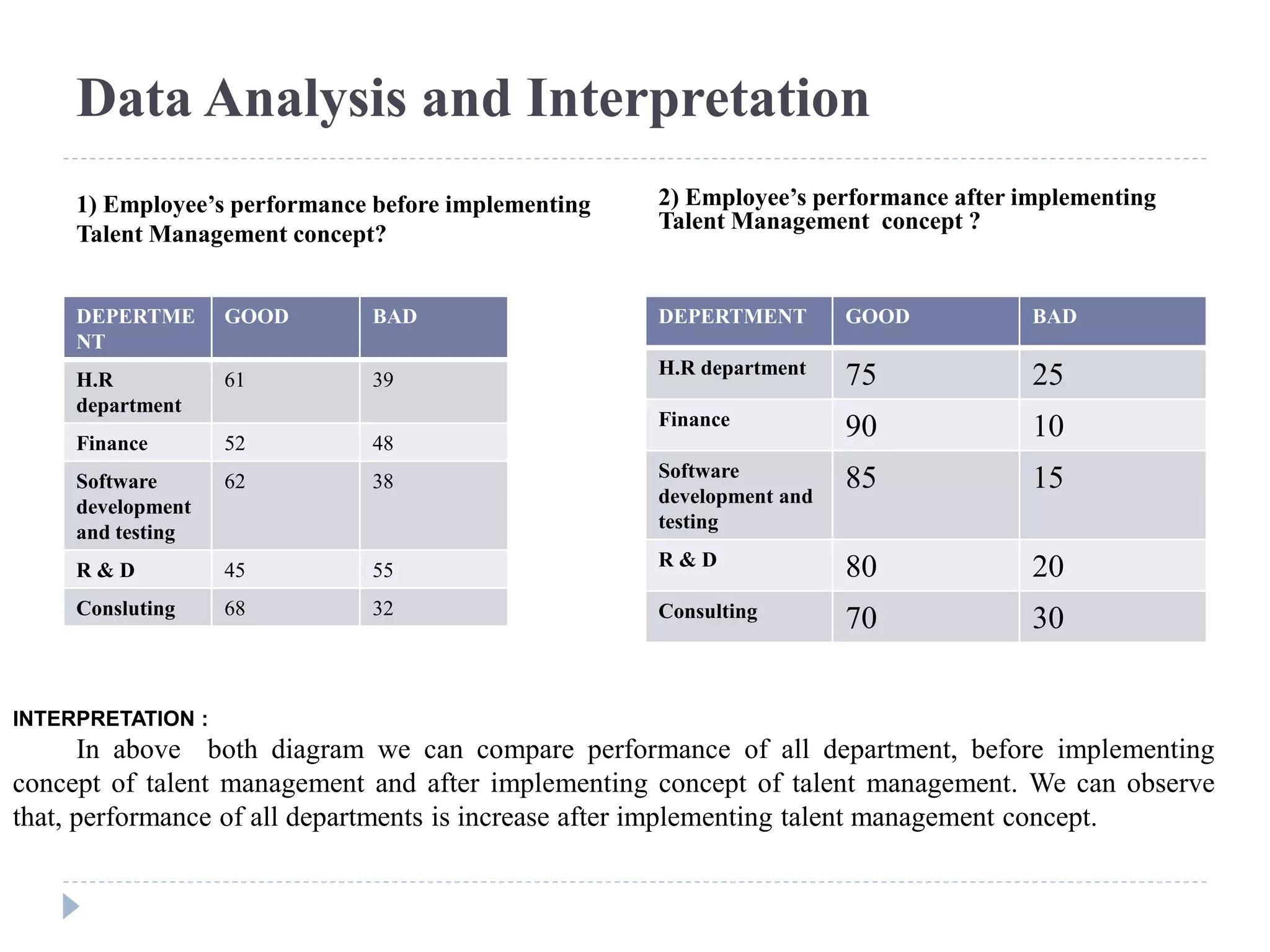
1) Employee’s performance before implementing
Talent Management concept?
2) Employee’s performance after implementing
Talent Management concept ?
DEPERTME
NT
GOOD BAD
H.R
department
61 39
Finance 52 48
Software
development
and testing
62 38
R & D 45 55
Consluting 68 32
DEPERTMENT GOOD BAD
H.R department 75 25
Finance 90 10
Software
development and
testing
85 15
R & D 80 20
Consulting 70 30
INTERPRETATION :
In above both diagram we can compare performance of all department, before implementing
concept of talent management and after implementing concept of talent management. We can observe
that, performance of all departments is increase after implementing talent management concept.
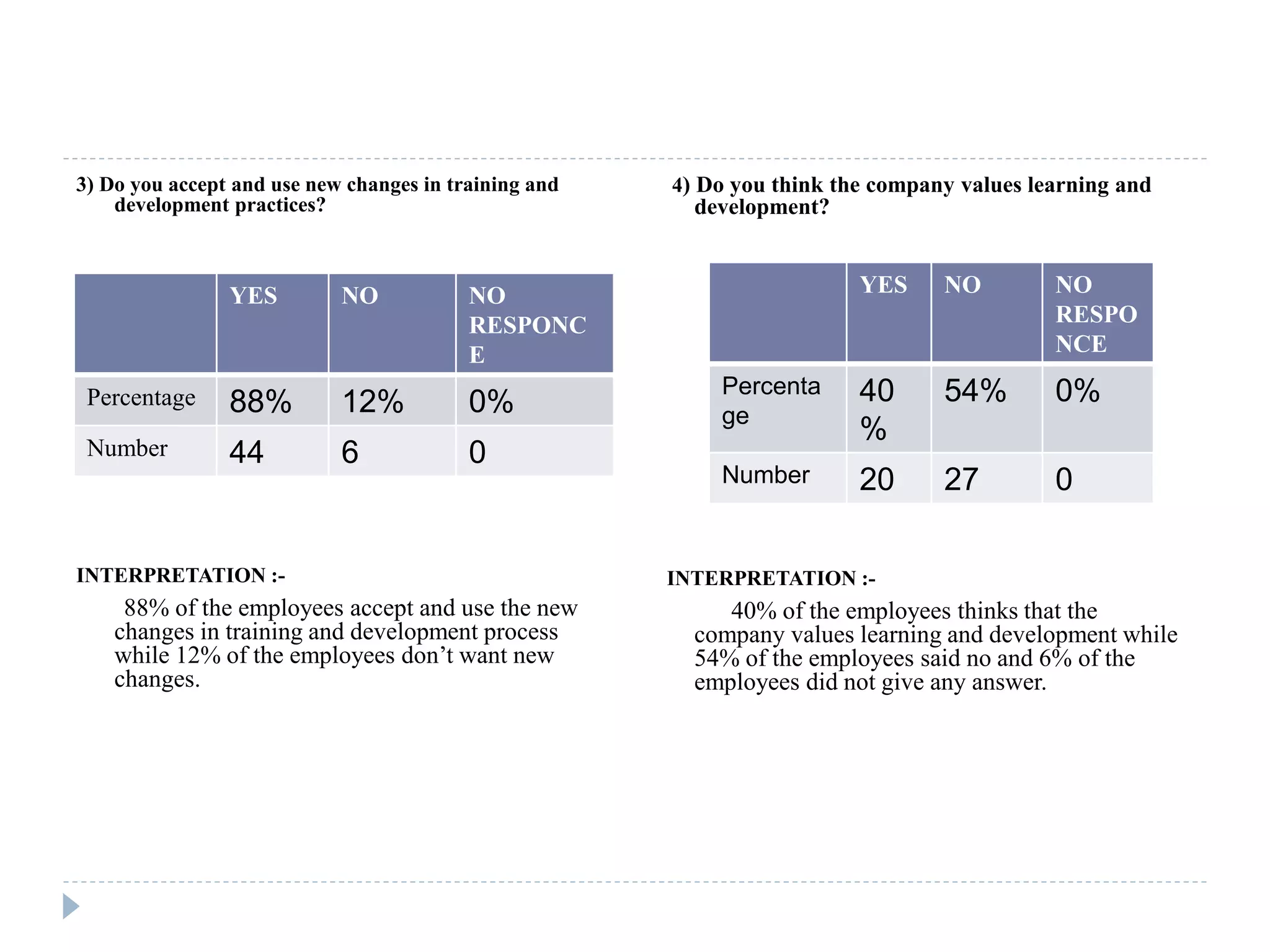
3) Do you accept and use new changes in training and
development practices?
INTERPRETATION :-
88% of the employees accept and use the new
changes in training and development process
while 12% of the employees don’t want new
changes.
4) Do you think the company values learning and
development?
INTERPRETATION :-
40% of the employees thinks that the
company values learning and development while
54% of the employees said no and 6% of the
employees did not give any answer.
YES NO NO
RESPONC
E
Percentage 88% 12% 0%
Number 44 6 0
YES NO NO
RESPO
NCE
Percenta
ge
40
%
54% 0%
Number 20 27 0
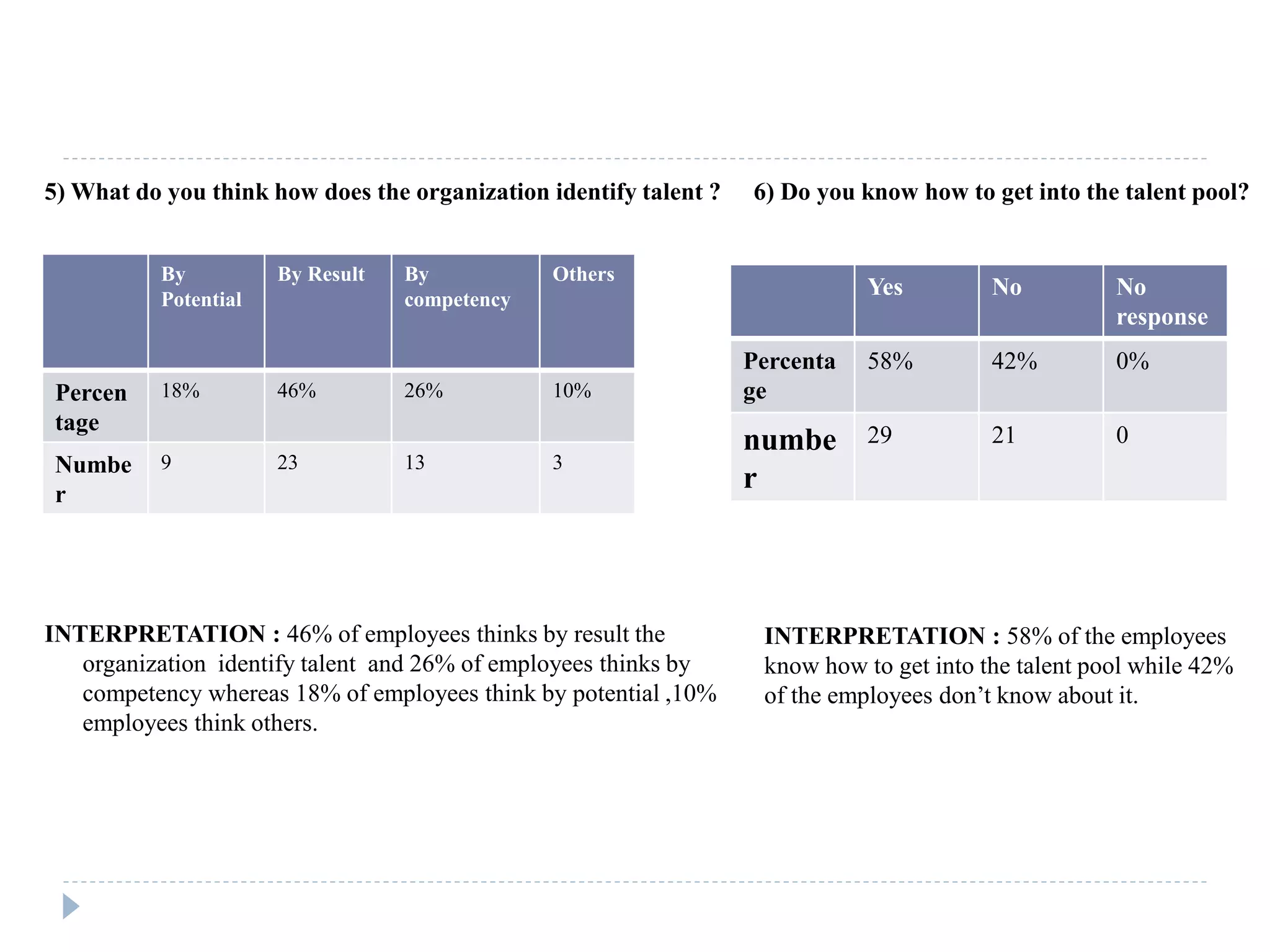
5) What do you think how does the organization identify talent ?
INTERPRETATION : 46% of employees thinks by result the
organization identify talent and 26% of employees thinks by
competency whereas 18% of employees think by potential ,10%
employees think others.
By
Potential
By Result By
competency
Others
Percen
tage
18% 46% 26% 10%
Numbe
r
9 23 13 3
6) Do you know how to get into the talent pool?
Yes No No
response
Percenta
ge
58% 42% 0%
numbe
r
29 21 0
INTERPRETATION : 58% of the employees
know how to get into the talent pool while 42%
of the employees don’t know about it.
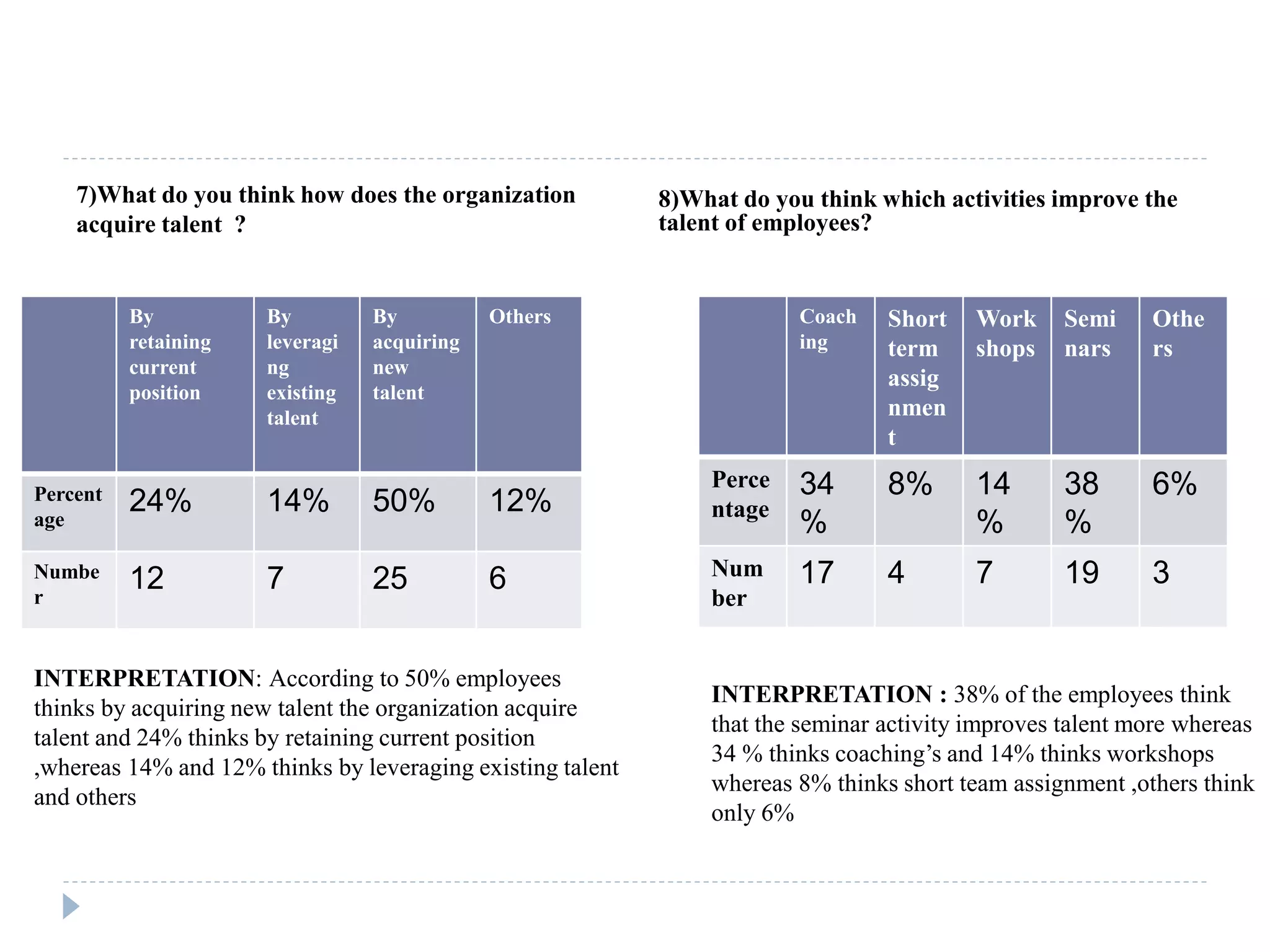
7)What do you think how does the organization
acquire talent ?
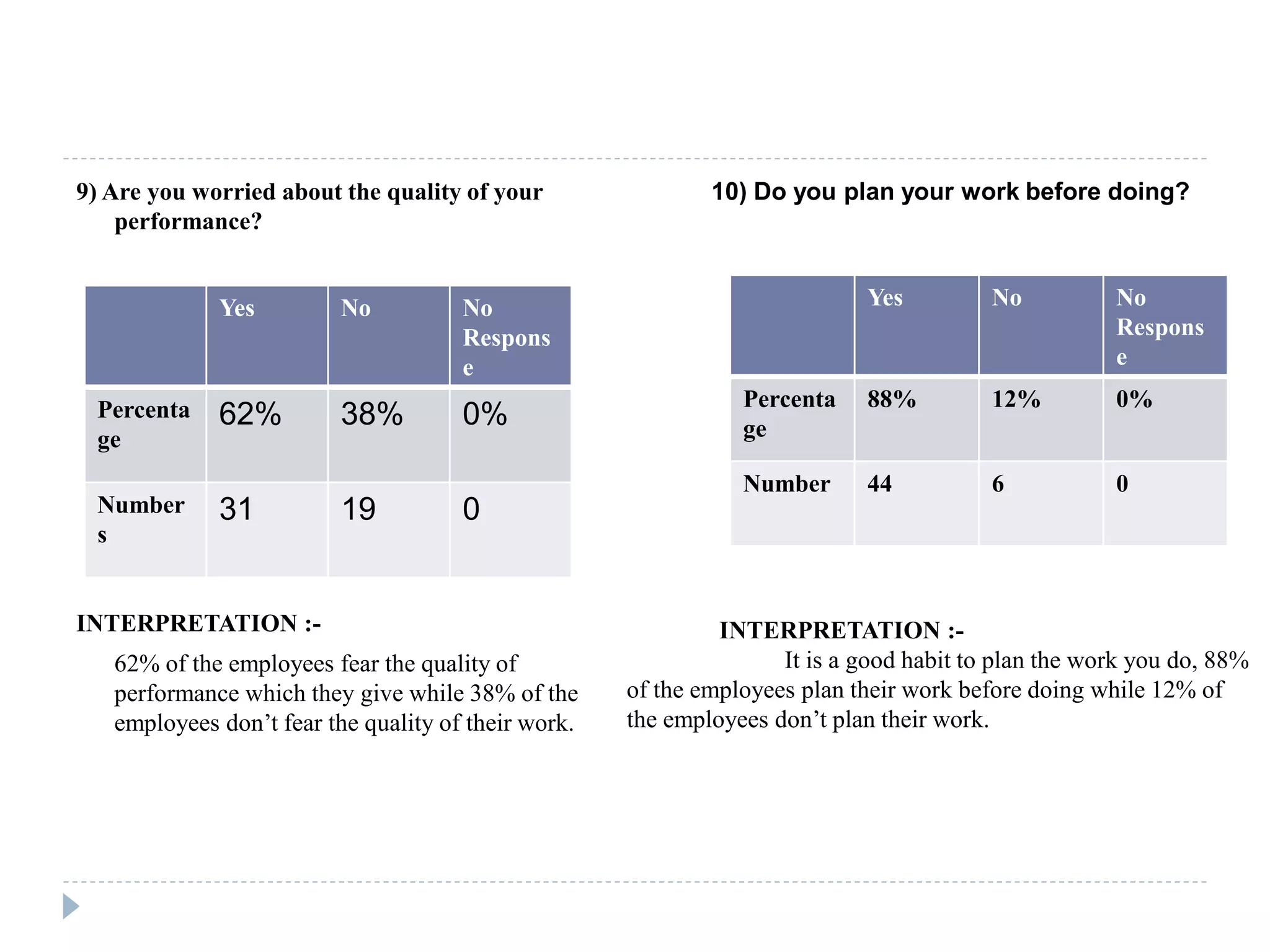
8)What do you think which activities improve the
talent of employees?
By
retaining
current
position
By
leveragi
ng
existing
talent
By
acquiring
new
talent
Others
Percent
age
24% 14% 50% 12%
Numbe
r
12 7 25 6
INTERPRETATION: According to 50% employees
thinks by acquiring new talent the organization acquire
talent and 24% thinks by retaining current position
,whereas 14% and 12% thinks by leveraging existing talent
and others
Coach
ing
Short
term
assig
nmen
t
Work
shops
Semi
nars
Othe
rs
Perce
ntage
34
%
8% 14
%
38
%
6%
Num
ber
17 4 7 19 3
INTERPRETATION : 38% of the employees think
that the seminar activity improves talent more whereas
34 % thinks coaching’s and 14% thinks workshops
whereas 8% thinks short team assignment ,others think
only 6%
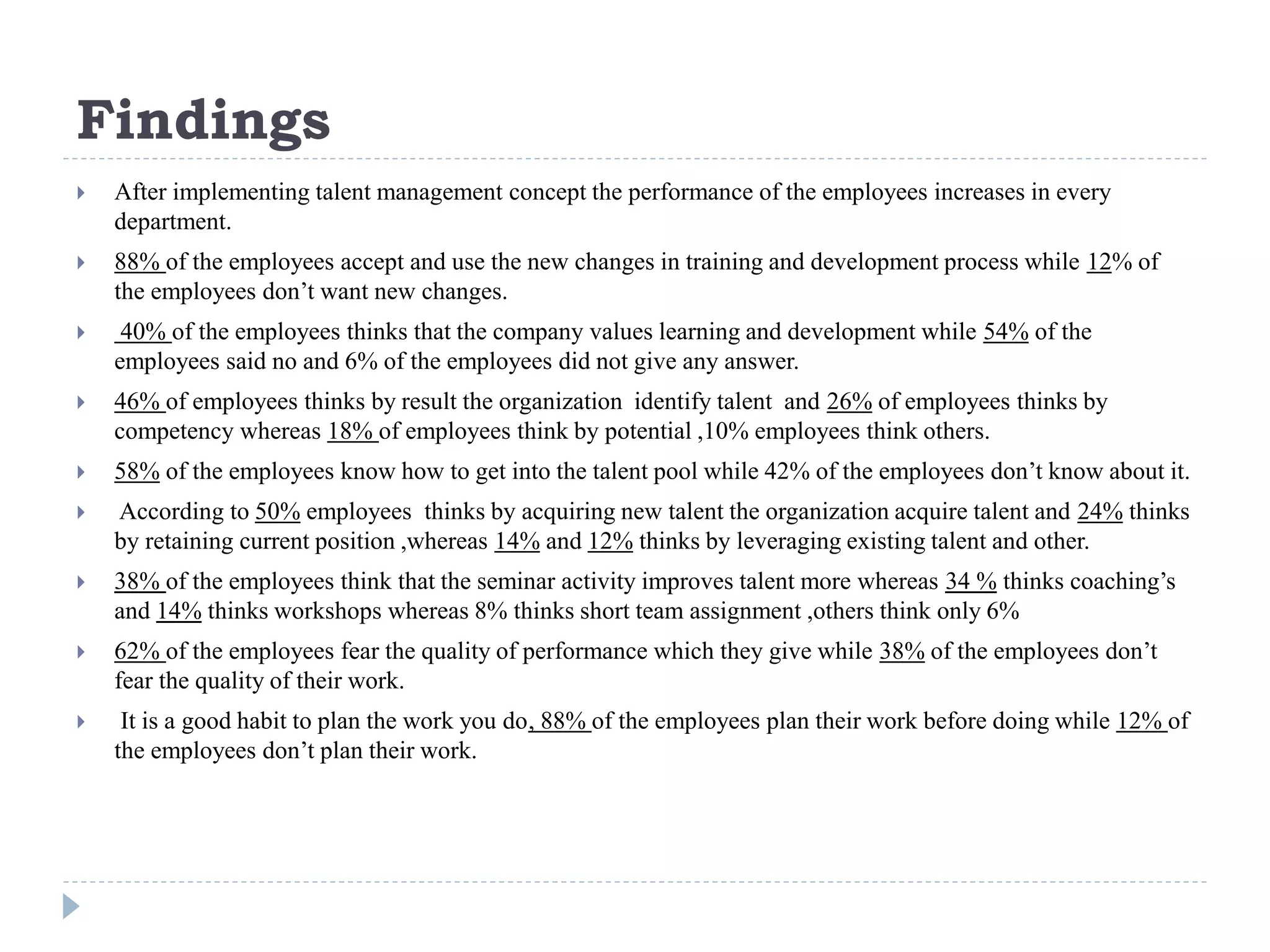
9) Are you worried about the quality of your
performance?
INTERPRETATION :-
62% of the employees fear the quality of
performance which they give while 38% of the
employees don’t fear the quality of their work.
Yes No No
Respons
e
Percenta
ge
62% 38% 0%
Number
s
31 19 0
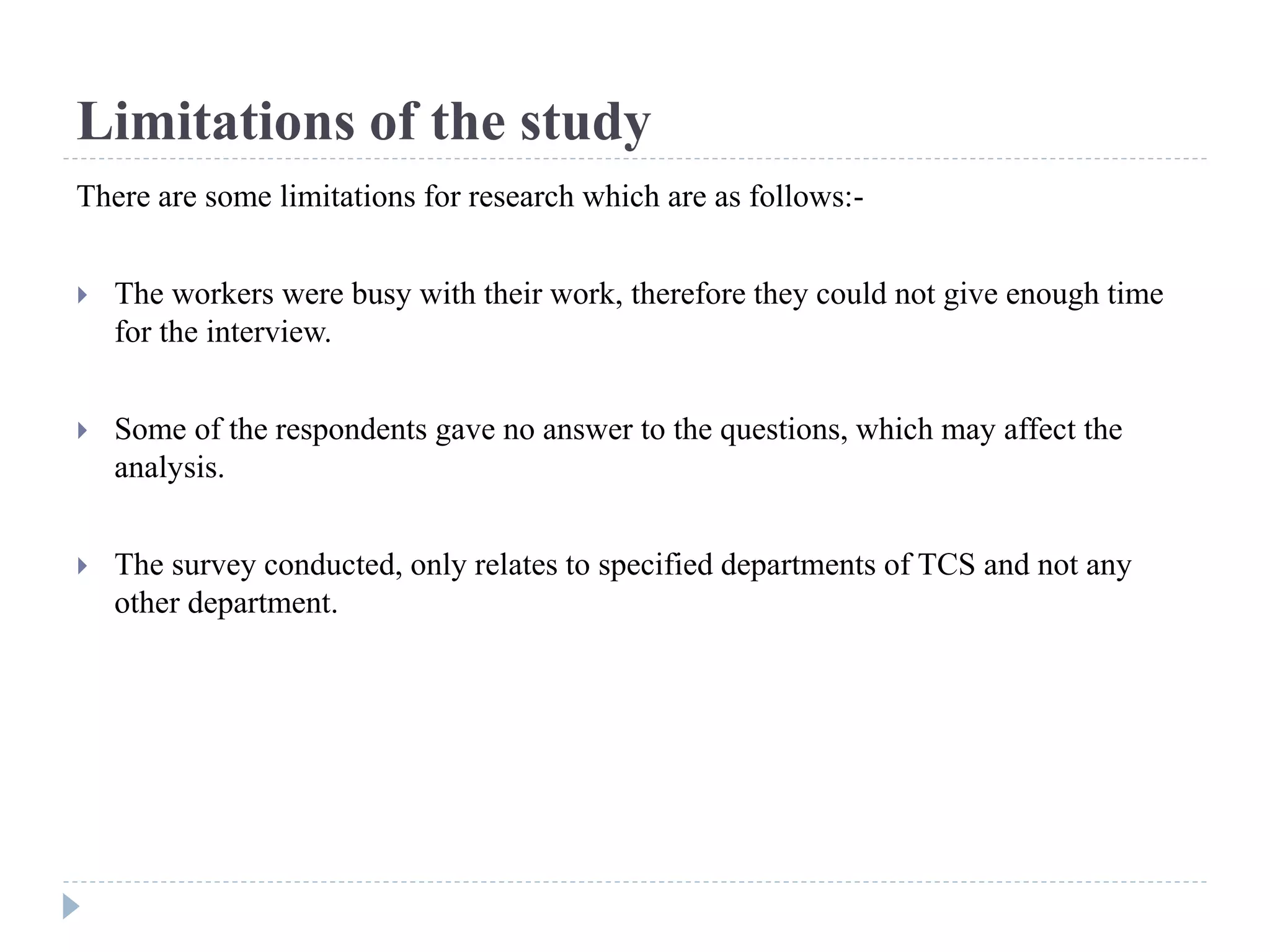
10) Do you plan your work before doing?
Yes No No
Respons
e
Percenta
ge
88% 12% 0%
Number 44 6 0
INTERPRETATION :-
It is a good habit to plan the work you do, 88%
of the employees plan their work before doing while 12% of
the employees don’t plan their work.
Findings
 After implementing talent management concept the performance of the employees increases in every
department.
 88% of the employees accept and use the new changes in training and development process while 12% of
the employees don’t want new changes.
 40% of the employees thinks that the company values learning and development while 54% of the
employees said no and 6% of the employees did not give any answer.
 46% of employees thinks by result the organization identify talent and 26% of employees thinks by
competency whereas 18% of employees think by potential ,10% employees think others.
 58% of the employees know how to get into the talent pool while 42% of the employees don’t know about it.
 According to 50% employees thinks by acquiring new talent the organization acquire talent and 24% thinks
by retaining current position ,whereas 14% and 12% thinks by leveraging existing talent and other.
 38% of the employees think that the seminar activity improves talent more whereas 34 % thinks coaching’s
and 14% thinks workshops whereas 8% thinks short team assignment ,others think only 6%
 62% of the employees fear the quality of performance which they give while 38% of the employees don’t
fear the quality of their work.
 It is a good habit to plan the work you do, 88% of the employees plan their work before doing while 12% of
the employees don’t plan their work.
Limitations of the study
There are some limitations for research which are as follows:-
 The workers were busy with their work, therefore they could not give enough time
for the interview.
 Some of the respondents gave no answer to the questions, which may affect the
analysis.
 The survey conducted, only relates to specified departments of TCS and not any
other department.
Suggestion
 TCS can do better in their Employee Support Services.
 TCS can improve their training practices.
 More certified training should be given to the employees to
boost their effectiveness and efficiency.
 TCS can make some innovative changes in the talent process.
 The company should know which talent management elements
can have the greatest impact on the business and therefore
provide a better basis for prioritization and implementation.
 TCS can be more attentive to market requirements
 TCS can add some more sections.
BIBILIOGRAPHY
Book Reference :-
 Human Capital Management ----- Garry Desslar (P 542)
 Human Resource Management ---- Himalaya Publications (P 386)
 Human Resource Management --- Oxford Higher education ( p74)
 Human Resource Management System ----- Prof. Mr. Subbarao (P, 243)
 Handbook of Human Resource Management ----Michel Armstrong (P ,128)
Websites -
 www.tcs.com
 www.google.com
 www.talentmanagement.com
 www.managementparadise.com
 www.wikkepeda.com
 www.scribd.com
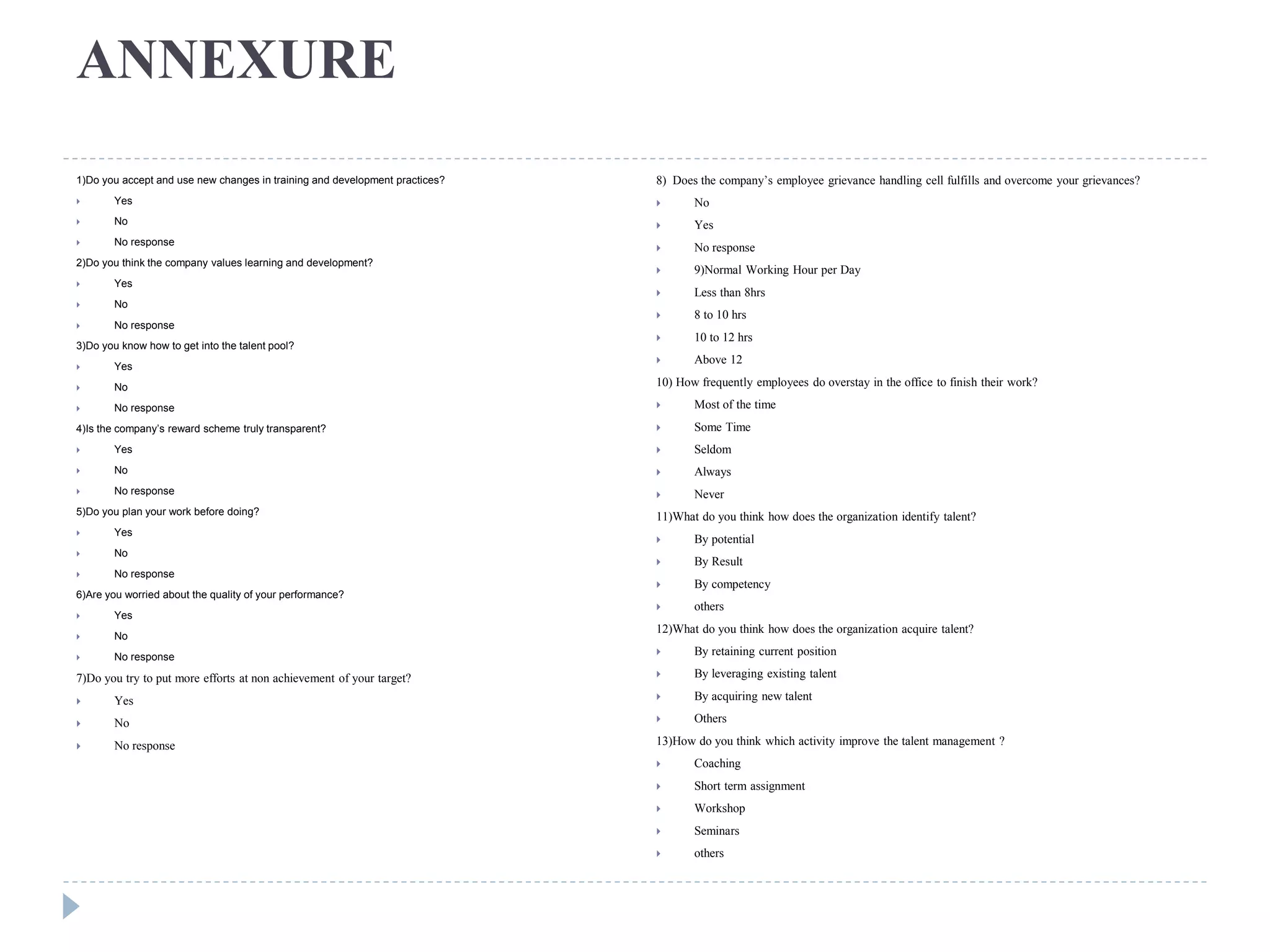
ANNEXURE
1)Do you accept and use new changes in training and development practices?
 Yes
 No
 No response
2)Do you think the company values learning and development?
 Yes
 No
 No response
3)Do you know how to get into the talent pool?
 Yes
 No
 No response
4)Is the company’s reward scheme truly transparent?
 Yes
 No
 No response
5)Do you plan your work before doing?
 Yes
 No
 No response
6)Are you worried about the quality of your performance?
 Yes
 No
 No response
7)Do you try to put more efforts at non achievement of your target?
 Yes
 No
 No response
8) Does the company’s employee grievance handling cell fulfills and overcome your grievances?
 No
 Yes
 No response
 9)Normal Working Hour per Day
 Less than 8hrs
 8 to 10 hrs
 10 to 12 hrs
 Above 12
10) How frequently employees do overstay in the office to finish their work?
 Most of the time
 Some Time
 Seldom
 Always
 Never
11)What do you think how does the organization identify talent?
 By potential
 By Result
 By competency
 others
12)What do you think how does the organization acquire talent?
 By retaining current position
 By leveraging existing talent
 By acquiring new talent
 Others
13)How do you think which activity improve the talent management ?
 Coaching
 Short term assignment
 Workshop
 Seminars
 others
THANK YOU !!!

An study of talent management ppt

  • 1.
    STUDY OF TALENTMANAGEMENT AT TATA CONSULTANCY SERVICES (TCS) A Presentation ON SUBMITTED BY Mr. Swapnil A. Khobragade
  • 2.
    Introduction & CompanyProfile Introduction What is Talent Management?  Talent management is an integral part of human resource management.  Talent management as the name itself suggests is managing the ability, competency and power of employees within an organization.  Everything that is done to recruit, retain , develop, reward and make people perform is the part of Talent Management . Company Profile  Tata Consultancy Services Limited (TCS) is an Indian multinational information technology (IT) service, consultin g and business solutions company Headquartered in Mumbai, Maharashtra.  Rajesh Gopinathan was appointed as the new MD and CEO for TCS.  TCS provides a wide range of services including business consulting , information technology , business process outsourcing(BPO),infrastructure and engineering.  The company operates in Americas ,Europe, Middle east and Asia Pacific .
  • 3.
    Benefits and Processof Talent Management Benefits of Talent Management  Right person in the right job.  Retaining the top talent.  Better hiring.  Understanding employee better.  Better professional development decision. Talent Management Process  Understanding the Requirement.  Sourcing the Talent.  Attracting the Talent.  Recruiting the Talent.  Selecting the Talent.  Training and Development.  Retention Promotion .  Competency Mapping.  Performance Appraisal .  Career Planning.  Succession Planning.  Exit.
  • 4.
    Objectives of theStudy  To know whether the employees of TCS have enough knowledge about the importance of Talent management.  To study various measures instituted in the company for an effective management of Talent in the area of work.  To interpret whether use and manage their Talent effectively.  To study the importance and benefits of the Talent Management.  To examine the different surveys of Talent Management
  • 5.
    Research Methodology  ResearchDesign : Descriptive.  Research Instrument :Questionnaire, Interview  Collection of data:  Primary data: Structured and detailed questionnaires were presented to the employees working at TCS India to collect their views and opinions about Talent management . Further having discussions and interacting with employees.  Secondary data: The secondary data was gathered by visiting through the company website, previous records of the firm and other websites.  Sampling unit :Employees of TCS India is the sample unit.  Sample size : The sample size chosen for this study is 50 respondent.  Data Analysis : The data is analyzed using analytical tools of SPSS software. MS EXCEL is also used to analyze a part of the data, the data is presented in tabular and graphical format and then interpreted.
  • 6.
    Data Analysis andInterpretation 1) Employee’s performance before implementing Talent Management concept? 2) Employee’s performance after implementing Talent Management concept ? DEPERTME NT GOOD BAD H.R department 61 39 Finance 52 48 Software development and testing 62 38 R & D 45 55 Consluting 68 32 DEPERTMENT GOOD BAD H.R department 75 25 Finance 90 10 Software development and testing 85 15 R & D 80 20 Consulting 70 30 INTERPRETATION : In above both diagram we can compare performance of all department, before implementing concept of talent management and after implementing concept of talent management. We can observe that, performance of all departments is increase after implementing talent management concept.
  • 7.
    3) Do youaccept and use new changes in training and development practices? INTERPRETATION :- 88% of the employees accept and use the new changes in training and development process while 12% of the employees don’t want new changes. 4) Do you think the company values learning and development? INTERPRETATION :- 40% of the employees thinks that the company values learning and development while 54% of the employees said no and 6% of the employees did not give any answer. YES NO NO RESPONC E Percentage 88% 12% 0% Number 44 6 0 YES NO NO RESPO NCE Percenta ge 40 % 54% 0% Number 20 27 0
  • 8.
    5) What doyou think how does the organization identify talent ? INTERPRETATION : 46% of employees thinks by result the organization identify talent and 26% of employees thinks by competency whereas 18% of employees think by potential ,10% employees think others. By Potential By Result By competency Others Percen tage 18% 46% 26% 10% Numbe r 9 23 13 3 6) Do you know how to get into the talent pool? Yes No No response Percenta ge 58% 42% 0% numbe r 29 21 0 INTERPRETATION : 58% of the employees know how to get into the talent pool while 42% of the employees don’t know about it.
  • 9.
    7)What do youthink how does the organization acquire talent ? 8)What do you think which activities improve the talent of employees? By retaining current position By leveragi ng existing talent By acquiring new talent Others Percent age 24% 14% 50% 12% Numbe r 12 7 25 6 INTERPRETATION: According to 50% employees thinks by acquiring new talent the organization acquire talent and 24% thinks by retaining current position ,whereas 14% and 12% thinks by leveraging existing talent and others Coach ing Short term assig nmen t Work shops Semi nars Othe rs Perce ntage 34 % 8% 14 % 38 % 6% Num ber 17 4 7 19 3 INTERPRETATION : 38% of the employees think that the seminar activity improves talent more whereas 34 % thinks coaching’s and 14% thinks workshops whereas 8% thinks short team assignment ,others think only 6%
  • 10.
    9) Are youworried about the quality of your performance? INTERPRETATION :- 62% of the employees fear the quality of performance which they give while 38% of the employees don’t fear the quality of their work. Yes No No Respons e Percenta ge 62% 38% 0% Number s 31 19 0 10) Do you plan your work before doing? Yes No No Respons e Percenta ge 88% 12% 0% Number 44 6 0 INTERPRETATION :- It is a good habit to plan the work you do, 88% of the employees plan their work before doing while 12% of the employees don’t plan their work.
  • 11.
    Findings  After implementingtalent management concept the performance of the employees increases in every department.  88% of the employees accept and use the new changes in training and development process while 12% of the employees don’t want new changes.  40% of the employees thinks that the company values learning and development while 54% of the employees said no and 6% of the employees did not give any answer.  46% of employees thinks by result the organization identify talent and 26% of employees thinks by competency whereas 18% of employees think by potential ,10% employees think others.  58% of the employees know how to get into the talent pool while 42% of the employees don’t know about it.  According to 50% employees thinks by acquiring new talent the organization acquire talent and 24% thinks by retaining current position ,whereas 14% and 12% thinks by leveraging existing talent and other.  38% of the employees think that the seminar activity improves talent more whereas 34 % thinks coaching’s and 14% thinks workshops whereas 8% thinks short team assignment ,others think only 6%  62% of the employees fear the quality of performance which they give while 38% of the employees don’t fear the quality of their work.  It is a good habit to plan the work you do, 88% of the employees plan their work before doing while 12% of the employees don’t plan their work.
  • 12.
    Limitations of thestudy There are some limitations for research which are as follows:-  The workers were busy with their work, therefore they could not give enough time for the interview.  Some of the respondents gave no answer to the questions, which may affect the analysis.  The survey conducted, only relates to specified departments of TCS and not any other department.
  • 13.
    Suggestion  TCS cando better in their Employee Support Services.  TCS can improve their training practices.  More certified training should be given to the employees to boost their effectiveness and efficiency.  TCS can make some innovative changes in the talent process.  The company should know which talent management elements can have the greatest impact on the business and therefore provide a better basis for prioritization and implementation.  TCS can be more attentive to market requirements  TCS can add some more sections.
  • 14.
    BIBILIOGRAPHY Book Reference :- Human Capital Management ----- Garry Desslar (P 542)  Human Resource Management ---- Himalaya Publications (P 386)  Human Resource Management --- Oxford Higher education ( p74)  Human Resource Management System ----- Prof. Mr. Subbarao (P, 243)  Handbook of Human Resource Management ----Michel Armstrong (P ,128) Websites -  www.tcs.com  www.google.com  www.talentmanagement.com  www.managementparadise.com  www.wikkepeda.com  www.scribd.com
  • 15.
    ANNEXURE 1)Do you acceptand use new changes in training and development practices?  Yes  No  No response 2)Do you think the company values learning and development?  Yes  No  No response 3)Do you know how to get into the talent pool?  Yes  No  No response 4)Is the company’s reward scheme truly transparent?  Yes  No  No response 5)Do you plan your work before doing?  Yes  No  No response 6)Are you worried about the quality of your performance?  Yes  No  No response 7)Do you try to put more efforts at non achievement of your target?  Yes  No  No response 8) Does the company’s employee grievance handling cell fulfills and overcome your grievances?  No  Yes  No response  9)Normal Working Hour per Day  Less than 8hrs  8 to 10 hrs  10 to 12 hrs  Above 12 10) How frequently employees do overstay in the office to finish their work?  Most of the time  Some Time  Seldom  Always  Never 11)What do you think how does the organization identify talent?  By potential  By Result  By competency  others 12)What do you think how does the organization acquire talent?  By retaining current position  By leveraging existing talent  By acquiring new talent  Others 13)How do you think which activity improve the talent management ?  Coaching  Short term assignment  Workshop  Seminars  others
  • 16.