Health policy in India
PRESENTED BY :- RAJNISH KUMAR
(RESEARCH SCHOLOR, SOCIAL WORK,
(MGKVP, VARANASI)
INTRODUCTION
 HEALTH: A state of complete physical, mental and social well being and not
merely the absence of disease or infirmity.
 POLICY: Policy is a system, which provides the logical framework and
rationality of decision making for the achievements
 HEALTH POLICY: Health policy of a nation is its strategy for controlling
and optimizing the social uses of its health knowledge of intended objectives.
National Health Policy 1983
 The Ministry of Health and Family Welfare, Govt. of India, evolved a National Health Policy in 1983 till
2002.
 The policy lays stress on preventive, promotive, public health and rehabilitation aspects of healthcare.
 The policy stresses the need of establishing comprehensive primary health care services to reach the
population in the remote area of the country.
 India had its first national health policy in 1983 i.e. 36 years after independence
Objectives of NHP 1983
 A phased, time-bound programme for setting up a well-dispersed network of comprehensive primary
health care services, linked with extension and health education, designed in the context of the ground
reality that elementary health problems can be resolved by the people themselves.
 Intermediation through ‘Health volunteers’ having appropriate knowledge, simple skills and requisite
technologies;
 Establishment of a well worked out referral system to ensure that patient load at the higher levels of the
hierarchy is not needlessly burdened by those who can be treated at the decentralized level;
 An integrated net-work of evenly spread speciality and super-speciality services; encouragement of such
facilities through private investments for patients who can pay, so that the draw on the Government’s
facilities is limited to those entitled to free use.
Salient features of the 1983 Health policy
 It was critical of the curative-oriented western model of health care
 Emphasized a preventive, promotive and rehabilitative primary health care approach
 Recommended a decentralized system of health care, the key features of which were low cost,
deprofessionalisation (use of volunteers and paramedics), & community participation,
 expansion of the private curative sector which would help reduce the government's burden
NATIONAL HEALTHPOLICY-2002
 A revised health policy for achieving better health care and unmet goals has been brought out
by government of India- National Health Policy 2002.
 According to this revised policy, government and health professionals are obligated to render
good health care to the society.
 Optimizing the use of health service to a large group rather than a small group is a foreseen
event by the NHP2002.
 Inclusion of social policies adds to the credit of the revised NHP 2002
Objectives & Key Strategies of NHP 2002
 Primary Health Care Approach
 Decentralized public health system
 Convergence of all health programme under single field umbrella
 Strengthening and extending public health services
 Enhanced contribution of private and NGO sector in health care delivery.
 Increase in public spending for health care.
POLICYPRESCRIPTIONS Or Key Components
 Financial Resources, Equity
 Delivery Of National Public Health Programs
 The state of public health infrastructure, Extending public health service
 Role of local self- Government Institutions , Norms of Health care Professional
 Indian Medical council Act and IndianNursing Council Act
 Education of Health care Professional
 Need for specialists in 'Public Health' and 'Family Medicine’
 Use of Generic drugs
 Urban health: Urban Community Health Centre
 Mental health
 Women's health
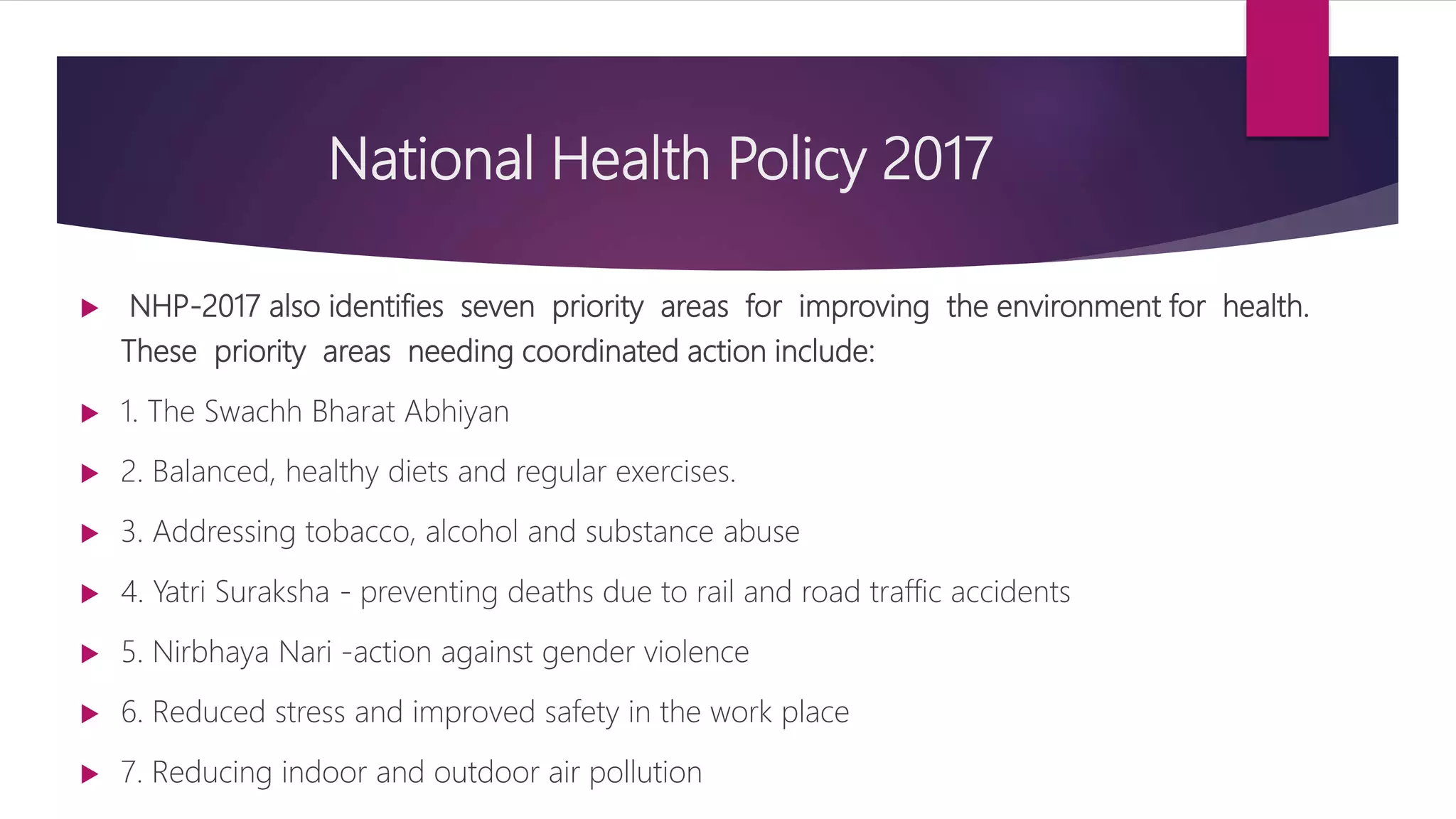
National Health Policy 2017
 NHP-2017 also identifies seven priority areas for improving the environment for health.
These priority areas needing coordinated action include:
 1. The Swachh Bharat Abhiyan
 2. Balanced, healthy diets and regular exercises.
 3. Addressing tobacco, alcohol and substance abuse
 4. Yatri Suraksha - preventing deaths due to rail and road traffic accidents
 5. Nirbhaya Nari -action against gender violence
 6. Reduced stress and improved safety in the work place
 7. Reducing indoor and outdoor air pollution
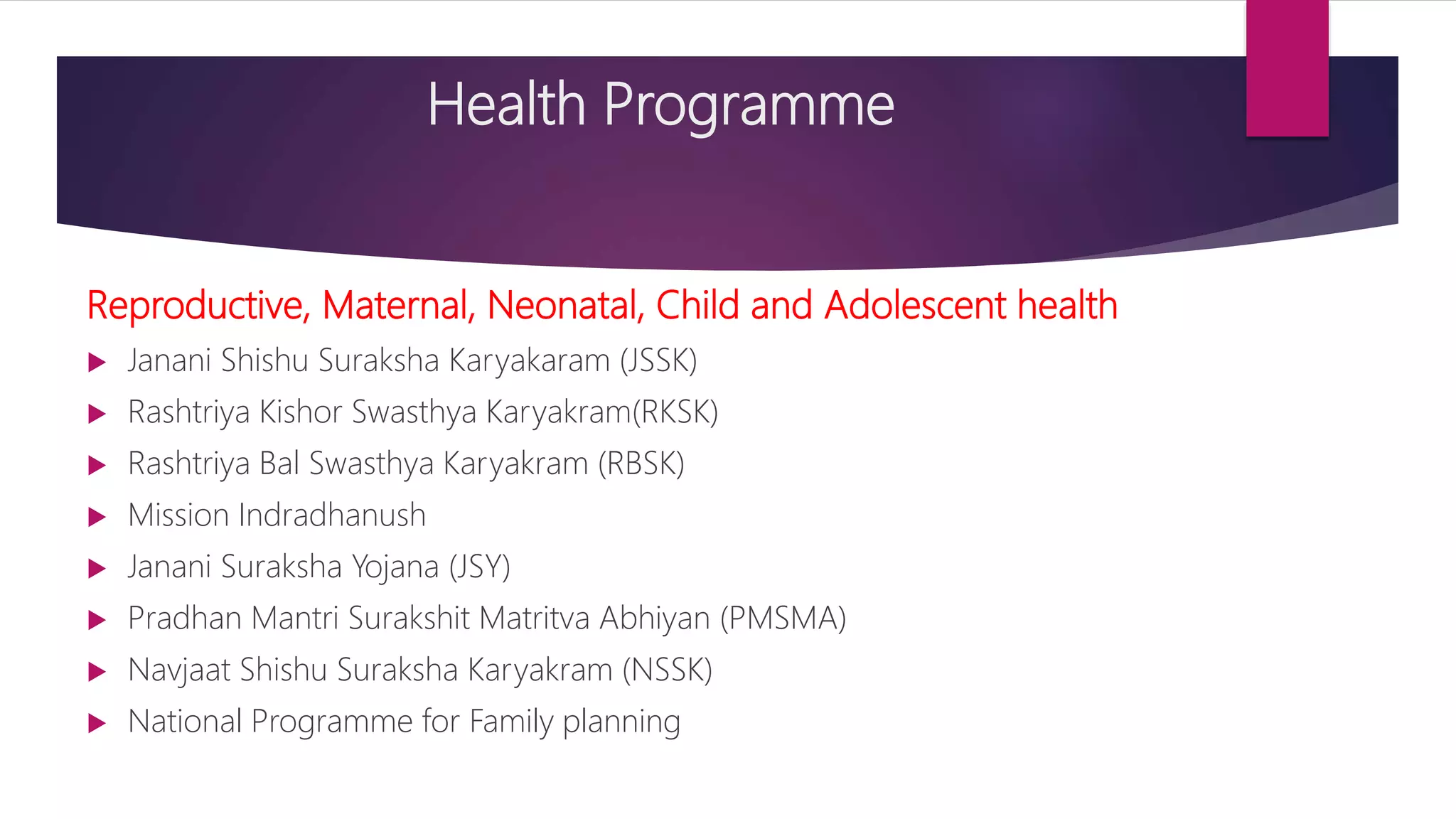
Health Programme
Reproductive, Maternal, Neonatal, Child and Adolescent health
 Janani Shishu Suraksha Karyakaram (JSSK)
 Rashtriya Kishor Swasthya Karyakram(RKSK)
 Rashtriya Bal Swasthya Karyakram (RBSK)
 Mission Indradhanush
 Janani Suraksha Yojana (JSY)
 Pradhan Mantri Surakshit Matritva Abhiyan (PMSMA)
 Navjaat Shishu Suraksha Karyakram (NSSK)
 National Programme for Family planning
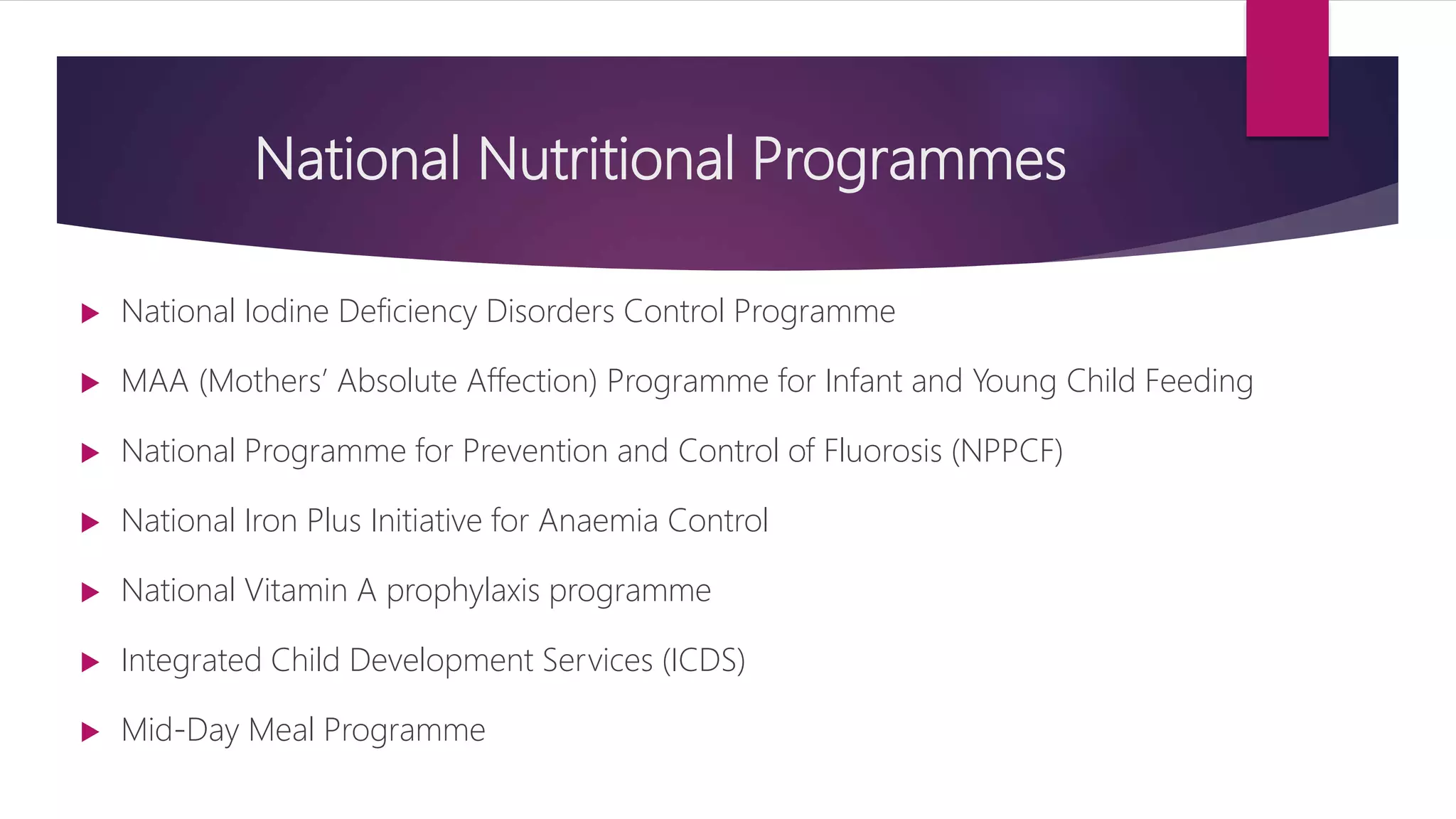
National Nutritional Programmes
 National Iodine Deficiency Disorders Control Programme
 MAA (Mothers’ Absolute Affection) Programme for Infant and Young Child Feeding
 National Programme for Prevention and Control of Fluorosis (NPPCF)
 National Iron Plus Initiative for Anaemia Control
 National Vitamin A prophylaxis programme
 Integrated Child Development Services (ICDS)
 Mid-Day Meal Programme
Communicable diseases
 Integrated Disease Surveillance Programme(IDSP)
 Revised National Tuberculosis Control Programme(RNTCP)
 National Leprosy Eradication Programme(NLEP)
 National Vector Borne Disease Control Programme
 National AIDS Control Programme(NACP)
 Pulse Polio Programme
 National Viral Hepatitis Control Program
 National Rabies Control Programme
 National Programme on Containment of Anti-Microbial Resistance (AMR)
Non-communicable diseases
 National Tobacco Control Programme(NTCP)
 National Programme for Prevention and Control of Cancer, Diabetes, Cardiovascular
Diseases & Stroke (NPCDCS)
 National Programme for Control Treatment of Occupational Diseases
 National Programme for Prevention and Control of Deafness (NPPCD)
 National Mental Health Programme
 National Programme for Control of Blindness& Visual impairment
 Pradhan Mantri National Dialysis Programme
 National Programme for the Health Care for the Elderly (NPHCE)
 National Programme for Prevention & Management of Burn Injuries (NPPMBI)
Health system strengthening programs
 Ayushman Bharat Yojana
 Pradhan Mantri Swasthya Suraksha Yojana (PMSSY)
 Laqshya’ programme (Labour Room Quality Improvement Initiative)
 National Health Mission
References
 https://www.slideshare.net/pramodkumarsikarawar/national-health-policy-66625010
 http://www.communityhealth.in/~commun26/wiki/index.php?title=National_Health_
 https://vikaspedia.in/health/nrhm/national-health-policies/national-health-policy-2017
 https://shodhganga.inflibnet.ac.in/bitstream/10603/43767/11/11_chapter%202.pdf
 https://www.researchgate.net/publication/326773745_National_Health_Policy_of_India
 https://www.nhp.gov.in/healthprogramme/national-health-programmes
 https://ncdc.gov.in/index4.php?lang=1&level=0&linkid=35&lid=95

Health policy in india

  • 1.
    Health policy inIndia PRESENTED BY :- RAJNISH KUMAR (RESEARCH SCHOLOR, SOCIAL WORK, (MGKVP, VARANASI)
  • 2.
    INTRODUCTION  HEALTH: Astate of complete physical, mental and social well being and not merely the absence of disease or infirmity.  POLICY: Policy is a system, which provides the logical framework and rationality of decision making for the achievements  HEALTH POLICY: Health policy of a nation is its strategy for controlling and optimizing the social uses of its health knowledge of intended objectives.
  • 3.
    National Health Policy1983  The Ministry of Health and Family Welfare, Govt. of India, evolved a National Health Policy in 1983 till 2002.  The policy lays stress on preventive, promotive, public health and rehabilitation aspects of healthcare.  The policy stresses the need of establishing comprehensive primary health care services to reach the population in the remote area of the country.  India had its first national health policy in 1983 i.e. 36 years after independence  India had its first national health policy in 1983 i.e. 36 years after independence
  • 4.
    Objectives of NHP1983  A phased, time-bound programme for setting up a well-dispersed network of comprehensive primary health care services, linked with extension and health education, designed in the context of the ground reality that elementary health problems can be resolved by the people themselves.  Intermediation through ‘Health volunteers’ having appropriate knowledge, simple skills and requisite technologies;  Establishment of a well worked out referral system to ensure that patient load at the higher levels of the hierarchy is not needlessly burdened by those who can be treated at the decentralized level;  An integrated net-work of evenly spread speciality and super-speciality services; encouragement of such facilities through private investments for patients who can pay, so that the draw on the Government’s facilities is limited to those entitled to free use.
  • 5.
    Salient features ofthe 1983 Health policy  It was critical of the curative-oriented western model of health care  Emphasized a preventive, promotive and rehabilitative primary health care approach  Recommended a decentralized system of health care, the key features of which were low cost, deprofessionalisation (use of volunteers and paramedics), & community participation,  expansion of the private curative sector which would help reduce the government's burden
  • 6.
    NATIONAL HEALTHPOLICY-2002  Arevised health policy for achieving better health care and unmet goals has been brought out by government of India- National Health Policy 2002.  According to this revised policy, government and health professionals are obligated to render good health care to the society.  Optimizing the use of health service to a large group rather than a small group is a foreseen event by the NHP2002.  Inclusion of social policies adds to the credit of the revised NHP 2002
  • 7.
    Objectives & KeyStrategies of NHP 2002  Primary Health Care Approach  Decentralized public health system  Convergence of all health programme under single field umbrella  Strengthening and extending public health services  Enhanced contribution of private and NGO sector in health care delivery.  Increase in public spending for health care.
  • 8.
    POLICYPRESCRIPTIONS Or KeyComponents  Financial Resources, Equity  Delivery Of National Public Health Programs  The state of public health infrastructure, Extending public health service  Role of local self- Government Institutions , Norms of Health care Professional  Indian Medical council Act and IndianNursing Council Act  Education of Health care Professional  Need for specialists in 'Public Health' and 'Family Medicine’  Use of Generic drugs  Urban health: Urban Community Health Centre  Mental health  Women's health
  • 9.
    National Health Policy2017  NHP-2017 also identifies seven priority areas for improving the environment for health. These priority areas needing coordinated action include:  1. The Swachh Bharat Abhiyan  2. Balanced, healthy diets and regular exercises.  3. Addressing tobacco, alcohol and substance abuse  4. Yatri Suraksha - preventing deaths due to rail and road traffic accidents  5. Nirbhaya Nari -action against gender violence  6. Reduced stress and improved safety in the work place  7. Reducing indoor and outdoor air pollution
  • 10.
    Health Programme Reproductive, Maternal,Neonatal, Child and Adolescent health  Janani Shishu Suraksha Karyakaram (JSSK)  Rashtriya Kishor Swasthya Karyakram(RKSK)  Rashtriya Bal Swasthya Karyakram (RBSK)  Mission Indradhanush  Janani Suraksha Yojana (JSY)  Pradhan Mantri Surakshit Matritva Abhiyan (PMSMA)  Navjaat Shishu Suraksha Karyakram (NSSK)  National Programme for Family planning
  • 11.
    National Nutritional Programmes National Iodine Deficiency Disorders Control Programme  MAA (Mothers’ Absolute Affection) Programme for Infant and Young Child Feeding  National Programme for Prevention and Control of Fluorosis (NPPCF)  National Iron Plus Initiative for Anaemia Control  National Vitamin A prophylaxis programme  Integrated Child Development Services (ICDS)  Mid-Day Meal Programme
  • 12.
    Communicable diseases  IntegratedDisease Surveillance Programme(IDSP)  Revised National Tuberculosis Control Programme(RNTCP)  National Leprosy Eradication Programme(NLEP)  National Vector Borne Disease Control Programme  National AIDS Control Programme(NACP)  Pulse Polio Programme  National Viral Hepatitis Control Program  National Rabies Control Programme  National Programme on Containment of Anti-Microbial Resistance (AMR)
  • 13.
    Non-communicable diseases  NationalTobacco Control Programme(NTCP)  National Programme for Prevention and Control of Cancer, Diabetes, Cardiovascular Diseases & Stroke (NPCDCS)  National Programme for Control Treatment of Occupational Diseases  National Programme for Prevention and Control of Deafness (NPPCD)  National Mental Health Programme  National Programme for Control of Blindness& Visual impairment  Pradhan Mantri National Dialysis Programme  National Programme for the Health Care for the Elderly (NPHCE)  National Programme for Prevention & Management of Burn Injuries (NPPMBI)
  • 14.
    Health system strengtheningprograms  Ayushman Bharat Yojana  Pradhan Mantri Swasthya Suraksha Yojana (PMSSY)  Laqshya’ programme (Labour Room Quality Improvement Initiative)  National Health Mission
  • 15.
    References  https://www.slideshare.net/pramodkumarsikarawar/national-health-policy-66625010  http://www.communityhealth.in/~commun26/wiki/index.php?title=National_Health_ https://vikaspedia.in/health/nrhm/national-health-policies/national-health-policy-2017  https://shodhganga.inflibnet.ac.in/bitstream/10603/43767/11/11_chapter%202.pdf  https://www.researchgate.net/publication/326773745_National_Health_Policy_of_India  https://www.nhp.gov.in/healthprogramme/national-health-programmes  https://ncdc.gov.in/index4.php?lang=1&level=0&linkid=35&lid=95