An ontology-based approach
to improve the accessibility of
ROS-based robotic systems
Ilaria Tiddi, Emanuele Bastianelli, Gianluca Bardaro,
Mathieu d’Aquin, Enrico Motta
Knowledge Capture (K-CAP2017)
Austin, Texas, USA
5/12/2017
@IlaTiddi
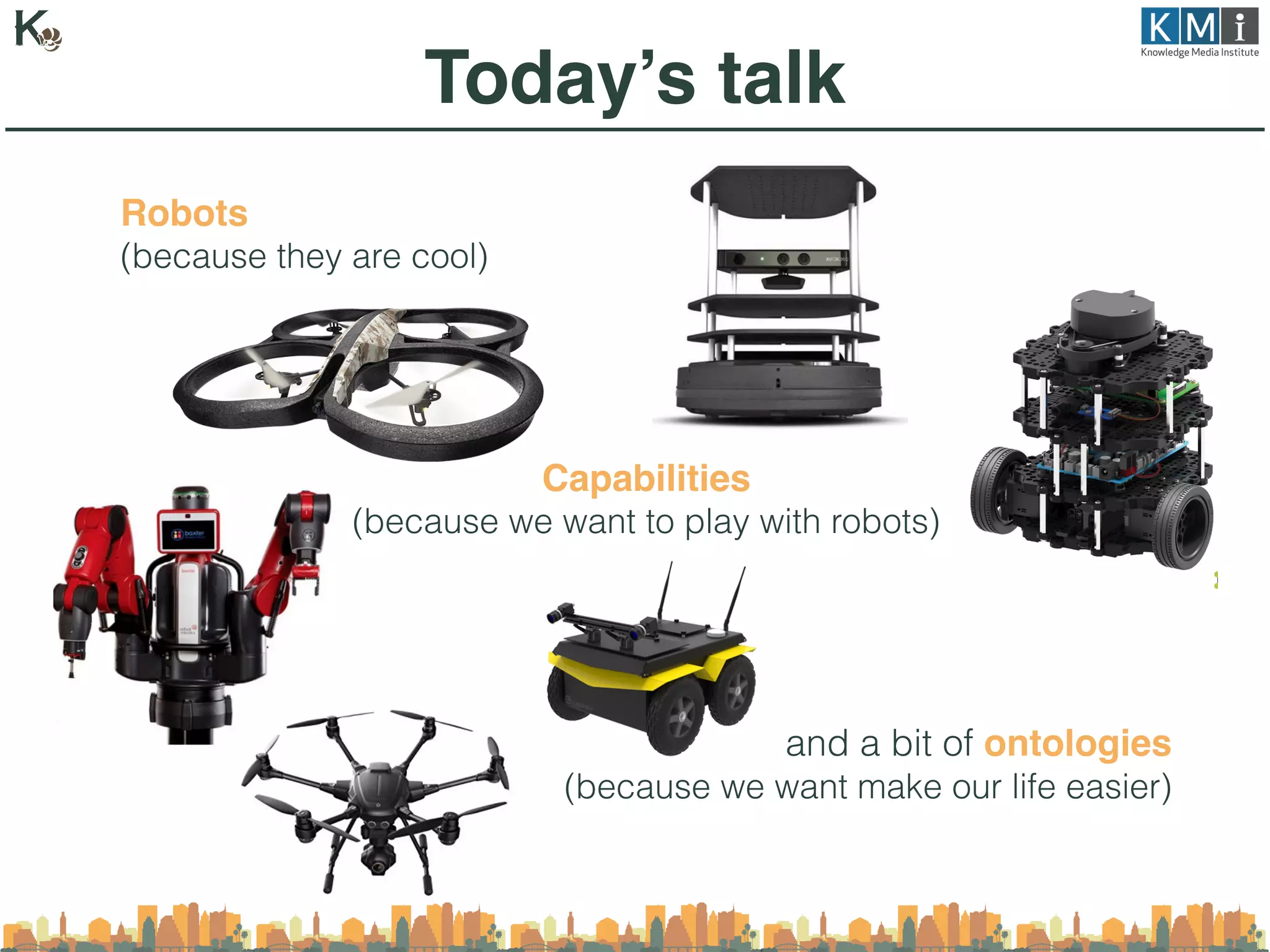
Robots
(because they are cool)
Capabilities
(because we want to play with robots)
and a bit of ontologies
(because we want make our life easier)
Today’s talk
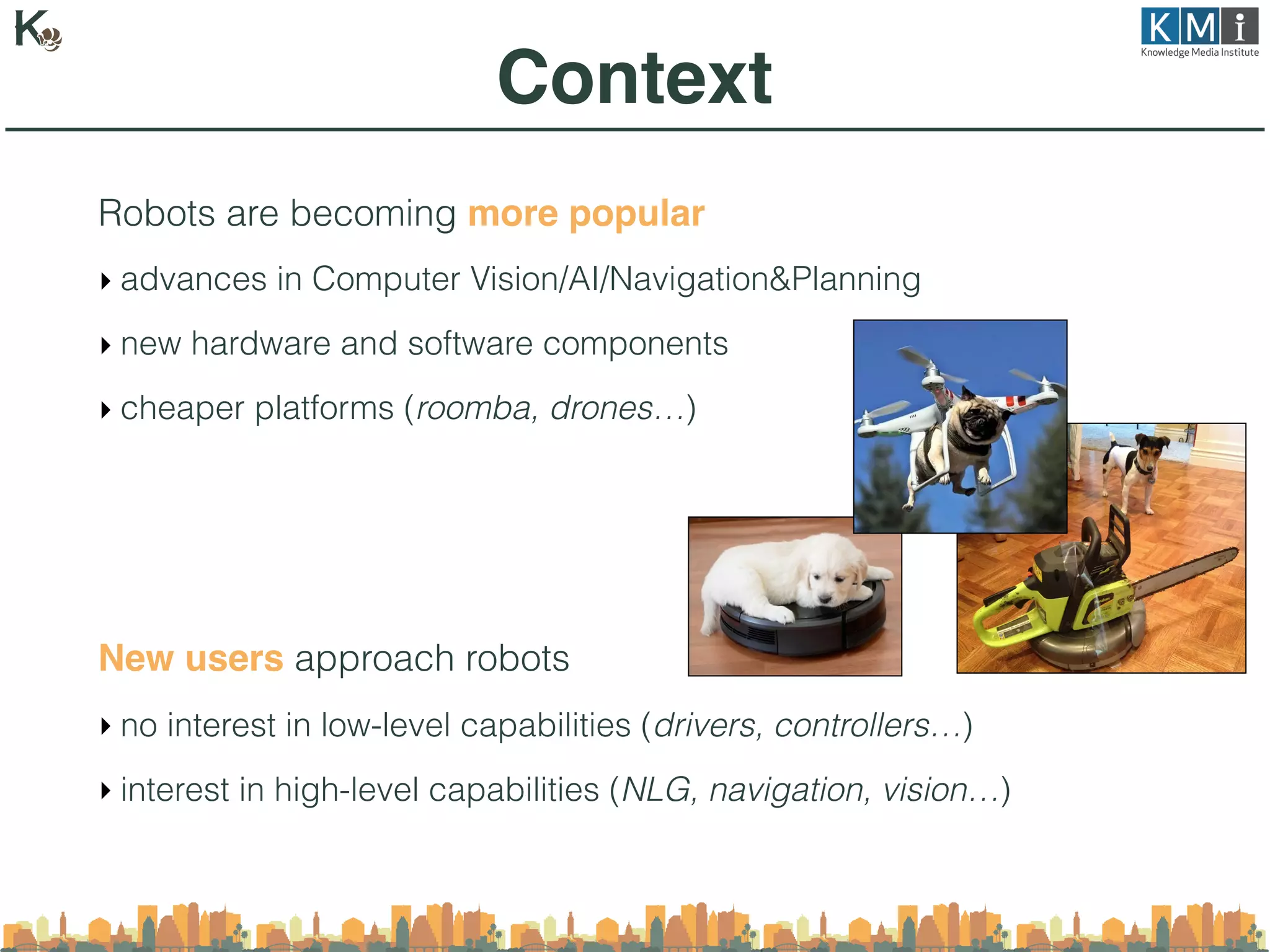
Robots are becoming more popular
‣ advances in Computer Vision/AI/Navigation&Planning
‣ new hardware and software components
‣ cheaper platforms (roomba, drones…)
New users approach robots
‣ no interest in low-level capabilities (drivers, controllers…)
‣ interest in high-level capabilities (NLG, navigation, vision…)
Context
Providers do not fully expose a robot’s capabilities
‣ robots become end products (unless being a robot developer)
e.g. drones for photography / roombas for cleaning
MK:Smart++ [1]: integrating robots in cities
‣ data collectors (drones for parking monitoring)
‣ data consumers (adaptive self-driving cars)
Example : team of robots for green space maintenance
‣ available capabilities : e.g. teleoperation, video recording
‣ expertise required to program trajectories/object recognition
‣ different platforms require different experts
Motivation
[1] www.mksmart.org
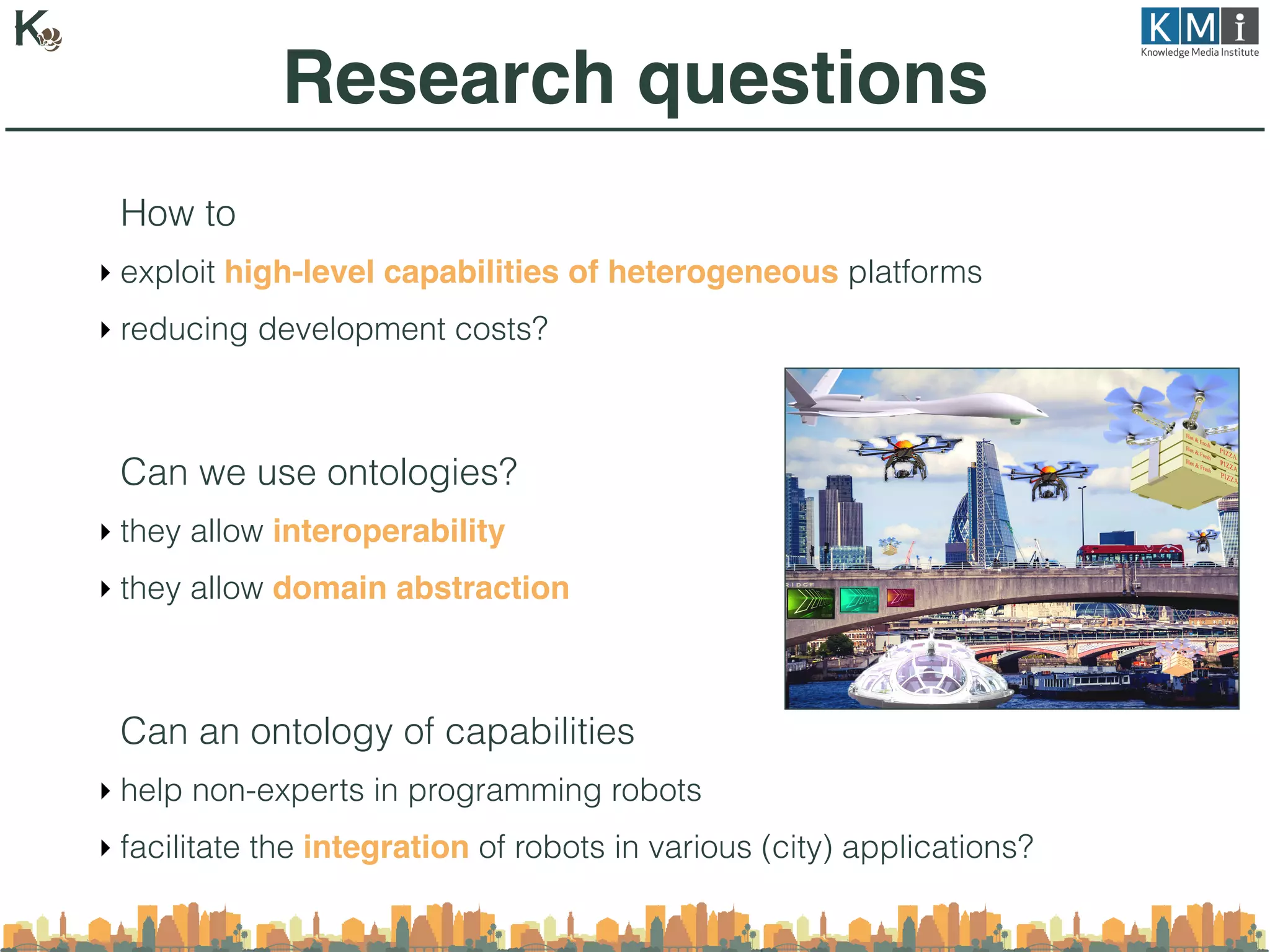
How to
‣ exploit high-level capabilities of heterogeneous platforms
‣ reducing development costs?
Can we use ontologies?
‣ they allow interoperability
‣ they allow domain abstraction
Can an ontology of capabilities
‣ help non-experts in programming robots
‣ facilitate the integration of robots in various (city) applications?
Research questions
[2] : the Robot Operating System
‣ collaborative middleware
‣ management of low-level components (share, reuse)
‣ need a fine-grained understanding of the robot architecture
Robot Operating System
[2] www.ros.org
Assisting non-experts for robot development through :
‣ creating an ontology of robots high-level capabilities
‣ mapping of low-level ROS functionalities to high-level capabilities
‣ a system that can understand what a robot can do based on these
Steps
1. Understanding and formalizing ROS
2. Mapping capabilities to ROS
3. Defining a taxonomy of capabilities
4. Wrapping these in a system
Proposed approach
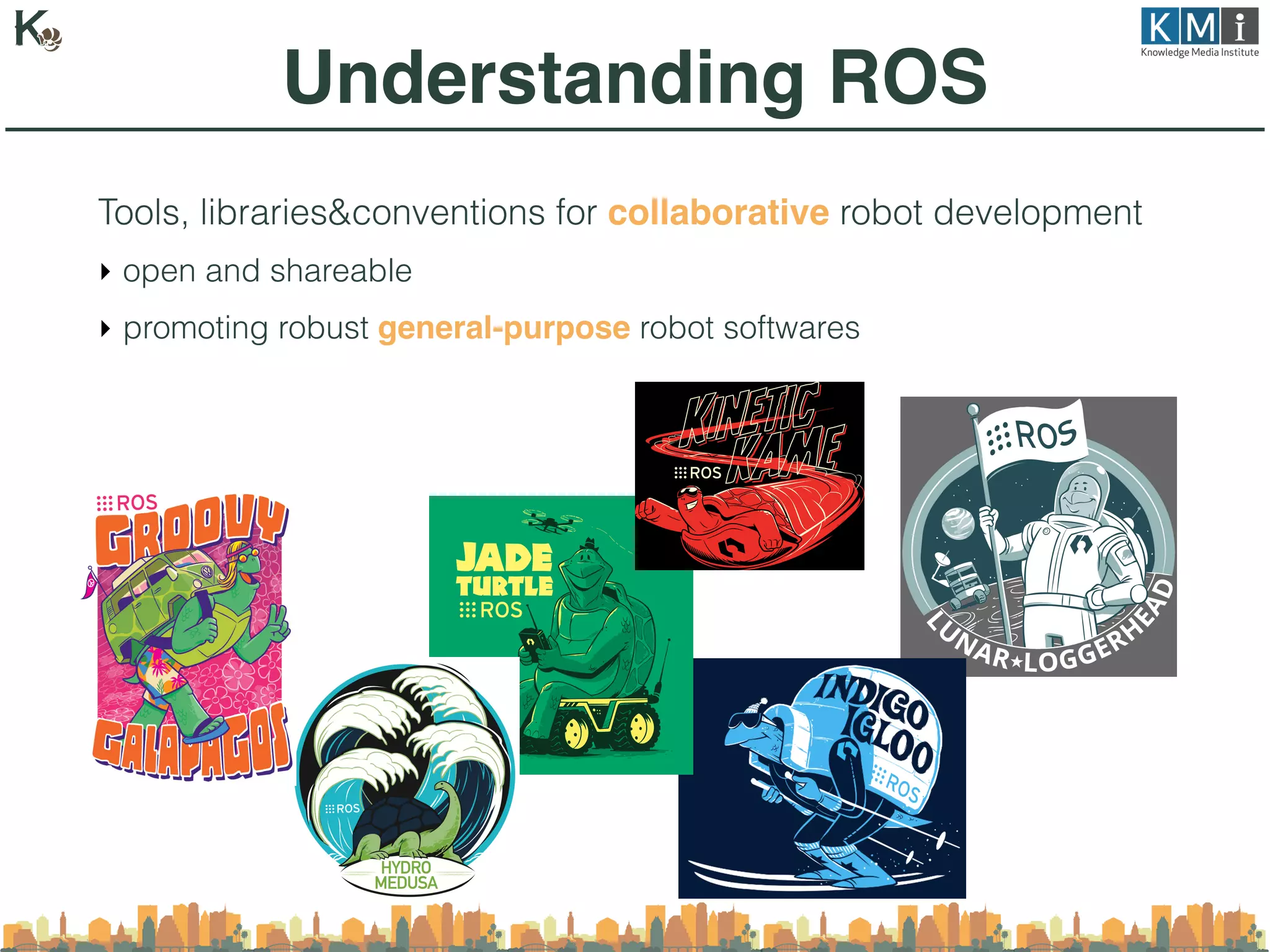
Tools, libraries&conventions for collaborative robot development
‣ open and shareable
‣ promoting robust general-purpose robot softwares
Understanding ROS
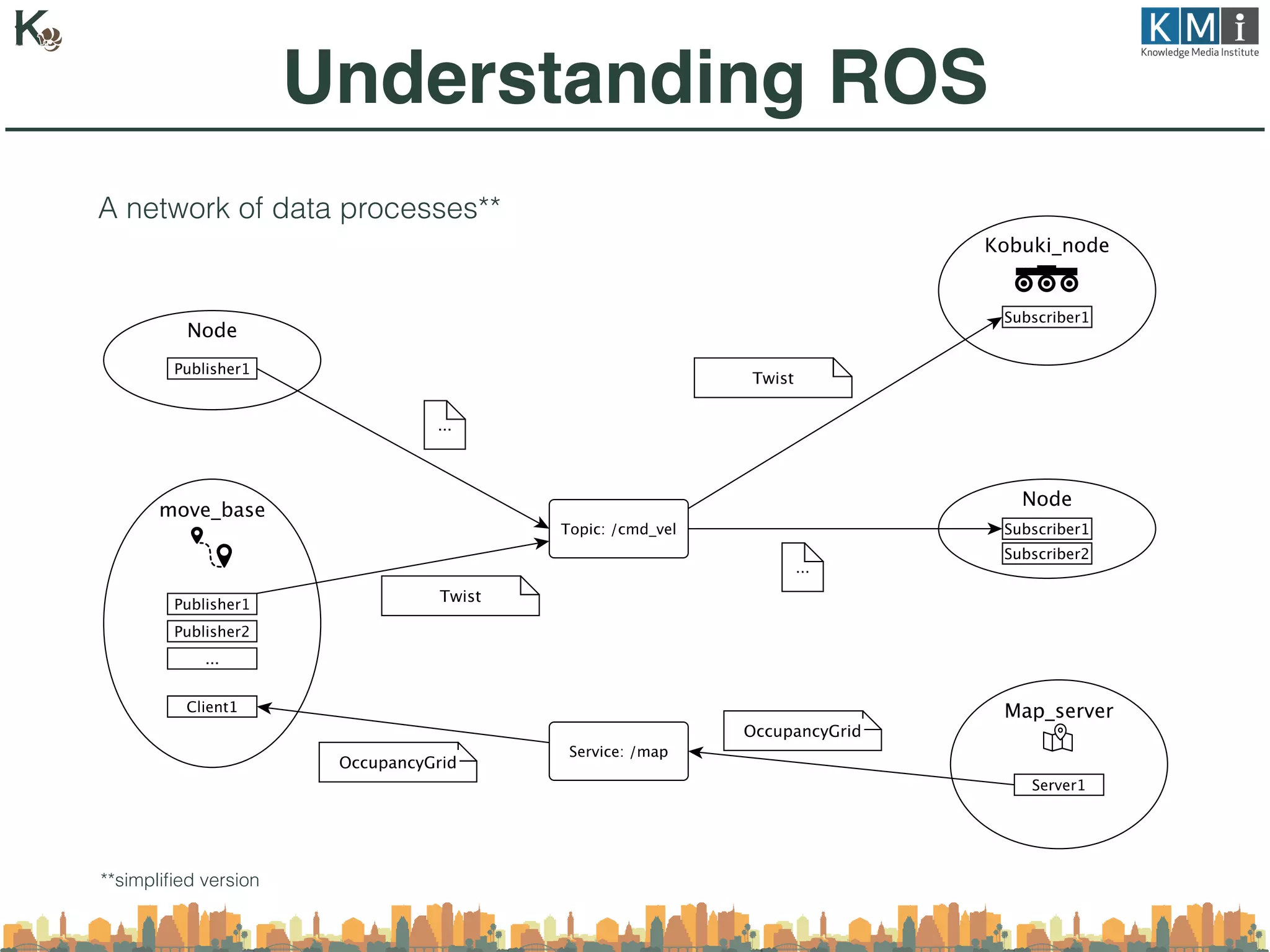
A network of data processes**
Understanding ROS
**simplified version
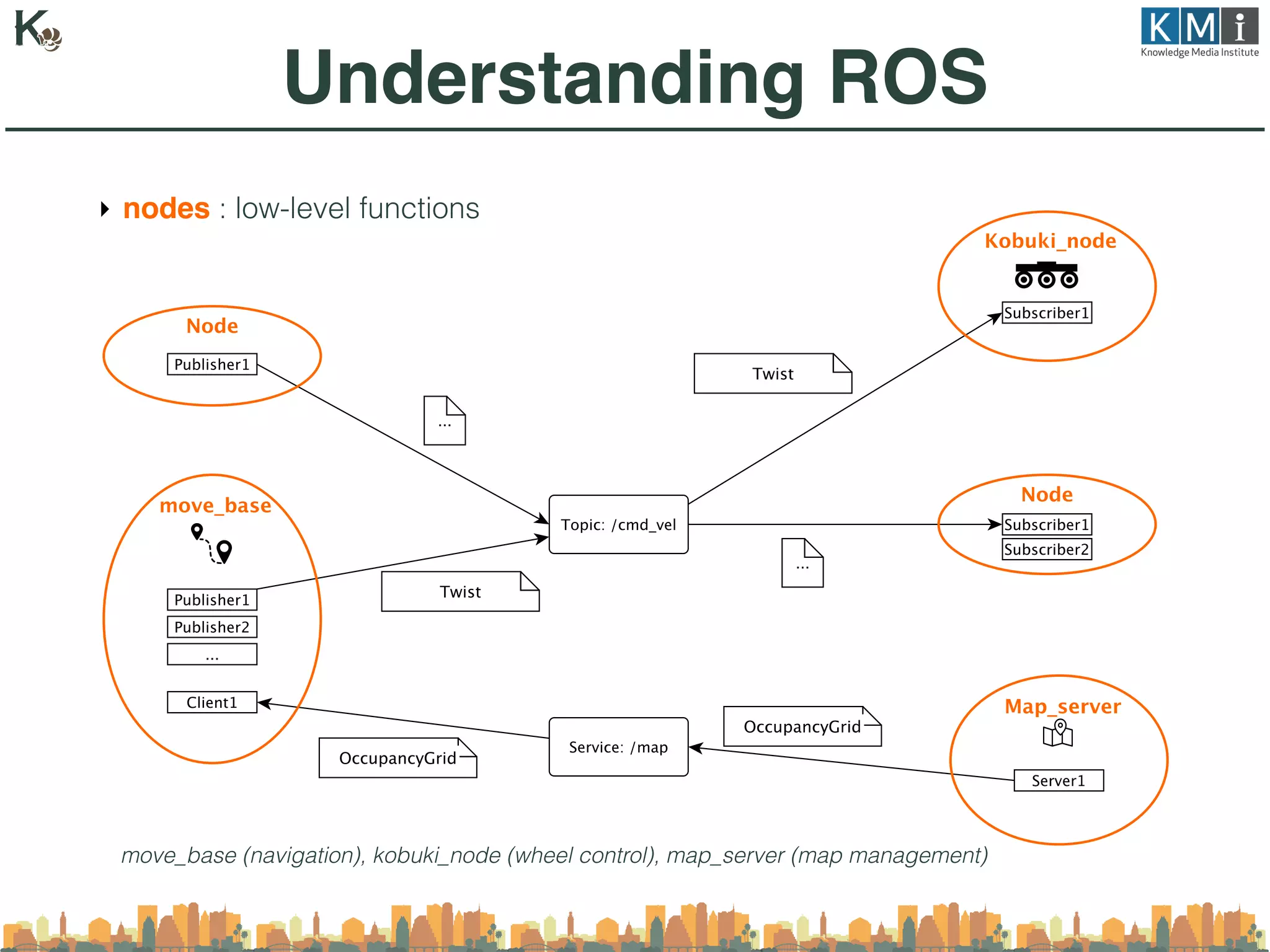
Understanding ROS
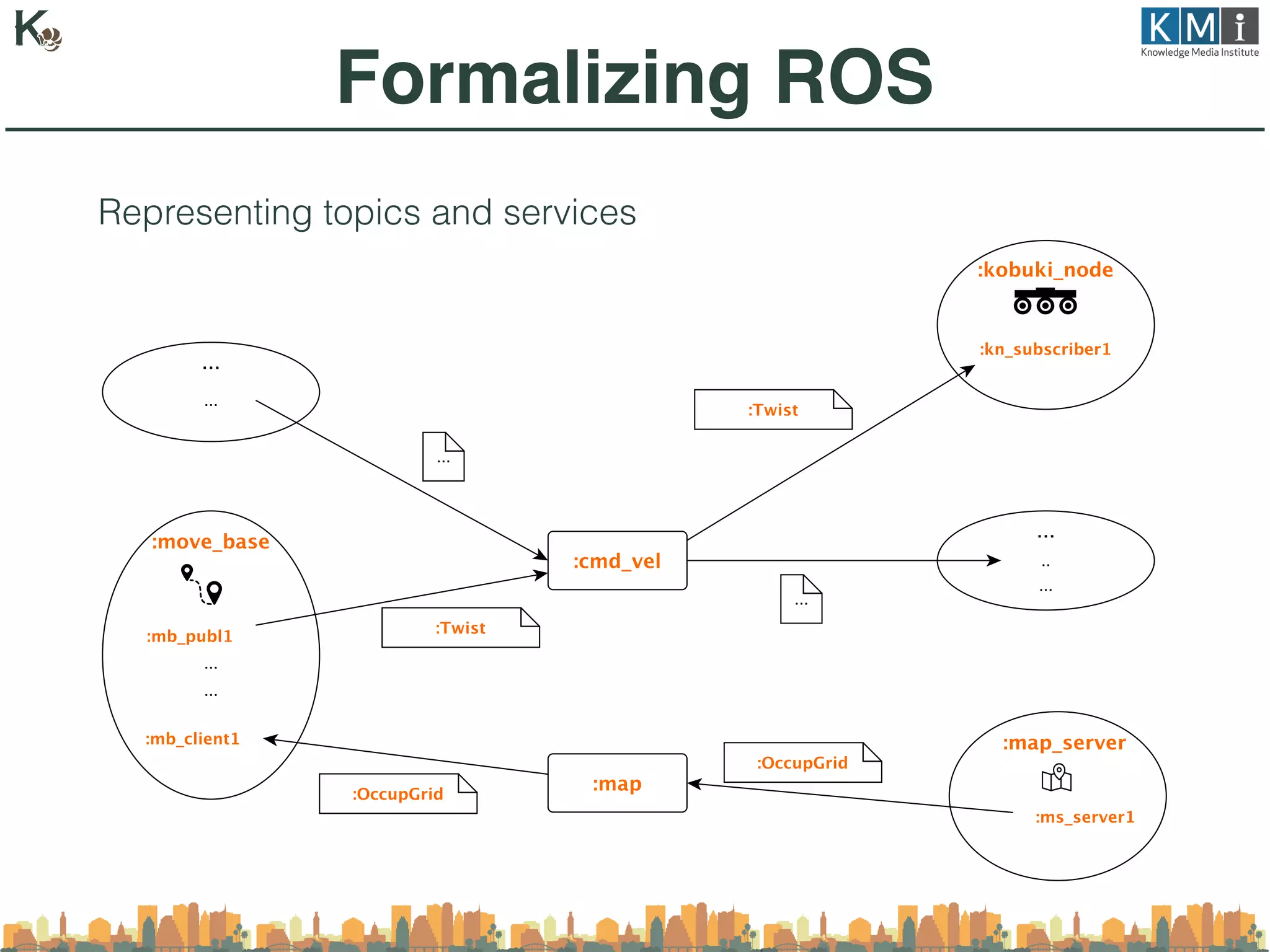
‣ nodes : low-level functions
move_base (navigation), kobuki_node (wheel control), map_server (map management)
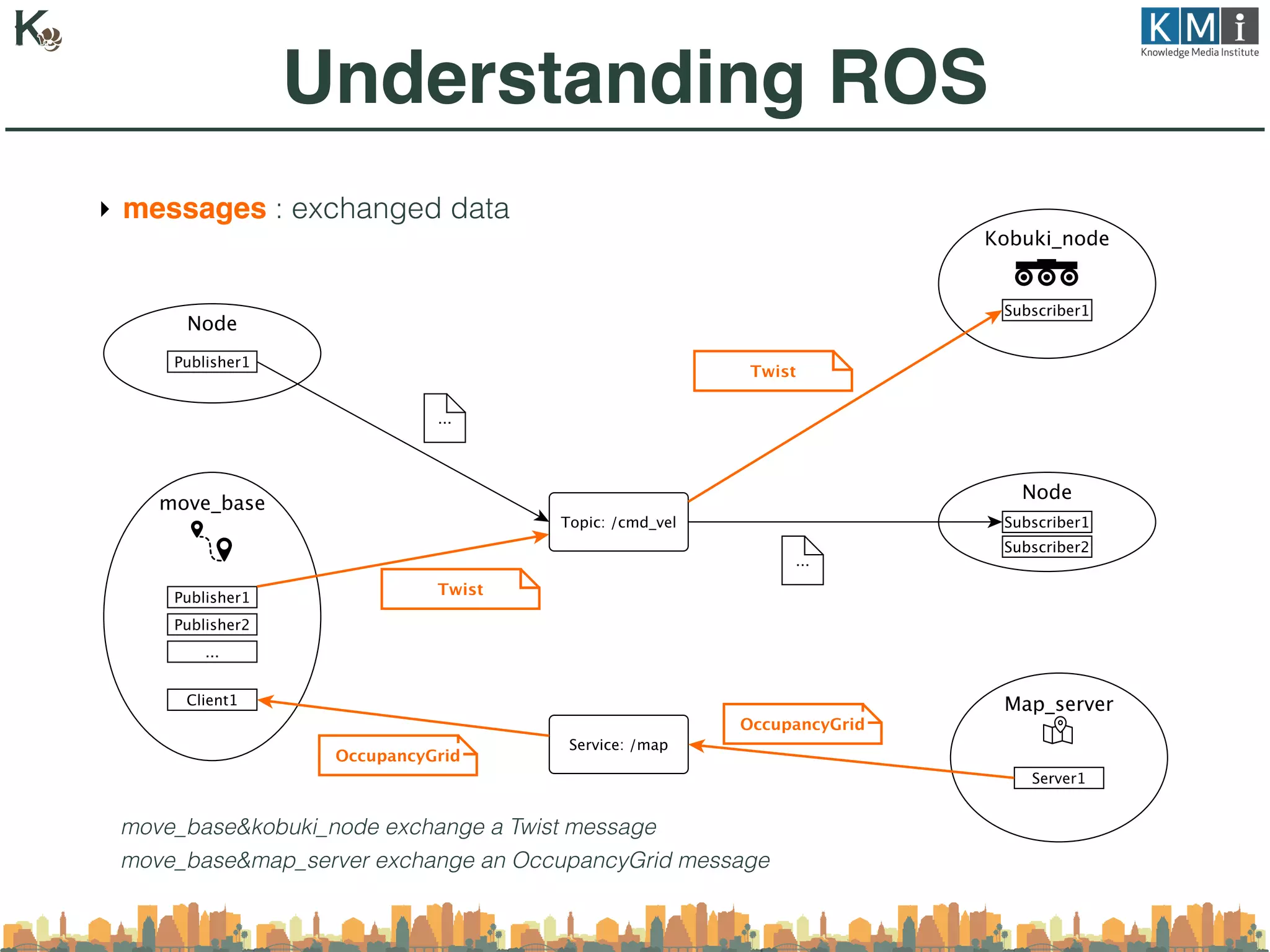
‣ messages : exchanged data
move_base&kobuki_node exchange a Twist message
move_base&map_server exchange an OccupancyGrid message
Understanding ROS
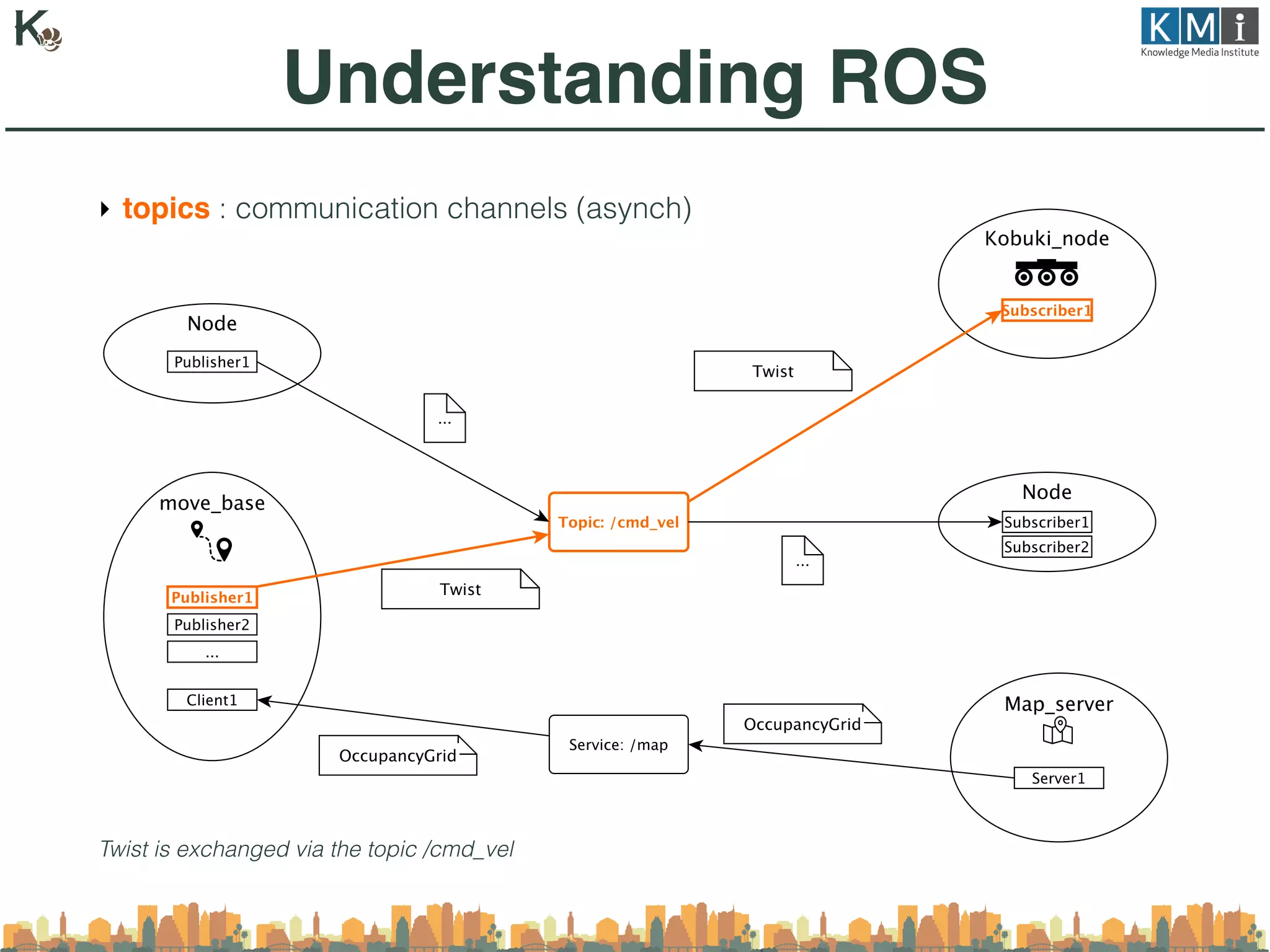
‣ topics : communication channels (asynch)
Twist is exchanged via the topic /cmd_vel
Understanding ROS
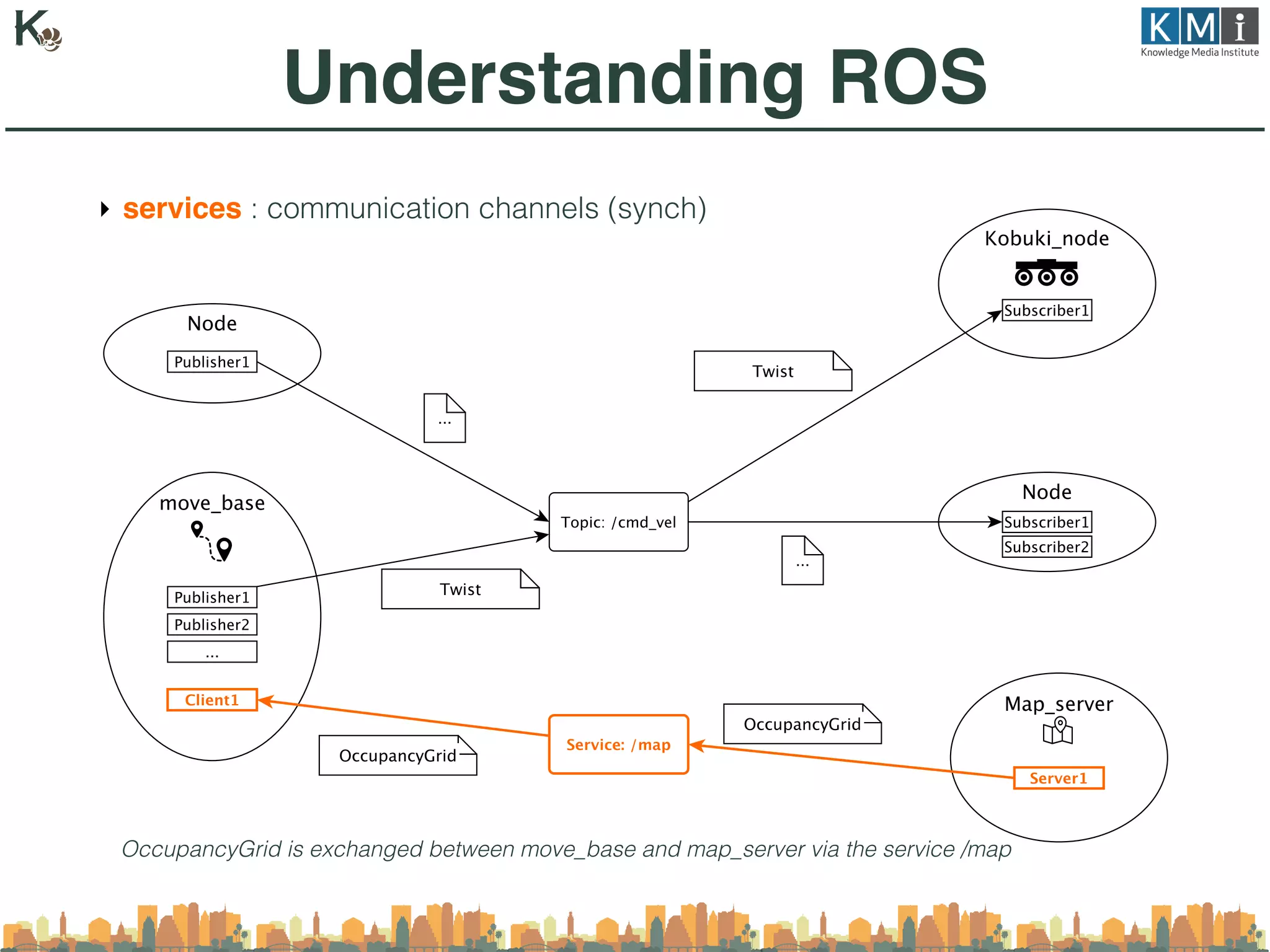
‣ services : communication channels (synch)
OccupancyGrid is exchanged between move_base and map_server via the service /map
Understanding ROS
Formalizing ROS
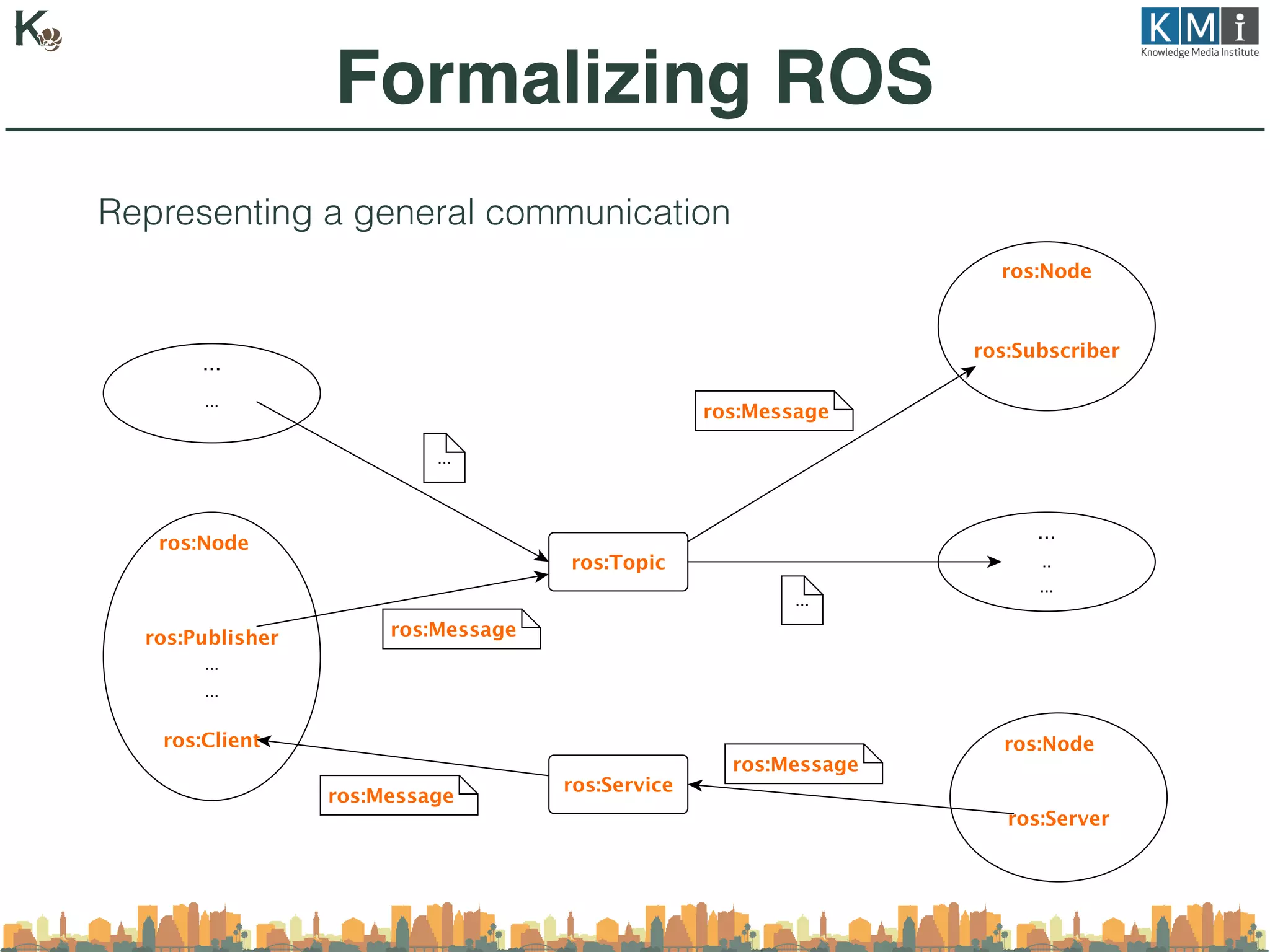
Representing a general communication
Formalizing ROS
Representing topics and services
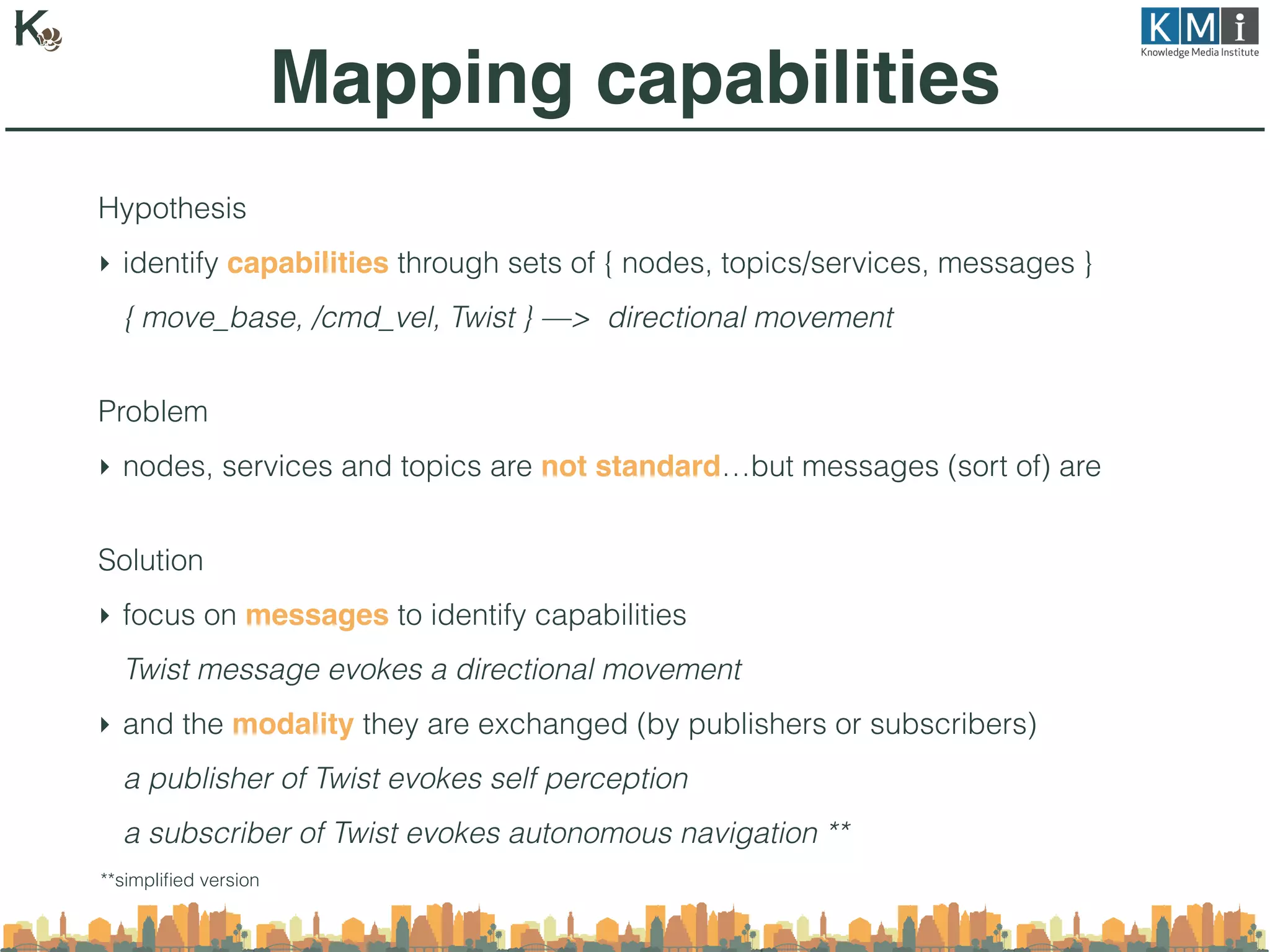
Hypothesis
‣ identify capabilities through sets of { nodes, topics/services, messages }
{ move_base, /cmd_vel, Twist } —> directional movement
Problem
‣ nodes, services and topics are not standard…but messages (sort of) are
Solution
‣ focus on messages to identify capabilities
Twist message evokes a directional movement
‣ and the modality they are exchanged (by publishers or subscribers)
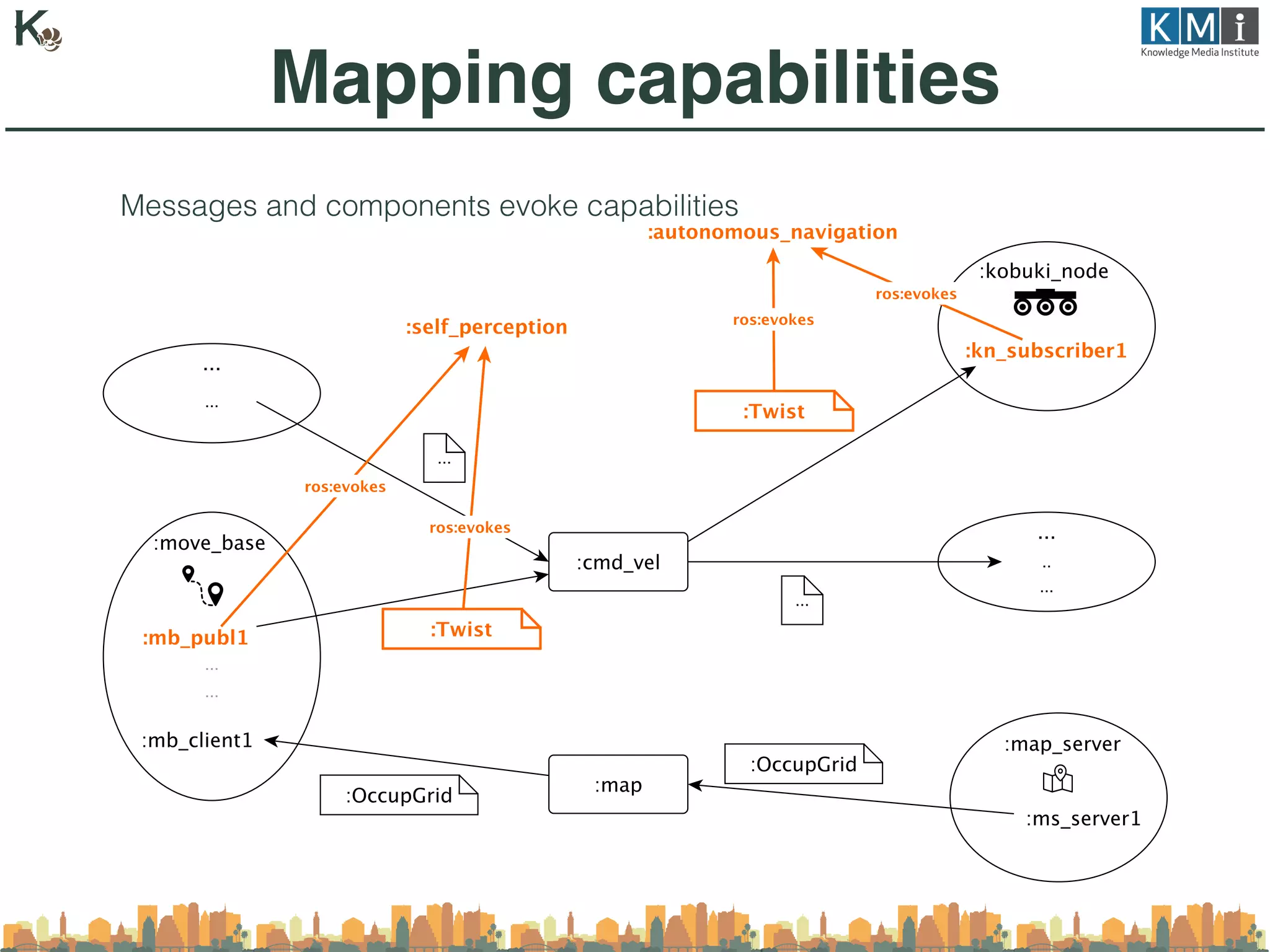
a publisher of Twist evokes self perception
a subscriber of Twist evokes autonomous navigation **
Mapping capabilities
**simplified version
Mapping capabilities
Messages and components evoke capabilities
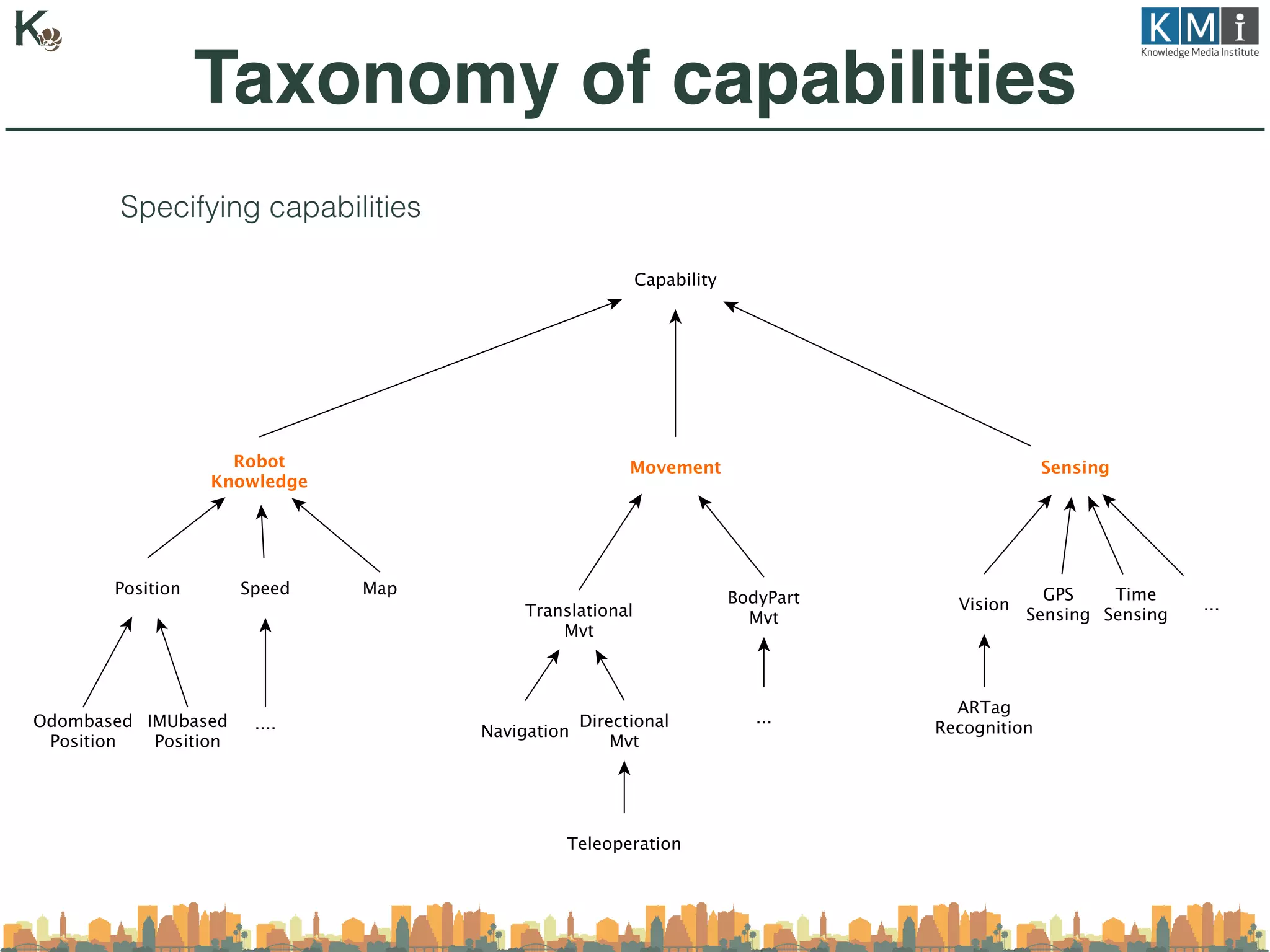
Taxonomy of capabilities
Specifying capabilities
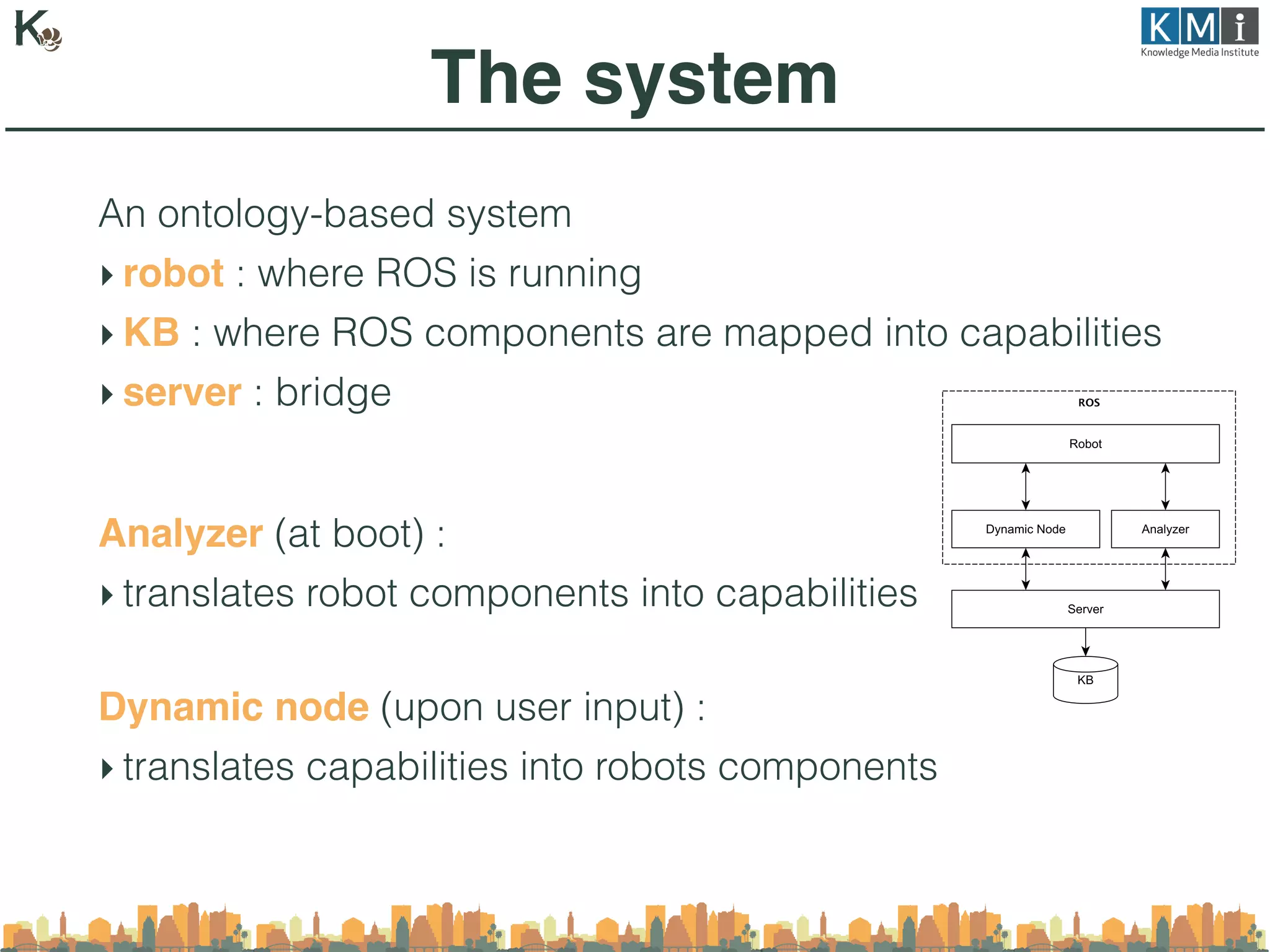
An ontology-based system
‣ robot : where ROS is running
‣ KB : where ROS components are mapped into capabilities
‣ server : bridge
Analyzer (at boot) :
‣ translates robot components into capabilities
Dynamic node (upon user input) :
‣ translates capabilities into robots components
The system
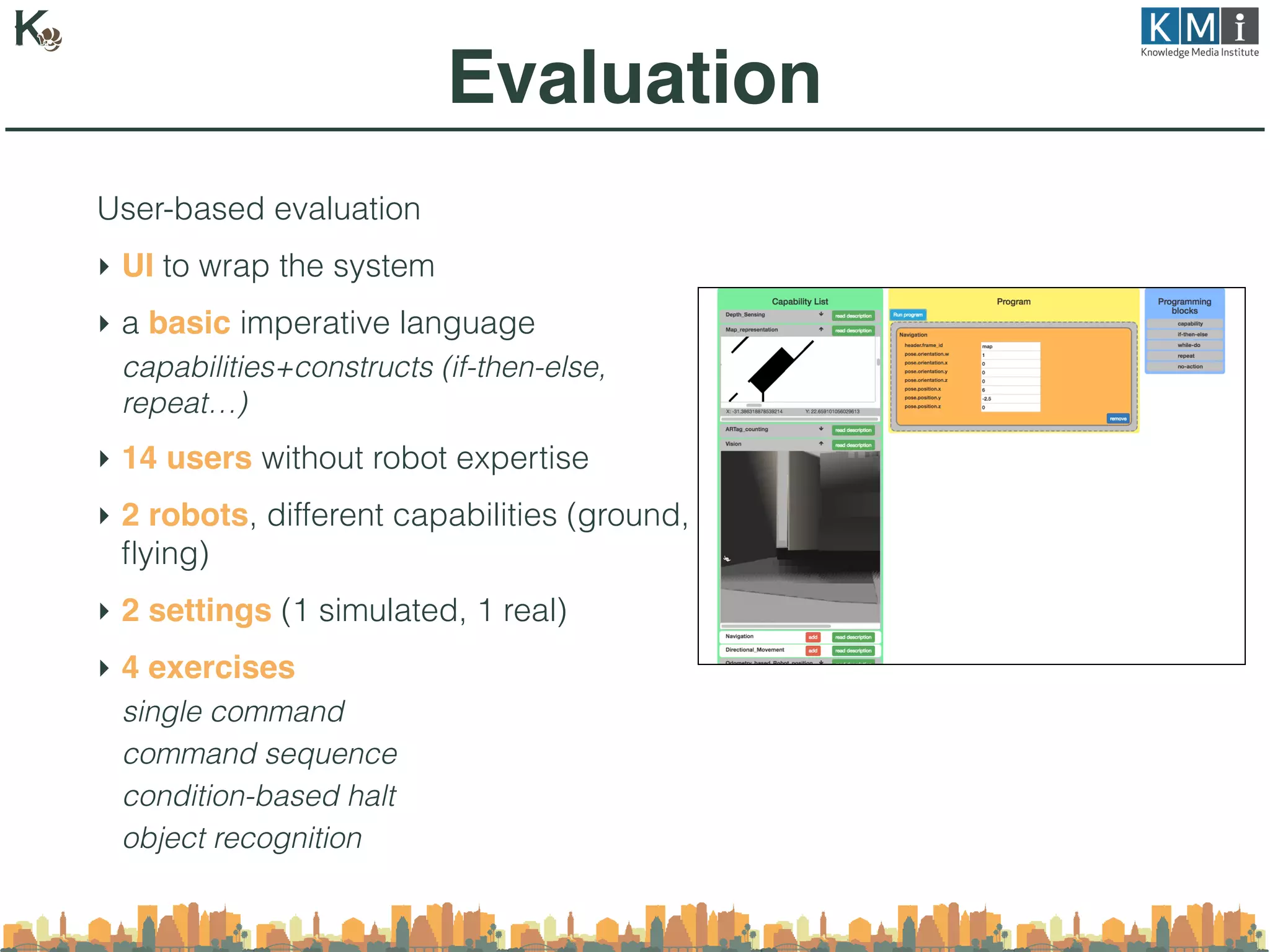
User-based evaluation
‣ UI to wrap the system
‣ a basic imperative language
capabilities+constructs (if-then-else,
repeat…)
‣ 14 users without robot expertise
‣ 2 robots, different capabilities (ground,
flying)
‣ 2 settings (1 simulated, 1 real)
‣ 4 exercises
single command
command sequence
condition-based halt
object recognition
Evaluation
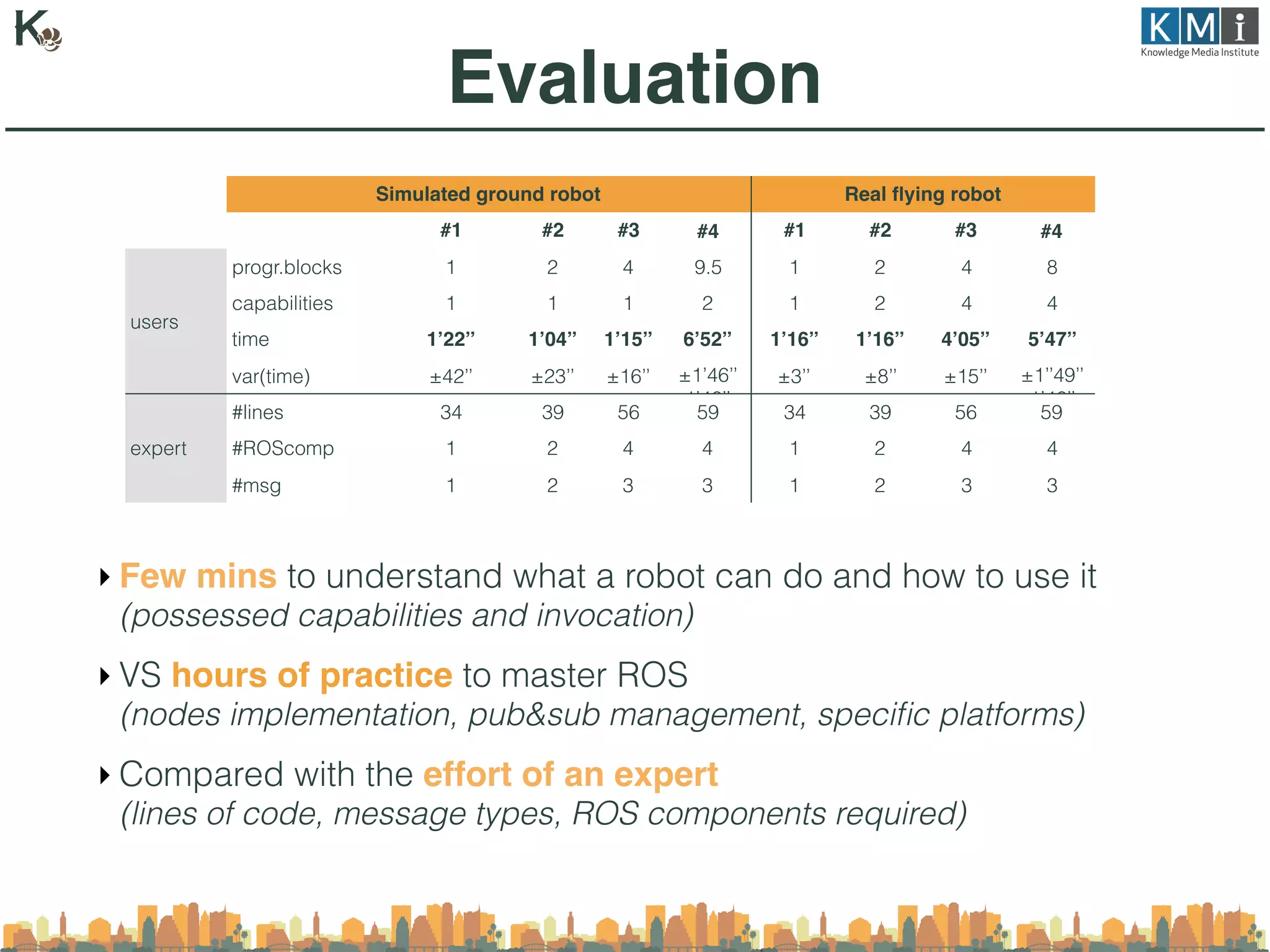
‣ Few mins to understand what a robot can do and how to use it
(possessed capabilities and invocation)
‣ VS hours of practice to master ROS
(nodes implementation, pub&sub management, specific platforms)
‣ Compared with the effort of an expert
(lines of code, message types, ROS components required)
Evaluation
Simulated ground robot Real flying robot
#1 #2 #3 #4 #1 #2 #3 #4
users
progr.blocks 1 2 4 9.5 1 2 4 8
capabilities 1 1 1 2 1 2 4 4
time 1’22’’ 1’04’’ 1’15’’ 6’52’’ 1’16’’ 1’16’’ 4’05’’ 5’47’’
var(time) ±42’’ ±23’’ ±16’’ ±1’46’’
1’46’’
±3’’ ±8’’ ±15’’ ±1’’49’’
1’46’’
expert
#lines 34 39 56 59 34 39 56 59
#ROScomp 1 2 4 4 1 2 4 4
#msg 1 2 3 3 1 2 3 3
Wrapping-up…
‣robots are cool, but we do not know how to use
them properly
‣ontologies can allow non-experts to access
different robots effortlessly
‣an ontology-based approach deriving
capabilities from ROS components
Conclusions
Future work
‣Refine/improve the taxonomy
autonomous navigation=sensing+localization+planning
‣include robots with manipulators
grasping, moving objects (fine-grained capabilities)
‣expose the system as APIs in a development workflow
to allow reusability!
Conclusions
Bloopers
ilaria.tiddi@open.ac.uk
Thank you

An ontology-based approach to improve the accessibility of ROS-based robotic systems

  • 1.
    An ontology-based approach toimprove the accessibility of ROS-based robotic systems Ilaria Tiddi, Emanuele Bastianelli, Gianluca Bardaro, Mathieu d’Aquin, Enrico Motta Knowledge Capture (K-CAP2017) Austin, Texas, USA 5/12/2017 @IlaTiddi
  • 2.
    Robots (because they arecool) Capabilities (because we want to play with robots) and a bit of ontologies (because we want make our life easier) Today’s talk
  • 3.
    Robots are becomingmore popular ‣ advances in Computer Vision/AI/Navigation&Planning ‣ new hardware and software components ‣ cheaper platforms (roomba, drones…) New users approach robots ‣ no interest in low-level capabilities (drivers, controllers…) ‣ interest in high-level capabilities (NLG, navigation, vision…) Context
  • 4.
    Providers do notfully expose a robot’s capabilities ‣ robots become end products (unless being a robot developer) e.g. drones for photography / roombas for cleaning MK:Smart++ [1]: integrating robots in cities ‣ data collectors (drones for parking monitoring) ‣ data consumers (adaptive self-driving cars) Example : team of robots for green space maintenance ‣ available capabilities : e.g. teleoperation, video recording ‣ expertise required to program trajectories/object recognition ‣ different platforms require different experts Motivation [1] www.mksmart.org
  • 5.
    How to ‣ exploithigh-level capabilities of heterogeneous platforms ‣ reducing development costs? Can we use ontologies? ‣ they allow interoperability ‣ they allow domain abstraction Can an ontology of capabilities ‣ help non-experts in programming robots ‣ facilitate the integration of robots in various (city) applications? Research questions
  • 6.
    [2] : theRobot Operating System ‣ collaborative middleware ‣ management of low-level components (share, reuse) ‣ need a fine-grained understanding of the robot architecture Robot Operating System [2] www.ros.org
  • 7.
    Assisting non-experts forrobot development through : ‣ creating an ontology of robots high-level capabilities ‣ mapping of low-level ROS functionalities to high-level capabilities ‣ a system that can understand what a robot can do based on these Steps 1. Understanding and formalizing ROS 2. Mapping capabilities to ROS 3. Defining a taxonomy of capabilities 4. Wrapping these in a system Proposed approach
  • 8.
    Tools, libraries&conventions forcollaborative robot development ‣ open and shareable ‣ promoting robust general-purpose robot softwares Understanding ROS
  • 9.
    A network ofdata processes** Understanding ROS **simplified version
  • 10.
    Understanding ROS ‣ nodes: low-level functions move_base (navigation), kobuki_node (wheel control), map_server (map management)
  • 11.
    ‣ messages :exchanged data move_base&kobuki_node exchange a Twist message move_base&map_server exchange an OccupancyGrid message Understanding ROS
  • 12.
    ‣ topics :communication channels (asynch) Twist is exchanged via the topic /cmd_vel Understanding ROS
  • 13.
    ‣ services :communication channels (synch) OccupancyGrid is exchanged between move_base and map_server via the service /map Understanding ROS
  • 14.
    Formalizing ROS Representing ageneral communication
  • 15.
  • 16.
    Hypothesis ‣ identify capabilitiesthrough sets of { nodes, topics/services, messages } { move_base, /cmd_vel, Twist } —> directional movement Problem ‣ nodes, services and topics are not standard…but messages (sort of) are Solution ‣ focus on messages to identify capabilities Twist message evokes a directional movement ‣ and the modality they are exchanged (by publishers or subscribers) a publisher of Twist evokes self perception a subscriber of Twist evokes autonomous navigation ** Mapping capabilities **simplified version
  • 17.
    Mapping capabilities Messages andcomponents evoke capabilities
  • 18.
  • 19.
    An ontology-based system ‣robot : where ROS is running ‣ KB : where ROS components are mapped into capabilities ‣ server : bridge Analyzer (at boot) : ‣ translates robot components into capabilities Dynamic node (upon user input) : ‣ translates capabilities into robots components The system
  • 20.
    User-based evaluation ‣ UIto wrap the system ‣ a basic imperative language capabilities+constructs (if-then-else, repeat…) ‣ 14 users without robot expertise ‣ 2 robots, different capabilities (ground, flying) ‣ 2 settings (1 simulated, 1 real) ‣ 4 exercises single command command sequence condition-based halt object recognition Evaluation
  • 21.
    ‣ Few minsto understand what a robot can do and how to use it (possessed capabilities and invocation) ‣ VS hours of practice to master ROS (nodes implementation, pub&sub management, specific platforms) ‣ Compared with the effort of an expert (lines of code, message types, ROS components required) Evaluation Simulated ground robot Real flying robot #1 #2 #3 #4 #1 #2 #3 #4 users progr.blocks 1 2 4 9.5 1 2 4 8 capabilities 1 1 1 2 1 2 4 4 time 1’22’’ 1’04’’ 1’15’’ 6’52’’ 1’16’’ 1’16’’ 4’05’’ 5’47’’ var(time) ±42’’ ±23’’ ±16’’ ±1’46’’ 1’46’’ ±3’’ ±8’’ ±15’’ ±1’’49’’ 1’46’’ expert #lines 34 39 56 59 34 39 56 59 #ROScomp 1 2 4 4 1 2 4 4 #msg 1 2 3 3 1 2 3 3
  • 22.
    Wrapping-up… ‣robots are cool,but we do not know how to use them properly ‣ontologies can allow non-experts to access different robots effortlessly ‣an ontology-based approach deriving capabilities from ROS components Conclusions
  • 23.
    Future work ‣Refine/improve thetaxonomy autonomous navigation=sensing+localization+planning ‣include robots with manipulators grasping, moving objects (fine-grained capabilities) ‣expose the system as APIs in a development workflow to allow reusability! Conclusions
  • 24.
  • 25.