An Ontology Design Pattern
to Define Explanations
Ilaria Tiddi, Mathieu d’Aquin, Enrico Motta
Knowledge Media Institute, The Open University, UK
@IlaTiddi
General problem
We need of a formal definition for an explanation
Explanations?
• many systems are based on them (data
analysis)
• vague definition
• process, components, interactions are
undefined
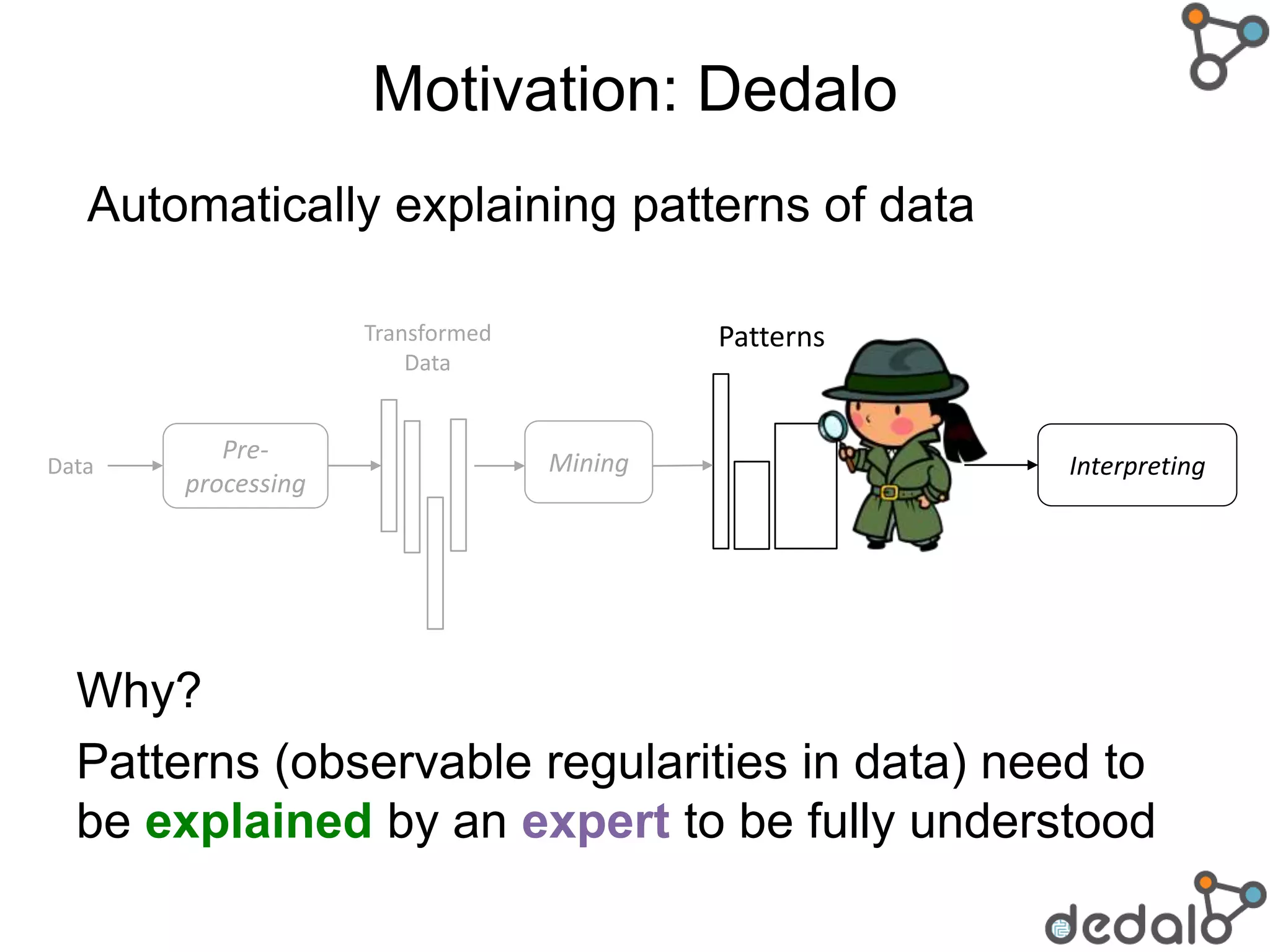
Motivation: Dedalo
Why?
Patterns (observable regularities in data) need to
be explained by an expert to be fully understood
Transformed
Data
Patterns
Pre-
processing
Data Mining Interpreting
Automatically explaining patterns of data
Motivation: Dedalo
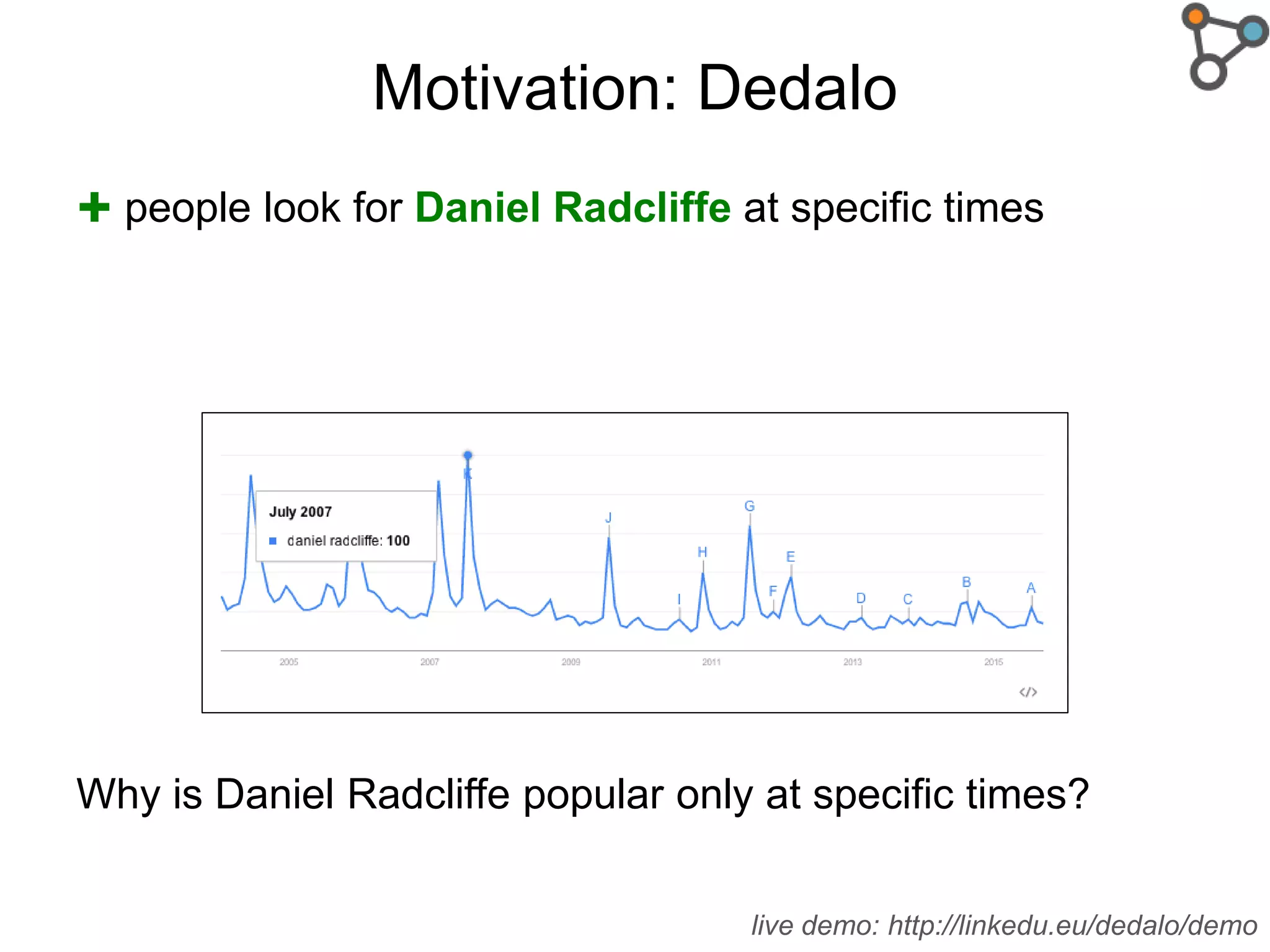
✚ people look for Daniel Radcliffe at specific times
Why is Daniel Radcliffe popular only at specific times?
live demo: http://linkedu.eu/dedalo/demo
Motivation: Dedalo
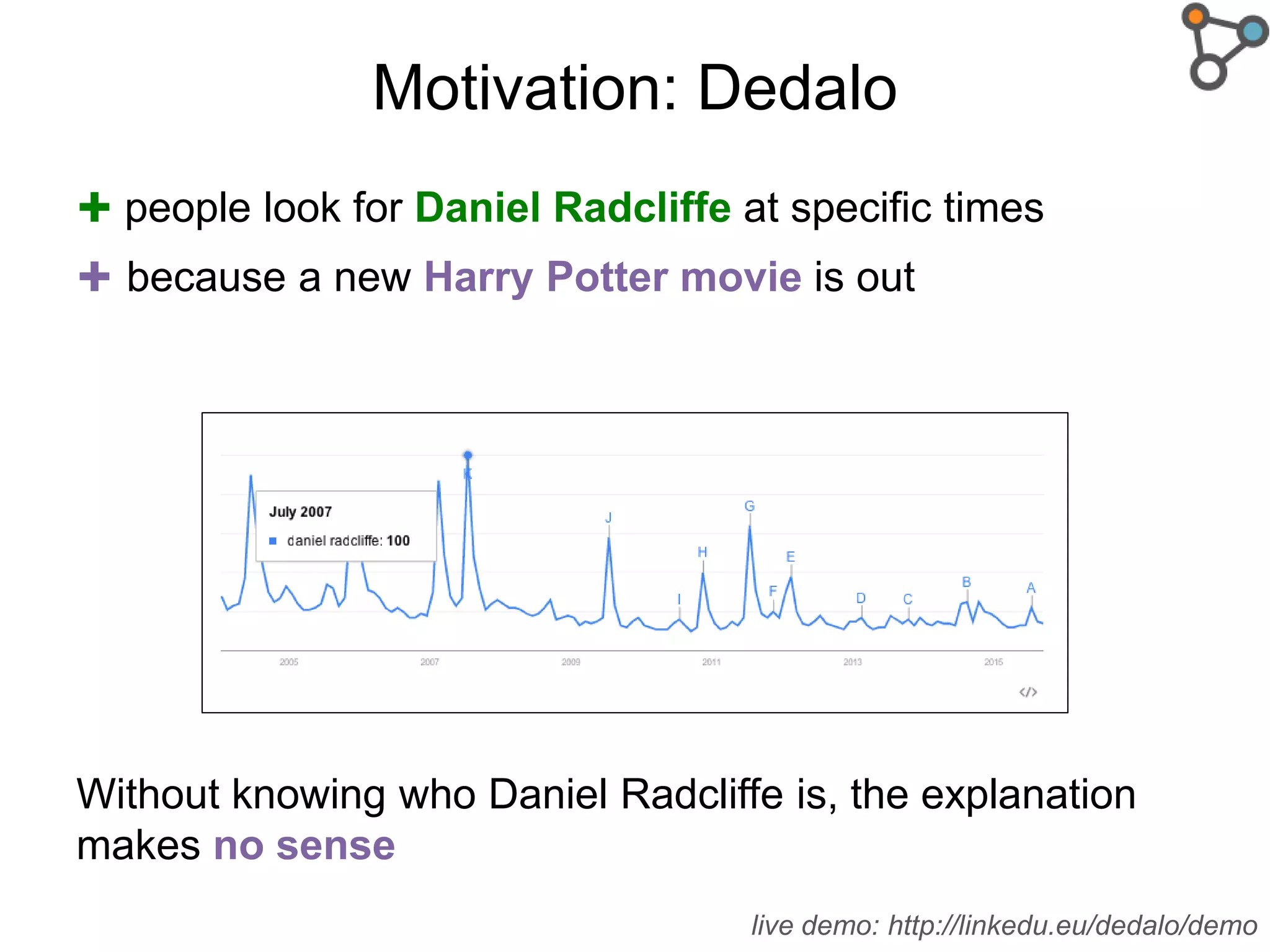
✚ people look for Daniel Radcliffe at specific times
✚ because a new Harry Potter movie is out
Without knowing who Daniel Radcliffe is, the explanation
makes no sense
live demo: http://linkedu.eu/dedalo/demo
Motivation: Dedalo
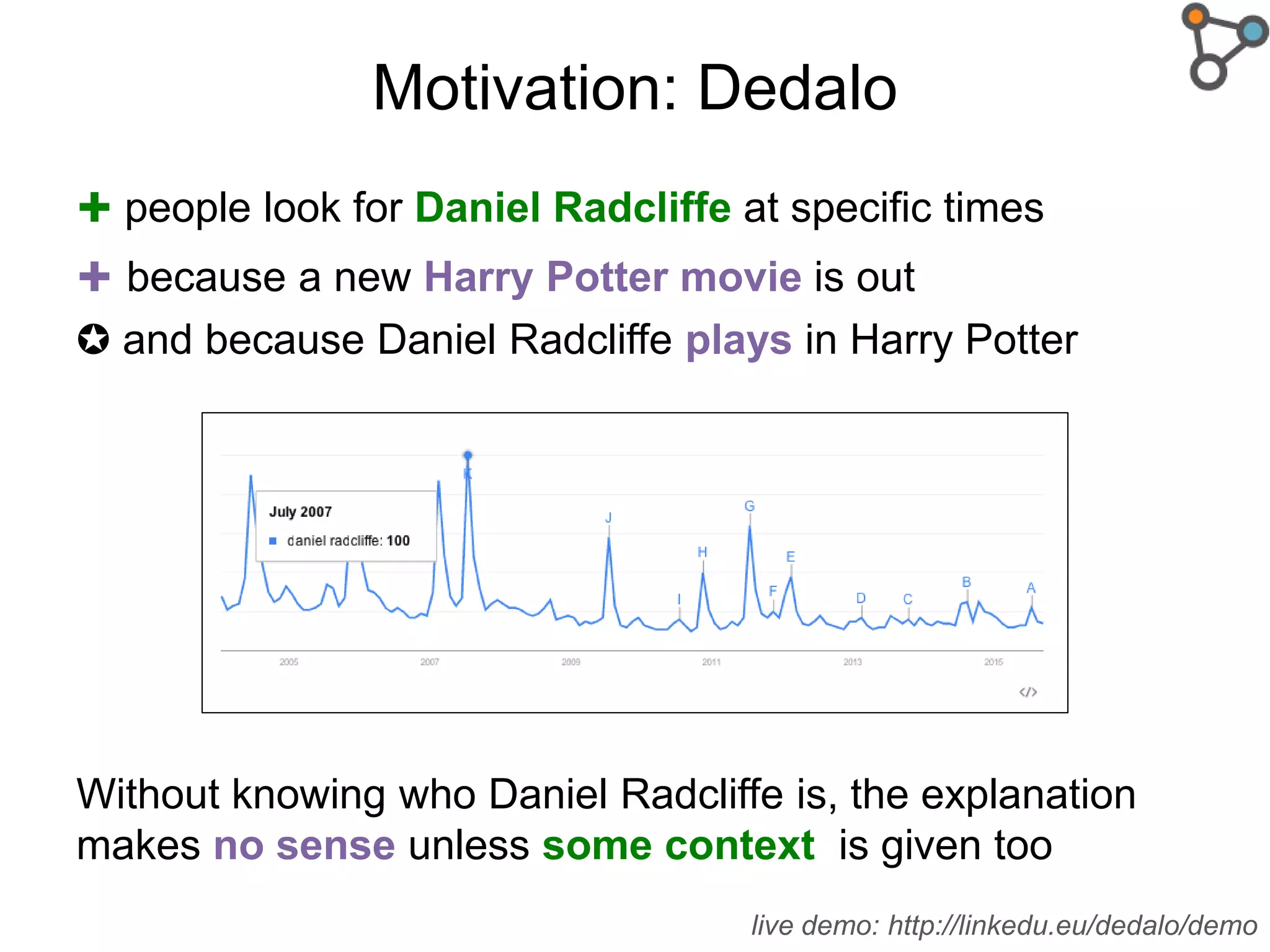
✚ people look for Daniel Radcliffe at specific times
✚ because a new Harry Potter movie is out
✪ and because Daniel Radcliffe plays in Harry Potter
Without knowing who Daniel Radcliffe is, the explanation
makes no sense unless some context is given too
live demo: http://linkedu.eu/dedalo/demo
Challenge
Dedalo needs a formal definition of an
explanation
• what components ?
• which interactions?
to differentiate it from a mere correlation
Challenge: how to figure out this definition
Approach
Philosophy
Neuroscience
Linguistics
Anthropology
Psychology
Artificial
Intelligence
How were “explanations” defined in Cognitive Science[1]?
H. Gardner (1985). The mind’s new science: A history of the cognitive revolution.
Contributions/1
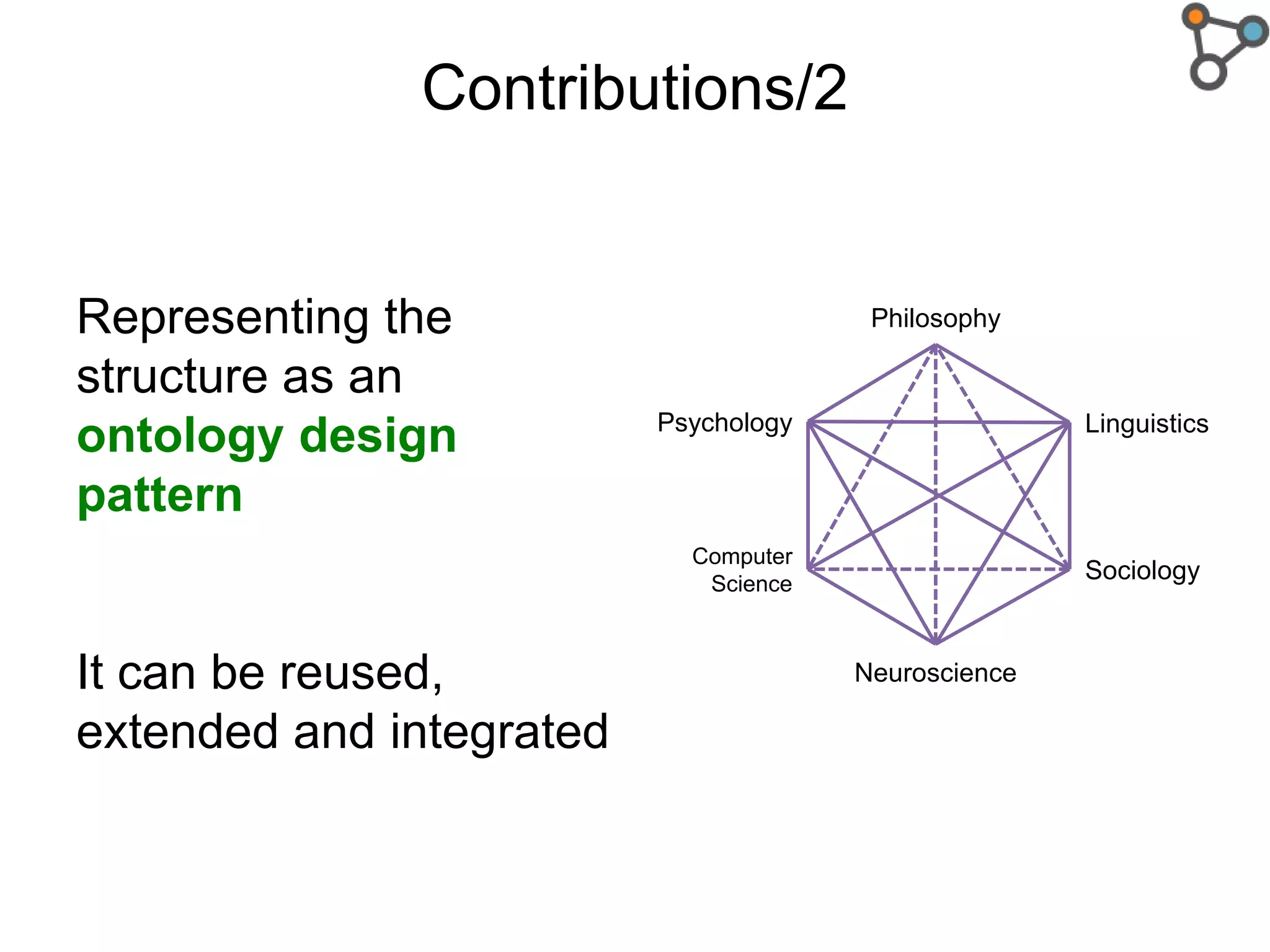
Philosophy
Neuroscience
Linguistics
Sociology
Psychology
Computer
Science
Surveying “explanations”
in Cognitive Science
Structure : ✚ ✚ ✪ 
“When ✚ happens, then,
due to a given set of
circumstances ✪, ✚ will
occur too because of a
given law ”[2]
E. Maaløe (2007). Modes of Explanation: From Rules to Emergence.
Contributions/2
Philosophy
Neuroscience
Linguistics
Sociology
Psychology
Computer
Science
Representing the
structure as an
ontology design
pattern
It can be reused,
extended and integrated
Explanation in Philosophy
Philosophy – asking questions and checking answers
Putting in a relation
✚ an event
✪ some initial conditions
✚ with an output phenomenon
 according to a set of (empirical or metaphysical) laws
Planets are near ✚; what is near does not twinkle 
; therefore, planets do not twinkle ✚ (context ✪: planets)
[Aristotles]
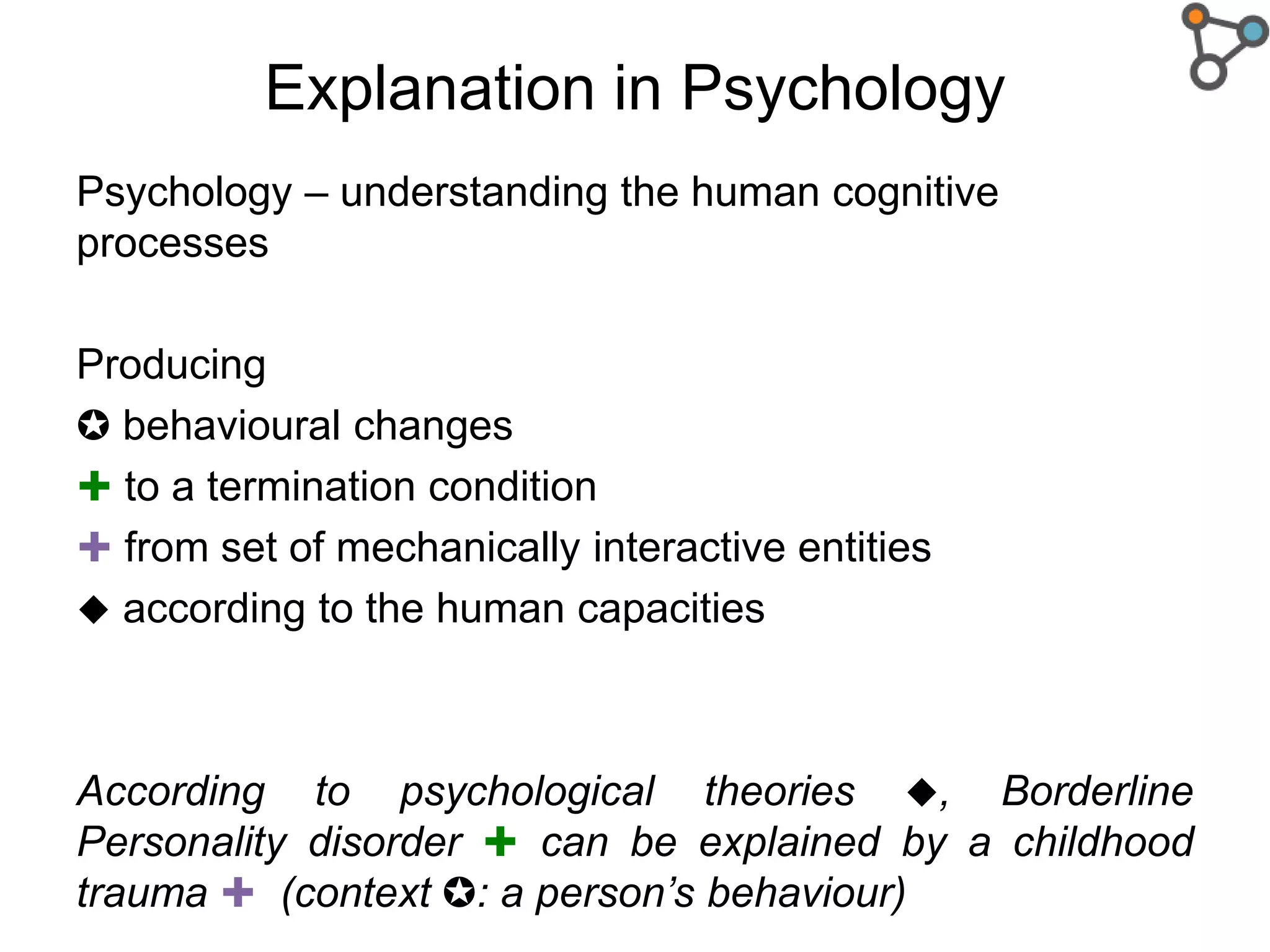
Explanation in Psychology
Psychology – understanding the human cognitive
processes
Producing
✪ behavioural changes
✚ to a termination condition
✚ from set of mechanically interactive entities
 according to the human capacities
According to psychological theories , Borderline
Personality disorder ✚ can be explained by a childhood
trauma ✚ (context ✪: a person’s behaviour)
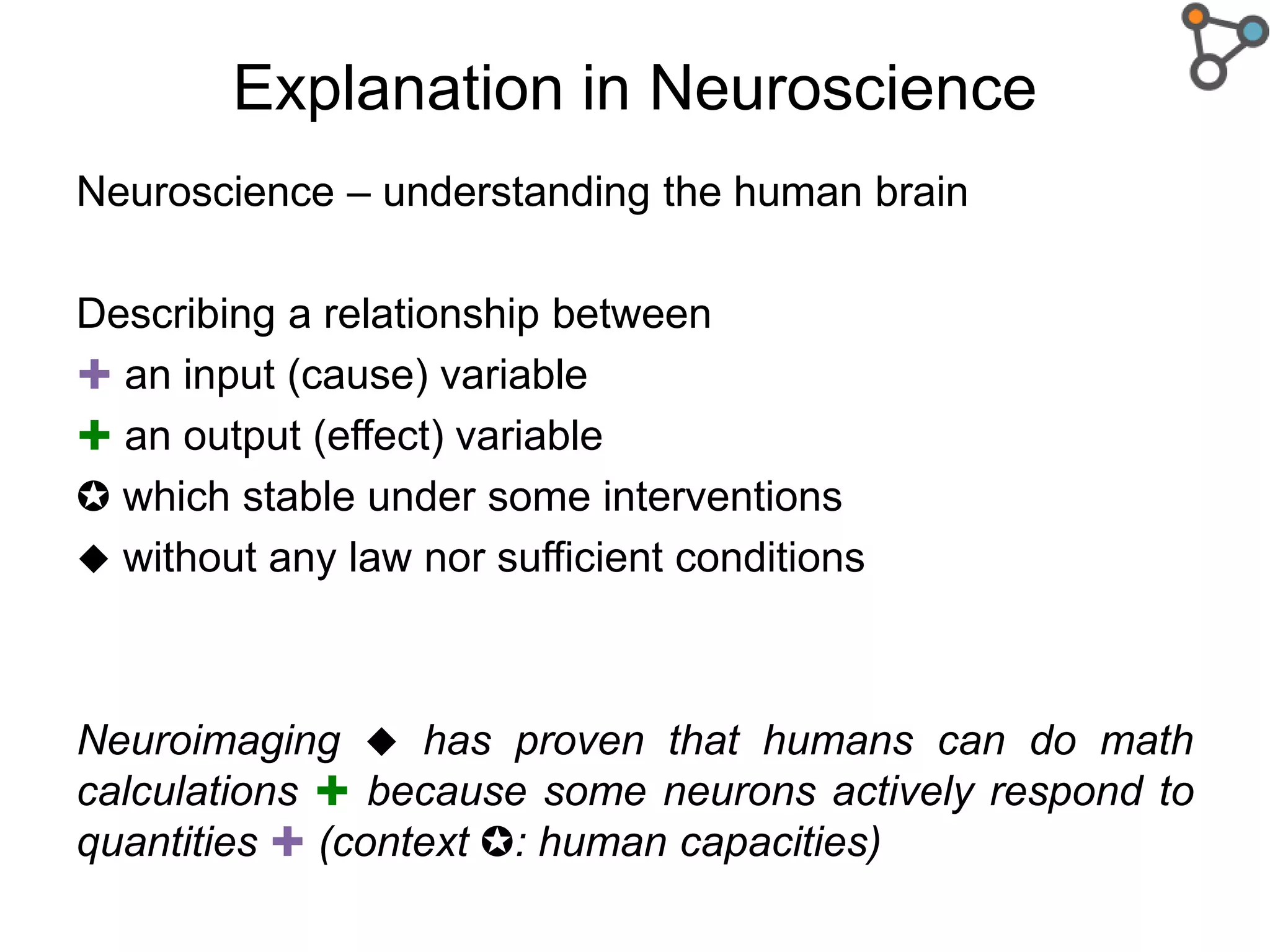
Explanation in Neuroscience
Neuroscience – understanding the human brain
Describing a relationship between
✚ an input (cause) variable
✚ an output (effect) variable
✪ which stable under some interventions
 without any law nor sufficient conditions
Neuroimaging  has proven that humans can do math
calculations ✚ because some neurons actively respond to
quantities ✚ (context ✪: human capacities)
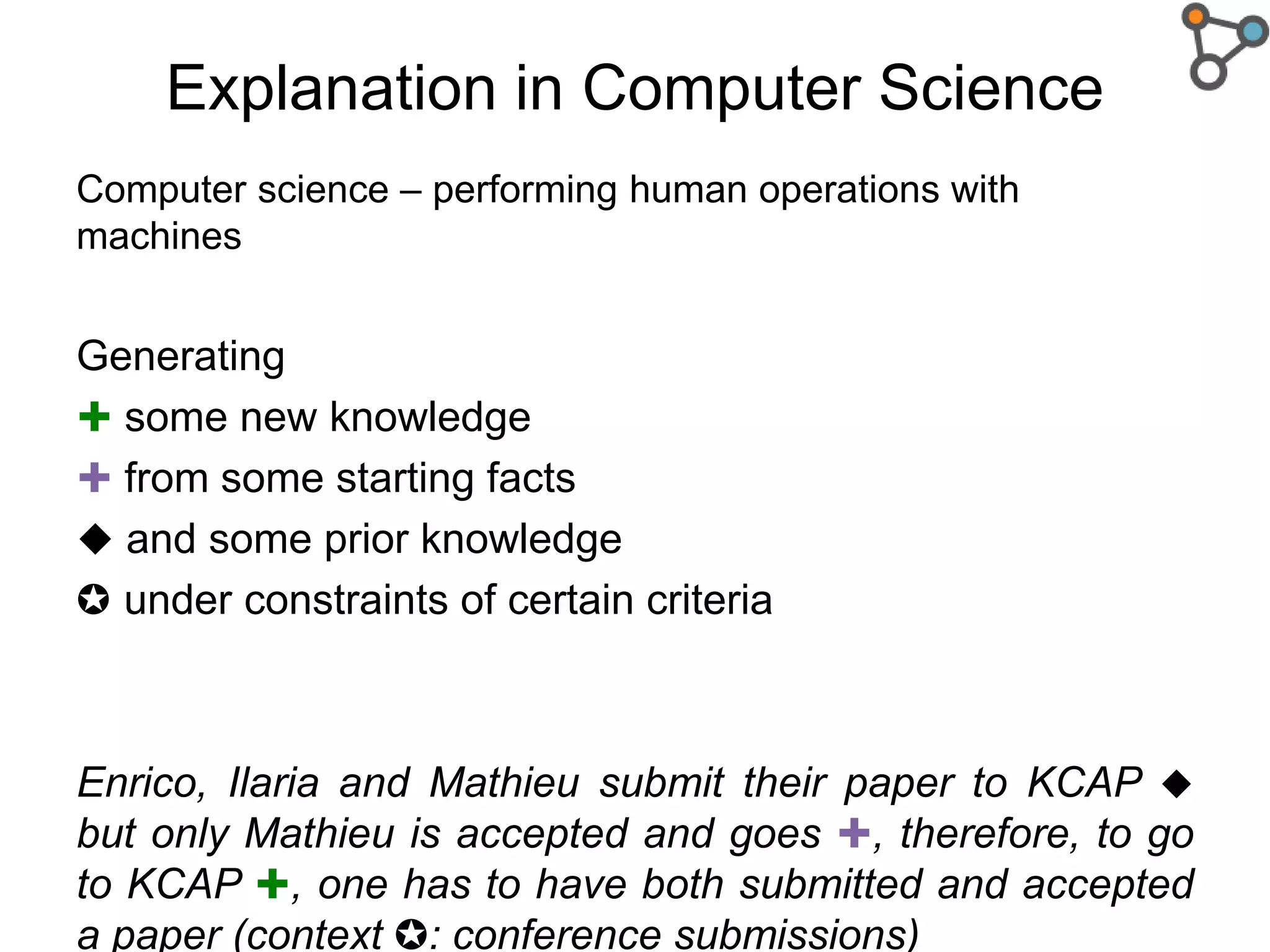
Explanation in Computer Science
Computer science – performing human operations with
machines
Generating
✚ some new knowledge
✚ from some starting facts
 and some prior knowledge
✪ under constraints of certain criteria
Enrico, Ilaria and Mathieu submit their paper to KCAP 
but only Mathieu is accepted and goes ✚, therefore, to go
to KCAP ✚, one has to have both submitted and accepted
a paper (context ✪: conference submissions)
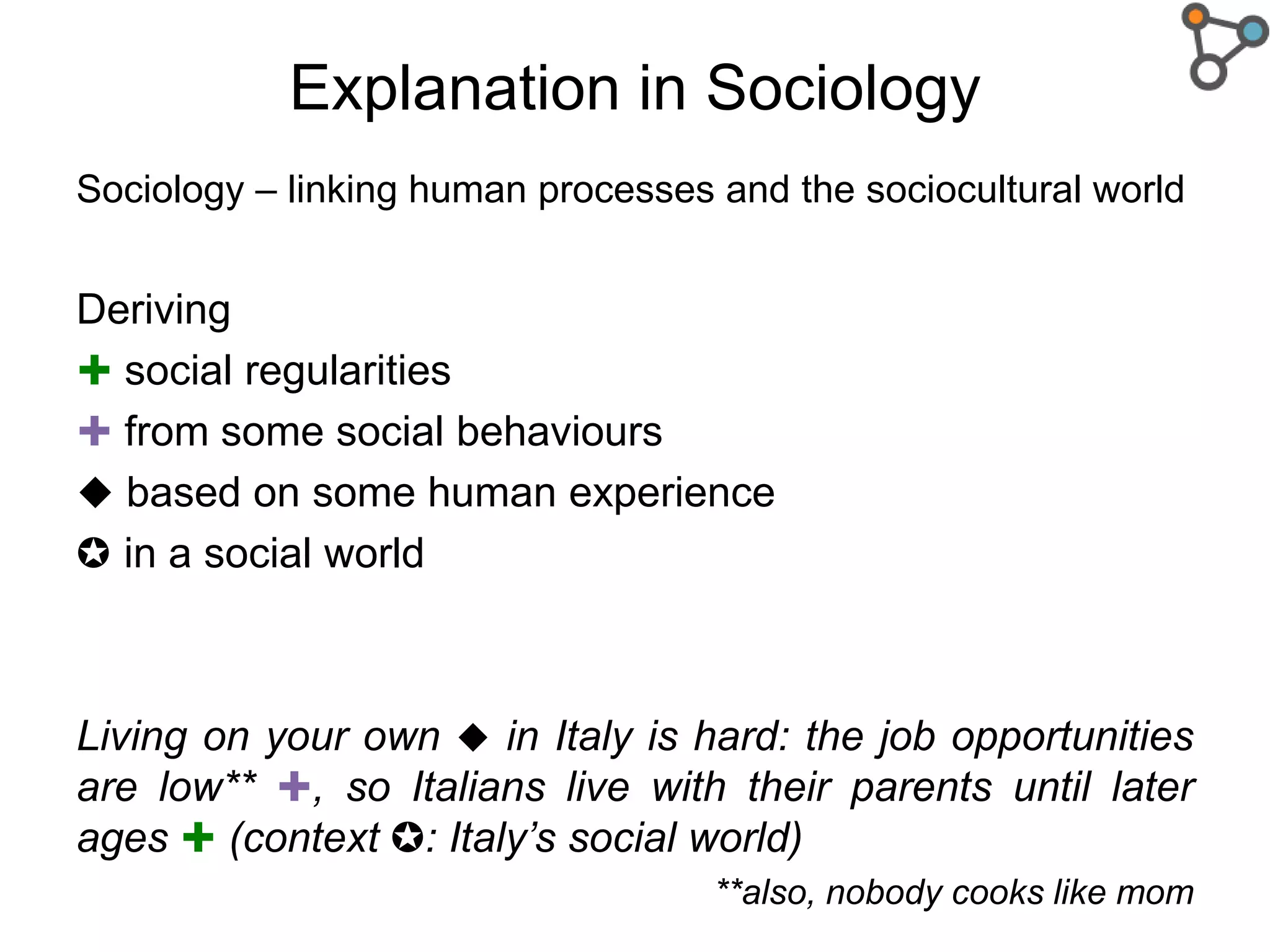
Explanation in Sociology
Sociology – linking human processes and the sociocultural world
Deriving
✚ social regularities
✚ from some social behaviours
 based on some human experience
✪ in a social world
Living on your own  in Italy is hard: the job opportunities
are low** ✚, so Italians live with their parents until later
ages ✚ (context ✪: Italy’s social world)
**also, nobody cooks like mom
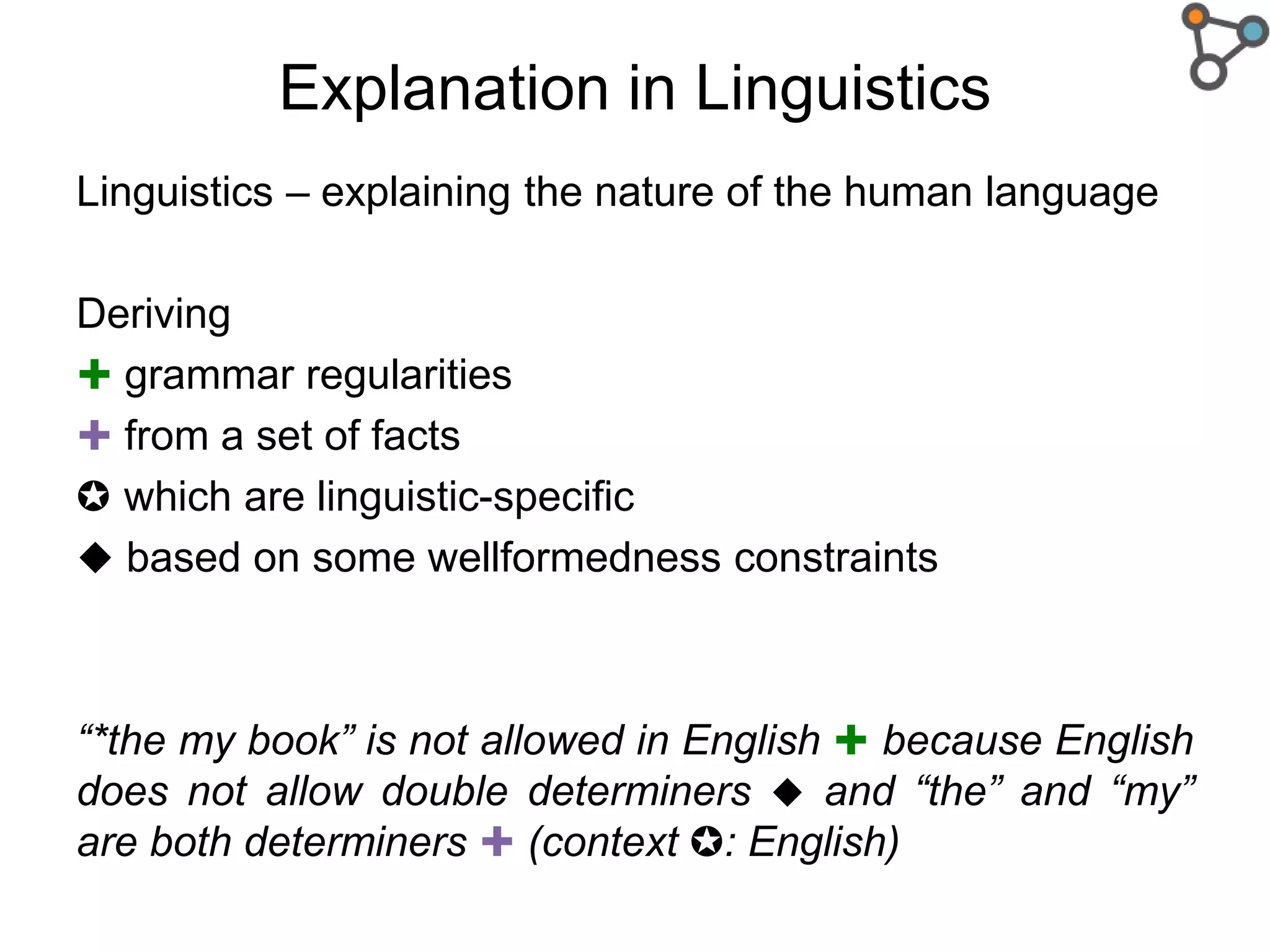
Explanation in Linguistics
Linguistics – explaining the nature of the human language
Deriving
✚ grammar regularities
✚ from a set of facts
✪ which are linguistic-specific
 based on some wellformedness constraints
“*the my book” is not allowed in English ✚ because English
does not allow double determiners  and “the” and “my”
are both determiners ✚ (context ✪: English)
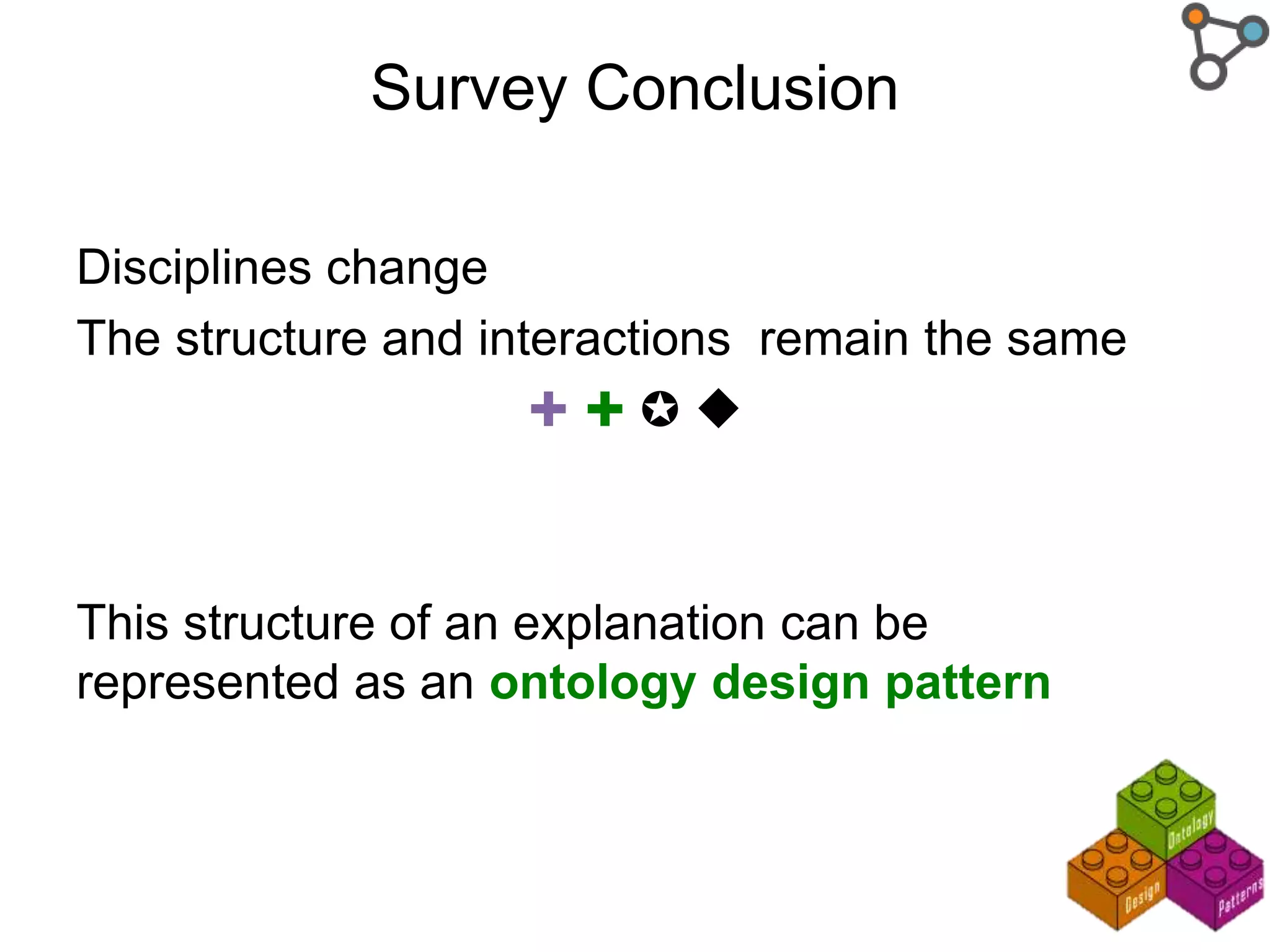
Survey Conclusion
Disciplines change
The structure and interactions remain the same
✚ ✚ ✪ 
This structure of an explanation can be
represented as an ontology design pattern
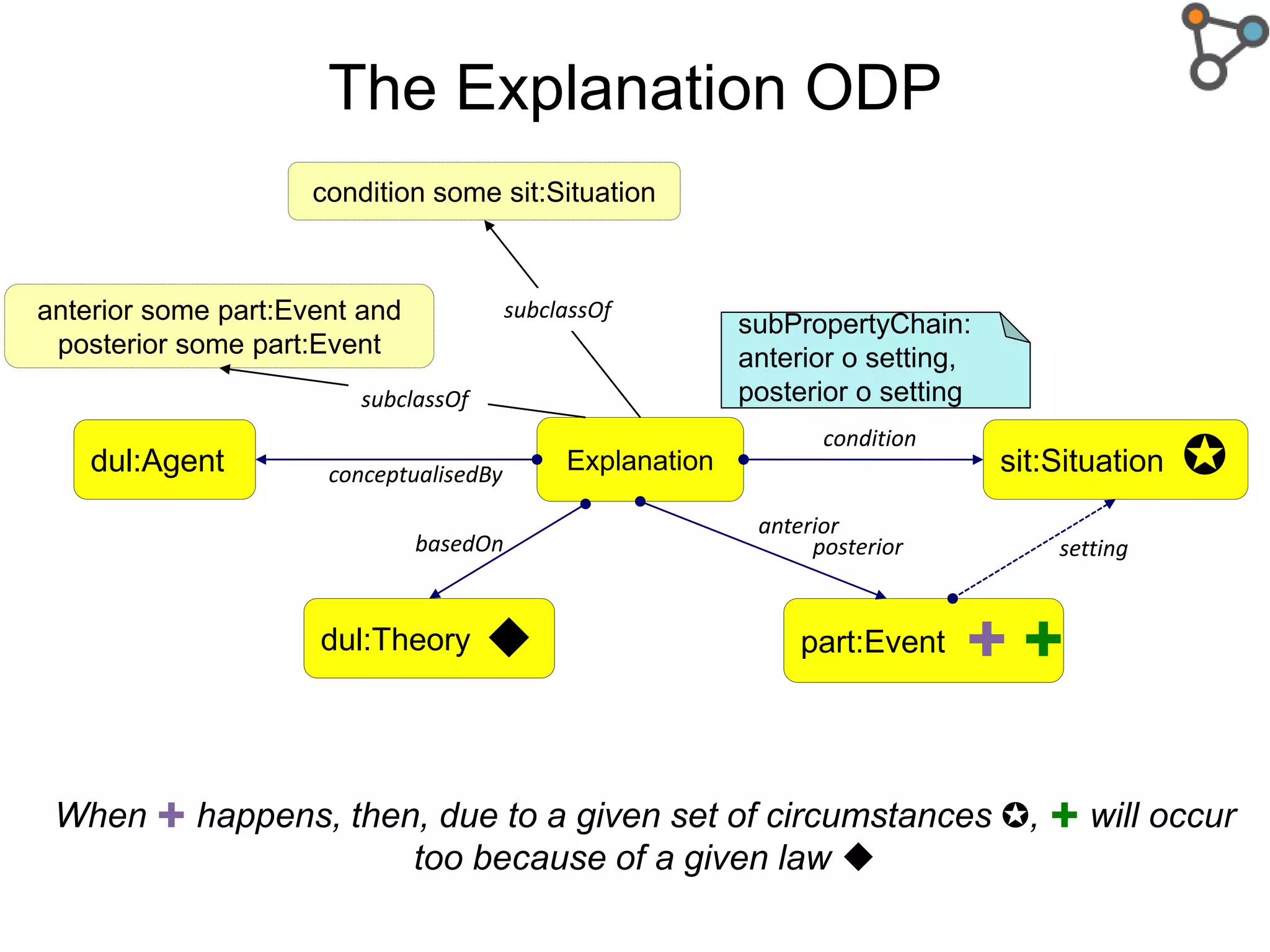
part:Event
The Explanation ODP
✚ ✚
When ✚ happens, then, due to a given set of circumstances ✪, ✚ will occur
too because of a given law 
dul:Theory
sit:Situation ✪

Explanation
posterior
anterior
setting
condition
basedOn
dul:Agent conceptualisedBy
subPropertyChain:
anterior o setting,
posterior o setting
condition some sit:Situation
anterior some part:Event and
posterior some part:Event
subclassOf
subclassOf
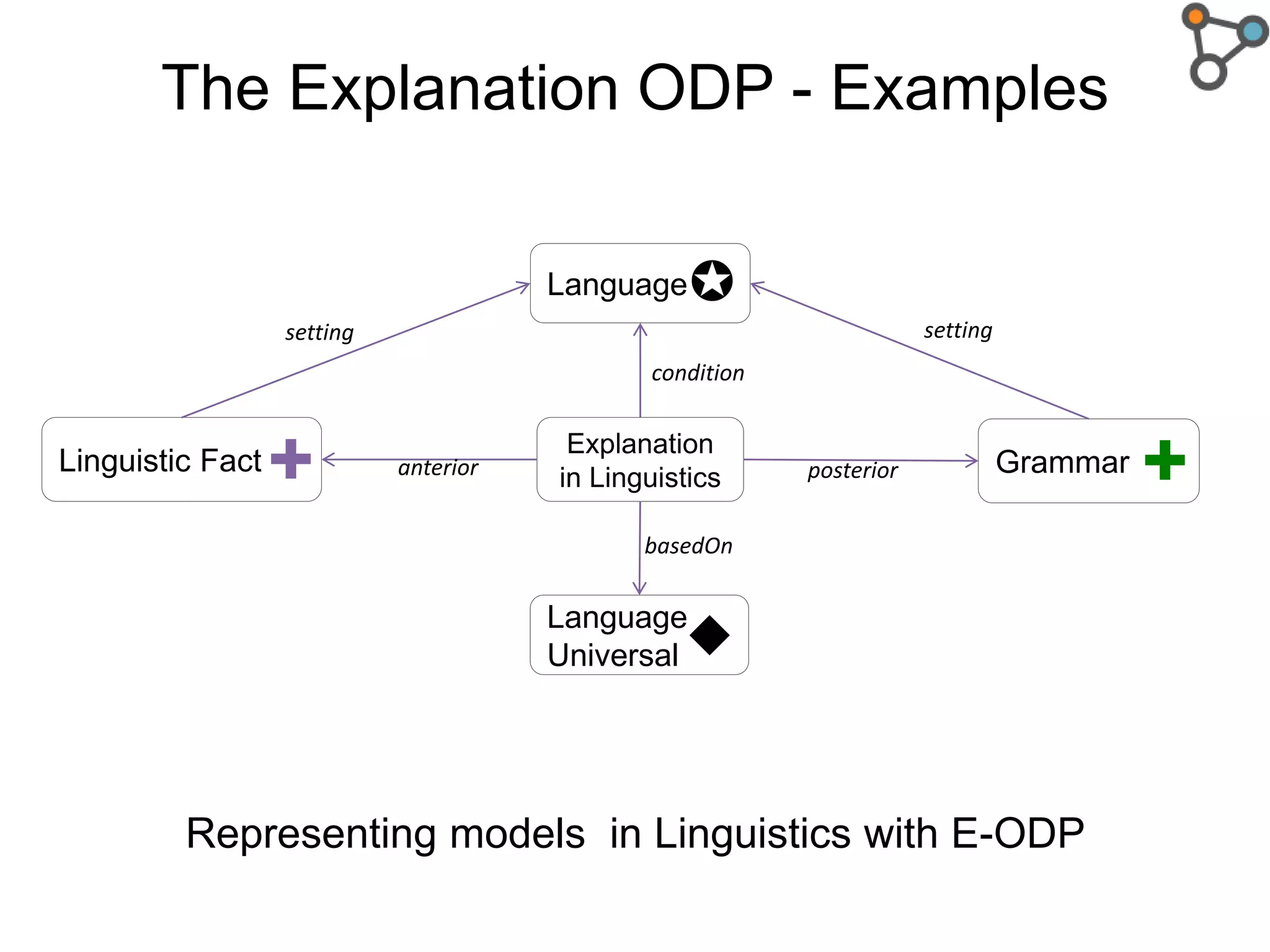
Language
Universal
GrammarLinguistic Fact
Language
The Explanation ODP - Examples
Representing models in Linguistics with E-ODP
✚
✪

✚ Explanation
in Linguistics posterioranterior
setting setting
condition
basedOn
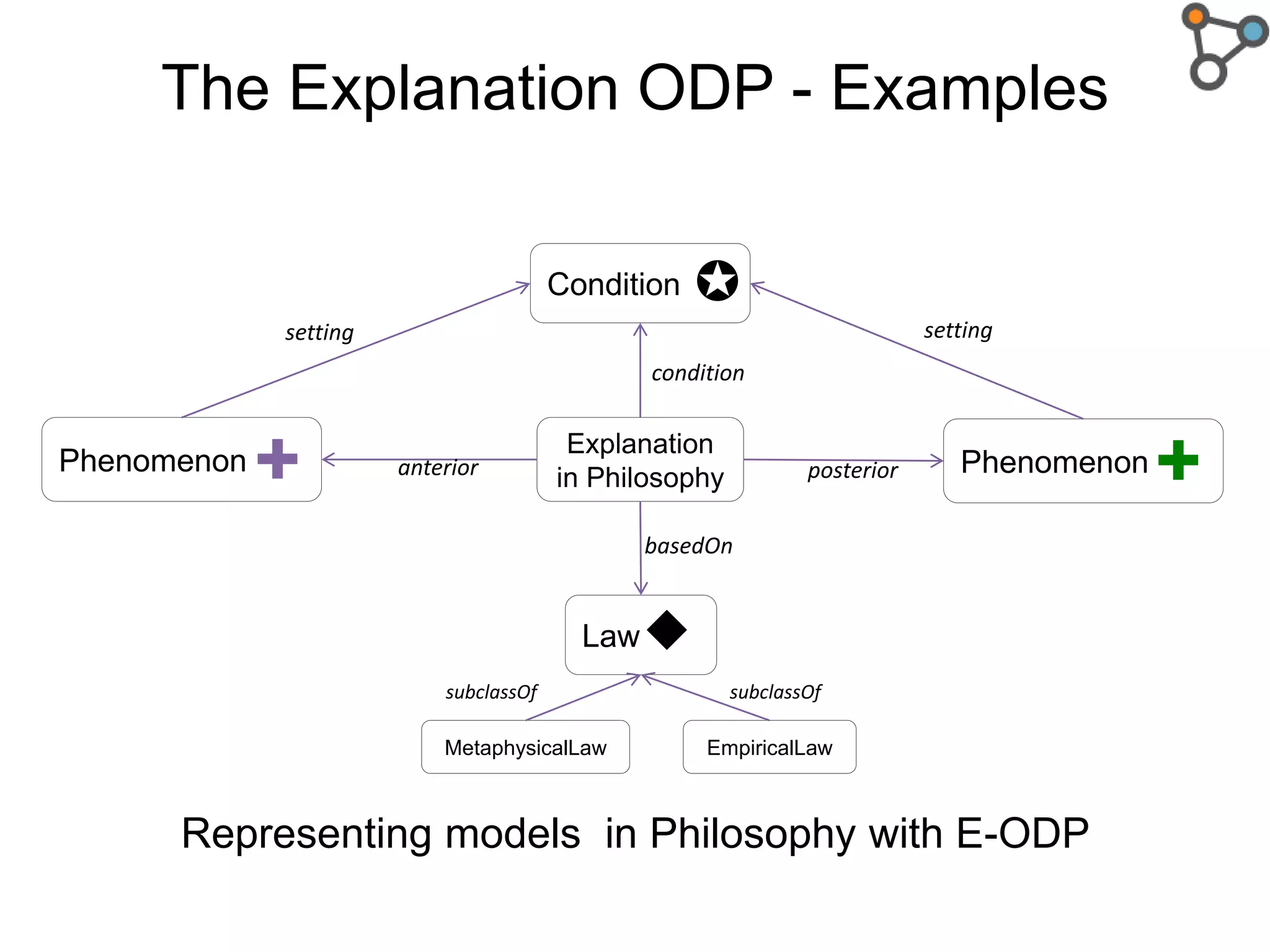
Law
PhenomenonPhenomenon
Condition
The Explanation ODP - Examples
Representing models in Philosophy with E-ODP
✚
✪

✚ Explanation
in Philosophy posterioranterior
setting setting
condition
basedOn
MetaphysicalLaw EmpiricalLaw
subclassOf subclassOf
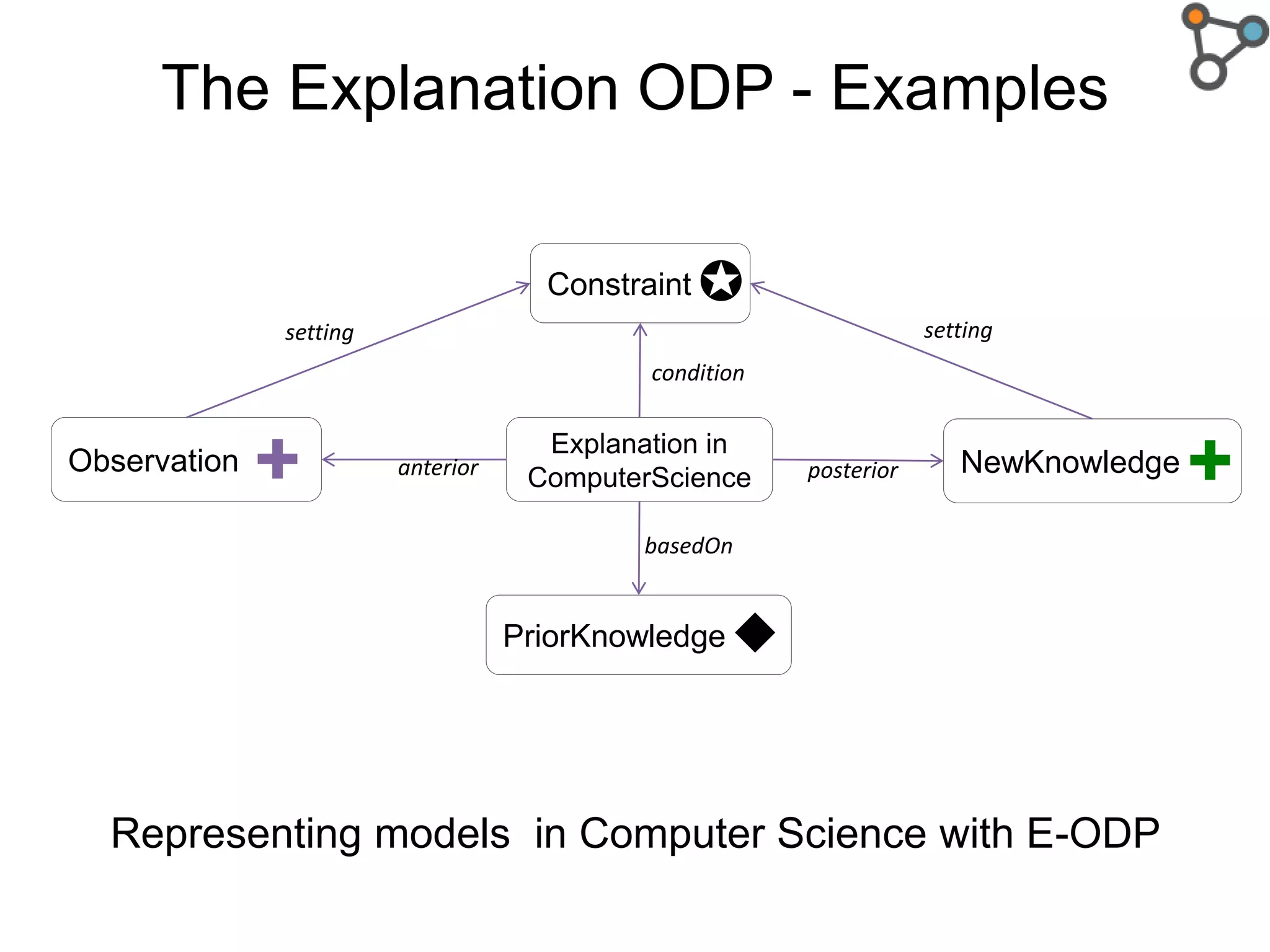
PriorKnowledge
NewKnowledgeObservation
Constraint
The Explanation ODP - Examples
Representing models in Computer Science with E-ODP
✚
✪

✚ Explanation in
ComputerScience posterioranterior
setting setting
condition
basedOn
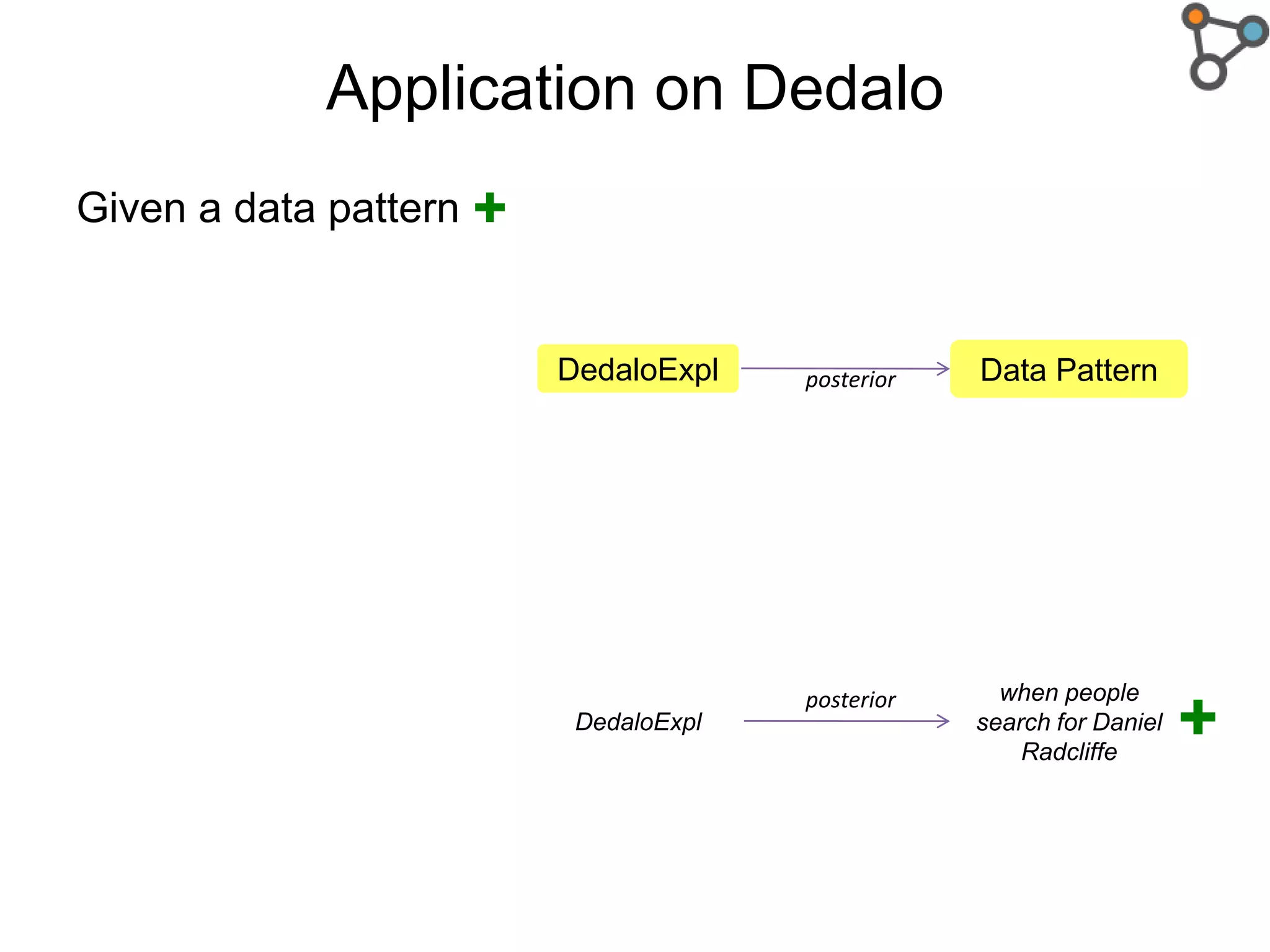
Application on Dedalo
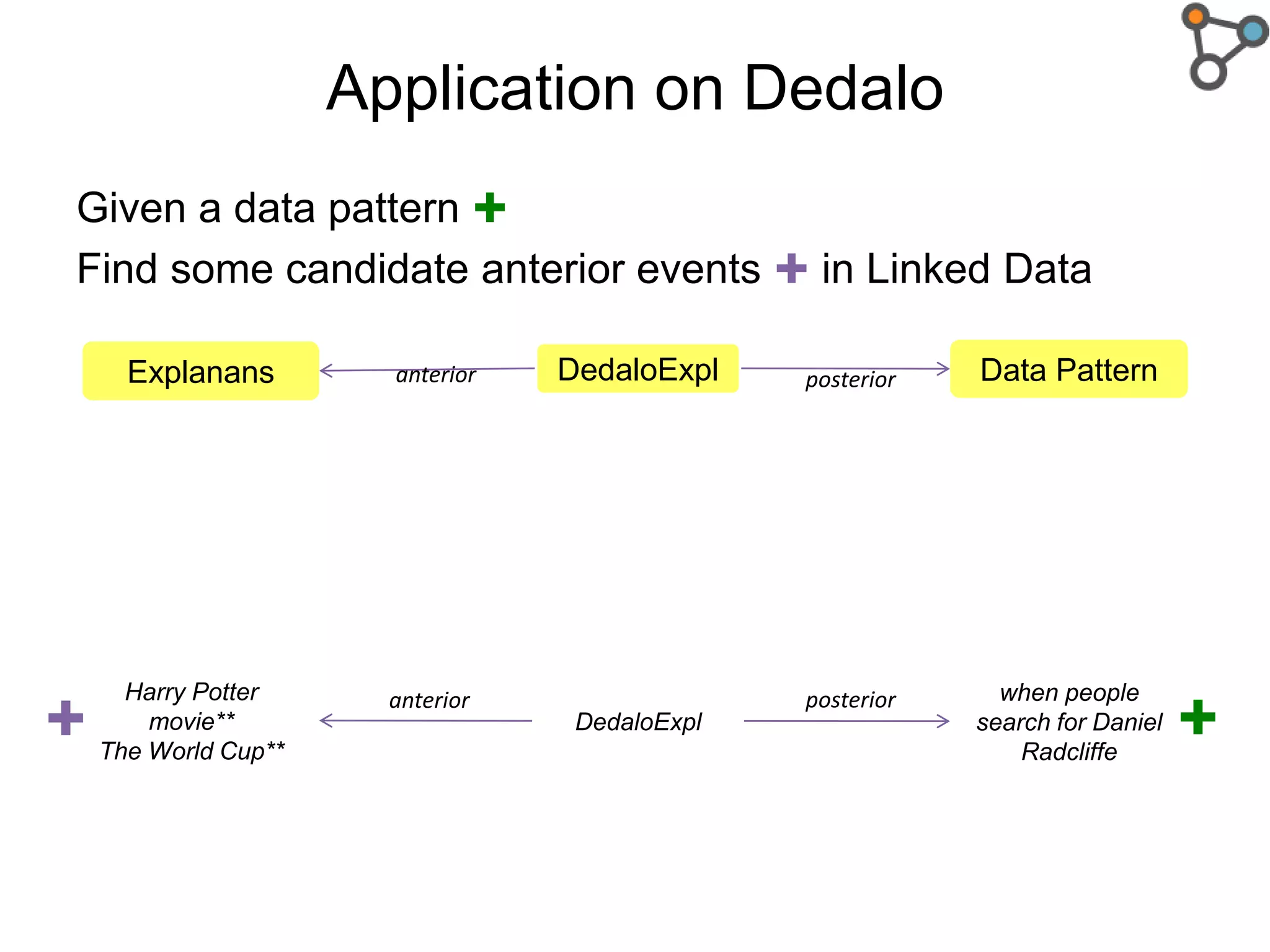
Given a data pattern ✚
DedaloExpl Data Patternposterior
when people
search for Daniel
Radcliffe
posterior
DedaloExpl ✚
Application on Dedalo
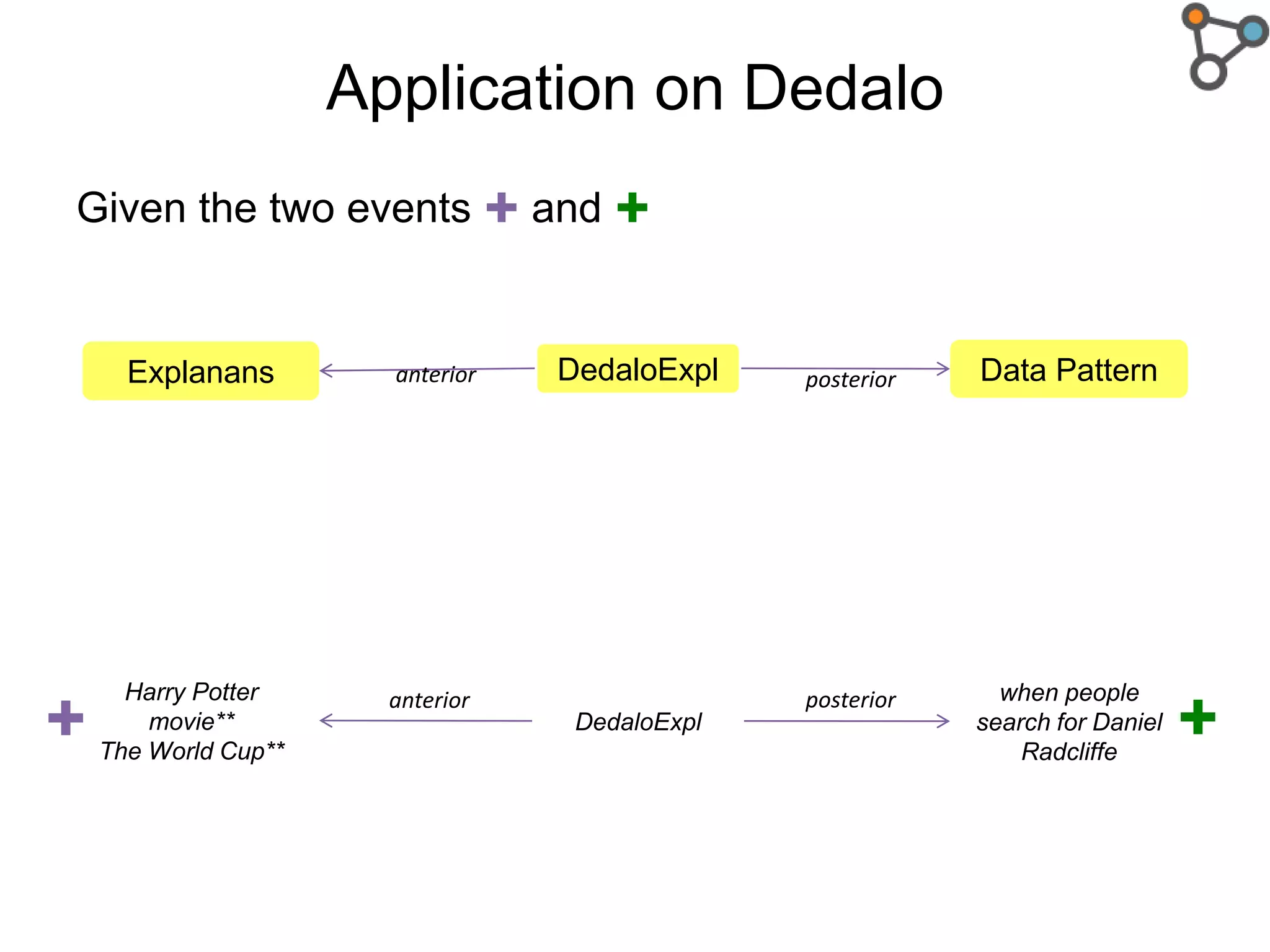
Given a data pattern ✚
Find some candidate anterior events ✚ in Linked Data
DedaloExpl Data Patternposterior
when people
search for Daniel
Radcliffe
posterioranterior
Explanans anterior
DedaloExpl
Harry Potter
movie**
The World Cup**
✚✚
Application on Dedalo
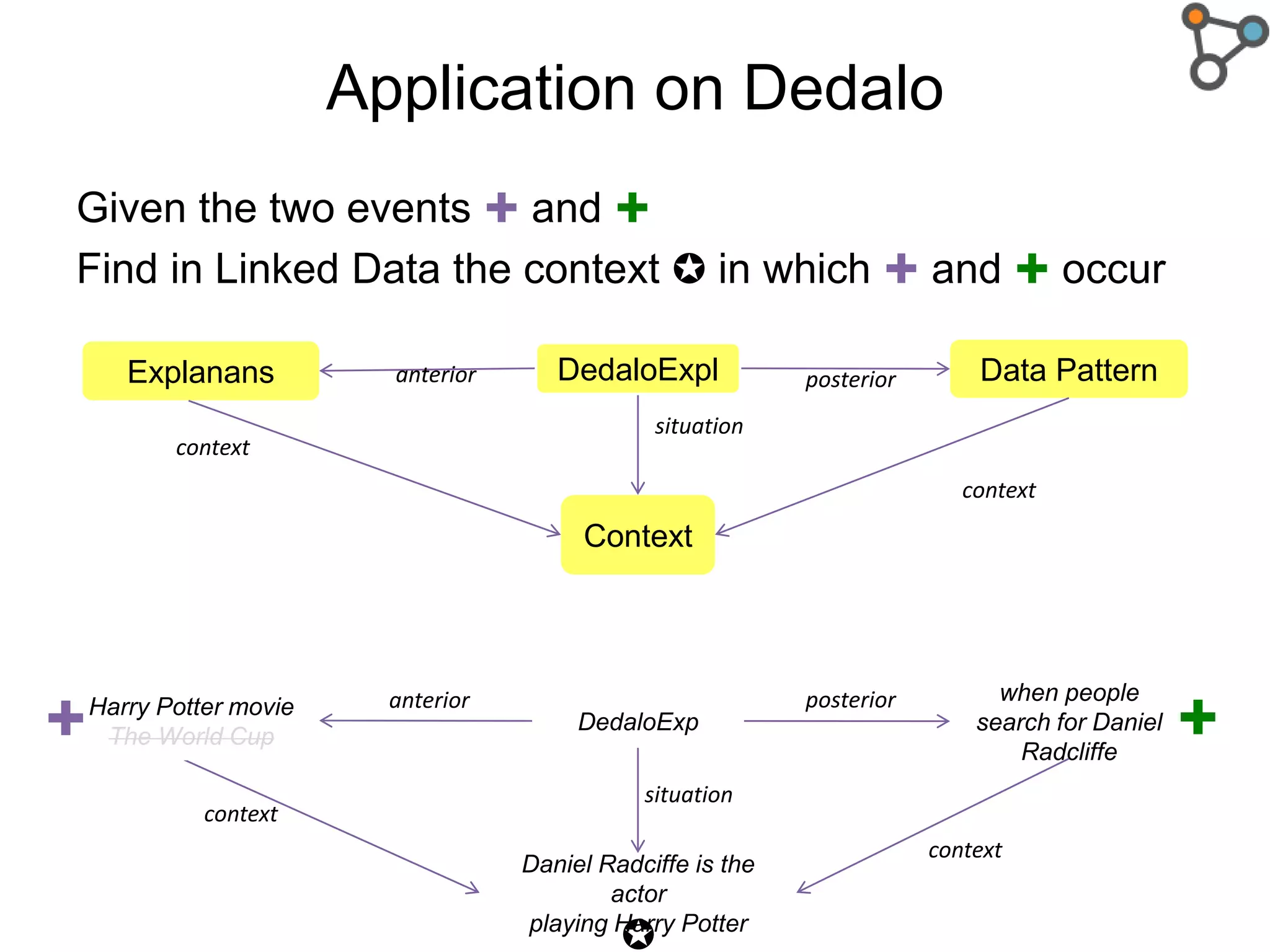
Given the two events ✚ and ✚
DedaloExpl Data Patternposterior
when people
search for Daniel
Radcliffe
posterioranterior
Explanans anterior
DedaloExpl
Harry Potter
movie**
The World Cup**
✚✚
Application on Dedalo
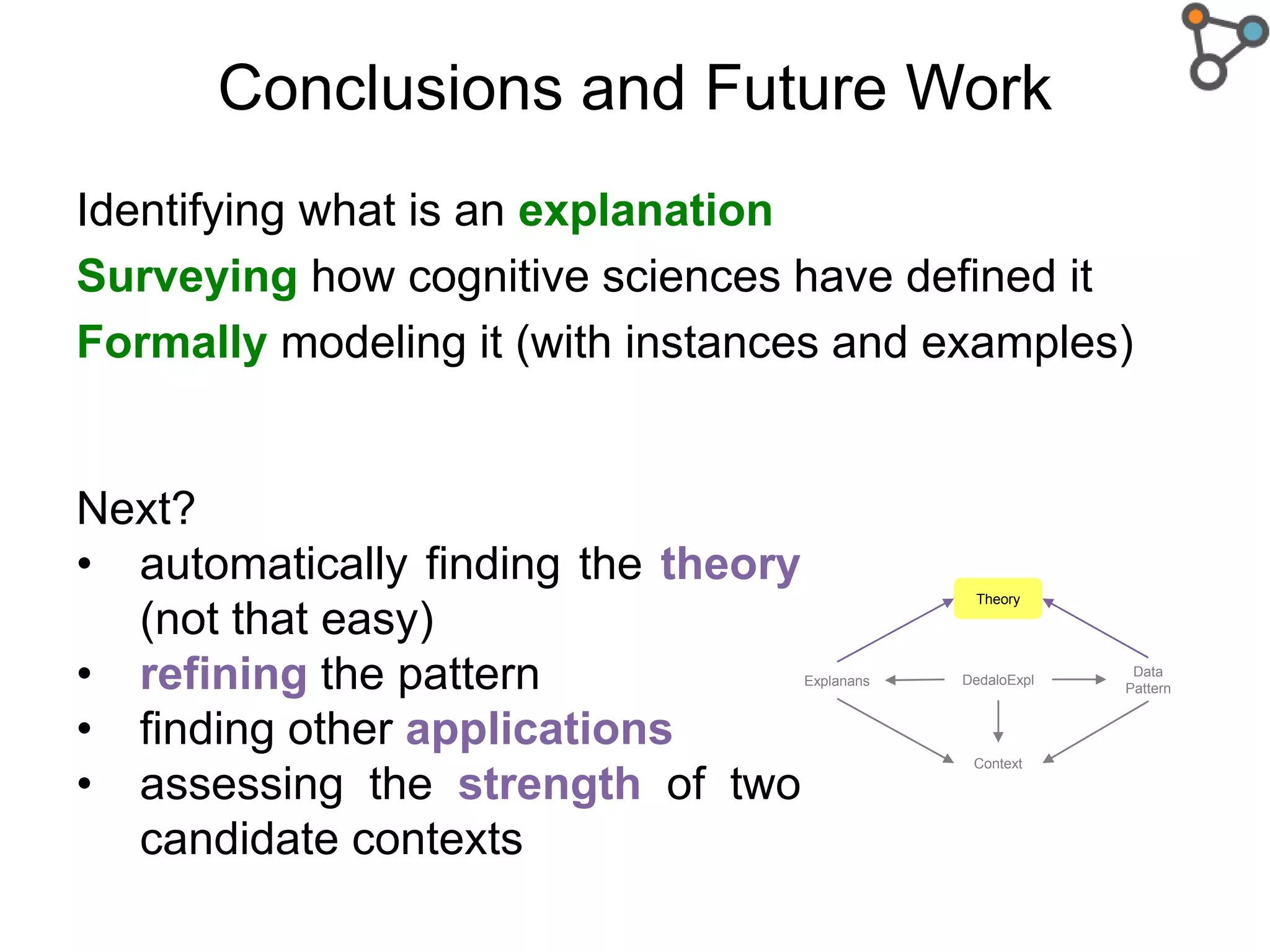
Given the two events ✚ and ✚
Find in Linked Data the context ✪ in which ✚ and ✚ occur
DedaloExpl Data Patternposterior
when people
search for Daniel
Radcliffe
posterioranterior
Explanans anterior
DedaloExp
Daniel Radciffe is the
actor
playing Harry Potter
context
context
situation
Context
context
context
situation
Harry Potter movie
The World Cup
✪
✚✚
Conclusions and Future Work
Identifying what is an explanation
Surveying how cognitive sciences have defined it
Formally modeling it (with instances and examples)
DedaloExpl
Data
Pattern
Explanans
Context
Theory
Next?
• automatically finding the theory
(not that easy)
• refining the pattern
• finding other applications
• assessing the strength of two
candidate contexts
Many thanks!
Do you need (more) explanations?
ilaria.tiddi@open.ac.uk
live demo: http://linkedu.eu/dedalo/demo
@IlaTiddi

An Ontology Design Pattern to Define Explanations

  • 1.
    An Ontology DesignPattern to Define Explanations Ilaria Tiddi, Mathieu d’Aquin, Enrico Motta Knowledge Media Institute, The Open University, UK @IlaTiddi
  • 2.
    General problem We needof a formal definition for an explanation Explanations? • many systems are based on them (data analysis) • vague definition • process, components, interactions are undefined
  • 3.
    Motivation: Dedalo Why? Patterns (observableregularities in data) need to be explained by an expert to be fully understood Transformed Data Patterns Pre- processing Data Mining Interpreting Automatically explaining patterns of data
  • 4.
    Motivation: Dedalo ✚ peoplelook for Daniel Radcliffe at specific times Why is Daniel Radcliffe popular only at specific times? live demo: http://linkedu.eu/dedalo/demo
  • 5.
    Motivation: Dedalo ✚ peoplelook for Daniel Radcliffe at specific times ✚ because a new Harry Potter movie is out Without knowing who Daniel Radcliffe is, the explanation makes no sense live demo: http://linkedu.eu/dedalo/demo
  • 6.
    Motivation: Dedalo ✚ peoplelook for Daniel Radcliffe at specific times ✚ because a new Harry Potter movie is out ✪ and because Daniel Radcliffe plays in Harry Potter Without knowing who Daniel Radcliffe is, the explanation makes no sense unless some context is given too live demo: http://linkedu.eu/dedalo/demo
  • 7.
    Challenge Dedalo needs aformal definition of an explanation • what components ? • which interactions? to differentiate it from a mere correlation Challenge: how to figure out this definition
  • 8.
    Approach Philosophy Neuroscience Linguistics Anthropology Psychology Artificial Intelligence How were “explanations”defined in Cognitive Science[1]? H. Gardner (1985). The mind’s new science: A history of the cognitive revolution.
  • 9.
    Contributions/1 Philosophy Neuroscience Linguistics Sociology Psychology Computer Science Surveying “explanations” in CognitiveScience Structure : ✚ ✚ ✪  “When ✚ happens, then, due to a given set of circumstances ✪, ✚ will occur too because of a given law ”[2] E. Maaløe (2007). Modes of Explanation: From Rules to Emergence.
  • 10.
  • 11.
    Explanation in Philosophy Philosophy– asking questions and checking answers Putting in a relation ✚ an event ✪ some initial conditions ✚ with an output phenomenon  according to a set of (empirical or metaphysical) laws Planets are near ✚; what is near does not twinkle  ; therefore, planets do not twinkle ✚ (context ✪: planets) [Aristotles]
  • 12.
    Explanation in Psychology Psychology– understanding the human cognitive processes Producing ✪ behavioural changes ✚ to a termination condition ✚ from set of mechanically interactive entities  according to the human capacities According to psychological theories , Borderline Personality disorder ✚ can be explained by a childhood trauma ✚ (context ✪: a person’s behaviour)
  • 13.
    Explanation in Neuroscience Neuroscience– understanding the human brain Describing a relationship between ✚ an input (cause) variable ✚ an output (effect) variable ✪ which stable under some interventions  without any law nor sufficient conditions Neuroimaging  has proven that humans can do math calculations ✚ because some neurons actively respond to quantities ✚ (context ✪: human capacities)
  • 14.
    Explanation in ComputerScience Computer science – performing human operations with machines Generating ✚ some new knowledge ✚ from some starting facts  and some prior knowledge ✪ under constraints of certain criteria Enrico, Ilaria and Mathieu submit their paper to KCAP  but only Mathieu is accepted and goes ✚, therefore, to go to KCAP ✚, one has to have both submitted and accepted a paper (context ✪: conference submissions)
  • 15.
    Explanation in Sociology Sociology– linking human processes and the sociocultural world Deriving ✚ social regularities ✚ from some social behaviours  based on some human experience ✪ in a social world Living on your own  in Italy is hard: the job opportunities are low** ✚, so Italians live with their parents until later ages ✚ (context ✪: Italy’s social world) **also, nobody cooks like mom
  • 16.
    Explanation in Linguistics Linguistics– explaining the nature of the human language Deriving ✚ grammar regularities ✚ from a set of facts ✪ which are linguistic-specific  based on some wellformedness constraints “*the my book” is not allowed in English ✚ because English does not allow double determiners  and “the” and “my” are both determiners ✚ (context ✪: English)
  • 17.
    Survey Conclusion Disciplines change Thestructure and interactions remain the same ✚ ✚ ✪  This structure of an explanation can be represented as an ontology design pattern
  • 18.
    part:Event The Explanation ODP ✚✚ When ✚ happens, then, due to a given set of circumstances ✪, ✚ will occur too because of a given law  dul:Theory sit:Situation ✪  Explanation posterior anterior setting condition basedOn dul:Agent conceptualisedBy subPropertyChain: anterior o setting, posterior o setting condition some sit:Situation anterior some part:Event and posterior some part:Event subclassOf subclassOf
  • 19.
    Language Universal GrammarLinguistic Fact Language The ExplanationODP - Examples Representing models in Linguistics with E-ODP ✚ ✪  ✚ Explanation in Linguistics posterioranterior setting setting condition basedOn
  • 20.
    Law PhenomenonPhenomenon Condition The Explanation ODP- Examples Representing models in Philosophy with E-ODP ✚ ✪  ✚ Explanation in Philosophy posterioranterior setting setting condition basedOn MetaphysicalLaw EmpiricalLaw subclassOf subclassOf
  • 21.
    PriorKnowledge NewKnowledgeObservation Constraint The Explanation ODP- Examples Representing models in Computer Science with E-ODP ✚ ✪  ✚ Explanation in ComputerScience posterioranterior setting setting condition basedOn
  • 22.
    Application on Dedalo Givena data pattern ✚ DedaloExpl Data Patternposterior when people search for Daniel Radcliffe posterior DedaloExpl ✚
  • 23.
    Application on Dedalo Givena data pattern ✚ Find some candidate anterior events ✚ in Linked Data DedaloExpl Data Patternposterior when people search for Daniel Radcliffe posterioranterior Explanans anterior DedaloExpl Harry Potter movie** The World Cup** ✚✚
  • 24.
    Application on Dedalo Giventhe two events ✚ and ✚ DedaloExpl Data Patternposterior when people search for Daniel Radcliffe posterioranterior Explanans anterior DedaloExpl Harry Potter movie** The World Cup** ✚✚
  • 25.
    Application on Dedalo Giventhe two events ✚ and ✚ Find in Linked Data the context ✪ in which ✚ and ✚ occur DedaloExpl Data Patternposterior when people search for Daniel Radcliffe posterioranterior Explanans anterior DedaloExp Daniel Radciffe is the actor playing Harry Potter context context situation Context context context situation Harry Potter movie The World Cup ✪ ✚✚
  • 26.
    Conclusions and FutureWork Identifying what is an explanation Surveying how cognitive sciences have defined it Formally modeling it (with instances and examples) DedaloExpl Data Pattern Explanans Context Theory Next? • automatically finding the theory (not that easy) • refining the pattern • finding other applications • assessing the strength of two candidate contexts
  • 27.
    Many thanks! Do youneed (more) explanations? ilaria.tiddi@open.ac.uk live demo: http://linkedu.eu/dedalo/demo @IlaTiddi

Editor's Notes

  • #3 even tho
  • #4 but if we explain it using linked data background knowledge the explanation process is faster
  • #5 ...in our case we had popular searches over the Web... we were interested at knowing why something becomes more popular at a given time it can be interesting especially when this happens regularly ✚★✚✪
  • #6 ...in our case we had popular searches over the Web... we were interested at knowing why something becomes more popular at a given time it can be interesting especially when this happens regularly ✚★✚✪
  • #7 ...in our case we had popular searches over the Web... we were interested at knowing why something becomes more popular at a given time it can be interesting especially when this happens regularly ✚★✚✪
  • #8 thisi is hwo we came out with if we want to talk about a process that automatically produces explanations
  • #9 We looked for disciplines that try to understand the human mind this is the cognitive hexagon as presented in 1971 connections
  • #10  Find each discipline’s view of explanations Abstract a model from it Represent it as a reusable ontology design pattern
  • #11 odp.... building blocks
  • #12 Explaining is (across time) comparing facts against general principles (Ancient Greeks) finding causality (Determinism) everything stems from experience (Empiricism) modern models for explanation (Carl Hempel)
  • #13 Explaining is (across time) comparing facts against general principles (Ancient Greeks) finding causality (Determinism) everything stems from experience (Empiricism) modern models for explanation (Carl Hempel)
  • #14 upper level explanations with macroscopic causes (e.g., environmental) lower level explanations with fine-grained causes (e.g. neural, genetic)
  • #15 Abduction - inference of the case from a rule and a result Induction - inference of a rule from a case and its result observations  tentative hypotheses  empirical pro goesToESWC(X) <- submitted(X)^paperAccepted(X,‘ESWC’)
  • #17 Explaining is finding how is the language acquisition possible finding language regularities but some are innate (Chomsky/Generativism) external elements are needed too (Greenberg/Functionalism
  • #18 interaction : some facts, something that governs, something that constraint ODP: Small ontologies exploited as building blocks in ontology design allow reuse, extension and integration we use existing ODPs to create ours
  • #19 The main class is inilised in each disclipline : it is “the process of providing an explanation” one Event (class from the participation ODP) is the explanans, the antecedent event the other one is the postertior /explanadum “that what is explained” the condition relating the event is expressed by the situation class from the situation ODP the owl axiom shows what we can infer: the context of an Explanation is shared by the two events (they have setting in it) Theory class from DolceUlL is the law governing the explanation Agent
  • #20 Plato Explanation InitialFact PosteriorFact Circumstance Form
  • #21 Plato Explanation InitialFact PosteriorFact Circumstance Form
  • #22 Plato Explanation InitialFact PosteriorFact Circumstance Form
  • #23 Dedalo is a CS instance of the odp
  • #24 Other examples Dedalo is a process of induction (generalisation)
  • #25 Other examples Dedalo is a process of induction (generalisation)
  • #26 Other examples Dedalo is a process of induction (generalisation)
  • #27 theory can be in different domains at the moment the theory is left to the humans