
IoT Overview
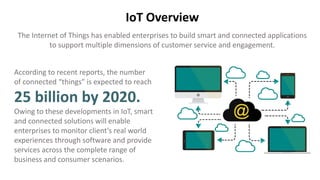
The Internet of Things has enabled enterprises to build smart and connected applications
to support multiple dimensions of customer service and engagement.
According to recent reports, the number
of connected “things” is expected to reach
25 billion by 2020.
Owing to these developments in IoT, smart
and connected solutions will enable
enterprises to monitor client’s real world
experiences through software and provide
services across the complete range of
business and consumer scenarios.
Complexity of IoT systems
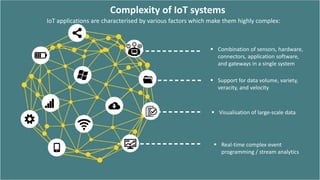
IoT applications are characterised by various factors which make them highly complex:
 Combination of sensors, hardware,
connectors, application software,
and gateways in a single system
 Support for data volume, variety,
veracity, and velocity
 Visualisation of large-scale data
 Real-time complex event
programming / stream analytics
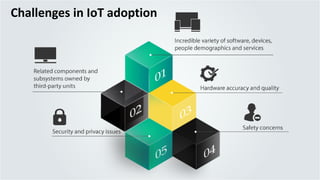
Challenges in IoT adoption
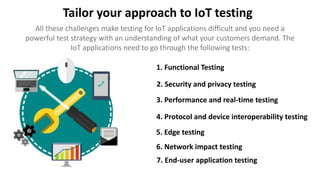
Tailor your approach to IoT testing
All these challenges make testing for IoT applications difficult and you need a
powerful test strategy with an understanding of what your customers demand. The
IoT applications need to go through the following tests:
1. Functional Testing
2. Security and privacy testing
3. Performance and real-time testing
4. Protocol and device interoperability testing
5. Edge testing
6. Network impact testing
7. End-user application testing
Key challenges that thwart IoT testing
The growing number of connected devices also poses real challenges
 Real-time complexity: IoT applications can have several, real-
time scenarios and its use cases are tremendously complex
 Dynamic environment: Contrasting to application testing
that is performed in a defined environment, IoT consists of
a dynamic environment with various devices and sensors
in combination with intelligent software
 Scalability of the system: The real challenge lies in
creating a test environment to assess functionality
along with reliability and scalability
TestingXperts IoT Validation Solution
TestingXperts’ (Tx) comprehensive QA strategy can handle the unique requirements
associated with validating IoT application. Our unique solution enables testing with a
combination of frameworks, tools, and devices. Tx’s IoT test framework offers all the
capabilities required to perform functional validation, load simulation, and security
verification, etc. It can easily integrate with various IoT platforms and protocols.
Want to know more about
Software Testing Services

An Insight on Testing the IoT Applications

  • 2.
    IoT Overview The Internetof Things has enabled enterprises to build smart and connected applications to support multiple dimensions of customer service and engagement. According to recent reports, the number of connected “things” is expected to reach 25 billion by 2020. Owing to these developments in IoT, smart and connected solutions will enable enterprises to monitor client’s real world experiences through software and provide services across the complete range of business and consumer scenarios.
  • 3.
    Complexity of IoTsystems IoT applications are characterised by various factors which make them highly complex:  Combination of sensors, hardware, connectors, application software, and gateways in a single system  Support for data volume, variety, veracity, and velocity  Visualisation of large-scale data  Real-time complex event programming / stream analytics
  • 4.
  • 5.
    Tailor your approachto IoT testing All these challenges make testing for IoT applications difficult and you need a powerful test strategy with an understanding of what your customers demand. The IoT applications need to go through the following tests: 1. Functional Testing 2. Security and privacy testing 3. Performance and real-time testing 4. Protocol and device interoperability testing 5. Edge testing 6. Network impact testing 7. End-user application testing
  • 6.
    Key challenges thatthwart IoT testing The growing number of connected devices also poses real challenges  Real-time complexity: IoT applications can have several, real- time scenarios and its use cases are tremendously complex  Dynamic environment: Contrasting to application testing that is performed in a defined environment, IoT consists of a dynamic environment with various devices and sensors in combination with intelligent software  Scalability of the system: The real challenge lies in creating a test environment to assess functionality along with reliability and scalability
  • 7.
    TestingXperts IoT ValidationSolution TestingXperts’ (Tx) comprehensive QA strategy can handle the unique requirements associated with validating IoT application. Our unique solution enables testing with a combination of frameworks, tools, and devices. Tx’s IoT test framework offers all the capabilities required to perform functional validation, load simulation, and security verification, etc. It can easily integrate with various IoT platforms and protocols. Want to know more about Software Testing Services