Download to read offline
![J Math Imaging Vis
DOI 10.1007/s10851-008-0067-4
An Improved Hybrid Model for Molecular Image Denoising
Jeny Rajan · K. Kannan · M.R. Kaimal
© Springer Science+Business Media, LLC 2008
Abstract In this paper an improved hybrid method for re-moving
noise from low SNR molecular images is intro-duced.
The method provides an improvement over the one
suggested by Jian Ling and Alan C. Bovik (IEEE Trans.
Med. Imaging, 21(4), 2002). The proposed model consists
of two stages. The first stage consists of a fourth order
PDE and the second stage is a relaxed median filter, which
processes the output of fourth order PDE. The model enjoys
the benefit of both nonlinear fourth order PDE and relaxed
median filter. Apart from the method suggested by Ling and
Bovik, the proposed method will not introduce any staircase
effect and preserves fine details, sharp corners, curved struc-tures
and thin lines. Experiments were done on molecular
images (fluorescence microscopic images) and standard test
images and the results shows that the proposed model per-forms
better even at higher levels of noise.
Keywords Fourth order PDEs · Hybrid filter · Molecular
images · Relaxed median filter
1 Introduction
Image denoising is an active area of interest for image
processing researchers for a long period. The use of par-
J. Rajan () · K. Kannan
Medical Imaging Research Group, Healthcare Division, NeST,
Technopark Campus, Trivandrum, Kerala 695 581, India
e-mail: jenyrajan@gmail.com
K. Kannan
e-mail: kannan_nk@yahoo.co.in
M.R. Kaimal
Department of Computer Science, University of Kerala,
Trivandrum, Kerala 695 581, India
e-mail: mrkaimal@yahoo.com
tial differential equations (PDEs) in image processing has
grown significantly over the past years and a large number
of PDE based methods have particularly been proposed to
tackle the problem of image denoising with a good preser-vation
of edges, and also to explicitly account for intrin-sic
geometry [1–5]. Before the development of non-linear
PDE based methods, the problem of noise reduction in im-ages
was treated through linear filtering, in which the im-age
intensity function is convolved with a Gaussian [6]. The
main problem with this method is the blurring of image
edges. Since the pioneering work of Perona and Malik [7]
on anisotropic diffusion there has been a flurry of activity in
PDE based denoising techniques. Although the method pro-posed
by Perona and Malik and its variants are much bet-ter
in denoising images, these methods tend to cause blocky
effects in images. This blocky effect is visually unpleasant
and the possibility of detecting them as false edges by edge
detection algorithms is high. In [8] it is noted that even with-out
noise, staircasing effect can arise around smooth edges.
Anisotropic diffusion is designed such that smooth areas are
diffused faster than less smooth ones and blocky effects will
appear in the early stage of diffusion, even though all the
blocks will finally merge to form a level image.
Recently many authors proposed hybrid filters for image
denoising e.g. [9–11]. In this paper we focused on improv-ing
the hybrid filter proposed by Jiang Ling and Alan Bovic
[9] to denoise low SNR molecular images. This filter is a
combination of anisotropic diffusion and median filter. The
anisotropic median diffusion filter produces excellent results
when compared with stand-alone anisotropic diffusion or
median filter. But it has certain drawbacks. Since the method
uses anisotropic diffusion in stage-1, the filter reflects the
staircase effects of anisotropic diffusion. The median filter
is far from being a perfect filtering method as it removes](https://image.slidesharecdn.com/animprovedhybridmodelformolecularimagedenoising-140904061538-phpapp02/85/An-Improved-Hybrid-Model-for-Molecular-Image-Denoising-1-320.jpg)
![J Math Imaging Vis
DOI 10.1007/s10851-008-0067-4
An Improved Hybrid Model for Molecular Image Denoising
Jeny Rajan · K. Kannan · M.R. Kaimal
© Springer Science+Business Media, LLC 2008
Abstract In this paper an improved hybrid method for re-moving
noise from low SNR molecular images is intro-duced.
The method provides an improvement over the one
suggested by Jian Ling and Alan C. Bovik (IEEE Trans.
Med. Imaging, 21(4), 2002). The proposed model consists
of two stages. The first stage consists of a fourth order
PDE and the second stage is a relaxed median filter, which
processes the output of fourth order PDE. The model enjoys
the benefit of both nonlinear fourth order PDE and relaxed
median filter. Apart from the method suggested by Ling and
Bovik, the proposed method will not introduce any staircase
effect and preserves fine details, sharp corners, curved struc-tures
and thin lines. Experiments were done on molecular
images (fluorescence microscopic images) and standard test
images and the results shows that the proposed model per-forms
better even at higher levels of noise.
Keywords Fourth order PDEs · Hybrid filter · Molecular
images · Relaxed median filter
1 Introduction
Image denoising is an active area of interest for image
processing researchers for a long period. The use of par-
J. Rajan () · K. Kannan
Medical Imaging Research Group, Healthcare Division, NeST,
Technopark Campus, Trivandrum, Kerala 695 581, India
e-mail: jenyrajan@gmail.com
K. Kannan
e-mail: kannan_nk@yahoo.co.in
M.R. Kaimal
Department of Computer Science, University of Kerala,
Trivandrum, Kerala 695 581, India
e-mail: mrkaimal@yahoo.com
tial differential equations (PDEs) in image processing has
grown significantly over the past years and a large number
of PDE based methods have particularly been proposed to
tackle the problem of image denoising with a good preser-vation
of edges, and also to explicitly account for intrin-sic
geometry [1–5]. Before the development of non-linear
PDE based methods, the problem of noise reduction in im-ages
was treated through linear filtering, in which the im-age
intensity function is convolved with a Gaussian [6]. The
main problem with this method is the blurring of image
edges. Since the pioneering work of Perona and Malik [7]
on anisotropic diffusion there has been a flurry of activity in
PDE based denoising techniques. Although the method pro-posed
by Perona and Malik and its variants are much bet-ter
in denoising images, these methods tend to cause blocky
effects in images. This blocky effect is visually unpleasant
and the possibility of detecting them as false edges by edge
detection algorithms is high. In [8] it is noted that even with-out
noise, staircasing effect can arise around smooth edges.
Anisotropic diffusion is designed such that smooth areas are
diffused faster than less smooth ones and blocky effects will
appear in the early stage of diffusion, even though all the
blocks will finally merge to form a level image.
Recently many authors proposed hybrid filters for image
denoising e.g. [9–11]. In this paper we focused on improv-ing
the hybrid filter proposed by Jiang Ling and Alan Bovic
[9] to denoise low SNR molecular images. This filter is a
combination of anisotropic diffusion and median filter. The
anisotropic median diffusion filter produces excellent results
when compared with stand-alone anisotropic diffusion or
median filter. But it has certain drawbacks. Since the method
uses anisotropic diffusion in stage-1, the filter reflects the
staircase effects of anisotropic diffusion. The median filter
is far from being a perfect filtering method as it removes](https://image.slidesharecdn.com/animprovedhybridmodelformolecularimagedenoising-140904061538-phpapp02/75/An-Improved-Hybrid-Model-for-Molecular-Image-Denoising-1-2048.jpg)
![J Math Imaging Vis
fine details, sharp corners and thin lines [12]. The main rea-son
is that the ordering process destroys any structural and
spatial neighborhood information [13].
So to remove these distortions, in the proposed model we
replaced the anisotropic diffusion method with non linear
fourth order PDE and median filter with more effective re-laxed
median filter. The fourth order PDEs proposed by You
and Kaveh [14] is used for analysis. As an alternative to me-dian
filter we used a version of median filter, the relaxed
median filter [12]. This filter is obtained by relaxing the or-der
statistic for pixel substitution. By using a relaxed median
filter we can preserve more image details than the standard
median filter. The proposed method will not introduce any
blocky effects in images (as can be seen in anisotropic me-dian
filter) and also preserve fine details, sharp corners and
thin lines and curved structures better than anisotropic me-dian
filter. The following section overviews the fourth order
PDEs proposed by You and Kaveh. Section 3 presents the
improved hybrid method and discuss its performance with
the existing methods, and finally we summarize the contri-bution
of this paper.
2 Fourth Order PDEs
Non-linear fourth order PDEs is a comparatively new ap-proach
for effective image denoising. A number of fourth
order PDEs have been proposed in recent years for image
denoising [6, 14, 15] and [16]. Although discrete implemen-tation
of these methods produces impressive results, very lit-tle
is known about the mathematical properties of the equa-tions
themselves. Indeed there are good reasons to consider
fourth order equations. First, fourth order linear diffusion
dampens oscillations at high frequencies (i.e. noise) much
faster than second order diffusion. Second, there is the pos-sibility
of having schemes that include effects of curvature
(i.e. the second derivatives of the image) in the dynamics,
thus creating a richer set of functional behaviors [6].
In the proposed model we used the L2-curvature gradient
flow method of You and Kaveh [14]. The model is shown
in (1).
∂u
∂t
=−∇2
c
∇2u
∇2u
(1)
where ∇2u is the Laplacian of the image u. Since the Lapla-cian
of an image at a pixel is zero if the image is planar
in its neighborhood, the PDE attempt to remove noise and
preserve edges by approximating an observed image with a
piecewise planar image. The desirable diffusion coefficient
c(·) should be such that (1) diffuses more in smooth areas
and less around less intensity transitions, so that small vari-ations
in image intensity such as noise and unwanted texture
are smoothed and edges are preserved. Another objective for
the selection of c(·) is to incur backward diffusion around in-tensity
transitions so that edges are sharpened, and to assure
forward diffusion in smooth areas for noise removal [17].
Here are some of the previously employed diffusivity func-tions
[18]:
A. Linear diffusivity [19]:
c(s) = 1. (2)
B. Charbonnier diffusivity [20]:
c(s) = 1
1+ s2
k2
. (3)
C. Perona–Malik diffusivity [7]:
c(s) = 1
k )2 , (4)
1+ ( s
−
c(s) = exp
s
k
2
. (5)
D. Weickert diffusivity [21]:
c(s) =](https://image.slidesharecdn.com/animprovedhybridmodelformolecularimagedenoising-140904061538-phpapp02/85/An-Improved-Hybrid-Model-for-Molecular-Image-Denoising-2-320.jpg)
![1
s = 0,
1− exp
−3.31488
(s/k)8
s 0.
(6)
E. TV diffusivity [22]:
c(s) = 1
s
. (7)
F. BFB diffusivity [23]:
c(s) = 1
s2 . (8)
In the implementation of the proposed method we used
Perona-Malik diffusivity function as shown in (4). The equa-tion
(1) was associated with the following energy functional
E(u) =
f
∇2u
dxdy (9)
where is the image support and ∇2 denotes Laplacian op-erator.
Since f (|∇2u|) is an increasing function of |∇2u|, its
global minimum is at |∇2u| = 0. Consequently, the global
minimum of E(u) occurs when
|∇2u| ≡ 0 for all (x, y) ∈ . (10)
A planar image obviously satisfies (10) [14], hence is a
global minimum of E(u). Planar images are the only global
minimum of E(u) if
f
(s) ≥ 0 for all s ≥ 0 (11)](https://image.slidesharecdn.com/animprovedhybridmodelformolecularimagedenoising-140904061538-phpapp02/85/An-Improved-Hybrid-Model-for-Molecular-Image-Denoising-3-320.jpg)
![J Math Imaging Vis
Fig. 1 Figure shows the inability of second order anisotropic median diffusion filter. (a) Original Signal. (b) Anisotropic median diffusion. It can
be seen that blocky effect is introduced in the signal. (c) Processed signal by proposed Method. (Here the iteration step T is taken as 3)
Fig. 2 Low SNR molecular
image denoising using improved
hybrid filter: (a) Phantom
cellular molecular image.
(b) Noisy image (SNR 5 dB).
(c) Image denoised with
Ling-Bovik method. (d) Image
denoised with proposed method.
Close examination shows that
Ling-Bovik method generates
false edges
because the cost functional E(u) is convex under this con-dition
[14]. Therefore, the evolution of (1) is a process in
which the image is smoothed more and more until it be-comes
a planar image. But in the case of second order
anisotropic diffusion f
(s) may not be greater than zero for
all s and as a result the image is evolved towards a step im-age
and that is why it suffers from blocky effects. So the
image processed by fourth order PDEs will look less blocky
than that processed by second order anisotropic diffusion.
Computational experiments shows that the edge detector
based on this theory yields edges and boundaries that re-main
more stable through scale t . In spite of this, this model
still has several theoretical and practical difficulties. For in-stance,
if the image is very noisy, the gradient ∇u will be
very large, and as a result, the function c(·) will be close
to zero at almost every point. Consequently, noise will re-main
when we use the smoothing process introduced by the
above model. This can be considerably reduced by attaching
a relaxed median filter at the end of the You-Kaveh model.
3 Proposed Method
The discrete form of non-linear fourth order PDE described
in (1) is as follows:
un+1
i,j
= un
i,j
−t∇2gn
i,j (12)](https://image.slidesharecdn.com/animprovedhybridmodelformolecularimagedenoising-140904061538-phpapp02/85/An-Improved-Hybrid-Model-for-Molecular-Image-Denoising-4-320.jpg)
![J Math Imaging Vis
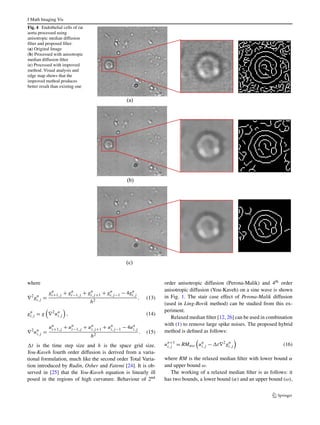
Fig. 4 Endothelial cells of rat
aorta processed using
anisotropic median diffusion
filter and proposed filter.
(a) Original Image
(b) Processed with anisotropic
median diffusion filter
(c) Processed with improved
method. Visual analysis and
edge map shows that the
improved method produces
better result than existing one
where
∇2gn
i,j
=
gn
i+1,j
+ gn
i−1,j
+ gn
i,j+1
+ gn
i,j−1
− 4gn
i,j
h2 , (13)
gn
i,j
= g
∇2un
i,j
, (14)
∇2un
i,j
=
un
i+1,j
+un
i−1,j
+ un
i,j+1
+ un
i,j−1
−4un
i,j
h2 . (15)
t is the time step size and h is the space grid size.
You-Kaveh fourth order diffusion is derived from a varia-tional
formulation, much like the second order Total Varia-tion
introduced by Rudin, Osher and Fatemi [24]. It is ob-served
in [25] that the You-Kaveh equation is linearly ill
posed in the regions of high curvature. Behaviour of 2nd
order anisotropic diffusion (Perona-Malik) and 4th order
anisotropic diffusion (You-Kaveh) on a sine wave is shown
in Fig. 1. The stair case effect of Perona-Malik diffusion
(used in Ling-Bovik method) can be studied from this ex-periment.
Relaxedmedian filter [12, 26] can be used in combination
with (1) to remove large spike noises. The proposed hybrid
method is defined as follows:
un+1
i,j
= RMαω
un
i,j
− t∇2gn
i,j
(16)
where RM is the relaxed median filter with lower bound α
and upper bound ω.
The working of a relaxed median filter is as follows: it
has two bounds, a lower bound (α) and an upper bound (ω),](https://image.slidesharecdn.com/animprovedhybridmodelformolecularimagedenoising-140904061538-phpapp02/85/An-Improved-Hybrid-Model-for-Molecular-Image-Denoising-6-320.jpg)
, which con-tains
the gray levels that we assume to be good enough not
to be filtered. If Y(i,j ) is the output of a relaxed median filter,
then Y(i,j ) can be written as
Y(i,j ) = RMα,ω{W(i,j )}
=
X(i,j ) if X(i,j ) ∈ [[W(i,j )](α)[W(i,j )]
(ω)
],
[W(i,j )]
(m) otherwise
(17)
where [W(i,j )](m) is the median value of then samples inside
the window W(i,j ). The sliding window W(i,j ) is
W(i,j ) =
X(i+r,j+r) : r ∈W
(18)
to be the window located at position i. The lower bound and
upper bounds for relaxed median used in the experiments
are 3 and 5 respectively.
When fourth order diffusion is applied to the images, the
areas having small gradients are smoothed, and which hav-ing
large gradients (edges and noise if any) remain undif-fused
and the blocky effects can be avoided. The gradients
generated by noise can be subsequently removed by a re-laxed
median filter without affecting the image structure.
However if the gradients are generated by edges, the relaxed
median filter will not affect them. So as iteration continues,
the nonlinear PDE removes the low level noise and sub-sequently
the relaxed median filter removes the impulsive
noise spikes. The proposed method preserves image struc-ture
much better than the other similar methods.
Figure 2 shows a comparative analysis of proposed
method with the existing anisotropic median diffusion filter.
The phantom molecular image used is same as in [9]. The
image consists of five regions (background, cytoplasm, nu-cleus,
mitochondria and endoplasmic reticulum). The noise
distributions in different regions are also different. It can be
seen that the Ling-Bovik method removes noise but gener-ates
false edges. Figure 2(d) shows that this artifact can be
eliminated by using the proposed method. Figure 3 shows
the plot of 54th row of the phantom image. The analysis
shows that the proposed method preserves the curved struc-tures
in the image much better than its counterpart. Fig-ure
4 illustrates the results of endothelial cells of rat aorta
processed using anisotropic median diffusion filter and pro-posed
filter. Close examination of the results shows that the
artifacts generated by anisotropic median filter can be re-duced
by using the improved method.
4 Conclusion
A method to improve the performance of Ling-Bovik
method is introduced in this paper. The artifacts generated
by the Ling-Bovik method can be can be considerably re-duced
by this approach. The method preserves curve like
structures and edges much better than the existing method.
The filter is tested against molecular images and standard
test images (by adding different levels of noise). The analy-sis
shows that Ling-Bovik method can be improved by ap-plying
the proposed approach.
References
1. Yezzi, A.: Modified curvature motion for image smoothing and
enhancement. IEEE Trans. Image Process. 7, 345–352 (1998)
2. Hero, A., Krim, H.: Mathematical methods in imaging. IEEE Sig-nal
Process. Mag. 19, 13–14 (2002)
3. Hamza, A.B., Krim, H.: Robust environmental image denoising.
In: The ISI International Conference on Environmental Statistics
and Health (2003)
4. Hamza, A.B., Krim, H., Unal, G.: Unifying probabilistic and
variational estimation. IEEE Signal Process. Mag. 19(5), 37–47
(2002)
5. Ben Hamza, A., Krim, H., Zerubia, J.: A nonlinear entropic
variational model for image filtering. EURASIP J. Appl. Signal
Process. 16, 2408–2422 (2004)
6. Greer, J.B., Bertozzi, A.L.: Travelling wave solutions of fourth
order PDEs for image processing. SIAM J. Math. Anal. 36, 38–68
(2004)
7. Perona, P., Malik, J.: Scale-space and edge detection using
anisotropic diffusion. IEEE Trans. Pattern Anal. Mach. Intel. 12,
629–639 (1990)
8. Whitaker, R.T., Prizer, S.M.: A multi scale approach to nonuni-form
diffusion. CVGIP: Image Underst. 57(1), 99–110 (1993)
9. Ling, J., Bovik, A.C.: Smoothing low-SNR molecular images via
anisotropic median diffusion. IEEE Trans. Med. Imaging 21, 377–
384 (2002)
10. Rajan, J., Kaimal, M.R.: Image denoising using wavelet embed-ded
anisotropic diffusion (WEAD). In: Proceedings of IET In-ternational
Conference on Visual Information Engineering 2006,
pp. 589–593, September 2006
11. Rajan, J., Kaimal, M.R.: Speckle reduction in images withWEAD
WECD. In: Computer Vision, Graphics and Image Process-ing.
Lecture Notes in Computer Science (LNCS), vol. 4338,
pp. 184–193. Springer, New York (2006)
12. Hamza, A.B., Escamilla, P.L., Aroza, J.M., Roldan, R.: Removing
noise and preserving details with relaxed median filters. J. Math.
Imaging Vis. 11, 161–177 (1999)
13. Pitas, I., Venetsanopoulos, A.N.: Nonlinear Digital Filters: Princi-ples
and Applications. Kluwer Academic, Dordrecht (1990)
14. You, Y.L., Kaveh, M.: Fourth-order partial differential equations
for noise removal. IEEE Trans. Image Process. 9, 1723–1730
(2000)
15. Lysaker, M., Lundervold, A., Tai, X.C.: Noise removal using
fourth-order partial differential equation with applications to med-ical
magnetic resonance images in space and time. IEEE Trans.
Image Process. 12, 1579–1590 (2003)
16. Wei, G.W.: Generalized Perona-Malik equation for image process-ing.
IEEE Signal Process. Lett. 6, 165–167 (1999)
17. You, Y.L., Xu,W., Tannenbaum, A., Kaveh, M.: Behavioral analy-sis
of anisotropic diffusion in image processing. IEEE Trans. Im-age
Process. 5, 1539–1553 (1996)
18. Mrazek, P., Weickert, J., Steidl, G.: Correspondence between
wavelet shrinkage and nonlinear diffusion. In: Scale-Space 2003.
LNCS, vol. 2695, pp. 101–116. Springer, New York (2003)](https://image.slidesharecdn.com/animprovedhybridmodelformolecularimagedenoising-140904061538-phpapp02/85/An-Improved-Hybrid-Model-for-Molecular-Image-Denoising-7-320.jpg)

This document presents an improved hybrid method for denoising low signal-to-noise ratio molecular images, enhancing the approach originally proposed by Ling and Bovik. The new method utilizes a fourth order PDE combined with a relaxed median filter to effectively minimize noise while preserving fine details in images, overcoming issues such as staircase effects and false edges. Experiments demonstrate that this improved technique outperforms existing methods, especially under high noise conditions.


