Welcome!
• This webinar will be recorded.
• Your microphone and camera will be turned off for the duration of the
webinar.
• To ensure accessibility, live captions can be enabled from the control
panel.
February 9, 2022
Presenter: David Buckeridge
Facilitator: Emily Clark
An Evidence-Informed Vision for a Public Health Data
System in Canada
Housekeeping
• Connection issues
• We recommend using a wired Internet
Connection
• If you are experiencing technical issues please
send a private message to Alanna Miller
• Use the Q&A and chat to post questions
and/or comments throughout the webinar
• Post your questions in the Q&A
• Send questions about technical difficulties in a
private chat to Alanna Miller
• Polling
After Today
After the webinar, access the recording (in English) at
www.youtube.com/nccmt and slides in English and French at
www.slideshare.net/NCCMT/presentations.
Pre-webinar Polling Questions
1. How many people are watching today’s session with you?
A) Just Me
B) 2-3
C) 4-5
D) 6-10
E) >10
2. Have you visited the National Collaborating Centre for Methods and Tools’ website or used its resources before?
A) Yes
B) No
3. If you stated YES on the previous question, how many times have you used the NCCMT’s resources?
A) Once
B) 2-3 times
C) 4-10 times
D) 10+ times
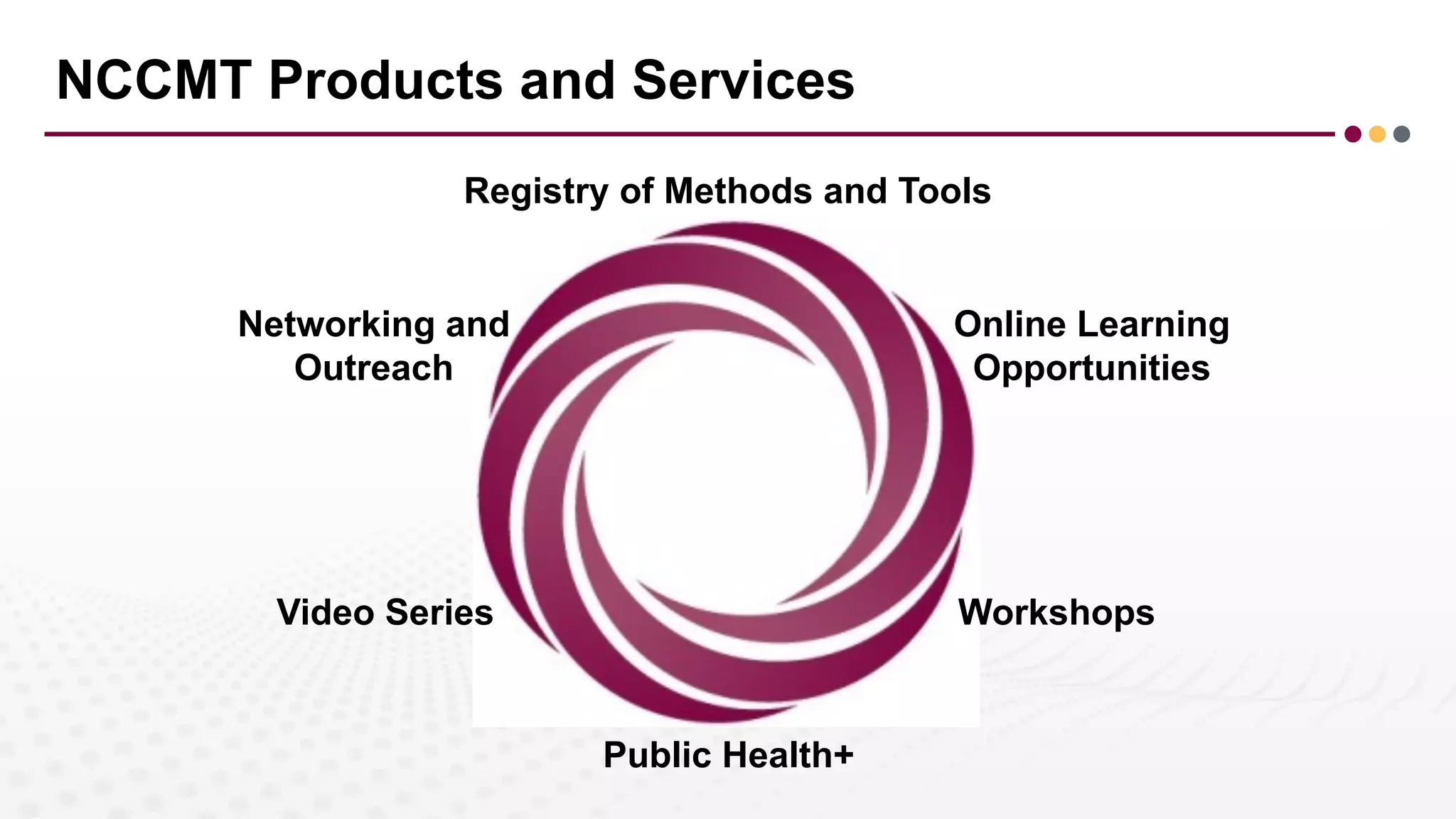
NCCMT Products and Services
Registry of Methods and Tools
Online Learning
Opportunities
Workshops
Video Series
Public Health+
Networking and
Outreach
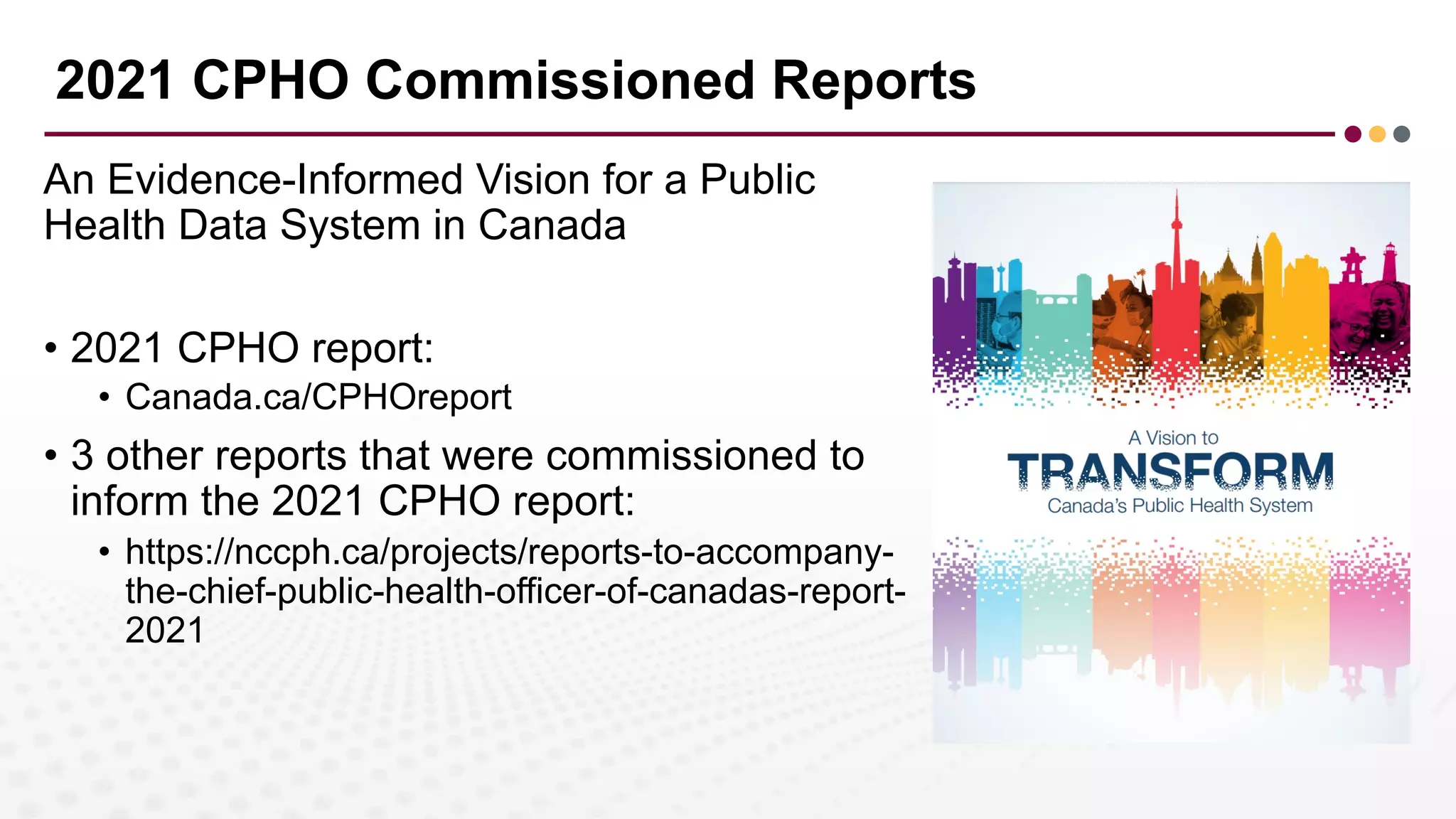
2021 CPHO Commissioned Reports
An Evidence-Informed Vision for a Public
Health Data System in Canada
• 2021 CPHO report:
• Canada.ca/CPHOreport
• 3 other reports that were commissioned to
inform the 2021 CPHO report:
• https://nccph.ca/projects/reports-to-accompany-
the-chief-public-health-officer-of-canadas-report-
2021
Presenter
Dr. David Buckeridge
Professor, Department of
Epidemiology,
Biostatistics and
Occupational Health at
McGill University
An Evidence-Informed
Vision for a Public Health
Data System in Canada
David Buckeridge, MD PhD FRCPC
Professor, School of Population and Global Health, McGill University
Canada Research Chair, Health Informatics and Data Science
david.buckeridge@mcgill.ca
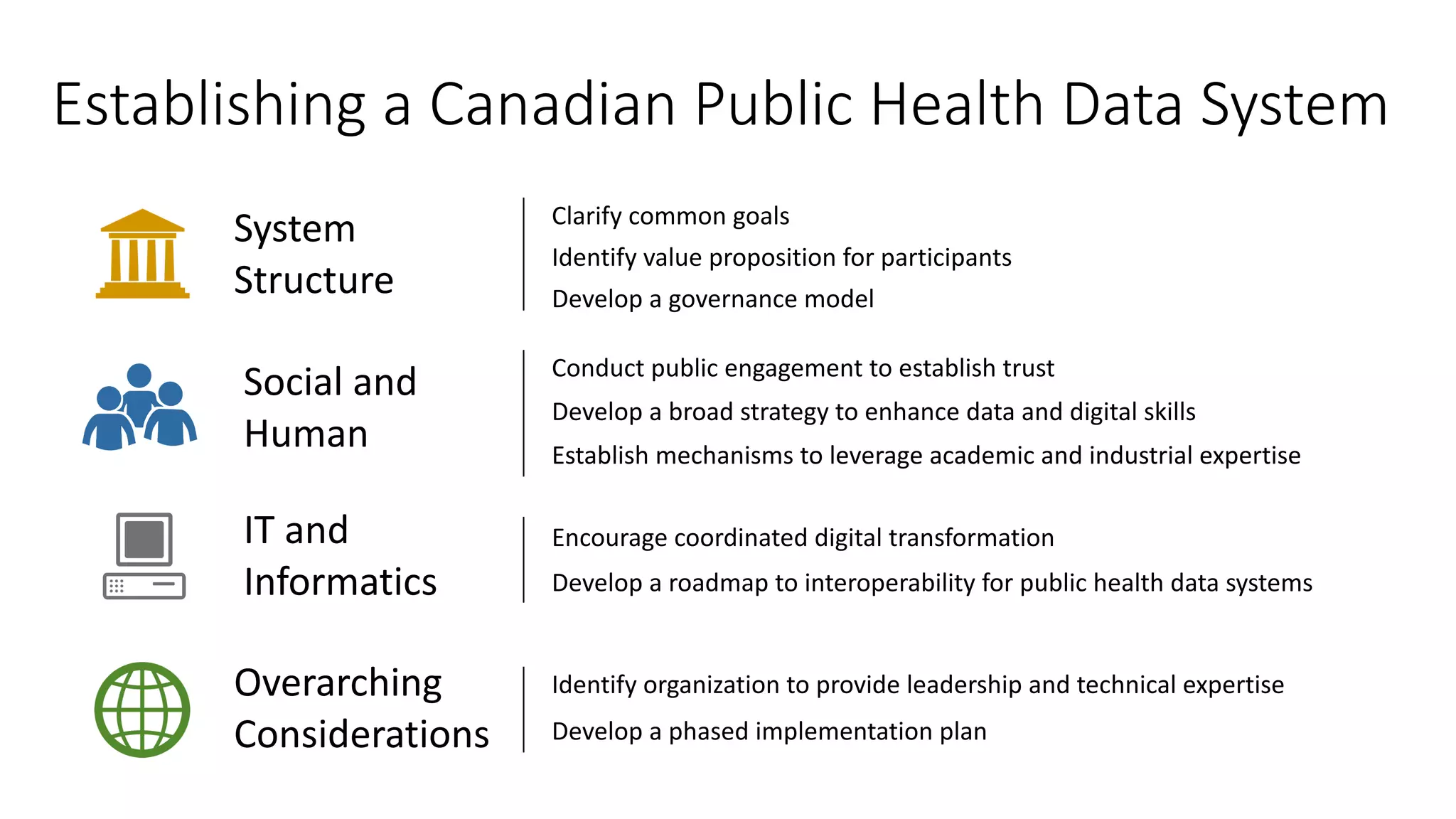
Establishing a Canadian Public Health Data System
System
Structure
Social and
Human
IT and
Informatics
Overarching
Considerations
Clarify common goals
Identify value proposition for participants
Develop a governance model
Conduct public engagement to establish trust
Develop a broad strategy to enhance data and digital skills
Establish mechanisms to leverage academic and industrial expertise
Encourage coordinated digital transformation
Develop a roadmap to interoperability for public health data systems
Identify organization to provide leadership and technical expertise
Develop a phased implementation plan
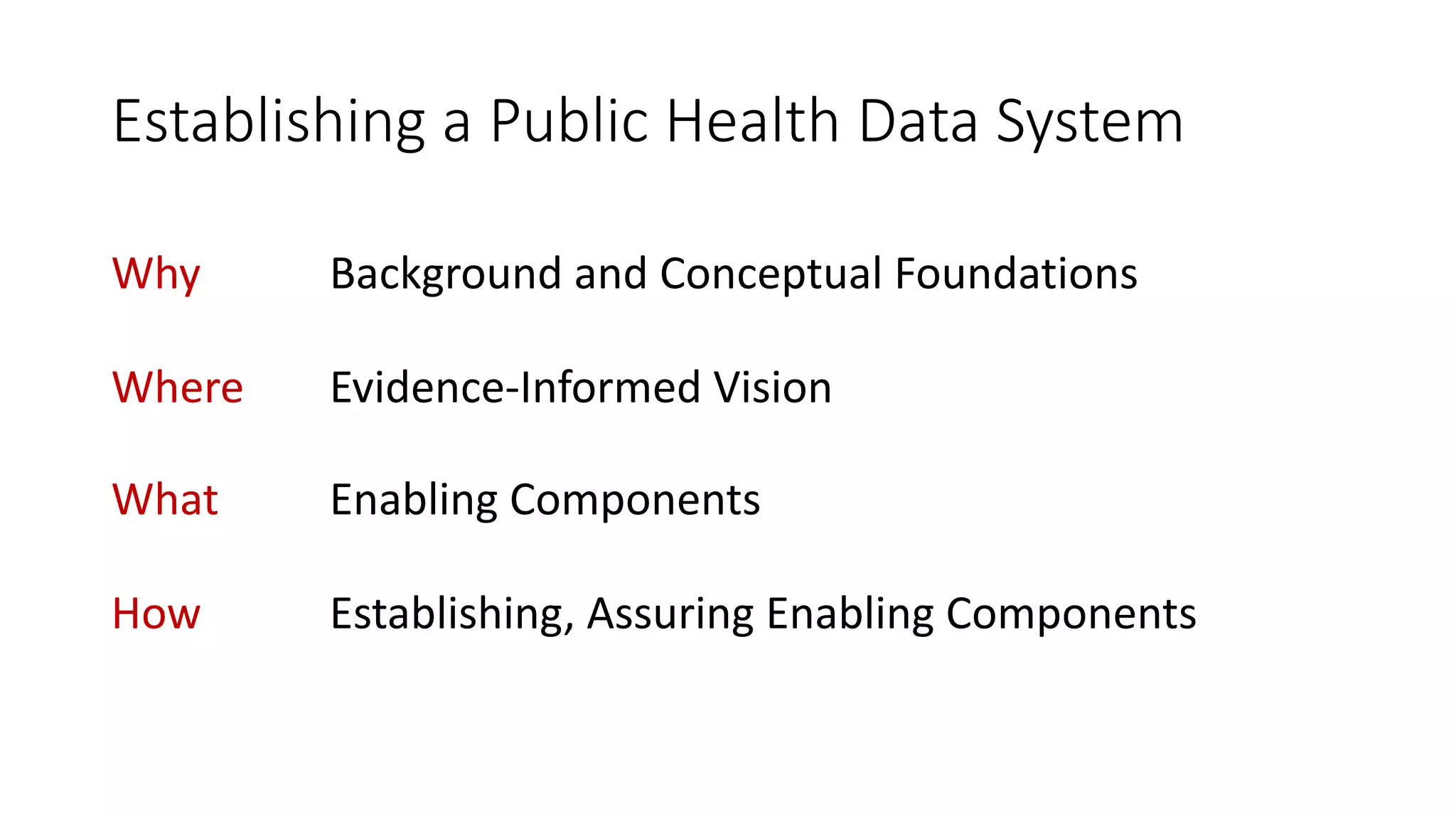
Establishing a Public Health Data System
Why Background and Conceptual Foundations
Where Evidence-Informed Vision
What Enabling Components
How Establishing, Assuring Enabling Components
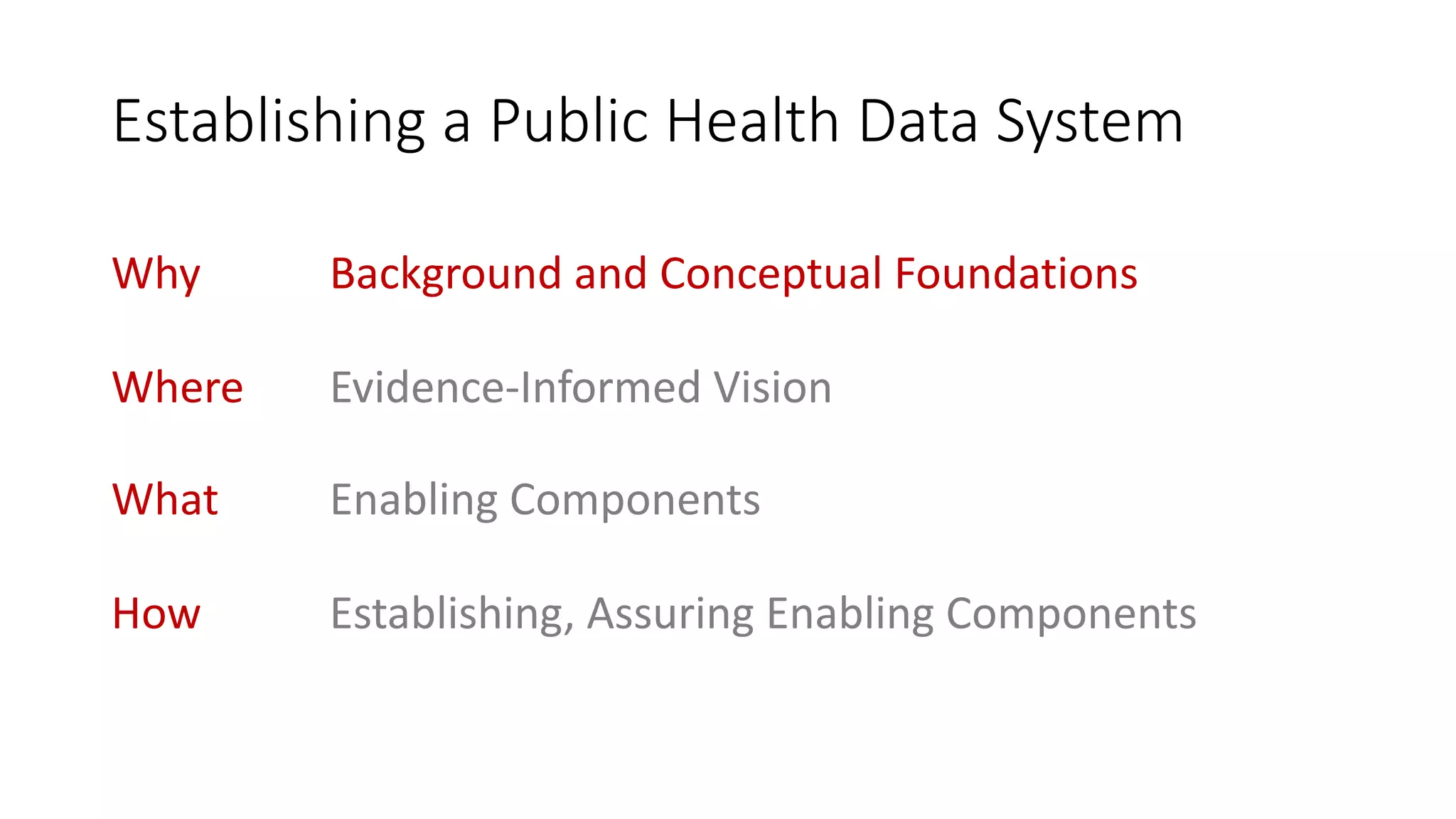
Establishing a Public Health Data System
Why Background and Conceptual Foundations
Where Evidence-Informed Vision
What Enabling Components
How Establishing, Assuring Enabling Components
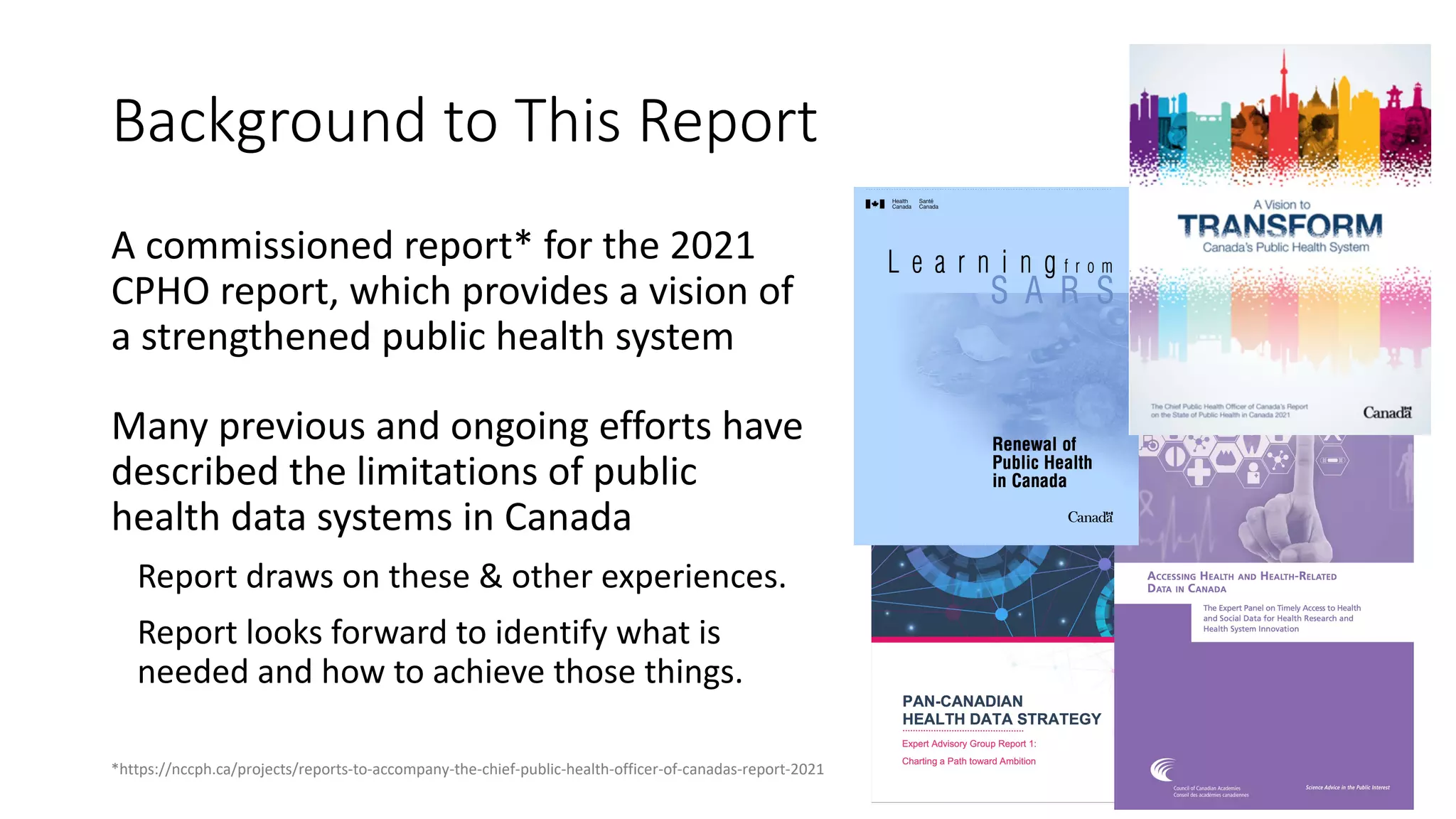
Background to This Report
A commissioned report* for the 2021
CPHO report, which provides a vision of
a strengthened public health system
Many previous and ongoing efforts have
described the limitations of public
health data systems in Canada
Report draws on these & other experiences.
Report looks forward to identify what is
needed and how to achieve those things.
*https://nccph.ca/projects/reports-to-accompany-the-chief-public-health-officer-of-canadas-report-2021
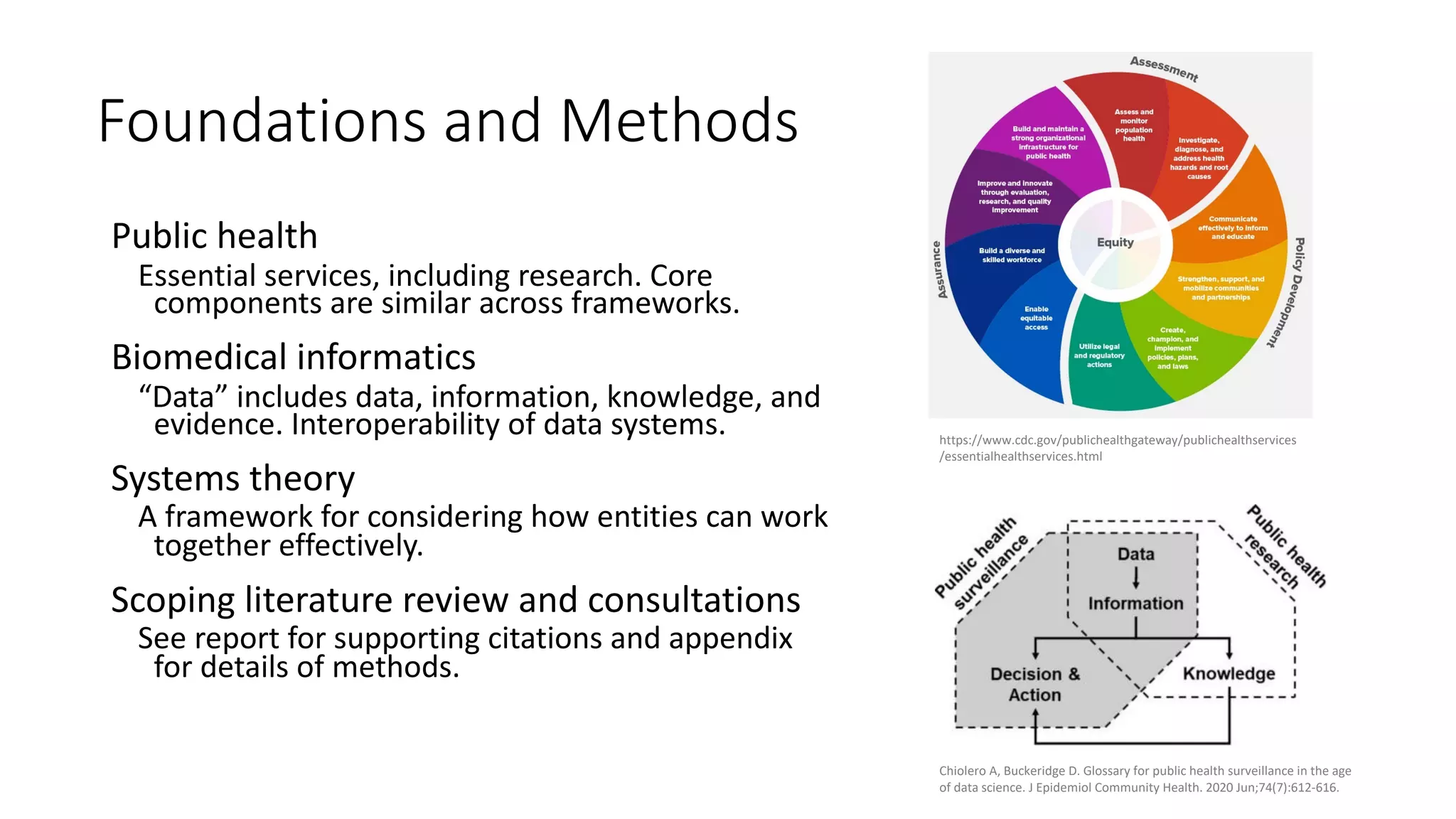
Foundations and Methods
Public health
Essential services, including research. Core
components are similar across frameworks.
Biomedical informatics
“Data” includes data, information, knowledge, and
evidence. Interoperability of data systems.
Systems theory
A framework for considering how entities can work
together effectively.
Scoping literature review and consultations
See report for supporting citations and appendix
for details of methods.
https://www.cdc.gov/publichealthgateway/publichealthservices
/essentialhealthservices.html
Chiolero A, Buckeridge D. Glossary for public health surveillance in the age
of data science. J Epidemiol Community Health. 2020 Jun;74(7):612-616.
Establishing a Public Health Data System
Why Background and Conceptual Foundations
Where Evidence-Informed Vision
What Enabling Components
How Establishing, Assuring Enabling Components
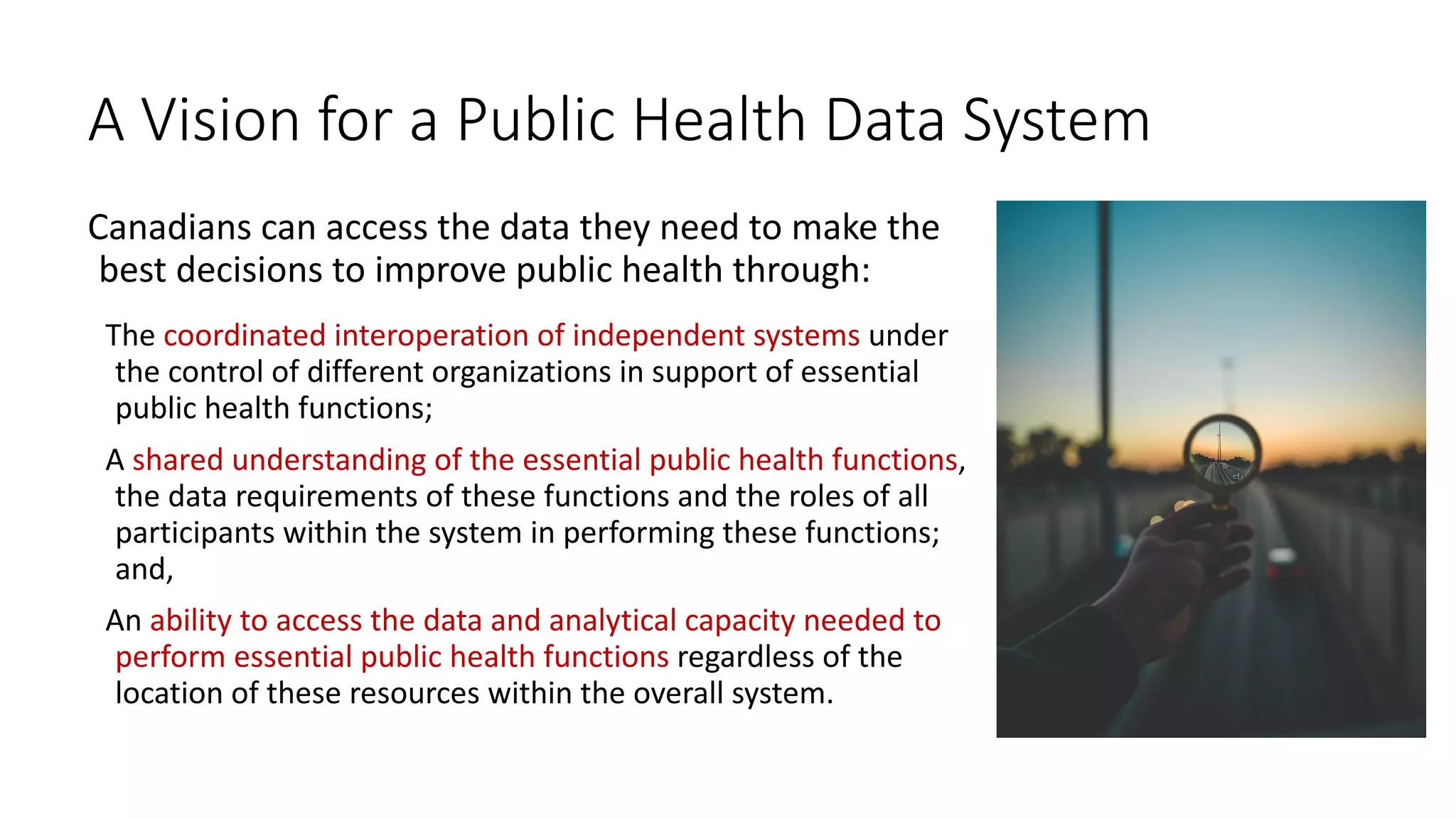
A Vision for a Public Health Data System
Canadians can access the data they need to make the
best decisions to improve public health through:
The coordinated interoperation of independent systems under
the control of different organizations in support of essential
public health functions;
A shared understanding of the essential public health functions,
the data requirements of these functions and the roles of all
participants within the system in performing these functions;
and,
An ability to access the data and analytical capacity needed to
perform essential public health functions regardless of the
location of these resources within the overall system.
Establishing a Public Health Data System
Why Background and Conceptual Foundations
Where Evidence-Informed Vision
What Enabling Components
How Establishing, Assuring Enabling Components
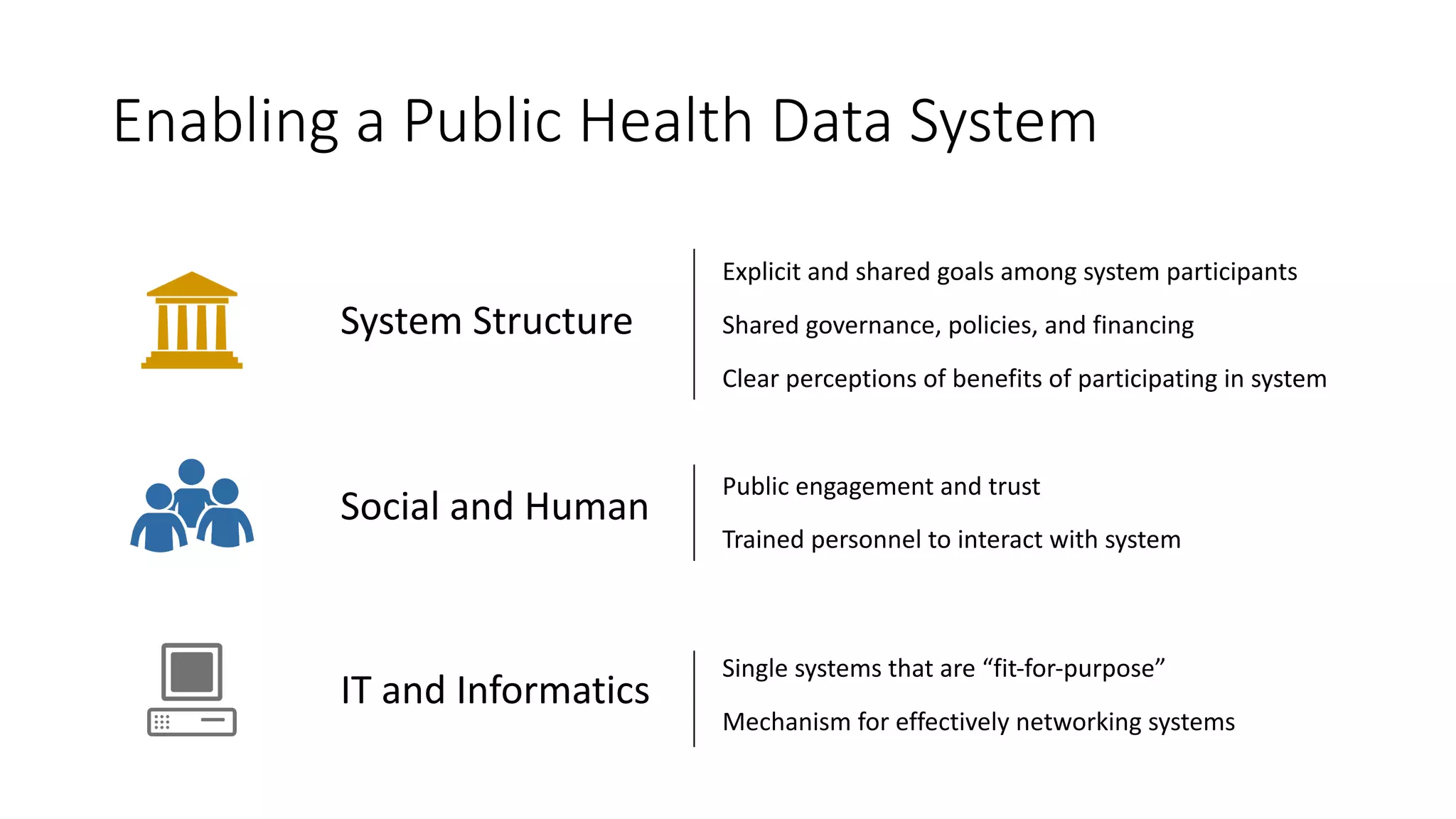
Enabling a Public Health Data System
System Structure Components
Social and Human Components
Information Technology and Informatics Components
System Structure Components
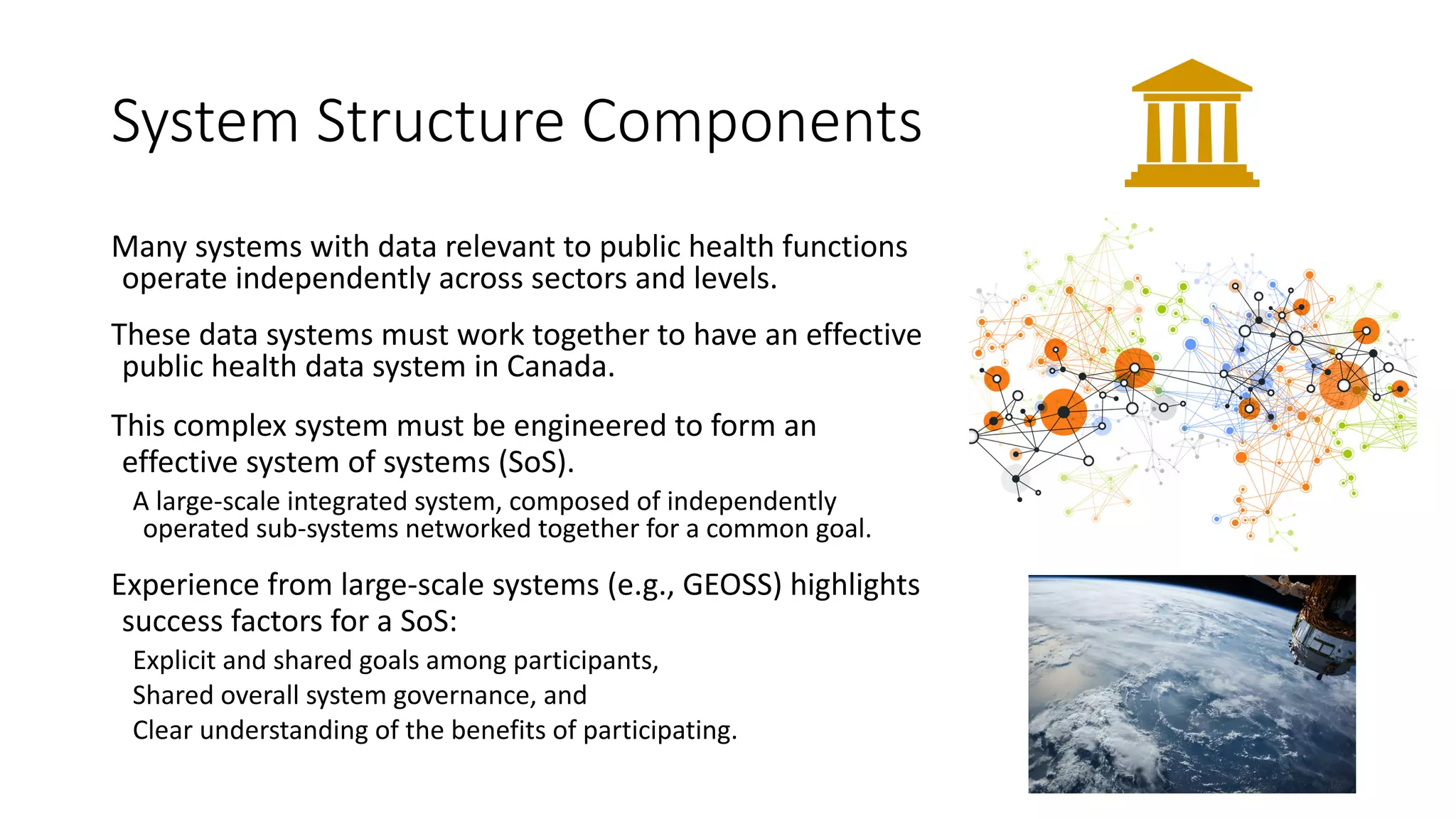
Many systems with data relevant to public health functions
operate independently across sectors and levels.
These data systems must work together to have an effective
public health data system in Canada.
This complex system must be engineered to form an
effective system of systems (SoS).
A large-scale integrated system, composed of independently
operated sub-systems networked together for a common goal.
Experience from large-scale systems (e.g., GEOSS) highlights
success factors for a SoS:
Explicit and shared goals among participants,
Shared overall system governance, and
Clear understanding of the benefits of participating.
Social and Human Components
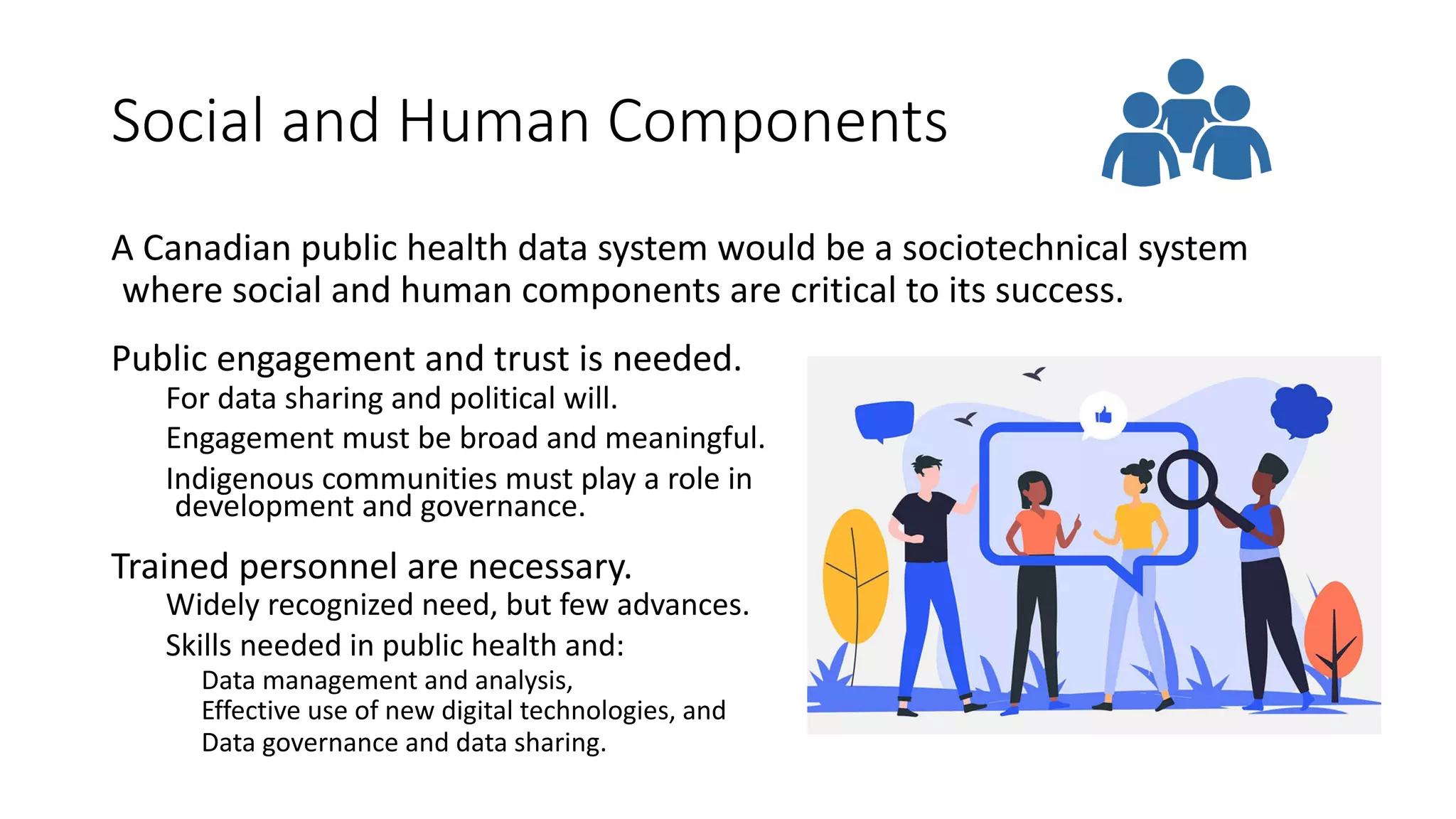
Public engagement and trust is needed.
For data sharing and political will.
Engagement must be broad and meaningful.
Indigenous communities must play a role in
development and governance.
Trained personnel are necessary.
Widely recognized need, but few advances.
Skills needed in public health and:
Data management and analysis,
Effective use of new digital technologies, and
Data governance and data sharing.
A Canadian public health data system would be a sociotechnical system
where social and human components are critical to its success.
IT and Informatics Components
To interact with a larger system, independent data
systems must be able capture, store, and
interchange data in a standard manner.
Many data systems in public health are outdated or
provide limited functionality, creating a “technical
debt”, which must be addressed.
Independent systems can be networked using a
federated approach (e.g., Sentinel) where
Disaggregated (“micro”) data remain within independent
data systems or enclaves, and
Analyses visit data as needed and return results.
A brokering approach can help limit the resources
needed for independent systems to participate.
Enabling a Public Health Data System
System Structure
Social and Human
IT and Informatics
Explicit and shared goals among system participants
Shared governance, policies, and financing
Clear perceptions of benefits of participating in system
Public engagement and trust
Trained personnel to interact with system
Single systems that are “fit-for-purpose”
Mechanism for effectively networking systems
Establishing a Public Health Data System
Why Background and Conceptual Foundations
Where Evidence-Informed Vision
What Enabling Components
How Establishing, Assuring Enabling Components
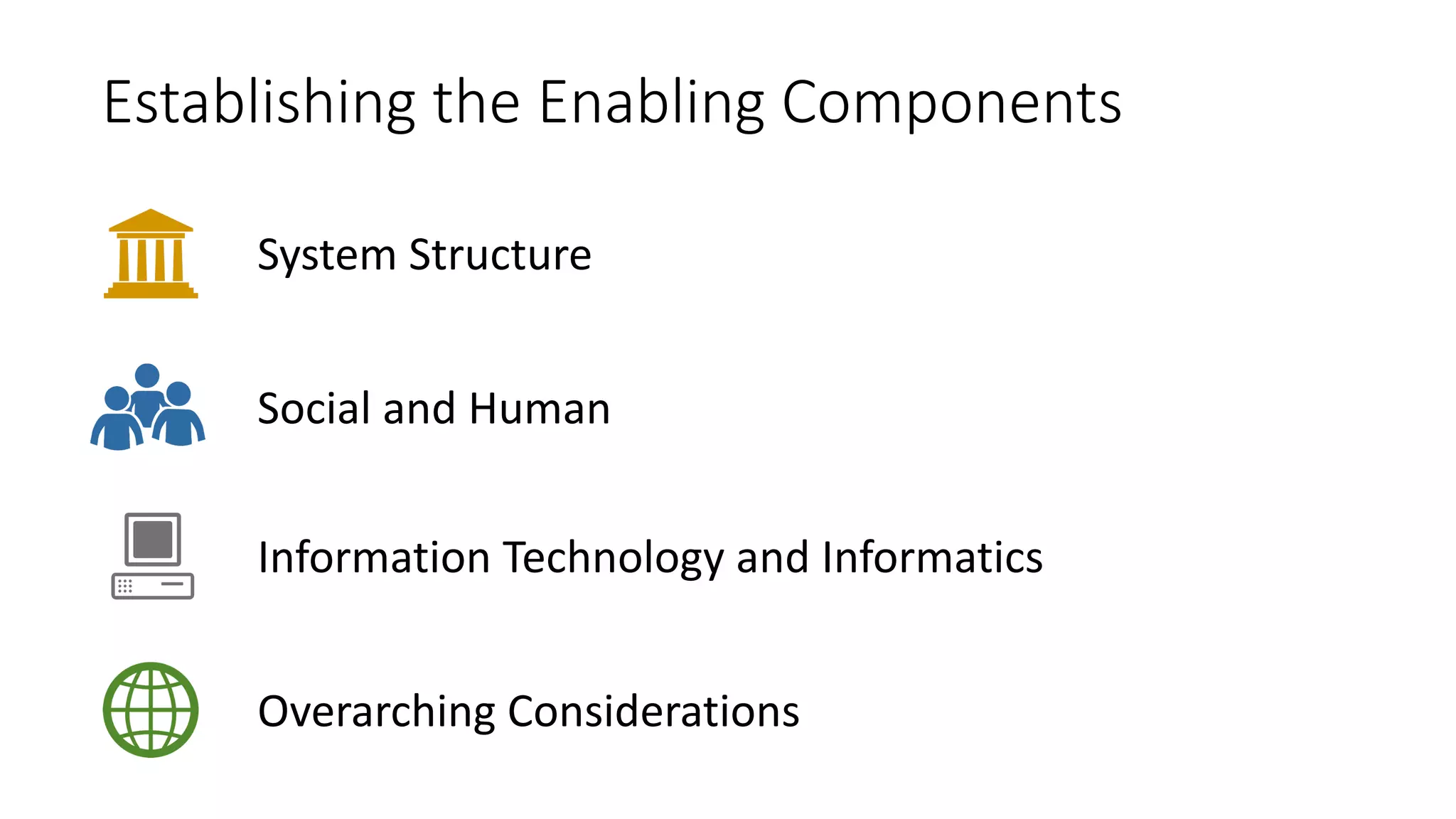
Establishing the Enabling Components
System Structure
Social and Human
Information Technology and Informatics
Overarching Considerations
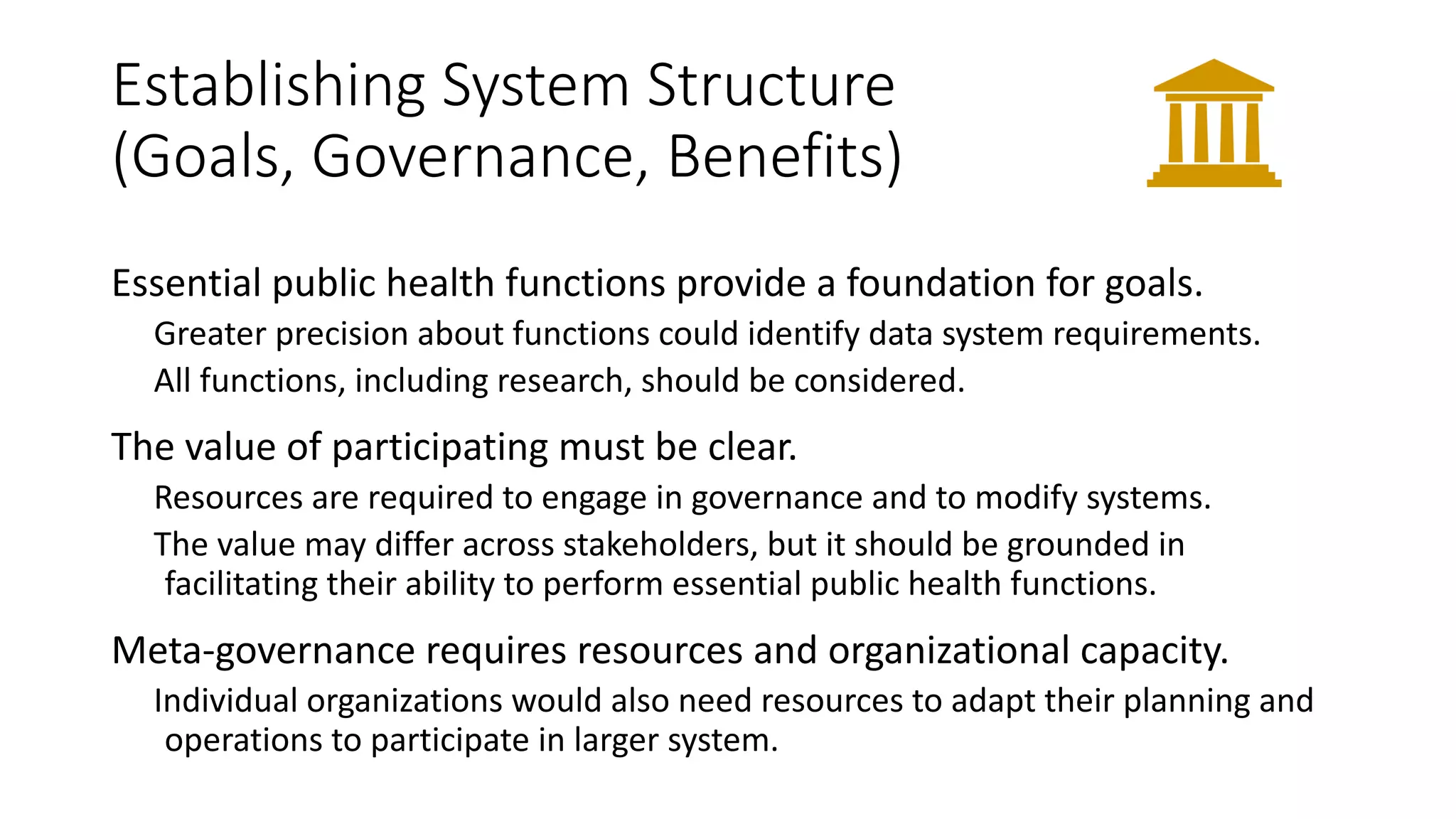
Establishing System Structure
(Goals, Governance, Benefits)
Essential public health functions provide a foundation for goals.
Greater precision about functions could identify data system requirements.
All functions, including research, should be considered.
The value of participating must be clear.
Resources are required to engage in governance and to modify systems.
The value may differ across stakeholders, but it should be grounded in
facilitating their ability to perform essential public health functions.
Meta-governance requires resources and organizational capacity.
Individual organizations would also need resources to adapt their planning and
operations to participate in larger system.
Establishing Social and Human
(Engagement, Trust, Skills)
Engagement is needed with a broad range of stakeholders to
transparently develop and communicate system goals and values.
Trust in data sharing requires compliance with existing privacy and security laws
and a robust set of practices and policies.
A broad training strategy is needed that goes beyond current core
competencies to address skills in data and digital systems.
Innovative mechanisms needed to support effective use of digital technologies.
Capacity can be leveraged from research and commercial partners.
Information blocking must be addressed.
Establishing IT and Informatics
(Robust, Interoperable)
Considerable investment will be required to address the technical debt.
Modernization would drive a digital transformation of public health in Canada
with digital technologies used to meet public health objectives.
This could drive evidence-based, convergent evolution towards interoperability.
Move to a federated model from a centralized, hierarchical approach.
Data governance clarifies who can access which data for what purpose.
Messaging and data standards (incl. common data model) need coordination.
Privacy-preserving approaches exist to enable data linkage and analysis.
Overarching Considerations
Awareness of shortcomings of public health data systems is not new.
Lessons can be learned from previous reviews.
Panorama highlighted the need for shared goals, agility, public health leadership.
Technical expertise and leadership in public health informatics and other
disciplines is needed to drive development and implementation.
Three models have been proposed
Use existing F/P/T structures: Post-SARS led to PHAC. Engages P/T, but can be slow and
influenced by short-term political considerations
Adapt existing pan-Canadian organization: Canada Health Infoway and Panorama post-
SARS. CIHI presents a promising operational and governance model.
Create new organization: As occurred with Canada Blood Services and Hema Quebec.
New organizations focused on public health data have been created in other countries.
Establishing a Canadian Public Health Data System
System
Structure
Social and
Human
IT and
Informatics
Overarching
Considerations
Clarify common goals
Identify value proposition for participants
Develop a governance model
Conduct public engagement to establish trust
Develop a broad strategy to enhance data and digital skills
Establish mechanisms to leverage academic and industrial expertise
Encourage coordinated digital transformation
Develop a roadmap to interoperability for public health data systems
Identify organization to provide leadership and technical expertise
Develop a phased implementation plan
Questions?
An Evidence-Informed
Vision for a Public Health
Data System in Canada
David Buckeridge, MD PhD FRCPC
Professor, School of Population and Global Health, McGill University
Canada Research Chair, Health Informatics and Data Science
david.buckeridge@mcgill.ca
Share your story!
• Are you using EIDM in your practice? We want to hear about it!
• Email us: nccmt@mcmaster.ca
• Need support for EIDM? Contact us for help!
• Email us: nccmt@mcmaster.ca
• We typically respond within 24 business hours
10
Webinar Feedback
Your responses will be kept anonymous.
Please indicate your level of agreement with the following:
1. Participating in the webinar increased my knowledge and understanding of evidence-informed decision
making.
2. I will use the information from today’s webinar in my own practice.
3. Which of the following statements apply to your experience with the webinar today (check all that
apply):
□ The webinar was relevant to me and my public health practice
□ The webinar was effectively facilitated
□ The webinar had opportunities to participate
□ The webinar was easy to follow along
□ The webinar met my expectations
Strongly agree Agree Undecided Disagree Strongly Disagree
Webinars from the NCCMT
Learn more about our webinars:
http://www.nccmt.ca/capacity-development/webinars
12
For more information:
NCCMT website: www.nccmt.ca
Contact: nccmt@mcmaster.ca

An Evidence Informed Vision for a Public Health Data System in Canada

  • 1.
    Welcome! • This webinarwill be recorded. • Your microphone and camera will be turned off for the duration of the webinar. • To ensure accessibility, live captions can be enabled from the control panel.
  • 2.
    February 9, 2022 Presenter:David Buckeridge Facilitator: Emily Clark An Evidence-Informed Vision for a Public Health Data System in Canada
  • 3.
    Housekeeping • Connection issues •We recommend using a wired Internet Connection • If you are experiencing technical issues please send a private message to Alanna Miller • Use the Q&A and chat to post questions and/or comments throughout the webinar • Post your questions in the Q&A • Send questions about technical difficulties in a private chat to Alanna Miller • Polling
  • 4.
    After Today After thewebinar, access the recording (in English) at www.youtube.com/nccmt and slides in English and French at www.slideshare.net/NCCMT/presentations.
  • 5.
    Pre-webinar Polling Questions 1.How many people are watching today’s session with you? A) Just Me B) 2-3 C) 4-5 D) 6-10 E) >10 2. Have you visited the National Collaborating Centre for Methods and Tools’ website or used its resources before? A) Yes B) No 3. If you stated YES on the previous question, how many times have you used the NCCMT’s resources? A) Once B) 2-3 times C) 4-10 times D) 10+ times
  • 7.
    NCCMT Products andServices Registry of Methods and Tools Online Learning Opportunities Workshops Video Series Public Health+ Networking and Outreach
  • 8.
    2021 CPHO CommissionedReports An Evidence-Informed Vision for a Public Health Data System in Canada • 2021 CPHO report: • Canada.ca/CPHOreport • 3 other reports that were commissioned to inform the 2021 CPHO report: • https://nccph.ca/projects/reports-to-accompany- the-chief-public-health-officer-of-canadas-report- 2021
  • 9.
    Presenter Dr. David Buckeridge Professor,Department of Epidemiology, Biostatistics and Occupational Health at McGill University
  • 10.
    An Evidence-Informed Vision fora Public Health Data System in Canada David Buckeridge, MD PhD FRCPC Professor, School of Population and Global Health, McGill University Canada Research Chair, Health Informatics and Data Science david.buckeridge@mcgill.ca
  • 11.
    Establishing a CanadianPublic Health Data System System Structure Social and Human IT and Informatics Overarching Considerations Clarify common goals Identify value proposition for participants Develop a governance model Conduct public engagement to establish trust Develop a broad strategy to enhance data and digital skills Establish mechanisms to leverage academic and industrial expertise Encourage coordinated digital transformation Develop a roadmap to interoperability for public health data systems Identify organization to provide leadership and technical expertise Develop a phased implementation plan
  • 12.
    Establishing a PublicHealth Data System Why Background and Conceptual Foundations Where Evidence-Informed Vision What Enabling Components How Establishing, Assuring Enabling Components
  • 13.
    Establishing a PublicHealth Data System Why Background and Conceptual Foundations Where Evidence-Informed Vision What Enabling Components How Establishing, Assuring Enabling Components
  • 14.
    Background to ThisReport A commissioned report* for the 2021 CPHO report, which provides a vision of a strengthened public health system Many previous and ongoing efforts have described the limitations of public health data systems in Canada Report draws on these & other experiences. Report looks forward to identify what is needed and how to achieve those things. *https://nccph.ca/projects/reports-to-accompany-the-chief-public-health-officer-of-canadas-report-2021
  • 15.
    Foundations and Methods Publichealth Essential services, including research. Core components are similar across frameworks. Biomedical informatics “Data” includes data, information, knowledge, and evidence. Interoperability of data systems. Systems theory A framework for considering how entities can work together effectively. Scoping literature review and consultations See report for supporting citations and appendix for details of methods. https://www.cdc.gov/publichealthgateway/publichealthservices /essentialhealthservices.html Chiolero A, Buckeridge D. Glossary for public health surveillance in the age of data science. J Epidemiol Community Health. 2020 Jun;74(7):612-616.
  • 16.
    Establishing a PublicHealth Data System Why Background and Conceptual Foundations Where Evidence-Informed Vision What Enabling Components How Establishing, Assuring Enabling Components
  • 17.
    A Vision fora Public Health Data System Canadians can access the data they need to make the best decisions to improve public health through: The coordinated interoperation of independent systems under the control of different organizations in support of essential public health functions; A shared understanding of the essential public health functions, the data requirements of these functions and the roles of all participants within the system in performing these functions; and, An ability to access the data and analytical capacity needed to perform essential public health functions regardless of the location of these resources within the overall system.
  • 18.
    Establishing a PublicHealth Data System Why Background and Conceptual Foundations Where Evidence-Informed Vision What Enabling Components How Establishing, Assuring Enabling Components
  • 19.
    Enabling a PublicHealth Data System System Structure Components Social and Human Components Information Technology and Informatics Components
  • 20.
    System Structure Components Manysystems with data relevant to public health functions operate independently across sectors and levels. These data systems must work together to have an effective public health data system in Canada. This complex system must be engineered to form an effective system of systems (SoS). A large-scale integrated system, composed of independently operated sub-systems networked together for a common goal. Experience from large-scale systems (e.g., GEOSS) highlights success factors for a SoS: Explicit and shared goals among participants, Shared overall system governance, and Clear understanding of the benefits of participating.
  • 21.
    Social and HumanComponents Public engagement and trust is needed. For data sharing and political will. Engagement must be broad and meaningful. Indigenous communities must play a role in development and governance. Trained personnel are necessary. Widely recognized need, but few advances. Skills needed in public health and: Data management and analysis, Effective use of new digital technologies, and Data governance and data sharing. A Canadian public health data system would be a sociotechnical system where social and human components are critical to its success.
  • 22.
    IT and InformaticsComponents To interact with a larger system, independent data systems must be able capture, store, and interchange data in a standard manner. Many data systems in public health are outdated or provide limited functionality, creating a “technical debt”, which must be addressed. Independent systems can be networked using a federated approach (e.g., Sentinel) where Disaggregated (“micro”) data remain within independent data systems or enclaves, and Analyses visit data as needed and return results. A brokering approach can help limit the resources needed for independent systems to participate.
  • 23.
    Enabling a PublicHealth Data System System Structure Social and Human IT and Informatics Explicit and shared goals among system participants Shared governance, policies, and financing Clear perceptions of benefits of participating in system Public engagement and trust Trained personnel to interact with system Single systems that are “fit-for-purpose” Mechanism for effectively networking systems
  • 24.
    Establishing a PublicHealth Data System Why Background and Conceptual Foundations Where Evidence-Informed Vision What Enabling Components How Establishing, Assuring Enabling Components
  • 25.
    Establishing the EnablingComponents System Structure Social and Human Information Technology and Informatics Overarching Considerations
  • 26.
    Establishing System Structure (Goals,Governance, Benefits) Essential public health functions provide a foundation for goals. Greater precision about functions could identify data system requirements. All functions, including research, should be considered. The value of participating must be clear. Resources are required to engage in governance and to modify systems. The value may differ across stakeholders, but it should be grounded in facilitating their ability to perform essential public health functions. Meta-governance requires resources and organizational capacity. Individual organizations would also need resources to adapt their planning and operations to participate in larger system.
  • 27.
    Establishing Social andHuman (Engagement, Trust, Skills) Engagement is needed with a broad range of stakeholders to transparently develop and communicate system goals and values. Trust in data sharing requires compliance with existing privacy and security laws and a robust set of practices and policies. A broad training strategy is needed that goes beyond current core competencies to address skills in data and digital systems. Innovative mechanisms needed to support effective use of digital technologies. Capacity can be leveraged from research and commercial partners. Information blocking must be addressed.
  • 28.
    Establishing IT andInformatics (Robust, Interoperable) Considerable investment will be required to address the technical debt. Modernization would drive a digital transformation of public health in Canada with digital technologies used to meet public health objectives. This could drive evidence-based, convergent evolution towards interoperability. Move to a federated model from a centralized, hierarchical approach. Data governance clarifies who can access which data for what purpose. Messaging and data standards (incl. common data model) need coordination. Privacy-preserving approaches exist to enable data linkage and analysis.
  • 29.
    Overarching Considerations Awareness ofshortcomings of public health data systems is not new. Lessons can be learned from previous reviews. Panorama highlighted the need for shared goals, agility, public health leadership. Technical expertise and leadership in public health informatics and other disciplines is needed to drive development and implementation. Three models have been proposed Use existing F/P/T structures: Post-SARS led to PHAC. Engages P/T, but can be slow and influenced by short-term political considerations Adapt existing pan-Canadian organization: Canada Health Infoway and Panorama post- SARS. CIHI presents a promising operational and governance model. Create new organization: As occurred with Canada Blood Services and Hema Quebec. New organizations focused on public health data have been created in other countries.
  • 30.
    Establishing a CanadianPublic Health Data System System Structure Social and Human IT and Informatics Overarching Considerations Clarify common goals Identify value proposition for participants Develop a governance model Conduct public engagement to establish trust Develop a broad strategy to enhance data and digital skills Establish mechanisms to leverage academic and industrial expertise Encourage coordinated digital transformation Develop a roadmap to interoperability for public health data systems Identify organization to provide leadership and technical expertise Develop a phased implementation plan
  • 31.
  • 32.
    An Evidence-Informed Vision fora Public Health Data System in Canada David Buckeridge, MD PhD FRCPC Professor, School of Population and Global Health, McGill University Canada Research Chair, Health Informatics and Data Science david.buckeridge@mcgill.ca
  • 33.
    Share your story! •Are you using EIDM in your practice? We want to hear about it! • Email us: nccmt@mcmaster.ca • Need support for EIDM? Contact us for help! • Email us: nccmt@mcmaster.ca • We typically respond within 24 business hours 10
  • 34.
    Webinar Feedback Your responseswill be kept anonymous. Please indicate your level of agreement with the following: 1. Participating in the webinar increased my knowledge and understanding of evidence-informed decision making. 2. I will use the information from today’s webinar in my own practice. 3. Which of the following statements apply to your experience with the webinar today (check all that apply): □ The webinar was relevant to me and my public health practice □ The webinar was effectively facilitated □ The webinar had opportunities to participate □ The webinar was easy to follow along □ The webinar met my expectations Strongly agree Agree Undecided Disagree Strongly Disagree Strongly agree Agree Undecided Disagree Strongly Disagree
  • 35.
    Webinars from theNCCMT Learn more about our webinars: http://www.nccmt.ca/capacity-development/webinars 12
  • 36.
    For more information: NCCMTwebsite: www.nccmt.ca Contact: nccmt@mcmaster.ca