
Pulling Together
to beat superbugs
Jonathan Wadsworth
Franck Berthe
World Bank Group
CGIAR Antimicrobial Resistance
hub launching, ILRI Nairobi,
21-22 February 2019
Human Cost of AMR – Lives Lost Economic Cost – Global GDP Lost
TACKLING DRUG-RESISTANT INFECTIONS GLOBALLY: FINAL REPORT AND RECOMMENDATIONS THE REVIEW ON ANTIMICROBIAL RESISTANCE CHAIRED BY JIM O’NEILL MAY 2016
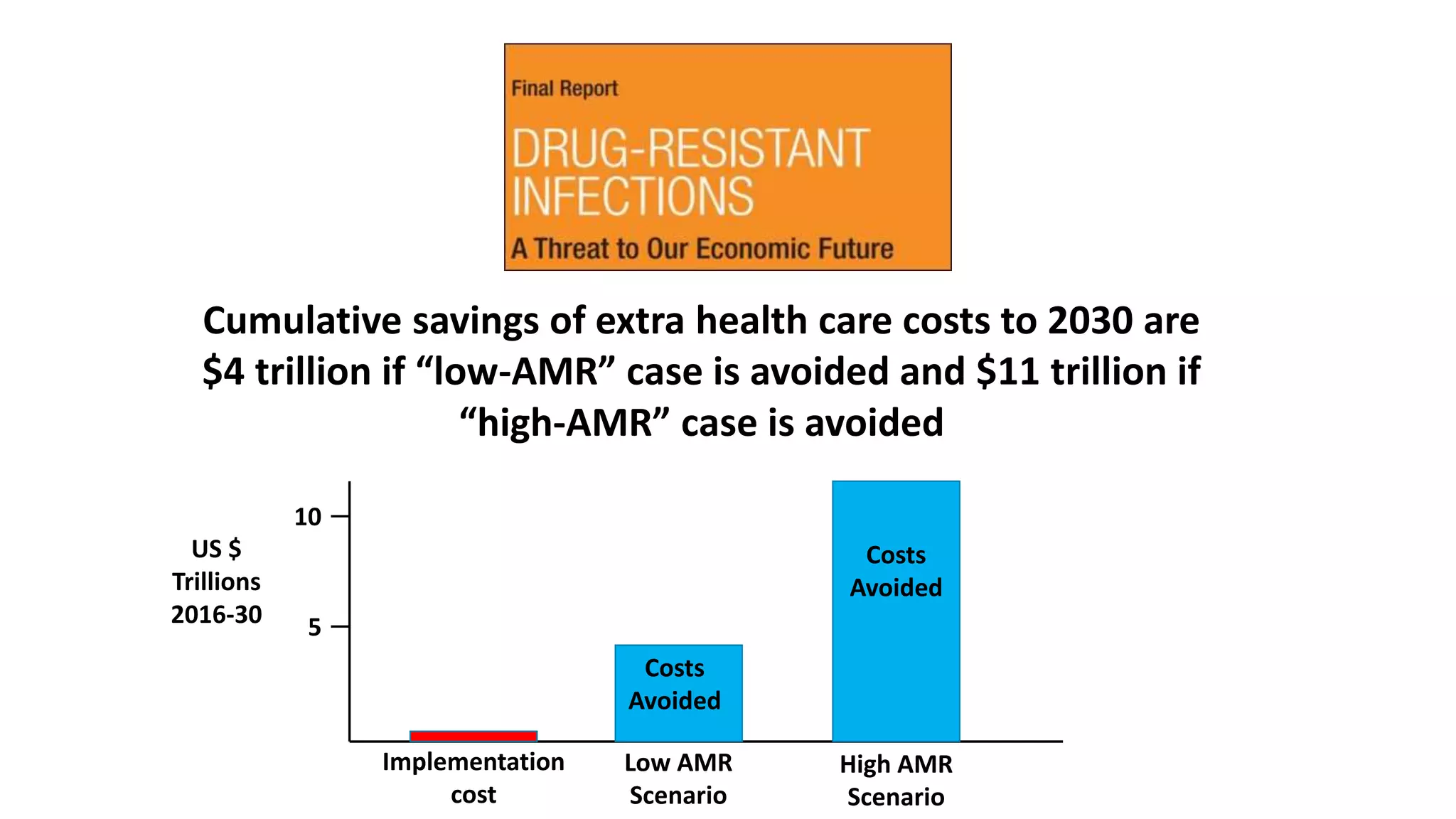
Cumulative savings of extra health care costs to 2030 are
$4 trillion if “low-AMR” case is avoided and $11 trillion if
“high-AMR” case is avoided​
US $
Trillions
2016-30
10
5
Implementation
cost
Costs
Avoided
High AMR
Scenario
Costs
Avoided
Low AMR
Scenario
SPOT QUIZ: HOW MUCH DOES THIS 10-DAY COURSE OF ANTIBIOTIC COST IN USA?
Similar scale effect to financial crisis
of 2008 – but AMR will be continuous.
Not a “one-off” event.
Reframing AMR not just as a public health or agricultural problem, but as an
adaptive development challenge (problem of development)
6
An adaptive development challenge
• AMR is a development challenge that will disproportionately affect low- and middle- income countries from an
economic and social perspective
• AMR will negatively affect some SDGs; on the other hand – progress on some SDGs will help combating AMR
…….. after some “jagged” thinking we identified a set of principles
to guide our approach…..
7
Principles
of our
approach
Focus on behavioral
and political
economy issues
over technical,
scientific
approachesFocus on
country
level
actions and
options
Aim to reach a
broad audience,
beyond those
conversant in
AMR
Focus on
knowledge and
implementation
gaps
Not making
assumptions about
new financing but
focusing on
smarter
financing
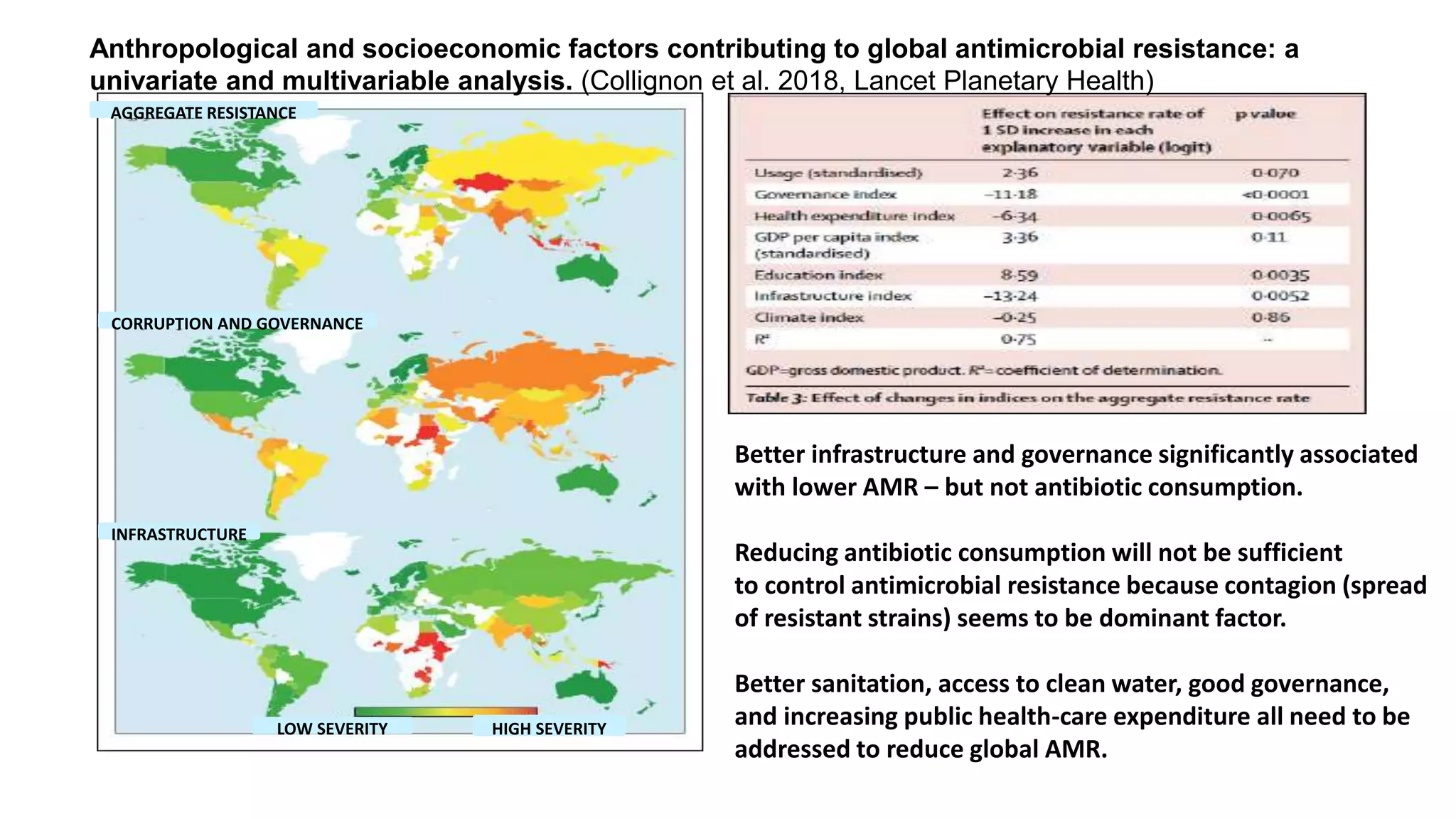
Anthropological and socioeconomic factors contributing to global antimicrobial resistance: a
univariate and multivariable analysis. (Collignon et al. 2018, Lancet Planetary Health)
AGGREGATE RESISTANCE
INFRASTRUCTURE
CORRUPTION AND GOVERNANCE
LOW SEVERITY HIGH SEVERITY
Better infrastructure and governance significantly associated
with lower AMR – but not antibiotic consumption.
Reducing antibiotic consumption will not be sufficient
to control antimicrobial resistance because contagion (spread
of resistant strains) seems to be dominant factor.
Better sanitation, access to clean water, good governance,
and increasing public health-care expenditure all need to be
addressed to reduce global AMR.
Seeking to articulate the importance of context in relation to AMR
9
Recognizing the importance of context and
the distinction between emergence and
spread
• AMR is often understood in terms of use [mis- and over-
use] of antimicrobials; however, limiting consumption of
antimicrobials will not be sufficient to control AMR.
• Context, determined by anthropological and
socioeconomic factors, is critical to understanding the
spread of resistance determinants.
• The use of antimicrobials has a bearing on emergence
of AMR, but the spread -sometimes referred to as
contagion- is driven by context.
• We need to address the underlying weaknesses of
systems to be able to address AMR; hence the need for
alignment of the AMR and Sustainable Development
agendas.
• AMR specific plus AMR sensitive investments.
Exploring three broad tensions: the way we think about antimicrobials, the
way we use them and external factors – as infrastructure of modernity
10
A challenge associated with knowledge,
attitudes and behavior
• Human behavior is about what people
know and the views they take of things.
• AMR is a behavioral and adaptive
challenge, that requires both technical
and adaptive approaches.
• It is growing not because of the absence
of new antimicrobials but because of the
way antimicrobials have become
entrenched into our social, cultural,
political and economic lives.
The way we
think
antimicrobials
The way we use them
External factors
influencing the system
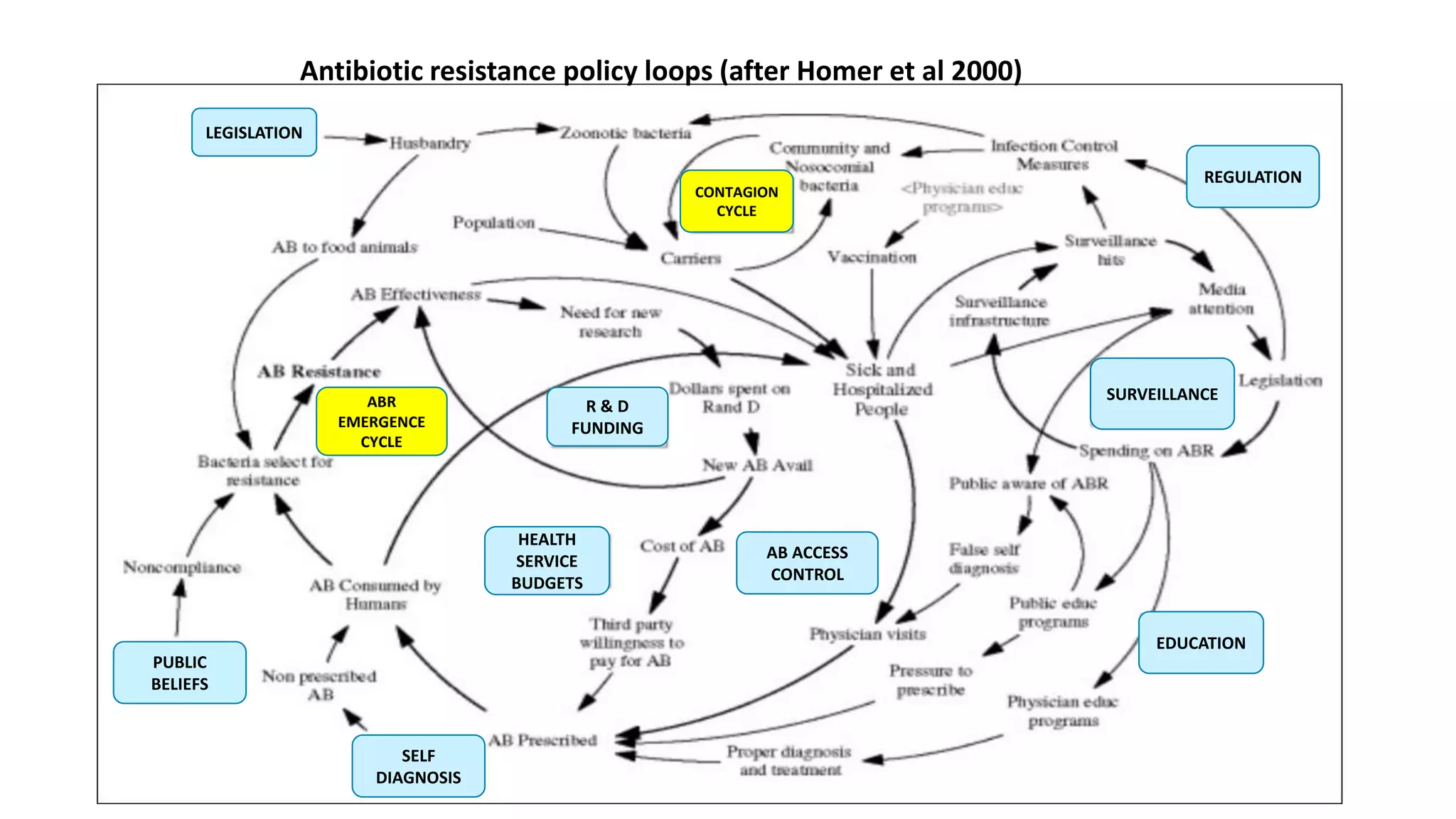
Antibiotic resistance policy loops (after Homer et al 2000)
EDUCATION
HEALTH
SERVICE
BUDGETS
LEGISLATION
REGULATION
CONTAGION
CYCLE
R & D
FUNDING
PUBLIC
BELIEFS
AB ACCESS
CONTROL
SURVEILLANCEABR
EMERGENCE
CYCLE
SELF
DIAGNOSIS
Effect of GDP per capita on antimicrobial consumption (human health)
Source: Authors
Describing typologies of countries, in terms of AMR risk
14
Type A Type B Type C Type D
Level of
economic
development
Low
income
Low & lower-
middle income
Upper-middle
& high income
Upper-middle
& high income
Antimicrobial
use
Low High High Low
Exposure to
other
contextual
risk factors
High High Medium Low
Expected level
of AMR
Medium High Medium/High Low
Lower- and Middle-income countries have the most dangerous
combination of risk factors for emergence and spread of
antimicrobial resistance
While the theoretical curve [above] exposes a historical transition process for countries from type A to D, the global action on AMR is expected to
offer avenues for new trajectories towards type D.
Type A Type B Type C Type D
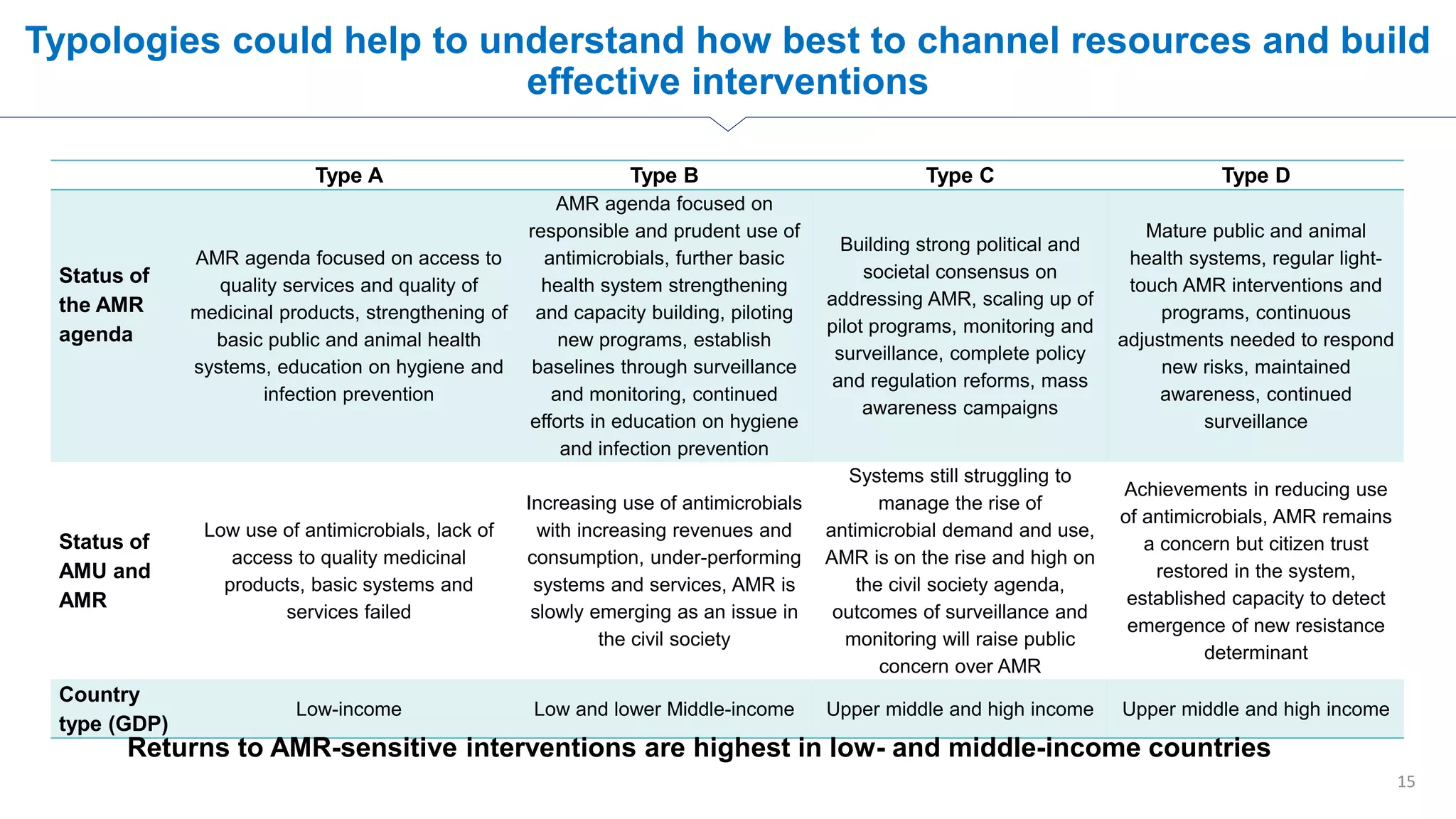
Typologies could help to understand how best to channel resources and build
effective interventions
15
Type A Type B Type C Type D
Status of
the AMR
agenda
AMR agenda focused on access to
quality services and quality of
medicinal products, strengthening of
basic public and animal health
systems, education on hygiene and
infection prevention
AMR agenda focused on
responsible and prudent use of
antimicrobials, further basic
health system strengthening
and capacity building, piloting
new programs, establish
baselines through surveillance
and monitoring, continued
efforts in education on hygiene
and infection prevention
Building strong political and
societal consensus on
addressing AMR, scaling up of
pilot programs, monitoring and
surveillance, complete policy
and regulation reforms, mass
awareness campaigns
Mature public and animal
health systems, regular light-
touch AMR interventions and
programs, continuous
adjustments needed to respond
new risks, maintained
awareness, continued
surveillance
Status of
AMU and
AMR
Low use of antimicrobials, lack of
access to quality medicinal
products, basic systems and
services failed
Increasing use of antimicrobials
with increasing revenues and
consumption, under-performing
systems and services, AMR is
slowly emerging as an issue in
the civil society
Systems still struggling to
manage the rise of
antimicrobial demand and use,
AMR is on the rise and high on
the civil society agenda,
outcomes of surveillance and
monitoring will raise public
concern over AMR
Achievements in reducing use
of antimicrobials, AMR remains
a concern but citizen trust
restored in the system,
established capacity to detect
emergence of new resistance
determinant
Country
type (GDP)
Low-income Low and lower Middle-income Upper middle and high income Upper middle and high income
Returns to AMR-sensitive interventions are highest in low- and middle-income countries
?
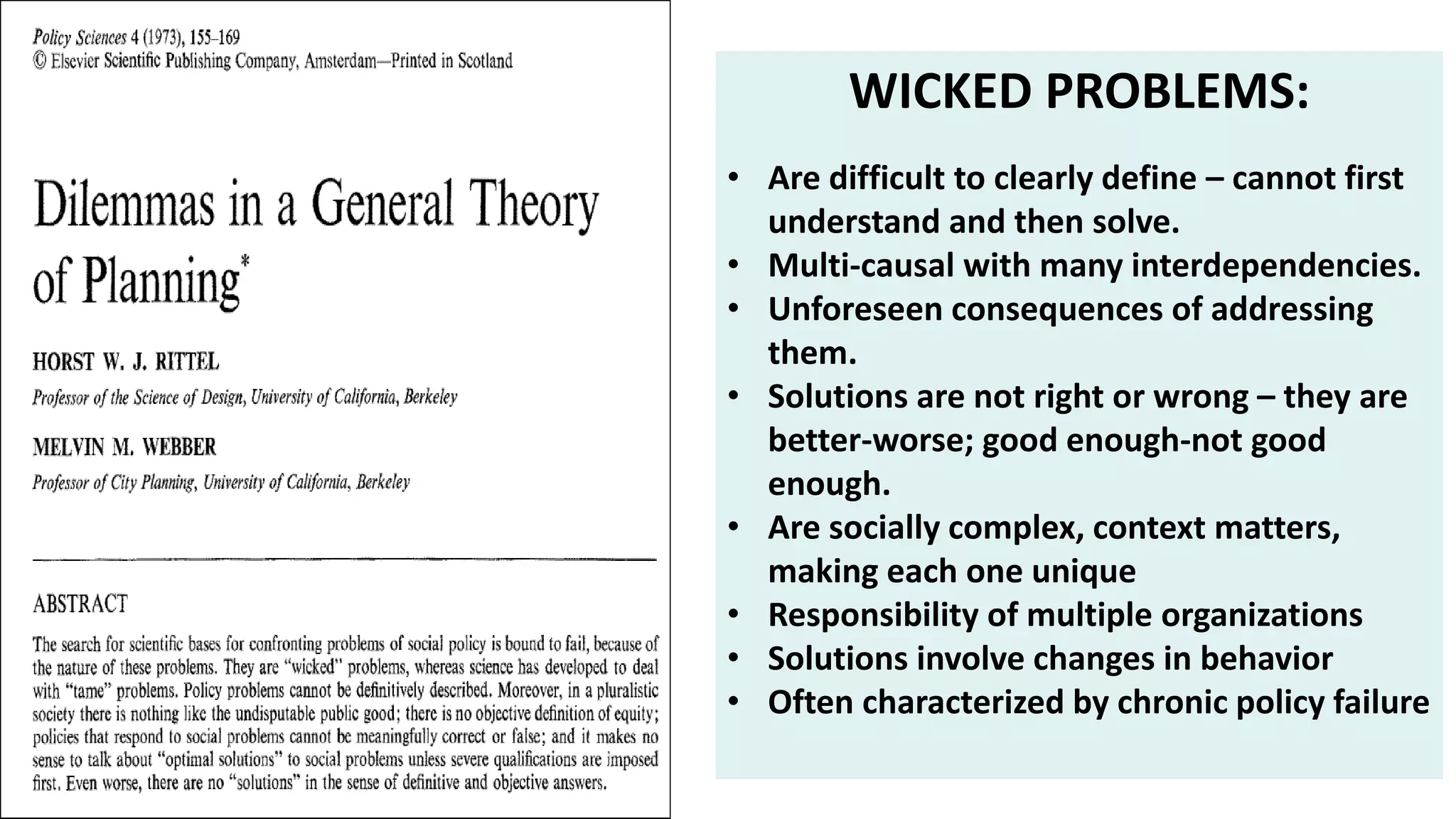
WICKED PROBLEMS:
• Are difficult to clearly define – cannot first
understand and then solve.
• Multi-causal with many interdependencies.
• Unforeseen consequences of addressing
them.
• Solutions are not right or wrong – they are
better-worse; good enough-not good
enough.
• Are socially complex, context matters,
making each one unique
• Responsibility of multiple organizations
• Solutions involve changes in behavior
• Often characterized by chronic policy failure
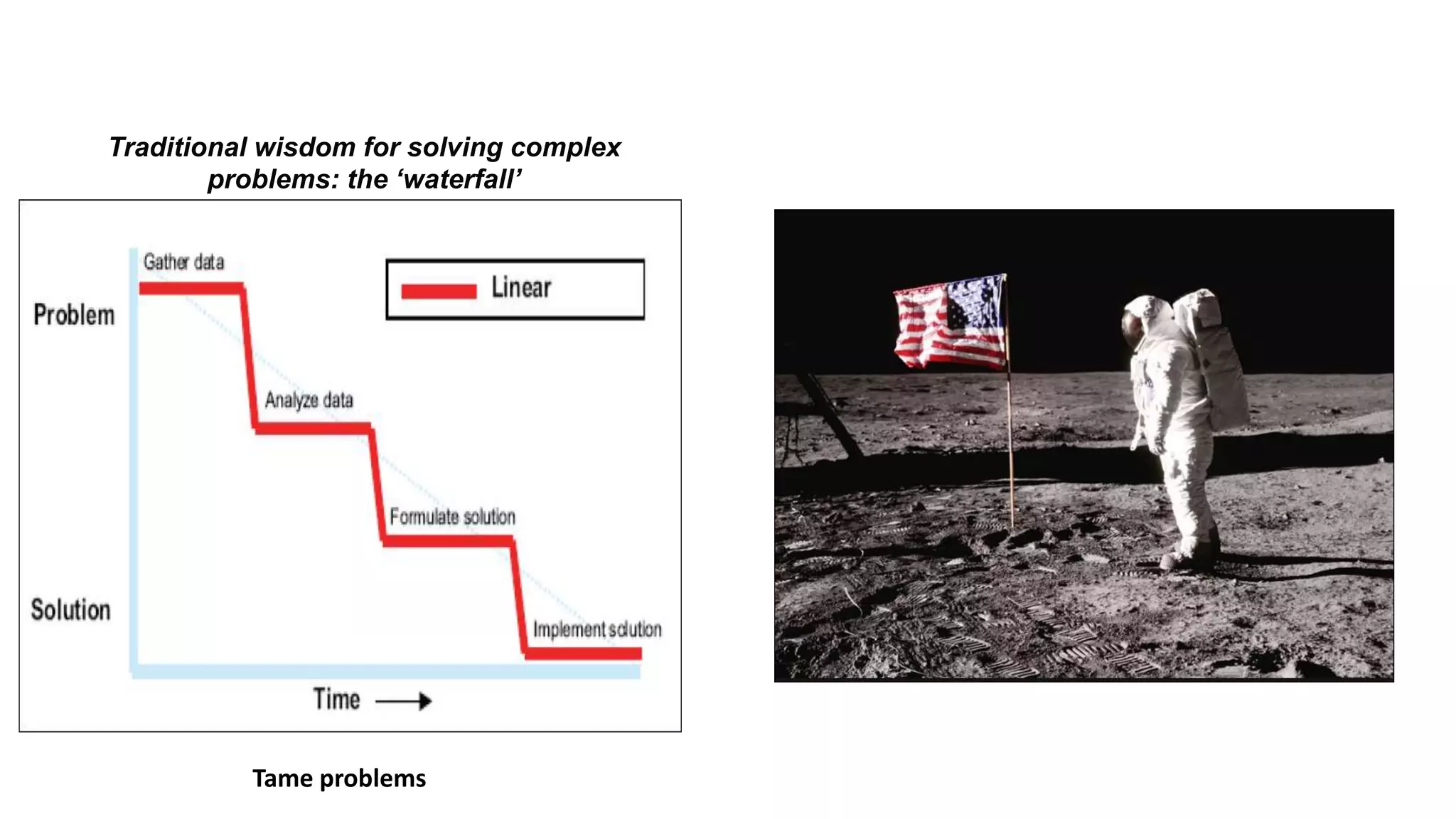
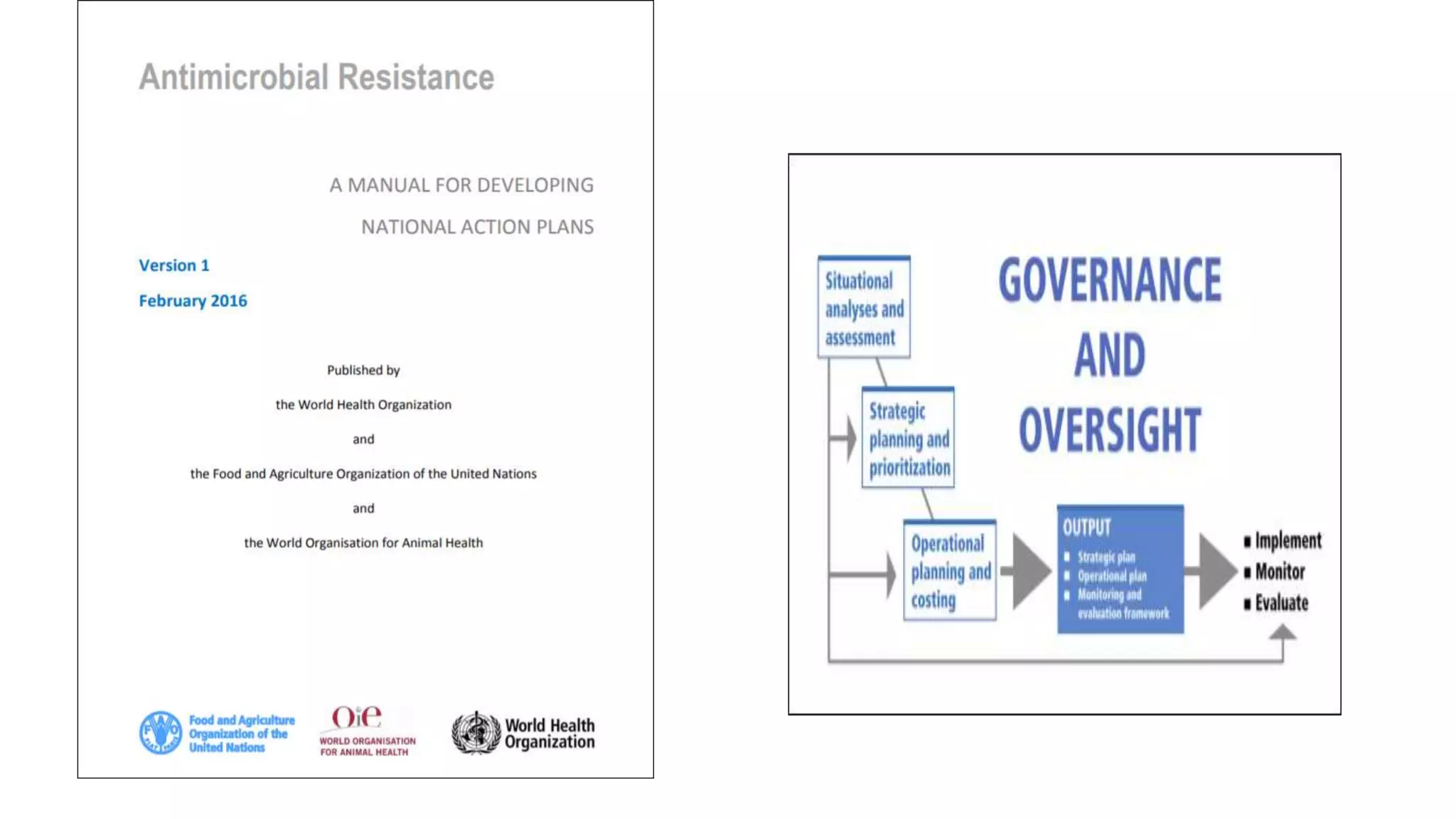
Traditional wisdom for solving complex
problems: the ‘waterfall’
Tame problems
Opportunity-driven problem solving:
the “jagged line of learning”
Wicked problems
N. B.
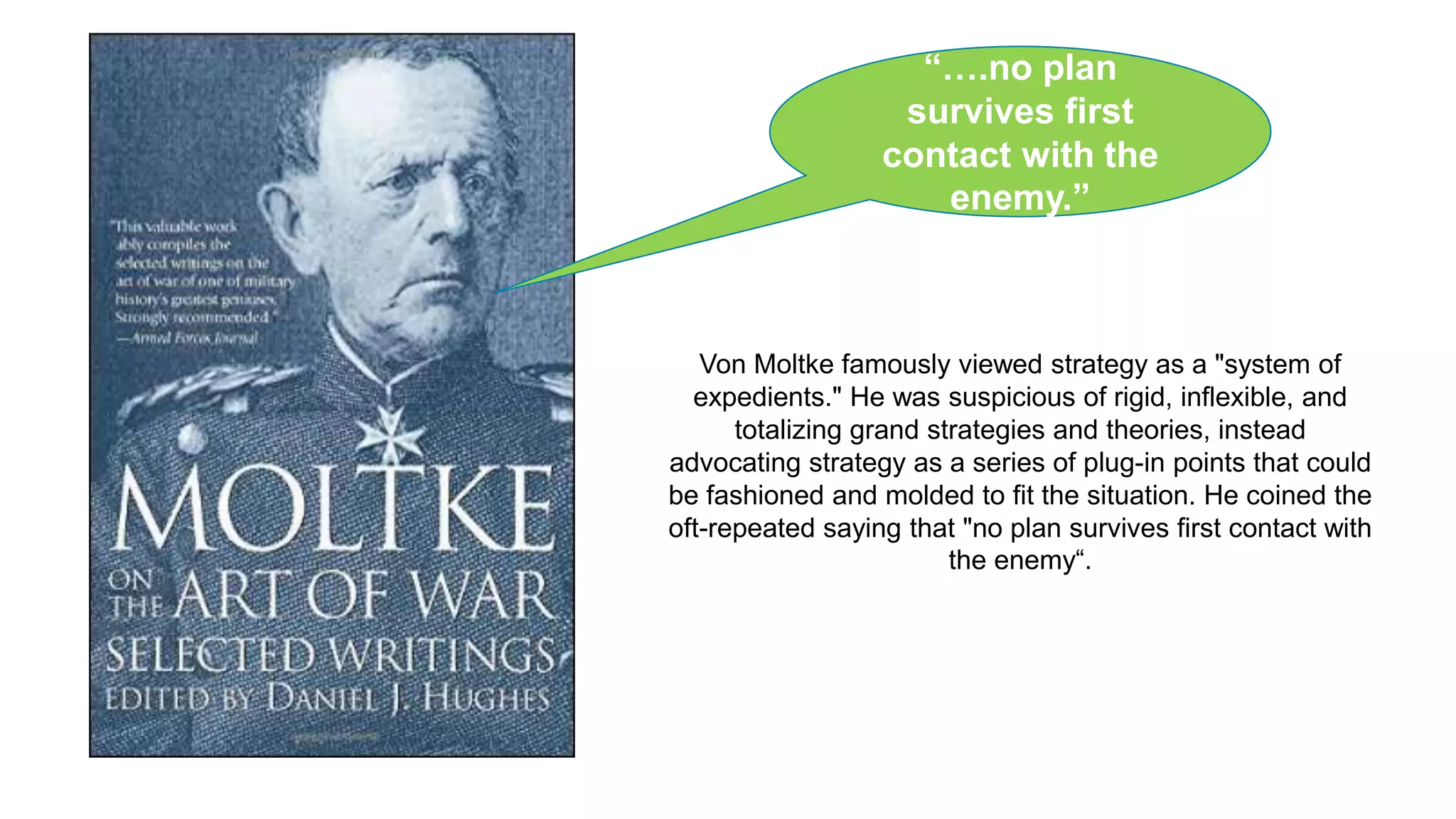
Von Moltke famously viewed strategy as a "system of
expedients." He was suspicious of rigid, inflexible, and
totalizing grand strategies and theories, instead
advocating strategy as a series of plug-in points that could
be fashioned and molded to fit the situation. He coined the
oft-repeated saying that "no plan survives first contact with
the enemy“.
“….no plan
survives first
contact with the
enemy.”
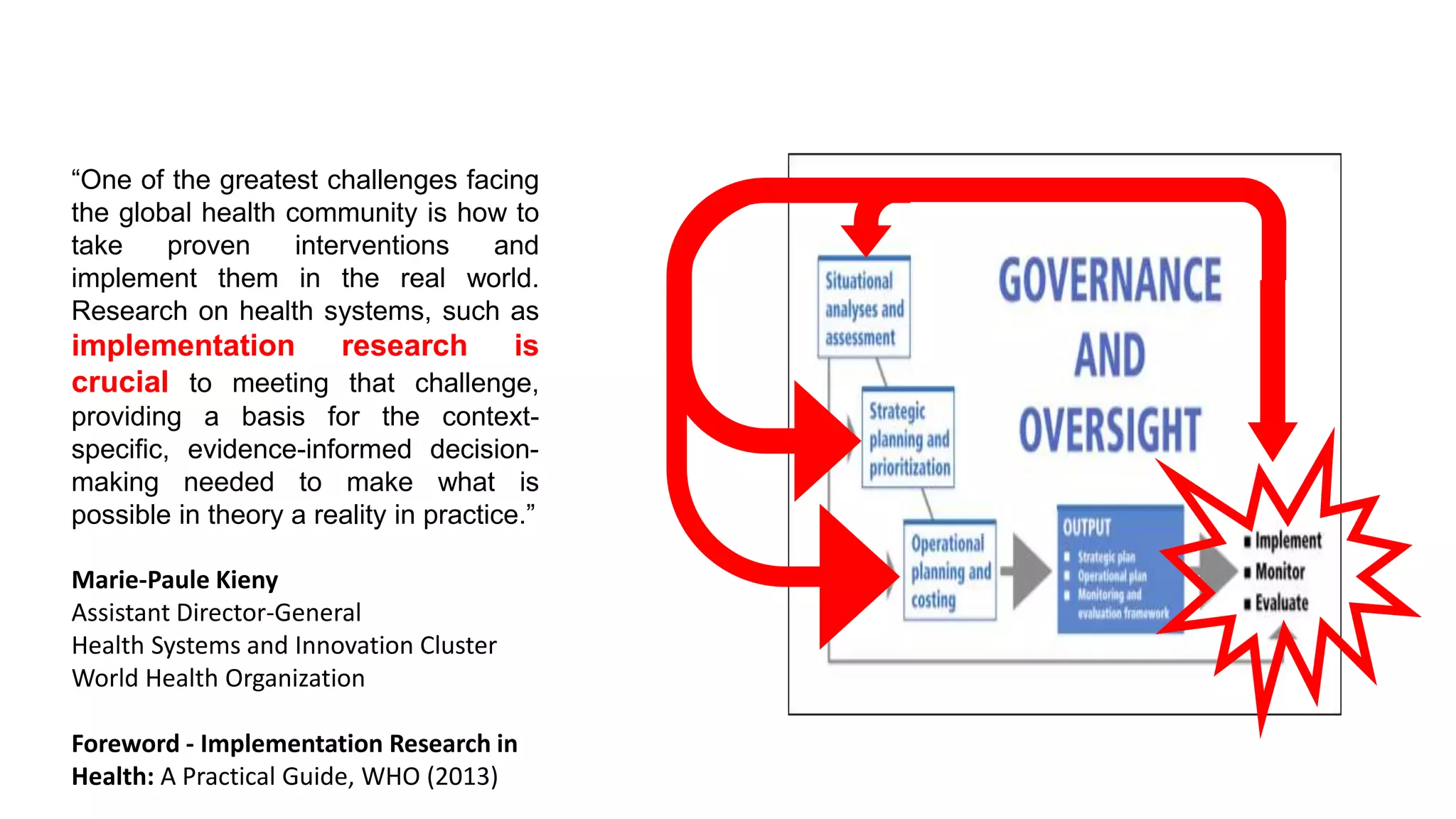
“One of the greatest challenges facing
the global health community is how to
take proven interventions and
implement them in the real world.
Research on health systems, such as
implementation research is
crucial to meeting that challenge,
providing a basis for the context-
specific, evidence-informed decision-
making needed to make what is
possible in theory a reality in practice.”
Marie-Paule Kieny
Assistant Director-General
Health Systems and Innovation Cluster
World Health Organization
Foreword - Implementation Research in
Health: A Practical Guide, WHO (2013)
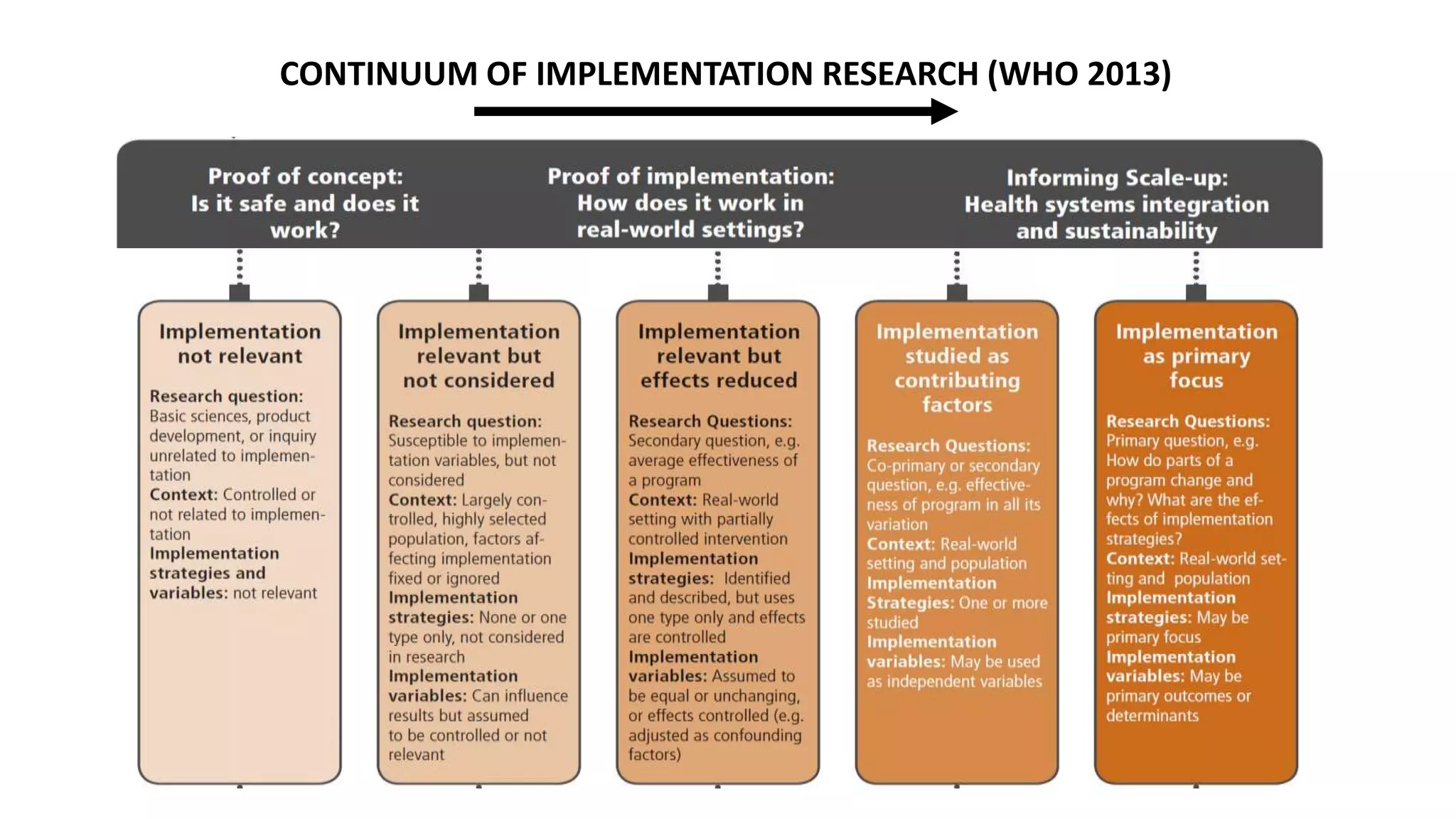
CONTINUUM OF IMPLEMENTATION RESEARCH (WHO 2013)
Relevance of Implementation Research to the AMR
Challenge and the ILRI Hub
• Despite growing evidence of the efficacy of numerous AMR interventions,
there is little understanding of how to deliver those interventions effectively
in diverse settings and within the wide range of existing health
systems.
• Implementation issues often arise as a result of contextual factors that
policy-makers and implementation managers have not even considered.
• Implementation research is crucial to improving our understanding of the
challenges we face in confronting the real world by broadening and
deepening our understanding of these real-world factors and how they
impact implementation.
• Implementation research is of immense value in shining a light on the
often bumpy interface between what can be achieved in theory and what
happens in practice.
Pragmatic approach – implementation research with existing mechanisms
and considerations for tackling AMR at the country level
26
Financing
options
National Action Plans
Understanding what works in a
given context, enablers and
barriers
Situation
analysis,
system
bottlenecks,
and blending of
AMR-sensitive
and AMR-
specific
interventions
AMR-sensitive and AMR-
specific interventions aimed
at:
1. maintaining an enabling
environment for AMR
control;
2. reducing the need for
antimicrobial usage; and
3. self-limiting the use of
antimicrobials.
Finally, important knowledge gaps and challenges that are consistent
across countries…
27
• Big gaps in understanding real world implementation processes and options
• Heavy focus on use of antimicrobials as a driver of AMR emergence - whilst AMR
spread and related risk factors relatively unresearched
• Impacts of AMR-specific interventions have been modelled but very little
evidence for estimating co-benefits of AMR-sensitive interventions
• An “AMR resilience and preparedness index” combining drivers for emergence
and spread of AMR might enable measurement of progress in a country’s
capacity to mitigate risks relating to AMR
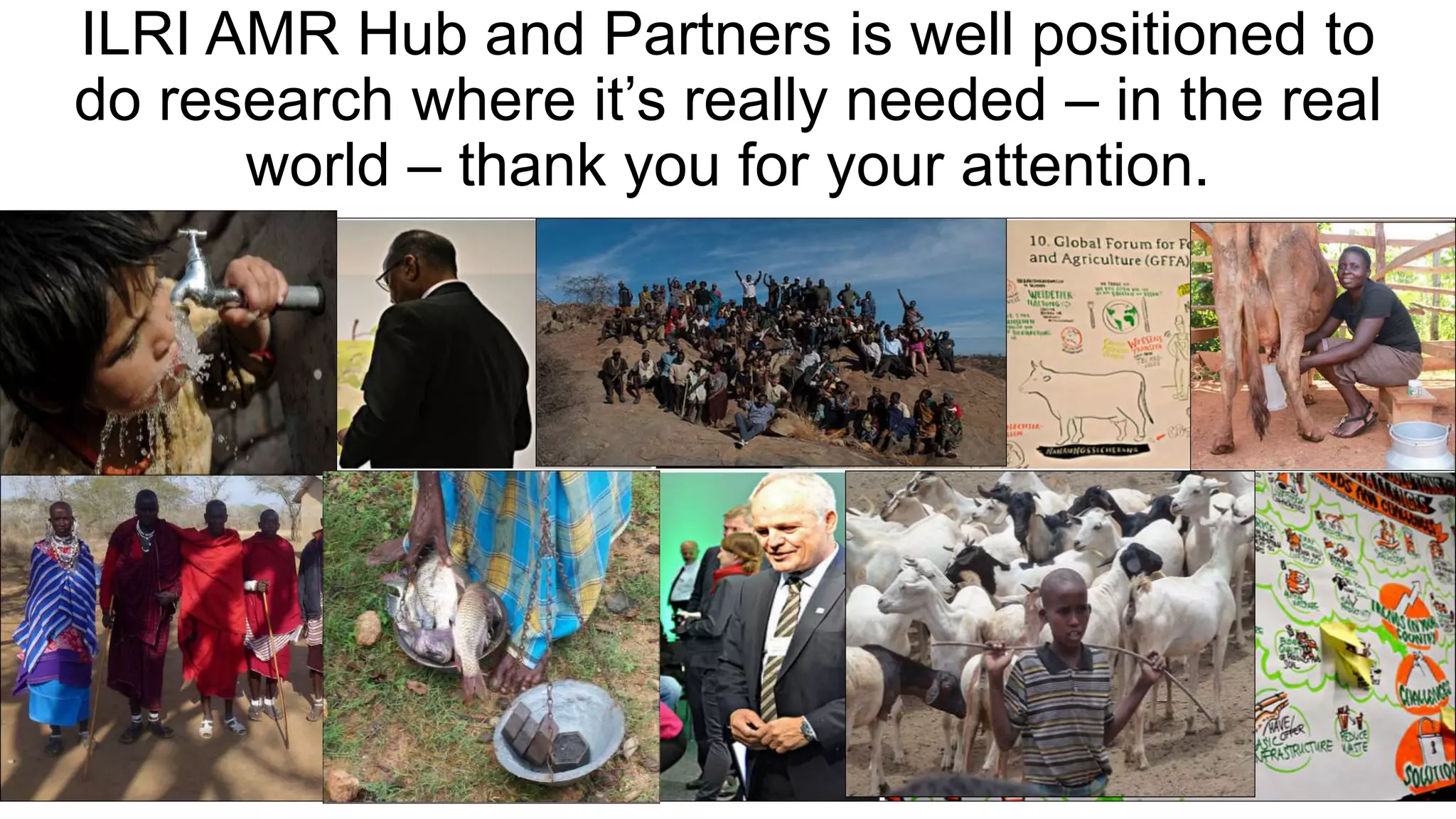
ILRI AMR Hub and Partners is well positioned to
do research where it’s really needed – in the real
world – thank you for your attention.

Pulling together to beat superbugs

  • 1.
    Pulling Together to beatsuperbugs Jonathan Wadsworth Franck Berthe World Bank Group CGIAR Antimicrobial Resistance hub launching, ILRI Nairobi, 21-22 February 2019
  • 2.
    Human Cost ofAMR – Lives Lost Economic Cost – Global GDP Lost TACKLING DRUG-RESISTANT INFECTIONS GLOBALLY: FINAL REPORT AND RECOMMENDATIONS THE REVIEW ON ANTIMICROBIAL RESISTANCE CHAIRED BY JIM O’NEILL MAY 2016
  • 3.
    Cumulative savings ofextra health care costs to 2030 are $4 trillion if “low-AMR” case is avoided and $11 trillion if “high-AMR” case is avoided​ US $ Trillions 2016-30 10 5 Implementation cost Costs Avoided High AMR Scenario Costs Avoided Low AMR Scenario
  • 4.
    SPOT QUIZ: HOWMUCH DOES THIS 10-DAY COURSE OF ANTIBIOTIC COST IN USA?
  • 5.
    Similar scale effectto financial crisis of 2008 – but AMR will be continuous. Not a “one-off” event.
  • 6.
    Reframing AMR notjust as a public health or agricultural problem, but as an adaptive development challenge (problem of development) 6 An adaptive development challenge • AMR is a development challenge that will disproportionately affect low- and middle- income countries from an economic and social perspective • AMR will negatively affect some SDGs; on the other hand – progress on some SDGs will help combating AMR
  • 7.
    …….. after some“jagged” thinking we identified a set of principles to guide our approach….. 7 Principles of our approach Focus on behavioral and political economy issues over technical, scientific approachesFocus on country level actions and options Aim to reach a broad audience, beyond those conversant in AMR Focus on knowledge and implementation gaps Not making assumptions about new financing but focusing on smarter financing
  • 8.
    Anthropological and socioeconomicfactors contributing to global antimicrobial resistance: a univariate and multivariable analysis. (Collignon et al. 2018, Lancet Planetary Health) AGGREGATE RESISTANCE INFRASTRUCTURE CORRUPTION AND GOVERNANCE LOW SEVERITY HIGH SEVERITY Better infrastructure and governance significantly associated with lower AMR – but not antibiotic consumption. Reducing antibiotic consumption will not be sufficient to control antimicrobial resistance because contagion (spread of resistant strains) seems to be dominant factor. Better sanitation, access to clean water, good governance, and increasing public health-care expenditure all need to be addressed to reduce global AMR.
  • 9.
    Seeking to articulatethe importance of context in relation to AMR 9 Recognizing the importance of context and the distinction between emergence and spread • AMR is often understood in terms of use [mis- and over- use] of antimicrobials; however, limiting consumption of antimicrobials will not be sufficient to control AMR. • Context, determined by anthropological and socioeconomic factors, is critical to understanding the spread of resistance determinants. • The use of antimicrobials has a bearing on emergence of AMR, but the spread -sometimes referred to as contagion- is driven by context. • We need to address the underlying weaknesses of systems to be able to address AMR; hence the need for alignment of the AMR and Sustainable Development agendas. • AMR specific plus AMR sensitive investments.
  • 10.
    Exploring three broadtensions: the way we think about antimicrobials, the way we use them and external factors – as infrastructure of modernity 10 A challenge associated with knowledge, attitudes and behavior • Human behavior is about what people know and the views they take of things. • AMR is a behavioral and adaptive challenge, that requires both technical and adaptive approaches. • It is growing not because of the absence of new antimicrobials but because of the way antimicrobials have become entrenched into our social, cultural, political and economic lives. The way we think antimicrobials The way we use them External factors influencing the system
  • 11.
    Antibiotic resistance policyloops (after Homer et al 2000) EDUCATION HEALTH SERVICE BUDGETS LEGISLATION REGULATION CONTAGION CYCLE R & D FUNDING PUBLIC BELIEFS AB ACCESS CONTROL SURVEILLANCEABR EMERGENCE CYCLE SELF DIAGNOSIS
  • 13.
    Effect of GDPper capita on antimicrobial consumption (human health) Source: Authors
  • 14.
    Describing typologies ofcountries, in terms of AMR risk 14 Type A Type B Type C Type D Level of economic development Low income Low & lower- middle income Upper-middle & high income Upper-middle & high income Antimicrobial use Low High High Low Exposure to other contextual risk factors High High Medium Low Expected level of AMR Medium High Medium/High Low Lower- and Middle-income countries have the most dangerous combination of risk factors for emergence and spread of antimicrobial resistance While the theoretical curve [above] exposes a historical transition process for countries from type A to D, the global action on AMR is expected to offer avenues for new trajectories towards type D. Type A Type B Type C Type D
  • 15.
    Typologies could helpto understand how best to channel resources and build effective interventions 15 Type A Type B Type C Type D Status of the AMR agenda AMR agenda focused on access to quality services and quality of medicinal products, strengthening of basic public and animal health systems, education on hygiene and infection prevention AMR agenda focused on responsible and prudent use of antimicrobials, further basic health system strengthening and capacity building, piloting new programs, establish baselines through surveillance and monitoring, continued efforts in education on hygiene and infection prevention Building strong political and societal consensus on addressing AMR, scaling up of pilot programs, monitoring and surveillance, complete policy and regulation reforms, mass awareness campaigns Mature public and animal health systems, regular light- touch AMR interventions and programs, continuous adjustments needed to respond new risks, maintained awareness, continued surveillance Status of AMU and AMR Low use of antimicrobials, lack of access to quality medicinal products, basic systems and services failed Increasing use of antimicrobials with increasing revenues and consumption, under-performing systems and services, AMR is slowly emerging as an issue in the civil society Systems still struggling to manage the rise of antimicrobial demand and use, AMR is on the rise and high on the civil society agenda, outcomes of surveillance and monitoring will raise public concern over AMR Achievements in reducing use of antimicrobials, AMR remains a concern but citizen trust restored in the system, established capacity to detect emergence of new resistance determinant Country type (GDP) Low-income Low and lower Middle-income Upper middle and high income Upper middle and high income Returns to AMR-sensitive interventions are highest in low- and middle-income countries
  • 16.
  • 17.
    WICKED PROBLEMS: • Aredifficult to clearly define – cannot first understand and then solve. • Multi-causal with many interdependencies. • Unforeseen consequences of addressing them. • Solutions are not right or wrong – they are better-worse; good enough-not good enough. • Are socially complex, context matters, making each one unique • Responsibility of multiple organizations • Solutions involve changes in behavior • Often characterized by chronic policy failure
  • 18.
    Traditional wisdom forsolving complex problems: the ‘waterfall’ Tame problems
  • 19.
    Opportunity-driven problem solving: the“jagged line of learning” Wicked problems
  • 21.
  • 22.
    Von Moltke famouslyviewed strategy as a "system of expedients." He was suspicious of rigid, inflexible, and totalizing grand strategies and theories, instead advocating strategy as a series of plug-in points that could be fashioned and molded to fit the situation. He coined the oft-repeated saying that "no plan survives first contact with the enemy“. “….no plan survives first contact with the enemy.”
  • 23.
    “One of thegreatest challenges facing the global health community is how to take proven interventions and implement them in the real world. Research on health systems, such as implementation research is crucial to meeting that challenge, providing a basis for the context- specific, evidence-informed decision- making needed to make what is possible in theory a reality in practice.” Marie-Paule Kieny Assistant Director-General Health Systems and Innovation Cluster World Health Organization Foreword - Implementation Research in Health: A Practical Guide, WHO (2013)
  • 24.
    CONTINUUM OF IMPLEMENTATIONRESEARCH (WHO 2013)
  • 25.
    Relevance of ImplementationResearch to the AMR Challenge and the ILRI Hub • Despite growing evidence of the efficacy of numerous AMR interventions, there is little understanding of how to deliver those interventions effectively in diverse settings and within the wide range of existing health systems. • Implementation issues often arise as a result of contextual factors that policy-makers and implementation managers have not even considered. • Implementation research is crucial to improving our understanding of the challenges we face in confronting the real world by broadening and deepening our understanding of these real-world factors and how they impact implementation. • Implementation research is of immense value in shining a light on the often bumpy interface between what can be achieved in theory and what happens in practice.
  • 26.
    Pragmatic approach –implementation research with existing mechanisms and considerations for tackling AMR at the country level 26 Financing options National Action Plans Understanding what works in a given context, enablers and barriers Situation analysis, system bottlenecks, and blending of AMR-sensitive and AMR- specific interventions AMR-sensitive and AMR- specific interventions aimed at: 1. maintaining an enabling environment for AMR control; 2. reducing the need for antimicrobial usage; and 3. self-limiting the use of antimicrobials.
  • 27.
    Finally, important knowledgegaps and challenges that are consistent across countries… 27 • Big gaps in understanding real world implementation processes and options • Heavy focus on use of antimicrobials as a driver of AMR emergence - whilst AMR spread and related risk factors relatively unresearched • Impacts of AMR-specific interventions have been modelled but very little evidence for estimating co-benefits of AMR-sensitive interventions • An “AMR resilience and preparedness index” combining drivers for emergence and spread of AMR might enable measurement of progress in a country’s capacity to mitigate risks relating to AMR
  • 28.
    ILRI AMR Huband Partners is well positioned to do research where it’s really needed – in the real world – thank you for your attention.

Editor's Notes