AMOEBIAS
IS
PRESENTED BY: KEAN G. AGAPITO, RN
AMOEBIASIS
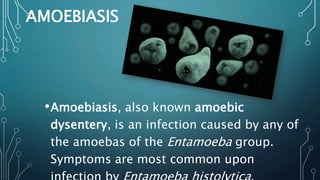
•Amoebiasis, also known amoebic
dysentery, is an infection caused by any of
the amoebas of the Entamoeba group.
Symptoms are most common upon
CAUSATIVE AGENT
Entamoeba histolytica
INCUBATION
PERIOD
•3 days in severe
infection; several
months in sub-
acute and chronic
form. In average
case vary from 3-4
weeks.
PERIOD OF
COMMUNICABILITY
For duration of
the illness.
MODE OF TRANSMISSION
FECAL-ORAL ROUTE
•CONTAMINATED WATER AND FOOD
•DIRECT HAND TO MOUTH
SIGNS AND
SYMPTOMS
•Abdominal cramps
•Diarrhea: passage of 3-8 semi-
formed stool per day or passage
of soft stool with mucus and
occasional blood
•Fatigue
•Excessive gas
•Tenesmus
DIAGNOSIS
Stool exam
Light microscopy:
•Examination of a fresh stool smear for
trophozoites that contain ingested RBCs.
•Routine microscopy cannot distinguish the E
dispar (nonpathogenic amebae) from E
histolytica.
IMAGING
STUDIES
Chest radiography : -
•elevated right hemidiaphragm and a
right-sided pleural effusion in patients
with amebic liver abscess.
•Ultrasonography (amoebic liver abscess
)
•cerebral amoebiasis, CT shows irregular
lesions without a surrounding capsule
OTHER
TESTS
Liver function tests :
•elevated alkaline phosphatase levels (in
80% of patients),
•elevated transaminase levels,
•mild elevation of serum bilirubin level,
•Erythrocyte sedimentation rate is
elevated.
TREATMENT
•Metronidazole (Flagyl, Protostat )
• Kills trophozoites of E histolytica in intestine and tissue. Does not
eradicate cysts from intestines.
• Adult
• Intestinal amebiasis:
PO: 500-750 mg PO TID for 5-10 days
IV: 500 mg IV q6h for 5-10 days
Amebic liver abscess: 500 mg IV q6h for 10 d
• Pediatric
• 35-50 mg/kg/d PO/IV divided q8h for 10 d
TREATMENT
•Iodoquinol (Yodoxin)
•Halogenated hydroxyquinoline. Luminal
amebicide; acts primarily in bowel
lumen because it is poorly absorbed, it
is used to eradicate cysts of E histolytica
after treatment of invasive disease.
TREATMEN
T
•Chloroquine phosphate (Aralen)
•Inhibits growth by concentrating within acid
vesicles of parasite, which increases internal
pH of organism. Also inhibits hemoglobin
utilization and metabolism of parasite. In
vitro studies with trophozoites of E
histolytica demonstrate that chloroquine
possesses amebicidal activity.
• Highly effective in treatment of amebic liver
abscess when administered with emetine or
PREVENTION
• Sanitation –
Safe excretion of human excreta,
good sanitary practice like handwashing.
• Water supply-
Water filtration, boiling
• Food hygiene –
prevent fecal contamination of food
and drink,
• Heath education –
food handlers and public
THANK YOU! 

Amoebiasis report