Model Transformation
A Personal Perspective
Edward D. Willink
ed@willink.me.uk
GMT Consortium
www.eclipse.org
also Thales Research and Technology (UK)
edwillink@iee.org
AMMA 2006
3 May 2006 Model Transformation - A Personal Perspective 2
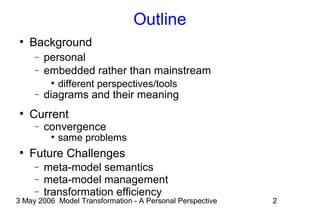
Outline
●
Background
− personal
− embedded rather than mainstream
●
different perspectives/tools
− diagrams and their meaning
●
Current
− convergence
●
same problems
●
Future Challenges
− meta-model semantics
− meta-model management
− transformation efficiency
3 May 2006 Model Transformation - A Personal Perspective 3
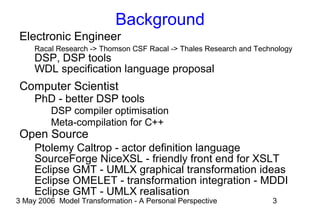
Background
Electronic Engineer
Racal Research -> Thomson CSF Racal -> Thales Research and Technology
DSP, DSP tools
WDL specification language proposal
Computer Scientist
PhD - better DSP tools
DSP compiler optimisation
Meta-compilation for C++
Open Source
Ptolemy Caltrop - actor definition language
SourceForge NiceXSL - friendly front end for XSLT
Eclipse GMT - UMLX graphical transformation ideas
Eclipse OMELET - transformation integration - MDDI
Eclipse GMT - UMLX realisation
3 May 2006 Model Transformation - A Personal Perspective 4
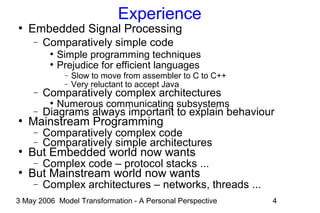
Experience
●
Embedded Signal Processing
− Comparatively simple code
●
Simple programming techniques
●
Prejudice for efficient languages
− Slow to move from assembler to C to C++
− Very reluctant to accept Java
− Comparatively complex architectures
●
Numerous communicating subsystems
− Diagrams always important to explain behaviour
●
Mainstream Programming
− Comparatively complex code
− Comparatively simple architectures
●
But Embedded world now wants
− Complex code – protocol stacks ...
●
But Mainstream world now wants
− Complex architectures – networks, threads ...
3 May 2006 Model Transformation - A Personal Perspective 5
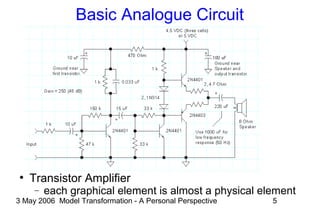
Basic Analogue Circuit
●
Transistor Amplifier
− each graphical element is almost a physical element
3 May 2006 Model Transformation - A Personal Perspective 6
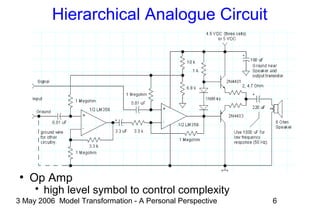
Hierarchical Analogue Circuit
●
Op Amp
 high level symbol to control complexity
3 May 2006 Model Transformation - A Personal Perspective 7
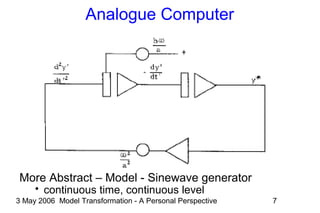
Analogue Computer
More Abstract – Model - Sinewave generator
 continuous time, continuous level
3 May 2006 Model Transformation - A Personal Perspective 8
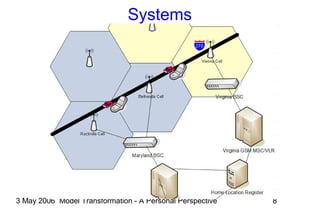
Systems
3 May 2006 Model Transformation - A Personal Perspective 9
Block Diagrams
●
Low, medium or high level
●
Friendly
 Convey an apparently simple meaning
 Open to review
●
Each element
 Independent
 continuously operating
3 May 2006 Model Transformation - A Personal Perspective 10
Continuous Time
appropriate model for
− audio, radio, ... continuous signals
inappropriate model for
− sporadic events
− push buttons
− GUI interactions
− power failures
− interrupts
− protocol messages
− video, ... sampled signals
dedicated resource
− always processing
− 'infinite' power processing element
3 May 2006 Model Transformation - A Personal Perspective 11
Discrete Time
●
shared resource
− process occasionally
− finite processing element
●
discrete time suitable for digital computers
− predictable, reliable, ...
●
continuous time impossible on digital computers
− create an illusion of continuous time
●
high enough sample rate (Nyquist)
●
Two practical forms of discrete time
− sporadic events/messages
●
state machines/protocols
− regular samples/tokens
●
Digital Signal Processing
3 May 2006 Model Transformation - A Personal Perspective 12
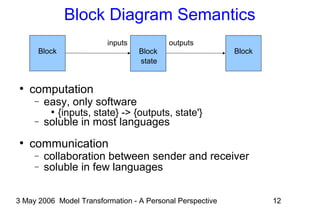
Block Diagram Semantics
●
computation
− easy, only software
●
{inputs, state} -> {outputs, state'}
− soluble in most languages
●
communication
− collaboration between sender and receiver
− soluble in few languages
Block Block Block
inputs outputs
state
3 May 2006 Model Transformation - A Personal Perspective 13
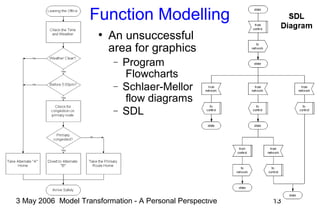
Function Modelling
●
An unsuccessful
area for graphics
− Program
Flowcharts
− Schlaer-Mellor
flow diagrams
− SDL
3 May 2006 Model Transformation - A Personal Perspective 14
Transformations as Program Steps
●
Generic state-based transaction
state state'
Mx
inputs outputs
state state'
inputs[constraint]/outputs
3 May 2006 Model Transformation - A Personal Perspective 15
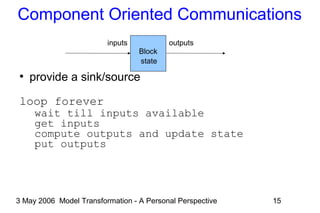
Component Oriented Communications
●
provide a sink/source
loop forever
wait till inputs available
get inputs
compute outputs and update state
put outputs
Block
inputs outputs
state
3 May 2006 Model Transformation - A Personal Perspective 16
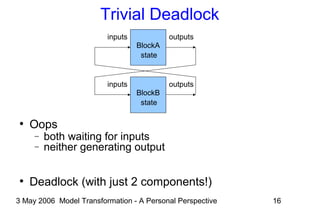
Trivial Deadlock
●
Oops
− both waiting for inputs
− neither generating output
●
Deadlock (with just 2 components!)
BlockA
inputs outputs
state
BlockB
inputs outputs
state
3 May 2006 Model Transformation - A Personal Perspective 17
System Oriented Communications
●
Component Oriented Communications (One Ended)
− system utility is not my problem
− deadlocks, livelocks are your problem
− difficult/intractable analysis
− component is not (re-)usable
●
System Oriented Communications (Two Ended)
− communication policy carefully chosen
●
suitable communication rates
●
suitable communication resources/bandwidths/routes
●
compliant sources and sinks on each end
− tractable synthesis
●
?? cf. Service Oriented Architectures ??
3 May 2006 Model Transformation - A Personal Perspective 18
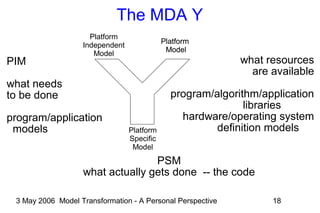
The MDA Y
PSM
what actually gets done -- the code
Platform
Independent
Model
Platform
Specific
Model
Platform
Model
Platform
Model
PIM
what needs
to be done
program/application
models
what resources
are available
program/algorithm/application
libraries
hardware/operating system
definition models
3 May 2006 Model Transformation - A Personal Perspective 19
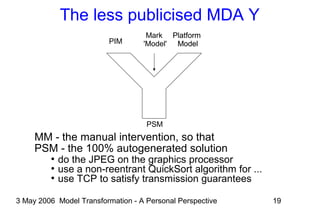
The less publicised MDA Y
MM - the manual intervention, so that
PSM - the 100% autogenerated solution
●
do the JPEG on the graphics processor
●
use a non-reentrant QuickSort algorithm for ...
●
use TCP to satisfy transmission guarantees
PIM
PSM
Platform
Model
Platform
Model
Mark
'Model'
3 May 2006 Model Transformation - A Personal Perspective 20
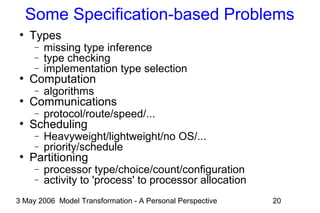
Some Specification-based Problems
●
Types
− missing type inference
− type checking
− implementation type selection
●
Computation
− algorithms
●
Communications
− protocol/route/speed/...
●
Scheduling
− Heavyweight/lightweight/no OS/...
− priority/schedule
●
Partitioning
− processor type/choice/count/configuration
− activity to 'process' to processor allocation
3 May 2006 Model Transformation - A Personal Perspective 21
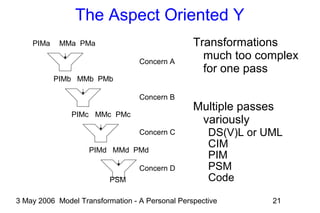
The Aspect Oriented Y
Transformations
much too complex
for one pass
Multiple passes
variously
DS(V)L or UML
CIM
PIM
PSM
Code
PIMa PMaMMa
Concern A
PIMb PMbMMb
Concern B
PIMc PMcMMc
Concern C
PIMd PMdMMd
Concern D
PSM
3 May 2006 Model Transformation - A Personal Perspective 22
Transformations Everywhere
[... from requirements
via vague specification
to executable specification]
●
Hundreds of transformations from:
− executable specification to implementation (code)
●
Code to executable
− currently hidden inside compilers
− could be exposed as hundreds of transformations
●
could then be customised for special purposes
●
could be optimised one transformation at a time
3 May 2006 Model Transformation - A Personal Perspective 23
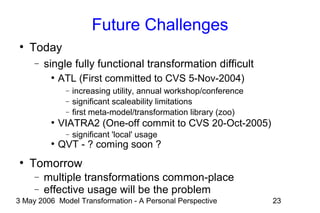
Future Challenges
●
Today
− single fully functional transformation difficult
●
ATL (First committed to CVS 5-Nov-2004)
− increasing utility, annual workshop/conference
− significant scaleability limitations
− first meta-model/transformation library (zoo)
●
VIATRA2 (One-off commit to CVS 20-Oct-2005)
− significant 'local' usage
●
QVT - ? coming soon ?
●
Tomorrow
− multiple transformations common-place
− effective usage will be the problem
3 May 2006 Model Transformation - A Personal Perspective 24
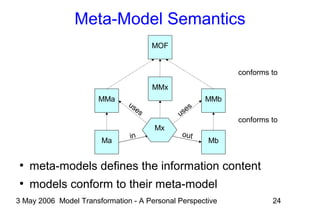
●
meta-models defines the information content
●
models conform to their meta-model
Meta-Model Semantics
Ma Mb
MMa MMb
MMx
in out
usesuses
conforms to
conforms to
MOF
Mx
3 May 2006 Model Transformation - A Personal Perspective 25
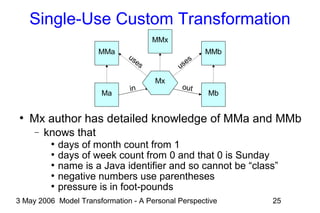
●
Mx author has detailed knowledge of MMa and MMb
− knows that
●
days of month count from 1
●
days of week count from 0 and that 0 is Sunday
●
name is a Java identifier and so cannot be “class”
●
negative numbers use parentheses
●
pressure is in foot-pounds
Single-Use Custom Transformation
Ma Mb
MMa MMb
MMx
in out
usesuses
Mx
3 May 2006 Model Transformation - A Personal Perspective 26
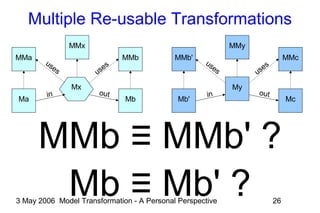
Mx
Multiple Re-usable Transformations
Ma Mb
MMa MMb
MMx
in out
usesuses
Mb' Mc
MMb' MMc
My
MMy
in out
usesuses
MMb ≡ MMb' ?
Mb ≡ Mb' ?
3 May 2006 Model Transformation - A Personal Perspective 27
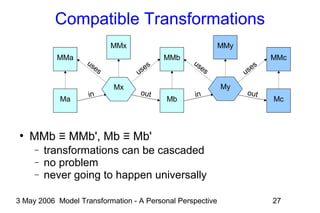
Compatible Transformations
●
MMb ≡ MMb', Mb ≡ Mb'
− transformations can be cascaded
− no problem
− never going to happen universally
Ma Mb
MMa MMb
MMx
in out
usesuses
Mc
MMc
MMy
in out
usesuses
Mx My
3 May 2006 Model Transformation - A Personal Perspective 28
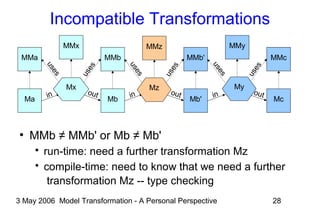
Incompatible Transformations
●
MMb ≠ MMb' or Mb ≠ Mb'
 run-time: need a further transformation Mz
 compile-time: need to know that we need a further
transformation Mz -- type checking
Ma Mb
MMa MMb
MMx
in out
uses
uses
Mb' Mc
MMb' MMc
MMy
in out
uses
uses
MMz
uses
uses
outin
Mx MyMz
3 May 2006 Model Transformation - A Personal Perspective 29
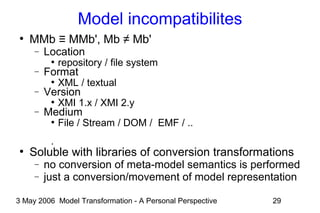
Model incompatibilites
●
MMb ≡ MMb', Mb ≠ Mb'
− Location
●
repository / file system
− Format
●
XML / textual
− Version
●
XMI 1.x / XMI 2.y
− Medium
●
File / Stream / DOM / EMF / ..
.
●
Soluble with libraries of conversion transformations
− no conversion of meta-model semantics is performed
− just a conversion/movement of model representation
3 May 2006 Model Transformation - A Personal Perspective 30
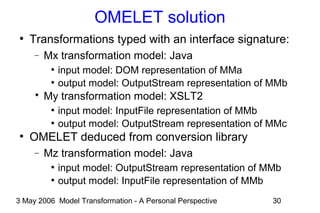
OMELET solution
●
Transformations typed with an interface signature:
− Mx transformation model: Java
●
input model: DOM representation of MMa
●
output model: OutputStream representation of MMb
 My transformation model: XSLT2
●
input model: InputFile representation of MMb
●
output model: OutputStream representation of MMc
●
OMELET deduced from conversion library
− Mz transformation model: Java
●
input model: OutputStream representation of MMb
●
output model: InputFile representation of MMb
3 May 2006 Model Transformation - A Personal Perspective 31
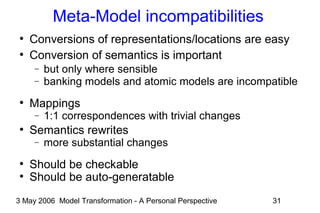
Meta-Model incompatibilities
●
Conversions of representations/locations are easy
●
Conversion of semantics is important
− but only where sensible
− banking models and atomic models are incompatible
●
Mappings
− 1:1 correspondences with trivial changes
●
Semantics rewrites
− more substantial changes
●
Should be checkable
●
Should be auto-generatable
3 May 2006 Model Transformation - A Personal Perspective 32
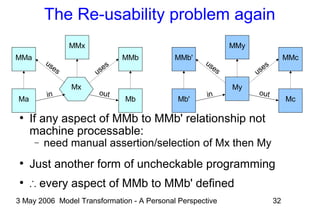
The Re-usability problem again
●
If any aspect of MMb to MMb' relationship not
machine processable:
− need manual assertion/selection of Mx then My
●
Just another form of uncheckable programming
●
∴ every aspect of MMb to MMb' defined
Mx
Ma Mb
MMa MMb
MMx
in out
usesuses
Mb' Mc
MMb' MMc
My
MMy
in out
usesuses
3 May 2006 Model Transformation - A Personal Perspective 33
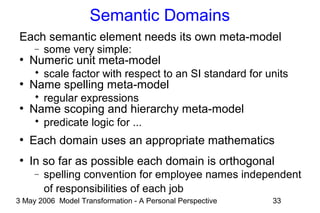
Semantic Domains
Each semantic element needs its own meta-model
− some very simple:
●
Numeric unit meta-model
 scale factor with respect to an SI standard for units
●
Name spelling meta-model
 regular expressions
●
Name scoping and hierarchy meta-model
 predicate logic for ...
●
Each domain uses an appropriate mathematics
●
In so far as possible each domain is orthogonal
− spelling convention for employee names independent
of responsibilities of each job
3 May 2006 Model Transformation - A Personal Perspective 34
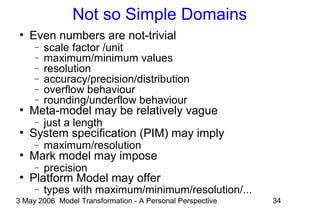
Not so Simple Domains
●
Even numbers are not-trivial
− scale factor /unit
− maximum/minimum values
− resolution
− accuracy/precision/distribution
− overflow behaviour
− rounding/underflow behaviour
●
Meta-model may be relatively vague
− just a length
●
System specification (PIM) may imply
− maximum/resolution
●
Mark model may impose
− precision
●
Platform Model may offer
− types with maximum/minimum/resolution/...
3 May 2006 Model Transformation - A Personal Perspective 35
Really not Simple Domains
●
Fowler: Analysis Patterns ...
●
Number becomes a Measurement
− what - the measurement
− who - the operator/equipment
− when - time ..
− where ...
− why - in response to request ...
− validated by ...
− ...
3 May 2006 Model Transformation - A Personal Perspective 36
Semantic Domain Resolution
●
Semantic conversions can be automated
− Fahrenheit to Centigrade
− Name mangling policy for illegal names
●
C++ identifiers in C are marginally readable
●
With a defined semantic language
− conversion transformations for each semantic
3 May 2006 Model Transformation - A Personal Perspective 37
Custom Semantics
●
Different 'enterprises' have special requirements
− banking
●
no lost fractional pennies/cents - COBOL
− security
●
no confusion of red/black data
●
data independent execution time
●
erasure of all temporary memory
●
minimised parasitic radio emissions
− integrity
●
guaranteed response time
●
guaranteed sub-system independence
− system
●
low power consumption/size/...
3 May 2006 Model Transformation - A Personal Perspective 38
Subset Semantics Requirement
●
Ideally transformations proven to be applicable
− to all possible input models
●
Pragmatically transformations may be applicable
− to many useful input models
●
For instance
− 'UML to RDBMS'
●
only applies to UML classes
●
definitely not applicable to UML use cases
●
dubiously applicable to UML inheritance
− 'UML to Java'
●
not applicable for certain class names
3 May 2006 Model Transformation - A Personal Perspective 39
Subset Semantics Solution
●
Mx is not valid for all Ma:MMa -> Mb:MMb
− is it valid for Mc:MMc where MMc ⊂ MMa ?
●
Proof of applicability
− ? semantic meta-models
●
Sub-set applicability
− can be defined by a sub-set meta-model
●
UML except {use cases ...}
●
MMc = MMa - ...
− can be defined by a constrained meta-model
●
UML except certain names to satisfy Java semantics
●
MMc = MMa ⋂ ...
− requires support for meta-model refinement
●
MOF package merge ...
●
MMc = MMa ⋃ ...
3 May 2006 Model Transformation - A Personal Perspective 40
Extensible Semantics
●
One commonality between different requirements
− all different
●
Custom tools for each requirement undesirable
− COBOL
●
Need to extend existing tools to new semantics
− not rewrite for each new semantic
3 May 2006 Model Transformation - A Personal Perspective 41
Semantic Satisfaction
●
Characterise
each semantic property for each transformation :
− each property is
●
established/destroyed/preserved/undefined
by each transformation
●
Satisfactory chain ends
− {don't care}*, establish, {preserve}*
for each required property
●
Given the source models (and meta-models)
a library of transformations
required properties
− valid transformation chain can be deduced
3 May 2006 Model Transformation - A Personal Perspective 42
Efficient composition
●
Single Transformations
− potentially inefficient
●
arbitrary pattern matching
●
amenable to pragmatic constrained approaches
●
Cascades of hundreds of transformations
− potentially very very inefficient
●
numerous intermediate models
− potentially very efficient
●
semantics/intent of declarative transformations known
●
multiple transformation 'passes' can be combined
●
Graph Transformation Theory can prove validity
− slow execution instantly
− fast execution after optimised composition
●
custom compiler
3 May 2006 Model Transformation - A Personal Perspective 43
Summary
●
Different programming worlds converging on MDA
●
Todays problems should become irrelevant
●
Tomorrows problems look interesting
− are Tx's the new programming language?
− are Tx chains deducible?
− is reusable software finally going to happen?

Model Transformation A Personal Perspective

  • 1.
    Model Transformation A PersonalPerspective Edward D. Willink ed@willink.me.uk GMT Consortium www.eclipse.org also Thales Research and Technology (UK) edwillink@iee.org AMMA 2006
  • 2.
    3 May 2006Model Transformation - A Personal Perspective 2 Outline ● Background − personal − embedded rather than mainstream ● different perspectives/tools − diagrams and their meaning ● Current − convergence ● same problems ● Future Challenges − meta-model semantics − meta-model management − transformation efficiency
  • 3.
    3 May 2006Model Transformation - A Personal Perspective 3 Background Electronic Engineer Racal Research -> Thomson CSF Racal -> Thales Research and Technology DSP, DSP tools WDL specification language proposal Computer Scientist PhD - better DSP tools DSP compiler optimisation Meta-compilation for C++ Open Source Ptolemy Caltrop - actor definition language SourceForge NiceXSL - friendly front end for XSLT Eclipse GMT - UMLX graphical transformation ideas Eclipse OMELET - transformation integration - MDDI Eclipse GMT - UMLX realisation
  • 4.
    3 May 2006Model Transformation - A Personal Perspective 4 Experience ● Embedded Signal Processing − Comparatively simple code ● Simple programming techniques ● Prejudice for efficient languages − Slow to move from assembler to C to C++ − Very reluctant to accept Java − Comparatively complex architectures ● Numerous communicating subsystems − Diagrams always important to explain behaviour ● Mainstream Programming − Comparatively complex code − Comparatively simple architectures ● But Embedded world now wants − Complex code – protocol stacks ... ● But Mainstream world now wants − Complex architectures – networks, threads ...
  • 5.
    3 May 2006Model Transformation - A Personal Perspective 5 Basic Analogue Circuit ● Transistor Amplifier − each graphical element is almost a physical element
  • 6.
    3 May 2006Model Transformation - A Personal Perspective 6 Hierarchical Analogue Circuit ● Op Amp  high level symbol to control complexity
  • 7.
    3 May 2006Model Transformation - A Personal Perspective 7 Analogue Computer More Abstract – Model - Sinewave generator  continuous time, continuous level
  • 8.
    3 May 2006Model Transformation - A Personal Perspective 8 Systems
  • 9.
    3 May 2006Model Transformation - A Personal Perspective 9 Block Diagrams ● Low, medium or high level ● Friendly  Convey an apparently simple meaning  Open to review ● Each element  Independent  continuously operating
  • 10.
    3 May 2006Model Transformation - A Personal Perspective 10 Continuous Time appropriate model for − audio, radio, ... continuous signals inappropriate model for − sporadic events − push buttons − GUI interactions − power failures − interrupts − protocol messages − video, ... sampled signals dedicated resource − always processing − 'infinite' power processing element
  • 11.
    3 May 2006Model Transformation - A Personal Perspective 11 Discrete Time ● shared resource − process occasionally − finite processing element ● discrete time suitable for digital computers − predictable, reliable, ... ● continuous time impossible on digital computers − create an illusion of continuous time ● high enough sample rate (Nyquist) ● Two practical forms of discrete time − sporadic events/messages ● state machines/protocols − regular samples/tokens ● Digital Signal Processing
  • 12.
    3 May 2006Model Transformation - A Personal Perspective 12 Block Diagram Semantics ● computation − easy, only software ● {inputs, state} -> {outputs, state'} − soluble in most languages ● communication − collaboration between sender and receiver − soluble in few languages Block Block Block inputs outputs state
  • 13.
    3 May 2006Model Transformation - A Personal Perspective 13 Function Modelling ● An unsuccessful area for graphics − Program Flowcharts − Schlaer-Mellor flow diagrams − SDL
  • 14.
    3 May 2006Model Transformation - A Personal Perspective 14 Transformations as Program Steps ● Generic state-based transaction state state' Mx inputs outputs state state' inputs[constraint]/outputs
  • 15.
    3 May 2006Model Transformation - A Personal Perspective 15 Component Oriented Communications ● provide a sink/source loop forever wait till inputs available get inputs compute outputs and update state put outputs Block inputs outputs state
  • 16.
    3 May 2006Model Transformation - A Personal Perspective 16 Trivial Deadlock ● Oops − both waiting for inputs − neither generating output ● Deadlock (with just 2 components!) BlockA inputs outputs state BlockB inputs outputs state
  • 17.
    3 May 2006Model Transformation - A Personal Perspective 17 System Oriented Communications ● Component Oriented Communications (One Ended) − system utility is not my problem − deadlocks, livelocks are your problem − difficult/intractable analysis − component is not (re-)usable ● System Oriented Communications (Two Ended) − communication policy carefully chosen ● suitable communication rates ● suitable communication resources/bandwidths/routes ● compliant sources and sinks on each end − tractable synthesis ● ?? cf. Service Oriented Architectures ??
  • 18.
    3 May 2006Model Transformation - A Personal Perspective 18 The MDA Y PSM what actually gets done -- the code Platform Independent Model Platform Specific Model Platform Model Platform Model PIM what needs to be done program/application models what resources are available program/algorithm/application libraries hardware/operating system definition models
  • 19.
    3 May 2006Model Transformation - A Personal Perspective 19 The less publicised MDA Y MM - the manual intervention, so that PSM - the 100% autogenerated solution ● do the JPEG on the graphics processor ● use a non-reentrant QuickSort algorithm for ... ● use TCP to satisfy transmission guarantees PIM PSM Platform Model Platform Model Mark 'Model'
  • 20.
    3 May 2006Model Transformation - A Personal Perspective 20 Some Specification-based Problems ● Types − missing type inference − type checking − implementation type selection ● Computation − algorithms ● Communications − protocol/route/speed/... ● Scheduling − Heavyweight/lightweight/no OS/... − priority/schedule ● Partitioning − processor type/choice/count/configuration − activity to 'process' to processor allocation
  • 21.
    3 May 2006Model Transformation - A Personal Perspective 21 The Aspect Oriented Y Transformations much too complex for one pass Multiple passes variously DS(V)L or UML CIM PIM PSM Code PIMa PMaMMa Concern A PIMb PMbMMb Concern B PIMc PMcMMc Concern C PIMd PMdMMd Concern D PSM
  • 22.
    3 May 2006Model Transformation - A Personal Perspective 22 Transformations Everywhere [... from requirements via vague specification to executable specification] ● Hundreds of transformations from: − executable specification to implementation (code) ● Code to executable − currently hidden inside compilers − could be exposed as hundreds of transformations ● could then be customised for special purposes ● could be optimised one transformation at a time
  • 23.
    3 May 2006Model Transformation - A Personal Perspective 23 Future Challenges ● Today − single fully functional transformation difficult ● ATL (First committed to CVS 5-Nov-2004) − increasing utility, annual workshop/conference − significant scaleability limitations − first meta-model/transformation library (zoo) ● VIATRA2 (One-off commit to CVS 20-Oct-2005) − significant 'local' usage ● QVT - ? coming soon ? ● Tomorrow − multiple transformations common-place − effective usage will be the problem
  • 24.
    3 May 2006Model Transformation - A Personal Perspective 24 ● meta-models defines the information content ● models conform to their meta-model Meta-Model Semantics Ma Mb MMa MMb MMx in out usesuses conforms to conforms to MOF Mx
  • 25.
    3 May 2006Model Transformation - A Personal Perspective 25 ● Mx author has detailed knowledge of MMa and MMb − knows that ● days of month count from 1 ● days of week count from 0 and that 0 is Sunday ● name is a Java identifier and so cannot be “class” ● negative numbers use parentheses ● pressure is in foot-pounds Single-Use Custom Transformation Ma Mb MMa MMb MMx in out usesuses Mx
  • 26.
    3 May 2006Model Transformation - A Personal Perspective 26 Mx Multiple Re-usable Transformations Ma Mb MMa MMb MMx in out usesuses Mb' Mc MMb' MMc My MMy in out usesuses MMb ≡ MMb' ? Mb ≡ Mb' ?
  • 27.
    3 May 2006Model Transformation - A Personal Perspective 27 Compatible Transformations ● MMb ≡ MMb', Mb ≡ Mb' − transformations can be cascaded − no problem − never going to happen universally Ma Mb MMa MMb MMx in out usesuses Mc MMc MMy in out usesuses Mx My
  • 28.
    3 May 2006Model Transformation - A Personal Perspective 28 Incompatible Transformations ● MMb ≠ MMb' or Mb ≠ Mb'  run-time: need a further transformation Mz  compile-time: need to know that we need a further transformation Mz -- type checking Ma Mb MMa MMb MMx in out uses uses Mb' Mc MMb' MMc MMy in out uses uses MMz uses uses outin Mx MyMz
  • 29.
    3 May 2006Model Transformation - A Personal Perspective 29 Model incompatibilites ● MMb ≡ MMb', Mb ≠ Mb' − Location ● repository / file system − Format ● XML / textual − Version ● XMI 1.x / XMI 2.y − Medium ● File / Stream / DOM / EMF / .. . ● Soluble with libraries of conversion transformations − no conversion of meta-model semantics is performed − just a conversion/movement of model representation
  • 30.
    3 May 2006Model Transformation - A Personal Perspective 30 OMELET solution ● Transformations typed with an interface signature: − Mx transformation model: Java ● input model: DOM representation of MMa ● output model: OutputStream representation of MMb  My transformation model: XSLT2 ● input model: InputFile representation of MMb ● output model: OutputStream representation of MMc ● OMELET deduced from conversion library − Mz transformation model: Java ● input model: OutputStream representation of MMb ● output model: InputFile representation of MMb
  • 31.
    3 May 2006Model Transformation - A Personal Perspective 31 Meta-Model incompatibilities ● Conversions of representations/locations are easy ● Conversion of semantics is important − but only where sensible − banking models and atomic models are incompatible ● Mappings − 1:1 correspondences with trivial changes ● Semantics rewrites − more substantial changes ● Should be checkable ● Should be auto-generatable
  • 32.
    3 May 2006Model Transformation - A Personal Perspective 32 The Re-usability problem again ● If any aspect of MMb to MMb' relationship not machine processable: − need manual assertion/selection of Mx then My ● Just another form of uncheckable programming ● ∴ every aspect of MMb to MMb' defined Mx Ma Mb MMa MMb MMx in out usesuses Mb' Mc MMb' MMc My MMy in out usesuses
  • 33.
    3 May 2006Model Transformation - A Personal Perspective 33 Semantic Domains Each semantic element needs its own meta-model − some very simple: ● Numeric unit meta-model  scale factor with respect to an SI standard for units ● Name spelling meta-model  regular expressions ● Name scoping and hierarchy meta-model  predicate logic for ... ● Each domain uses an appropriate mathematics ● In so far as possible each domain is orthogonal − spelling convention for employee names independent of responsibilities of each job
  • 34.
    3 May 2006Model Transformation - A Personal Perspective 34 Not so Simple Domains ● Even numbers are not-trivial − scale factor /unit − maximum/minimum values − resolution − accuracy/precision/distribution − overflow behaviour − rounding/underflow behaviour ● Meta-model may be relatively vague − just a length ● System specification (PIM) may imply − maximum/resolution ● Mark model may impose − precision ● Platform Model may offer − types with maximum/minimum/resolution/...
  • 35.
    3 May 2006Model Transformation - A Personal Perspective 35 Really not Simple Domains ● Fowler: Analysis Patterns ... ● Number becomes a Measurement − what - the measurement − who - the operator/equipment − when - time .. − where ... − why - in response to request ... − validated by ... − ...
  • 36.
    3 May 2006Model Transformation - A Personal Perspective 36 Semantic Domain Resolution ● Semantic conversions can be automated − Fahrenheit to Centigrade − Name mangling policy for illegal names ● C++ identifiers in C are marginally readable ● With a defined semantic language − conversion transformations for each semantic
  • 37.
    3 May 2006Model Transformation - A Personal Perspective 37 Custom Semantics ● Different 'enterprises' have special requirements − banking ● no lost fractional pennies/cents - COBOL − security ● no confusion of red/black data ● data independent execution time ● erasure of all temporary memory ● minimised parasitic radio emissions − integrity ● guaranteed response time ● guaranteed sub-system independence − system ● low power consumption/size/...
  • 38.
    3 May 2006Model Transformation - A Personal Perspective 38 Subset Semantics Requirement ● Ideally transformations proven to be applicable − to all possible input models ● Pragmatically transformations may be applicable − to many useful input models ● For instance − 'UML to RDBMS' ● only applies to UML classes ● definitely not applicable to UML use cases ● dubiously applicable to UML inheritance − 'UML to Java' ● not applicable for certain class names
  • 39.
    3 May 2006Model Transformation - A Personal Perspective 39 Subset Semantics Solution ● Mx is not valid for all Ma:MMa -> Mb:MMb − is it valid for Mc:MMc where MMc ⊂ MMa ? ● Proof of applicability − ? semantic meta-models ● Sub-set applicability − can be defined by a sub-set meta-model ● UML except {use cases ...} ● MMc = MMa - ... − can be defined by a constrained meta-model ● UML except certain names to satisfy Java semantics ● MMc = MMa ⋂ ... − requires support for meta-model refinement ● MOF package merge ... ● MMc = MMa ⋃ ...
  • 40.
    3 May 2006Model Transformation - A Personal Perspective 40 Extensible Semantics ● One commonality between different requirements − all different ● Custom tools for each requirement undesirable − COBOL ● Need to extend existing tools to new semantics − not rewrite for each new semantic
  • 41.
    3 May 2006Model Transformation - A Personal Perspective 41 Semantic Satisfaction ● Characterise each semantic property for each transformation : − each property is ● established/destroyed/preserved/undefined by each transformation ● Satisfactory chain ends − {don't care}*, establish, {preserve}* for each required property ● Given the source models (and meta-models) a library of transformations required properties − valid transformation chain can be deduced
  • 42.
    3 May 2006Model Transformation - A Personal Perspective 42 Efficient composition ● Single Transformations − potentially inefficient ● arbitrary pattern matching ● amenable to pragmatic constrained approaches ● Cascades of hundreds of transformations − potentially very very inefficient ● numerous intermediate models − potentially very efficient ● semantics/intent of declarative transformations known ● multiple transformation 'passes' can be combined ● Graph Transformation Theory can prove validity − slow execution instantly − fast execution after optimised composition ● custom compiler
  • 43.
    3 May 2006Model Transformation - A Personal Perspective 43 Summary ● Different programming worlds converging on MDA ● Todays problems should become irrelevant ● Tomorrows problems look interesting − are Tx's the new programming language? − are Tx chains deducible? − is reusable software finally going to happen?