
MODEL-DRIVEN ENGINEERING
in Practice
The $800-Million Bombshell (Motivation)
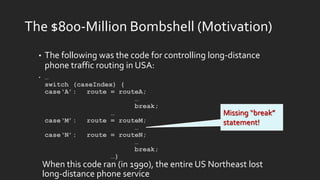
• The following was the code for controlling long-distance
phone traffic routing in USA:
• …
switch (caseIndex) {
case‘A’: route = routeA;
…
break;
…
case‘M’: route = routeM;
…
case‘N’: route = routeN;
…
break;
…}
Missing “break”
statement!
When this code ran (in 1990), the entire US Northeast lost
long-distance phone service
Engineering Model
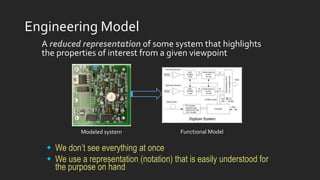
A reduced representation of some system that highlights
the properties of interest from a given viewpoint
Functional ModelModeled system
 We don’t see everything at once
 We use a representation (notation) that is easily understood for
the purpose on hand
Models vs. Systems
Differences due to:
• Unique properties of actual
construction materials
• Construction methods
• Scaling-up effects
• Skill sets/technologies
• Misunderstandings
Can lead to serious errors and
discrepancies in the realization
Characteristics of Useful Models
• Abstract
• Emphasize important aspects while removing irrelevant ones
• Understandable
• Expressed in a form that is readily understood by observers
• Accurate
• Faithfully represents the modeled system
• Predictive
• Can be used to answer questions about the modeled system
• Inexpensive
• Much cheaper to construct and study than the modeled system
To be useful, engineering models must satisfy
all of these characteristics!
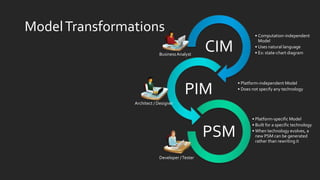
ModelTransformations • Computation-independent
Model
• Uses natural language
• Ex: state-chart diagram
CIM
• Platform-independent Model
• Does not specify any technology
PIM
• Platform-specific Model
• Built for a specific technology
• When technology evolves, a
new PSM can be generated
rather than rewriting it
PSM
BusinessAnalyst
Architect / Designer
Developer /Tester
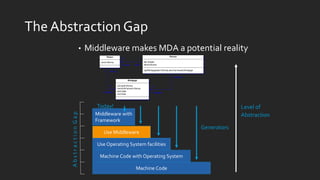
Machine Code
Impossible?
TheAbstraction Gap
• Middleware makes MDA a potential reality
Level of
Abstraction
Generators
1
0..*
security
mortgages
1
0..*
borrower
mortgages
10..*
ownerhouses
House
-value:Money
Person
-ssn:Integer
-salary:Money
+getMortgage(sum:Money,security:House):Mortgage
Mortgage
-principal:Money
-monthlyPayment:Money
-start:Date
-end:Date
Machine Code with Operating System
Impractical?Use Operating System facilities
Unlikely?Use Middleware
Practical(ly)
Middleware with
Framework
Today!
AbstractionGap
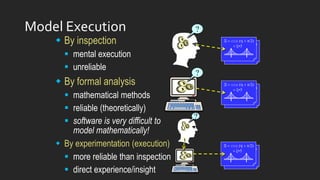
Model Execution
X = cos (h + p/2)
+ x*5
X = cos (h + p/2)
+ x*5
?
 By formal analysis
 mathematical methods
 reliable (theoretically)
 software is very difficult to
model mathematically!
?
X = cos (h + p/2)
+ x*5
X = cos (h + p/2)
+ x*5
 By experimentation (execution)
 more reliable than inspection
 direct experience/insight
X = cos (h + p/2)
+ x*5
X = cos (h + p/2)
+ x*5
?
 By inspection
 mental execution
 unreliable
MDE Prospects
• The problem:
• We cannot keep implementing our applications using the
programming technologies of the late Fifties’
• The demands on functionality, reliability, dependability,
availability, security, and performance demanded of modern
software.
• We need to, can do, and have already done better!
• MDE:
• Increased levels of abstraction
• Open unified standards
• Increased levels of automation
Primary Forms of Automation for MDE
• Computer-based validation
• Formal methods (qualitative and quantitative)
• Computer-based testing
• Automated test generation, setup, and execution
• Computer-based model execution
• Particularly execution of abstract and incomplete models
-- when most of the important decisions are made
• Model transformations
• Code generation, between PSMs, …
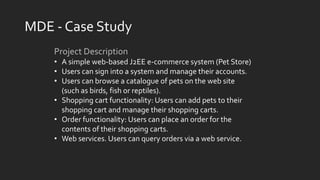
MDE - Case Study
Project Description
• A simple web-based J2EE e-commerce system (Pet Store)
• Users can sign into a system and manage their accounts.
• Users can browse a catalogue of pets on the web site
(such as birds, fish or reptiles).
• Shopping cart functionality: Users can add pets to their
shopping cart and manage their shopping carts.
• Order functionality: Users can place an order for the
contents of their shopping carts.
• Web services. Users can query orders via a web service.
MDE - Case Study
Teams Description
• 2 development teams
• Traditional development lifecycle
• Model-driven Development style
• 1 senior J2EE architect + 2 experienced J2EE programmers per team
• Each team uses the same HTML, images and database schema.
• MDA team was required to use an MDA tool
• Traditional team was required to use leading J2EE IDE
• Both teams must use EJB in their code bases
• No further constraints
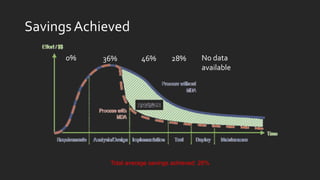
Savings Achieved
0% 36% 46% 28% No data
available
Total average savings achieved: 26%
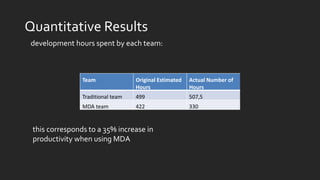
Quantitative Results
development hours spent by each team:
Team Original Estimated
Hours
Actual Number of
Hours
Traditional team 499 507,5
MDA team 422 330
this corresponds to a 35% increase in
productivity when using MDA
Thank you!
Hussein Alshkhir

MODEL-DRIVEN ENGINEERING (MDE) in Practice

  • 1.
  • 2.
    The $800-Million Bombshell(Motivation) • The following was the code for controlling long-distance phone traffic routing in USA: • … switch (caseIndex) { case‘A’: route = routeA; … break; … case‘M’: route = routeM; … case‘N’: route = routeN; … break; …} Missing “break” statement! When this code ran (in 1990), the entire US Northeast lost long-distance phone service
  • 3.
    Engineering Model A reducedrepresentation of some system that highlights the properties of interest from a given viewpoint Functional ModelModeled system  We don’t see everything at once  We use a representation (notation) that is easily understood for the purpose on hand
  • 4.
    Models vs. Systems Differencesdue to: • Unique properties of actual construction materials • Construction methods • Scaling-up effects • Skill sets/technologies • Misunderstandings Can lead to serious errors and discrepancies in the realization
  • 5.
    Characteristics of UsefulModels • Abstract • Emphasize important aspects while removing irrelevant ones • Understandable • Expressed in a form that is readily understood by observers • Accurate • Faithfully represents the modeled system • Predictive • Can be used to answer questions about the modeled system • Inexpensive • Much cheaper to construct and study than the modeled system To be useful, engineering models must satisfy all of these characteristics!
  • 6.
    ModelTransformations • Computation-independent Model •Uses natural language • Ex: state-chart diagram CIM • Platform-independent Model • Does not specify any technology PIM • Platform-specific Model • Built for a specific technology • When technology evolves, a new PSM can be generated rather than rewriting it PSM BusinessAnalyst Architect / Designer Developer /Tester
  • 7.
    Machine Code Impossible? TheAbstraction Gap •Middleware makes MDA a potential reality Level of Abstraction Generators 1 0..* security mortgages 1 0..* borrower mortgages 10..* ownerhouses House -value:Money Person -ssn:Integer -salary:Money +getMortgage(sum:Money,security:House):Mortgage Mortgage -principal:Money -monthlyPayment:Money -start:Date -end:Date Machine Code with Operating System Impractical?Use Operating System facilities Unlikely?Use Middleware Practical(ly) Middleware with Framework Today! AbstractionGap
  • 8.
    Model Execution X =cos (h + p/2) + x*5 X = cos (h + p/2) + x*5 ?  By formal analysis  mathematical methods  reliable (theoretically)  software is very difficult to model mathematically! ? X = cos (h + p/2) + x*5 X = cos (h + p/2) + x*5  By experimentation (execution)  more reliable than inspection  direct experience/insight X = cos (h + p/2) + x*5 X = cos (h + p/2) + x*5 ?  By inspection  mental execution  unreliable
  • 9.
    MDE Prospects • Theproblem: • We cannot keep implementing our applications using the programming technologies of the late Fifties’ • The demands on functionality, reliability, dependability, availability, security, and performance demanded of modern software. • We need to, can do, and have already done better! • MDE: • Increased levels of abstraction • Open unified standards • Increased levels of automation
  • 10.
    Primary Forms ofAutomation for MDE • Computer-based validation • Formal methods (qualitative and quantitative) • Computer-based testing • Automated test generation, setup, and execution • Computer-based model execution • Particularly execution of abstract and incomplete models -- when most of the important decisions are made • Model transformations • Code generation, between PSMs, …
  • 11.
    MDE - CaseStudy Project Description • A simple web-based J2EE e-commerce system (Pet Store) • Users can sign into a system and manage their accounts. • Users can browse a catalogue of pets on the web site (such as birds, fish or reptiles). • Shopping cart functionality: Users can add pets to their shopping cart and manage their shopping carts. • Order functionality: Users can place an order for the contents of their shopping carts. • Web services. Users can query orders via a web service.
  • 12.
    MDE - CaseStudy Teams Description • 2 development teams • Traditional development lifecycle • Model-driven Development style • 1 senior J2EE architect + 2 experienced J2EE programmers per team • Each team uses the same HTML, images and database schema. • MDA team was required to use an MDA tool • Traditional team was required to use leading J2EE IDE • Both teams must use EJB in their code bases • No further constraints
  • 13.
    Savings Achieved 0% 36%46% 28% No data available Total average savings achieved: 26%
  • 14.
    Quantitative Results development hoursspent by each team: Team Original Estimated Hours Actual Number of Hours Traditional team 499 507,5 MDA team 422 330 this corresponds to a 35% increase in productivity when using MDA
  • 15.