
Introduction to AMI
What is Smart Metering?
• Many different definitions
• Siemens says that Smart Meters “enable” the last mile
– Intelligent monitoring of consumption
– Bi-directional data transmission
– Increased security of supply and higher efficiency
– Variable tariffs dependent on overall consumption and
grid load
Www.Rmktechnology.Com
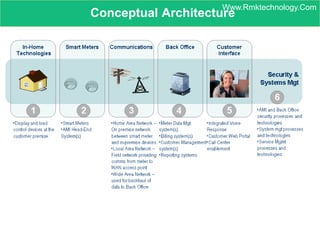
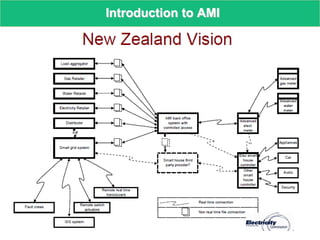
Conceptual Architecture
Www.Rmktechnology.Com
Introduction to AMI
What Smart Metering Offers
• Provides detailed information on what is being consumed/delivered on a
quasi-real-time basis
– Supports in-home displays
• Provides the data for consumers and utilities to make smart energy
choices
• Improves utility operations by (for example):
– Identifying where energy is being consumed
– Helps localize outages
– Highlights areas with possible energy theft
• Helps customers deliver energy to grid
• Eliminates the need to change meters when services or features are
modified (such as time-of-use)
• Provides a pathway to the Smart Grid
Www.Rmktechnology.Com
Introduction to AMI
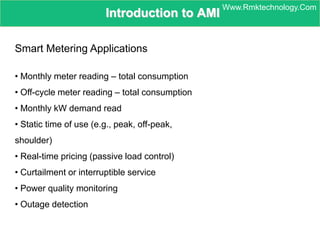
Smart Metering Applications
• Monthly meter reading – total consumption
• Off-cycle meter reading – total consumption
• Monthly kW demand read
• Static time of use (e.g., peak, off-peak,
shoulder)
• Real-time pricing (passive load control)
• Curtailment or interruptible service
• Power quality monitoring
• Outage detection
Www.Rmktechnology.Com
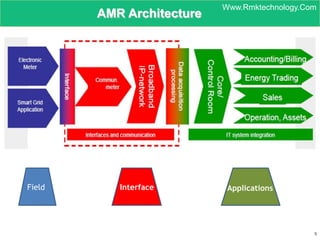
AMR Architecture
5
Field Interface Applications
Www.Rmktechnology.Com
AMR Architecture
6
Field
Www.Rmktechnology.Com
AMR Architecture
Field
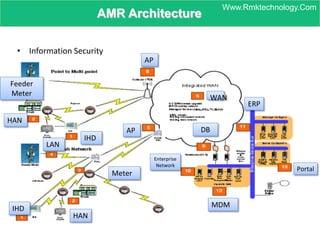
• Information Security
IHD
HAN
HAN
IHD
Meter
LAN
AP
WAN
Feeder
Meter
DB
Enterprise
Network
ERP
AP
MDM
Portal
Www.Rmktechnology.Com
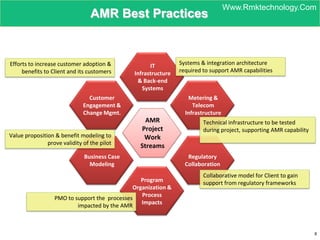
AMR Best Practices
8
Field
Customer
Engagement &
Change Mgmt.
AMR
Project
Work
Streams
Metering &
Telecom
Infrastructure
IT
Infrastructure
& Back-end
Systems
Business Case
Modeling
Regulatory
Collaboration
Program
Organization &
Process
Impacts
Systems & integration architecture
required to support AMR capabilities
Collaborative model for Client to gain
support from regulatory frameworks
Technical infrastructure to be tested
during project, supporting AMR capability
Efforts to increase customer adoption &
benefits to Client and its customers
Value proposition & benefit modeling to
prove validity of the pilot
PMO to support the processes
impacted by the AMR
Www.Rmktechnology.Com
Introduction to AMI
Www.Rmktechnology.Com
Introduction to AMI
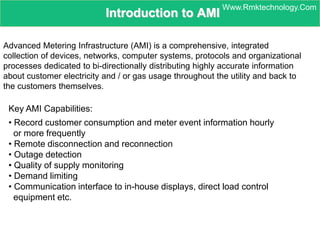
Advanced Metering Infrastructure (AMI) is a comprehensive, integrated
collection of devices, networks, computer systems, protocols and organizational
processes dedicated to bi-directionally distributing highly accurate information
about customer electricity and / or gas usage throughout the utility and back to
the customers themselves.
Key AMI Capabilities:
• Record customer consumption and meter event information hourly
or more frequently
• Remote disconnection and reconnection
• Outage detection
• Quality of supply monitoring
• Demand limiting
• Communication interface to in-house displays, direct load control
equipment etc.
Www.Rmktechnology.Com
Introduction to AMI
Middle-
ware
Www.Rmktechnology.Com
Introduction to AMI
Www.Rmktechnology.Com
Introduction to AMI
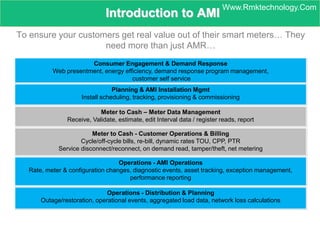
To ensure your customers get real value out of their smart meters… They
need more than just AMR…
You need more than just MDM
Planning & AMI Installation Mgmt
Install scheduling, tracking, provisioning & commissioning
Operations - AMI Operations
Rate, meter & configuration changes, diagnostic events, asset tracking, exception management,
performance reporting
Consumer Engagement & Demand Response
Web presentment, energy efficiency, demand response program management,
customer self service
Operations - Distribution & Planning
Outage/restoration, operational events, aggregated load data, network loss calculations
Meter to Cash – Meter Data Management
Receive, Validate, estimate, edit Interval data / register reads, report
Meter to Cash - Customer Operations & Billing
Cycle/off-cycle bills, re-bill, dynamic rates TOU, CPP, PTR
Service disconnect/reconnect, on demand read, tamper/theft, net metering
Www.Rmktechnology.Com
Introduction to AMI
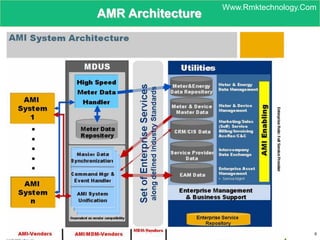
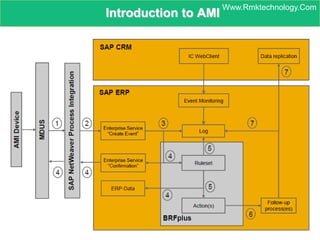
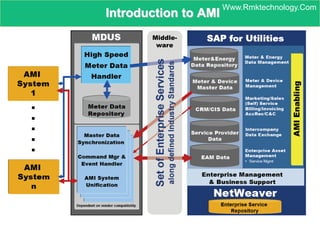
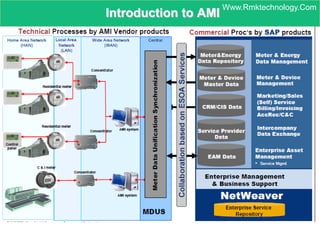
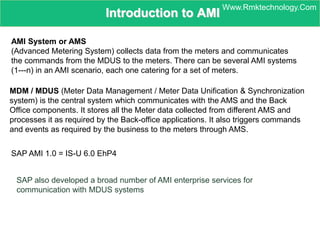
AMI System or AMS
(Advanced Metering System) collects data from the meters and communicates
the commands from the MDUS to the meters. There can be several AMI systems
(1---n) in an AMI scenario, each one catering for a set of meters.
MDM / MDUS (Meter Data Management / Meter Data Unification & Synchronization
system) is the central system which communicates with the AMS and the Back
Office components. It stores all the Meter data collected from different AMS and
processes it as required by the Back-office applications. It also triggers commands
and events as required by the business to the meters through AMS.
SAP AMI 1.0 = IS-U 6.0 EhP4
SAP also developed a broad number of AMI enterprise services for
communication with MDUS systems
Www.Rmktechnology.Com
Introduction to AMI
Key Enhancements were made in the following areas:
• Device Management
• Meter Reading
• Customer Service
SAP also developed a broad number of AMI enterprise
services for communication with MDUS systems
Www.Rmktechnology.Com
Introduction to AMI
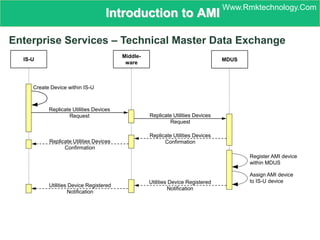
Enterprise Services – Technical Master Data Exchange
IS-U
Replicate Utilities Devices
Request
Replicate Utilities Devices
Confirmation
Create Device within IS-U
Replicate Utilities Devices
Request
Replicate Utilities Devices
Confirmation
Register AMI device
within MDUS
Assign AMI device
to IS-U deviceUtilities Device Registered
Notification
MDUS
Middle-
ware
Utilities Device Registered
Notification
Www.Rmktechnology.Com
Introduction to AMI
Introduction to AMI
Www.Rmktechnology.Com
Visit www.rmktechnology.com

Ami introduction demo_2

  • 1.
    Introduction to AMI Whatis Smart Metering? • Many different definitions • Siemens says that Smart Meters “enable” the last mile – Intelligent monitoring of consumption – Bi-directional data transmission – Increased security of supply and higher efficiency – Variable tariffs dependent on overall consumption and grid load Www.Rmktechnology.Com
  • 2.
  • 3.
    Introduction to AMI WhatSmart Metering Offers • Provides detailed information on what is being consumed/delivered on a quasi-real-time basis – Supports in-home displays • Provides the data for consumers and utilities to make smart energy choices • Improves utility operations by (for example): – Identifying where energy is being consumed – Helps localize outages – Highlights areas with possible energy theft • Helps customers deliver energy to grid • Eliminates the need to change meters when services or features are modified (such as time-of-use) • Provides a pathway to the Smart Grid Www.Rmktechnology.Com
  • 4.
    Introduction to AMI SmartMetering Applications • Monthly meter reading – total consumption • Off-cycle meter reading – total consumption • Monthly kW demand read • Static time of use (e.g., peak, off-peak, shoulder) • Real-time pricing (passive load control) • Curtailment or interruptible service • Power quality monitoring • Outage detection Www.Rmktechnology.Com
  • 5.
    AMR Architecture 5 Field InterfaceApplications Www.Rmktechnology.Com
  • 6.
  • 7.
    AMR Architecture Field • InformationSecurity IHD HAN HAN IHD Meter LAN AP WAN Feeder Meter DB Enterprise Network ERP AP MDM Portal Www.Rmktechnology.Com
  • 8.
    AMR Best Practices 8 Field Customer Engagement& Change Mgmt. AMR Project Work Streams Metering & Telecom Infrastructure IT Infrastructure & Back-end Systems Business Case Modeling Regulatory Collaboration Program Organization & Process Impacts Systems & integration architecture required to support AMR capabilities Collaborative model for Client to gain support from regulatory frameworks Technical infrastructure to be tested during project, supporting AMR capability Efforts to increase customer adoption & benefits to Client and its customers Value proposition & benefit modeling to prove validity of the pilot PMO to support the processes impacted by the AMR Www.Rmktechnology.Com
  • 9.
  • 10.
    Introduction to AMI AdvancedMetering Infrastructure (AMI) is a comprehensive, integrated collection of devices, networks, computer systems, protocols and organizational processes dedicated to bi-directionally distributing highly accurate information about customer electricity and / or gas usage throughout the utility and back to the customers themselves. Key AMI Capabilities: • Record customer consumption and meter event information hourly or more frequently • Remote disconnection and reconnection • Outage detection • Quality of supply monitoring • Demand limiting • Communication interface to in-house displays, direct load control equipment etc. Www.Rmktechnology.Com
  • 11.
  • 12.
  • 13.
    Introduction to AMI Toensure your customers get real value out of their smart meters… They need more than just AMR… You need more than just MDM Planning & AMI Installation Mgmt Install scheduling, tracking, provisioning & commissioning Operations - AMI Operations Rate, meter & configuration changes, diagnostic events, asset tracking, exception management, performance reporting Consumer Engagement & Demand Response Web presentment, energy efficiency, demand response program management, customer self service Operations - Distribution & Planning Outage/restoration, operational events, aggregated load data, network loss calculations Meter to Cash – Meter Data Management Receive, Validate, estimate, edit Interval data / register reads, report Meter to Cash - Customer Operations & Billing Cycle/off-cycle bills, re-bill, dynamic rates TOU, CPP, PTR Service disconnect/reconnect, on demand read, tamper/theft, net metering Www.Rmktechnology.Com
  • 14.
    Introduction to AMI AMISystem or AMS (Advanced Metering System) collects data from the meters and communicates the commands from the MDUS to the meters. There can be several AMI systems (1---n) in an AMI scenario, each one catering for a set of meters. MDM / MDUS (Meter Data Management / Meter Data Unification & Synchronization system) is the central system which communicates with the AMS and the Back Office components. It stores all the Meter data collected from different AMS and processes it as required by the Back-office applications. It also triggers commands and events as required by the business to the meters through AMS. SAP AMI 1.0 = IS-U 6.0 EhP4 SAP also developed a broad number of AMI enterprise services for communication with MDUS systems Www.Rmktechnology.Com
  • 15.
    Introduction to AMI KeyEnhancements were made in the following areas: • Device Management • Meter Reading • Customer Service SAP also developed a broad number of AMI enterprise services for communication with MDUS systems Www.Rmktechnology.Com
  • 16.
    Introduction to AMI EnterpriseServices – Technical Master Data Exchange IS-U Replicate Utilities Devices Request Replicate Utilities Devices Confirmation Create Device within IS-U Replicate Utilities Devices Request Replicate Utilities Devices Confirmation Register AMI device within MDUS Assign AMI device to IS-U deviceUtilities Device Registered Notification MDUS Middle- ware Utilities Device Registered Notification Www.Rmktechnology.Com
  • 17.
  • 18.