1
AMERICAN IDENTITIES
Instructor: Ms. Megan E. Williams Summer 2008
Email: mwillia@ku.edu AMS 110 ‐ 80203
Office: 215 Bailey Hall MTWRF
Office Hours: T/R, 9:20– 10:20 am 10:20 – 11:20 am
Office Phone: 864‐2167 202 Bailey Hall
COURSE DESCRIPTION
AMS 110 is an interdisciplinary introduction to the interplay between individual and group
identities in American society between World War II and today. Given the influence of
difference and power in American culture, we will consider the profound impact of the
diversity of the American peoples on society and address differential power structures in
American life and social relations. Our analysis of ethnicity, race, religion, gender, sexuality,
region, class, and age will reveal the degree to which our identities are socially constructed.
We will also focus on how identities constitute lived realities and shared communities as well
as how prejudice and institutional discrimination shape certain individual’s and groups’ life
chances and impact their access to resources, rights, and privileges. We will attempt to
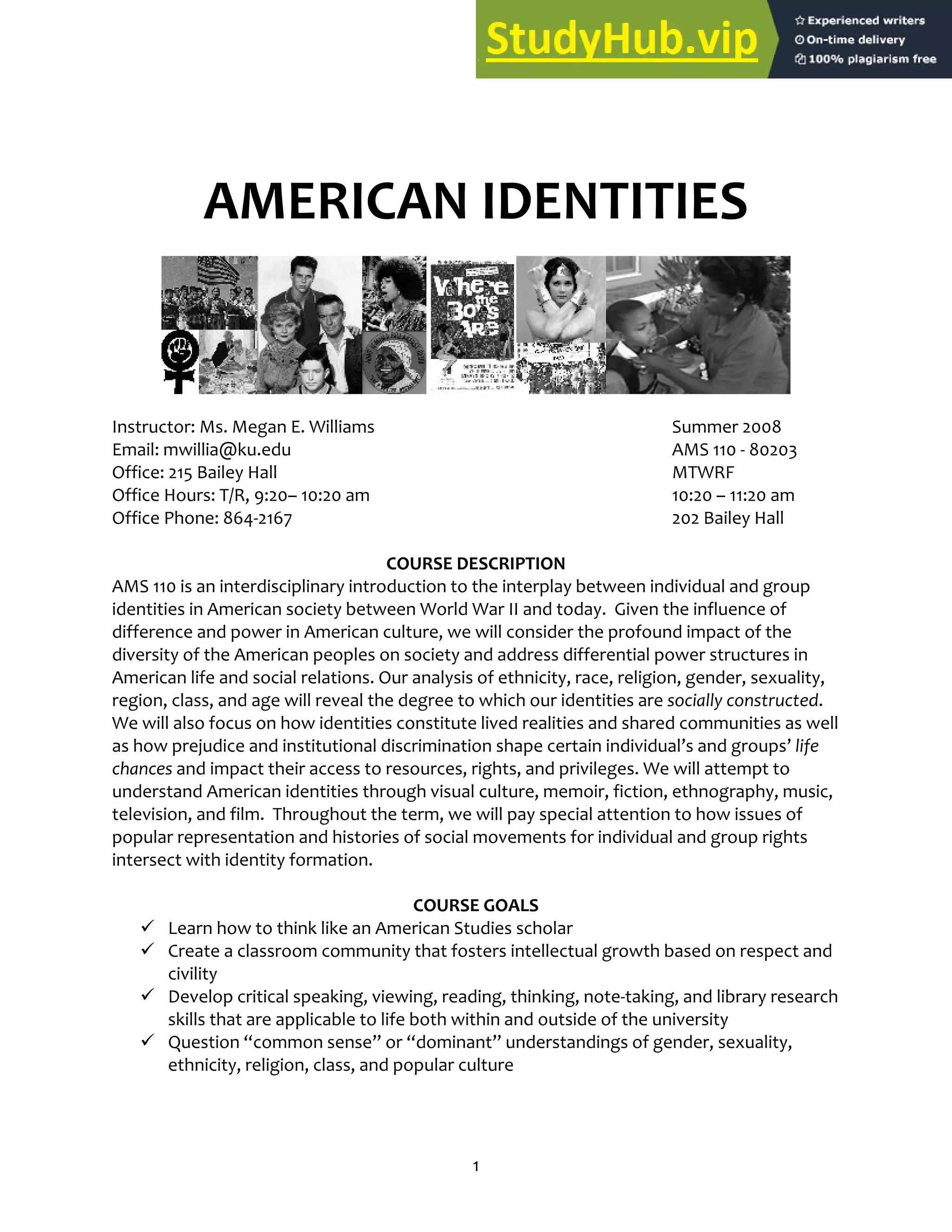
understand American identities through visual culture, memoir, fiction, ethnography, music,
television, and film. Throughout the term, we will pay special attention to how issues of
popular representation and histories of social movements for individual and group rights
intersect with identity formation.
COURSE GOALS
 Learn how to think like an American Studies scholar
 Create a classroom community that fosters intellectual growth based on respect and
civility
 Develop critical speaking, viewing, reading, thinking, note‐taking, and library research
skills that are applicable to life both within and outside of the university
 Question “common sense” or “dominant” understandings of gender, sexuality,
ethnicity, religion, class, and popular culture
2
ESSENTIAL QUESTIONS
 What does it mean “to think like an American Studies scholar”?
 What evidence indicates that identities are socially constructed?
 How do identities constitute lived realities and shared communities?
 How do prejudice and institutional discrimination shape certain individuals and
groups life chances and impact their access to resources, rights, and privileges?
 To whom do the rights and freedoms outlined in the Declaration of Independence and
the Constitution of the United States belong?
 Do Americans have a responsibility to “exercise” their rights and freedoms? Should
they push for greater liberties?
 How have Americans, through social movements, affected political change – what
were their goals, strategies, successes, and failures?
 Is American history a history of social progress? Is social progress inevitable?
 How does popular culture shape and reflect American cultural ideals and values?
 How do popular representations of a group affect how members of that group see
themselves and how others see them?
 How are popular representations of a group related to the group’s access to political
representation – to quote Richard Dyer, “to their right to the rights [America] claims
to ensure its citizens”?
COURSE TEXTS
Required Books
Ronald Takaki, Double Victory: A Multicultural History of America in World War II (New York:
Little, Brown and Company, 2000)
Susan J. Douglas, Where the Girls Are: Growing Up Female with the Mass Media (New York:
Three Rivers Press, 1995)
Marita Golden, Don’t Play in the Sun: One Woman’s Journey Through the Color Complex (New
York: Doubleday, 2004)
George Chauncey, Why Marriage? The History Shaping Today's Debate Over Gay Equality, (New
York: Basic Books, 2004)
Handout
Shelby Steele, A Bound Man: Why We Are Excited About Obama and Why He Can’t Win (New
York: Free Press, 2008)
Course Texts Available on ERESERVES
Kathryn Nocerino, “Americanism,” in Growing Up Ethnic in America: Contemporary Fiction
about Learning to Be American, ed. Maria G. Gillian and Jennifer Gillian (New York:
Penguin Books, 1999), 79‐82.
Stephanie Coontz, “What We Really Miss About the 1950s,” in Rereading America: Cultural
Contexts for Critical Thinking and Writing, ed. Gary Colombo, Robert Cullen, and
Bonnie Lisle (Boston: Bedford Books, 1998), 55‐70.
Andi Zeisler, “Breed All About It: An Interview with The Mommy Myth Coauthor Susan J.
Douglas,” Bitch: Feminist Response to Pop Culture, no. 24 (2004): 64‐68, 94.
Andi Zeisler, “Hog Heaven: Ariel Levy on Female Chauvinist Pigs and the Rise of Raunch
Culture,” Bitch: Feminist Response to Pop Culture, no. 30 (2005): 54‐59
3
Kathy Russell, Midge Wilson, and Ronald Hall, The Color Complex: The Politics of Skin Color
Among African Americans (New York: Anchor Books, 1992), 1‐35.
Pierrette Hondagneu‐Sotelo, Doméstica: Immigrant Workers Cleaning and Caring in the
Shadows of Affluence (Berkley: University of California Press, 2001), ix‐xxi, 3‐60
Harry M. Benshoff and Sean Griffin, “Heterosexuality, Homosexuality and Classical
Hollywood,” in America on Film: Representing Race, Class, Gender, and Sexuality at the
Movies (Malden: Blackwell Publishing, 2004), 297‐317.
Directions for Accessing ERESERVES
Go to the KU Libraries homepage. Under “Research” click on “Electronic and Course
Reserves” OR use the following link: http://www.lib.ku.edu/reserves/eres/. Once you have
reached the “Course Reserves” page, click on “Find E‐reserves” under “Students.”
BLACKBOARD, EMAIL, AND OFFICE HOURS
This course uses Blackboard; you must check Blackboard and your email frequently for
announcements concerning the course. Email is the best way to reach me with questions
and concerns. I check my email daily (except on Shabbat – between sundown on Friday and
sundown on Saturday) and will respond within 42 hours. Still, email cannot replace the one‐
on‐one interactions possible during office hours. Therefore, I encourage you to make
appointments to see me during my posted office hours.
COURSE GRADING
Blackboard Posts 30%
 6 Posts at 5%
Projects (Choose 2 out of 6) 30%
 2 Projects a 15%
Reflection Essay on Wiki 30%
Discussion Participation 10%
Total 100%
COURSE ASSIGNMENTS
Students will work in learning groups throughout the semester exchanging Blackboard
Posts on readings and shaping an assignment for the collaborative Reflection Essay. When
class activities call for group work, the learning teams convene in person, but you will also
interact electronically.
Blackboard Posts
Each participant is responsible for contributing a total of 6 Blackboard Posts on the same
dates as their group members (see the course schedule). Each post will consist of 25‐word
summaries (your summaries must not exceed twenty‐five words and should reflect what
you see as the main argument, theme, or thesis of the reading(s)) and discussion questions
(questions raised in your mind as you read that will provoke student discussion in class).
Further instructions for each individual assignment are found on Blackboard under "Forum"
in the "Discussion Board." You must post your summaries and questions to the discussion
4
board under the correct "Forum" on Blackboard by 11:59 pm on the night before class; every
member of the class should read her/his peers' summaries and questions prior to class.
These short summaries of readings, paired with student‐developed discussion questions,
serve three functions: 1) they require you to read and think about the course texts prior to
coming to class; 2) they encourage you to cultivate important reading and writing skills (ex:
reading for a purpose, identifying arguments, writing succinctly); and 3) they provide
questions for class discussion that originate from you and your peers.
Grading Criteria for Blackboard Posts
50/50 points (advanced) = summaries accurately reflect the reading(s) main thesis, theme,
or argument and do not exceed twenty‐five words each; questions invite discussion and
conversation and are grounded in specific readings (and provide citation)
Example by Jessica Hampton:
Doméstica explains the circumstances of Latino/a domestic workers in global cities and the perception of these
workers in the eyes the employees and the employers.
1. In the article housekeeping is not seen as real job, it is seen as a hobby and never quite gains legitimacy. Why is
this line of work not seen as a real job? If this was your job would you consider it a real job? Why is housekeeping
such a good stepping stone to a "real" job (p.9‐10)?
2. There seems to be a correlation in the demographics of domestic workers with the immigration of the time
period, with Irish, German, Scandinavian immigrants, to U.S. born women in the late 19th century to African
American workers in the early 20th century, to Latina workers from the 1980s to today (p.14). From what
demographic background do you think the next influx of domestic workers will come from? Or, do you think
domestic work will disappear as it once was thought?
45/50 points (good) = either the summaries accurately reflect the reading(s) main thesis,
theme, or argument, the summaries exceed twenty‐five words each, or the questions invite
discussion and conversation but are not all grounded in specific readings (does not include
citations).
Example by Anonymous Student:
Doméstica discusses the growing population of Latinos and how the jobs they perform in the US are a crucial part
of the economy.
1. Being American and going to another country to live because it would better your life, how do you think you
would react and expect to be treated in another country?
2. If your boss gave you his or her old clothes would it make you work harder and longer for them? Is this
manipulative (p.11)?
40/50 points (threshold) = summaries inaccurately reflect the reading(s) main thesis, theme,
or argument and/or exceed twenty‐five words each and/or the questions do not invite
discussion and conversation and/or are not grounded in specific readings.
Example by Anonymous Student:
The book Doméstica discusses how the need for migrant work has increased why it has occurred, and who it has
affected.
5
1. Although the need to hire and employee immigrant workers for menial work has increased dramatically to keep
job costs low, why is there still so much hatred and discrimination against Latinos/Hispanics?
2. Have any of the students in the class ever been witness to or participated in discrimination against a person who
does is doing menial/manual labor work?
0/50 points (unacceptable) = work is not posted on time or is incomplete
Projects
Throughout the course of the semester, each student is responsible for completing 2
projects designed to develop and refine research, writing, and analytical skills crucial to
“doing” American Studies. There are 5 possible projects; you choose 2. Refer to Blackboard
– http://courseware.ku.edu/– for further details concerning each project as well as grading
rubrics.
FOUR FREEDOMS PROJECT ‐ due Tuesday, 6/17
ORAL HISTORY PROJECT – due Monday, 6/30
DOCUMENT ANALYSIS PROJECT – due Friday, 7/11
LIBRARY DATABASE PROJECT – due Friday, 7/18
ANNOTATED BIBLIOGRAPHY PROJECT – due Tuesday, 7/22
If you are unsatisfied with your project grades, you have one week from the date they are
returned to you to make revisions, incorporating/responding to my feedback and rubric
comments, for a second grade.
Wiki Reflection Essay
As a group, please write a joint essay (no longer than 7‐8 pages) reflecting your experiences
in AMS110: American Identities that addresses one or more of Essential Questions outlined
in the syllabus OR one or more of the following questions:
What did we get out of reading about and discussing issues of identity in American Studies?
How have the readings and discussions changed the way we view “Americans,” “American
culture,” popular culture, power and difference? How do we see this course fitting into our
overall KU education and our lives outside of the university?
In answering the above questions, you must make meticulous, well‐cited, productive use of
the texts we have discussed in class.
Please construct this essay collaboratively. You will build this piece by piece on the Wiki tool,
using your group Wiki inside the Reflection Essay button. Each group needs to organize
parts and also organize editing and an approval system to decide when the essay is
complete and offers an analysis that is agreed to by the group. There will be time in class to
discuss this, but also use email to the group and comments inside the Wiki tool.
6
Wiki Reflection Essay Timeline
Thursday 7/10 Proposal Due
Thursday 7/17 30 min. Prep Time with Group
Thursday 7/24 Draft Due/In‐Class Workshop
Tuesday 7/29 Final Wiki Due on Blackboard
Refer to the Reflection Essay link on Blackboard – http://courseware.ku.edu/ – for further
details concerning the reflection essay and grading rubric as well as basic instructions for
using a Wiki to generate a collaborative document. Due date: TBD.
Discussion Participation
You are expected to attend every class and you should come to each class having read and
thought about the material for discussion. You must bring your text(s) to class with you and
participate in each class meeting. You are expected to add to discussions through
constructive comments and questions as well as to complete assignments – such as surveys
on www.SurveyMonkey.com, group work, viewing worksheets, or in‐class prompts.
CLASSROOM VALUES, RESOURCES, & POLICIES
American Studies classrooms often involve lectures and discussions covering sensitive topics
and issues with conflicting viewpoints. My hope is that we can create an environment
conducive to open and considerate expression. As a group, we will discuss classroom civility
and agree upon our policies for creating this type of setting.
KU Writing Center
Most colleges and universities have a writing center, a place for students to talk about their
writing with trained peer consultants. At KU, our writing center has locations across campus
called Writer's Roosts. Please check the website at www.writing.ku.edu for current
locations and hours. The Writing Center welcomes both drop‐ins and appointments, and
there is no charge for their services. For more information, please call 864‐2399 or send an e‐
mail to writing@ku.edu.
Late Work & Extensions
Late work is unacceptable; do not ask to turn in late work – the answer is always “no.”
Work is due by the announced deadline at the beginning of the class unless otherwise
noted. Incomplete work – work that does not fulfill the outlined requirements – receives no
more than half credit.
If you feel that given more time you will produce better work, I am willing to discuss
reasonable extensions on a case‐by‐case basis but only if the extension is requested at least
48 hours prior to the date that the assignment is due; under no circumstances will I allow
more than one extension per student per semester.
7
Students with Documented Disabilities
The KU Office of Disability Resources (DR) coordinates accommodations and services for all
eligible students with disabilities. If you have a disability and wish to request
accommodations and have not contacted DR, please do so as soon as possible. Their office
is located in 22 Strong Hall; their phone number is 785‐864‐2620 (V/TTY). Information about
their services can be found at http://www.disability.ku.edu/. Please also contact me privately
in regard to your needs in this course.
Religious Observances
If you have recognized religious observances that conflict with our course schedule, please
let me know by the second week of class, so that we may discuss and arrange reasonable
accommodations.
Academic Misconduct
Please read carefully the University of Kansas policy on academic misconduct:
http://www.writing.ku.edu/~writing/instructors/guides/academic_misconduct.shtml
Any student violating any of these provisions—by cheating or contributing in any way to
cheating—will receive a failing grade in the course. That you were unaware of what
comprises academic misconduct is an unacceptable excuse for committing it.
How to Avoid Plagiarism
One of the major objectives of a college education is to develop the skills to engage other
people's ideas, concepts, interpretations, and perspectives. As a result, we are constantly
exposed and asked to respond to others' ideas—in our reading, in lectures, in discussions,
and in a myriad of daily activities. Given the complex nature of human communication in
today's world—especially with relatively easy access to a wealth of information on the
Internet, it is inevitable, natural, and frequently desirable—indeed, necessary—to use
others' ideas in constructing a spoken or written argument. As virtually all of the written
materials that we'll read this semester indicate, it is perfectly acceptable to use others'
materials, so long as you cite the sources from which they were obtained. However,
whenever you use someone else's ideas or words, it is necessary to give credit to the source
from which you took them.
Indiana University’s Writing Tutorial Services (http://www.indiana.edu/~wts/pamphlets/
plagiarism.shtml) provides a succinct outline of how to avoid plagiarism, which we will
adhere to in this course:
To avoid plagiarism, you must give credit whenever you use
 another person’s idea, opinion, or theory;
 any facts, statistics, graphs, drawings—any pieces of information—that
are not common knowledge;
 quotations of another person’s actual spoken or written words; or
 paraphrase of another person’s spoken or written words.
8
For those unfamiliar with the word, to plagiarize is to appropriate and present as one's own
the writing, ideas, or thoughts of someone else. In other words, you may not use another
person's words, ideas, opinions, interpretations, theories, or thoughts (either paraphrased
or in direct quotes) without indicating the source from which you obtained them (no matter
what that source is). If the words you are using are direct quotes of someone else's spoken
or written words, you are required to indicate this by enclosing the directly quoted material
in quotation marks and by providing explicit and precise information on the sources from
which you obtained the material. If you use someone else's ideas but paraphrase them and
don't quote them directly, you are still responsible for indicating the source from which you
obtained them.
If there is any ambiguity about this definition or you have any questions about what
comprises plagiarism, please contact me, either by email or during my posted office hours,
before you submit a written essay. Plagiarism will result in an automatic failing grade for the
entire course. That you were unaware of what comprises plagiarism is an unacceptable
excuse for committing it.
Policy on Student Academic Productions
Uses of student‐authored work are subject to the University’s Policy on Intellectual Property
and the Family Educational Rights and Privacy Act. I would like to use your work outside of
this class (e.g. as a sample for a teaching portfolio or for future classes). You will be asked to
fill out and sign a written form authorizing such use. Your decision to allow me to use your
work or your decision not to allow me to use your work for these purposes will not affect
your grade for this course.
AMS 110 COURSE SCHEDULE
***Note: I reserve the right to alter and amend the syllabus and course schedule***
1) COURSE INTRODUCTION
Tuesday, 6/3
FIRST DAY OF CLASS
Introductions; overview of syllabus, course goals, and essential questions; discussion of classroom
civility and policies using CTE’s “Keys to Civility for Faculty and Students”; and tips on how to
read, write, and view effectively
Wednesday, 6/4
Before Class: Take an anonymous survey at SurveyMonkey.com via Blackboard by 9 pm
Cowan, “American Studies: An Overview” in Encyclopedia of American Studies [HANDOUT]
Lansford, “Popular Culture” in Encyclopedia of American Studies [BLACKBOARD – COURSE
DOCUMENTS]
Anderson and Taylor, Chapter 2, “Culture” in Sociology, 46‐57 [HANDOUT]
Anderson and Taylor, Chapter 16, “Social Change and Social Movements” in Sociology, 424‐448
[HANDOUT]
9
2) WHO IS an AMERICAN?
WORLD WAR II and the 1950s in AMERICA
Thursday, 6/5
Rockwell’s Four Freedoms [BLACKBOARD ‐ WEBSITES]
FDR’s Annual Message to Congress [BLACKBOARD ‐ WEBSITES]
Anderson and Taylor, Chapter 9, “Race and Ethnicity” in Sociology, 232‐259 [HANDOUT]
Double Victory, 3‐21
Friday, 6/6
View The Negro Soldier (1944)
Monday, 6/9
Double Victory, 22‐110
BEFORE CLASS: GROUP A POST 1 DUE by 11:59 pm on Su, 6/8
Tuesday, 6/10
Double Victory, 111‐136; 144‐179
BEFORE CLASS: GROUP B POST 1 DUE by 11:59 pm on M, 6/9
Wednesday, 6/11
Double Victory, 180‐236
BEFORE CLASS: GROUP C POST 1 DUE by 11:59 pm on T, 6/10
Thursday, 6/12
View Leave It to Beaver (1957)
Friday, 6/13
Soto, “Looking for Work” in Growing Up Ethnic in America [BLACKBOARD – COURSE DOCUMENTS]
Nocerino, “Americanism” in Growing Up Ethnic in America, 79‐82 [ERESERVES]
Coontz, “What We Really Miss About the 1950s” in Rereading America [ERESERVES]
BEFORE CLASS: GROUP D POST 1 DUE by 11:59 pm on R, 6/12
3) WOMEN, the MASS MEDIA, and the “F” WORD
Monday, 6/16
View Imitation of Life (1959)
Tuesday, 6/17
View Imitation of Life (1959)
FOUR FREEDOMS PROJECT DUE
Wednesday, 6/18
Anderson and Taylor, Chapter 10, “Gender” in Sociology, 260‐287 [HANDOUT]
Where the Girls Are, 3‐20
BEFORE CLASS: GROUP A POST 2 DUE by 11:59 pm on T, 6/18
10
Thursday, 6/19
Discuss Imitation of Life (1959)
Where the Girls Are, 21‐122
Before Class Listen to The Shirelles, “Will You Love Me Tomorrow” [BLACKBOARD – COURSE
DOCUMENTS]
BEFORE CLASS: GROUP B POST 2 DUE by 11:59 pm on W, 6/18
Friday, 6/20
Continue discussion of Where the Girls Are, 43‐122
In Class: View episode of Bewitched (1964)
Monday, 6/23
Where the Girls Are, 123‐138
BEFORE CLASS: GROUP C POST 2 DUE by 11:59 pm on Su, 6/22
Where the Girls, 139‐192
Before Class View Helen Reddy, “I Am Woman” [BLACKBOARD – COURSE DOCUMENTS]
BEFORE CLASS: GROUP D POST 2 DUE by 11:59 pm on Su, 6/22
Tuesday, 6/24
View episode of Wonder Woman (1976)
Wednesday, 6/25
Where the Girls, 193‐268
BEFORE CLASS: GROUP A POST 3 DUE by 11:59 pm on T, 6/24
4) COLOR ADJUSTMENTS
Thursday, 6/26
In‐class Discussion of Wiki Timeline and Guidelines
View Ethnic Notions (1987)
Friday, 6/27
NO CLASS
Monday, 6/30 – Tuesday, 7/1
View Ethnic Notions (1987)
View Color Adjustment (1991)
BEFORE CLASS: Please fill out mid‐semester assessment on SurveyMonkey.com via Blackboard by
11:59 pm on Su, 6/29
ORAL HISTORY PROJECT DUE ON M 6/30
Wednesday, 7/2
Benshoff and Griffin, “African Americans and American Film” in America on Film, 75‐95
[BLACKBOARD – COURSE DOCUMENTS]
King, “Letter from Birmingham Jail” [BLACKBOARD – COURSE DOCUMENTS]
Malcolm X, “The Ballot or the Bullet” [BLACKBOARD – COURSE DOCUMENTS]
Hyman, “The Shape of Race” in Bitch [HANDOUT]
BEFORE CLASS: GROUP B POST 3 DUE by 11:59 pm on T, 7/1
11
Thursday, 7/3
Don’t Play in the Sun, 3‐49
BEFORE CLASS: GROUP C POST 3 DUE by 11:59 pm on W, 7/2
Friday, 7/4
NO CLASS – FOURTH OF JULY
Monday, 7/7
Don’t Play in the Sun, 50‐107
BEFORE CLASS: GROUP D POST 3 DUE by 11:59 pm on Su, 7/6
Tuesday, 7/8
Don’t Play in the Sun, 108‐144
McIntosh, “White Privilege: Unpacking the Invisible Knapsack” [BLACKBOARD – COURSE
DOCUMENTS]
BEFORE CLASS: GROUP A POST 4 DUE by 11:59 pm on M, 7/7
Wednesday, 7/9
Don’t Play in the Sun, 145‐196
BEFORE CLASS: GROUP B POST 4 DUE by 11:59 pm on T, 7/8
5) MAID in the USA
Thursday, 7/10
**REFLECTION ESSAY PROPOSAL DUE**
Anderson and Taylor, Chapter 7, “Social Class and Social Stratification,” in Sociology, 176‐207
[HANDOUT]
Hondagneu‐Sotelo, Doméstica, Preface and Chapter 1 [ERESERVES]
In class view A Day without a Mexican (short)
BEFORE CLASS: GROUP C POST 4 DUE by 11:59 pm on W, 7/9
Friday, 7/11
View Maid in America (2005)
DOCUMENT ANALYSIS PROJECT DUE
Monday, 7/14
Hondagneu‐Sotelo, Doméstica, Chapters 2 & 8 [BLACKBOARD – COURSE DOCUMENTS]
Before Class View This Is CHIRLA! [BLACKBOARD ‐ WEBSITES]
BEFORE CLASS: GROUP D POST 4 DUE by 11:59 pm on R, 7/10
6) WHY MARRIAGE?
Tuesday, 7/15
Benshoff and Griffin, “Heterosexuality, Homosexuality and Classical Hollywood,” in America on Film,
297‐317 [ERESERVES]
View Celluloid Closet (1995) excerpts
BEFORE CLASS: GROUP A POST 5 DUE by 11:59 pm on M, 7/14
12
Wednesday, 7/16
Anderson and Taylor, Chapter 11, “Sexuality” in Sociology, 288‐309 [HANDOUT]
Why Marriage, Introduction and Chapter 1
BEFORE CLASS: GROUP B POST 5 DUE by 11:59 pm on T, 7/15
Thursday, 7/17
**30 MINUTES OF IN‐CLASS PREP TIME WITH GROUP**
Why Marriage, Chapters 2‐3
BEFORE CLASS: GROUP C POST 5 DUE by 11:59 pm on W, 7/16
Friday, 7/18
View Tying the Knot (2004)
LIBRARY DATABASE PROJECT DUE
Monday, 7/21
View Tying the Knot (2004)
Why Marriage, Chapters 4‐5
BEFORE CLASS: GROUP D POST 5 DUE by 11:59 pm on Su, 7/20
7) OBAMA in ’08?
Tuesday, 7/22
Steele, A Bound Man, Part I, 3‐58 [HANDOUT]
Pinckney, “Dreams from Obama” in New York Review of Books [HANDOUT]
BEFORE CLASS: GROUPs A & B POST 6 DUE by 11:59 pm on M, 7/21
ANNOTATED BIBLIOGRAPHY PROJECT DUE via email by 11:59 pm
Wednesday, 7/23
Steele, A Bound Man, Part II, 59‐134 [HANDOUT]
Nelson, “Identity Politics” in New York Times [HANDOUT]
BEFORE CLASS: GROUPs C & D POST 6 DUE by 11:59 pm on T, 7/22
Thursday, 7/24
**REFLECTION PAPER DRAFT DUE & IN‐CLASS WORKSHOP**
Friday, 7/25
LAST DAY OF CLASS
BEFORE CLASS: Take an anonymous survey at SurveyMonkey.com via Blackboard by 9 pm
Tuesday, 7/29
**FINAL WIKI DUE ON BLACKBOARD by 12 noon**
13
GROUP A
Post Number Date Due
1 Su 6/8
2 T 6/18
3 T 6/24
4 M 7/7
5 M 7/14
6 T 7/22
GROUP B
Post Number Date Due
1 M 6/9
2 W 6/18
3 T, 7/1
4 T 7/8
5 T 7/15
6 T 7/22
GROUP C
Post Number Date Due
1 T 6/10
2 Su 6/22
3 W 7/2
4 W 7/9
5 W 7/16
6 W 7/23
GROUP D
Post Number Date Due
1 R 6/12
2 Su 6/22
3 Su 7/6
4 R 7/10
5 Su 7/20
6 W 7/23

American Identities (Syllabus).pdf

  • 1.
    1 AMERICAN IDENTITIES Instructor: Ms.Megan E. Williams Summer 2008 Email: mwillia@ku.edu AMS 110 ‐ 80203 Office: 215 Bailey Hall MTWRF Office Hours: T/R, 9:20– 10:20 am 10:20 – 11:20 am Office Phone: 864‐2167 202 Bailey Hall COURSE DESCRIPTION AMS 110 is an interdisciplinary introduction to the interplay between individual and group identities in American society between World War II and today. Given the influence of difference and power in American culture, we will consider the profound impact of the diversity of the American peoples on society and address differential power structures in American life and social relations. Our analysis of ethnicity, race, religion, gender, sexuality, region, class, and age will reveal the degree to which our identities are socially constructed. We will also focus on how identities constitute lived realities and shared communities as well as how prejudice and institutional discrimination shape certain individual’s and groups’ life chances and impact their access to resources, rights, and privileges. We will attempt to understand American identities through visual culture, memoir, fiction, ethnography, music, television, and film. Throughout the term, we will pay special attention to how issues of popular representation and histories of social movements for individual and group rights intersect with identity formation. COURSE GOALS  Learn how to think like an American Studies scholar  Create a classroom community that fosters intellectual growth based on respect and civility  Develop critical speaking, viewing, reading, thinking, note‐taking, and library research skills that are applicable to life both within and outside of the university  Question “common sense” or “dominant” understandings of gender, sexuality, ethnicity, religion, class, and popular culture
  • 2.
    2 ESSENTIAL QUESTIONS  Whatdoes it mean “to think like an American Studies scholar”?  What evidence indicates that identities are socially constructed?  How do identities constitute lived realities and shared communities?  How do prejudice and institutional discrimination shape certain individuals and groups life chances and impact their access to resources, rights, and privileges?  To whom do the rights and freedoms outlined in the Declaration of Independence and the Constitution of the United States belong?  Do Americans have a responsibility to “exercise” their rights and freedoms? Should they push for greater liberties?  How have Americans, through social movements, affected political change – what were their goals, strategies, successes, and failures?  Is American history a history of social progress? Is social progress inevitable?  How does popular culture shape and reflect American cultural ideals and values?  How do popular representations of a group affect how members of that group see themselves and how others see them?  How are popular representations of a group related to the group’s access to political representation – to quote Richard Dyer, “to their right to the rights [America] claims to ensure its citizens”? COURSE TEXTS Required Books Ronald Takaki, Double Victory: A Multicultural History of America in World War II (New York: Little, Brown and Company, 2000) Susan J. Douglas, Where the Girls Are: Growing Up Female with the Mass Media (New York: Three Rivers Press, 1995) Marita Golden, Don’t Play in the Sun: One Woman’s Journey Through the Color Complex (New York: Doubleday, 2004) George Chauncey, Why Marriage? The History Shaping Today's Debate Over Gay Equality, (New York: Basic Books, 2004) Handout Shelby Steele, A Bound Man: Why We Are Excited About Obama and Why He Can’t Win (New York: Free Press, 2008) Course Texts Available on ERESERVES Kathryn Nocerino, “Americanism,” in Growing Up Ethnic in America: Contemporary Fiction about Learning to Be American, ed. Maria G. Gillian and Jennifer Gillian (New York: Penguin Books, 1999), 79‐82. Stephanie Coontz, “What We Really Miss About the 1950s,” in Rereading America: Cultural Contexts for Critical Thinking and Writing, ed. Gary Colombo, Robert Cullen, and Bonnie Lisle (Boston: Bedford Books, 1998), 55‐70. Andi Zeisler, “Breed All About It: An Interview with The Mommy Myth Coauthor Susan J. Douglas,” Bitch: Feminist Response to Pop Culture, no. 24 (2004): 64‐68, 94. Andi Zeisler, “Hog Heaven: Ariel Levy on Female Chauvinist Pigs and the Rise of Raunch Culture,” Bitch: Feminist Response to Pop Culture, no. 30 (2005): 54‐59
  • 3.
    3 Kathy Russell, MidgeWilson, and Ronald Hall, The Color Complex: The Politics of Skin Color Among African Americans (New York: Anchor Books, 1992), 1‐35. Pierrette Hondagneu‐Sotelo, Doméstica: Immigrant Workers Cleaning and Caring in the Shadows of Affluence (Berkley: University of California Press, 2001), ix‐xxi, 3‐60 Harry M. Benshoff and Sean Griffin, “Heterosexuality, Homosexuality and Classical Hollywood,” in America on Film: Representing Race, Class, Gender, and Sexuality at the Movies (Malden: Blackwell Publishing, 2004), 297‐317. Directions for Accessing ERESERVES Go to the KU Libraries homepage. Under “Research” click on “Electronic and Course Reserves” OR use the following link: http://www.lib.ku.edu/reserves/eres/. Once you have reached the “Course Reserves” page, click on “Find E‐reserves” under “Students.” BLACKBOARD, EMAIL, AND OFFICE HOURS This course uses Blackboard; you must check Blackboard and your email frequently for announcements concerning the course. Email is the best way to reach me with questions and concerns. I check my email daily (except on Shabbat – between sundown on Friday and sundown on Saturday) and will respond within 42 hours. Still, email cannot replace the one‐ on‐one interactions possible during office hours. Therefore, I encourage you to make appointments to see me during my posted office hours. COURSE GRADING Blackboard Posts 30%  6 Posts at 5% Projects (Choose 2 out of 6) 30%  2 Projects a 15% Reflection Essay on Wiki 30% Discussion Participation 10% Total 100% COURSE ASSIGNMENTS Students will work in learning groups throughout the semester exchanging Blackboard Posts on readings and shaping an assignment for the collaborative Reflection Essay. When class activities call for group work, the learning teams convene in person, but you will also interact electronically. Blackboard Posts Each participant is responsible for contributing a total of 6 Blackboard Posts on the same dates as their group members (see the course schedule). Each post will consist of 25‐word summaries (your summaries must not exceed twenty‐five words and should reflect what you see as the main argument, theme, or thesis of the reading(s)) and discussion questions (questions raised in your mind as you read that will provoke student discussion in class). Further instructions for each individual assignment are found on Blackboard under "Forum" in the "Discussion Board." You must post your summaries and questions to the discussion
  • 4.
    4 board under thecorrect "Forum" on Blackboard by 11:59 pm on the night before class; every member of the class should read her/his peers' summaries and questions prior to class. These short summaries of readings, paired with student‐developed discussion questions, serve three functions: 1) they require you to read and think about the course texts prior to coming to class; 2) they encourage you to cultivate important reading and writing skills (ex: reading for a purpose, identifying arguments, writing succinctly); and 3) they provide questions for class discussion that originate from you and your peers. Grading Criteria for Blackboard Posts 50/50 points (advanced) = summaries accurately reflect the reading(s) main thesis, theme, or argument and do not exceed twenty‐five words each; questions invite discussion and conversation and are grounded in specific readings (and provide citation) Example by Jessica Hampton: Doméstica explains the circumstances of Latino/a domestic workers in global cities and the perception of these workers in the eyes the employees and the employers. 1. In the article housekeeping is not seen as real job, it is seen as a hobby and never quite gains legitimacy. Why is this line of work not seen as a real job? If this was your job would you consider it a real job? Why is housekeeping such a good stepping stone to a "real" job (p.9‐10)? 2. There seems to be a correlation in the demographics of domestic workers with the immigration of the time period, with Irish, German, Scandinavian immigrants, to U.S. born women in the late 19th century to African American workers in the early 20th century, to Latina workers from the 1980s to today (p.14). From what demographic background do you think the next influx of domestic workers will come from? Or, do you think domestic work will disappear as it once was thought? 45/50 points (good) = either the summaries accurately reflect the reading(s) main thesis, theme, or argument, the summaries exceed twenty‐five words each, or the questions invite discussion and conversation but are not all grounded in specific readings (does not include citations). Example by Anonymous Student: Doméstica discusses the growing population of Latinos and how the jobs they perform in the US are a crucial part of the economy. 1. Being American and going to another country to live because it would better your life, how do you think you would react and expect to be treated in another country? 2. If your boss gave you his or her old clothes would it make you work harder and longer for them? Is this manipulative (p.11)? 40/50 points (threshold) = summaries inaccurately reflect the reading(s) main thesis, theme, or argument and/or exceed twenty‐five words each and/or the questions do not invite discussion and conversation and/or are not grounded in specific readings. Example by Anonymous Student: The book Doméstica discusses how the need for migrant work has increased why it has occurred, and who it has affected.
  • 5.
    5 1. Although theneed to hire and employee immigrant workers for menial work has increased dramatically to keep job costs low, why is there still so much hatred and discrimination against Latinos/Hispanics? 2. Have any of the students in the class ever been witness to or participated in discrimination against a person who does is doing menial/manual labor work? 0/50 points (unacceptable) = work is not posted on time or is incomplete Projects Throughout the course of the semester, each student is responsible for completing 2 projects designed to develop and refine research, writing, and analytical skills crucial to “doing” American Studies. There are 5 possible projects; you choose 2. Refer to Blackboard – http://courseware.ku.edu/– for further details concerning each project as well as grading rubrics. FOUR FREEDOMS PROJECT ‐ due Tuesday, 6/17 ORAL HISTORY PROJECT – due Monday, 6/30 DOCUMENT ANALYSIS PROJECT – due Friday, 7/11 LIBRARY DATABASE PROJECT – due Friday, 7/18 ANNOTATED BIBLIOGRAPHY PROJECT – due Tuesday, 7/22 If you are unsatisfied with your project grades, you have one week from the date they are returned to you to make revisions, incorporating/responding to my feedback and rubric comments, for a second grade. Wiki Reflection Essay As a group, please write a joint essay (no longer than 7‐8 pages) reflecting your experiences in AMS110: American Identities that addresses one or more of Essential Questions outlined in the syllabus OR one or more of the following questions: What did we get out of reading about and discussing issues of identity in American Studies? How have the readings and discussions changed the way we view “Americans,” “American culture,” popular culture, power and difference? How do we see this course fitting into our overall KU education and our lives outside of the university? In answering the above questions, you must make meticulous, well‐cited, productive use of the texts we have discussed in class. Please construct this essay collaboratively. You will build this piece by piece on the Wiki tool, using your group Wiki inside the Reflection Essay button. Each group needs to organize parts and also organize editing and an approval system to decide when the essay is complete and offers an analysis that is agreed to by the group. There will be time in class to discuss this, but also use email to the group and comments inside the Wiki tool.
  • 6.
    6 Wiki Reflection EssayTimeline Thursday 7/10 Proposal Due Thursday 7/17 30 min. Prep Time with Group Thursday 7/24 Draft Due/In‐Class Workshop Tuesday 7/29 Final Wiki Due on Blackboard Refer to the Reflection Essay link on Blackboard – http://courseware.ku.edu/ – for further details concerning the reflection essay and grading rubric as well as basic instructions for using a Wiki to generate a collaborative document. Due date: TBD. Discussion Participation You are expected to attend every class and you should come to each class having read and thought about the material for discussion. You must bring your text(s) to class with you and participate in each class meeting. You are expected to add to discussions through constructive comments and questions as well as to complete assignments – such as surveys on www.SurveyMonkey.com, group work, viewing worksheets, or in‐class prompts. CLASSROOM VALUES, RESOURCES, & POLICIES American Studies classrooms often involve lectures and discussions covering sensitive topics and issues with conflicting viewpoints. My hope is that we can create an environment conducive to open and considerate expression. As a group, we will discuss classroom civility and agree upon our policies for creating this type of setting. KU Writing Center Most colleges and universities have a writing center, a place for students to talk about their writing with trained peer consultants. At KU, our writing center has locations across campus called Writer's Roosts. Please check the website at www.writing.ku.edu for current locations and hours. The Writing Center welcomes both drop‐ins and appointments, and there is no charge for their services. For more information, please call 864‐2399 or send an e‐ mail to writing@ku.edu. Late Work & Extensions Late work is unacceptable; do not ask to turn in late work – the answer is always “no.” Work is due by the announced deadline at the beginning of the class unless otherwise noted. Incomplete work – work that does not fulfill the outlined requirements – receives no more than half credit. If you feel that given more time you will produce better work, I am willing to discuss reasonable extensions on a case‐by‐case basis but only if the extension is requested at least 48 hours prior to the date that the assignment is due; under no circumstances will I allow more than one extension per student per semester.
  • 7.
    7 Students with DocumentedDisabilities The KU Office of Disability Resources (DR) coordinates accommodations and services for all eligible students with disabilities. If you have a disability and wish to request accommodations and have not contacted DR, please do so as soon as possible. Their office is located in 22 Strong Hall; their phone number is 785‐864‐2620 (V/TTY). Information about their services can be found at http://www.disability.ku.edu/. Please also contact me privately in regard to your needs in this course. Religious Observances If you have recognized religious observances that conflict with our course schedule, please let me know by the second week of class, so that we may discuss and arrange reasonable accommodations. Academic Misconduct Please read carefully the University of Kansas policy on academic misconduct: http://www.writing.ku.edu/~writing/instructors/guides/academic_misconduct.shtml Any student violating any of these provisions—by cheating or contributing in any way to cheating—will receive a failing grade in the course. That you were unaware of what comprises academic misconduct is an unacceptable excuse for committing it. How to Avoid Plagiarism One of the major objectives of a college education is to develop the skills to engage other people's ideas, concepts, interpretations, and perspectives. As a result, we are constantly exposed and asked to respond to others' ideas—in our reading, in lectures, in discussions, and in a myriad of daily activities. Given the complex nature of human communication in today's world—especially with relatively easy access to a wealth of information on the Internet, it is inevitable, natural, and frequently desirable—indeed, necessary—to use others' ideas in constructing a spoken or written argument. As virtually all of the written materials that we'll read this semester indicate, it is perfectly acceptable to use others' materials, so long as you cite the sources from which they were obtained. However, whenever you use someone else's ideas or words, it is necessary to give credit to the source from which you took them. Indiana University’s Writing Tutorial Services (http://www.indiana.edu/~wts/pamphlets/ plagiarism.shtml) provides a succinct outline of how to avoid plagiarism, which we will adhere to in this course: To avoid plagiarism, you must give credit whenever you use  another person’s idea, opinion, or theory;  any facts, statistics, graphs, drawings—any pieces of information—that are not common knowledge;  quotations of another person’s actual spoken or written words; or  paraphrase of another person’s spoken or written words.
  • 8.
    8 For those unfamiliarwith the word, to plagiarize is to appropriate and present as one's own the writing, ideas, or thoughts of someone else. In other words, you may not use another person's words, ideas, opinions, interpretations, theories, or thoughts (either paraphrased or in direct quotes) without indicating the source from which you obtained them (no matter what that source is). If the words you are using are direct quotes of someone else's spoken or written words, you are required to indicate this by enclosing the directly quoted material in quotation marks and by providing explicit and precise information on the sources from which you obtained the material. If you use someone else's ideas but paraphrase them and don't quote them directly, you are still responsible for indicating the source from which you obtained them. If there is any ambiguity about this definition or you have any questions about what comprises plagiarism, please contact me, either by email or during my posted office hours, before you submit a written essay. Plagiarism will result in an automatic failing grade for the entire course. That you were unaware of what comprises plagiarism is an unacceptable excuse for committing it. Policy on Student Academic Productions Uses of student‐authored work are subject to the University’s Policy on Intellectual Property and the Family Educational Rights and Privacy Act. I would like to use your work outside of this class (e.g. as a sample for a teaching portfolio or for future classes). You will be asked to fill out and sign a written form authorizing such use. Your decision to allow me to use your work or your decision not to allow me to use your work for these purposes will not affect your grade for this course. AMS 110 COURSE SCHEDULE ***Note: I reserve the right to alter and amend the syllabus and course schedule*** 1) COURSE INTRODUCTION Tuesday, 6/3 FIRST DAY OF CLASS Introductions; overview of syllabus, course goals, and essential questions; discussion of classroom civility and policies using CTE’s “Keys to Civility for Faculty and Students”; and tips on how to read, write, and view effectively Wednesday, 6/4 Before Class: Take an anonymous survey at SurveyMonkey.com via Blackboard by 9 pm Cowan, “American Studies: An Overview” in Encyclopedia of American Studies [HANDOUT] Lansford, “Popular Culture” in Encyclopedia of American Studies [BLACKBOARD – COURSE DOCUMENTS] Anderson and Taylor, Chapter 2, “Culture” in Sociology, 46‐57 [HANDOUT] Anderson and Taylor, Chapter 16, “Social Change and Social Movements” in Sociology, 424‐448 [HANDOUT]
  • 9.
    9 2) WHO ISan AMERICAN? WORLD WAR II and the 1950s in AMERICA Thursday, 6/5 Rockwell’s Four Freedoms [BLACKBOARD ‐ WEBSITES] FDR’s Annual Message to Congress [BLACKBOARD ‐ WEBSITES] Anderson and Taylor, Chapter 9, “Race and Ethnicity” in Sociology, 232‐259 [HANDOUT] Double Victory, 3‐21 Friday, 6/6 View The Negro Soldier (1944) Monday, 6/9 Double Victory, 22‐110 BEFORE CLASS: GROUP A POST 1 DUE by 11:59 pm on Su, 6/8 Tuesday, 6/10 Double Victory, 111‐136; 144‐179 BEFORE CLASS: GROUP B POST 1 DUE by 11:59 pm on M, 6/9 Wednesday, 6/11 Double Victory, 180‐236 BEFORE CLASS: GROUP C POST 1 DUE by 11:59 pm on T, 6/10 Thursday, 6/12 View Leave It to Beaver (1957) Friday, 6/13 Soto, “Looking for Work” in Growing Up Ethnic in America [BLACKBOARD – COURSE DOCUMENTS] Nocerino, “Americanism” in Growing Up Ethnic in America, 79‐82 [ERESERVES] Coontz, “What We Really Miss About the 1950s” in Rereading America [ERESERVES] BEFORE CLASS: GROUP D POST 1 DUE by 11:59 pm on R, 6/12 3) WOMEN, the MASS MEDIA, and the “F” WORD Monday, 6/16 View Imitation of Life (1959) Tuesday, 6/17 View Imitation of Life (1959) FOUR FREEDOMS PROJECT DUE Wednesday, 6/18 Anderson and Taylor, Chapter 10, “Gender” in Sociology, 260‐287 [HANDOUT] Where the Girls Are, 3‐20 BEFORE CLASS: GROUP A POST 2 DUE by 11:59 pm on T, 6/18
  • 10.
    10 Thursday, 6/19 Discuss Imitationof Life (1959) Where the Girls Are, 21‐122 Before Class Listen to The Shirelles, “Will You Love Me Tomorrow” [BLACKBOARD – COURSE DOCUMENTS] BEFORE CLASS: GROUP B POST 2 DUE by 11:59 pm on W, 6/18 Friday, 6/20 Continue discussion of Where the Girls Are, 43‐122 In Class: View episode of Bewitched (1964) Monday, 6/23 Where the Girls Are, 123‐138 BEFORE CLASS: GROUP C POST 2 DUE by 11:59 pm on Su, 6/22 Where the Girls, 139‐192 Before Class View Helen Reddy, “I Am Woman” [BLACKBOARD – COURSE DOCUMENTS] BEFORE CLASS: GROUP D POST 2 DUE by 11:59 pm on Su, 6/22 Tuesday, 6/24 View episode of Wonder Woman (1976) Wednesday, 6/25 Where the Girls, 193‐268 BEFORE CLASS: GROUP A POST 3 DUE by 11:59 pm on T, 6/24 4) COLOR ADJUSTMENTS Thursday, 6/26 In‐class Discussion of Wiki Timeline and Guidelines View Ethnic Notions (1987) Friday, 6/27 NO CLASS Monday, 6/30 – Tuesday, 7/1 View Ethnic Notions (1987) View Color Adjustment (1991) BEFORE CLASS: Please fill out mid‐semester assessment on SurveyMonkey.com via Blackboard by 11:59 pm on Su, 6/29 ORAL HISTORY PROJECT DUE ON M 6/30 Wednesday, 7/2 Benshoff and Griffin, “African Americans and American Film” in America on Film, 75‐95 [BLACKBOARD – COURSE DOCUMENTS] King, “Letter from Birmingham Jail” [BLACKBOARD – COURSE DOCUMENTS] Malcolm X, “The Ballot or the Bullet” [BLACKBOARD – COURSE DOCUMENTS] Hyman, “The Shape of Race” in Bitch [HANDOUT] BEFORE CLASS: GROUP B POST 3 DUE by 11:59 pm on T, 7/1
  • 11.
    11 Thursday, 7/3 Don’t Playin the Sun, 3‐49 BEFORE CLASS: GROUP C POST 3 DUE by 11:59 pm on W, 7/2 Friday, 7/4 NO CLASS – FOURTH OF JULY Monday, 7/7 Don’t Play in the Sun, 50‐107 BEFORE CLASS: GROUP D POST 3 DUE by 11:59 pm on Su, 7/6 Tuesday, 7/8 Don’t Play in the Sun, 108‐144 McIntosh, “White Privilege: Unpacking the Invisible Knapsack” [BLACKBOARD – COURSE DOCUMENTS] BEFORE CLASS: GROUP A POST 4 DUE by 11:59 pm on M, 7/7 Wednesday, 7/9 Don’t Play in the Sun, 145‐196 BEFORE CLASS: GROUP B POST 4 DUE by 11:59 pm on T, 7/8 5) MAID in the USA Thursday, 7/10 **REFLECTION ESSAY PROPOSAL DUE** Anderson and Taylor, Chapter 7, “Social Class and Social Stratification,” in Sociology, 176‐207 [HANDOUT] Hondagneu‐Sotelo, Doméstica, Preface and Chapter 1 [ERESERVES] In class view A Day without a Mexican (short) BEFORE CLASS: GROUP C POST 4 DUE by 11:59 pm on W, 7/9 Friday, 7/11 View Maid in America (2005) DOCUMENT ANALYSIS PROJECT DUE Monday, 7/14 Hondagneu‐Sotelo, Doméstica, Chapters 2 & 8 [BLACKBOARD – COURSE DOCUMENTS] Before Class View This Is CHIRLA! [BLACKBOARD ‐ WEBSITES] BEFORE CLASS: GROUP D POST 4 DUE by 11:59 pm on R, 7/10 6) WHY MARRIAGE? Tuesday, 7/15 Benshoff and Griffin, “Heterosexuality, Homosexuality and Classical Hollywood,” in America on Film, 297‐317 [ERESERVES] View Celluloid Closet (1995) excerpts BEFORE CLASS: GROUP A POST 5 DUE by 11:59 pm on M, 7/14
  • 12.
    12 Wednesday, 7/16 Anderson andTaylor, Chapter 11, “Sexuality” in Sociology, 288‐309 [HANDOUT] Why Marriage, Introduction and Chapter 1 BEFORE CLASS: GROUP B POST 5 DUE by 11:59 pm on T, 7/15 Thursday, 7/17 **30 MINUTES OF IN‐CLASS PREP TIME WITH GROUP** Why Marriage, Chapters 2‐3 BEFORE CLASS: GROUP C POST 5 DUE by 11:59 pm on W, 7/16 Friday, 7/18 View Tying the Knot (2004) LIBRARY DATABASE PROJECT DUE Monday, 7/21 View Tying the Knot (2004) Why Marriage, Chapters 4‐5 BEFORE CLASS: GROUP D POST 5 DUE by 11:59 pm on Su, 7/20 7) OBAMA in ’08? Tuesday, 7/22 Steele, A Bound Man, Part I, 3‐58 [HANDOUT] Pinckney, “Dreams from Obama” in New York Review of Books [HANDOUT] BEFORE CLASS: GROUPs A & B POST 6 DUE by 11:59 pm on M, 7/21 ANNOTATED BIBLIOGRAPHY PROJECT DUE via email by 11:59 pm Wednesday, 7/23 Steele, A Bound Man, Part II, 59‐134 [HANDOUT] Nelson, “Identity Politics” in New York Times [HANDOUT] BEFORE CLASS: GROUPs C & D POST 6 DUE by 11:59 pm on T, 7/22 Thursday, 7/24 **REFLECTION PAPER DRAFT DUE & IN‐CLASS WORKSHOP** Friday, 7/25 LAST DAY OF CLASS BEFORE CLASS: Take an anonymous survey at SurveyMonkey.com via Blackboard by 9 pm Tuesday, 7/29 **FINAL WIKI DUE ON BLACKBOARD by 12 noon**
  • 13.
    13 GROUP A Post NumberDate Due 1 Su 6/8 2 T 6/18 3 T 6/24 4 M 7/7 5 M 7/14 6 T 7/22 GROUP B Post Number Date Due 1 M 6/9 2 W 6/18 3 T, 7/1 4 T 7/8 5 T 7/15 6 T 7/22 GROUP C Post Number Date Due 1 T 6/10 2 Su 6/22 3 W 7/2 4 W 7/9 5 W 7/16 6 W 7/23 GROUP D Post Number Date Due 1 R 6/12 2 Su 6/22 3 Su 7/6 4 R 7/10 5 Su 7/20 6 W 7/23