


The amazon
jungle
Important
information• It has a surface of 2.5 millions of miles square covering
nine countrys of south America.
• More than 20% of the oxygen of the world is made in
this region.
• The diversity of birds in the amazon jungle form the
1/3 of all the species in the world.
• More than 5 millions species of insects, plants, and
animals are here.
• There are approximately 50 tribes who live in the heart
of the jungle.
• Nowadays 108.000 millions areas per year are
destroyed.
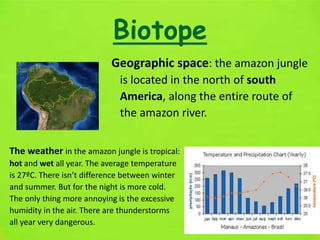
Biotope
Geographic space: the amazon jungle
is located in the north of south
America, along the entire route of
the amazon river.
The weather in the amazon jungle is tropical:
hot and wet all year. The average temperature
is 27ºC. There isn’t difference between winter
and summer. But for the night is more cold.
The only thing more annoying is the excessive
humidity in the air. There are thunderstorms
all year very dangerous.
The land in the amazon jungle
is poor in nutrients.
And it has a low potential of
retention.
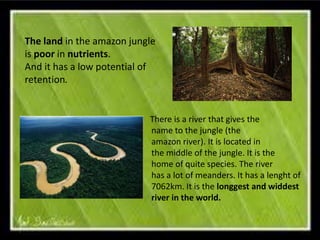
There is a river that gives the
name to the jungle (the
amazon river). It is located in
the middle of the jungle. It is the
home of quite species. The river
has a lot of meanders. It has a lenght of
7062km. It is the longgest and widdest
river in the world.
Biocoenosis
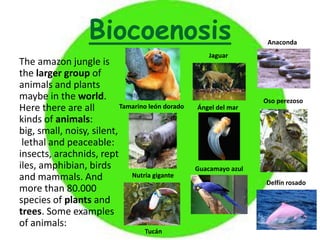
The amazon jungle is
the larger group of
animals and plants
maybe in the world.
Here there are all
kinds of animals:
big, small, noisy, silent,
lethal and peaceable:
insects, arachnids, rept
iles, amphibian, birds
and mammals. And
more than 80.000
species of plants and
trees. Some examples
of animals:
Tamarino león dorado
Nutria gigante
Tucán
Jaguar
Ángel del mar
Guacamayo azul
Anaconda
Oso perezoso
Delfín rosado
Interactions
BIOTOPE
• There isn’t difference
between winter and
summer.
• During all year there is
the same
temperature, more or
less 27ºC .
• The precipitations are
constant but with a
slight difference
throughout the year.
• The storms are frequent
and quite dangerous.
• The humidity is high.
But all this are in balance.
BIOTOPE-BIOCOENOSIS
• All species, animals as
much as plants are
adapted to this climate.
• All the species are
adapted to the
environment that is so
extreme.
• There are all kinds of
animals and plants to all
types of environment.
And this jungle has a lot
of them like: aqueous,
terrestrial and aerial.
BIOCOENOSIS
• There are so many
species, it is good to the
survival of the majority
of them. Because there
are more predators, but
also more preys.
• Intraspecific connection:
relationships between
members of the same
specie.
• Interspecific
connection:
relationships between
different species.
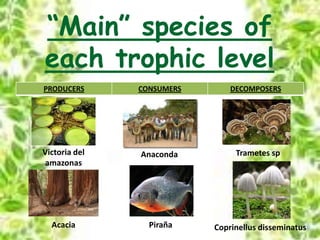
“Main” species of
each trophic level
PRODUCERS CONSUMERS DECOMPOSERS
Victoria del
amazonas
Anaconda
PirañaAcacia
Trametes sp
Coprinellus disseminatus
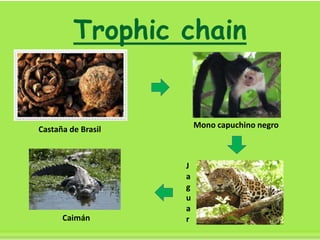
Trophic chain
Castaña de Brasil Mono capuchino negro
J
a
g
u
a
rCaimán
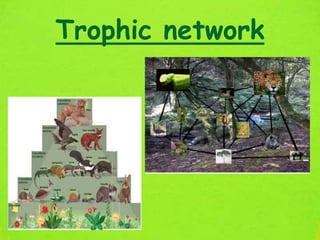
Trophic network
History
The amazon jungle was formed during the “Eoceno” era after the
temperatures were down in all the world, doing that the atlantic ocean
grew up. The amazon jungle have at least 55 millions years old. After of
the extinction of dinosaurs, the climate was more wet and the jungle grew
up. The last glacial was threat for the amazonia, but it survived. Important
changes were introduced to the jungle during this last glacial, that went
on 21000 years. The size of the jungle and the amount of rain were
reduced. There are people who say the jungle was a very little and
isolated region, with wet vegetation separated by pastures. The amazon
jungle was discovered by the spaniard explorer called Francisco de
Orellana who was the first european to was across the amazon river
1542. He thought that the jungle was the greek mythology when he was
attacked by a tribe leadded by women (“las amazonas”).
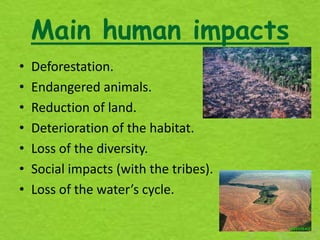
Main human impacts
• Deforestation.
• Endangered animals.
• Reduction of land.
• Deterioration of the habitat.
• Loss of the diversity.
• Social impacts (with the tribes).
• Loss of the water’s cycle.
BY:
ALE
JAN
DRO
LIÉ
BAN
A
ORT
4ºA

Amazonjungle

  • 1.
  • 2.
    Important information• It hasa surface of 2.5 millions of miles square covering nine countrys of south America. • More than 20% of the oxygen of the world is made in this region. • The diversity of birds in the amazon jungle form the 1/3 of all the species in the world. • More than 5 millions species of insects, plants, and animals are here. • There are approximately 50 tribes who live in the heart of the jungle. • Nowadays 108.000 millions areas per year are destroyed.
  • 3.
    Biotope Geographic space: theamazon jungle is located in the north of south America, along the entire route of the amazon river. The weather in the amazon jungle is tropical: hot and wet all year. The average temperature is 27ºC. There isn’t difference between winter and summer. But for the night is more cold. The only thing more annoying is the excessive humidity in the air. There are thunderstorms all year very dangerous.
  • 4.
    The land inthe amazon jungle is poor in nutrients. And it has a low potential of retention. There is a river that gives the name to the jungle (the amazon river). It is located in the middle of the jungle. It is the home of quite species. The river has a lot of meanders. It has a lenght of 7062km. It is the longgest and widdest river in the world.
  • 5.
    Biocoenosis The amazon jungleis the larger group of animals and plants maybe in the world. Here there are all kinds of animals: big, small, noisy, silent, lethal and peaceable: insects, arachnids, rept iles, amphibian, birds and mammals. And more than 80.000 species of plants and trees. Some examples of animals: Tamarino león dorado Nutria gigante Tucán Jaguar Ángel del mar Guacamayo azul Anaconda Oso perezoso Delfín rosado
  • 6.
    Interactions BIOTOPE • There isn’tdifference between winter and summer. • During all year there is the same temperature, more or less 27ºC . • The precipitations are constant but with a slight difference throughout the year. • The storms are frequent and quite dangerous. • The humidity is high. But all this are in balance. BIOTOPE-BIOCOENOSIS • All species, animals as much as plants are adapted to this climate. • All the species are adapted to the environment that is so extreme. • There are all kinds of animals and plants to all types of environment. And this jungle has a lot of them like: aqueous, terrestrial and aerial. BIOCOENOSIS • There are so many species, it is good to the survival of the majority of them. Because there are more predators, but also more preys. • Intraspecific connection: relationships between members of the same specie. • Interspecific connection: relationships between different species.
  • 7.
    “Main” species of eachtrophic level PRODUCERS CONSUMERS DECOMPOSERS Victoria del amazonas Anaconda PirañaAcacia Trametes sp Coprinellus disseminatus
  • 8.
    Trophic chain Castaña deBrasil Mono capuchino negro J a g u a rCaimán
  • 9.
  • 10.
    History The amazon junglewas formed during the “Eoceno” era after the temperatures were down in all the world, doing that the atlantic ocean grew up. The amazon jungle have at least 55 millions years old. After of the extinction of dinosaurs, the climate was more wet and the jungle grew up. The last glacial was threat for the amazonia, but it survived. Important changes were introduced to the jungle during this last glacial, that went on 21000 years. The size of the jungle and the amount of rain were reduced. There are people who say the jungle was a very little and isolated region, with wet vegetation separated by pastures. The amazon jungle was discovered by the spaniard explorer called Francisco de Orellana who was the first european to was across the amazon river 1542. He thought that the jungle was the greek mythology when he was attacked by a tribe leadded by women (“las amazonas”).
  • 11.
    Main human impacts •Deforestation. • Endangered animals. • Reduction of land. • Deterioration of the habitat. • Loss of the diversity. • Social impacts (with the tribes). • Loss of the water’s cycle.
  • 12.