UNIT - V
ALTERNATIVE ENERGY SOURCES
PROPERTIES OF ALTERNATIVE FUELS
1.Energy density:
petrol, diesel- higher energy densities
Ethanol, methanol also liquid
methanol- half the energy content
Ethanol- two-thirds of energy density
LPG- gas at normal temperature and
pressure is stored in a liquid form 100 psi to 300
psi.
2.Volatility:
• Volatility indicates a fuels ability to vapourize
under different temperature and pressure.
• It is the property that most affects startup the
engine performance.
3.Octane number:
• Octane number is a measure a fuels tendency
to knock in a SI engine.
• The self ignition occurs before the cylinder
reaches the top of its stroke thereby causing
the cylinder to push against the crank shaft.
4.Cetane number:
• The combustion and ignition characteristics of
CI engine fuels are expressed in the form of
Cetane number.
• Fuels with high cetane numbers have low auto
ignition temperature and short ignition delay
times.
5.Heat of vapourization:
• Heat of vapourization affects both engine
power and efficiency.
• It is the amount of heat absorbed by fuel as it
evaporates from a liquid state which occurs
when the fuel is mixed with air prior to
combustion.
• The alcohol fuels have higher heat of
vapourization than gasoline or diesel.
6.Flame speed:
• The speed at which a flame front propagates
through a fuel/air mixture can affect engine
performance and emissions.
• High flame speed allows the complete
combustion and potentially lean fuel mixtures.
• Methanol –higher flame speed than gasoline.
• Natural gas- slow flame speed.
• Hydrogen – highest flame speed in alternative
fuels.
7.Flame temperature and luminosity:
• For alcohol fuels, the flame temperature is
lower than gasoline and luminosity is also low
that less thermal energy is lost through
conduction or radiation.
• Low flame temperature also helps to reduce
the formation of nitrogen oxide.
• Lower luminosity is a safety issue because the
flame is essentially invisible.
8.Auto –ignition temperature:
• Auto-ignition temperature is a temperatue at
which the fuel will self-ignite.
• Self ignition is a concern in the environment
where the fuel might escape and come into
contact with hot engine parts.
• Hydrogen has highest auto ignition
temperature about 1065 degree F.
• GASOLINE AND DIESEL - 495 &600 degree F.
9.Flash point:
• The flash point is the lowest temperature at
which combustible mixtures of fuel vapour
and air from above the fuel.
10.Flammability:
• Flammability limits the range of fuel/air
mixtures that ignite.
• Among hydrocarbon fuels, methanol has the
widest flammability limits (7.3% to 36%)
followed by ethanol.
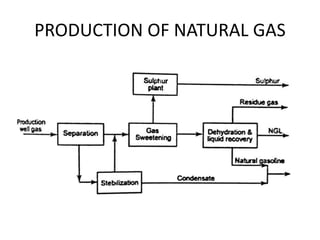
PRODUCTION OF NATURAL GAS
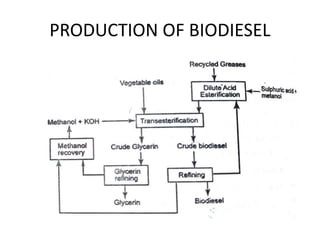
PRODUCTION OF BIODIESEL
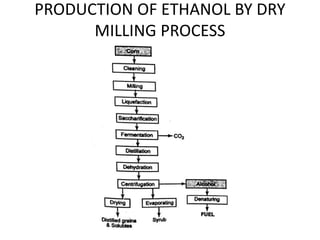
PRODUCTION OF ETHANOL BY DRY
MILLING PROCESS
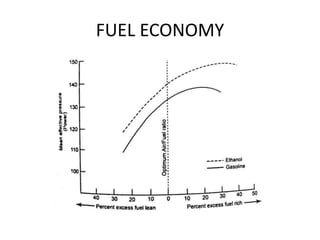
FUEL ECONOMY
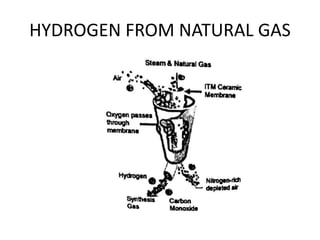
HYDROGEN FROM NATURAL GAS
ENGINE MODIFICATIONS REQUIRED FOR
ALTERNATIVE FUELS
1. Dual fuel engine (diesel and natural gas)
2. Bi-fuel engine (either petrol or gas)
3. Dedicated/single fuel (natural gas)
Engine Modification for Bio-Ethanol(Alcohol) as
Gasohol
• Fuel filters
• Cold starting
• Mechanical modifications required for
bioethanol as a fuel in SI ENGINE
(a). Reversible modifications
(b). Irreversible modifications
(a). Reversible modifications
i). Spark timing
ii). Vacuum advance
iii). Carburettor modifications
iv). Preheating air-fuel mixture
v). Cold start modification
(b). Irreversible modifications
i). Camshaft change
ii). Increasing in compression ratio
iii). Using turbochargers or superchargers
4. Mechanical modifications required for
bioethanol as a fuel in CI Engine
• Converting diesel engine to a high compression
spark ignition engine.
• Modifying the diesel to tolerate straight ethanol
injection.
• Changing carburettor for the use of ethanol.
• Using dual injection of ethanol and diesel fuel.
Engine modification for Biodiesel
i). Rubber seals
ii). Cold starting
iii). Oil changing
iv). Engine timing
v). Engine modifications
weight of vehicle
Power and torque output in relation to braking
Strength of vehicle
Effect of steering and suspension components
The effect on vehicle handling.
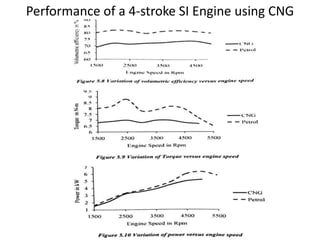
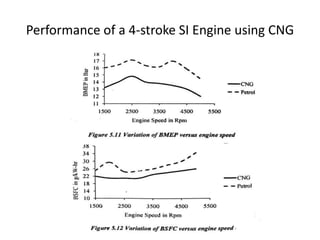
Performance of a 4-stroke SI Engine using CNG
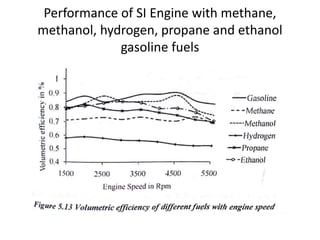
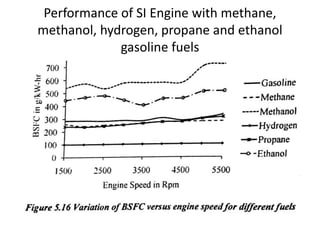
Performance of SI Engine with methane,
methanol, hydrogen, propane and ethanol
gasoline fuels
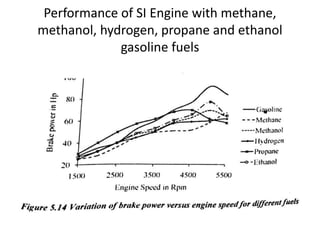
Performance of SI Engine with methane,
methanol, hydrogen, propane and ethanol
gasoline fuels
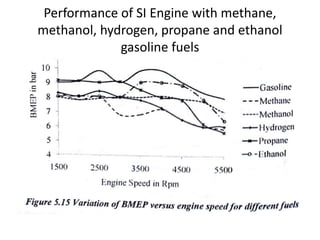
Performance of SI Engine with methane,
methanol, hydrogen, propane and ethanol
gasoline fuels
Performance of SI Engine with methane,
methanol, hydrogen, propane and ethanol
gasoline fuels
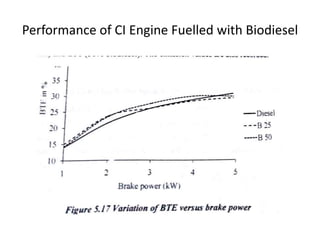
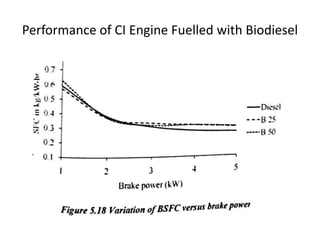
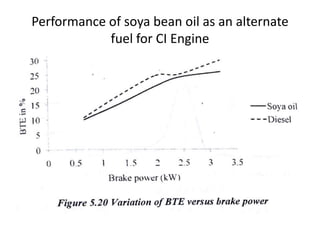
Performance of CI Engine Fuelled with Biodiesel
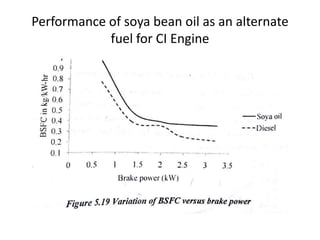
Performance of soya bean oil as an alternate
fuel for CI Engine
Performance of soya bean oil as an alternate
fuel for CI Engine
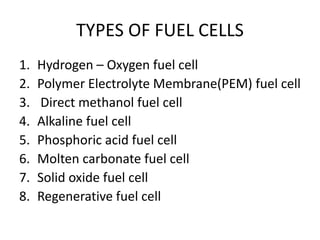
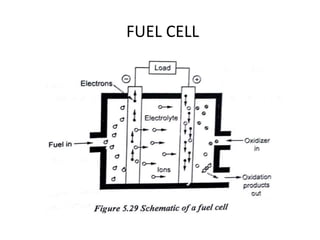
FUEL CELL
TYPES OF FUEL CELLS
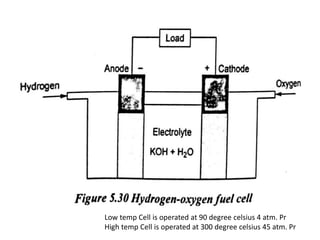
1. Hydrogen – Oxygen fuel cell
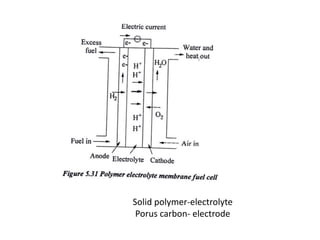
2. Polymer Electrolyte Membrane(PEM) fuel cell
3. Direct methanol fuel cell
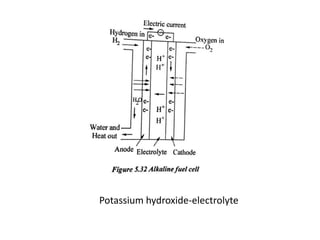
4. Alkaline fuel cell
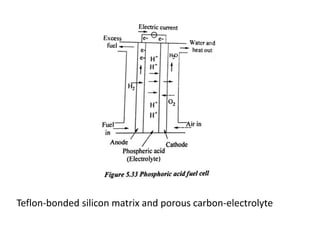
5. Phosphoric acid fuel cell
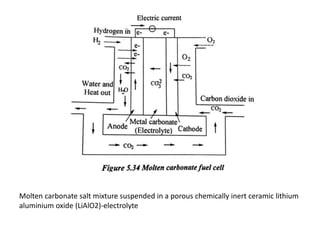
6. Molten carbonate fuel cell
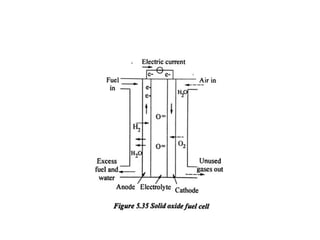
7. Solid oxide fuel cell
8. Regenerative fuel cell
Low temp Cell is operated at 90 degree celsius 4 atm. Pr
High temp Cell is operated at 300 degree celsius 45 atm. Pr
Solid polymer-electrolyte
Porus carbon- electrode
Potassium hydroxide-electrolyte
Teflon-bonded silicon matrix and porous carbon-electrolyte
Molten carbonate salt mixture suspended in a porous chemically inert ceramic lithium
aluminium oxide (LiAlO2)-electrolyte
Alternative energy sources

Alternative energy sources

  • 1.
    UNIT - V ALTERNATIVEENERGY SOURCES
  • 2.
    PROPERTIES OF ALTERNATIVEFUELS 1.Energy density: petrol, diesel- higher energy densities Ethanol, methanol also liquid methanol- half the energy content Ethanol- two-thirds of energy density LPG- gas at normal temperature and pressure is stored in a liquid form 100 psi to 300 psi.
  • 3.
    2.Volatility: • Volatility indicatesa fuels ability to vapourize under different temperature and pressure. • It is the property that most affects startup the engine performance.
  • 4.
    3.Octane number: • Octanenumber is a measure a fuels tendency to knock in a SI engine. • The self ignition occurs before the cylinder reaches the top of its stroke thereby causing the cylinder to push against the crank shaft.
  • 5.
    4.Cetane number: • Thecombustion and ignition characteristics of CI engine fuels are expressed in the form of Cetane number. • Fuels with high cetane numbers have low auto ignition temperature and short ignition delay times.
  • 6.
    5.Heat of vapourization: •Heat of vapourization affects both engine power and efficiency. • It is the amount of heat absorbed by fuel as it evaporates from a liquid state which occurs when the fuel is mixed with air prior to combustion. • The alcohol fuels have higher heat of vapourization than gasoline or diesel.
  • 7.
    6.Flame speed: • Thespeed at which a flame front propagates through a fuel/air mixture can affect engine performance and emissions. • High flame speed allows the complete combustion and potentially lean fuel mixtures. • Methanol –higher flame speed than gasoline. • Natural gas- slow flame speed. • Hydrogen – highest flame speed in alternative fuels.
  • 8.
    7.Flame temperature andluminosity: • For alcohol fuels, the flame temperature is lower than gasoline and luminosity is also low that less thermal energy is lost through conduction or radiation. • Low flame temperature also helps to reduce the formation of nitrogen oxide. • Lower luminosity is a safety issue because the flame is essentially invisible.
  • 9.
    8.Auto –ignition temperature: •Auto-ignition temperature is a temperatue at which the fuel will self-ignite. • Self ignition is a concern in the environment where the fuel might escape and come into contact with hot engine parts. • Hydrogen has highest auto ignition temperature about 1065 degree F. • GASOLINE AND DIESEL - 495 &600 degree F.
  • 10.
    9.Flash point: • Theflash point is the lowest temperature at which combustible mixtures of fuel vapour and air from above the fuel.
  • 11.
    10.Flammability: • Flammability limitsthe range of fuel/air mixtures that ignite. • Among hydrocarbon fuels, methanol has the widest flammability limits (7.3% to 36%) followed by ethanol.
  • 12.
  • 13.
  • 14.
    PRODUCTION OF ETHANOLBY DRY MILLING PROCESS
  • 15.
  • 16.
  • 17.
    ENGINE MODIFICATIONS REQUIREDFOR ALTERNATIVE FUELS 1. Dual fuel engine (diesel and natural gas) 2. Bi-fuel engine (either petrol or gas) 3. Dedicated/single fuel (natural gas)
  • 18.
    Engine Modification forBio-Ethanol(Alcohol) as Gasohol • Fuel filters • Cold starting • Mechanical modifications required for bioethanol as a fuel in SI ENGINE (a). Reversible modifications (b). Irreversible modifications
  • 19.
    (a). Reversible modifications i).Spark timing ii). Vacuum advance iii). Carburettor modifications iv). Preheating air-fuel mixture v). Cold start modification
  • 20.
    (b). Irreversible modifications i).Camshaft change ii). Increasing in compression ratio iii). Using turbochargers or superchargers
  • 21.
    4. Mechanical modificationsrequired for bioethanol as a fuel in CI Engine • Converting diesel engine to a high compression spark ignition engine. • Modifying the diesel to tolerate straight ethanol injection. • Changing carburettor for the use of ethanol. • Using dual injection of ethanol and diesel fuel.
  • 22.
    Engine modification forBiodiesel i). Rubber seals ii). Cold starting iii). Oil changing iv). Engine timing v). Engine modifications weight of vehicle Power and torque output in relation to braking Strength of vehicle Effect of steering and suspension components The effect on vehicle handling.
  • 23.
    Performance of a4-stroke SI Engine using CNG
  • 24.
    Performance of a4-stroke SI Engine using CNG
  • 25.
    Performance of SIEngine with methane, methanol, hydrogen, propane and ethanol gasoline fuels
  • 26.
    Performance of SIEngine with methane, methanol, hydrogen, propane and ethanol gasoline fuels
  • 27.
    Performance of SIEngine with methane, methanol, hydrogen, propane and ethanol gasoline fuels
  • 28.
    Performance of SIEngine with methane, methanol, hydrogen, propane and ethanol gasoline fuels
  • 29.
    Performance of CIEngine Fuelled with Biodiesel
  • 30.
    Performance of CIEngine Fuelled with Biodiesel
  • 31.
    Performance of soyabean oil as an alternate fuel for CI Engine
  • 32.
    Performance of soyabean oil as an alternate fuel for CI Engine
  • 38.
  • 39.
    TYPES OF FUELCELLS 1. Hydrogen – Oxygen fuel cell 2. Polymer Electrolyte Membrane(PEM) fuel cell 3. Direct methanol fuel cell 4. Alkaline fuel cell 5. Phosphoric acid fuel cell 6. Molten carbonate fuel cell 7. Solid oxide fuel cell 8. Regenerative fuel cell
  • 40.
    Low temp Cellis operated at 90 degree celsius 4 atm. Pr High temp Cell is operated at 300 degree celsius 45 atm. Pr
  • 41.
  • 42.
  • 43.
    Teflon-bonded silicon matrixand porous carbon-electrolyte
  • 44.
    Molten carbonate saltmixture suspended in a porous chemically inert ceramic lithium aluminium oxide (LiAlO2)-electrolyte